
India Retail Fuel Market Size and Share
Market Overview
| Study Period | 2020 - 2031 |
|---|---|
| Forecast Data Period | 2026 - 2031 |
| Historical Data Period | 2020 - 2024 |
| Growth Rate | 2.59 % |
| Market Concentration | Medium |
Major Players *Disclaimer: Major Players sorted in no particular order Image © Mordor Intelligence. Reuse requires attribution under CC BY 4.0. | |
India Retail Fuel Market Analysis by Mordor Intelligence
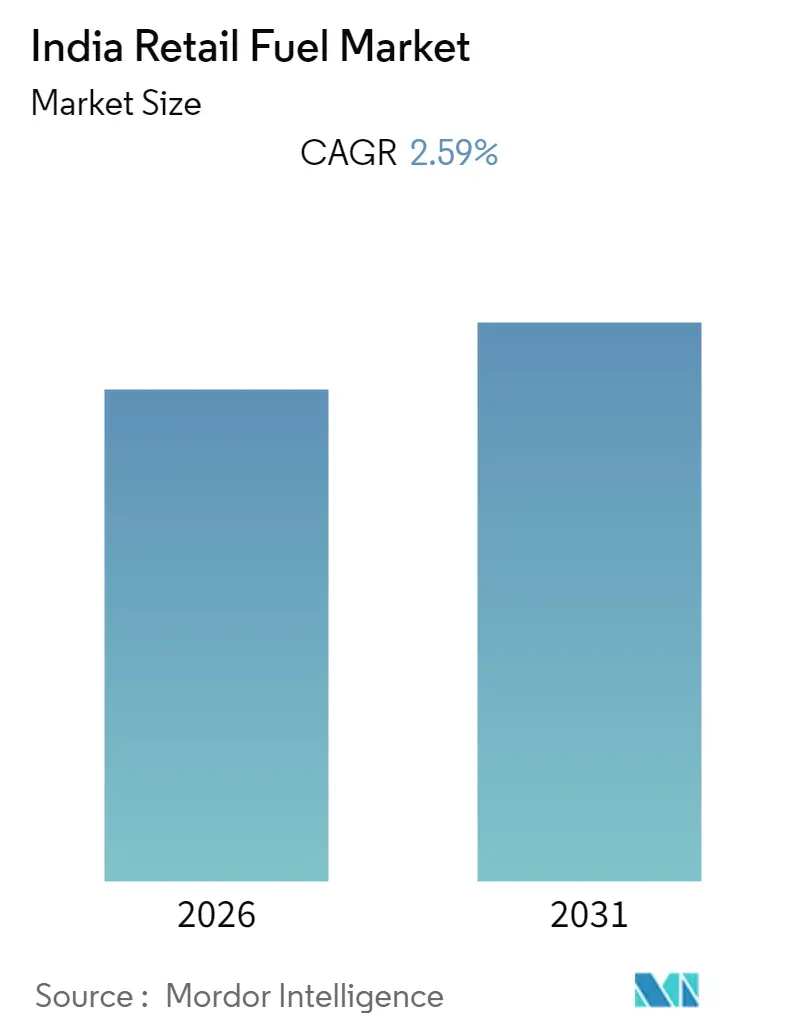
The India Retail Fuel market size is expected to grow from USD 54.8 billion in 2025 to USD 56.22 billion in 2026 and is forecast to reach USD 63.87 billion by 2031 at 2.59% CAGR over 2026-2031.
India's retail fuel market landscape is undergoing significant transformation driven by evolving market dynamics and structural changes in the energy sector. The market is characterized by a concentrated competitive structure, with public sector undertakings dominating the fuel market distribution network. As of 2022, the market share of petroleum companies in India shows Indian Oil Corporation Limited commanding 38% of the market, followed by Bharat Petroleum Corporation Limited at 20.1%, Hindustan Petroleum Corporation Limited at 18%, and private players collectively holding 21.7% of the market share. This established network of over 77,000 retail outlets across major public sector players demonstrates the robust infrastructure supporting fuel distribution across the country.
The transportation sector is witnessing a paradigm shift towards sustainable alternatives, impacting the traditional petrol market. Indian Railways has made substantial progress in its electrification initiative, achieving electrification of 52,247 Route Kilometers out of a total 65,414 RKM, marking a significant step towards its goal of complete electrification. Additionally, the government's ambitious plan to replace approximately 30,000 diesel-run buses with electric powertrain vehicles in the next 2-3 years signals a strong push towards clean mobility solutions, particularly in urban transportation.
The market is experiencing dynamic changes in response to demographic and economic factors. With India's population projected to reach 1.515 billion by 2030 and a median age of 28.7 years as of 2022, the country's young demographic is driving increased vehicle ownership. This trend is reflected in the passenger vehicle sales, which reached 3.07 million units in FY 2022, marking a 13% increase from the previous year. The growing middle class and increasing urbanization continue to shape consumption patterns in the fuel companies in India sector.
The discovery of significant mineral resources is poised to influence the industrial demand for retail fuels. In February 2023, India announced the discovery of 5.9 million tonnes of lithium reserves in the Reasi district of Jammu and Kashmir, positioning India among the world's top lithium reserve holders. This discovery, coupled with Coal India Ltd's January 2023 announcement of nine new coal mining projects with a combined production capacity of 127 million tonnes, indicates substantial industrial activity that will drive fuel demand in the mining and quarrying sectors, despite the gradual transition towards sustainable energy solutions.
Note: Market size and forecast figures in this report are generated using Mordor Intelligence’s proprietary estimation framework, updated with the latest available data and insights as of 2026.
India Retail Fuel Market Trends and Insights
Strong Public Sector Infrastructure and Government Support
The robust infrastructure network and government backing of Public Sector Undertakings (PSUs) serve as a significant driver for India's size of the retail market in India. PSUs like Indian Oil Corporation (IOC), Bharat Petroleum Corporation Limited (BPCL), and Hindustan Petroleum Corporation Limited (HPCL) have established an extensive network of fuel stations, pipelines, terminals, and storage facilities, ensuring widespread fuel availability across urban and rural areas. This infrastructure advantage is further strengthened by continuous investments, as evidenced by Indian Oil Corporation Limited's announcement in February 2023 to invest USD 25.44 million in West Bengal for expanding and developing greener fuel retail infrastructure.
The government's support in pricing policies and infrastructure development has enabled PSUs to maintain competitive pricing while ensuring fuel quality and safety standards. This is reflected in their expansion of green auto fuel availability, which is set to grow from 275 retail outlets in 2022 to more than 1,000 by the end of 2024. The strong government backing also allows PSUs to maintain stable fuel costs, providing price security to consumers while ensuring consistent fuel availability. According to the Ministry of Petroleum and Natural Gas, India witnessed a significant increase of more than 6% in petroleum products consumption between April 2022 and April 2023, with PSU retail outlets accounting for the majority of this consumption.
Rising Vehicle Ownership and Automotive Market Growth
The substantial increase in vehicle ownership across India has emerged as a crucial driver for the fuel retail business, supported by rising disposable incomes and accelerating urbanization. According to the Society of Indian Automobile Manufacturers, vehicle sales in India demonstrated remarkable growth with a more than 20% increase between 2021 and 2022, directly translating to increased fuel consumption and more frequent visits to fuel retail stations. This trend is further reinforced by the automotive industry's continued expansion and introduction of new vehicles, as exemplified by BMW's announcement in May 2023 regarding the launch of their X3 M40i model in India.
The growth in vehicle ownership is creating sustained demand for petrol retail, particularly in urban areas where car ownership is rapidly increasing. The automotive market's dynamism is evident in the introduction of new high-performance vehicles, such as BMW's upcoming X3 M40i featuring a 3.0-liter six-cylinder turbocharged petrol engine, which indicates a continued strong demand for retail fuels. This increasing vehicle population not only drives higher fuel consumption but also necessitates the expansion of retail fuel infrastructure to meet the growing demand, creating a positive feedback loop that further strengthens the market's growth trajectory.
Segment Analysis
Public Sector Undertakings Segment in India Retail Fuel Market
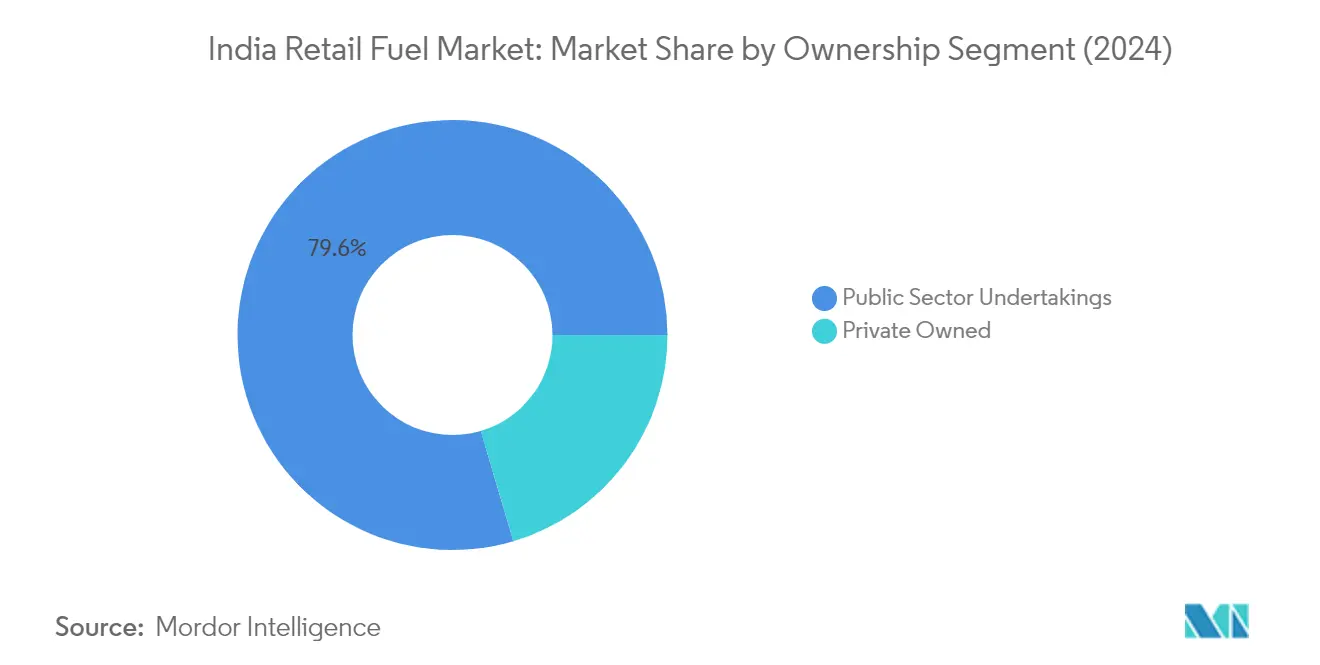
The Public Sector Undertakings (PSU) segment dominates the India fuel retail industry, commanding approximately 79.25% fuel market share in 2025. This segment, led by major players like Indian Oil Corporation Limited (IOCL), Bharat Petroleum Corporation Limited (BPCL), and Hindustan Petroleum Corporation Limited (HPCL), demonstrates both market leadership and robust growth potential. The segment's strong performance is driven by several factors, including extensive retail network coverage, competitive fuel pricing compared to private players, and strategic capacity expansion initiatives. PSU companies collectively operate over 77,000 retail outlets across India, with IOCL alone managing more than 35,500 outlets. The segment is projected to maintain its growth trajectory at around 9.3% annually from 2026 to 2031, supported by increasing fuel demand from end-users and ongoing expansion of refining capacities. The government's support and the PSUs' ability to maintain lower fuel prices compared to private players continue to strengthen their market position.
Private Owned Segment in India Retail Fuel Market
The Private Owned segment, while smaller in fuel market share, plays a crucial role in India's retail fuel landscape by introducing competition and innovative service offerings. This segment includes prominent players like Reliance Industries Limited, Nayara Energy, and Shell, who collectively operate thousands of retail outlets across the country. The segment's operations are characterized by premium quality fuels, superior customer service, and modern retail infrastructure. Despite facing challenges from price differentials with PSU players, private retailers continue to maintain their presence through value-added services and strategic location selection. The segment's growth is supported by the government's liberalization of fuel retailing policies and increasing demand for premium fuel products in urban areas.
Segment Analysis: End-User
Private Sector Segment in India Retail Fuel Market
The private sector segment dominates the India retail fuel market, commanding approximately 87% petrol market share in India in 2024. This segment encompasses various end-users, including manufacturing industries, agriculture, retail consumers, and private transportation. The robust growth in this segment is driven by India's expanding population, which has reached over 1.41 billion, making it the world's most populous country with a relatively young median age of 28.7 years. The segment has shown remarkable resilience and growth potential, supported by increasing passenger vehicle sales, expansion in manufacturing industries, and growing agricultural sector demands. The government's implementation of various supply-side policies to boost manufacturing has further strengthened this segment's position, making India an increasingly attractive destination for investments. Additionally, the retail consumer base within this segment continues to expand, driven by urbanization and rising disposable incomes.
Public Sector Segment in India Retail Fuel Market
The public sector segment, while holding a smaller market share of around 13% in 2024, plays a crucial role in India's retail fuel market. This segment primarily serves government entities, public transportation systems, railways, and state-owned enterprises. The segment's growth is closely tied to public infrastructure development, government initiatives in transportation, and public sector industrial activities. Key consumers in this segment include railways, state transport undertakings, public sector mining operations, and government-owned power generation facilities. The segment's development is particularly influenced by the government's push towards infrastructure development and public transportation expansion, though this is being balanced against initiatives for electrification and sustainable transport solutions.
Regulatory Landscape
India's retail marketing of motor spirit and high speed diesel operates under the Ministry of Petroleum and Natural Gas (MoPNG) policy framework, with core controls anchored in the Motor Spirit and High Speed Diesel (Regulation of Supply, Distribution and Prevention of Malpractices) Order, 2005. Retail marketing authorizations for transport fuels are processed through the National Single Window System (NSWS) portal, which centralizes oversight of new outlet development and market entry.
Technical, safety, and consumer protection requirements at retail outlets are governed by the Petroleum and Natural Gas Regulatory Board (PNGRB), including notified Technical Standards and Specifications (T4S) covering layout, engineering, and safety compliance, alongside approvals linked to the Petroleum and Explosives Safety Organisation (PESO). In June 2026, MoPNG exercised emergency-type supply controls via the Motor Spirit and High Speed Diesel (Temporary Regulation of Supply through Retail Outlets) Order, 2026, including a 200-litre-per-vehicle-per-day diesel cap and restrictions on bulk purchases from retail pumps. MoPNG withdrew these temporary restrictions effective July 1, 2026 after supply conditions stabilized.
Value Chain Analysis
The retail fuel value chain in India runs from crude sourcing and refining to primary distribution, secondary transport, and retail dispensing through branded outlets. Public sector oil marketing companies (OMCs), notably Indian Oil Corporation (IOCL), Bharat Petroleum (BPCL), and Hindustan Petroleum (HPCL), anchor this chain through integrated access to refineries, terminals, depots, and large retail networks, supported by sector oversight and data monitoring through MoPNG and agencies such as PPAC.
Refineries to depots is typically handled via pipelines, coastal shipping, rail, and road, while depot-to-outlet replenishment is carried out by road tank trucks. As a result, secondary logistics and outlet-level inventory discipline become central. The June 2026 restrictions on bulk purchases from retail outlets, including the 200-litre diesel cap, underscored how retail-bulk price gaps can redirect demand into pumps and strain last-mile distribution, which in turn required administrative controls and tighter channel separation until the order was withdrawn from July 1, 2026.
Competitive Landscape
Top Companies in India Retail Fuel Market
The Indian retail fuel market is dominated by major public sector undertakings, including Indian Oil Corporation Limited (IOCL), Bharat Petroleum Corporation Limited (BPCL), and Hindustan Petroleum Corporation Limited (HPCL), alongside private players like Nayara Energy, Reliance Industries, and Shell. These petrol pump companies in India are actively pursuing product innovation through the introduction of premium and cleaner fuels while expanding their service offerings to include convenience stores, car wash facilities, and EV charging stations. The industry is witnessing significant operational transformations through digital initiatives and automation of fuel stations. Strategic partnerships and joint ventures, such as the collaboration between Reliance and BP, are reshaping market dynamics. Companies are aggressively expanding their retail networks, particularly in untapped regions, while simultaneously upgrading existing outlets to modern mobility stations with integrated services.
PSU Dominance Shapes Market Competition Landscape
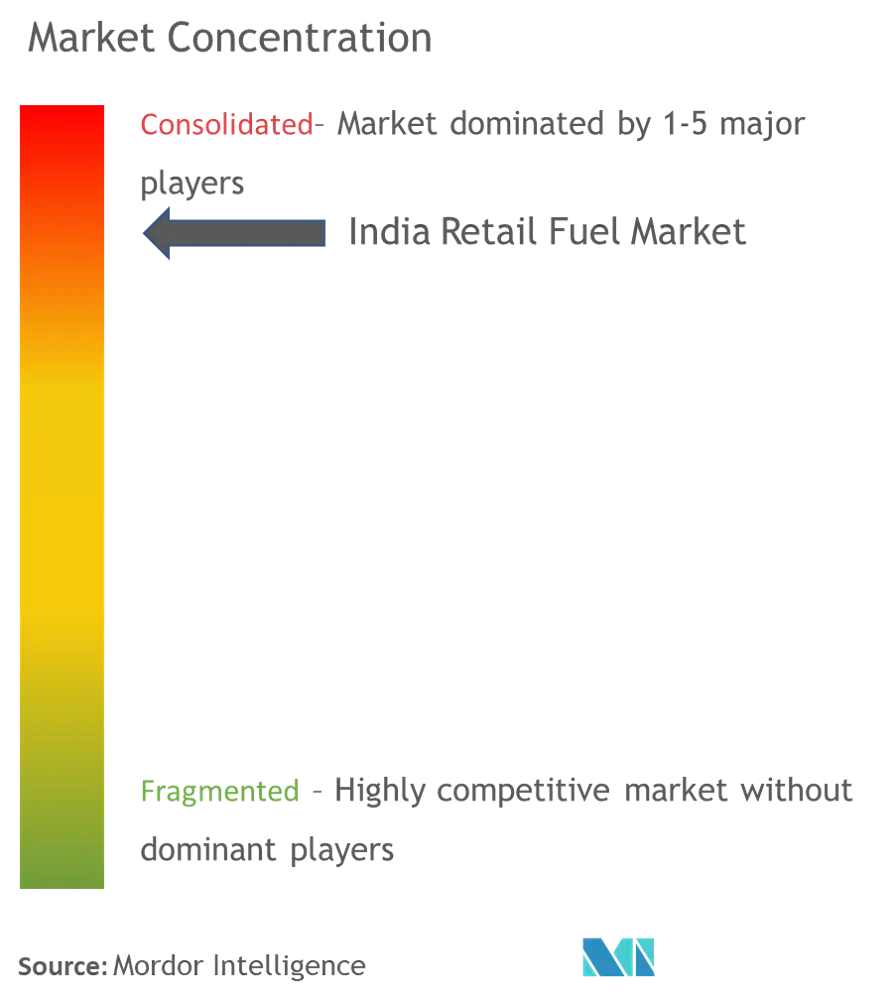
The Indian retail fuel market exhibits a unique structure characterized by strong public sector dominance, with PSUs controlling the majority of market share through their extensive retail network and established supply chain infrastructure. The market demonstrates moderate consolidation, with three major PSUs holding significant market positions, while private players operate in specific regional strongholds. Recent years have witnessed increased participation from global energy majors through joint ventures and strategic partnerships, particularly in premium fuel segments and value-added services. The competitive dynamics are further influenced by government policies regarding fuel pricing and retail licensing, creating distinct operational environments for public and private sector players.
The market has experienced notable merger and acquisition activities, primarily driven by private sector players seeking to establish or expand their presence in the Indian market. Joint ventures between domestic and international players have emerged as a preferred mode of market entry, combining local market knowledge with global expertise. The industry is witnessing vertical integration attempts by major players, extending from refining to retail operations, while smaller players focus on niche segments or regional markets. Cross-industry partnerships, particularly in the areas of digital payments, convenience retailing, and electric mobility, are becoming increasingly common as companies seek to diversify their revenue streams.
Innovation and Diversification Drive Future Growth
Success in the Indian retail fuel market increasingly depends on companies' ability to innovate across multiple dimensions, from fuel quality and service offerings to digital integration and customer experience. Incumbent players must focus on modernizing their retail networks, implementing advanced technologies for operations management, and developing value-added services to maintain their market position. The ability to manage fuel pricing effectively while maintaining profitability, particularly during periods of international price volatility, remains crucial. Companies need to invest in supply chain optimization and storage infrastructure to ensure consistent fuel availability and maintain competitive pricing.
For new entrants and smaller players, success lies in identifying and exploiting niche market segments, developing differentiated service offerings, and building a strong regional presence before expanding nationally. The increasing focus on alternative fuels and electric mobility presents opportunities for market disruption, requiring players to develop adaptive strategies. Regulatory compliance, particularly regarding environmental standards and safety requirements, will become increasingly important as the government pushes for cleaner fuels and sustainable practices. Customer service excellence, brand building, and loyalty programs will play crucial roles in maintaining competitive advantage, while strategic partnerships across the value chain will become essential for sustainable growth. Companies such as fuel retail companies and Indian petrol pump companies are well-positioned to leverage these trends.
India Retail Fuel Industry Leaders
-
Indian Oil Corporation Ltd
-
Bharat Petroleum Corp Ltd
-
Hindustan Petroleum Corporation Limited
-
Nayara Energy Limited
-
Reliance Industries Limited
- *Disclaimer: Major Players sorted in no particular order
Market Opportunities and Future Outlook
Network densification and conversion of outlets into multi-energy mobility stations stands out as a current whitespace as large operators expand footprints and add non-fuel services. Nayara Energy crossing 7,000 operational petrol pumps (June 2026) and IOCL and BPCL reporting large annual outlet additions in FY25-26 highlight continued site rollout, while initiatives such as BPCL's Project Aspire (announced July 2026, including retail expansion, EV charging, and digital transformation) and HPCL's Rajasthan rollout program (July 2026, 304 new pumps announced) show investment-led competition across corridors and underserved markets.
Operators are also using the retail footprint as an infrastructure platform for alternative energy and adjacent services, creating room for EV charging, battery swapping, and digital-first customer experience upgrades. Government data disclosed in December 2025 reported over 27,432 EV charging stations installed in India, including 18,500 by oil marketing companies, indicating the scale at which OMC-led charging is being integrated with fuel retail. In 2026, policy actions such as temporary restrictions on bulk purchases from retail outlets, along with downstream-management measures, reinforce the need for compliant channel design, supply planning discipline, and diversification beyond commodity fuel margins.
Recent Industry Developments
- July 2026: Nayara Energy reduced petrol prices by Rs 5 per litre and diesel by Rs 3 per litre across its network of more than 7,000 fuel stations. The action highlighted competitive pricing as a lever for private retailers and can shift traffic toward outlets that pair price actions with wider network coverage.
- July 2025: The Ministry of Petroleum and Natural Gas formed an expert committee to review the 2019 licensing guidelines for fuel marketing authorization. The review process indicated a push to align retail licensing with decarbonization and alternative fuel targets, which can affect the pace and conditions of outlet additions and upgrades.
- February 2024: The Government of India expanded the rollout of E20 petrol through launches across multiple states and union territories at designated retail outlets. The program-level expansion strengthened ethanol blending implementation at the pump and increased operational focus on compatible storage, dispensing, and consumer communication at stations.
Research Methodology Framework and Report Scope
Market Definition and Coverage
For this study, we define the India retail fuel market as the value of automotive and related fuels sold through retail outlets to end customers for everyday mobility and operational needs, which includes both public and privately owned station networks.
Scope exclusions: We exclude bulk direct-to-consumer deliveries and non-retail industrial supply contracts where fuel is not sold through a retail outlet.
Segmentation Overview
- Ownership
- Public Sector Undertakings
- Private Owned
- End User
- Public Sector
- Private Sector
Data Sources, Market Sizing, and Validation
Desk Research
Desk research was used to anchor the market to observable fuel demand and retail channel signals, then we stress-tested assumptions with field discussions. We relied on public sources such as the Petroleum Planning and Analysis Cell (PPAC) for product-wise consumption trends, the Ministry of Petroleum and Natural Gas for policy direction, and releases from the Office of the Economic Adviser and RBI for inflation and macro indicators that feed into retail price and volume behavior.
To make the picture more complete, we also used indicative inputs from NITI Aayog energy transition publications, and from oil company annual reports and investor presentations. For supply tightness and seasonality context, we used India customs trade statistics where imports and exports help explain changes in availability. In addition, we used paid subscriptions focused on company financials and intelligence, news and financials, and an import and export shipment-level database to validate select price and flow assumptions. These desk research sources are illustrative and not exhaustive, and many other public documents were reviewed for data collection, validation, and clarification.
Primary Interviews and Surveys
Primary work was done to confirm how retail selling prices, dealer margins, product mix shifts, and throughput patterns are behaving across the country, since these drivers can move faster than public datasets. We spoke with a spread of stakeholders across retail operations, logistics, and downstream planning roles, then used follow-up surveys to cross-check assumptions by geography and outlet ownership types so gaps from desk research could be closed.
Distribution of primary research fieldwork respondents
| Company type | Respondent position |
|---|---|
| Top tier: 33% | CXOs: 17% |
| Mid tier: 50% | Functional/Unit leaders: 36% |
| Smaller Players: 17% | Managers: 47% |
Market-Sizing & Forecasting
Our sizing starts from a top-down build, using national fuel consumption series and retail channel participation to reconstruct the addressable retail pool. We then convert this pool into value using observed retail pricing behavior. As the model is built, we corroborate with selective bottom-up approximations, including sampled outlet throughput checks, dealer network expansion pace, and product mix roll-ups. Those checks are used to adjust totals where the top-level signals look off.
A few market fingerprints are tracked closely because they explain most of the yearly movement. These include petrol versus diesel share shifts, retail outlet count additions and commissioning speed, average throughput per outlet (linked to road traffic and freight activity), regulated and de-regulated price movement patterns, and the spread between retail prices and indicative crude-linked costs that influences pass-through timing. When data is thin for smaller ownership groups or for newer product types, we use proxy ratios derived from comparable regions and validate them through interviews before they flow into the final model.
For forecasting, we use scenario analysis around key variables in India, namely expected fuel demand growth, inflation and tax-driven price progression, and the pace of alternative fuel adoption at the retail level. Scenarios are kept practical, and the final forecast path is selected after checking against expert consensus and near-term policy and macro signals.
Data Validation & Update Cycle
We validate the outputs by comparing modeled demand and value trends against independent signals, including publicly reported consumption totals, changes in retail selling prices, and visible network expansion activity. If an unusually high jump or drop shows up, we re-check the drivers, revisit assumptions, and re-contact respondents when the gap cannot be explained using public data.
The model and write-up go through multi-step analyst reviews, with cross-checks across historical years so growth is not overstated in a single period. Reports are refreshed annually, with interim updates when material events occur, such as major tax changes, sharp crude price shifts, or policy moves affecting retail pricing. Before delivery, we complete a fresh review pass so clients receive the most up-to-date view available at that time.
Mordor Intelligence's India Retail Fuel Market Sizing Compared With Other Published Estimates
Published market values for India retail fuel can differ, even when the topic name appears similar, because teams make different choices on what counts as retail, which fuels are included, and whether value is tracked at pump price or closer to ex-tax levels.
The biggest gap drivers usually come from scope and price construction. Some estimates treat the market like a fuel-station business metric and lean on outlet revenues and services, while others focus mainly on transport fuels and use a different mix of petrol, diesel, LPG, and gas. The spread also increases when price progression is applied too smoothly across years, or when currency timing and inflation effects are not aligned with how retail prices actually changed during the year.
Benchmark comparison
| Source | Market Size | Gaps in Research Methodology |
|---|---|---|
| Mordor Intelligence | USD 54.80 B (2025) | |
| Industry Research Desk A | USD 184.35 B (2026) | This figure likely reflects a much broader value pool, where retail fuel is treated closer to total downstream fuel retail revenues with aggressive price and volume growth, and may blend in non-fuel services or wider channel coverage beyond standard retail outlet fuel sales. |
| Business Advisory Note B | USD 164.50 B (2025) | This estimate appears to use a headline rupee value for the petroleum retail sector that can include taxes and a wider basket of petroleum products, which makes it less comparable to a narrower, outlet-fuel-only construction tied to observed consumption and pump-price movements. |
The table shows that the range is mostly explained by whether the study sticks to fuel sold via retail outlets and how retail prices are translated into yearly value, and then it widens further when extra petroleum categories or service revenues are folded in. By keeping the value build tied to fuel consumption, product mix, and retail price changes at the outlet level, and by leaving out non-retail and bulk supply flows, the sizing remains repeatable and transparent, a choice applied by Mordor Intelligence.
Key Questions Answered in the Report
What is the current India Retail Fuel Market size in 2026?
The India Retail Fuel Market size is USD 56.22 billion in 2026, and the market is projected to register a CAGR of 2.59% during the forecast period (2026-2031)
Who are the key players in India Retail Fuel Market?
Indian Oil Corporation Ltd, Bharat Petroleum Corp Ltd, Hindustan Petroleum Corporation Limited, Nayara Energy Limited and Reliance Industries Limited are the major companies operating in the India Retail Fuel Market.
What years does this India Retail Fuel Market cover?
The report covers the India Retail Fuel Market historical market size for years: 2019, 2020, 2021, 2022, 2023, 2024 and 2025. The report also forecasts the India Retail Fuel Market size for years: 2026, 2027, 2028, 2029, 2030 and 2031.