
India Refrigerator Market Size and Share
Market Overview
| Study Period | 2020 - 2031 |
|---|---|
| Forecast Data Period | 2026 - 2031 |
| Base Year Market Size (2025) | USD 5.34 Billion |
| Market Size (2026) | USD 5.90 Billion |
| Market Size (2031) | USD 9.26 Billion |
| Growth Rate (2026 - 2031) | 9.46 % |
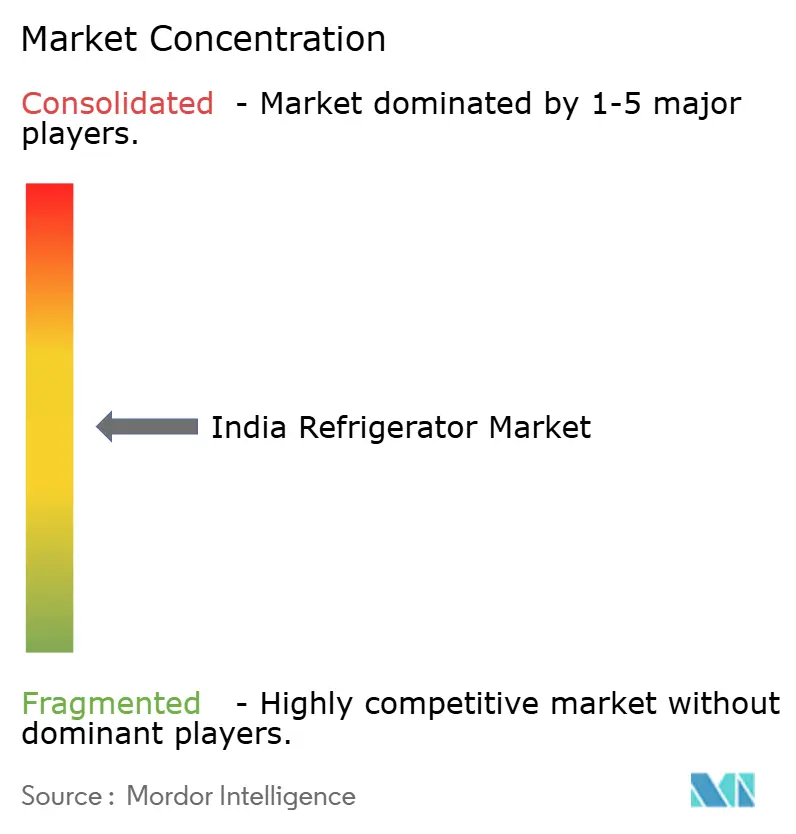
| Market Concentration | Medium |
Major Players *Disclaimer: Major Players sorted in no particular order Image © Mordor Intelligence. Reuse requires attribution under CC BY 4.0. | |
India Refrigerator Market Analysis by Mordor Intelligence
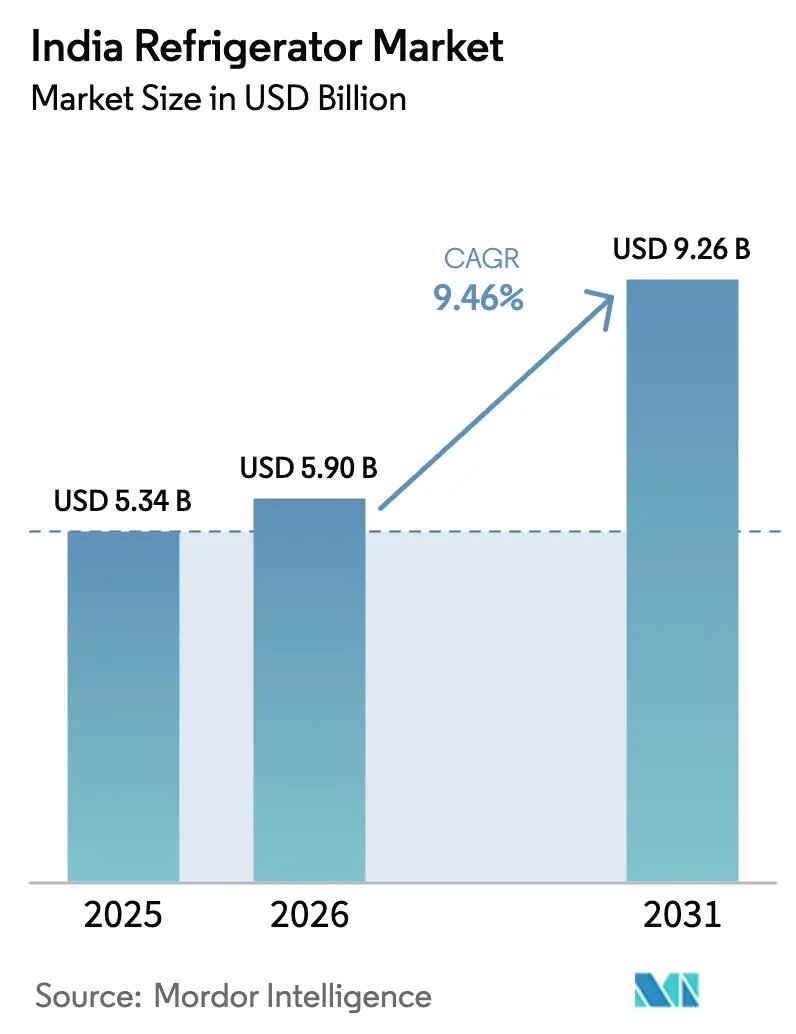
The India refrigerator market size is expected to grow from USD 5.34 billion in 2025 to USD 5.90 billion in 2026 and is forecast to reach USD 9.26 billion by 2031 at a 9.46% CAGR over 2026-2031. Premium adoption is rising, with double-door models leading the market, while side-by-side and French-door formats are showing strong growth potential over the coming years. Freestanding units continue to dominate in terms of volume, though built-in refrigerators are gaining popularity, supported by the increasing adoption of modular kitchens in smaller cities. Regulatory changes have influenced product strategies, as the Bureau of Energy Efficiency’s January 2026 star-rating update raised efficiency standards, prompting companies to clear pre-update inventories. Innovation is shaping mid-to-premium offerings, with AI-enabled compressors and connected features now central to portfolios. On the policy front, the PLI scheme for white goods continues to bolster domestic manufacturing.[1]Press Information Bureau, “PLI Scheme Boosts White Goods Manufacturing,” pib.gov.in
Key Report Takeaways
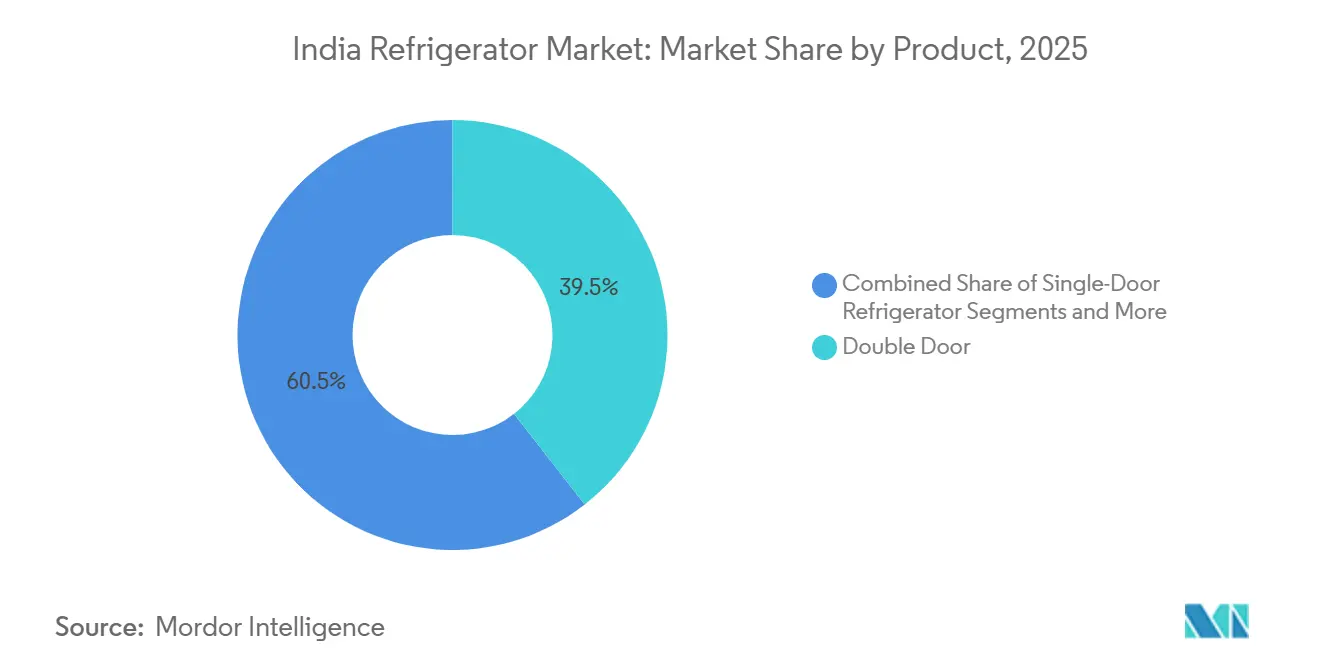
- By product, double-door refrigerators led the India refrigerator market with 39.46% market share in 2025, while side-by-side models are forecast to grow at a 11.46% CAGR through 2031.
- By capacity, more than 200 liters accounted for 72% of the India refrigerator market share in 2025 and is advancing at a 9.5% CAGR through 2031, within the India refrigerator market size context for this segment.
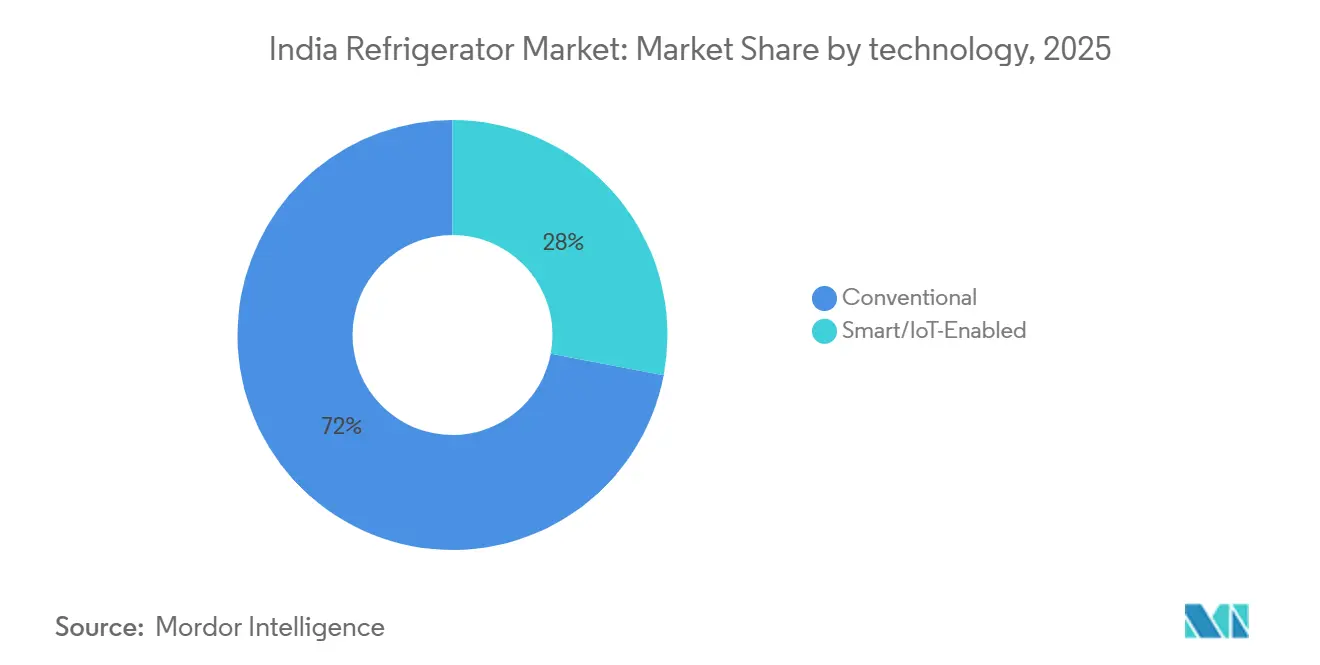
- By technology, conventional technology accounted for 72% of the Indian refrigerator market share in 2025, and Smart/IoT-Enabled are growing at a 17% CAGR to 2031.
- By distribution channel, multi-brand store retail accounted for 45% of the India refrigerator market share in 2025, and online channels are growing at a 12.86% CAGR to 2031.
- By geography, the refrigerator market size in India was led by North India, which held 33.47% in 2025, while West India is the fastest-growing zone at 11.88% CAGR through 2031.
Note: Market size and forecast figures in this report are generated using Mordor Intelligence’s proprietary estimation framework, updated with the latest available data and insights as of January 2026.
India Refrigerator Market Trends and Insights
Drivers Impact Analysis*
| Driver | (~) % Impact on CAGR Forecast | Geographic Relevance | Impact Timeline |
|---|---|---|---|
| Rising Disposable Incomes and Enhanced Electrification in Tier-2 and Tier-3 Towns | +2.1% | National, with accelerated gains in Indore, Coimbatore, Nagpur, Surat, Ludhiana, Panipat, Kanpur | Medium term (2-4 years) |
| Support From PLI Schemes and 'Make in India' for Compressor Manufacturing | +1.9% | National manufacturing hubs: Greater Noida, Pune, Chennai, Ranjangaon, Sri City | Long term (≥ 4 years) |
| Adoption of Inverter Technology and AI-Enabled Compressors | +1.4% | Urban centers and tier-1 cities with spillover to tier-2 | Short term (≤ 2 years) |
| Increased Demand for Premium Multi-Door and Designer Appliances | +1.6% | Metropolitan markets and affluent suburban clusters | Medium term (2-4 years) |
| Focus on Energy-Efficient and BEE-Certified Products | +1.7% | Pan-India, with higher adoption in energy-conscious urban markets | Medium term (2-4 years) |
| Expansion of Organized Retail and E-Commerce Networks | +1.0% | Tier-1 and tier-2 cities, emerging online markets nationwide | Short to medium term (≤ 3 years) |
| Source: Mordor Intelligence | |||
Rising Disposable Incomes and Enhanced Electrification in Electrification in Tier -⅔ Towns
The India refrigerator market is experiencing strong growth, driven in part by rising disposable incomes and increasing electrification in tier-2 and tier-3 towns. As more households gain access to reliable electricity, demand for modern and energy-efficient refrigerators has expanded beyond traditional urban centers. Consumers in smaller cities are increasingly able to afford mid- to premium-range models, including double-door and multi-door refrigerators. This shift is also fueling the adoption of smart, inverter-based technologies, which offer improved energy efficiency and performance. Retailers and manufacturers are responding by expanding their distribution networks and e-commerce presence in these emerging markets. Overall, tier-2 and tier-3 towns are becoming key growth engines, contributing significantly to the country’s overall refrigerator market expansion.
Support From PLI Schemes and 'Make in India' for Compressor Manufacturing
The Indian government’s PLI scheme and Make in India initiatives are significantly boosting domestic manufacturing of refrigerator components, particularly compressors. Domestic players increased localization in refrigerators, supported by facility upgrades and new lines, as seen in Haier’s Greater Noida expansion and planned capacity investments that deepen component in-sourcing across printed circuit boards and injection molded parts.[2]Source: Haier India Newsroom, “Haier Expands Greater Noida Plant,” Haier, haier.com. Similarly, Samsung has announced an investment of around USD 200 million to establish a refrigerator compressor manufacturing plant in Sriperumbudur, Tamil Nadu, and has signed an MoU with the state government to expand the local component ecosystem. The new 22‑acre facility will produce compressors for Samsung’s India‑manufactured refrigerators and for export, strengthening domestic production capacity. [3]Source: MyBrandBook, “Samsung Announces INR 1,588 Crore Investment for Refrigerator Compressor Plant in Tamil Nadu,” mybrandbook.co.in. These investments not only reduce dependency on imports but also create a robust local component ecosystem, enhancing supply chain resilience and lowering production costs. Smaller manufacturers are also participating, leveraging government incentives to invest in automation, energy-efficient production, and skilled workforce development, which improves quality standards. Collectively, these initiatives are expected to accelerate capacity expansion, promote innovation, and drive competitiveness, supporting the rapid growth of the India refrigerator market across tier-1, tier-2, and tier-3 cities.
Adoption of Inverter Technology and AI-Enabled Compressors
Inverter compressors have become a standard feature among leading refrigerator brands, offering enhanced energy efficiency and precise temperature control. These compressors use signals such as door openings, ambient temperature, and stored load to optimize cooling performance. Samsung introduced its 2025 Bespoke AI appliance lineup in India, featuring connected devices powered by AI Home, Bixby voice control, and SmartThings for smarter, personalized home experiences. The range includes the Bespoke AI Laundry Combo, refrigerators with AI food recognition, and other AI‑enabled appliances, aimed at enhancing convenience, energy efficiency, and seamless connectivity in modern households.[4]Source: Samsung Newsroom India, “Samsung Unveils 2025 Bespoke AI Appliances in India; Debuts Innovative Bespoke AI Laundry Combo,” Samsung Electronics, samsung.com. These innovations align with the push for higher-star-rated models under the Bureau of Energy Efficiency’s updated labeling rules. The combination of inverter and AI technologies is driving consumer preference for intelligent, energy-efficient appliances.
Increased Demand for Premium Multi-Door and Designer Appliances
Premiumization is becoming a key trend in the India refrigerator market, as consumers increasingly seek multi-door and designer-finish models that blend functionality with aesthetics. Double-door, side-by-side, and French-door refrigerators are gaining popularity, especially among urban and affluent households. These premium models offer larger capacities, better storage organization, and advanced features such as smart connectivity and energy-efficient compressors. Manufacturers are also introducing customizable finishes, colors, and textures to cater to modern kitchen designs and personal preferences. The growing adoption of modular kitchens in tier-2 and tier-3 cities is further boosting demand for stylish, built-in refrigerator formats. Retailers are promoting these high-end models through experiential stores and targeted marketing campaigns to highlight their premium appeal. Overall, this trend is driving higher average selling prices and stimulating growth in the mid-to-premium segment of India’s refrigerator market.
Restraints Impact Analysis*
| Restraint | (~) % Impact on CAGR Forecast | Geographic Relevance | Impact Timeline |
|---|---|---|---|
| Power-Voltage Instability Continues to Affect Semi-Urban Grids | -1.4% | Semi-urban and rural clusters across Uttar Pradesh, Bihar, Jharkhand, Madhya Pradesh, Rajasthan | Medium term (2-4 years) |
| Rural Regions Experience Significant After-Sales Service Deficiencies | -0.9% | Rural districts in East India and Northeast states | Long term (≥ 4 years) |
| Smart Metering Infrastructure Adoption Remains Minimal | -1.2% | Urban-adjacent semi-urban areas in Maharashtra, Karnataka, and Gujarat | Medium term (2-4 years) |
| Seasonal Agricultural Loads Drive High Dependency in Certain Areas | -0.8% | Rural districts in Punjab, Haryana, and West Bengal | Long term (≥ 4 years) |
| Source: Mordor Intelligence | |||
Power-Voltage Instability Continues to Affect Semi-Urban Grids
Voltage fluctuations are a persistent challenge in semi-urban and smaller towns across North and East India, especially during peak summer periods. These fluctuations often necessitate the use of stabilizers, which increases the effective purchase cost and limits the availability of stabilizer-free budget models. Load spikes during heat waves can damage compressor components in basic refrigerators, leading to higher warranty claims and affecting brand trust in markets where word-of-mouth strongly influences purchase decisions. While mid-range and premium models increasingly incorporate inverter technology and stabilizer-free operation, these features remain scarce in the affordable segment, slowing adoption among rural and semi-urban households. In addition, sparse after-sales service networks prolong repair times and increase logistical costs, further discouraging consumers in off-grid or underserved regions. Efforts to introduce solar- and battery-compatible refrigerators are underway, but high prices continue to restrict penetration in lower-income segments.
Rural Regions Experience Significant After-Sales Service Deficiencies
Rural districts often face limited technician coverage, leading to longer response times and higher repair costs than in urban centers. While larger brands maintain robust service networks in cities, coverage in smaller towns and remote areas remains inconsistent, which can discourage repeat purchases where quick repair turnaround influences buying decisions. Emerging solutions like predictive maintenance and connected appliances offer promise but are difficult to scale in regions with patchy mobile networks or lower smartphone adoption. Additionally, some consumers remain hesitant about certain refrigerant types due to misconceptions, even though modern systems comply with national safety standards. To address these challenges, brands are expanding direct-to-dealer supply chains and offering low-cost service options, aiming to reduce total ownership costs and improve accessibility for households in lower-income and underserved regions.
*Our forecasts treat driver/restraint impacts as directional, not additive. The impact forecasts reflect baseline growth, mix effects, and variable interactions.
Segment Analysis
By Product: Side-By-Side Door Segment Leads Premium Shift
Double-door refrigerators captured a 39.46% market share in the India refrigerator market in 2025, and side-by-side models are projected to grow the fastest at 11.46% through 2031, as premium adoption accelerates. French-door refrigerators are gaining popularity among families seeking spacious, fresh compartments and convenient lower-positioned freezers. Brands are focusing on features like convertible freezer logic, quick-cool modes, and noise reduction to enhance daily usability and support pre-chill routines for planned grocery purchases. Price tiers in the side-by-side segment allow brands to target both value-conscious buyers and high-end consumers with advanced connectivity and smart display options. Meanwhile, entry-level single-door direct-cool refrigerators remain relevant in smaller towns, although first-time buyers increasingly opt for frost-free double-door units with higher capacities. This shift is further supported by flexible financing options that make larger refrigerators more accessible to emerging urban households.
Refrigerator portfolios in India are being refreshed with emphasis on energy efficiency, smart diagnostics, and faster cooling cycles to meet evolving consumer expectations. French-door designs combine functional capacity with premium aesthetics, offering matte finishes, glass doors, and pantry-style compartments for fresh foods. Side-by-side models continue to appeal to large families and frequent entertainers, particularly in cities with higher disposable incomes and electricity tariffs that favor efficient inverter systems. Designer finishes allow kitchens to be upgraded without structural changes, lowering the barrier for retrofitting high-end models. Premium price bands extend to advanced connected features, while mid-tier refrigerators with inverter compressors remain the most widely adopted. Overall, the market is witnessing a gradual shift from basic entry-level models to feature-rich refrigerators that balance capacity, convenience, and lifestyle preferences.


By Capacity: Mid-Range Units Sustain Volume as Large-Format Momentum Builds
The 200–500L capacity band commanded a 72.0% market share in 2025, reflecting its alignment with the urban Indian household's daily storage requirements - fresh produce, dairy, and a limited frozen goods footprint that the single-door segment can no longer serve once family size crosses 3 members. Within this band, the 330–350L sub-segment has become the most competitive battleground, where twin-cooling zones, convertible 5-in-1 freezer logic, and AI energy management are increasingly standard features at accessible price points.
Refrigerators above 500L represent the fastest-growing capacity segment, forecast at a 12.5% CAGR through 2031, driven by multi-generational households, increased frozen-food consumption, and bulk-buying habits amplified by the rapid rise of quick-commerce grocery platforms.
By Technology: Conventional Remains the Volume Base as Smart/IoT Grows at Roughly Twice the Market Rate
Conventional refrigerators - encompassing non-connected compressor-based and inverter models - accounted for 72.0% of market share in 2025, reflecting the broad base of cost-sensitive buyers in Tier 2, Tier 3, and rural markets where connectivity is not a primary purchase criterion. Inverter technology, once a premium differentiator, has now migrated into the standard feature set for most double-door models above 250L, effectively raising the performance floor across the entire conventional segment. The regulatory recalibration creates an underappreciated opportunity: brands that launch newly compliant, re-labelled conventional models earliest can capture the price-sensitive buyer upgrading away from old stock that no longer carries a competitive star rating.
Smart/IoT refrigerators project the fastest technology growth at a 17.0% CAGR through 2031 - nearly double the overall market CAGR of 9.46% - and the pace of adoption is outrunning early projections. The Smart/IoT segment's durable competitive moat is not hardware but ecosystem stickiness - consumers enrolled in a connected platform show materially lower brand-switching rates at the next replacement cycle, a dynamic that incumbent leaders are actively exploiting to lock in the next upgrade cohort.
By Distribution Channel: Multi-Brand Stores Sustain Volume While Online Reshapes the Purchase Funnel
Multi-brand stores retained a 45.0% share of refrigerator distribution in 2025, sustained by the high-involvement, sensory nature of the purchase - consumers assess door-open noise levels, evaluate cooling performance, and inspect finish quality before committing to an appliance with an average tenure of 10–12 years. Online distribution registers the fastest growth at a 12.9% CAGR through 2031, benefiting from a confluence of structural and policy-driven tailwinds that deepened materially in 2025. Exclusive brand outlets served a differentiated role as premium experience centers: Samsung's Bespoke customization studios and LG's lifestyle showrooms allow consumers to visualize refrigerators in modular kitchen settings, justifying higher price points through an aspirational selling environment that multi-brand formats cannot replicate at scale.
Geography Analysis
North India accounted for 33.47% of the 2025 market share, aided by its dense population and high seasonal temperatures, which make cooling essential for food safety and household comfort. Premium adoption is strongest in Delhi NCR’s affluent suburbs, where modular kitchens and smart-home ecosystems encourage faster uptake of side-by-side and French-door refrigerators. Grid instability during peak summers has increased demand for stabilizer-free, inverter-equipped units that can withstand wide voltage fluctuations. Limited after-sales reach in tier-3 towns slows conversions to higher-capacity models, as repair turnaround can take several days. Overall, replacement cycles and rural conversion, combined with urban premium upgrades, continue to support steady growth in North India.
West India is the fastest-growing region, with a 11.88% CAGR through 2031, supported by dense, organized retail networks, fast logistics, and higher per-capita incomes across major urban centers. Festive promotions and brand studios in cities like Mumbai and Pune encourage premium purchases, allowing consumers to customize panels and explore AI-enabled features before buying. Rising electricity tariffs make energy ratings a key purchase consideration, and regulatory updates have prompted brands to introduce higher-efficiency models at slightly higher price points. Built-in-compatible refrigerators are gaining traction in affluent neighborhoods, aligning with designer-led kitchen remodels. Premium product mix, higher capacity preferences, and faster replenishment cycles are expected to sustain above-average growth in West India.
South India shows steady demand, led by energy-conscious urban professionals and early technology adopters in major cities. Replacement cycles in Kerala and urban Tamil Nadu are driving upgrades to connected, larger-capacity 5-star inverter models, often integrated into modular kitchens. Tier-2 cities continue to grow through transitions from entry-level to mid-range models in the 260–350 liter range, supported by financing and retail expansion. Manufacturing clusters in South and West India supply both domestic and export demand, enabling longer-term investment in component localization and export competitiveness. The market is deepening as energy efficiency, premium finishes, and connected features drive higher average selling prices and faster replacement cycles.
Value Chain Analysis
The value chain runs from steel and plastics, insulation, electronics, and refrigerant circuits, to component manufacturing (especially compressors and control boards), final assembly, testing, and then distribution through B2C retail (multi-brand and exclusive brand outlets, plus online) and B2B channels for commercial buyers. India has refrigerator manufacturing and assembly clusters around Pune, Chennai, and NCR, but the ecosystem is still import-dependent for several critical components, particularly compressors and select electronics, which leaves OEMs exposed to external supply disruptions and qualification requirements.
On compliance and go-to-market, efficiency labeling and product standards shape design choices, testing throughput, and channel inventory cycles. From January 1, 2026, BEE star-labeling becomes mandatory for energy efficiency, and transition requirements such as IS 17550 (Part 1):2024 (mandatory compliance by May 12, 2025) add testing and documentation steps that can slow component substitution and new model ramp-ups. OEMs and suppliers are responding by deepening localization under the White Goods PLI scheme, expanding in-country sourcing, and qualifying alternate suppliers to reduce single-origin risks for compressors and other constrained inputs.
Competitive Landscape
The India refrigerator market is moderately concentrated, with the top brands together holding a significant share, though there is room for challengers to grow in select segments. Leading players differentiate themselves through features such as AI-driven and inverter platforms, convertible systems, rapid cooling, and noise reduction, which now anchor product launches across various price bands. Competitors continue to expand their presence in niche segments driven by price and consumer preferences. Supply-side enhancements are noticeable as some brands increase local production and automate manufacturing processes to improve efficiency and reduce dependence on imported components. Connected features and design customization are increasingly central to product roadmaps, elevating the importance of immersive retail experiences, particularly in premium categories. Retail strategies balance broad multi-brand availability with exclusive brand studios, which tend to attract higher conversion among affluent customers.
Strategic investments have accelerated as major players focus on expanding manufacturing capacity and deepening local sourcing to strengthen market positions. Some brands have automated core production lines, enabling better scale economics for both domestic and export demand. Others have adjusted balance-sheet priorities, creating opportunities for rivals to gain market share. Volume expansion is being supported by wider retail coverage and consumer financing programs, particularly in key segments. Regulatory updates, including changes to energy efficiency ratings, have prompted selective product redesigns and modest price adjustments. Overall, companies are leveraging both capital inflows and partnerships to optimize sourcing, distribution, and retail synergies.
Product innovation remains a key differentiator, with convertible technology enabling flexible storage and rapid temperature adjustments via app-based modes. Design-led offerings, such as matte and glass finishes, cater to younger buyers seeking appliances that complement modern interiors, thereby expanding options in premium and designer lines. Investment in smart, efficient, and customizable features is shaping competition in higher-end segments. At the same time, challengers focus on pricing and service coverage to capture emerging opportunities. Collaboration with telecom and retail partners is helping brands strengthen distribution and consumer engagement. Overall, premium growth, component localization, and innovative features are expected to define the competitive landscape in the India refrigerator market over the coming years.
India Refrigerator Industry Leaders
Samsung Electronics
LG Electronics
Whirlpool Corporation
Godrej Appliances
Haier Smart Home Co. Ltd.
- *Disclaimer: Major Players sorted in no particular order

Market Opportunities and Future Outlook
Domestic manufacturing and supplier localization are one of the clearest whitespace areas, supported by the Government of India white goods PLI scheme (launched in 2021), which incentivizes incremental production, and by announced capex tied to new lines and deeper component ecosystems. The announced LG Electronics foundation stone for a manufacturing facility at Sri City, Andhra Pradesh (May 2025), and Haier's INR 7,400 crore investment for a third plant in India (April 2026) are both positioned around scaling output and strengthening local sourcing. The investment cycle creates practical opportunities for component suppliers (compressors, PCBs, plastics, sheet metal, and insulation) and for partners providing testing, certification, and industrial automation that can reduce product development and qualification lead times.
Energy efficiency and connected features also create additional headroom across mid-to-premium and mass-premium price bands. BEE made star-labeling mandatory for refrigerators from January 2026 and has discussed a roadmap toward higher efficiency benchmarks through 2027. Product strategies already reflect migration of AI-led energy management and IoT connectivity beyond flagship models, including Samsung expanding Bespoke AI refrigerators in India with SmartThings AI Energy Mode (2025) and continuing lineup expansion in 2026. On the demand side, the most actionable opportunity is omni-channel execution, with online-led discovery supported by serviceable last-mile installation and after-sales coverage in tier-2 and tier-3 cities, where voltage variability and service gaps still limit higher-value SKU adoption.
Recent Industry Developments
- July 2026: LG Electronics India expanded its premium refrigerator portfolio with a new French Door refrigerator range. The launch reinforces the push toward larger-capacity, feature-led models in the premium segment and supports stronger differentiation on convenience features such as integrated ice-making.
- April 2026: Samsung Electronics India expanded its Bespoke AI Top-Mount Freezer refrigerator lineup in India, extending SmartThings connectivity and AI Energy Mode into more mainstream capacities. The move broadens the addressable base for connected and energy-optimization features while aligning new models with updated BEE efficiency requirements for the 2026-2028 period.
- August 2025: Samsung launched 330-liter and 350-liter Bespoke AI Double Door refrigerators in India with SmartThings AI Energy Mode, Twin Cooling Plus, convertible 5-in-1 modes, and Wi-Fi-enabled Home Care. By bringing AI-enabled energy management into mid-range double-door capacities, Samsung increased competitive pressure on feature parity across the mid-to-premium band where upgrade demand is concentrated.


Research Methodology Framework and Report Scope
Market Definition and Coverage
For this study, the market covers revenue generated from the sale of refrigerators in India, measured at the point of sale into the market, and expressed in USD for consistent comparison across years.
Scope exclusions: Refrigerated display cabinets and cold-room equipment are excluded because they align with commercial refrigeration equipment categories rather than household refrigerator purchases.
Segmentation Overview
- By Product
- Single-Door Refrigerator
- Double-Door Refrigerator
- Top Freezer
- Bottom Freezer
- Side-By-Side Door Refrigerator
- French-Door Refrigerator
- Other Refrigerators
- By Capacity
- Less than 200 Liters
- 200–500 Liters
- Greater than 500 Liters
- By Capacity
- Less Than 15 cu. Feet
- More Than 15 cu. Feet
- By Technology
- Conventional
- Smart/IoT-Enabled
- By Distribution Channel
- Multi-brand Stores
- Exclusive Brand Outlets
- Online
- Other Distribution Channels
- By Geography
- North India
- South India
- West India
- East India
Data Sources, Market Sizing, and Validation
Desk Research
Desk research was used to build the basic demand context and keep assumptions grounded in public, repeatable data. We referred to sources such as the Ministry of Statistics and Programme Implementation (household consumption indicators), household ownership signals from National Sample Survey style publications where available, and RBI macro series that help explain durable buying cycles.
We also reviewed Bureau of Energy Efficiency updates (including star-rating changes that can shift replacement timing), customs trade statistics for appliances and components, and publicly available standards or policy notes that influence product mix. Company annual reports, investor presentations, and reputable business press were used to track pricing movement, channel shifts, and the pace of premiumization. In some cases, paid subscriptions for company financials and news, patent databases, and an import-export shipment level database were used to speed up cross-checks, especially when public data was lagged. The desk sources listed here are illustrative, and additional references were used across data collection, validation, and clarification during the work.
Primary Interviews and Surveys
Primary work was done through expert interviews and short surveys with manufacturers, component suppliers, distributors, large-format retailers, and service ecosystem participants who track sell-in and sell-out patterns. Because this is an India-specific market, respondent input was balanced across major regions and city tiers, then checked with commercial buyers where refrigerators are procured for small businesses and institutions.
Distribution of primary research fieldwork respondents
| Company type | Respondent position |
|---|---|
| Top tier: 28% | CXOs: 18% |
| Mid tier: 53% | Functional/Unit leaders: 38% |
| Smaller Players: 19% | Managers: 44% |
Market-Sizing & Forecasting
Sizing starts with a top-down build where household demand is reconstructed from India appliance penetration signals, replacement cycles, and the annual run-rate of refrigerator shipments into retail and distribution. To keep the outputs realistic, we corroborate with selective bottom-up checks, such as sampled price-by-capacity bands multiplied by indicative unit volumes and channel checks across B2C retail and B2B.
A few inputs matter most in this market, so they are tracked closely. These include product mix shifts across single-door, double-door, and higher-end formats, the split between built-in and freestanding where relevant, and capacity preferences (such as below and above 15 cu. feet), which change the average selling price. We also monitor BEE efficiency labeling changes because they can pull forward upgrades, and we account for regional demand differences across North, West, South, and East India to avoid overweighting metro-driven trends.
For forecasting, we use scenario analysis with a focused set of drivers, followed by expert validation so the assumptions remain practical. The demand outlook is adjusted using indicators like real income trends, electrification reliability and urban housing additions, and expected pricing movement from component costs and product premiumization. When bottom-up inputs are missing for smaller geographies or newer formats, we fill gaps using proxy ratios from similar regions, then correct them after channel feedback.
Data Validation & Update Cycle
Outputs are checked through triangulation across independent signals, including shipment trend direction, pricing movement, and channel mix, before numbers are finalized. If a region or product type shows an unusual swing, the model is re-opened, assumptions are inspected, and primary respondents are re-contacted to determine whether it is a real shift or a data timing issue.
A multi-step review is used, where another analyst rechecks logic, units, and currency conversions, then a final pass is completed before release. Reports refresh annually, and interim updates are made when material events occur, such as a major policy change, a sharp demand shock, or an industry-wide price reset. Before delivery, a fresh review is completed so clients receive the latest updated view.
Mordor Intelligence's India Refrigerator Market Size Versus Other Published Estimates
Published market values can look far apart because each publisher may include a different set of products, use different price points, and pick different base years for currency conversion. Differences also show up when some models lean more on shipment proxies, while others rely more on consumer demand indicators.
Refrigerated display cabinets and cold-room equipment sit outside Mordor Intelligence's scope for the India refrigerator market, which is one common reason other totals run higher when commercial refrigeration is folded into the same number. A second driver is how pricing is handled, since some estimates apply aggressive premiumization assumptions across all regions, whereas our checks split capacity and format mix and validate with channel feedback. Update timing also matters because policy changes such as BEE label revisions can change replacement behavior, and older models may miss the inflection.
Benchmark comparison
| Source | Market Size | Gaps in Research Methodology |
|---|---|---|
| Mordor Intelligence | USD 5.34 B (2025) | |
| Industry Publication A | USD 6.91 B (2027) | Uses a later year and appears to report a broader revenue pool that can blend adjacent commercial refrigeration demand, and it may apply a single growth path without separating capacity and format mix. |
| Regional Consultancy B | USD 3.60 B (2023) | Likely reflects a narrower definition or earlier pricing base, and it can understate premium models if average selling prices are not refreshed using format and capacity splits. |
The spread is mainly explained by what is counted as a refrigerator sale and how quickly price and mix assumptions are updated. Our estimate stays traceable because the same demand pool is rebuilt from penetration and replacement logic, then checked with practical price-by-mix validations before the final number is signed off.


Key Questions Answered in the Report
What is the current size and growth outlook for the India refrigerator market?
The India refrigerator market size is estimated USD 5.90 billion in 2026 and is projected to reach USD 9.26 billion by 2031 at a 9.46% CAGR, reflecting sustained demand across city tiers.
Which product formats are growing the fastest in India?
Side-by-side and French-door models are the fastest-growing formats, supported by premium adoption and modular kitchen penetration, with side-by-side projected at 11.46% CAGR through 2031.
How are regulations affecting refrigerator purchases in India?
The January 2026 BEE star-rating revision raised efficiency thresholds and prompted portfolio redesigns, which temporarily lifted pre-changeover sales and then led to selective price increases for high-capacity SKUs.
What are the leading distribution channels for refrigerators in India?
B2C retail dominates with 84.44% of 2025 market share, while online platforms are the fastest-growing channel at a 12.86% CAGR due to festive promotions and financing options.
Which regions lead demand within India?
North India held 33.47% of 2025 market share, while West India is the fastest-growing region through 2031 at 11.88% CAGR due to higher incomes, dense retail networks, and faster logistics.
What features are most in demand among Indian buyers?
Inverter compressors, stabilizer-free operation, convertible freezer modes, and connected energy optimization via platforms like SmartThings and ThinQ are central to purchase decisions in mid-to-premium segments.
Page last updated on:


 Your data is secure and never sold or shared.


