
Market Overview
| Study Period | 2020 - 2031 |
|---|---|
| Forecast Data Period | 2026 - 2031 |
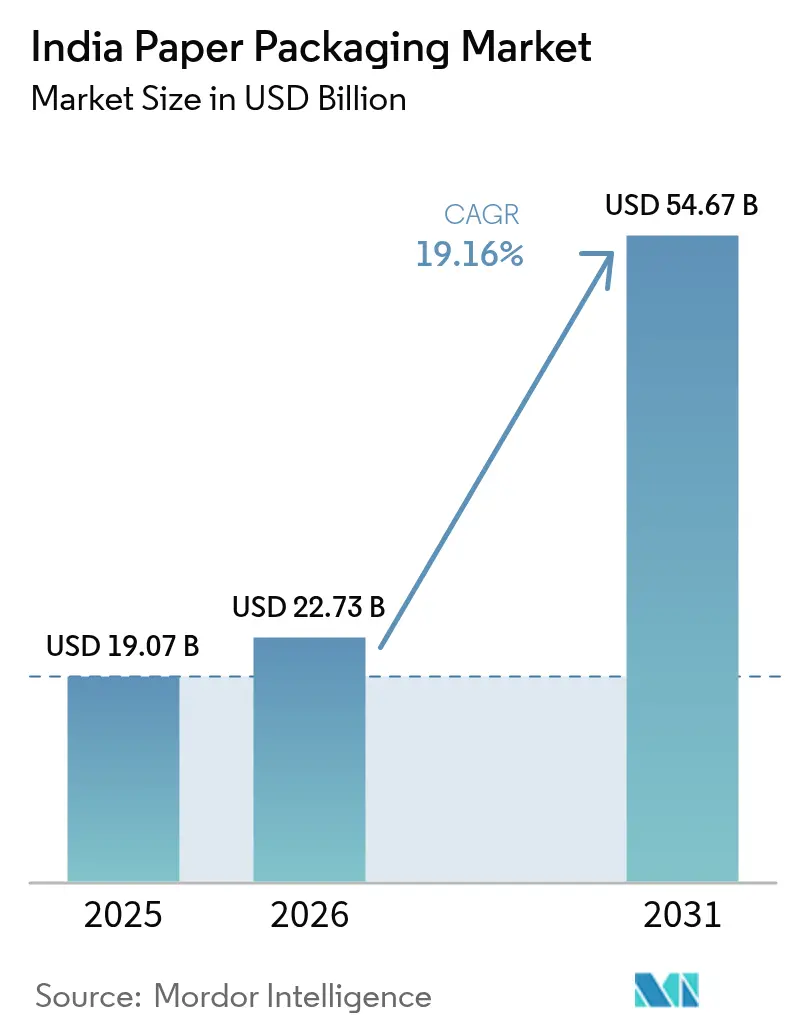
| Base Year Market Size (2025) | USD 19.07 Billion |
| Market Size (2026) | USD 22.73 Billion |
| Market Size (2031) | USD 54.67 Billion |
| Growth Rate (2026 - 2031) | 19.16 % |
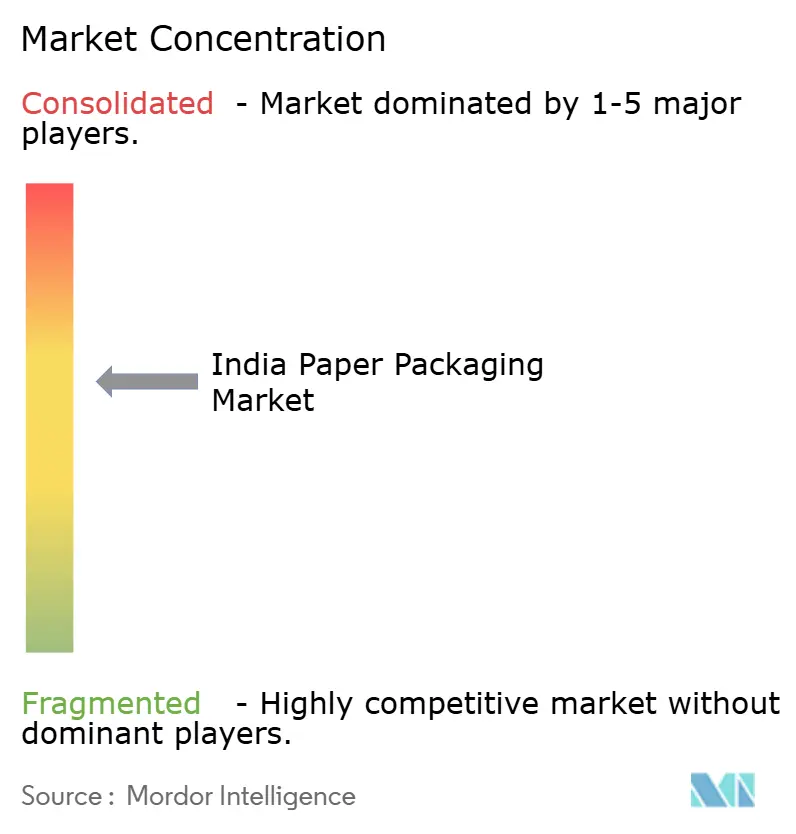
| Market Concentration | Medium |
Major Players *Disclaimer: Major Players sorted in no particular order Image © Mordor Intelligence. Reuse requires attribution under CC BY 4.0. | |
India Paper Packaging Market Analysis by Mordor Intelligence
India paper packaging market size in 2026 is estimated at USD 22.73 billion, growing from 2025 value of USD 19.07 billion with 2031 projections showing USD 54.67 billion, growing at 19.16% CAGR over 2026-2031. Expansive e-commerce operations, plastic-use restrictions, and rising fast-moving consumer goods (FMCG) volumes combine to lift demand for lightweight, recyclable substrates across primary and secondary formats. Regulatory bans on selected single-use plastics in all 28 states accelerate substitution, while brand owners invest in premium barrier-coated paperboard to meet sustainability pledges and consumer expectations.[1]Ministry of Environment, Forest and Climate Change, “Plastic Waste Management Amendment Rules 2024,” moef.gov.in Digital printing adoption, already at 18% penetration in label lines, supports agile production, late-stage customization, and counterfeit deterrence. Amid growth, raw-material exposure to kraft-paper price swings and cost-competitive zero-duty ASEAN imports pressure margins, prompting domestic mills to scale, backward-integrate, and secure recovered-fiber feedstock. Overall, India paper packaging market participants deploy capital toward coating, molded-fiber, and smart-label technologies that strengthen product stewardship credentials and capture higher-value applications along the supply chain.
Key Report Takeaways
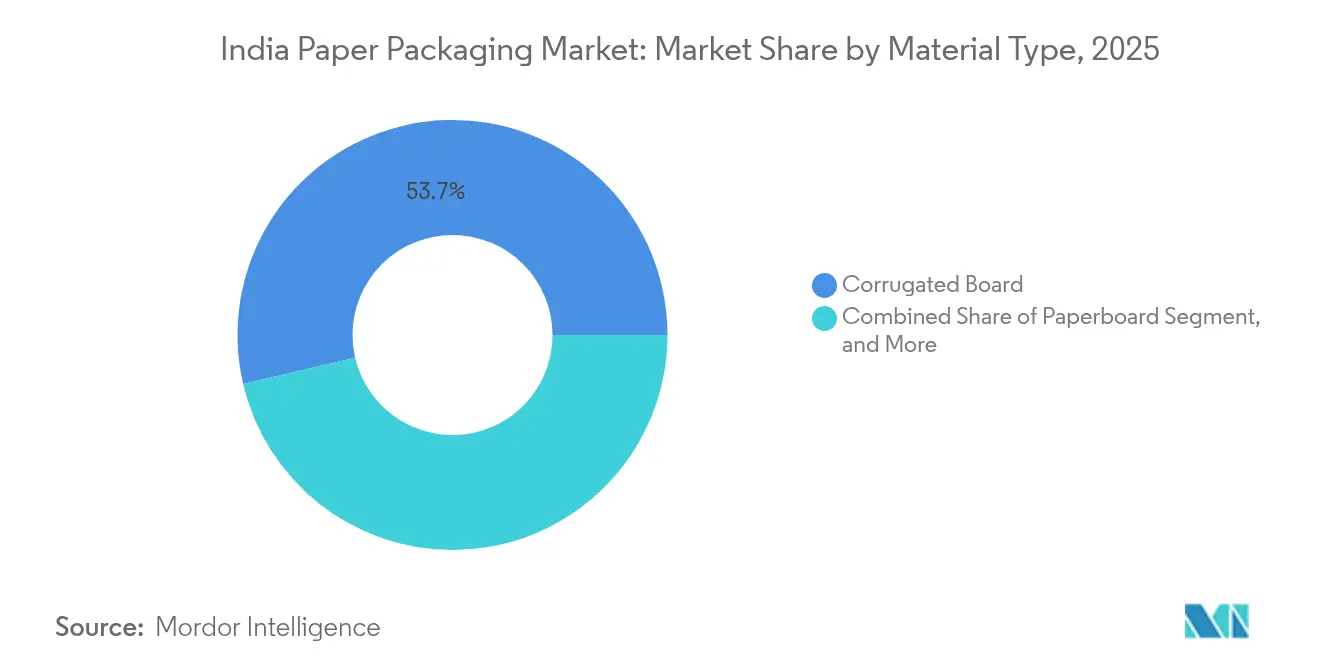
- By material type, corrugated board led with 53.65% of India paper packaging market share in 2025, while paperboard is forecast to advance at a 20.95% CAGR to 2031.
- By product category, flexible paper packaging commanded 53.74% share of the India paper packaging market size in 2025 and is projected to expand at a 21.55% CAGR through 2031.
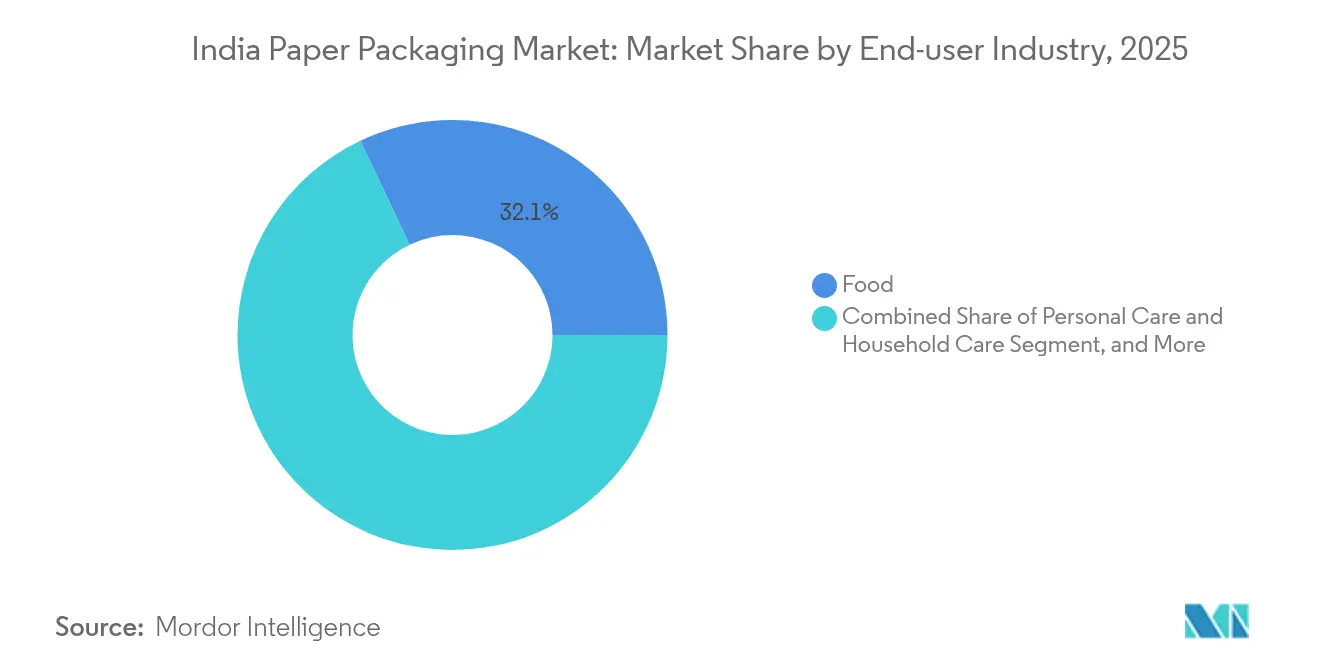
- By end-use industry, food applications captured 32.05% revenue share in 2025; personal care is poised for the fastest growth at a 23.12% CAGR to 2031.
- By packaging format, primary packaging accounted for 45.88% of the India paper packaging market size in 2025, whereas secondary packaging is set to register a 20.64% CAGR during 2026-2031.
Note: Market size and forecast figures in this report are generated using Mordor Intelligence’s proprietary estimation framework, updated with the latest available data and insights as of 2026.
India Paper Packaging Market Trends and Insights
Drivers Impact Analysis*
| Driver | (~) % Impact on CAGR Forecast | Geographic Relevance | Impact Timeline |
|---|---|---|---|
| Accelerating e-commerce fulfillment demand | +4.2% | Major metros and Tier-1 corridors | Medium term (2-4 years) |
| FMCG and packaged-food volume expansion | +3.8% | Pan-India, strong in Gujarat, Maharashtra, Tamil Nadu | Long term (≥ 4 years) |
| Government ban on select single-use plastics | +3.5% | Nationwide; state enforcement varies | Short term (≤ 2 years) |
| Brand-owner switch to premium lightweight board | +2.9% | Urban consumption centers | Medium term (2-4 years) |
| Rapid adoption of digital and on-demand printing | +2.1% | Metro clusters; spreading to Tier-2 cities | Medium term (2-4 years) |
| Supply-chain traceability and smart-label uptake | +1.8% | Export-oriented zones, organized retail | Long term (≥ 4 years) |
| Source: Mordor Intelligence | |||
Accelerating E-commerce Fulfillment Demand
India processed 5.2 billion online shipments in 2024 compared with 3.8 billion a year earlier, boosting corrugated-box volumes and encouraging adoption of lightweight high-strength grades. Large platforms added automated packing lines that standardize dimensions and reduce empty space. Quick-commerce operators favor compact corrugated formats designed for micro-fulfillment centers. Digital payment penetration reached 87% in urban areas, allowing removal of cash-on-delivery inserts and lowering material usage. Subscription-commerce models provide predictable demand, enabling converters to dedicate lines and secure raw-material contracts, thereby stabilizing throughput.
FMCG and Packaged-Food Volume Expansion
The packaged-food sector grew 8.2% in 2024, supported by organized retail penetration of 12% nationally and 35% in metros. Nestlé India allocated INR 2,600 crore (USD 29.28 crore ) for capacity upgrades, underscoring confidence in sustained consumption growth. Rural-income support schemes stimulated demand for branded goods sold in small pack sizes that favor coated paperboard. Growth in the organized dairy channel at 12% annually requires insulated corrugated containers for cold-chain logistics. These shifts reinforce multiyear contracting between food majors and packaging suppliers, anchoring baseline order volumes for the India paper packaging market.
Government Ban on Select Single-Use Plastics
The Plastic Waste Management Amendment Rules 2024 prohibit plastic cups, plates, and certain flexible laminates, driving urgent substitution toward paper solutions. Tamil Nadu achieved 78% compliance, compared with a national average of 45%, producing regional demand clusters. Extended Producer Responsibility mandates that brand owners collect 60% of plastic waste, making paper alternatives more attractive despite their 15-20% higher unit cost. Fines ranging from INR 5,000 (USD 56.31 crore) to INR 100,000 (USD 1,126.38 crore) per violation accelerate compliance, particularly in organized food service and retail. While medical uses remain exempt, food, personal care, and e-commerce categories present immediate scale for paper converters.
Rapid Adoption of Digital and On-Demand Printing
Digital presses accounted for 18% of label capacity in 2024, enabling variable data and region-specific graphics without plate costs. Brand owners deploy QR codes and NFC chips to authenticate products and engage consumers, lifting paper substrate requirements that accommodate embedded electronics. Short-run economics cut inventory carrying costs by 25-30% and shorten product-launch cycles. The technology also democratizes premium packaging for small and medium enterprises, expanding the addressable customer base inside the India paper packaging market. Converter investment in color-management software and post-press embellishment further differentiates value propositions.
Restraints Impact Analysis*
| Restraint | (~) % Impact on CAGR Forecast | Geographic Relevance | Impact Timeline |
|---|---|---|---|
| Kraft-paper input-price volatility | -2.4% | National, import-reliant processors | Short term (≤ 2 years) |
| Zero-duty ASEAN imports squeezing margins | -1.9% | Coastal hubs adjacent to ports | Medium term (2-4 years) |
| Structural shortage of recovered fiber | -1.6% | North and West mills | Long term (≥ 4 years) |
| Excess corrugator capacity and fragmentation | -1.3% | Regional SME clusters | Medium term (2-4 years) |
| Source: Mordor Intelligence | |||
Kraft-paper input-price volatility
Spot kraft prices fluctuated 15–20% in 2024 due to ocean-freight spikes and energy-cost swings, eroding SME corrugator margins that lack hedging capacity. Mills with captive pulping muted exposure, underscoring integration’s value. Price uncertainty delays capacity upgrades as payback models become fluid, and it hampers long-term contracts with brand owners expecting stable cost curves.
Zero-duty ASEAN imports squeezing margins
Under free-trade concessions, Indonesian and Thai linerboard enters at zero duty, undercutting domestic rates by up to 10% in coastal markets. Local mills augment value-added coatings and shorter lead-times to compete, but smaller converters face margin compression, often passing costs downstream or forfeiting share.
*Our forecasts treat driver/restraint impacts as directional, not additive. The impact forecasts reflect baseline growth, mix effects, and variable interactions.
Segment Analysis
By Material Type: Corrugated board retains lead while coated paperboard accelerates
Corrugated board maintained 53.65% India paper packaging market share in 2025, driven by e-commerce durability requirements and industrial stacking needs. Yet coated paperboard registers a 20.95% CAGR to 2031, propelled by premium FMCG and pharmaceutical applications that demand moisture and grease barriers. India paper packaging market size for paperboard is projected to reach USD 18.47 billion by 2031, up from USD 5.9 billion in 2025. Coated variants also leverage government procurement favoring recyclable substrates, particularly in public food-distribution channels. Investments such as ITC’s INR 800 crore (USD 9.011 crore) barrier-coating line reflect this structural tailwind.
Advanced multiwall kraft innovations cut weight in cement sacks without sacrificing burst strength, winning share from woven polypropylene. Recovered-fiber content rises alongside FSC certification uptake, helping brands achieve Scope-3 carbon reductions. Material diversification cushions mills against kraft price cycles and broadens the India paper packaging market addressable for specialized grades.


By Product Type: Flexible formats dominate but rigid solutions scale
Flexible structures secured 53.74% India paper packaging market share during 2025 thanks to pouches, sachets, and wraps optimized for snack, confectionery, and personal-care items. The sub-category posts a 21.55% CAGR as barrier coatings allow plastic-free laminates. Digital web presses tune graphics to micro-market preferences, reinforcing volume gains. Meanwhile, rigid folding cartons and corrugated cases expand as omnichannel brands harmonize shelf-ready and ship-in-own-container designs.
Rigid formats benefit from micro-flute and litho-lam innovations that reduce fiber by 8-10% yet elevate print fidelity, deepening penetration in cosmetics and electronics. Cartonboard lines tailored for pharmaceutical serialization add tamper evidence crucial to regulatory compliance, accelerating rigid adoption.
By End-Use Industry: Food retains primacy while personal care surges
Food applications accounted for 32.05% of India paper packaging market size in 2025, reflecting ongoing processed-food formalization and cold-chain expansion. Rising snack consumption and direct-to-consumer models sustain corrugated and flexible demand. Personal care, though smaller, advances at 23.12% CAGR, fueled by premiumization, sustainability pledges, and gender-neutral grooming lines.
Beverage paper applications remain mainly secondary due to liquid-pack barriers; however, trials using aqueous-coated board for dairy gable-tops open future avenues. Electronics, automotive, and textiles provide steady secondary and tertiary uptake, tethered to national manufacturing-linked-incentive policies.
By Packaging Format: Primary packs prevail, secondary packs outpace
Primary packs represented 45.88% India paper packaging market share in 2025, largely via food-contact cartons and direct-meal service clamshells. Secondary packs record a 20.64% CAGR on the back of shelf-ready display requirements and brand stories printed on outer sleeves. India paper packaging market size for secondary formats is forecast at USD 11.55 billion by 2031, nearly doubling 2025 levels.
Tertiary logistics solutions standardize around e-commerce parcel dimensions, lowering inventory complexity for fulfillment partners. Government directives encouraging plastic-replacement in public-sector tenders further tilt contracts toward primary and secondary board.
Geography Analysis
The western corridor’s dominance stems from integrated mills situated near container ports that handle recovered-fiber imports and finished-goods exports efficiently. Corrugator clusters around Mumbai and Surat tap robust FMCG backward-linkages. Proximity to chemical feedstocks supports specialty coating lines producing grease-proof wraps for snack majors.
Southern growth reflects diverse industry bases from electronics in Bengaluru to automotive in Chennai each demanding differentiated transit and retail packs. Infrastructure upgrades such as dedicated freight corridors lower inbound raw-material costs, enhancing mill competitiveness. Policy incentives for greenfield pulp units in Andhra Pradesh and Telangana further tilt capacity expansion southward.
Northern expansion aligns with agricultural consolidation and cold-chain rollouts covering perishables bound for Delhi’s cash-rich consumer base. Here, medium mills retrofit biomass boilers to mitigate fuel cost spikes, while brand owners drive certification adoption to meet export protocols. Inland logistics constraints persist but road-widening projects promise cost relief over the forecast horizon.
Regulatory Landscape
India paper packaging is shaped by food-contact safety rules, quality control standards, and plastic-waste policies that accelerate substitution toward fiber-based formats. Food-contact paper and board used for packaging must comply with the Food Safety and Standards Authority of India (FSSAI) framework, including the Food Safety and Standards (Packaging) Regulations, with alignment to relevant BIS specifications for grades such as greaseproof paper and corrugated fibreboard boxes. In 2025, FSSAI also issued draft packaging amendments with tighter restrictions on certain chemicals used in food-contact materials, including PFAS and BPA proposals, prompting converters to audit coatings, inks, and barrier chemistries.
On sustainability and trade policy, the Ministry of Environment, Forest and Climate Change (MoEFCC) Plastic Waste Management (Amendment) Rules 2024 broadened EPR compliance requirements for plastic packaging, including mandatory registration on the CPCB EPR portal. This indirectly lifts demand for paper alternatives in categories moving away from plastic. Standards and import measures also influence competitive dynamics: the Writing and Printing Papers, Coated Paper and Board (Quality Control) Order 2025 requires specified coated paper and board products to conform to Indian Standards and carry the BIS Standard Mark, and in April 2026 the DGFT extended the Minimum Import Price (MIP) framework for specified Chapter 48 paper and paperboard products until September 2026, aiming to stabilize domestic pricing for a subset of paper and board imports.
Value Chain Analysis
The value chain begins with fiber sourcing (recovered paper and virgin pulp), pulp and paperboard manufacturing, converting (corrugation, folding cartons, flexible paper converting, coatings/lamination), printing and finishing, and then distribution to FMCG, food service, e-commerce fulfillment, and industrial users. A key upstream constraint is recovered-fiber availability and quality, which keeps many players exposed to imported wastepaper and pulp. This raises sensitivity to shipping and energy volatility and, in parallel, encourages integrated mills to secure feedstock and invest in pulping, coating, and barrier capabilities for higher-value food and personal-care applications.
Midstream, converters span a large SME base alongside integrated leaders, with differentiation increasingly coming from barrier-coated paperboard, digital and on-demand printing for short runs and variable data, and smart-label and traceability features for organized retail and exports. Downstream, large e-commerce platforms and packaged-food brand owners anchor volumes through standardized box specifications and multi-location supply programs, while compliance requirements (food-contact norms and sustainability mandates) add documentation needs that favor organized converters with QA labs, ERP-enabled traceability, and certified sourcing. Ongoing consolidation and vertical integration, such as board producers expanding into folding carton and corrugated conversion, reflect efforts to capture more value per tonne and improve service levels across India.
Competitive Landscape
Roughly 2,000 converters operate nationwide, yet the top-10 integrated firms hold 35% collective share, signaling moderate concentration. ITC’s INR 3,498 crore (USD39.39 crore ) acquisition of Century Pulp and Paper vaults it to an 850,000-tonne capacity lead, underscoring the consolidation trend.[2]The Economic Times, “ITC Completes Century Pulp Acquisition for INR 3,498 Crore,” economictimes.indiatimes.com JK Paper’s INR 1,200 crore (USD 13.51 crore) board line in Gujarat and Pakka’s INR 675 crore (USD 7.60 crore) molded-fiber project illustrate aggressive capex cycles aimed at premium segments.[3]JK Paper, “Capacity Expansion and Strategic Investments,” jkpaper.com
Technology deployment differentiates market leaders: WestRock India and Parksons roll out automated corrugators with inline die-cutting to cut waste, while TCPL leverages digital presses for Amazon’s multicenter contract. Start-ups commercializing agri-waste fiber integrate with legacy players through supply agreements, providing circular-economy narratives without large cap-outlays. International entrants eye high-growth categories but face duty structures favoring local make-in-India conversions.
Competitive intensity remains highest among SME corrugators serving regional produce exporters, where price undercutting is prevalent. Integrated players steer toward coatings, molded-fiber, and smart-packaging value pools that defend margins and embed switching costs.
India Paper Packaging Industry Leaders
Smurfit WestRock
JK Paper Ltd.
Parksons Packaging Ltd.
TCPL Packaging Ltd.
Horizon Packs Pvt. Ltd.
- *Disclaimer: Major Players sorted in no particular order

Market Opportunities and Future Outlook
Regulation-driven substitution and compliance-led upgrading are creating whitespace in certified, food-safe, and functionally coated paper packaging. The Plastic Waste Management Amendment Rules 2024 broadened EPR obligations for plastic packaging and increased urgency to replace selected single-use plastics in organized food service and retail, while FSSAI packaging oversight and its 2025 draft amendments, including proposed restrictions around PFAS and BPA in food-contact materials, elevate demand for verified food-contact compliant paper, barrier boards, and documented supply chains. The resulting opportunity supports converters and mills that can supply grease and moisture barrier paper solutions without chemistries that face tightening scrutiny, supported by validated migration testing and BIS-aligned specifications where applicable.
A second opportunity area sits in capacity expansion, backward integration, and circularity infrastructure that reduces exposure to kraft price swings and recovered-fiber shortages. The market has visible momentum toward new pulping and value-added board capabilities, including JK Paper commencing commercial production at a 125,000 ADMT per annum BCTMP plant at Songadh in June 2026, and ITC expanding sustainable paperboard product lines positioned as plastic substitutes. Capex also remains directed toward carton infrastructure and efficiency upgrades, such as TCPL Packaging highlighting an INR 100 crore capex program for capacity and technology upgrades. These moves align with addressable demand for reliable domestic supply of specialty paperboard, barrier coatings, molded-fiber formats, and digitally printed packaging tuned to e-commerce and FMCG requirements, where lead time, print agility, and documented sustainability credentials influence supplier selection.
Recent Industry Developments
- June 2026: JK Paper announced the commencement of commercial production at its new 125,000 ADMT per annum Hardwood Bleach Chemical Thermo-Mechanical Pulp (BCTMP) plant at CPM, Songadh. The added pulp capability supports backward integration for packaging grades and can improve security of supply for paperboard and packaging paper manufacturing.
- July 2025: JK Paper approved the acquisition of a 72% stake in Borkar Packaging Private Limited, which manufactures folding cartons and corrugated boxes. The move expands JK Paper further into conversion, strengthening its ability to serve brand owners with integrated paperboard-to-pack solutions across formats.
- June 2024: Parksons Packaging invested in a new Koenig and Bauer Rapida 105 printing press at its MK Print Pack subsidiary facility in Daman. The press upgrade strengthens high-quality carton printing and finishing capability, supporting premium FMCG and personal-care packaging demand where shelf impact and short turnaround matter.


Research Methodology Framework and Report Scope
Market Definition and Coverage
The market is defined as the value of paper-based packaging products used in India across key packaging applications, where demand is tracked from brand owners and industrial users through packaging conversion and supply flows.
Scope exclusions: This sizing excludes non-paper packaging materials and excludes paper used for printing and writing that is not converted into packaging.
Segmentation Overview
- By Material Type
- Kraft Paper
- Paperboard
- Corrugated Board
- Other Material Types
- By Product Type
- Flexible Paper Packaging
- Pouches and Bags
- Wraps and Films
- Other Flexible Paper Packaging
- Rigid Paper Packaging
- Folding Carton
- Corrugated Boxes
- Other Rigid Paper Packaging
- Flexible Paper Packaging
- By Packaging Format
- Primary Packaging
- Secondary Packaging
- Tertiary / Transit Packaging
- By End-Use Industry
- Food
- Beverage
- Healthcare and Pharmaceuticals
- Personal Care and Cosmetics
- Industrial and Electronic
- Other End-Use Industries
Data Sources, Market Sizing, and Validation
Desk Research
Desk research was used to set the factual base for the model and to keep assumptions realistic across years. We reviewed public sources such as DPIIT and other Government of India publications, Ministry of Commerce and Industry trade statistics, policy notes linked to packaging and waste rules, and Customs import-export summaries where packaging papers and boards are visible.
Along with that, we used company annual reports, investor presentations, association websites, and credible press coverage to understand capacity additions, mill operating rates, and demand shifts from end-use industries like food, beverages, and e-commerce. Patent databases and standards references were also checked in a light way to see technology direction (for example barrier coatings and recycling-friendly designs), and paid subscriptions that support company financials and intelligence, news and financials, patent searches, and shipment-level trade views were used only to cross-check and fill gaps. The sources cited above are illustrative rather than exhaustive, and several other public references were also used for data collection, validation, and clarification.
Primary Interviews and Surveys
Primary work focused on expert interviews and structured surveys with converters, paper and board suppliers, distributors, and large end users who buy packaging at scale. These conversations were used to validate price ranges, typical mix shifts between corrugated, paperboard, and bags, and also to confirm adoption triggers from sustainability targets and plastics restrictions across major demand centers in India.
Distribution of primary research fieldwork respondents
| Company type | Respondent position |
|---|---|
| Top tier: 38% | CXOs: 17% |
| Mid tier: 45% | Functional/Unit leaders: 28% |
| Smaller Players: 17% | Managers: 55% |
Market-Sizing & Forecasting
Sizing was built using a top-down demand reconstruction, where packaging consumption in India is linked back to end-use output and packaging intensity, and then converted into value using checked price bands. To keep the totals grounded, we then corroborated results with selective bottom-up approximations like sampled converter revenues, channel checks on corrugated box demand, and typical ASP times volume calculations for high-visibility formats.
Key inputs used in the model include packaging paper and paperboard price movements, kraft paper and paperboard availability, capacity additions and utilization cues, substitution pace from plastics to paper in selected applications, and demand indicators such as e-commerce parcel movement and packaged food volumes. When data was missing for smaller formats or informal conversion activity, gaps were handled through conservative penetration assumptions validated in interviews, and then normalized so totals remain consistent with observed supply and demand signals.
Forecasting relies mainly on scenario analysis, since regulatory changes, recycling availability, and price cycles can move adoption faster or slower depending on the year. Assumptions for growth rates and ASP progression were reviewed with industry participants, and then applied with clear year-by-year drivers so the forecast can be replicated and updated without over-complicated math.
Data Validation & Update Cycle
Outputs are validated through triangulation across independent signals, and large variances are investigated before the model is finalized. Checks include year-over-year reasonableness, price and volume alignment, and consistency with trade and capacity direction, which are then reviewed in a multi-step internal analyst pass.
If an assumption moves the market too sharply without a matching real-world trigger, we recheck the input, revisit the desk evidence, and re-contact select experts to understand what changed. The report is refreshed annually, and interim adjustments are made when material events occur, such as policy shifts, major capacity changes, or sharp raw material price swings. Before delivery, a final analyst review is completed so clients receive the latest updated view.
Mordor Intelligence's India Paper Packaging Market Size Versus Other Published Estimates
Published market sizes for India paper packaging can look different across sources, even when the topic name appears the same. The most common reasons are differences in what is counted as paper packaging, which year is treated as the base, and how pricing is carried forward in forecasts.
In this market, the split between packaging paper and converted packaging products matters a lot, and some estimates mix the two without stating it clearly. Another driver is whether flexible and rigid paper packaging formats are both included, and whether end-use coverage is broad enough to capture demand coming from food, beverages, healthcare, personal care, and e-commerce at the same time.
Benchmark comparison
| Source | Market Size | Gaps in Research Methodology |
|---|---|---|
| Mordor Intelligence | USD 19.07 B (2025) | |
| Industry Publisher A | USD 19.42 B (2025) | Uses a broad segmentation structure that can capture additional packaging grades and regional splits, and it applies a steadier price path, which can shift the value slightly even when the same base year is used. |
| Trade Journal B | USD 15.80 B (2024) | Tracks packaging paper and paperboard demand closer to a materials view, which can undercount converter value addition and may not fully reflect application-level mix changes across cartons, bags, and transit packaging. |
The spread is explained mostly by whether the estimate is built around packaging paper demand versus converted packaging value, and also by base-year choice and how ASP changes are applied over time. Since converter realization and end-use pull checks are refreshed during the sizing pass to avoid carrying forward older price bands, the 2025 value stays tied to how packaging is actually bought and used in India, which is treated this way by Mordor Intelligence.


Key Questions Answered in the Report
How large is the India paper packaging market in 2026?
India paper packaging market size is USD 22.73 billion in 2026 and is set to hit USD 54.67 billion by 2031.
What CAGR is forecast for India’s paper packaging sector to 2031?
The market is expected to grow at a 19.16% CAGR during 2026-2031.
Which product segment grows fastest in Indian paper packaging?
Flexible formats log the highest growth, expanding at a 21.55% CAGR on rising snack and personal-care demand.
Which region leads capacity in Indian paper packaging?
Western India, led by Maharashtra, accounts for 22% of national capacity, with southern states showing the fastest growth.
How does the plastic ban influence Indian paper packaging?
The ban on selected single-use plastics pushes brands toward recyclable paper solutions, adding roughly 3.5 percentage-points to sector CAGR in the short term.
Who are the key players driving consolidation?
ITC, JK Paper, and Pakka Limited spearhead consolidation via acquisitions and capacity expansions, enlarging integrated footprints.
Page last updated on:


 Your data is secure and never sold or shared.


