
Market Overview
| Study Period | 2020 - 2031 |
|---|---|
| Forecast Data Period | 2026 - 2031 |
| Base Year Market Size (2025) | USD 13.72 Billion |
| Market Size (2026) | USD 14.54 Billion |
| Market Size (2031) | USD 19.57 Billion |
| Growth Rate (2026 - 2031) | 6.13 % |
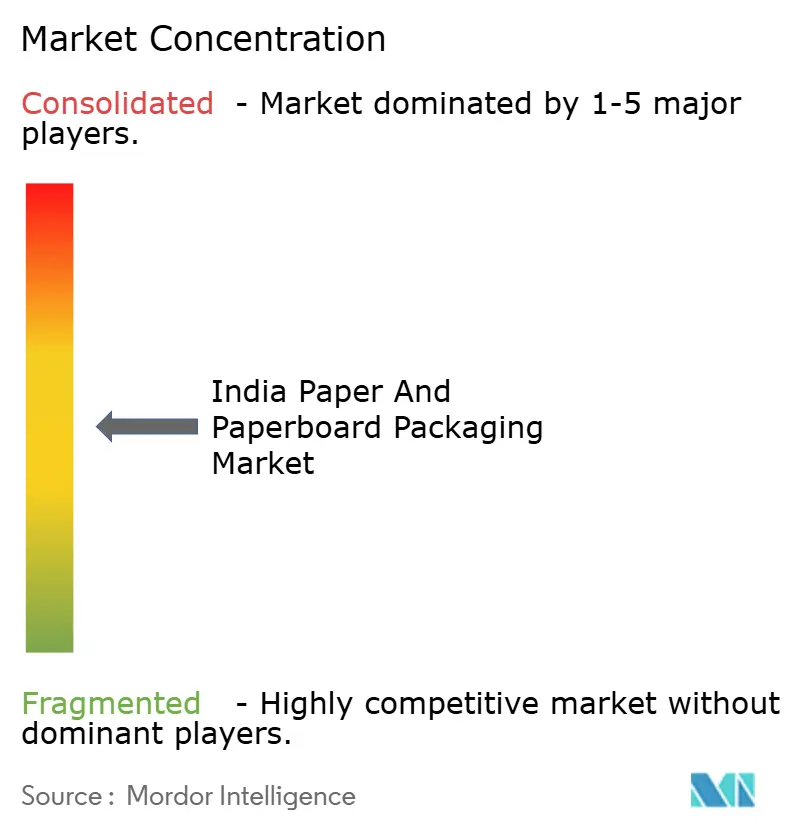
| Market Concentration | Medium |
Major Players *Disclaimer: Major Players sorted in no particular order Image © Mordor Intelligence. Reuse requires attribution under CC BY 4.0. | |
India Paper And Paperboard Packaging Market Analysis by Mordor Intelligence
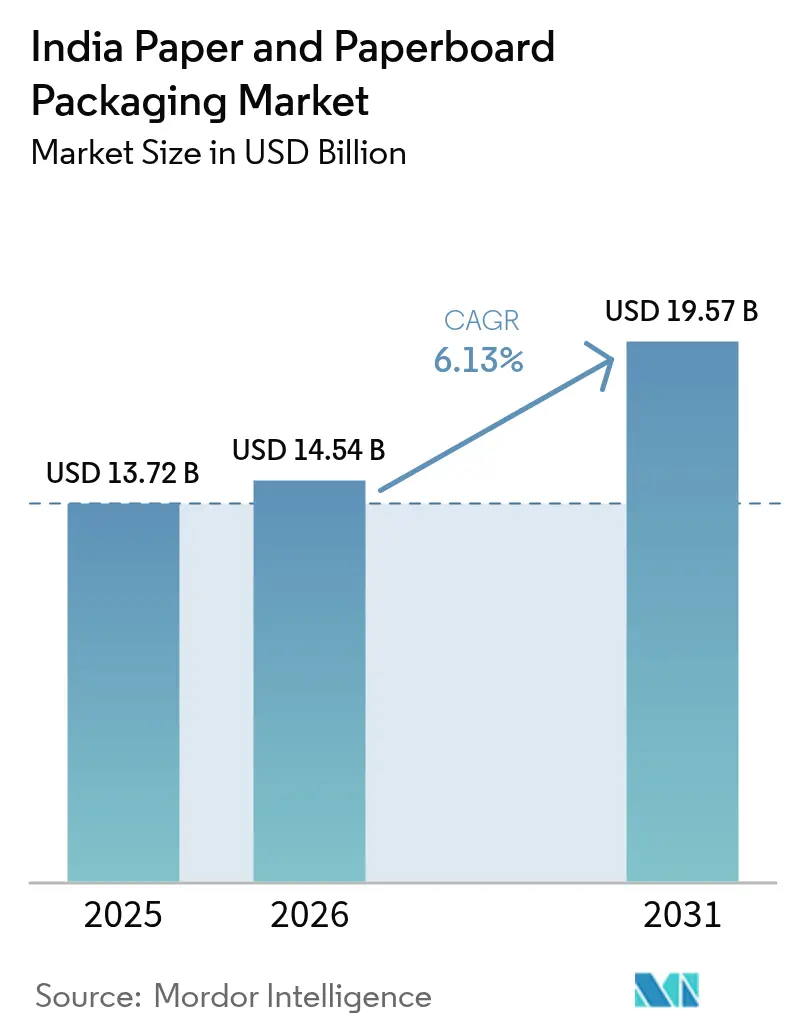
The India paper and paperboard packaging market size is expected to grow from USD 13.72 billion in 2025 to USD 14.54 billion in 2026 and is forecast to reach USD 19.57 billion by 2031 at a 6.13% CAGR over 2026-2031. A nationwide ban on select single-use plastics, fast-rising e-commerce penetration and record investments in agro-residue pulping have become the core pillars supporting this trajectory. Order profiles are fragmenting as quick-commerce platforms favor right-sized corrugated shippers, while food and beverage brands move toward QR-code-enabled mono-material packs that simplify Extended Producer Responsibility audits. Integrated mills with captive pulp and biomass energy are widening their cost gap over converters that rely on volatile imported waste paper. At the same time, automated flexographic and digital presses allow nimble converters to win premium short-run work in cosmetics and pharmaceuticals despite higher raw-material costs.
Key Report Takeaways
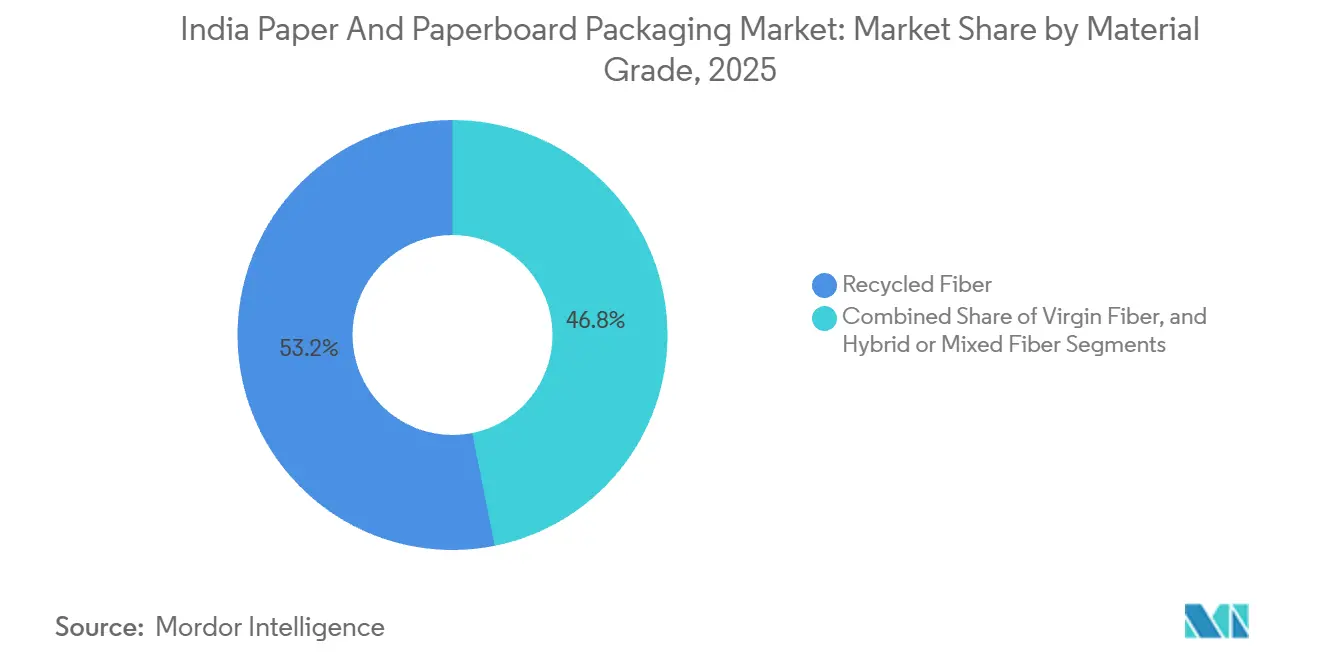
- By material grade, recycled fiber led with 53.16% of India paper and paperboard packaging market share in 2025, whereas hybrid or mixed fiber is projected to post the fastest 7.14% CAGR through 2031.
- By product type, corrugated packaging accounted for 48.24% of the India paper and paperboard packaging market size in 2025, while liquid cartons are set to expand at a 7.63% CAGR to 2031.
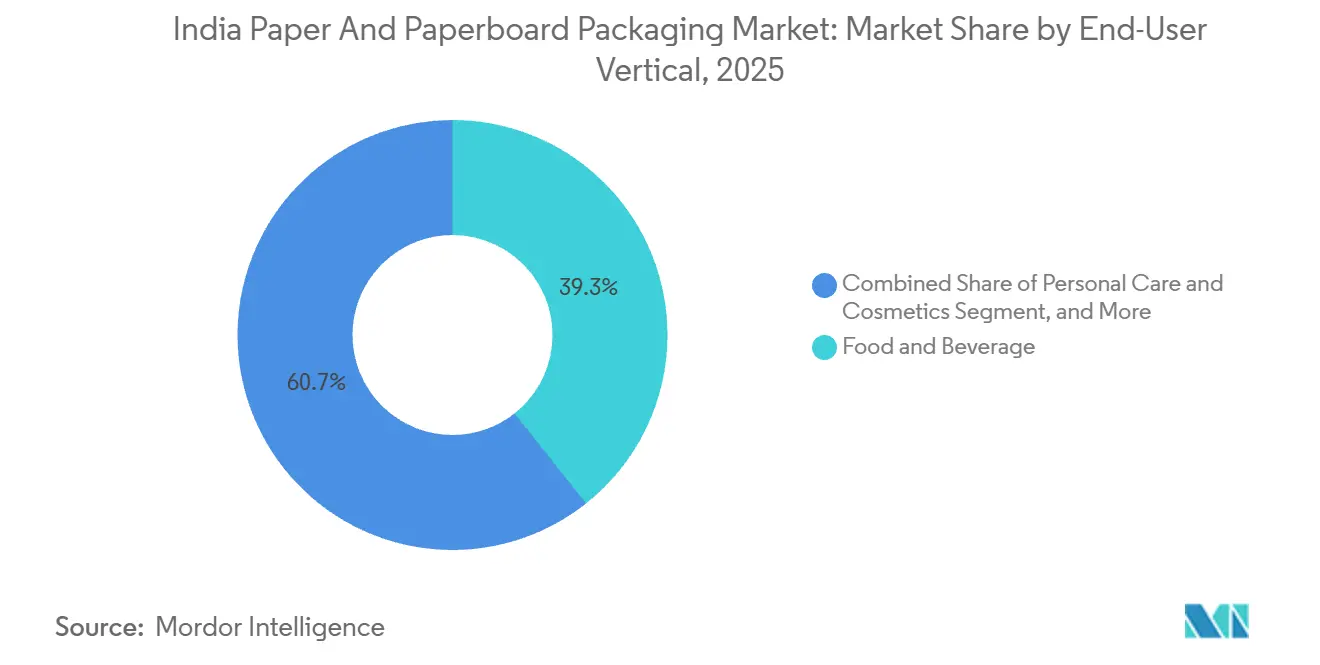
- By end-user vertical, food and beverage held 39.34% market share in 2025, whereas personal care and cosmetics is forecast to grow at an 8.12% CAGR during 2026-2031.
- By packaging format, secondary packaging represented 45.24% of the India paper and paperboard packaging market size in 2025 and is expected to grow at a 7.85% CAGR over the same period.
Note: Market size and forecast figures in this report are generated using Mordor Intelligence’s proprietary estimation framework, updated with the latest available data and insights as of 2026.
India Paper And Paperboard Packaging Market Trends and Insights
Drivers Impact Analysis*
| Driver | (~) Impact on CAGR Forecast | Geographic Relevance | Impact Timeline |
|---|---|---|---|
| Rising E-commerce Corrugated Demand | +1.8% | National, with concentration in metro dark-store clusters and tier-2 quick-commerce hubs | Short term (≤ 2 years) |
| Food Brand Shift to Recyclable Mono-Material Packs | +1.3% | National, led by FMCG majors in Maharashtra, Tamil Nadu, Gujarat | Medium term (2-4 years) |
| Government Ban on Single-Use Plastics | +1.1% | National, with stricter enforcement in Delhi, Karnataka, Maharashtra | Medium term (2-4 years) |
| Emergence of Quick-Commerce Regional Hubs | +0.9% | Tier-2 and tier-3 cities including Jaipur, Lucknow, Coimbatore, Indore | Short term (≤ 2 years) |
| Automated High-Speed Flexo Printing Investments | +0.6% | National, concentrated in Gujarat, Tamil Nadu, Haryana converter clusters | Long term (≥ 4 years) |
| Agro-Residue Pulp Capacity Additions | +0.5% | Punjab, Haryana, Uttar Pradesh (wheat straw); Maharashtra, Karnataka (bagasse) | Long term (≥ 4 years) |
| Source: Mordor Intelligence | |||


Rising E-commerce Corrugated Demand
Order-to-dispatch cycles in quick-commerce have compressed from hours to minutes, forcing converters near fulfillment hubs to keep pre-assembled shippers ready at all times. Average units per shipment are now closer to one SKU than the three to five typical in earlier e-retail models, effectively multiplying corrugated demand per rupee of merchandise sold. Tier-2 cities such as Jaipur, Lucknow, Coimbatore and Indore are expanding fastest because dark-store operators secure lower real-estate costs there, drawing regional converters to invest in rotary die-cutters and slitter-scorers. Right-weighting to cut excess void fill has become a key cost lever for platforms dispatching millions of micro-orders each month. The resulting boom in micro-flute boards that deliver crush resistance at lighter basis weights adds fresh momentum to the India paper and paperboard packaging market.
Food Brand Shift to Recyclable Mono-Material Packs
Extended Producer Responsibility rules mandate QR-code traceability from July 2025, pushing brand owners to redesign packs around a single substrate.[1]Ministry of Environment, Forest and Climate Change, “Plastic Waste Management Amendment Rules 2024,” moef.gov.in Carton makers responded with barrier-coated paperboard that withstands oil, moisture and oxygen without relying on multilayer plastic laminates. Although these substrates cost 8-12% more than polyethylene pouches, leading consumer-goods companies absorb the premium to avoid non-compliance fines and reputational risk. Retailers now favor matte cartons that showcase sustainability credentials, a shift that boosts print value per pack. Large converters securing multiyear supply agreements can therefore justify further automation and widen their competitive moat.
Government Ban on Single-Use Plastics
The prohibition on 19 single-use plastic items has positioned paper as the default replacement for carry bags, cutlery and food-service ware.[2]Press Information Bureau, “Single-Use Plastic Ban Enforcement,” pib.gov.in States with well-staffed inspection squads such as Delhi and Karnataka collected most of the INR 198 million in fines recorded by 2024, reinforcing compliance urgency. Demand for kraft grocery bags and molded-pulp trays that was negligible before the ban surged across modern retail formats. Mills are upgrading pulping chemistries to meet tighter migration limits for heavy metals in food-contact grades. While illicit plastic flows persist in informal retail, the regulatory direction cements a durable demand floor for fiber-based solutions.
Emergence of Quick-Commerce Regional Hubs
Platforms such as Blinkit and Zepto have opened micro-fulfillment centers in Jaipur, Lucknow, Coimbatore and Indore, each stocking 2,000-3,000 SKUs and promising 15-minute delivery windows. These hubs require customized shippers that optimize shelf density, prompting converters to site flexographic lines within 50 km of dark stores. Localized supply eliminates interstate freight delays and ensures same-day replenishment commitments. Durable secondary packs that survive multiple reverse-logistics cycles are gaining favor, increasing demand for high-burst board grades. Together, these trends create new profit pools for agile converters in emerging consumption centers.
Restraints Impact Analysis*
| Restraint | (~) % Impact on CAGR Forecast | Geographic Relevance | Impact Timeline |
|---|---|---|---|
| Price Volatility of Imported Waste Paper | -0.8% | National, acute in coastal states with port access (Gujarat, Maharashtra, Tamil Nadu) | Short term (≤ 2 years) |
| Chronic Containerboard Energy-Cost Inflation | -0.7% | National, most severe in states with coal-dependent grids (Chhattisgarh, Odisha, Jharkhand) | Medium term (2-4 years) |
| Delayed GST Refunds for SME Converters | -0.4% | National, disproportionately affects SMEs in Gujarat, Haryana, Uttar Pradesh | Medium term (2-4 years) |
| Digital Substitution in Billing and Publishing | -0.3% | National, concentrated in urban centers with high digital-payment adoption | Long term (≥ 4 years) |
| Source: Mordor Intelligence | |||
Price Volatility of Imported Waste Paper
India imported roughly 1.5 million t of waste paper in FY 2023-24, yet domestic collection efficiency remains below 30%.[3]Ministry of Commerce and Industry, “Waste Paper Import Data FY 2023-24,” commerce.gov.in Bale prices swung 20-30% during 2024 after China’s National Sword policy rerouted shipments, forcing recycled-board mills to trade off margin versus volume. Standalone converters locked into annual price contracts resist cost pass-through, squeezing mill profitability. Some producers blend agro-residue pulp, but wheat-straw fibers lack the tensile strength required for heavy-duty liners. Until organized collection scales, volatility will continue to undercut recycled-fiber economics.
Chronic Containerboard Energy-Cost Inflation
Thermal-coal and grid tariffs rose 10-15% across India in 2024, lifting energy toward 20% of board production cost for mills without captive power. Integrated players such as ITC and JK Paper installed biomass cogeneration that burns agro-residue or black liquor, partially insulating them from fossil-fuel swings. Stand-alone converters purchasing finished board cannot hedge and consequently exit low-margin SKUs or consolidate with stronger rivals. Sustained inflation narrows the traditional price gap between recycled and virgin grades, subtly reshaping substrate decisions. Energy cost pressure therefore doubles as a consolidation catalyst within the market.
*Our forecasts treat driver/restraint impacts as directional, not additive. The impact forecasts reflect baseline growth, mix effects, and variable interactions.
Segment Analysis
By Material Grade: Hybrid Fiber Blends Gain Momentum
Recycled fiber controlled 53.16% of India paper and paperboard packaging market share in 2025, yet hybrid grades are forecast to deliver a 7.14% CAGR to 2031, outpacing all other material options. These blends combine agro-residue pulp with recycled furnish, providing crush strength while satisfying recycled-content criteria. The Directorate General of Trade Remedies began probing subsidized virgin imports from Chile and China in 2024, making domestically sourced hybrids more attractive. Imported waste-paper volatility further drives mills to secure agro-residue feedstock from wheat straw and bagasse, stabilizing cost curves. Policy incentives that reward stubble-burning reduction and circular-economy targets reinforce the transition toward hybrid boards.
Hybrid adoption also benefits converters: boards run clean on high-speed corrugators and accept water-based inks without extra primer, reducing downtime. Brand owners display recycled-content logos prominently, enhancing on-shelf perception without sacrificing box compression strength. Integrated mills with both pulp and converting assets therefore defend margins even in down cycles. Smaller firms can still participate by buying pre-trimmed hybrid sheets, though their cost base remains higher than that of vertically integrated rivals. Overall, hybrid grades advance both sustainability messaging and performance, securing their place in the growth mix of the India paper and paperboard packaging market.


By Product Type: Liquid Cartons Ride Dairy Upswing
Corrugated packaging dominated 48.24% of India paper and paperboard packaging market size in 2025, but liquid cartons are poised for the fastest 7.63% CAGR through 2031. Less than 10% of India’s milk output reaches consumers in packaged form, leaving vast headroom for aseptic cartons that permit ambient storage. SIG Combibloc’s USD 96 million plant in Ahmedabad can produce 4 billion packs a year, ensuring local supply for co-operatives modernizing distribution. Dairy processors in tier-2 cities value shelf-stable packs that bypass cold-chain costs, broadening market access and curbing spoilage.
Beyond dairy, fruit-based beverages and flavored milks adopt carton formats to differentiate from PET bottles. Folding cartons maintain relevance in pharmaceuticals and confectionery because anti-counterfeit features such as holographic foils fit easily on carton substrate. Paper bags continue to benefit from grocery bans on thin plastics, although reusable non-woven options slow their penetration. Rigid boxes, despite a niche volume base, capture premium margins in smartphones and luxury accessories. Collectively, this diversified demand profile consolidates liquid cartons and allied paperboard formats as structural growth pillars.
By End-User Vertical: Personal Care Leads Premiumization
Food and beverage held 39.34% of India paper and paperboard packaging market share in 2025, yet personal care and cosmetics is tipped to expand at an 8.12% CAGR during 2026-2031. A USD 28 billion domestic personal-care sector produced 186.6 billion packaging pieces in 2024, favoring matte-finish cartons with soft-touch lacquers and foil stamping. Brand owners localize designs for festivals, resulting in frequent changeovers that reward converters equipped with servo-driven presses. QR-code authentication printed inline also supports direct-to-consumer engagement campaigns.
Healthcare and pharmaceuticals demand tamper-evident seals and serialization, adding complexity that boosts per-unit revenue for folding-carton suppliers. Electronics require micro-flute corrugated inserts and molded-pulp cushioning to cut transit damage, expanding use of lightweight but high-strength board. Industrial and automotive parts ship in heavy-duty containers, though growth there follows broader manufacturing cycles. Consequently, while staples anchor volume, premium personal care and regulated pharma drive value growth for converters.
By Packaging Format: Secondary Packs Streamline Fulfillment
Secondary packaging represented 45.24% of India paper and paperboard packaging market share in 2025 and is expected to grow at a 7.85% CAGR through 2031. Omnichannel retailers standardize shipper sizes so automated sorters handle mixed-SKU orders without stoppages. Quick-commerce dark stores under 4,000 sq ft rely on knock-down boxes that pop open in seconds and nest flat when empty, conserving limited aisle space. Right-sized shippers also reduce void fill, lowering freight costs and improving eco-scores on retailer dashboards.
Primary packs still communicate brand identity and meet barrier performance needs, with coated boards replacing multilayer plastic in snacks and impulse foods. Tertiary packs such as pallet wraps remain commoditized, yet upcoming QR-code mandates spur limited demand for data-rich outer wraps. Converters installing inline digital printers can embed batch-level codes without extra handling steps, earning service premiums. As fulfillment models evolve, secondary format innovation stays crucial to efficiency gains across supply chains.
Geography Analysis
Western and southern coastal states dominate fiber inflows because ports at Mundra, Kandla, JNPT and Chennai handle nearly all imported waste paper. Gujarat and Tamil Nadu therefore house India’s densest converter clusters, serving FMCG factories located within 150 km of port gates. Integrated mills in Maharashtra leverage proximity to brand headquarters in Mumbai and Pune, shortening design-to-market cycles for new SKUs.
Punjab, Haryana, and Uttar Pradesh provide abundant wheat straw and rice husk, which are consumed by new agro-residue pulp lines. This aligns with efforts to mitigate stubble burning and ensure fiber security. Inland states without port access, such as Chhattisgarh and Madhya Pradesh, are shifting toward agro-based furnishes to avoid volatile bale prices, creating a north-central pulp corridor that counters the traditional west-coast bias.
Compliance readiness for QR-code traceability varies widely. Urban districts like Pune and Surat already pilot digital links between packaging batches and recycler receipts, whereas many rural blocks still build basic collection networks. Early-mover converters in metros gain preferred-supplier status for multinational brands, but tier-3 locations present greenfield potential for players willing to brave fragmented logistics, ensuring geographic diversification of the India paper and paperboard packaging market.
Regulatory Landscape
India’s regulatory framework for paper and paperboard packaging is tightening around waste accountability and product standards. Extended Producer Responsibility (EPR) traceability rules that started in July 2025 for packaging waste reporting have moved into mandatory compliance programs for paper and paperboard packaging from April 1, 2026, administered via the Central Pollution Control Board (CPCB) registration and reporting system for Producers, Importers, and Brand Owners (PIBOs). This shift is pushing brand owners to require verifiable recycled-content declarations and recycler tie-ups across carton, corrugated, and paper-bag supply chains.
Product and performance compliance continues to be shaped by the Bureau of Indian Standards (BIS) through commonly referenced specifications used in procurement and QA, including standards for kraft paper, corrugated fiberboard boxes, and paper-based composite cartons. Alongside EPR, enforcement momentum from the nationwide prohibition on select single-use plastic items (with states such as Delhi and Karnataka among active enforcers) reinforces substitution toward fiber-based packs, particularly in carry-bags and food-service applications, while also increasing scrutiny on food-contact safety and migration compliance for paperboard grades.
Value Chain Analysis
The value chain runs from fiber sourcing (domestic recovered paper collection, imported waste paper via ports such as Mundra, Kandla, JNPT, and Chennai, and agro-residue feedstocks like wheat straw and bagasse) to pulp and paperboard production, converting, and distribution to brand owners and e-commerce/quick-commerce platforms. Integrated players with captive pulp and biomass energy (for example, ITC and JK Paper) typically buffer volatility in imported waste paper and energy tariffs, while non-integrated converters depend on purchased containerboard and are more exposed to price swings, port-linked supply continuity risk, and working-capital stress.
Downstream, converters add value through corrugation, carton folding, barrier coatings, and printing (flexo/digital) before shipment to FMCG, food and beverage, pharma, and e-commerce clients. EPR implementation from April 2026 adds new operational steps across the chain, including CPCB portal-linked documentation, recycler partnerships, and auditable claims (for recycled content and chain-of-custody), which is encouraging formalization and consolidation. Recent inorganic and capacity moves, such as Canpac Trends acquiring Krishna Creation and announcing a greenfield premium paper packaging unit in Ahmedabad (July 2026), point to converters expanding design and finishing capabilities closer to demand clusters while seeking to meet compliance-led tender requirements.
Competitive Landscape
The India paper and paperboard packaging market shows moderate fragmentation. ITC Limited and JK Paper Limited operate integrated pulp-to-carton chains, insulating margins against fiber and energy shocks that squeeze converters purchasing board on the spot market. Smurfit WestRock couples imported design know-how with localized right-sizing services for quick-commerce clients, reinforcing its value proposition beyond plain corrugated supply.
Automation is a key battleground. TCPL Packaging and Parksons Packaging each installed multi-color flexographic lines with inline foiling that slash changeover time, enabling profitable execution of cosmetics runs under 10,000 units. Sustainability certifications such as Forest Stewardship Council labels and ISO 22000 food-safety systems now influence tender awards, allowing credentialed suppliers to levy 5-8% premiums.
Cost inflation is driving consolidation, with several SME converters entering structured sale talks after energy and waste-paper spikes erased gross margins in 2024. Larger groups are focusing on tuck-in acquisitions that add territory coverage or specialized coatings. This indicates that market power will concentrate even as overall demand expands, shaping the future competitiveness of the India paper and paperboard packaging market.
India Paper And Paperboard Packaging Industry Leaders
Tetra-Pak India Private Limited
Oji India Packaging Private Limited
ITC Limited – Paperboards and Specialty Papers Division
Huhtamaki India Limited
Smurfit WestRock
- *Disclaimer: Major Players sorted in no particular order

Market Opportunities and Future Outlook
EPR compliance that took effect from April 1, 2026 is creating near-term whitespace for organized collection, sorting, and certified recycling linkages that can supply auditable recycled fiber and compliance documentation to PIBOs. This is shifting procurement from spot, price-led buying to traceable sourcing and multi-year relationships, which benefits converters and mills that can bundle QR-code-ready printing, recycled-content declarations, and recycler tie-ups into a single supply proposition. The Eco-Mark Rules, 2024 draft amendments proposed by MoEF&CC in June 2026, including tighter chemical limits and monitoring requirements for pulp and paper units, further open opportunities for mills investing in cleaner processes and for converters positioning certified, food-contact-safe paperboard formats.
Domestic capacity build-outs aimed at import substitution in specialty and packaging boards provide another opportunity layer, particularly for food-contact, barrier-coated, and high-performance carton grades. Announcements such as Pudumjee Paper Products plans for a 68,000 MT specialty paper facility at Mahad, Maharashtra (July 2026), and NR Agarwal Industries reporting full utilization of its multilayer board plant while pursuing a greenfield packaging board project (January 2026) indicate continued investment to replace imported grades. On the demand side, quick-commerce right-sizing and micro-flute adoption, along with expansion of aseptic and paper-based carton formats beyond dairy into categories such as ready-to-drink functional beverages and pet food, are widening the addressable use-cases for paperboard packaging where printed differentiation and compliance traceability are becoming baseline requirements.
Recent Industry Developments
- May 2026: Parag Milk Foods launched Avvatar Protein Cold Coffee in Tetra Prisma Aseptic 250E packs in collaboration with Tetra Pak, extending aseptic paperboard usage into ready-to-drink functional beverages. The move adds new volume pools for carton packaging beyond traditional dairy while raising the need for higher print quality and brand protection features on paperboard formats.
- April 2026: Drools launched fresh pet food in Tetra Recart packaging in India after investing INR 180 crore in processing and packaging infrastructure. This supported the adoption of paper-based retortable carton solutions in a non-traditional category, strengthening the case for higher-barrier paperboard structures and localized supply capability.
- August 2025: India’s Directorate General of Foreign Trade imposed a Minimum Import Price on virgin multi-layer paperboard, tightening the trade environment for low-priced imports. The measure improved pricing discipline for domestic paperboard producers supplying folding cartons and liquid cartons, influencing sourcing decisions for converters that had relied on imported board.


Research Methodology Framework and Report Scope
Market Definition and Coverage
This market covers the value of paper and paperboard based packaging sold and used in India for packaging applications, including cartons, corrugated packs, paper bags, and similar formats, across major consuming industries. We treat market size in current USD and align it to packaging demand generated inside the country.
Scope exclusions: Plastic packaging, metal packaging, and glass packaging are excluded, and we also exclude standalone printing services that are not part of a packaging product sale.
Segmentation Overview
- By Material Grade
- Virgin Fiber
- Recycled Fiber
- Hybrid or Mixed Fiber
- By Product Type
- Folding Cartons
- Corrugated Packaging
- Liquid Cartons
- Paper Bags and Sacks
- Rigid Boxes
- Other Product Types
- By End-User Vertical
- Food and Beverage
- Healthcare and Pharmaceuticals
- Personal Care and Cosmetics
- Electrical and Electronics
- Industrial and Automotive
- Other End-user Industries
- By Packaging Format
- Primary Packaging
- Secondary Packaging
- Tertiary Packaging
Data Sources, Market Sizing, and Validation
Desk Research
Desk work started with mapping how paper and paperboard packaging demand ties to India end use consumption, then narrowing to inputs that can be checked consistently year to year. We relied on public sources such as Ministry of Commerce and Industry trade statistics, Central Pollution Control Board notifications on single use plastic restrictions, Reserve Bank of India macro series, and Press Information Bureau releases.
To keep assumptions grounded, we also reviewed company annual reports and investor presentations from packaging and pulp and paper value chain participants, alongside association and standards references such as FSSAI packaging related guidance and BIS standards where applicable. Patent databases and an import and export shipment level database were used selectively to cross check technology moves and trade mix shifts for paper grades and packaging items. These desk sources are illustrative and not exhaustive, and additional public references were used to validate, clarify, and fill data gaps.
Primary Interviews and Surveys
Primary work was used to test desk assumptions against how packaging orders actually move across food, pharma, personal care, e commerce, and industrial buyers, which is where the demand pool gets shaped. We spoke with converters, paper and board suppliers, distributors, and large packaging buyers so pricing logic, mix shifts (virgin versus recycled), and utilization realities could be reconciled before finalizing the model.
Distribution of primary research fieldwork respondents
| Company type | Respondent position |
|---|---|
| Top tier: 30% | CXOs: 13% |
| Mid tier: 56% | Functional/Unit leaders: 41% |
| Smaller Players: 14% | Managers: 46% |
Market-Sizing & Forecasting
Sizing was built using a top-down approach where packaging demand is reconstructed from India end use output and consumption signals, and then filtered through paper and paperboard packaging penetration and packaging intensity. In practice, we tied demand to indicators such as packaged food and beverage volumes, e commerce parcel shipments, pharma production trends, and shifts in organized retail packaging usage, and then adjusted for pack format movement between primary, secondary, and tertiary needs.
The total was corroborated with selective bottom-up checks, such as sampled converter capacity and utilization discussions, channel checks on average selling price movement for key formats (like corrugated shippers and folding cartons), and sanity checks on trade flows for paper and board grades used for packaging. Where bottom-up coverage was thin, we applied conservative gap handling by keeping assumptions tied to verifiable capacity additions, fiber mix availability, and observed price ranges, and then stress tested outcomes. Forecasts were built using scenario analysis, where variables like fiber cost direction, recycled content availability, plastic substitution pace, and end user demand growth were varied and then aligned to what interviewees described as realistic over the period.
Data Validation & Update Cycle
Validation was done through stepwise checks, where model outputs were compared against independent signals such as domestic paper and board supply movements, trade direction for relevant grades, and observed pricing bands from interviews. If a variance looked too large versus these outside signals, the assumptions were revisited and, when needed, respondents were re contacted to confirm whether the change was structural or temporary.
Before sign off, the work goes through internal reviews focused on logic consistency, unit alignment, and currency conversion timing so the final values stay comparable across years. Reports are refreshed annually, and interim updates are done when a material event changes demand or pricing, after which a final pre delivery pass is completed to keep the view current.
Mordor Intelligence's India Paper and Paperboard Packaging Market Size Compared Against Other Published Estimates
Published market values for this space can differ even when the topic name sounds identical, because boundaries around what counts as packaging, which grades are included, and whether pricing is taken at mill gate or at converter selling levels often vary. Timing also matters, since paper and board prices can move quickly, and some studies lock currency conversion and inflation assumptions early.
By tracking packaging format level demand drivers and refreshing key price and fiber mix assumptions, Mordor Intelligence keeps the India paper and paperboard packaging total tied to product level consumption, instead of blending in adjacent paper categories that are not sold as packaging. Differences usually show up around whether liquid cartons and rigid paper boxes are counted fully, whether recycled fiber based packs are treated as a separate pool, and how fast plastic replacement is assumed to happen across end uses.
Benchmark comparison
| Source | Market Size | Gaps in Research Methodology |
|---|---|---|
| Mordor Intelligence | USD 13.72 B (2025) | |
| Industry Association A | USD 12.10 B (2025) | Uses a narrower converter shipment view that tends to undercount liquid cartons and some rigid paper box applications, and it applies conservative price realization assumptions during volatile pulp and board cycles. |
| Trade Journal B | USD 15.90 B (2025) | Blends in adjacent paper categories used for wrapping and certain non packaging paper products, and it appears to use retail price proxies which can inflate values versus packaging product selling levels. |
The spread is mainly explained by what gets counted as a packaging product and where pricing is taken in the value chain. When scope is limited to true packaging formats and then cross checked with demand indicators and practical price bands, the result becomes easier to trace and replicate for planning.


Key Questions Answered in the Report
How big is the India paper and paperboard packaging market in 2026?
The market stands at USD 14.54 billion in 2026 and is projected to reach USD 19.57 billion by 2031.
Which segment grows the fastest through 2031?
Liquid cartons are forecast to expand at a 7.63% CAGR as dairy processors adopt ambient packaging.
Why are hybrid fiber boards gaining popularity?
They blend agro-residue virgin pulp with recycled furnish, delivering needed strength while meeting recycled-content mandates and avoiding anti-dumping duties.
What drives secondary packaging demand?
Omnichannel and quick-commerce fulfillment centers standardize shipper sizes for automated sortation, pushing secondary packs to a 7.85% CAGR.
How does the single-use plastic ban affect paper packaging?
The ban positions paper as the default substitute for carry bags and service ware, unlocking new volume for kraft bags and molded-pulp trays.
Page last updated on:


 Your data is secure and never sold or shared.


