
Market Overview
| Study Period | 2020 - 2031 |
|---|---|
| Forecast Data Period | 2026 - 2031 |
| Base Year Market Size (2025) | USD 4.81 Billion |
| Market Size (2026) | USD 5.21 Billion |
| Market Size (2031) | USD 7.73 Billion |
| Growth Rate (2026 - 2031) | 8.23% CAGR |
| Market Concentration | Medium |
Major Players *Disclaimer: Major Players sorted in no particular order Image © Mordor Intelligence. Reuse requires attribution under CC BY 4.0. | |
India Office Furniture Market Analysis by Mordor Intelligence
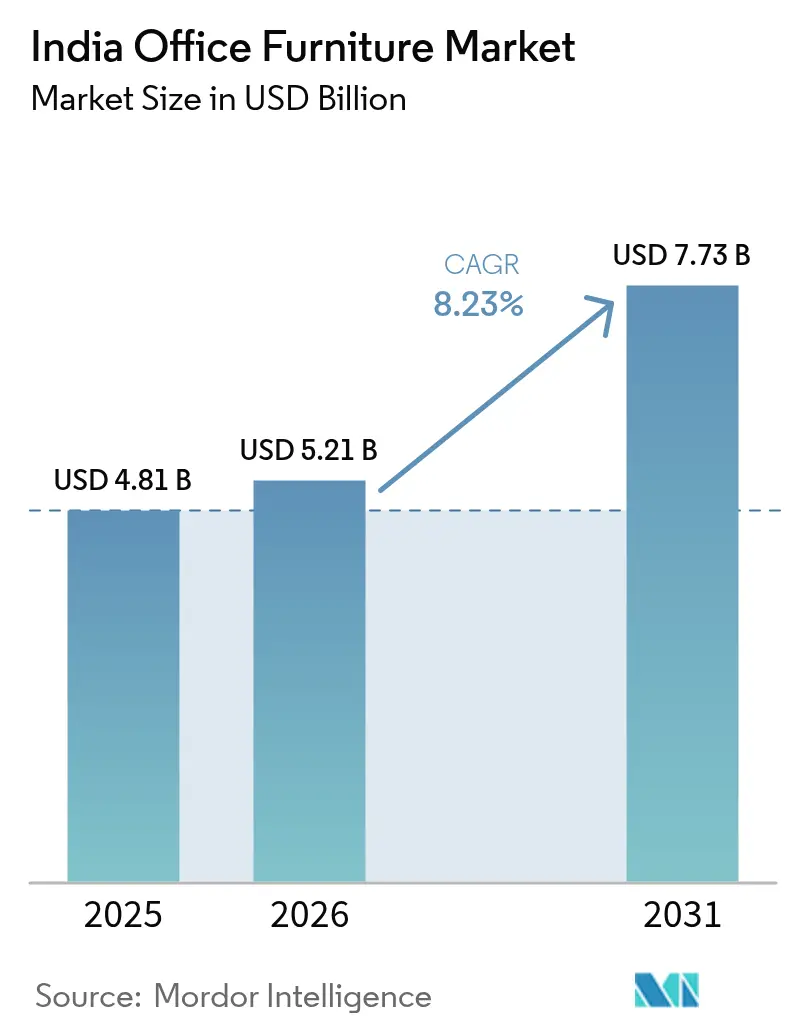
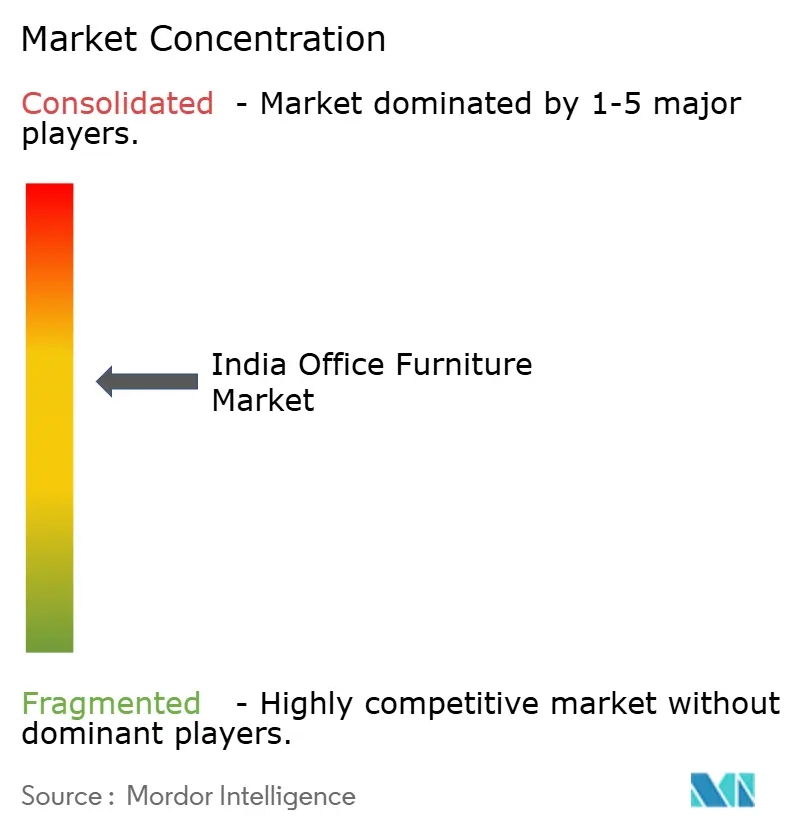
India office furniture market size in 2026 is estimated at USD 5.21 billion, growing from 2025 value of USD 4.81 billion with 2031 projections showing USD 7.73 billion, growing at 8.23% CAGR over 2026-2031. Continued momentum comes from hybrid working models, government manufacturing incentives, and rising ergonomic awareness that together reshape workplace procurement behaviour. Chair demand stays resilient because firms replace seating more often than other fixtures, while tables surge on the back of collaborative space fit-outs. Material preferences are shifting as polymer innovation challenges wood’s long-held dominance, offering lighter products that meet BIS quality norms at lower cost. Price-sensitive customers still drive high volumes in the economy tier, yet premium lines accelerate as multinationals elevate branding and employee-well-being needs. A moderate concentration top five brands command 52% creates headroom for regional challengers that can meet certification requirements and deliver nationwide project execution.
Key Report Takeaways
- By product, chairs led with 26.08% of the India office furniture market share in 2025; tables are projected to grow fastest at a 8.74% CAGR through 2031.
- By material, wood captured 42.25% of the India office furniture market share in 2025, while plastic and polymer segments are forecast to expand at an 8.61% CAGR to 2031.
- By price range, the economy tier accounted for 48.22% of the India office furniture market share in 2025; premium products record the highest expected CAGR at 8.32% through 2031.
- By end-user, corporate offices contributed 39.15% of the India office furniture market share in 2025; government and public offices post the strongest 8.85% CAGR outlook.
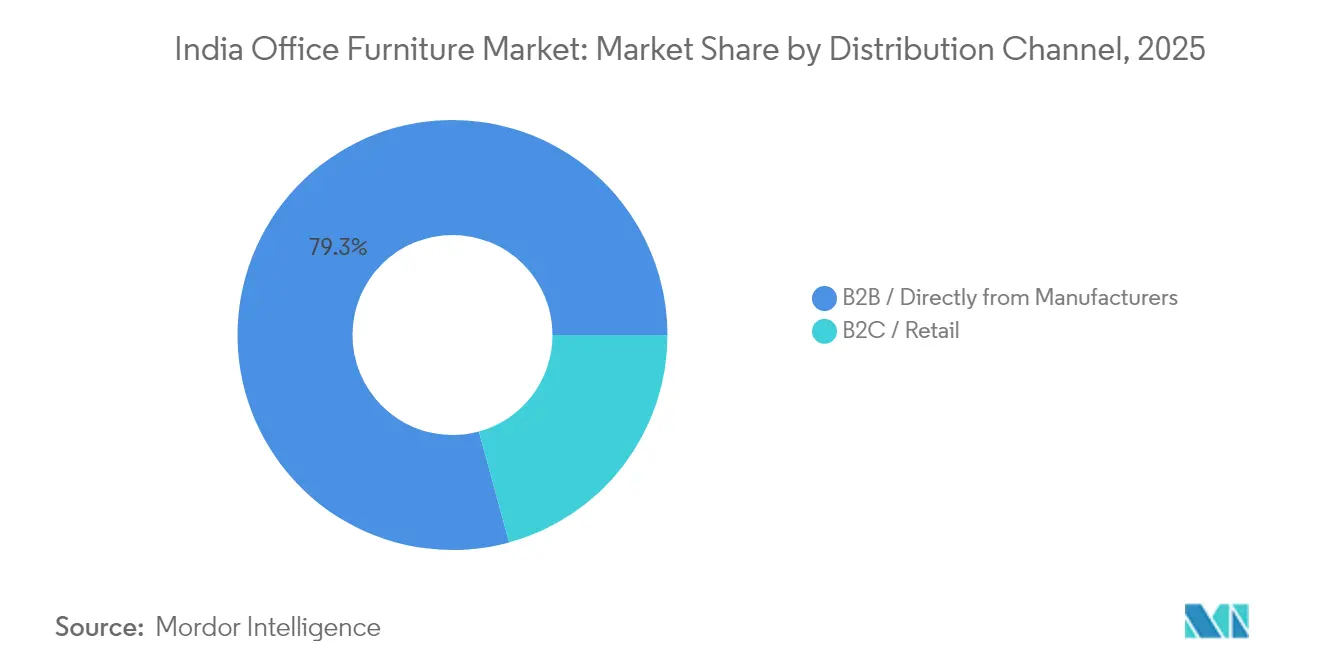
- By distribution channel, B2B direct sales held 79.25% of the India office furniture market share in 2025, underscoring the sector’s project-based selling model.
- By geography, West India generated 25.31% of 2025 revenues; North India is projected to deliver the highest 8.46% CAGR to 2031.
Note: Market size and forecast figures in this report are generated using Mordor Intelligence’s proprietary estimation framework, updated with the latest available data and insights as of 2026.
India Office Furniture Market Trends and Insights
Drivers Impact Analysis*
| Driver | (~) % Impact on CAGR Forecast | Geographic Relevance | Impact Timeline |
|---|---|---|---|
| Hybrid working models driving demand for flexible furniture | +1.8% | National, with early adoption in metros | Medium term (2-4 years) |
| Expansion of corporate real estate footprint | +1.5% | West India, North India, South India | Long term (≥ 4 years) |
| Government "Make in India" incentives for furniture manufacturing | +1.2% | National, concentrated in manufacturing hubs | Long term (≥ 4 years) |
| Rising ergonomic and employee-well-being focus | +1.0% | National, led by IT/corporate sectors | Medium term (2-4 years) |
| Tier-II & III co-working boom | +0.9% | Tier-2/3 cities across all regions | Medium term (2-4 years) |
| Modular demountable partitions shorten fit-out cycles | +0.7% | National, concentrated in commercial hubs | Short term (≤ 2 years) |
| Source: Mordor Intelligence | |||
Hybrid Working Models Driving Demand for Flexible Furniture
Corporate occupancy now averages 60-70% on any given day, prompting companies to prioritize modular desks, height-adjustable workstations, and movable storage that can be reconfigured quickly when teams alternate between office and home. Demand for such adaptive solutions caused manufacturers to ship more than 100,000 home-office kits during the pandemic transition. Smart desks embedded with occupancy sensors mark the next wave, allowing facility managers to monitor space utilization in real time. As certification under BIS QCO 2025 tightens, vendors able to combine flexibility with compliance win larger multi-city rollout contracts. This preference for modularity feeds directly into the India office furniture market, reinforcing growth momentum across both premium and mid-range price bands.
Expansion of Corporate Real Estate Footprint
Rapid scaling of Global Capability Centres, which already employ 1.9 million people in 1,950 facilities, underpins sustained demand for quality furniture that meets global standards[1]Business Wire India, “India’s Largest Workplace Furniture Manufacturing Firm AFC Furniture Solutions Acquires the Brands Xbench, Vibrant and Livo,” businesswireindia.com. . Large occupiers increasingly engage single-vendor partners to furnish multiple sites, rewarding suppliers with nationwide installation and after-sales capacity. Premium finishes, collaborative tables, and acoustic booths dominate new fit-outs as technology and financial services firms elevate employee experience. Continuous growth in floor space across tier-1 cities and the rise of managed office operators in satellite towns keep the India office furniture market firmly on an upward trajectory.
Government “Make in India” Incentives for Furniture Manufacturing
Production-linked incentives encourage local sourcing, helping brands cut lead times and tailor products to project-specific requirements. Domestic plants equipped with German and Italian machinery now replicate global quality at competitive cost, reducing reliance on imports subject to long shipping cycles and currency risk. Manufacturers receive faster GST refunds and preferential procurement in public projects when they qualify as local content suppliers, directly boosting order books in the India office furniture market. Implementation hurdles remain land allotment delays in clusters hamper capacity additions but overall policy direction favors scaling indigenous capability[2]FDT Bureau, “Delay in Land Allotment for Furniture Cluster Jeopardises Investment Plans,” furnituredesignindia.com. .
Rising Ergonomic and Employee-Well-Being Focus
Ergonomic chairs certified to BIFMA or EN-1335 have moved from optional to mandatory in corporate RFPs. Height-adjustable desks, monitor arms, and footrests now appear on standard equipment lists, reflecting the link between posture support and productivity. Procurement teams weigh warranty terms and recyclability credentials alongside price, adopting lifecycle costing frameworks that reinforce demand for higher-grade materials. As wellness KPIs enter ESG reporting, furniture that supports biophilic design integrating planters and acoustic felt made from recycled PET gains traction. This premiumization trend elevates average selling prices within the India office furniture market, even while volumes grow in the value tier.
Restraints Impact Analysis*
| Restraint | (~) % Impact on CAGR Forecast | Geographic Relevance | Impact Timeline |
|---|---|---|---|
| Volatile wood, steel and polymer prices | -1.4% | National, acute in manufacturing regions | Short term (≤ 2 years) |
| Price pressure from unorganised manufacturers | -0.8% | National, concentrated in tier-2/3 cities | Medium term (2-4 years) |
| Lengthy municipal fire-safety certification | -0.6% | National, severe in metros | Medium term (2-4 years) |
| Sustainability audits limiting VOC-heavy finishes | -0.4% | National, led by corporate sectors | Long term (≥ 4 years) |
| Source: Mordor Intelligence | |||
Volatile Wood, Steel and Polymer Prices
Input cost swings force suppliers to shorten quotation validity and build price-escalation clauses into contracts. Steel frames used in modular cubicles have seen double-digit quarterly adjustments, while imported veneer prices fluctuate with shipping rates and currency moves. Manufacturers hedge inventories but margin compression persists, particularly on long-cycle government orders. Some vendors redesign products to reduce metal content and incorporate engineered panels that lower exposure to commodity volatility. Although raw-material turbulence dents immediate profitability, sustained demand keeps the India office furniture market expanding.
Price Pressure from Unorganised Manufacturers
Smaller workshops command 60-70% of volumes in the economy tier by leveraging low overheads and flexible labor. They undercut organized players by 20-30%, challenging brands to justify premiums through service quality and certifications. Established companies counter by launching entry-price collections and offering three-year warranties even on value lines, a proposition many informal outfits cannot match. Government moves to enforce GST compliance and the forthcoming BIS QCO 2025 may gradually squeeze non-compliant producers, yet for now price competition remains intense across most regional hubs of the India office furniture market.
*Our forecasts treat driver/restraint impacts as directional, not additive. The impact forecasts reflect baseline growth, mix effects, and variable interactions.
Segment Analysis
By Product: Chairs Retain Leadership While Tables Accelerate
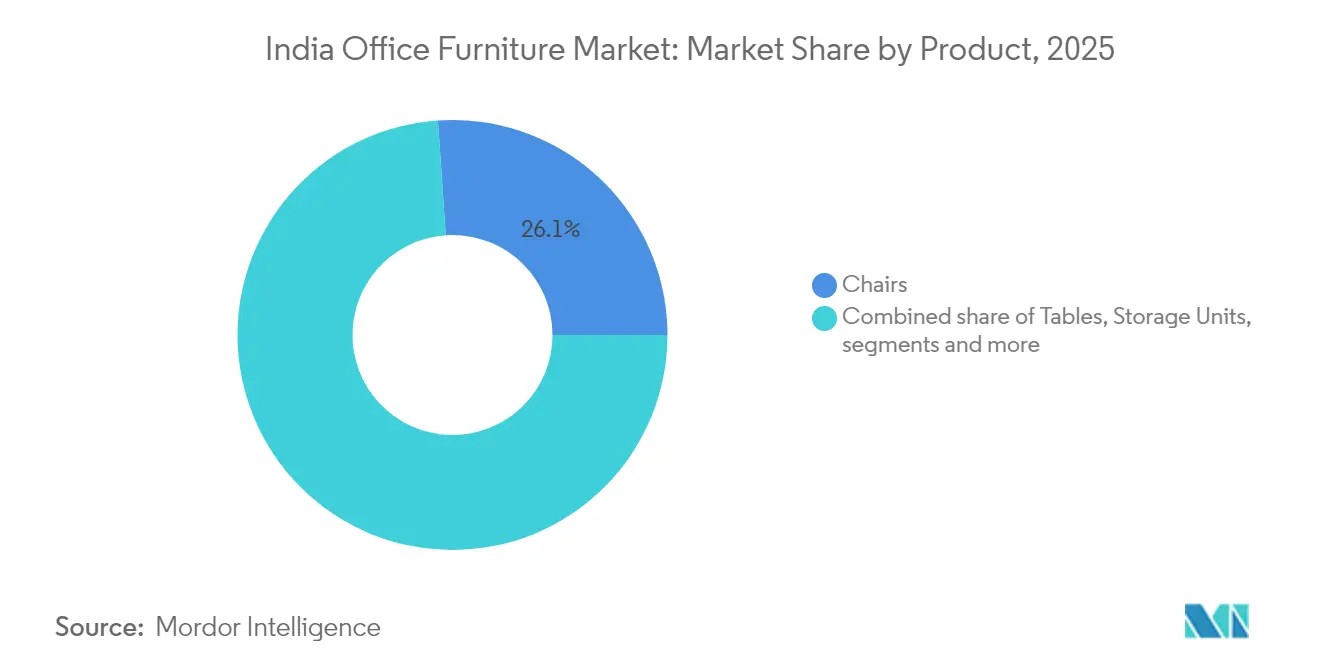
Chairs generated a 26.08% slice of 2025 revenues as enterprises refreshed seating stock to meet ergonomic guidelines. Within the segment, high-back task chairs and mesh models see consistent replacement cycles of three to four years, stabilizing base demand. Tables, however, exhibit the fastest 8.74% CAGR outlook, buoyed by breakout zones and hot-desk layouts that multiply worksurface requirements. The India office furniture market size for tables is projected to expand from USD 1.14 billion in 2026 to USD 1.74 billion by 2031.
Growth also stems from wider adoption of conference pods and sit-stand stations that blend table and divider functions. Mobile pedestal units bundle with benching systems, raising ticket size per workstation. Meanwhile, storage units confront digitalization headwinds, although lockable modular cubes gain favor in flexible offices. Soft seating and acoustic booths carve niches as employers add focus pods to open plans. Suppliers that offer coordinated chair-table packages with rapid lead times capture larger project awards, reinforcing their presence in the India office furniture market.


By Material: Wood Dominance Faces Polymer Challenge
Wood preserved a 42.25% share in 2025 on the strength of executive cabins and boardroom suites, yet its position erodes as polymers replicate timber aesthetics at lighter weight. The India office furniture market share for polymers is slated to reach 27.65% by 2031 after rising at an 8.61% CAGR.
Polypropylene and glass-fiber blends allow complex geometries while meeting the 60 kg load standard for desks under BIS QCO 2025. Metal remains critical for healthcare and industrial settings that demand easy disinfection, though inflationary steel prices restrain its advance. Manufacturers investing in automated powder-coating lines and recycled PET felt panels gain an edge with sustainability-minded buyers. Wood suppliers, for their part, pivot to FSC-certified tropical hardwood substitutes and water-based lacquers to align with low-VOC mandates.
By Price Range: Economy Drives Volume, Premium Accelerates
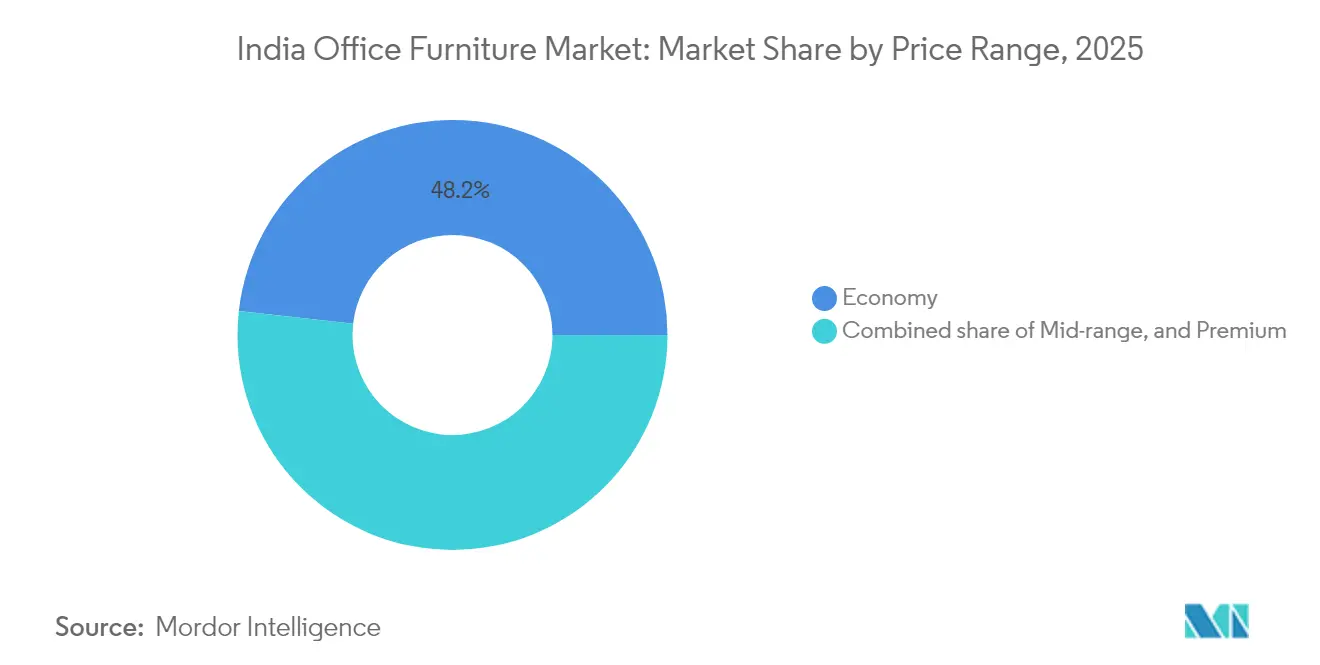
Economy-tier products delivered 48.22% of receipts in 2025 thanks to SME roll-outs and public-sector bulk tenders. Vendors differentiate through knock-down packaging that minimizes freight and enables self-assembly. Even so, the premium bracket is forecast to clock an 8.32% CAGR, lifting the India office furniture market size for premium lines to USD 1.58 billion by 2031.
Premium buyers seek veneer-clad desks with integrated cable management, proprietary ergonomic mechanisms, and five-year warranties. Bundled design consultancy and virtual reality walkthroughs further justify elevated prices. Mid-range collections grow steadily by balancing BIFMA compliance with competitive cost, often leveraging laminated engineered boards to cap material spend.
By End-User: Corporate Offices Remain Core While Government Procurement Accelerates
Corporate occupiers commanded 39.15% of 2025 spending as multinationals standardized fit-outs across captive centres and third-party campuses. The India office furniture market share for government and public offices is smaller today yet set to rise fastest at 8.85% CAGR through 2031.
Central agencies fast-track modernization to comply with safety norms and disability access rules, fuelling orders for height-adjustable desks and fire-retardant partitions. Educational institutions, hospitality back-offices, and healthcare admin wings each follow distinct specification checklists antibacterial laminates for hospitals, compact footprint desks for colleges but collectively bolster demand variety.
By Distribution Channel: B2B Direct Sales Dominate Project-Based Buying
Direct engagements accounted for 79.25% of 2025 revenue as clients valued single-window delivery from design to after-sales maintenance. Long-term annual rate contracts lock in pricing for national rollouts, securing predictable volume for established suppliers. Retail formats and e-commerce cater to small firms and freelancers, yet complex installation requirements keep their penetration modest in large projects.
Online marketplaces still influence brand discovery; configurable 3D planners allow customers to visualize layouts before sending purchase requisitions. Showrooms supplement the consultant network by displaying product ergonomics first-hand, especially in tier-2 cities where digital adoption climbs more gradually. Together these channels widen the catchment for the India office furniture market while preserving the primacy of direct project selling.
Geography Analysis
West India generated 25.31% of 2025 sales, anchored by Maharashtra’s financial sector and Gujarat’s manufacturing base. Mumbai drives premium demand with global banks outfitting high-rise offices, whereas Pune’s IT corridor selects modular benching and acoustic pods to suit agile teams. Supply clusters around Pune and Ahmedabad shorten delivery cycles, a key advantage when projects specify tight handover timelines.
North India delivers the highest 8.46% CAGR outlook as Delhi NCR updates government complexes and corporates shift headquarters to Gurugram’s Grade-A towers. The India office furniture market size for North India is expected to climb from USD 1.23 billion in 2026 to USD 1.84 billion by 2031. Chandigarh, Lucknow and Jaipur add incremental demand via co-working hubs that target startups migrating from metros.
South India remains the single largest consumption zone by floor-space addition, propelled by technology clusters in Bengaluru, Hyderabad and Chennai. Diversified demand spans premium task chairs for software developers, corrosion-resistant steel desks for coastal R&D centres, and reception lounges for global capability campuses. East India lags on absolute value but benefits from public-sector refurbishments in Kolkata and resource-industry offices in Odisha. Suppliers forging dealer partnerships in these emerging pockets tap new growth lanes within the India office furniture market.
Regulatory Landscape
India office furniture compliance is increasingly shaped by the Furniture (Quality Control) Order, 2025 issued by the Department for Promotion of Industry and Internal Trade (DPIIT), which mandates BIS certification (ISI marking) for specified furniture categories including work chairs, general purpose chairs and stools, tables/desks, storage units, beds, and bunk beds. These are aligned to Indian Standards such as IS 17631:2022 through IS 17636:2022. Enforcement commenced on February 14, 2026 for general enterprises, creating a clear compliance threshold for organized manufacturers and for importers placing regulated SKUs into the Indian market.
Implementation details remain operationally relevant. Micro and small enterprises have an extended deadline until August 14, 2026 to secure BIS licensing, and the Furniture (Quality Control) Second Amendment Order, 2026 (S.O. 1125(E)) provided transitional relief for imports when Bills of Lading pre-date February 13, 2026 and Bills of Entry are filed within 180 days from implementation. In parallel, Plant Quarantine regulations (2003) under the Destructive Insects and Pests Act, 1914 continue to apply to timber and wood-based furniture imports, driving treatment and ISPM-15 related requirements that affect documentation, lead times, and landed cost planning.
Value Chain Analysis
India office furniture follows a split value chain across organized national brands and a large unorganized base of local workshops. Upstream inputs include wood and engineered panels, steel tubing and sheets, plastics and polymers, foam, and textiles, followed by fabrication (carpentry, metalworking, molding), surface finishing (laminates, veneers, powder coating), upholstery, assembly, and quality testing. Raw materials remain the principal cost driver (often around 60-65% of product cost in industry breakdowns), while BIS QCO compliance is pushing more sourcing toward standardized substrates and repeatable processes that can be validated via in-house labs or certified third-party testing.
Downstream, the market is project-led, with B2B direct sales accounting for 79.25% of 2025 revenue in this report. These deals typically bundle design support, site measurement, customization, delivery, installation, and post-install service. Logistics and execution capability have become differentiators as constraints extend beyond ports to hinterland connectivity and last-mile installation readiness for bulky furniture. In response, players are adjusting fulfillment models, including IKEA Indias use of urban stores in Mumbai, Bengaluru, and Hyderabad as fulfillment hubs, to reduce last-mile friction and improve service levels across metros and expanding tier-2 demand centers.
Competitive Landscape
The market’s moderate concentration creates opportunities for mid-tier players to grow by focusing on niche segments and regional strengths. Godrej Interio holds the leading position, driven by its comprehensive product range and a network of 1,000 omnichannel stores that combine retail presence with corporate project showcases. Featherlite follows closely, known for its expertise in mesh-chair design and a strong dealer network across southern India. Nilkamal stands out for its polymer molding capabilities, which support both its office seating and value-oriented storage product lines.
Strategic moves center on portfolio expansion and vertical integration. AFC Furniture Solutions’ 2024 purchase of Wipro’s Xbench, Vibrant and Livo brands expanded its addressable range from budget cubicles to premium desking, enabling cross-selling to existing enterprise accounts[3]Business Wire India, “India’s Largest Workplace Furniture Manufacturing Firm AFC Furniture Solutions Acquires the Brands Xbench, Vibrant and Livo,” businesswireindia.com. . Durian and Spacewood invest in robotic panel-processing to lift output consistency and cut turnaround on custom orders. Many firms embed IoT sensors in desks and lockers, allowing corporate clients to track occupancy and asset utilization through cloud dashboards.
Compliance with BIS QCO 2025 separates organized players from informal workshops by requiring in-house testing labs or certified third-party audits. Brands advertise E1-grade panels and GREENGUARD coatings to pass multinational sustainability audits. Distribution alliances with architects and interior design studios remain critical to securing early specification, while direct-to-consumer e-stores extend reach to freelancers and hybrid workers. These dynamics reinforce steady consolidation in the India office furniture market without stifling innovation.
India Office Furniture Industry Leaders
Feather Lite
Durian
Nilkamal
Godrej Interio
HNI India
- *Disclaimer: Major Players sorted in no particular order

Market Opportunities and Future Outlook
Formalization around BIS certification under the Furniture (Quality Control) Order, with enforcement from February 14, 2026 for general enterprises, creates whitespace for compliant manufacturers and system integrators that can document conformance across high-volume categories such as work chairs and tables/desks. The enforcement timeline, combined with the MSE extension until August 14, 2026, is steering procurement toward vendors that can demonstrate ISI readiness, stable substrates, and auditable quality systems, which tends to favor organized firms with testing access and repeatable production.
Factory-led modular execution and turnkey delivery capability also stands out as an opportunity area, supported by capacity build-outs and large project references. Teknion opened a manufacturing facility in Bengaluru (over 40,000 sq ft) to support domestic and export-oriented production, while ANJ Group highlighted its Wada, Maharashtra manufacturing campus consisting of seven specialized plants as part of its growth strategy, reinforcing the shift toward centralized, engineered output for faster site deployment. On the demand side, Interio by Godrej completing a 75,000 sq ft turnkey fit-out for State Bank of Indias local head office in BKC, Mumbai, reflects continued appetite for end-to-end workplace delivery models that combine furniture with interior execution, benefiting suppliers that can manage multi-trade coordination, standardized rollouts, and post-install maintenance across multiple cities.
Recent Industry Developments
- July 2026: Nilkamal Homes launched its 80th flagship store in Thane, expanding its physical footprint as organized retail scales in furniture. A broader store network strengthens brand visibility and supports faster conversion for office-oriented categories that benefit from in-person trials, financing, and delivery assurance.
- June 2026: Godrej Interio announced plans to add 102 new stores in FY27 with focus on North and East India. Wider coverage supports project and SME sourcing outside the largest metros, while also tightening service reach for installation and after-sales, which are important in B2B and institutional office orders.
- October 2024: Zuari Industries acquired an additional 50.85% stake in Forte Furniture Products India, deepening control in modular furniture. The deal supports portfolio and distribution integration in a segment aligned to faster fit-outs and repeatable workstation deployment for enterprises and co-working operators.


Research Methodology Framework and Report Scope
Market Definition and Coverage
For this study, the market covers the value of furniture sold for use in office and workspace settings across India, including common items like seating, desks, tables, and storage used by organizations and commercial workplaces.
Scope exclusions: We exclude home furniture bought for residential-only use, office fit-out services, and pure decor items that are not furniture.
Segmentation Overview
- By Product
- Chairs
- Employee Chairs
- Meeting Chairs
- Guest Chairs
- Tables
- Conference Tables
- Desks
- Other Tables
- Storage Units
- Filing Cabinets
- Bookcases & Shelving
- Sofas/Soft Seating
- Booths and Office Dividers
- Other Office Furniture (Stools, Reception Area Furniture, Accessories, Others)
- Chairs
- By Material
- Wood
- Metal
- Plastic & Polymer
- Other Materials
- By Price Range
- Economy
- Mid-range
- Premium
- By End-user
- Corporate Offices
- Healthcare Offices
- Educational Institutions
- Government & Public Offices
- Hospitality & Retail Back-office
- Others
- By Distribution Channel
- B2C / Retail
- Home Centers
- Specialty Furniture Stores
- Online
- Other Distribution Channels
- B2B / Directly from Manufacturers
- B2C / Retail
- By Geography
- North India
- West India
- South India
- East India
Data Sources, Market Sizing, and Validation
Desk Research
Desk research starts by mapping what counts as office furniture in the Indian context, then linking demand to office activity and procurement cycles. We use public sources such as the Ministry of Statistics and Programme Implementation (MOSPI), the Department for Promotion of Industry and Internal Trade (DPIIT), and NSDC skill and employment releases to understand the formal industry footprint.
To keep the model grounded, we also track signals that move office furniture demand, including commercial real estate leasing updates shared by credible industry bodies, standards and notifications from BIS, and relevant academic or design journals on ergonomics and material preferences. We then cross-check pricing direction and capacity additions using company filings, investor presentations, and reputable press coverage. Where needed, paid subscriptions for company financials and an import export shipment-level database are used to support revenue ranges and trade-linked supply cues. These sources are illustrative, and other public and secondary references were also used for data collection, validation, and clarification.
Primary Interviews and Surveys
Primary inputs are collected through structured conversations and short surveys with manufacturers, distributors, large institutional buyers, office project teams, and selected material and component suppliers. Since this is an India market, we ensure coverage reflects major demand pockets across North, West, South, and East India, and then close gaps from desk research through follow-up checks on price points, replacement cycles, and channel mix.
Distribution of primary research fieldwork respondents
| Company type | Respondent position | Region |
|---|---|---|
| Top tier: 32% | CXOs: 15% | |
| Mid tier: 49% | Functional/Unit leaders: 40% | |
| Smaller Players: 19% | Managers: 45% |
Market-Sizing & Forecasting
Sizing is built with a top-down and bottom-up approach, where office space activity and furniture demand intensity are reconstructed at a national level, then checked using selective supplier and channel math. In practice, we start from office-using sectors and workspace expansion signals, and then translate that into furniture spending using realistic procurement and replacement behavior.
Key inputs in the model include growth in Grade-A office leasing and new workplace builds, the shift toward hybrid layouts (which changes the seating and workstation mix), typical replacement cycles for seating and workstations, imported versus locally made share for certain categories, and average selling price movement by material choices like wood, metal, and polymer. Where pricing is scattered, we anchor midpoints through channel checks and project quotes that are validated with buyer feedback. For forecasting, scenario analysis is used around office absorption and capex cycles, then the outputs are smoothed with trend checks so one-off project spikes do not overstate the forward curve.
Data Validation & Update Cycle
Outputs are checked through triangulation across demand indicators, trade cues, and what interviewees report as realistic order flow, before the final numbers are signed off. When an outlier shows up, such as an unusual price jump or a sudden demand dip, assumptions are re-checked and respondents are re-contacted to confirm whether it is a true shift or a timing issue.
The model also goes through multi-step internal reviews where calculations, unit logic, and conversions are verified by another analyst. Reports are refreshed annually, and interim updates are made when material events occur, including major policy changes, sharp currency moves affecting imports, or a shift in office construction cycles. Before delivery, a fresh pass is completed so clients receive the most current view.
Mordor Intelligence's India Office Furniture Market Size Compared With Other Published Estimates
Published market values for India office furniture can differ across sources even when they appear to measure the same underlying area. The spread usually comes from differences in what is included as office furniture, the anchor year used, and how pricing and channel mix are treated.
Including broader contract furniture categories and adjacent fit-out spending is a common gap driver, and it can lift totals quickly if partitions, interior works, or non-furniture items are counted. Some estimates also rely on a single reference year and then extend growth forward, while others build the curve from office absorption, replacement cycles, and realistic ASP movement. The main gap comes from separating office furniture value from related workspace spending, where Mordor Intelligence counts only furniture sold for office use and validates pricing through channel checks rather than bundling interior services into the same total.
Benchmark comparison
| Source | Market Size | Gaps in Research Methodology |
|---|---|---|
| Mordor Intelligence | USD 4.81 B (2025) | |
| Trade Journal A | USD 7.30 B (2030) | Uses a forward projection headline year, and the implied growth path is not clearly tied to replacement cycles, category mix shifts, or an explicit ASP build for the intervening years. |
| Industry Publication B | USD 5.20 B (2023) | Anchored to an earlier year and a longer forecast window, and the scope language suggests broader workspace-driven demand without clearly separating office furniture value from adjacent spending choices. |
The table shows that year selection and what gets counted around workspace purchases explain most of the variation. When scope is kept furniture-only and the demand pool is tied to office expansion plus replacement behavior, the total stays easier to reproduce and to track over time.


Key Questions Answered in the Report
How fast is demand growing for premium office desks in India?
Premium categories are projected to advance at an 8.32% CAGR to 2031, outpacing the overall market as multinationals upgrade workspace aesthetics.
Which region is projected to expand quickest in corporate furniture purchases?
North India shows the fastest 8.46% CAGR through 2031, spurred by Delhi NCR office expansions and government modernization.
Why do direct B2B channels dominate sales?
Large projects require layout design, on-site installation and after-sales service, making manufacturer-to-client engagements the preferred model with 79.25% share.
What materials are gaining share against traditional wood?
Polymers such as polypropylene-glass blends are growing at an 8.61% CAGR due to cost, weight and design flexibility advantages under BIS load norms.
How is hybrid work shaping procurement choices?
Organizations increasingly select modular, height-adjustable and sensor-enabled furniture that adapts to fluctuating office occupancy levels.
Page last updated on:


