
Market Overview
| Study Period | 2020 - 2031 |
|---|---|
| Forecast Data Period | 2026 - 2031 |
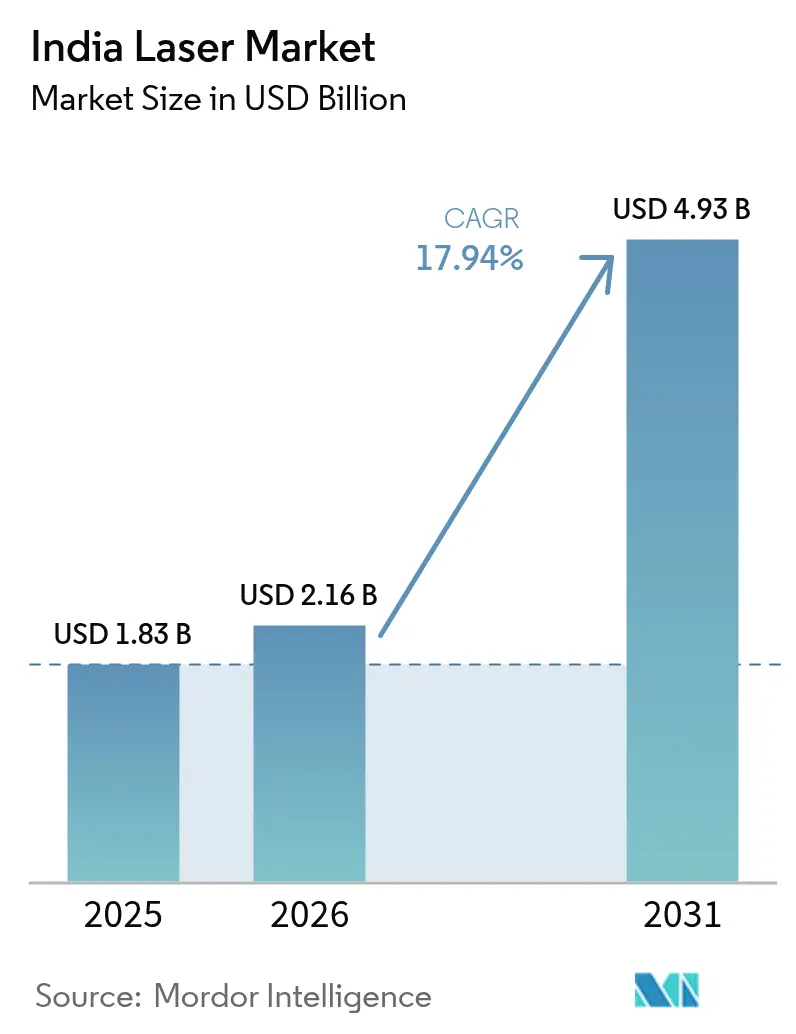
| Base Year Market Size (2025) | USD 1.83 Billion |
| Market Size (2026) | USD 2.16 Billion |
| Market Size (2031) | USD 4.93 Billion |
| Growth Rate (2026 - 2031) | 17.94 % |
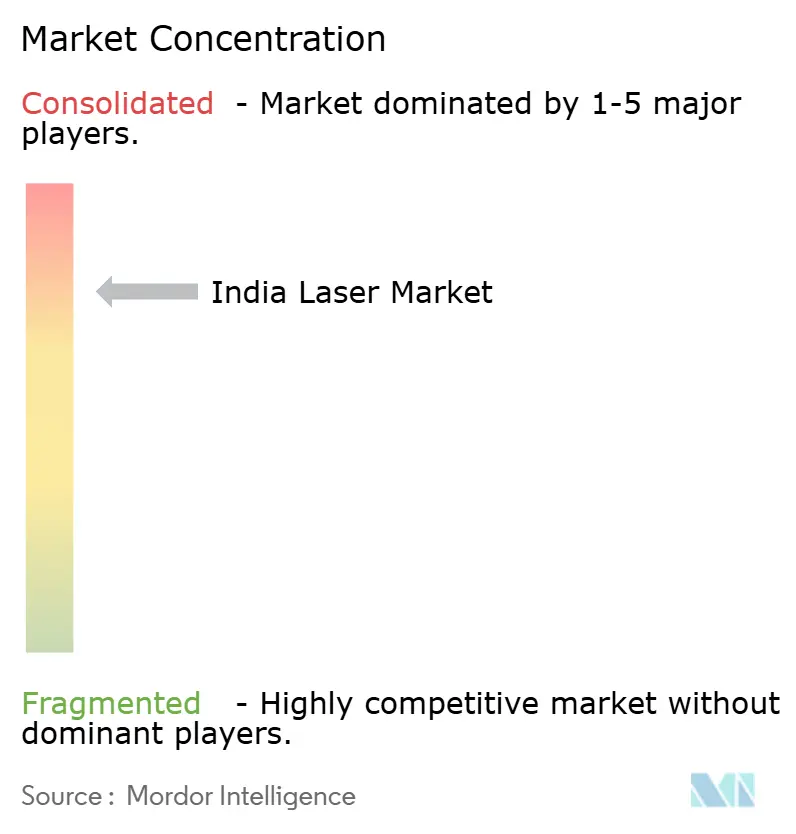
| Market Concentration | High |
Major Players *Disclaimer: Major Players sorted in no particular order Image © Mordor Intelligence. Reuse requires attribution under CC BY 4.0. | |
India Laser Market Analysis by Mordor Intelligence
The India laser market size is projected to expand from USD 1.83 billion in 2025 and USD 2.16 billion in 2026 to USD 4.93 billion by 2031, registering a CAGR of 17.94% between 2026 and 2031. Implied demand is shifting from tool-room precision jobs to round-the-clock production assets as semiconductor fabs, EV battery lines and solar-cell plants embed lasers at multiple process nodes. Government incentive programs are front-loading purchases, while falling total cost of ownership for fiber platforms accelerates replacement of plasma, oxy-fuel and mechanical scribing. Chinese brands are sustaining a price gap of 30%-40%, but their share is bounded by after-sales support gaps that favor premium Western and entrenched domestic suppliers. Import tariffs and currency moves remain swing factors for buyers, yet rising lease finance penetration and zero-duty concessions in special economic zones are easing near-term capital constraints.
Key Report Takeaways
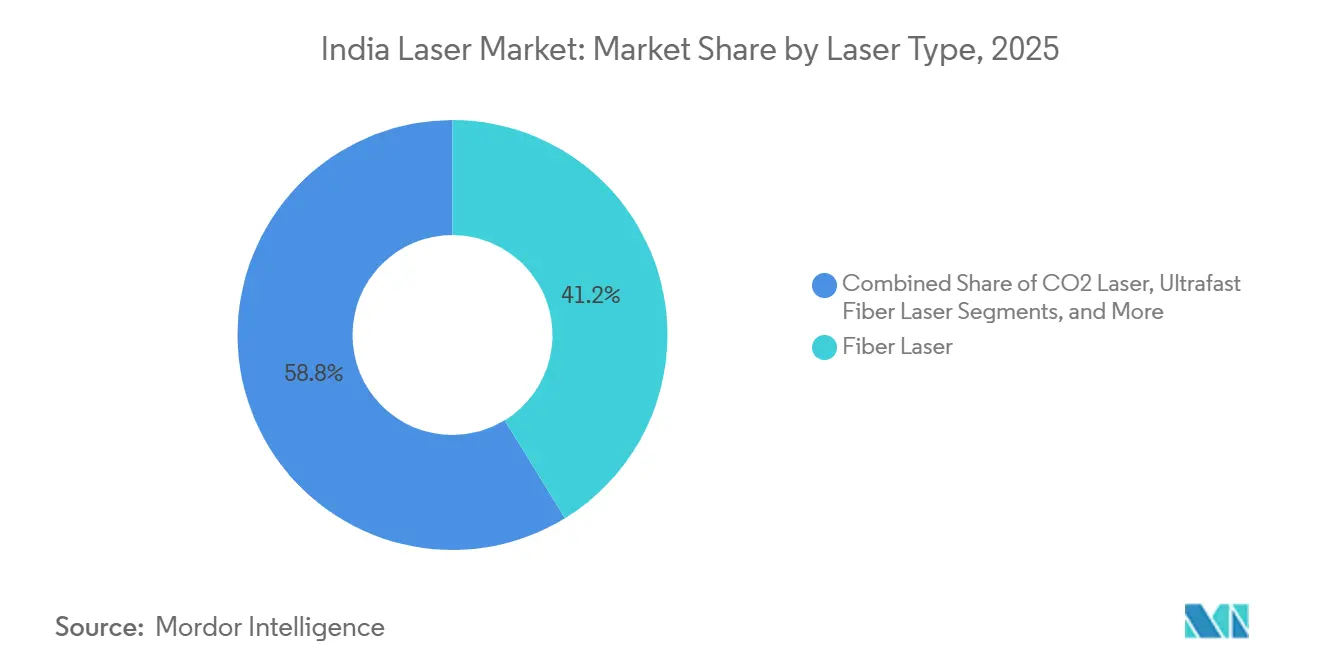
- By laser type, fiber platforms led with 41.23 % revenue share in 2025; ultrafast fiber lasers are advancing at a 19.18 % CAGR through 2031.
- By power output, medium-power units (1-100 watts) held 48.67 % of the India laser market share in 2025, while high-power systems above 100 watts are growing at an 18.67 % CAGR.
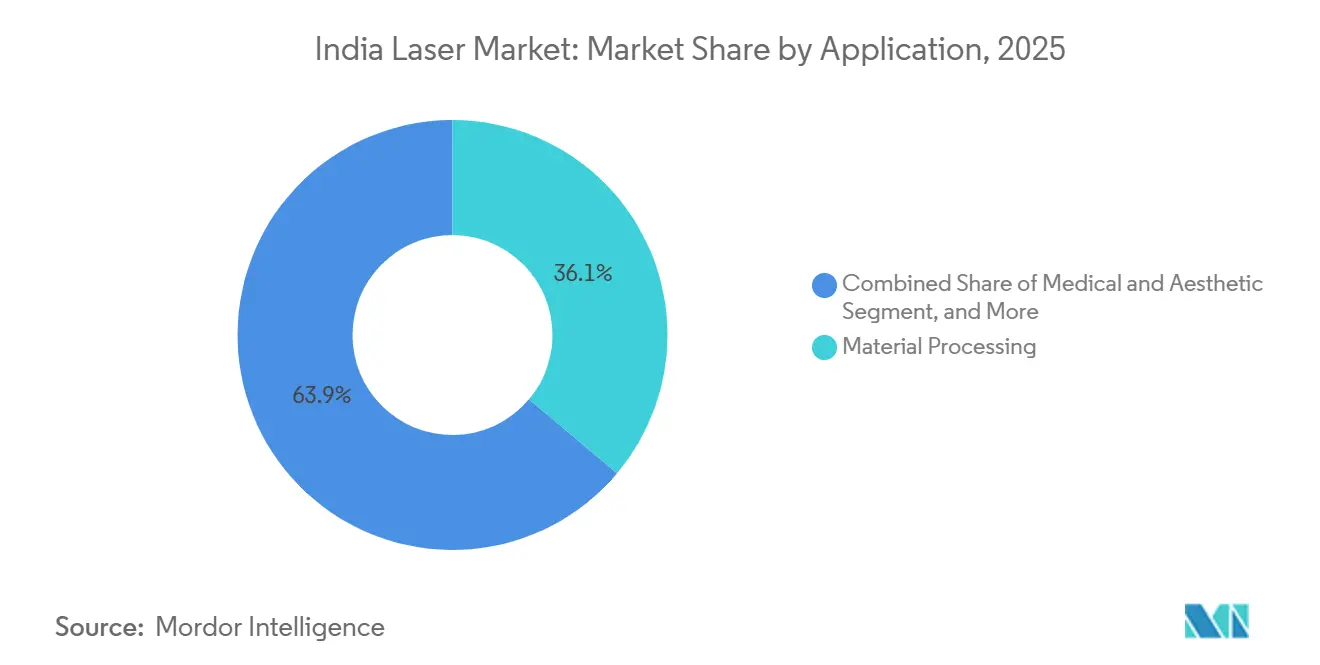
- By application, material processing accounted for 36.12 % of the India laser market size in 2025 and medical and aesthetic procedures are expanding at a 19.43 % CAGR to 2031.
- By end-user industry, electronics and semiconductors contributed 29.63 % of 2025 revenue, whereas healthcare is projected to post the fastest growth at 19.83 % through 2031.
Note: Market size and forecast figures in this report are generated using Mordor Intelligence’s proprietary estimation framework, updated with the latest available data and insights as of 2026.
India Laser Market Trends and Insights
Drivers Impact Analysis*
| Driver | (~) % Impact on CAGR Forecast | Geographic Relevance | Impact Timeline |
|---|---|---|---|
| Government Incentives for Semiconductor Fabs | +4.1% | Gujarat, Assam, Tamil Nadu | Long term (≥ 4 years) |
| Rapid Adoption of EV and Battery Fabrication Lines | +3.5% | Maharashtra, Gujarat, Tamil Nadu | Medium term (2-4 years) |
| Surge in Domestic Electronics Manufacturing Clusters | +3.2% | Uttar Pradesh, Tamil Nadu, Karnataka | Medium term (2-4 years) |
| PLI for Solar Module Lines Requiring Laser Scribing | +2.3% | Gujarat, Rajasthan, Tamil Nadu | Medium term (2-4 years) |
| Rising Procurement of Laser-Based LiDAR Sensors by Smart-City Projects | +2.1% | Delhi NCR, Mumbai, Bangalore | Short term (≤ 2 years) |
| Expansion of Laser-Based Additive Manufacturing Startups | +1.8% | Bangalore, Pune, Hyderabad | Long term (≥ 4 years) |
| Source: Mordor Intelligence | |||
Government Incentives For Semiconductor Fabs
Policy support under the India Semiconductor Mission approved 10 fabs with INR 1.6 lakh crore (USD 19.2 billion) committed, each embedding laser dicing, marking and scribing tools that must run at sub-micron tolerances. Zero-duty imports under the Export Promotion Capital Goods window cut ownership cost by 18%-22%, compressing payback periods on high-uptime fiber platforms. Micron’s Sanand plant alone will require several dozen laser-based inspection and marking stations once operations commence. Collectively, the fab build-out implies a 15-fold scale-up in installed laser base by 2030, locking in long-tail service and consumables demand.
Rapid Adoption of EV And Battery Fabrication Lines
The Advanced Chemistry Cell PLI of INR 18,100 crore (USD 2.2 billion) creates a 50 GWh battery capacity pipeline that favors laser welding for aluminum-to-copper joints, cutting joint resistance by 18% relative to spot welding. Subsidies under the PM E-DRIVE scheme support 1.6 million electric two-wheelers and 0.5 million three-wheelers, each battery pack relying on laser seam welds to meet AIS-156 crash norms. Automotive OEMs adapting remote laser welding have recorded 30 % faster roof-seam cycles versus resistance methods. Growing line densities are therefore shifting high-power demand from plasma cutters to multi-kilowatt continuous-wave fiber units.
Surge In Domestic Electronics Manufacturing Clusters
Electronics Manufacturing Clusters 2.0 earmarked INR 3,762 crore (USD 452 million) to fund plug-and-play lines that bundle laser marking and rework cells for SMEs that cannot justify stand-alone capex.[1] Traceability codes mandated by IS 16537:2016 require laser-etched 0.1 mm features on conformal-coated boards. Shared access to selective soldering and micro-machining lasers de-risks adoption, lifting utilization and spreading maintenance costs across tenant manufacturers. The scheme thus raises the India laser market’s addressable base beyond tier-1 multinationals to thousands of mid-tier EMS providers.
PLI For Solar Module Lines Requiring Laser Scribing
The solar PLI allocates INR 24,000 crore (USD 2.9 billion) and ties incentive multipliers to thin-film and heterojunction cells that need laser scribing to avoid edge damage. Laser-cut isolation grooves reduce shunt losses by up to 15%, directly lifting module efficiency and helping makers qualify for higher PLI payouts. Each gigawatt of thin-film capacity demands 8-12 high-rep-rate laser scribers running above 50 kHz, translating into a sizeable baseline for service and optics replacement. Revised electroluminescence tests in 2025 penalize mechanical scribe-induced micro-cracks, further tilting orders toward laser-processed modules.
Restraints Impact Analysis*
| Restraint | (~) % Impact on CAGR Forecast | Geographic Relevance | Impact Timeline |
|---|---|---|---|
| High Capex of High-Power Fiber Lasers | -2.8% | Tier-2 and tier-3 hubs nationwide | Short term (≤ 2 years) |
| Rupee Volatility vs USD/CNY | -1.9% | Import-dependent integrators | Short term (≤ 2 years) |
| Inter-State GST Credit Delays on Capital Machinery | -1.3% | States with complex reconciliation | Medium term (2-4 years) |
| Limited Local Supply Chain for High-Precision Optical Isolators | -1.1% | All laser assemblers | Medium term (2-4 years) |
| Source: Mordor Intelligence | |||
High Capex Of High-Power Fiber Lasers
Multi-kilowatt units priced between USD 150,000 and USD 400,000 strain balance sheets of job shops operating on 12%-18% net margins. Lease finance penetration is below 25% versus 60%-70% in Germany, forcing buyers into working-capital loans at 9%-11% interest, stretching paybacks beyond four years. The absence of a secondary market for refurbished lasers doubles the net outlay, while deferred purchases pressured IPG’s India revenue to fall 8% year-over-year in 2025. SME adopters in tier-3 cities also lack access to application labs, raising perceived technical risk and slowing order conversion.
Rupee Volatility Vs USD/CNY
The INR slipped from 82.8 to 85.4 per USD in 2025, inflating landed costs for imported sources by roughly 3 %.[2] A similar 2.8 % depreciation against the yuan narrowed the price advantage of Chinese brands, neutralizing part of their cost edge. Forward hedges cover single-tranche payments, yet laser procurements involve staged installments that expose buyers to spot-rate swings at each milestone. Export-oriented fabs can offset duty through EPCG zero-tariff imports, but domestic-focused users bear the full forex burden, creating a two-speed market where exporters enjoy up to 22 % lower capex on identical models.
*Our forecasts treat driver/restraint impacts as directional, not additive. The impact forecasts reflect baseline growth, mix effects, and variable interactions.
Segment Analysis
By Laser Type: Fiber Platforms Anchor Revenue, Ultrafast Systems Lead Innovation
Fiber platforms dominated 41.23 % of 2025 revenue, underlining their fit for sheet-metal cutting, battery tab welding and PCB marking. The india laser market size for fiber systems is projected to expand by more than four-fold as fabs, EV lines and solar plants race to standardize on single-mode sources with wall-plug efficiencies exceeding 40%. Ultrafast fiber lasers, though just a niche today, are climbing at a 19.18% CAGR on the back of femtosecond micro-machining in medical devices and transparent-substrate drilling for smartphone cover glass. Solid-state Nd-YAG and diode-pumped variants keep resonance in jewelry welding and watchmaking, protected by installed-base familiarity rather than raw performance. CO₂ units still cut acrylic, wood and leather, yet many job shops are shedding dual-wavelength setups to streamline maintenance under tighter delivery windows.
In research and defense, excimer, ultraviolet and emerging terahertz sources fill specialized roles. ISRO’s December 2025 tender for a harmonics-enabled femtosecond system underscores how national labs are staking claims in quantum optics and high-energy experiments.[3] The Council of Scientific and Industrial Research procured frequency-stabilized helium-neon lasers for metrology, hinting at enduring demand for low-power but ultrastable benches. Dye and free-electron configurations remain academic curiosities, yet breakthroughs here often migrate to commercial wavelengths within a decade, ensuring that innovation cycles continue to refresh the india laser market long after the present forecast horizon.

By Power Output: Medium-Power Dominance Meets High-Power Acceleration
Medium-power lasers between 1 and 100 watts accounted for 48.67 % of 2025 revenue, covering serial-number marking, selective soldering and thin-metal cutting tasks that populate most Indian workshops. Their plug-and-play air cooling, 220-volt compatibility and 48-hour nationwide service reach keep total downtime below 2 %, a critical selling point for SMEs. The india laser market share for high-power systems above 100 watts is rising fast, tied to multi-kilowatt weld cells that fuse aluminum battery enclosures and 20-millimeter ship-steel blanks at speeds unattainable by plasma. TRUMPF’s Pune factory, opened in August 2025, now assembles 6 kW through 12 kW disk and fiber sources locally, slicing lead times to 8-10 weeks and comforting OEMs wary of shipment uncertainty.
System integrators still confront a skills gap. Only three in ten can program six-axis robots to the sub-0.1 mm path accuracy that remote welding demands, limiting provincial roll-outs. Conversely, the low-power tier below 1 watt keeps volume leadership in barcode scanners, smartphone depth sensors and alignment modules. ASP compression, however, means this tier contributes a minor fraction of india laser market size, even as shipment counts explode alongside handset assembly.
By Application: Material Processing Anchors Demand, Medical Aesthetics Surge
Material processing held 36.12 % of 2025 spend, cemented by its centrality to cutting, welding and engraving across automotive, aerospace and general fabrication. Fiber units slash traverse time 40 % and kerf width 25 % relative to plasma, reducing scrap on stainless and aluminum. That operational win is propelling replacement cycles in sheet-metal towns like Ludhiana and Rajkot. Medical and aesthetic usage, by contrast, is rising at 19.43% annually, with Q-switched Nd- YAG and fractional CO₂ devices eclipsing dermabrasion in cosmetic clinics. Public-hospital backlogs of eight months for laser dermatology procedures tilt affluent patients toward private chains, inflating procedure counts and broadening service revenue.
Optical communications embed distributed-feedback diodes and erbium-doped amplifiers in 400 G and 800 G transceiver lines as data-center capacity races toward 1,800 MW by end-2026. Instrumentation markets are maturing too, with Indian Railways ordering LiDAR-track scanners across 68,000 route-km. Defense allocations for a 300 kW directed-energy weapon project and 10 kW technology transfers add a dual-use kicker, ensuring that R&D, security and metrology budgets keep the india laser market diversified against cyclical dips in any single vertical.
By End-User Industry: Electronics Lead, Healthcare Accelerates
Electronics and semiconductors formed 29.63 % of 2025 revenue, anchored by the 10-fab pipeline and Electronics Manufacturing Clusters 2.0 that hard-wire laser marking, dicing and trimming into board and silicon flows. The india laser market size linked to healthcare is forecast to scale at a 19.83 % CAGR, fueled by holmium lithotripsy, thulium prostate therapy and femtosecond LASIK platforms. Aesthetic chains expand networks to capture unmet demand from metro millennials, while insurance cashless coverage for urology laser procedures grows acceptance across tier-2 cities.
Auto OEMs remain pivotal. The PM E-DRIVE subsidy is accelerating EV body-in-white adoption of remote laser welding, essential for sealing aluminum-intensive skateboard chassis. Aerospace customers direct titanium powder-bed fusion orders to startups like Fabheads, leveraging the freeform design freedom of laser additive manufacturing. Telecom equipment vendors, spurred by National Telecom Policy 2025, are sourcing or codeveloping laser diode assemblies domestically to qualify for preference-in-procurement quotas. Research institutions account for roughly one-tenth of 2025 buys, but their high-specification ultrafast benches seed downstream commercial platforms, sustaining an innovation loop within the india laser industry.
Geography Analysis
Gujarat, Maharashtra, Tamil Nadu and Karnataka together captured roughly 62 % of installed base in 2025, with semiconductor fabs in Dholera and Sanand, automotive clusters in Pune and Chennai and electronics hubs in Bangalore and Noida acting as anchor customers. State incentives such as 75 % electricity duty waivers and 100 % stamp-duty refunds lower lifetime costs for multi-kilowatt systems, tilting fab planners toward these corridors. Tamil Nadu’s electronics prowess, visible in Sriperumbudur handset lines, drives continuous-duty laser marking demand at process uptimes exceeding 95 %.
Emerging nodes like Assam’s Jagiroad packaging plant and multiple cluster sites in Uttar Pradesh extend the india laser market footprint eastward. These greenfield parks benefit from shared laser rework centers and 48-hour technician reach, though they still lag tier-1 metros on optics inventory depth. Coastal special-economic-zone states leverage zero-duty import privileges and port proximity to shave 18 %-22 % off landed cost relative to landlocked competitors, reinforcing regional disparities.
Defense and R&D spending remains concentrated in Bangalore and Hyderabad, where labs prototype directed-energy weapons and quantum photonics benches. Solar-module PLI winners in Rajasthan, Gujarat and Tamil Nadu are rolling out high-rep-rate scribers, dispersing precision-laser expertise beyond metal fabrication. Taken together, geographic spread is broadening, yet after-sales talent and spare optics logistics remain most mature along the west-and south-coast industrial belt, a factor that purchasers continue to weigh in site-selection calculus.
Regulatory Landscape
India’s laser market is shaped by cross-cutting safety, product compliance, and sector-specific conformity assessment. For telecom-facing laser equipment (such as laser-based optical transmission modules, optical networking gear, and laser-enabled test systems), the Department of Telecommunications (DoT) framework is central. The Telecommunications (Framework to Notify Standards, Conformity Assessment and Certification) Rules, 2025 tightened the requirement that notified telecom equipment undergo conformity assessment prior to sale or import, with the Telecommunication Engineering Centre (TEC) acting as the Appropriate Authority through its Mandatory Testing and Certification of Telecom Equipment (MTCTE) process, including MTCTE Procedure v3.0 released in 2024.
On safety and standards, laser and optical radiation hazard assessment for fiber-optic systems aligns with BIS guidance such as IS 14624-2:2012, which mirrors international practice for optical radiation hazard assessment. It is referenced in deployment contexts such as Quantum Key Distribution (QKD), where laser safety expectations track IEC 60825-1 alongside IS 14624-2 for laser components mounted in systems. On the industrialization side, policy programs anchored by the India Semiconductor Mission, including Semicon India (Semicon 2.0) with a fiscal outlay of INR 1,27,500 crore, influence procurement routes and localization priorities for advanced manufacturing tools and materials used across semiconductor and electronics production lines where lasers are embedded at multiple process nodes.
Value Chain Analysis
The India laser value chain spans imported core components, domestic integration, and application-layer services. Upstream, critical items such as pump diodes, gain fibers, and high-precision beam-delivery optics are still largely imported (notably from suppliers in Germany, China, and the United States), while domestic capability is stronger in enclosures, chillers, power electronics, motion platforms, and software. Midstream, India’s ecosystem is concentrated in industrial hubs such as Pune and Navi Mumbai (Maharashtra), Gandhinagar and Vadodara (Gujarat), Bengaluru (Karnataka), Chennai (Tamil Nadu), and Sonepat (Haryana), where system builders and integrators assemble complete laser machines and configure application-specific workcells.
Downstream, distributors, application labs, and integrators handle commissioning, process tuning, spares, and service contracts for end users across sheet metal, electronics, medical, and research. Companies such as Sahajanand Laser Technology Ltd (SLTL) and SILASERS highlight local value-add in resonator assembly and custom CNC laser solutions, though localized supply of precision optical subsystems remains a constraint. Policy support is also emerging as a value-chain lever: Semicon 2.0 explicitly includes a “Machines and Materials” pillar to incentivize R&D and manufacturing of equipment essential for semiconductor production. This links laser-tool integrators and subsystem suppliers to government-backed pathways for capability building and partial import substitution.
Competitive Landscape
Global incumbents IPG Photonics, Coherent and TRUMPF held an estimated 45 %-50 % combined revenue in 2025, defending positions through multi-year service contracts, application engineering depth and ISO-compliant documentation packs favored by automotive and aerospace auditors. Chinese challengers Raycus, Maxphotonics and Han’s Laser carved out 25 %-30 % share by pricing 30 %-40 % below Western quotes and courting sheet-metal job shops. Import manifests show Maxphotonics and Han’s Laser shipments rising despite 18 % basic customs duty, hinting at resilient cost appeal.
Domestic specialist Sahajanand Laser Technology dominates diamond cutting and jewelry welding niches on the back of a 21-year installed base, proprietary optics and Gujarat-centric service density. White-space upside exists in ultrafast femtosecond job-shop services for medical-device micro-machining and transparent glass drilling, segments where turn-key local capability is still sparse. Additive-manufacturing startups such as Fabheads and ThinkMetal are disrupting traditional cnc tooling by offering laser powder-bed fusion for rapid mold and aerospace parts, buoyed by Technology Development Board grants.
Technology roadmaps emphasize real-time process monitoring and AI-driven parameter optimization. IPG’s 2025 machine-learning module cut battery-pack weld defects by 12 %-15% in field trials. Partnerships, exemplified by Lam Research’s USD 1 billion India engineering center, localize plasma-etch and laser-anneal know-how, shortening feedback loops between tool makers and fabs. The net result is a moderately concentrated india laser market where top five players control roughly 75 % of value, yet room persists for local champions to scale in application-specific or service-intensive niches.
India Laser Industry Leaders
-
IPG Photonics Corporation
-
Coherent Corp.
-
TRUMPF SE + Co. KG
-
nLIGHT, Inc.
-
Jenoptik AG
- *Disclaimer: Major Players sorted in no particular order
Market Opportunities and Future Outlook
A near-term opportunity is compliance-led upgrades and localization tied to government programs affecting laser-intensive production lines. TEC’s MTCTE regime (Procedure v3.0 in 2024) and the Telecommunications (Framework to Notify Standards, Conformity Assessment and Certification) Rules, 2025 increase the premium on conformity-ready designs for laser-enabled telecom equipment and test systems. This creates whitespace for suppliers and integrators that can package documentation, testing, and service support for India deployments. At the same time, Semicon 2.0 under the India Semiconductor Mission, with a fiscal outlay of INR 1,27,500 crore and an explicit “Machines and Materials” pillar, provides a channel for domestic laser machine builders and subsystem suppliers to align R&D and manufacturing with semiconductor toolchain needs.
Another opportunity is widening access to laser automation for MSMEs and new manufacturing clusters through public programs and shared infrastructure. The Ministry of Heavy Industries’ SAMARTH Udyog Bharat 4.0 program supports adoption of smart manufacturing practices, and the Phase II expansion of Industry 4.0 demonstration centers, including additional centers being set up by C4i4 Pune, provides a route for laser cutting, welding, and marking workflows to be piloted and standardized outside tier-1 OEMs. On the supply side, India already has a dense base of domestic system providers in hubs such as Gujarat (Ahmedabad-Gandhinagar) and Maharashtra (Pune), including SLTL Group, Laser Automation, Unique Laser, and others. This supports faster deployment of configured laser workcells and after-sales service, particularly when imported sources are paired with locally built motion, safety, and software stacks.
Recent Industry Developments
- May 2026: IPG Photonics entered into a global settlement agreement to resolve patent litigation with TRUMPF. The settlement reduces legal overhang for two major laser OEMs and can ease procurement risk for Indian buyers who standardize on imported laser sources and turnkey systems tied to these portfolios.
- March 2026: Coherent and NVIDIA announced a multiyear strategic partnership, including a USD 2 billion investment by NVIDIA to support Coherent’s R&D, future capacity, and U.S.-based manufacturing. For India, the move reinforces supply-chain resilience for lasers and optical components used in AI-linked optical networking and high-end industrial applications where Coherent is a key supplier.
- August 2025: TRUMPF inaugurated its first manufacturing facility in India at Nighoje, Pune (about 4,400 square meters). Local assembly shortens lead times and improves service readiness for high-utilization industrial users, supporting broader adoption of higher-power laser systems in automotive, fabrication, and electronics clusters.
Research Methodology Framework and Report Scope
Market Definition and Coverage
For this study, the market refers to revenues generated from laser sources and related laser systems sold and used within India across industrial and non-industrial applications, counted at the point of sale to end users and integrators.
Scope exclusions: We exclude downstream services that are not tied to the laser equipment sale (such as pure contract manufacturing work done using lasers) and also exclude unrelated optics that are not part of a laser system.
Segmentation Overview
- By Laser Type
- Fiber Laser
- Solid-State Laser (Nd-YAG, DPSS etc.)
- CO2 Laser
- Diode / Direct Semiconductor Laser
- Excimer / UV Laser
- Ultrafast Fiber Laser
- Other Laser Types
- By Power Output
- Low-Power (less than 1 W)
- Medium-Power (1-100 W)
- High-Power (above 100 W)
- By Application
- Material Processing (Cutting, Welding, Marking)
- Communication and Optical Storage
- Medical and Aesthetic
- Instrumentation and Measurement
- Defense and Security
- Research and Development
- Consumer Electronics
- Other Applications
- By End-User Industry
- Automotive
- Aerospace and Defense
- Electronics and Semiconductors
- Healthcare
- Telecommunications
- Research Institutions
- Other End-User Industries
Data Sources, Market Sizing, and Validation
Desk Research
Desk work started with building a clean boundary around laser demand in India and the main end-use pull points, and then mapping what can be verified in public data. We relied on official and open sources such as the Ministry of Commerce and Industry trade statistics, the Department for Promotion of Industry and Internal Trade releases, the Reserve Bank of India macro series, and standards and safety guidance available through Indian and international laser safety bodies.
To avoid building the model on one data stream, we also reviewed supporting evidence from sources such as peer reviewed photonics and manufacturing journals, customs and tariff notifications, and public procurement and tender portals where laser equipment is specified. This was complemented with company filings, investor presentations, and reputable press coverage to understand product mix shifts and pricing direction. Where needed, we used a paid subscription for company financials and for shipment level import and export intelligence to sanity check volumes and supplier footprints. The desk sources listed here are indicative, and many additional sources were used to collect data, validate assumptions, and clarify open questions during the research.
Primary Interviews and Surveys
Primary work focused on confirming what is actually being bought and installed in India, and what changes purchasing teams are planning over the next few years. We spoke with a spread of stakeholders, including laser system suppliers, local distributors and integrators, service engineers, and procurement and plant managers in metal fabrication, electronics manufacturing, and medical settings to verify adoption levels, typical price bands, and replacement cycles.
Distribution of primary research fieldwork respondents
| Company type | Respondent position |
|---|---|
| Top tier: 27% | CXOs: 16% |
| Mid tier: 55% | Functional/Unit leaders: 25% |
| Smaller Players: 18% | Managers: 59% |
Market-Sizing & Forecasting
Sizing was built using a top-down and bottom-up mix, with the main spine coming from a top-down demand reconstruction tied to India specific manufacturing and healthcare activity. We translated demand pools into value by connecting visible indicators, and then converting them through price and penetration assumptions that are consistent across applications.
Key inputs used in the model include laser system import intensity and mix, the share shift toward fiber and solid-state platforms, typical installed base replacement and upgrade timing, average selling price movement by power class and application, and capex momentum in electronics and precision manufacturing. Where public information was thin, the gaps were handled by using ranges from primary interviews and then narrowing them using what integrators report as common project sizes and buying bundles.
For the forecast, scenario analysis was used so that adoption can be flexed with manufacturing investment cycles and currency and tariff effects, and then the final path was aligned to what practitioners expect for order conversion and lead times. Selective bottom-up checks were added through supplier and channel roll ups and sampled ASP times unit estimates so totals stayed realistic and internally consistent.
Data Validation & Update Cycle
Before finalizing the numbers, we ran multiple cross checks so the outputs matched independent signals like import value trends, end-use capex direction, and the implied installed base turnover. Outliers were investigated by revisiting the assumptions behind pricing, product mix, and demand timing, and then rechecking them with interview inputs when needed.
A second analyst review is completed to confirm that calculations are repeatable and that the narrative aligns with the model logic. Reports are refreshed annually, and interim updates are triggered when material events occur such as large policy shifts, step changes in import duties, or sharp currency moves that affect equipment pricing. Before delivery, a final pass is done so clients receive the latest updated view.
Mordor Intelligence's India Laser Market Size Measured Against Other Published Estimates
It is common to see different market values for lasers in India because the boundary is not always defined the same way, and because pricing and shipment assumptions can be handled differently. Some estimates are closer to a component view, while others try to capture full systems and related setup, which naturally changes the total.
By tracking import intensity, installed base turnover, and ASP movement by application, Mordor Intelligence keeps the India laser total tied to equipment sales occurring inside the country, instead of mixing it with downstream processing revenue or adjacent photonics hardware.
Benchmark comparison
| Source | Market Size | Gaps in Research Methodology |
|---|---|---|
| Mordor Intelligence | USD 1.83 B (2025) | |
| Regional Consultancy A | USD 2.27 B (2026) | Uses a later start year and appears to include a wider application basket (such as communications and defense programs) where project timing can inflate one-year revenue capture. |
| Trade Journal B | USD 1.55 B (2025) | Leans on conservative pricing and narrower coverage that can undercount higher power industrial installations and the integrator delivered system value captured at sale. |
The spread in the table mainly comes from what gets counted as the market and how quickly pricing and product mix are refreshed in the model. When the scope is kept to laser equipment sales in India and the assumptions are checked against import signals and buyer feedback, the outcome is easier to trace back to clear variables and to update in a repeatable way.
Key Questions Answered in the Report
How big will the India laser market be by 2031?
It is forecast to reach USD 4.93 billion, expanding at a 17.94% CAGR from 2026 to 2031.
Which laser type holds the largest share in India?
Fiber platforms commanded 41.23 % of 2025 revenue and remain the primary choice for material processing tasks.
What application segment is growing the fastest?
Medical and aesthetic procedures are projected to register a 19.43 % CAGR through 2031 as private clinics add Q-switched and fractional CO₂ systems.
How are government policies affecting laser demand?
Production-Linked Incentive schemes for semiconductors, EV batteries and solar modules embed lasers at multiple process steps, adding more than fourfold tool demand over the forecast period.
Which states dominate laser installations?
Gujarat, Maharashtra, Tamil Nadu and Karnataka together account for about 62 % of installed base due to semiconductor fabs, automotive hubs and electronics clusters.
Who are the leading suppliers?
IPG Photonics, Coherent and TRUMPF lead premium tiers, while Raycus, Maxphotonics and Han’s Laser hold price-focused positions, and Sahajanand Laser Technology leads in jewelry and diamond cutting niches.