
India Industrial Automation Market Analysis by Mordor Intelligence
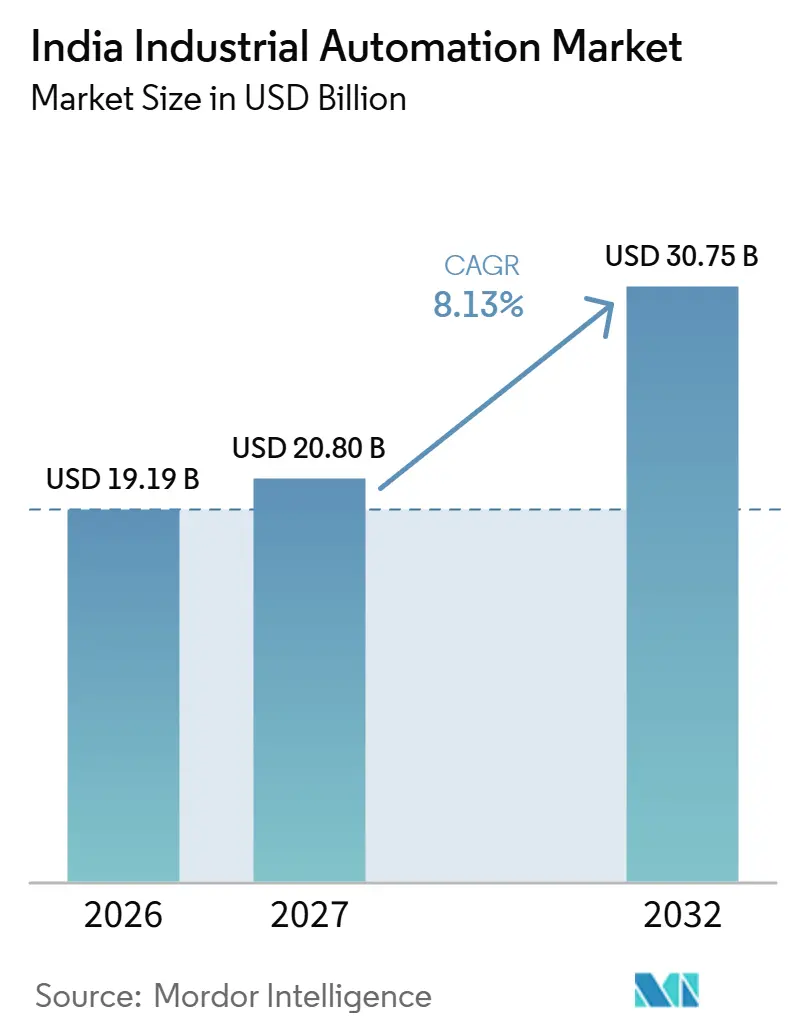
The India industrial automation market size is expected to increase from USD 19.19 billion in 2026 to USD 20.8 billion in 2027 and reach USD 30.75 billion by 2032, growing at a CAGR of 8.13% over 2027-2032.
In India, manufacturing investment and production-linked incentives connect automation demand to the ability to make qualified automotive products and execute precise production tasks. Existing control-system modernization and manufacturing software add another demand channel, where the commercial objective is to keep production supportable and make its records usable. Suppliers can respond through local production, engineering capabilities and lifecycle services, combining equipment availability with the expertise needed to apply and sustain the system. That combination favors an application-led commercial offer, while upfront financing and disputed integration responsibility can delay how much automation reaches smaller suppliers.
Key Report Takeaways
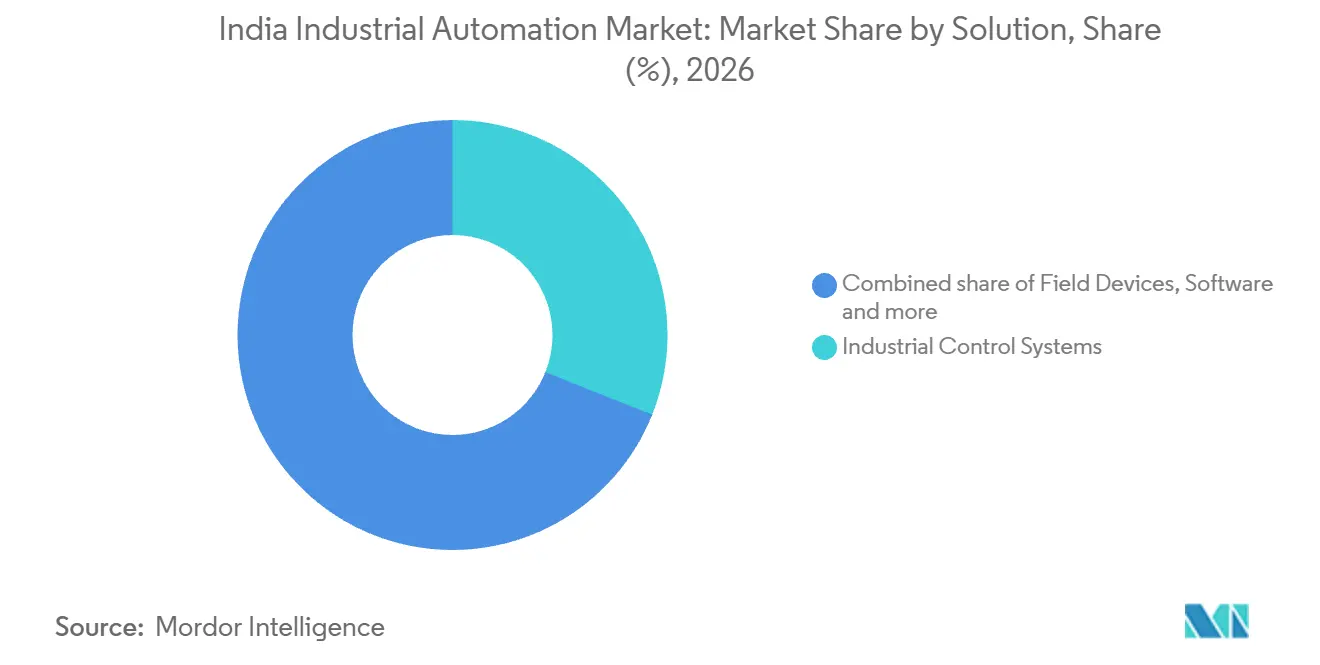
- By solution, industrial control systems held a 31.04% India industrial automation market share in 2026, while software is the fastest-growing segment with a forecast CAGR of 9.35% over 2027-2032.
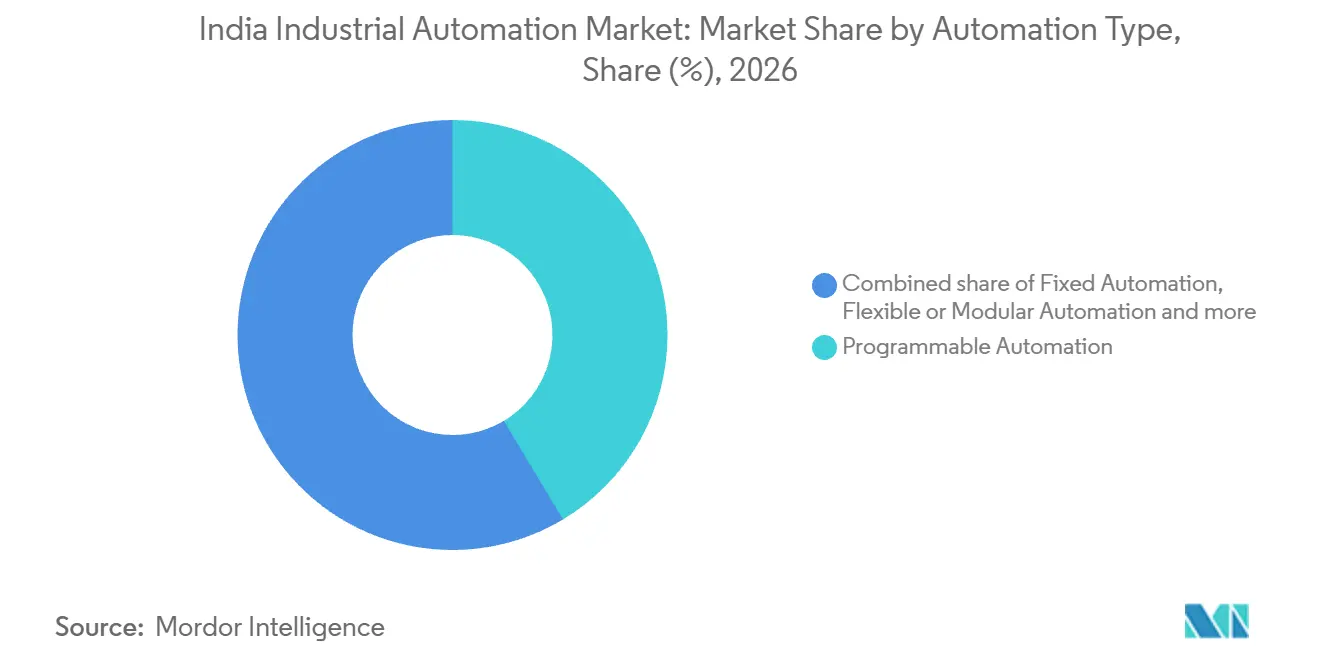
- Programmable automation led automation types with a 41.4% share of the India industrial automation market size in 2026, and integrated or hyper-automation is the fastest-growing segment, forecast at a CAGR of 10.05% over 2027-2032.
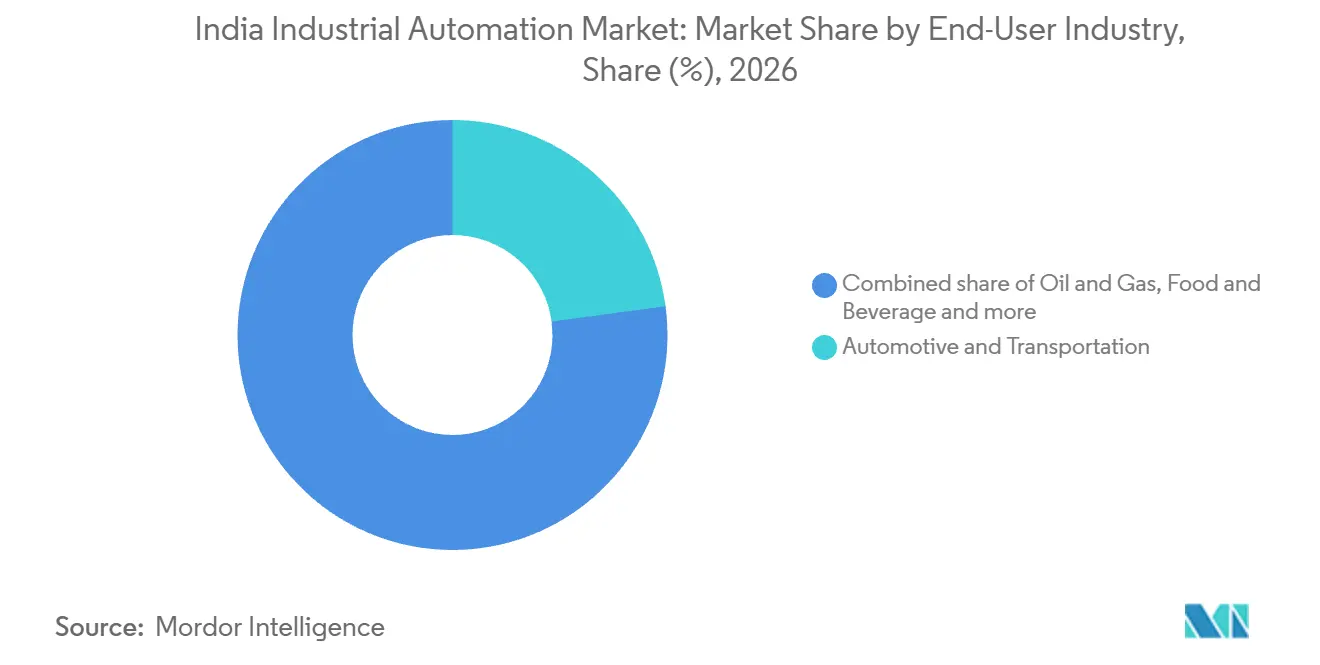
- Among end-user industries, automotive and transportation accounted for 22.86% of the market in 2026, while the electronics and semiconductors segment is forecast to grow fastest at a CAGR of 11.75% over 2027-2032.
- By deployment mode, on-premise led with 42.74% of the market in 2026, and hybrid is the fastest-growing segment with a forecast CAGR of 10.8% over 2027-2032.
- Geographically, Maharashtra led in absolute terms, while Tamil Nadu is the fastest-growing state.
Note: Market numbers in this report are based on Mordor Intelligence's proprietary estimation framework, which combines nine months of actuals with Q4 projections for base year 2026.
Market Trends and Insights
Drivers Impact Analysis of India Industrial Automation Market*
| Driver | (~) % Impact on CAGR Forecast | Geographic Relevance | Impact Timeline |
|---|---|---|---|
| Accelerated "Make in India" Manufacturing Investments | +3.3% | Nationwide | Medium term (2-4 years) |
| Government PLI Scheme Incentives for Discrete Industries | +2.6% | Maharashtra, Tamil Nadu, Haryana and Karnataka | Short term (≤ 2 years) |
| Rapid Expansion of Brownfield Digital Retrofits across MSMEs | +2.1% | Nationwide | Short term (≤ 2 years) |
| Sharp Decline in Industrial Sensor Costs | +1.5% | Nationwide | Medium term (2-4 years) |
| AI-Driven Predictive Maintenance Demand from Mid-Tier Plants | +1.2% | Nationwide | Short term (≤ 2 years) |
| Carbon-Credit Linked Automation for Energy-Intensive Metals Vertical | +0.8% | Nationwide | Long term (≥ 4 years) |
| Source: Mordor Intelligence | |||
Accelerated "Make in India" Manufacturing Investments
Manufacturing investment creates an automation requirement when the production process calls for precise handling of fragile components. Fixed capital in India's registered manufacturing sector rose 10.54% in current prices in FY2024-25 from FY2023-24.[1] In July 2025, Atal Solar said it had ordered equipment from SC Solar for a planned TOPCon module plant in Rajkot, Gujarat, with annual module capacity of 1 GW. The reported design assigned robotic arms to delicate, accurate cell placement. For the equipment supplier, this turns the factory investment into a defined automation task whose commercial relevance rests on handling accuracy.
Government PLI Scheme Incentives for Discrete Industries
PLI-Auto's product qualifications connect the incentive opportunity to manufacturers' ability to deliver eligible automotive output. In February 2026, the Ministry of Heavy Industries said FY2025-26 claims covered actual FY2024-25 sales of domestic-value-addition-certified advanced automotive products and the revised allocation had no implication for investment. As of March 31, 2026, 225 automotive and auto-component manufacturing units had been set up under PLI-Auto across India.[2] By December 2025, the Ministry of Heavy Industries reported that PLI-Auto required at least 50% domestic value addition for qualifying advanced automotive technology products. Automation suppliers can align production-control proposals with an applicant's eligible products, while the manufacturer retains responsibility for satisfying the localization condition.
Rapid Expansion of Brownfield Digital Retrofits across MSMEs
Retrofitting an existing machine can create an automation project without requiring an MSME to replace its productive equipment. That separates the value of a digital function from the decision to fund new production machinery and redesign the surrounding process. A narrowly defined retrofit can focus on one operating requirement, such as capturing machine status or connecting a production step to supervisory control. The project's feasibility then depends on whether the added function can operate within the existing machine's physical and control constraints. Retrofit suppliers can build an initial assignment around the retained machine, with further work dependent on the additional production functions the operator chooses to connect.
Sharp Decline in Industrial Sensor Costs
Lower sensor costs can make broader measurement coverage economical within an automated production line. The benefit extends beyond cheaper hardware because additional measurement points can reveal operating conditions that a control system would otherwise have to address indirectly. For an operator monitoring several machines, that changes the choice between instrumenting only a critical point and observing a wider set of production states. Additional observations can support more targeted control or maintenance decisions, provided they are connected to a usable application. Denser sensing can increase the number of hardware positions supplied, making lower unit costs a potential source of equipment volume as well as buyer savings.
Restraints Impact Analysis of India Industrial Automation Market*
| Restraint | (~) % Impact on CAGR Forecast | Geographic Relevance | Impact Timeline |
|---|---|---|---|
| High CAPEX Sensitivity among Tier-3 Suppliers | -1.2% | Nationwide | Short term (≤ 2 years) |
| Fragmented System-Integrator Ecosystem Quality Gaps | -0.9% | Nationwide | Medium term (2-4 years) |
| Persistent Supply Chain Disruptions for Automation Components | -0.7% | Nationwide | Short term (≤ 2 years) |
| Cyber-Insurance Premium Escalation for OT Networks | -0.5% | Nationwide | Medium term (2-4 years) |
| Source: Mordor Intelligence | |||
High CAPEX Sensitivity among Tier-3 Suppliers
Automotive component suppliers can face an automation funding constraint when process investment competes for limited capital. In its 2025 study of India's projected EV transition, WRI India reported that automotive component MSMEs often lacked capital and technology to move to newer manufacturing processes. The study included Tier-2 and Tier-3 automotive component MSMEs in its interview sample. For an automation project, the financing exposure includes equipment and engineering funded before the production task generates a return. That gap can limit the scope a small supplier is able to implement, even when the system has a defined operating purpose. Staging can reduce the initial commitment, but unfinished functions still require funding, extending the period before the full production task is automated.
Fragmented System-Integrator Ecosystem Quality Gaps
Quality variation in system integration can constrain automation when responsibility for a complete production sequence is split across equipment and control functions. In a line linking programmable controllers, field devices and supervisory software, an interface error can interrupt the sequence even when individual components function. Resolving that fault can require engineering work across supplier boundaries, making the completed system more difficult to deliver than its component specifications suggest. The buyer then faces the possibility that commissioning will depend on work outside any single equipment supplier's responsibility. Defined acceptance tests can reduce that exposure, but a disputed handoff can leave the plant waiting for additional engineering before it can use the automated line.
*Our forecasts treat driver/restraint impacts as directional, not additive. The impact forecasts reflect baseline growth, mix effects, and variable interactions.
India Industrial Automation Market Segment Analysis
By Solution:
Control Modernization Anchors Demand While Software Connects Production RecordsIndustrial control systems accounted for a 31.04% share of the India industrial automation market size in 2026. In August 2025, Primetals Technologies received an order from Jindal Steel and Power to upgrade Level 1 and 2 automation at its Angul plate mill in Odisha, including a SIMATIC S7-1500 control system. The announced upgrade targeted system availability and a stable supply of spare parts. For the mill owner, this connects a control-system upgrade to the operating requirements of an established production asset. The spare-parts objective makes continued support for installed controls a source of replacement demand, even without a new mill.
Software is the fastest-growing segment, with a forecast CAGR of 9.35% over 2027-2032. In its FY2025-26 report, Tata Power described SAP-MES integration and automated serial-number capture in module manufacturing to enhance production efficiency, quality assurance and traceability. The commercial value is the connection between production activity and usable manufacturing records, making software relevant to a defined operating task. Services add a contracted support role, illustrated by Brahmaputra Cracker and Polymer Limited's September 11, 2025, 3-year maintenance order with Siemens Limited for its Siemens DCS and PLC system at Lepetkata. The 3-year Lepetkata order ties service revenue to installed-system maintenance, while the module-manufacturing example connects software value to production records rather than another equipment sale.



By Automation Type:
Programmable Controls Serve Equipment Makers While Integration Links Operations and MaintenanceProgrammable automation represented a 41.4% India industrial automation market share in 2026. ABB India reported strong PLC automation performance in the solar segment and expansion into new OEM applications and industries in 2025. In OEM applications, PLCs can provide control within the equipment offered to industrial plants. ABB India's reported expansion therefore broadens the potential buyer base beyond the solar segment.
Integrated or hyper-automation is the fastest-growing segment, with a forecast CAGR of 10.05% over 2027-2032. In FY2025-26, Tata Steel reported AI-enabled remote operations and maintenance for predictive, real-time asset management within its manufacturing excellence work. That application joins an operating function with an asset-management function, giving integration a purpose defined by the manufacturing process and its maintenance needs. For suppliers, the opening is to connect these functions into a coherent operating service, so predictive information can inform management of the asset within the same application rather than remain a separate analytical output.

By End-User Industry:
Automotive Scale Meets Expanding Electronics ProductionAutomotive and transportation was the largest segment, accounting for 22.86% of the market in 2026. In FY2025-26, SIAM reported production of 34.71 million passenger vehicles, commercial vehicles, three-wheelers, two-wheelers and quadricycles in India across its covered manufacturers. That range brings several vehicle formats into the industry's manufacturing base, giving automation suppliers multiple production contexts for their applications. At this aggregate scale, a control application can be commercially relevant across repeated manufacturing tasks, even when its scope is defined at one process step.
The electronics and semiconductors segment is forecast to grow fastest, at a CAGR of 11.75% over 2027-2032. India's electronics goods production value grew 15.8% year over year in FY2025-26. By September 18, 2026, 5 semiconductor manufacturing plants in India had commenced commercial production and were exporting chips as well as serving domestic needs. This gives automation suppliers an electronics sector with higher reported production value alongside chip manufacturers already serving customers, creating distinct operating-buyer contexts. Suppliers can therefore target automation for existing electronics and chip production lines without waiting for additional plants to be built.
By Deployment Mode:
Plant-Based Control Coexists With Dual-Platform MonitoringOn-premise deployment was the largest segment, with 42.74% of the market in 2026. Bharat Petroleum's Mumbai Refinery uses a microprocessor-based digital distributed control system and has 12 million metric tons of annual crude-processing capacity following debottlenecking and major projects. The refinery illustrates the buyer scale served by on-premise control, since its distributed control system operates at a site with that annual crude-processing capacity.
Hybrid is the fastest-growing segment, with a forecast CAGR of 10.8% over 2027-2032. In 2025, Hindustan Zinc implemented an AI-enabled switchyard hotspot monitoring system at its Debari smelter in Rajasthan, accessible through on-premises and cloud platforms. Vedanta Spark and Ripik.AI were development partners. The dual access routes make equipment-condition monitoring a route into hybrid deployment for smelter operators. Growth in this mode can therefore arise from extending access to a single asset-monitoring application, rather than requiring a plant-wide control replacement.
Geography Analysis
Maharashtra Industrial Automation Market
Maharashtra led the India industrial automation market in absolute terms. It generated 15.92% of India's registered-manufacturing gross value added in FY2024-25, the highest state share. Valeo inaugurated an automated e-Axle manufacturing line at its Pune plant on March 28, 2026, to supply Mahindra's Born Electric platform with a system integrating a motor, inverter and reducer. The production scope included automated stator, reducer, inverter and final e-Axle assembly, supported by digitalization and end-to-end traceability. End-to-end traceability across stator, reducer, inverter and final assembly requires an automation supplier serving this plant to connect station controls with final e-Axle production records.
Tamil Nadu Industrial Automation Market
Tamil Nadu is the fastest-growing state, with commercial automation activity illustrated by Delta Electronics India's own power-supply production in Krishnagiri. On September 11, 2025, the company unveiled a smart-manufacturing line combining its own robots, servo motion, programmable controllers and networking switches for home-appliance power-supply applications. Its line-management software facilitated automated production line changeovers through smart configuration, equipment management and real-time materials logistics coordination. For a power-supply manufacturer, the commercial relevance lies in coordinating changeovers across equipment and materials, beyond automating individual assembly motions.
Gujarat offers a semiconductor assembly-and-test buyer context, with CG Semi's Sanand OSAT facility beginning commercial chip packaging in July 2026. Karnataka has a supplier-side role, illustrated by ABB's March 2026 announcement of USD 21 million for expanding low-voltage-drive and specialized-motor manufacturing at Peenya. In Haryana, BEUMER Group began operating its Jhajjar factory in December 2025, with planned output covering baggage handling, conveying, sorting, cement packing and loading equipment, and mineral and mining machinery components. The state-level contrast is between Gujarat's semiconductor assembly buyer base and equipment-supply locations in Karnataka and Haryana, where drives, motors and material-handling systems shape the supplier opportunity.
Regulatory Framework and Outlook
Selected jurisdictions are compared from the perspective of covered factory operators deploying industrial automation. The Occupational Safety, Health and Working Conditions Code, 2020 took effect on November 21, 2025. It assigns factory occupational-safety authority to the concerned state and places workplace hazard-control duties on covered employers. For an operator, the factory's obligations and state administration therefore form part of the commercial setting for equipment deployment.
Regulatory Table of India Industrial Automation Market
| Decision factor | India | Maharashtra |
|---|---|---|
| Primary authority | Concerned state governments for factory occupational safety and health | Directorate of Occupational Safety and Health, Labour Department |
| Key instruments or direction | Machinery safety omnibus order rescinded in January 2026; OSHWC Code effective from November 2025 | OSHWC Code; 2025 electronic factory-administration amendment; May 2026 draft factory rules |
| Commercial effect | Employers owe workplace hazard-control duties; new covered establishments formed after Code commencement must apply electronically for registration within 60 days of applicability | Covered factory operators use electronic application, licensing and renewal processes; draft rules propose electronic registration, identity verification and payment procedures |
| Current policy attractiveness | Medium | Medium |
| Future direction of policy attractiveness | No change | No change |
| Source: Mordor Intelligence | ||
India's Medium rating reflects a defined employer-duty framework and a registration requirement for new covered establishments. Maharashtra is also Medium because electronic factory administration has an operative baseline and the May 2026 draft develops registration, verification and payment procedures within that approach. No change reflects the existing national electronic-registration requirement and the state proposal's continuity with electronic procedures introduced in October 2025. Electronic administration can organize the filing task, while hazard-control duties keep equipment deployment tied to the factory employer's operating responsibilities.
Value Chain Stages
This comparison follows value from automation equipment supply through application engineering to services attached to installed systems. ABB India's Automation business provides integrated control, software, machine and factory automation, measurement, analytics, and related services for process, hybrid, and maritime industries. Separating these activities clarifies how suppliers can earn from an initial equipment requirement and from the engineering and support needed to apply it.
Value Chain Analysis Table of India Industrial Automation Market
| Primary activity | Key participants | Value capture | Bottleneck | Resilience response |
|---|---|---|---|---|
| Equipment and control supply | Automation equipment suppliers such as ABB India Limited | Equipment and software sales | Exposure to concentrated critical-item sources | Protect single-source critical items with safety stock and diversify suppliers for complex, high-scale projects |
| Application engineering and commissioning | Machine-tool engineering providers such as Siemens | Engineering and commissioning revenue | Translating a machining strategy into an application that can be commissioned | Validate the application design before equipment commissioning |
| Installed-base lifecycle support | Lifecycle service providers such as ABB India Limited | Maintenance and digital-service revenue | Access to equipment-specific diagnostic expertise | Retain configuration records and connect fault escalation to equipment specialists |
| Source: Mordor Intelligence | ||||
Application engineering turns product capability into a machine-specific solution, making it the commercial handoff between equipment supply and operational support. Siemens' Bengaluru Digital Experience and Application Center supports machine-tool activities from design through engineering and commissioning. In its 2025 report, ABB India linked digital services attached to its installed base and lifecycle services with smoothing business cycles.[3] The installed base therefore gives service providers a continuing earnings opportunity, while application knowledge can connect an initial project to subsequent support work.
Competitive Landscape
Market Concentration
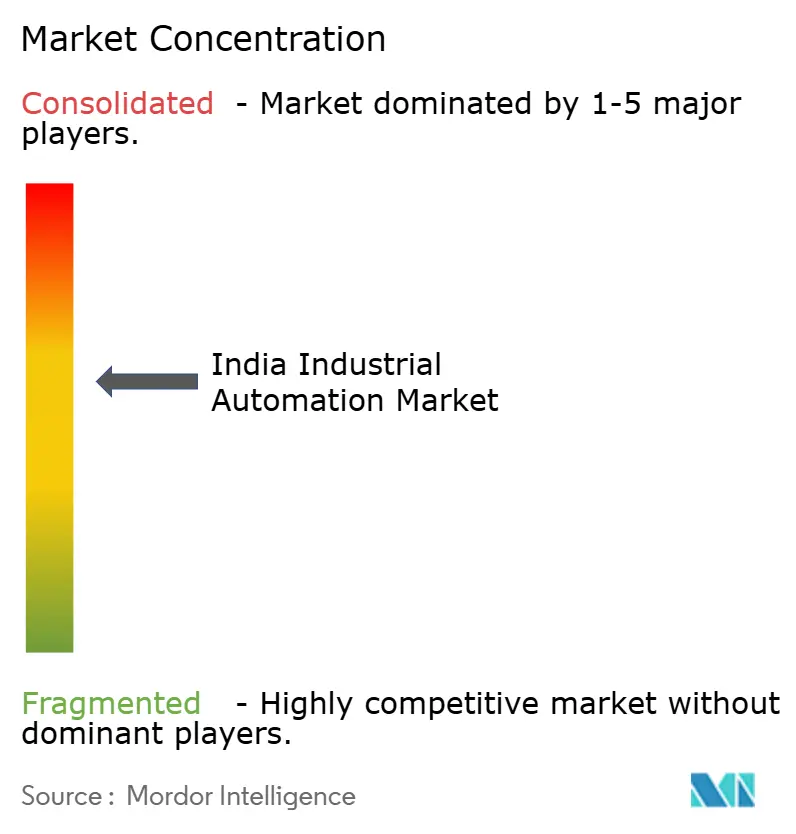
Competitive supply is spread across several established technology groups, with local operating capabilities providing a basis for differentiation alongside product breadth. On October 28, 2025, ABB India Limited added a variable-speed-drive module production line at its Peenya factory in Bengaluru, increasing local drive-production capacity by about 25%. Other leading participants include Siemens Limited, Schneider Electric India Pvt. Ltd., Rockwell Automation India Pvt. Ltd., and Mitsubishi Electric India Pvt. Ltd. Siemens serves industry, infrastructure and mobility, while Schneider Electric India supplies power-management and automation systems. For drive buyers, Peenya adds local supply capacity alongside ABB India's integrated control, software and machine automation offerings for process, hybrid and maritime industries.
Equipment suppliers can compete through the engineering organization behind an automation offer as well as through the physical product being delivered. On August 11, 2026, Rockwell Automation inaugurated a campus in Electronics City, Bengaluru, bringing together global capability-center teams focused on digital and manufacturing operations management. Rockwell supplies industrial automation hardware, software and services and integrates control and information across industrial enterprises. Consolidating its digital and manufacturing operations management teams therefore strengthens the organizational base behind the software and services side of that offer.
Ownership changes and business-line orders reveal different routes to competitive expansion. Schneider Electric SE's proposed acquisition of separate 35% stakes in Schneider Electric India Pvt. Ltd. and Schneider Electric JV Holdings 2 Pte. Ltd. received approval from the Competition Commission of India on December 9, 2025. On December 18, 2025, Schneider Electric completed its acquisition of the remaining 35% of Schneider Electric India Pvt. Ltd. from Temasek, reaching full ownership. ABB India's continuing business reported record orders for the second quarter of CY2026, up 50% year over year, with orders rising across all business areas and increased export orders in Motion and Automation. For challengers, Schneider Electric's July 2025 plan to expand India capacity by 2.5 to 3 times points to a potential scale barrier beyond the completed ownership consolidation.
India Industrial Automation Industry Leaders
-
ABB India Limited
-
Siemens Limited
-
Schneider Electric India Pvt. Ltd.
-
Rockwell Automation India Pvt. Ltd.
-
Mitsubishi Electric India Pvt. Ltd.
- *Disclaimer: Major Players sorted in no particular order
India Industrial Automation Market Companies Covered in this Report
- Siemens Limited
- ABB India Limited
- Schneider Electric India Pvt. Ltd.
- Rockwell Automation India Pvt. Ltd.
- Honeywell Automation India Ltd.
- Emerson Automation Solutions India Pvt. Ltd.
- Mitsubishi Electric India Pvt. Ltd.
- Yokogawa India Ltd.
- Omron Automation Private Limited
- Bosch Rexroth India Pvt. Ltd.
- B&R Industrial Automation Pvt. Ltd.
- Fanuc India Pvt. Ltd.
- Delta Electronics India Pvt. Ltd.
- Larsen & Toubro Ltd.
- Danfoss Industries Pvt. Ltd.
- Yaskawa India Pvt. Ltd.
- Pepperl+Fuchs (India) Pvt. Ltd.
- Phoenix Contact (India) Pvt. Ltd.
- Beckhoff Automation Pvt. Ltd.
Key Opportunities for Market Participants
This comparison identifies automation work within distribution-equipment procurement, from field interfaces to control-center integration and lifecycle support. Madhya Pradesh Paschim Kshetra Vidyut Vitran Company Ltd. (MPPKVVCL) invited bids for 11 kV and 33 kV motorized ring main units integrated with existing and upcoming SCADA-DMS/ADMS systems in Ujjain and Indore. The October 17, 2026, tender scheduled bid submissions for October 27 to November 5, 2026.
Market Opportunities Table of India Industrial Automation Market
| Opportunity | Why now | Buyer / lead segment | Recommended play | Main barrier | Likely beneficiaries |
|---|---|---|---|---|---|
| SCADA-ready field automation | Procurement specifies SCADA-compatible units with pre-fitted field remote terminal units | Distribution utilities and ring main unit suppliers | Bundle field-terminal configuration and interfaces with equipment supply | Meeting the control architecture's requirements at equipment level | Field-control hardware providers |
| Control-center integration | Connections to existing and upcoming SCADA-DMS/ADMS systems are included | Utility SCADA operators and prime contractors | Define integration responsibilities and system acceptance tests before handover | Demonstrating coordinated operation across equipment and control-center systems | SCADA integrators and industrial communications specialists |
| Lifecycle automation support | Scope includes a 5-year comprehensive maintenance contract | Distribution-utility asset operators | Include fault diagnosis and configuration support within the maintenance offer | Maintaining technical responsibility across hardware, communications and controls | Automation service providers |
| Source: Mordor Intelligence | |||||
The central opening is responsibility for the interfaces between field equipment and the utility's control systems. An automation specialist can make its offer commercially useful by fitting that responsibility into the wider equipment package, with a defined route from commissioning to maintenance. Interface engineering can therefore connect commissioning revenue with continuing application support over the contracted maintenance term.
Recent Industry Developments in India Industrial Automation Market
- Oct 2026: MPPKVVCL invited bids for 11 kV and 33 kV motorized ring main units with SCADA-DMS/ADMS integration in Ujjain and Indore. Submissions were scheduled for October 27 to November 5, 2026.
- Aug 2026: Rockwell Automation inaugurated a Bengaluru campus bringing together its global capability-center teams focused on digital and manufacturing operations management.
- Jul 2026: CG Semi's outsourced semiconductor assembly and test facility in Sanand, Gujarat, began commercial chip-packaging production.
India Industrial Automation Market Report Scope and Research Methodology
Market Definition and Coverage
The India industrial automation market measures annual spending in India on control systems, field devices, industrial software and related services used to automate industrial processes and machinery. Value covers sales to industrial users across different automation configurations and deployment modes.
Scope exclusions: Non-automation production machinery and general factory equipment, consumer and residential automation products, and general-purpose corporate information technology software and services are excluded.
Segments Covered in This Report
- By Solution
- Industrial Control Systems
- Distributed Control System (DCS)
- Supervisory Control and Data Acquisition (SCADA)
- Programmable Logic Controller (PLC)
- Human Machine Interface (HMI)
- Other Industrial Control Systems
- Field Devices
- Sensors and Transmitters
- Valves and Actuators
- Motors and Drives
- Robotics
- Other Field Devices
- Software
- Product Lifecycle Management (PLM)
- Enterprise Resource Planning (ERP)
- Manufacturing Execution System (MES)
- Other Softwares
- Services
- Integration
- Maintenance and Training
- Industrial Control Systems
- By Automation Type
- Fixed Automation
- Programmable Automation
- Flexible or Modular Automation
- Integrated or Hyper-Automation
- By End-User Industry
- Automotive and Transportation
- Oil and Gas
- Food and Beverage
- Pharmaceuticals and Life Sciences
- Power and Utilities
- Electronics and Semiconductors
- Chemicals and Petrochemicals
- Metals and Mining
- Fast-Moving Consumer Goods (FMCG)
- Packaging
- Others End-User Industries
- By Deployment Mode
- On-Premise
- Cloud
- Hybrid
Data Sources, Market Sizing, and Validation
Desk Research
The market model would draw on sources such as the Ministry of Statistics and Programme Implementation's Index of Industrial Production for factory activity, the Ministry of Heavy Industries' PLI-Auto releases for policy-linked manufacturing investment, International Federation of Robotics data for robot installations, and ABB India's annual report for supplier and installed-base context. These sources help set demand indicators and check how industrial automation products and services are used in India.
Company filings, investor materials and reputable business reporting would add evidence on automation orders, manufacturing capacity, retrofit projects and deployment economics, with reported operating measures treated as context rather than market revenue. These sources are not exhaustive, and further sources inform collection, validation and clarification.
Primary Interviews and Surveys
A planned India-focused interview and survey program would cover automation suppliers, system integrators, industrial users and procurement or engineering specialists across large, mid-sized and smaller organizations. Structured questions would check secondary findings on project spending, bundled system values, replacement cycles and segment demand, while follow-up interviews would clarify gaps or conflicting definitions. Analysts would compare respondent evidence with reported sales and production indicators and retain a range where sources do not resolve a value.
Distribution of primary research fieldwork respondents
| Company type | Respondent position | Region |
|---|---|---|
| Top tier: 35% | CXOs: 20% | |
| Mid tier: 45% | Functional/Unit leaders: 35% | |
| Smaller Players: 20% | Managers: 45% |
Market-Sizing & Forecasting
The analyst would estimate annual India spending from the top down, using industrial production and manufacturing investment as demand anchors, then allocating spending across controls, field devices, software and services and checking selected totals against supplier and integrator evidence. When the model follows India's factory cycle, the Index of Industrial Production supplies manufacturing and capital-goods indicators. As automation investment deepens, robot installations and operating stock indicate equipment adoption. PLI-Auto approvals and domestic manufacturing progress signal investment in eligible automotive production, while supplier filings and reported projects provide checks on equipment, software and service demand. Segment shares would reflect the product or service attached to each counted end-user sale, the automation configuration, buyer industry and deployment mode, with bundled system spending counted once. A multivariate regression using these indicators would inform the 2027-2032 forecast, with scenario analysis adjusting for slower or faster investment and retrofit activity. Primary respondents would be asked to test whether each driver and its expected timing fit their India applications. Analysts would use selective bottom-up checks, including supplier revenue roll-ups and sampled system selling prices multiplied by plausible project volumes, to test the top-down totals, and would document assumptions and use a bounded range where company coverage, bundled sales or project timing leaves gaps.
Data Validation & Update Cycle
Analysts would triangulate official manufacturing indicators, supplier disclosures, project announcements and respondent evidence, then investigate material variances in coverage, unit value, timing or duplicate bundled sales before sign-off. A second analyst review would check calculations, segment shares and source traceability, and a further review would resolve outliers or request re-contact when a source's definition changes or new evidence conflicts with an earlier response. The dataset would be refreshed annually, updated between cycles after material policy or investment events, and given a fresh pre-delivery review for source dates, calculation consistency and unresolved discrepancies.
Mordor Intelligence's India Industrial Automation Market Size Compared With Other Published Estimates
Published estimates can differ in the transactions and products they count and the inputs used to model demand. The India industrial automation market measures annual spending in India on control systems, field devices, industrial software and related services used to automate industrial processes and machinery.
Key Gap Drivers include the study's defined coverage and market-specific modeling choices. When the model follows India's factory cycle, the Index of Industrial Production supplies manufacturing and capital-goods indicators.
Benchmark comparison
| Source | Market Size | Gaps in Research Methodology |
|---|---|---|
| Mordor Intelligence | USD 20.8 B (2027) | |
| Regional Consultancy A | USD 17.28 B (2025) | At its 2025 base, this estimate is 16.9% below this report's 2027 value of USD 20.8 B, 2 years later. Its published 2025 total predates the report's 2027 measurement year, so it represents an earlier year of India spending. |
| Global Consultancy B | USD 16.7 B (2025) | At its 2025 base, this estimate is 19.7% below this report's 2027 value of USD 20.8 B, 2 years later. Its stated industrial control and factory automation category is narrower than the report's broader product and service boundary. |
Mordor Intelligence's analysts would triangulate official manufacturing indicators, supplier disclosures, project announcements and respondent evidence, then investigate material variances in coverage, unit value, timing or duplicate bundled sales before sign-off.
Key Questions Answered in the Report
What is the India industrial automation market size and growth outlook?
The market is expected to grow from USD 20.8 billion in 2027 to USD 30.75 billion by 2032, at a CAGR of 8.13% over 2027-2032.
What drives demand for factory automation in India?
Manufacturing investment and production-linked incentives create opportunities for controls and production systems. By March 31, 2026, 225 automotive and auto-component manufacturing units had been set up under PLI-Auto.
Which solution holds the largest share of India's industrial automation sector?
Industrial control systems held 31.04% of the market in 2026, while software is forecast to be the fastest-growing segment at a CAGR of 9.35% over 2027-2032.
Which companies compete in India's industrial automation industry?
ABB India Limited, Siemens Limited, Schneider Electric India Pvt. Ltd., Rockwell Automation India Pvt. Ltd., and Mitsubishi Electric India Pvt. Ltd. are leading participants.
What can delay industrial automation deployment by smaller suppliers?
WRI India's September 2025 study of the projected EV transition identified capital and technology constraints among automotive-component MSMEs. Such constraints can delay smaller suppliers' automation upgrades.
Which Indian states lead industrial automation activity and growth?
Maharashtra led in absolute terms, while Tamil Nadu is the fastest-growing state.