India Full-Service Restaurants Market Size and Share
Market Overview
| Study Period | 2021 - 2031 |
|---|---|
| Forecast Data Period | 2026 - 2031 |
| Base Year Market Size (2025) | USD 37.93 Billion |
| Market Size (2026) | USD 42.09 Billion |
| Market Size (2031) | USD 70.82 Billion |
| Growth Rate (2026 - 2031) | 10.97 % |
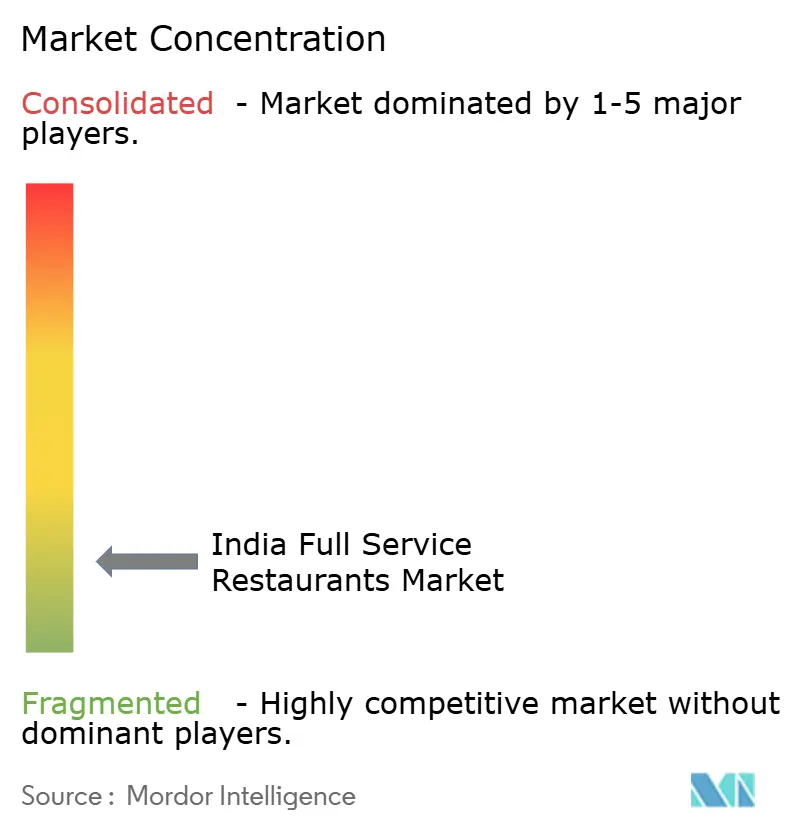
| Market Concentration | Low |
Major Players *Disclaimer: Major Players sorted in no particular order Image © Mordor Intelligence. Reuse requires attribution under CC BY 4.0. | |
India Full-Service Restaurants Market Analysis by Mordor Intelligence
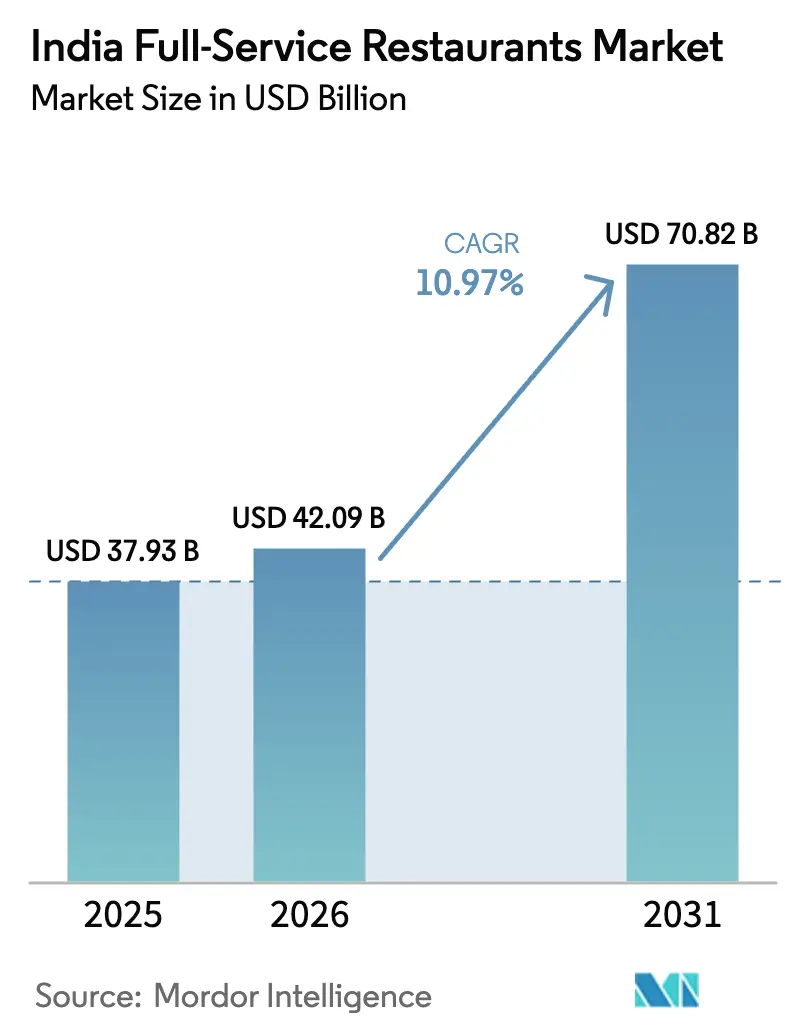
The India full service restaurants market size is expected to grow from USD 37.93 billion in 2025 to USD 42.09 billion in 2026 and is forecast to reach USD 70.82 billion by 2031 at 10.97% CAGR over 2026-2031. This growth reflects a shift in consumer behavior, particularly among urban and semi-urban populations, where dining out is becoming an increasingly regular social activity rather than an occasional indulgence. Factors such as rising disposable incomes, increased smartphone usage, and the growing influence of food delivery aggregator platforms have made it easier for consumers to discover and access dining options. Despite competition from quick-service restaurants, which emphasize speed and affordability, full-service establishments are differentiating themselves by offering value through these experiential dining options. Furthermore, the anticipated growth in domestic tourism, which is projected to double by 2030, is expected to drive more customers to leisure destinations. In these areas, curated dining experiences are becoming an integral part of travel plans, further boosting the market. The India full service restaurants market remains highly fragmented, with numerous players competing to capture market share.
Key Report Takeaways
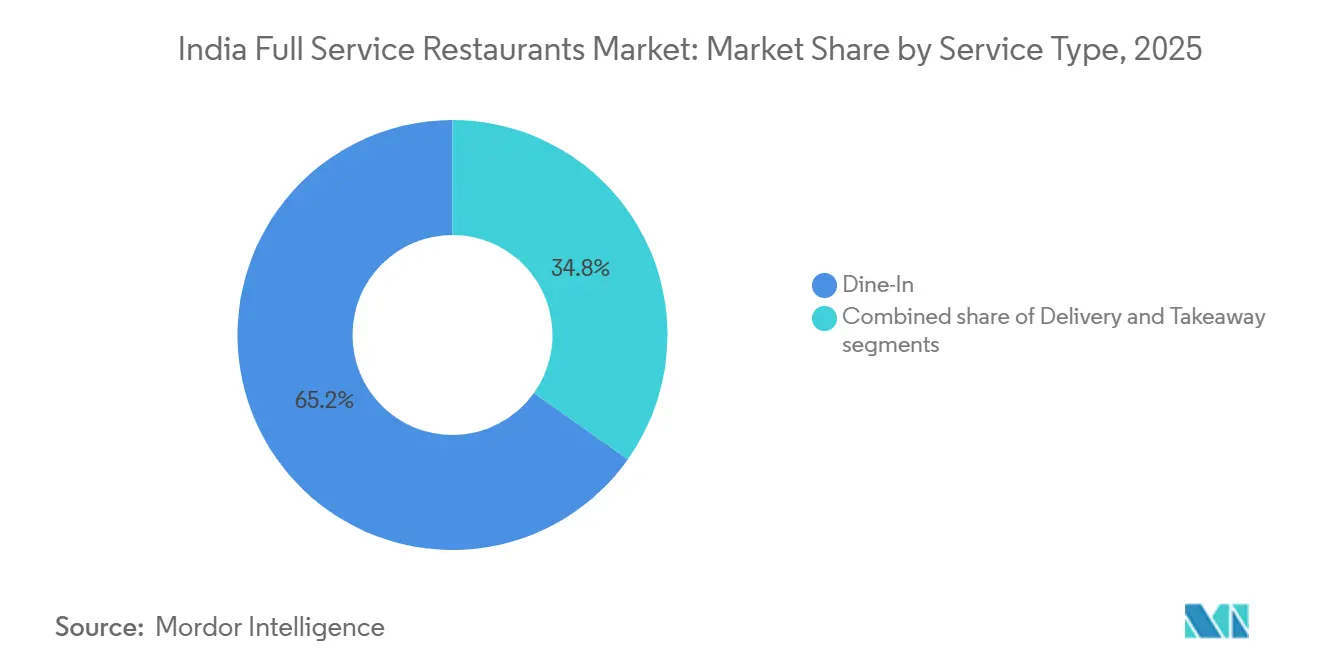
- By service type, dine-in dominated with 65.12% of India full service restaurants market share in 2025, while delivery is forecast to expand at a 13.67% CAGR to 2031.
- By cuisine, Asian formats held a 72.10% revenue share in 2025; Latin American cuisine is expected to advance at a 15.08% CAGR through 2031.
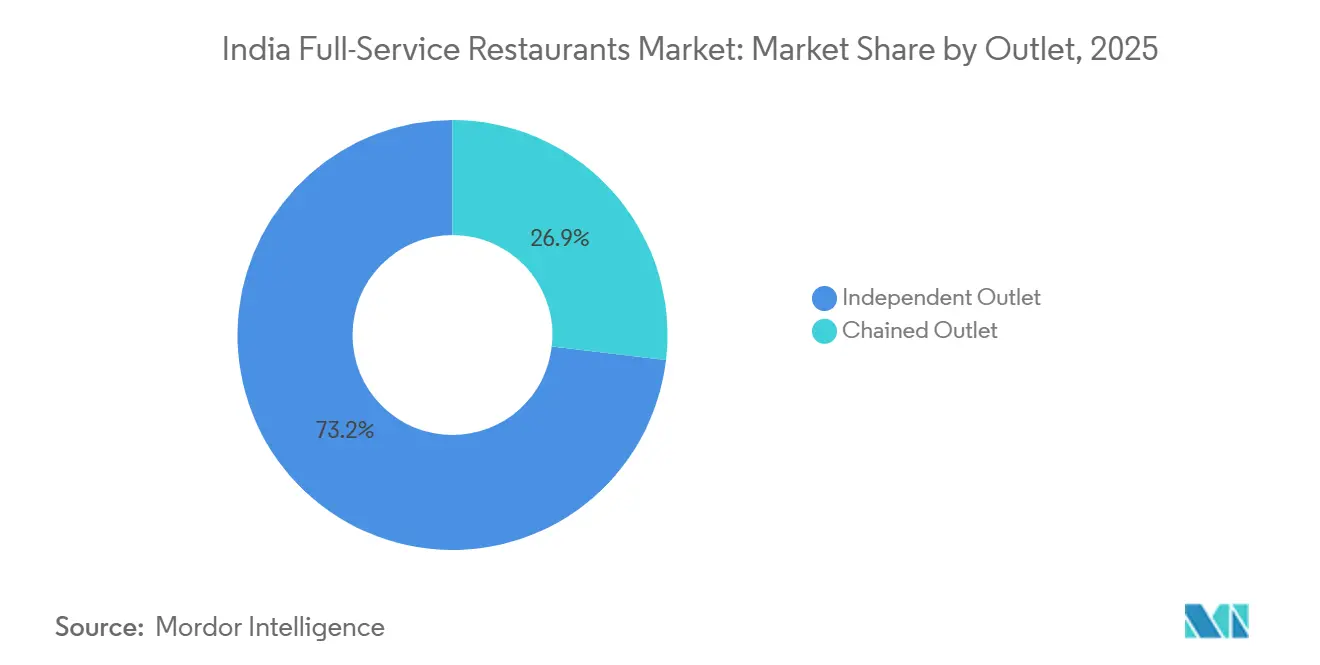
- By outlet model, independent operators accounted for 73.15% of India's full service restaurants market size in 2025; however, chained formats are growing at a 12.84% CAGR to 2031.
- By location, standalone sites captured 47.62% share of the India full service restaurants market size in 2025, whereas lodging-based venues are set to rise at a 12.18% CAGR to 2031.
Note: Market size and forecast figures in this report are generated using Mordor Intelligence’s proprietary estimation framework, updated with the latest available data and insights as of 2026.
Market Trends and Insights
Drivers Impact Analysis of India Full-Service Restaurants Market*
| Driver | (~) % Impact on CAGR Forecast | Geographic Relevance | Impact Timeline |
|---|---|---|---|
| Changing consumer preferences for experiential dining | +2.3% | National, with early gains in metros (Mumbai, Delhi, Bangalore, Hyderabad) | Medium term (2-4 years) |
| Digital transformation through online reservations, delivery apps, and social media marketing | +2.8% | National, accelerated in Tier-1 and Tier-2 cities | Short term (≤ 2 years) |
| Domestic tourism and hospitality growth | +1.9% | National, concentrated in leisure destinations (Goa, Kerala, Rajasthan, Himachal Pradesh) | Long term (≥ 4 years) |
| Corporate dining and MICE events | +1.2% | Metro clusters (NCR, Mumbai, Bangalore, Pune, Hyderabad) | Medium term (2-4 years) |
| Penetration of international chains and partnerships with Indian operators | +1.7% | National, with initial focus on Tier-1 cities expanding to Tier-2 | Medium term (2-4 years) |
| Menu innovation around fusion and regional specialties | +1.4% | National, led by urban centers with cosmopolitan demographics | Medium term (2-4 years) |
| Source: Mordor Intelligence | |||
Changing consumer preferences for experiential dining
In India, full-service restaurants are evolving into lifestyle destinations as customers increasingly seek more than just food; they want a complete dining experience that includes ambiance, interaction, and entertainment. To meet these expectations, restaurant operators are introducing unique features such as themed interiors, live grills, and chef-interaction counters. These elements not only encourage customers to spend more time at the restaurant but also allow businesses to charge premium prices. Rising disposable incomes in urban areas, coupled with India's robust economic growth, as estimated by the International Monetary Fund at USD 4,130 billion, are driving higher discretionary spending in India [1]. This has led to an increase in the frequency of dining out, making experiential dining a regular activity rather than an occasional treat. Restaurants that continuously update their concepts and offerings are better positioned to attract repeat customers in this segment.
Domestic tourism and hospitality growth
India’s full service restaurants market is experiencing significant growth, driven by the expansion of domestic tourism and the hospitality sector. In 2024, the country welcomed 9.66 million foreign tourists, generating INR 2,77,842 crore in foreign exchange earnings, marking a 19.8% increase, according to the Ministry of Tourism [2]. This growing influx of tourists, along with rising domestic travel, has boosted spending on food and beverages, particularly in popular leisure and resort destinations. Hotels are increasingly promoting their signature restaurants as key attractions for both tourists and residents. For instance, Bukhara at ITC Maurya in New Delhi has become a popular choice, benefiting from a steady flow of foreign visitors and business travelers. As travelers increasingly seek unique culinary experiences, restaurants are transforming into key highlights of travel itineraries.
Menu innovation around fusion and regional specialties
Menu innovation focusing on fusion dishes and regional specialties is becoming a significant growth driver for India’s full-service restaurants. Restaurants are introducing creative variations, such as quinoa biryani and seasonal monsoon-themed menus. These offerings bring a sense of novelty while maintaining the essence of traditional flavors, appealing to a wide range of customers. Many restaurants have embraced fusion experimentation. For instance, Raiya, which opened in South Delhi in September 2025, garnered attention for its distinctive Indo-global fusion. Its launch menu featured dishes like Mooradabadi served with thinly sliced sourdough, and Pinwheel Ravioli, an Indo-Italian dish combining ghee-roasted mushrooms with handmade pasta. Many operators are leveraging data analytics to fine-tune recipes and control ingredient costs. This approach ensures that their innovative offerings align with customer preferences while maintaining profitability.
Corporate dining and MICE events
Corporate dining and MICE (Meetings, Incentives, Conferences, and Exhibitions) activities are becoming significant drivers of weekday demand for full-service restaurants in India’s metropolitan areas. As of March 2024, India has 2,663,016 registered companies, with 64% of them actively operating, according to the India Brand Equity Foundation [3]. This has led to consistent corporate activity in business districts throughout the week. The growing number of conferences, training sessions, and off-site meetings is boosting lunch traffic for premium restaurants located near commercial hubs. To cater to this demand, many restaurants are introducing tailored prix-fixe menus, which streamline kitchen operations while offering value to corporate clients. Companies are utilizing hosted lunches as a strategy to boost employee satisfaction and foster stronger client relationships.
Restraints Impact Analysis of India Full-Service Restaurants Market*
| Restraint | (~) % Impact on CAGR Forecast | Geographic Relevance | Impact Timeline |
|---|---|---|---|
| High rental costs in prime metros | -1.8% | Metro centers (Mumbai, Delhi, Bangalore, Pune, Hyderabad) | Short term (≤ 2 years) |
| Intense competition from quick-service restaurants | -1.3% | National, particularly in Tier-2 and Tier-3 cities | Medium term (2-4 years) |
| Complex licensing requirements | -0.9% | National, with state-level variations (Maharashtra, Karnataka, Tamil Nadu) | Long term (≥ 4 years) |
| Rising food inflation and supply chain inefficiencies | -1.5% | National, acute in regions dependent on long-haul produce transport | Short term (≤ 2 years) |
| Source: Mordor Intelligence | |||
Complex licensing requirements
Complex licensing requirements significantly hinder the expansion of full-service restaurants in India. Restaurant operators are required to obtain multiple approvals, including Food Safety and Standards Authority of India (FSSAI) registration or license, fire-safety NOC (Fire No Objection Certificate), health-trade license from local municipal authorities, pollution control clearance, shop and establishment registration, music and entertainment permits, and, in many cases, state excise licenses for serving alcohol. This extensive list of approvals increases the initial setup costs, making it particularly challenging for first-time entrepreneurs to enter the market. Delays in regulatory processing further exacerbate the financial strain, as operators must comply with stringent guidelines set by the FSSAI and local municipal bodies. Larger restaurant chains often manage these challenges more effectively by employing dedicated compliance teams to handle the paperwork and processes.
High rental costs in prime metros
High rental costs in major metropolitan areas remain a significant challenge for full-service restaurants in India. For instance, monthly rentals at Connaught Place (Inner Circle) ranged between INR 1,150 and 1,250 per square foot in Q1 2025, marking a 14% increase compared to the previous year, as reported by Business Standard in April 2025, citing Cushman and Wakefield. Similarly, Khan Market, recognized as one of the most expensive high-street locations globally, saw rental rates of INR 1,600 to 1,650 per square foot per month during the same period, reflecting a 7% year-on-year rise. These high rental rates, coupled with standard three-year lock-in agreements and substantial security deposits, significantly increase the financial risks for new restaurant operators. The costs of interior fit-outs and renovations further strain the cash flow during the initial stages of operation.
*Our forecasts treat driver/restraint impacts as directional, not additive. The impact forecasts reflect baseline growth, mix effects, and variable interactions.
India Full-Service Restaurants Market Segment Analysis
By Service Type:
Delivery Gains Share Despite Dine-In DominanceDine-in formats are the leading segment in India’s full-service restaurants market, contributing 65.12% of the market share in 2025. These restaurants attract customers by offering a unique dining experience that includes social interactions, themed interiors, and live kitchen setups. The ambiance and personalized service provided by these establishments make them a preferred choice for consumers, especially in metro cities and Tier I areas. As dining out becomes a lifestyle trend, dine-in formats continue to drive significant revenue for the market.
The delivery segment is growing rapidly and is expected to achieve a 13.67% CAGR by 2031. Consumers are increasingly opting for premium full-service meals delivered to their homes, thanks to better packaging that maintains food quality during transit. Restaurants are adapting by creating delivery-specific menus, introducing exclusive chef-curated meal boxes, and partnering with efficient logistics providers to streamline their operations. With convenience becoming a key factor for customers, the delivery segment is poised to complement dine-in services and play a larger role in driving market growth.

By Cuisine:
Latin American Formats Challenge Asian HegemonyAsian cuisines continued to dominate India’s full-service restaurants market in 2025, accounting for 72.10% of the total market share. This category encompasses a diverse range of offerings, including Indian regional dishes, Chinese cuisine, and other Pan-Asian menus, which remain popular due to their cultural familiarity and adaptability for vegetarian diets. Restaurants are introducing more niche Asian cuisines, such as Japanese, Korean, and Thai, to cater to the growing interest among younger consumers. The variety and adaptability of Asian food ensure consistent customer traffic in both metropolitan areas and smaller cities.
Latin American cuisine is emerging as the fastest-growing segment in the market, with a projected CAGR of 15.08% through 2031. This growth is fueled by global brands and local restaurants that are tailoring dishes to suit Indian tastes by adjusting spice levels, proteins, and accompaniments. Popular items, such as tacos, chimichurri bowls, and Peruvian grills, are increasingly featured on premium dining menus. As Indian consumers explore more global flavors, Latin American cuisine is expected to gain significant traction, both in dine-in experiences and through delivery services, outpacing other categories in terms of growth.
By Outlet:
Chained Models Scale Through Franchise EconomicsIndependent restaurants led the Indian full-service restaurants market in 2025, accounting for 73.15% of the total market share. These restaurants thrive due to their family-run traditions, regionally inspired menus, and chef-driven concepts that foster strong local connections. They often offer unique, localized flavors and personalized dining experiences that cater to the preferences of nearby communities. Independent restaurants are highly adaptable, allowing them to quickly adjust their menus to meet shifting consumer tastes and trends.
Chained full-service restaurants are expected to grow at a rapid 12.84% CAGR through 2031, making them the fastest-growing segment in the market. Franchise expansions, efficient supply chain management, and easier access to funding from investors drive their growth. These chains attract customers with consistent food quality, strong branding, and strategic locations in malls and high-traffic areas. As they improve operational efficiency, these chains are likely to expand their presence in both metropolitan cities and Tier II markets, catering to a broader customer base.
By Location:
Lodging Integration Captures Captive And Local DemandStandalone restaurants accounted for 47.62% of the Indian full-service restaurants market in 2025, making them the most dominant format. These restaurants benefit from their ability to customize layouts, operate with flexible hours, and establish strong, unique branding. They often serve as popular destinations for both residents and tourists, offering personalized dining experiences. Their independence allows them to quickly adapt their menus, themes, and décor to meet changing customer preferences and local demand trends.
Lodging-based restaurants are expected to grow at a 12.18% CAGR through 2031, driven by the rise in domestic tourism and increased demand for dining within hospitality settings. Hotels are leveraging underutilized spaces by introducing signature dining concepts, showcasing regional cuisines, and offering chef-curated menus that highlight local flavors. These restaurants also benefit from cross-selling opportunities, attracting hotel guests and event attendees. As hotels focus on creating standout culinary experiences, this format is likely to play a more significant role in the full-service restaurants market in the years to come.
Geography Analysis
Major metropolitan cities, such as Mumbai, Delhi, Bangalore, Hyderabad, and Pune, lead the full-service restaurants market in India due to their high consumer spending power and the presence of premium and international brands. However, increasing rental costs in these cities are encouraging restaurant operators to expand into suburban areas. These suburbs present significant untapped demand, and food delivery platforms ensure customer access without the need for expensive prime locations. While metros will continue to grow in market size, rising operational costs are prompting businesses to explore more cost-effective Tier-2 cities for expansion opportunities.
Tier-2 cities such as Chandigarh, Jaipur, Lucknow, and Coimbatore are experiencing rapid growth in the full-service restaurants segment, driven by the expanding middle-class population. Lower rental expenses in these cities allow restaurants to achieve profitability more quickly. Additionally, the growing influence of social media has helped bridge the gap in consumer aspirations, making these cities attractive for restaurant chains. Many operators are introducing smaller, more affordable formats with menus customized to regional tastes, including a stronger focus on vegetarian options to cater to local preferences.
Tourist destinations like Goa, Kerala’s backwaters, and Rajasthan’s heritage circuits are also benefiting from the anticipated doubling of tourism by 2030. Restaurants located within hotels are seeing increased footfall from both tourists and local customers seeking unique dining experiences. Enhanced cold-chain logistics have improved ingredient sourcing, ensuring consistent menu quality even in remote locations. However, operators face challenges such as varying state regulations and labor laws, requiring careful planning to align their expansion strategies with favorable policies and cultural preferences.
Competitive Landscape
The India full-service restaurants market is highly fragmented and includes a wide variety of players, ranging from traditional family-owned businesses to modern ventures and global franchises. Established brands like Haldiram Foods International Pvt Ltd and Barbeque Nation Hospitality Ltd focus on their legacy recipes and own their properties, which helps them maintain profitability despite limited use of advanced technology. Meanwhile, newer brands such as Wow Momo and Biryani By Kilo use cloud kitchens to test new markets before investing in physical outlets. International chains like Nando’s bring global standards and branding, but must adapt their offerings to suit local tastes and pricing expectations.
Different strategies are being adopted by businesses to remain competitive in this fragmented market. Others cater to niche audiences by offering premium, chef-driven menus and unique dining experiences, which allow them to charge higher prices but limit their scalability. A growing trend is the hybrid approach, where businesses maintain flagship dine-in outlets while launching virtual brands for delivery. Technology is a key enabler, with tools like AI-driven menu optimization, inventory management, and customer engagement apps helping businesses improve efficiency and enhance customer loyalty.
To stay competitive in this diverse market, businesses are using various strategies. Many are focusing on expanding quickly through franchising, which helps them increase their presence and brand visibility, even if it means sacrificing short-term profits. Some businesses are carving out a niche by offering premium dining experiences, such as chef-curated menus or unique themes, allowing them to charge higher prices. However, these niche strategies often limit their ability to scale operations widely.
India Full-Service Restaurants Industry Leaders
-
Barbeque Nation Hospitality Ltd
-
Speciality Restaurants Ltd.
-
Haldiram Foods International Pvt Ltd.
-
The Indian Hotels Company Ltd (Tata Group)
-
ITC Ltd
- *Disclaimer: Major Players sorted in no particular order
India Full-Service Restaurants Market Companies Covered in this Report
- Barbeque Nation Hospitality Ltd
- Speciality Restaurants Ltd.
- Haldiram Foods International Pvt Ltd.
- The Indian Hotels Company Ltd (Tata Group)
- ITC Ltd
- Saravana Bhavan Private Limited
- Paradise Food Court Pvt Ltd
- Sagar Ratna Restaurants Pvt Ltd
- Ohri’s Group
- Bikanervala Foods Private Limited
- Absolute Barbecues Pvt Ltd (AB’s)
- Impresario Handmade Restaurants
- Olive Bar & Kitchen Pvt Ltd
- The Yellow Chilli (SK Restaurants)
- Bikkgane Biryani Pvt Ltd
- Biryani By Kilo (Sky Gate Hospitality)
- Nando’s India
- Chili’s Grill & Bar India
- Mainland China ( Speciality Restaurants)
- Wow! Momo Foods Pvt Ltd
Recent Industry Developments in India Full-Service Restaurants Market
- October 2025: Andrea’s Eatery introduced its unique concept, “World of Flavors on a Plate,” to the Gurugram dining scene. Situated in Ambience Mall, the restaurant offers a serene and inviting atmosphere, making it an ideal spot for individuals and groups to come together, socialize, and savor a diverse range of global cuisines.
- August 2025: Gordon Ramsay Street Burger launched its first outlet in Delhi, marking its entry into the Indian market. Interestingly, the brand chose Delhi Airport's Terminal 1 as its debut location, diverging from the typical high-street openings seen with similar ventures.
- October 2024: Barbeque Nation Hospitality broadened its brand portfolio by introducing Bricks Bar and Restaurant. This move followed the successful establishment of its other brands, including Toscano and Salt.
- January 2024: The Khar-based restaurant, All Saints, introduced a new multi-cuisine menu that combines a diverse range of Italian and Asian flavors to cater to a broader audience by blending the rich, hearty tastes of Italian cuisine with the vibrant, bold flavors of Asian dishes.
India Full-Service Restaurants Market Report Scope
The India Full-Service Restaurants Market Report is Segmented by Service Type (Dine-In, Delivery, and More), Cuisine (Asian, European, and More), Outlet (Chained Outlets and Independent Outlets), and Location (Leisure, Travel, and More). The Market Forecasts are Provided in Terms of Value (USD).
Segmentation Overview
| Dine-In |
| Takeaway |
| Delivery |
| Asian |
| European |
| Latin American |
| Middle Eastern |
| North American |
| Other FSR Cuisines |
| Chained Outlets |
| Independent Outlets |
| Leisure |
| Lodging |
| Retail |
| Standalone |
| Travel |
| By Service Type | Dine-In |
| Takeaway | |
| Delivery | |
| By Cuisine | Asian |
| European | |
| Latin American | |
| Middle Eastern | |
| North American | |
| Other FSR Cuisines | |
| By Outlet | Chained Outlets |
| Independent Outlets | |
| By Location | Leisure |
| Lodging | |
| Retail | |
| Standalone | |
| Travel |
Market Definition
- FULL-SERVICE RESTAURANTS - A foodservice establishment where customers are seated at a table, give their order to a server and are served food at a table.
- QUICK SERVICE RESTAURANTS - A foodservice establishment that provides customers convenience, speed, and food offerings at lower prices. Customers usually help themselves and carry their own food to their tables.
- CAFES & BARS - A type of foodservice business that include bars and pubs that are licensed to serve alcoholic drinks for consumption, cafes that serve refreshments and light food items, as well as specialty tea and coffee shops, dessert bars, smoothie bars, and juice bars.
- CLOUD KITCHEN - A foodservice business that utilizes a commercial kitchen for the purpose of preparing food for delivery or takeout only, with no dine-in customers.
| Keyword | Definition |
|---|---|
| Albacore Tuna | It is one of the smallest species of tuna found in the six distinct stocks known globally in the Atlantic, Pacific, and Indian oceans, as well as the Mediterranean Sea. |
| Angus beef | It is beef derived from a specific breed of cattle indigenous to Scotland. It requires certification from the American Angus Association to receive the "Certified Angus Beef" quality mark. |
| Asian cuisine | It includes full-service offerings in restaurants that serve cuisines from cultures such as Chinese, Indian, Korean, Japanese, Bengali, Southeast Asian, etc. |
| Average Order Value | It is the average value of all orders made by the customers at a foodservice establishment. |
| Bacon | It is salted or smoked meat that comes from the back or sides of a pig. |
| Bars & Pubs | It is a drinking establishment that is licensed to serve alcoholic drinks for consumption on the premises. |
| Black Angus | It is beef derived from a black-hided breed of cows that don't have horns. |
| BRC | British Retail Consortium |
| Burger | It is a sandwich consisting of one or more cooked beef patties, placed inside a sliced bread roll or bun roll. |
| Café | It is a foodservice establishment serving various refreshments (mainly coffee) and light meals. |
| Cafes & Bars | It is a type of foodservice business that include bars and pubs that are licensed to serve alcoholic drinks for consumption, cafes that serve refreshments and light food items, as well as specialty tea and coffee shops, dessert bars, smoothie bars, and juice bars. |
| Cappuccino | It is an Italian coffee drink that is traditionally prepared with equal parts double espresso, steamed milk, and steamed milk foam. |
| CFIA | Canadian Food Inspection Agency |
| Chained Outlet | It refers to a foodservice establishment that shares brands, operates in several locations, has central management, and standardized business practices. |
| Chicken Tender | It refers to chicken meat prepared from the pectoralis minor muscles of a chicken bird. |
| Cloud Kitchen | It is a foodservice business that utilizes a commercial kitchen for the purpose of preparing food for delivery or takeout only, with no dine-in customers. |
| Cocktail | It is an alcoholic mixed drink made with either a single spirit or a combination of spirits, mixed with other ingredients such as juices, flavored syrups, tonic water, shrubs, and bitters. |
| Edamame | It is a Japanese dish prepared with soybeans (harvested before they ripen or harden) and cooked in its pod. |
| EFSA | European Food Safety Authority |
| ERS | Economic Research Service of the USDA |
| Espresso | It is a concentrated form of coffee, served in shots. |
| European cuisine | It includes full-service offerings in restaurants that serve cuisines from cultures such as Italian, French, German, English, Dutch, Danish, etc. |
| FDA | Food and Drug Administration |
| Fillet Mignon | It is a cut of meat taken from the smaller end of the tenderloin. |
| Flank Steak | It is a cut of beef steak taken from the flank, which lies forward of the rear quarter of a cow. |
| Foodservice | It refers to the part of the food industry which includes businesses, institutions, and companies which prepare meals outside the home. It includes restaurants, school and hospital cafeterias, catering operations, and many other formats. |
| Franks | Also known as frankfurter or Würstchen, it is a type of highly seasoned smoked sausage popular in Austria and Germany. |
| FSANZ | Food Standards Australia New Zealand |
| FSIS | Food Safety and Inspection Service |
| FSSAI | Food Safety and Standards Authority of India |
| Full service restaurant | It refers to a foodservice establishment where customers are seated at a table, give their order to a server, and are served food at a table. |
| Ghost Kitchen | It refers to a cloud kitchen. |
| GLA | Gross Leasable Area |
| Gluten | It is a family of proteins found in grains, including wheat, rye, spelt, and barley. |
| Grain-fed beef | It is beef derived from cattle that have been fed a diet supplemented with soy and corn and other additives. Grain-fed cows can also be given antibiotics and growth hormones to fatten them up more quickly. |
| Grass-fed beef | It is beef derived from cattle that have only been fed grass as feed. |
| Ham | It refers to the pork meat taken from the leg of a pig. |
| HoReCa | Hotels, Restaurants and Cafes |
| Independent Outlet | It refers to a foodservice establishment that operates with a single outlet or is structured as a small chain with no more than three locations. |
| Juice | It is a drink made from the extraction or pressing of the natural liquid contained in fruit and vegetables. |
| Latin American | It includes full-service offerings in restaurants that serve cuisines from cultures such as Mexican, Brazilian, Argentinian, Colombian, etc. |
| Latte | It is a milk-based coffee that is made up of one or two shots of espresso, steamed milk, and a thin layer of frothed milk. |
| Leisure | It refers to foodservice offered as a part of a recreation business, such as sports arenas, zoos, movie theaters, and museums. |
| Lodging | It refers to foodservice offerings at hotels, motels, guesthouses, holiday homes, etc. |
| Macchiato | It is an espresso coffee drink with a small amount of milk, usually foamed. |
| Meat-based cuisines | This inlcudes food items like fried chicken, steak, ribs, etc. where meat is the primary ingredient for the dish. |
| Middle Eastern cuisine | It includes full-service offerings in restaurants that serve cuisines from cultures such as Arabic, Lebanese, Iranian, Israeli, etc. |
| Mocktail | It is an non-alcoholic mixed drink. |
| Mortadella | It is a large Italian sausage or luncheon meat made of finely hashed or ground heat-cured pork, which incorporates at least 15% small cubes of pork fat. |
| North American | It includes full-service offerings in restaurants that serve cuisines from cultures such as American, Canadian, Caribbean, etc. |
| Pastrami | It refers to a highly seasoned smoked beef, typically served in thin slices. |
| PDO | Protected Designation of Origin: It is the name of a geographical region or specific area that is recognized by official rules to produce certain foods with special characteristics related to location. |
| Pepperoni | It is an American variety of spicy salami made from cured meat. |
| Pizza | It is a dish made typically of flattened bread dough spread with a savory mixture usually including tomatoes and cheese and often other toppings and baked. |
| Primal cuts | It refers to the major sections of the carcass. |
| Quick service restaurant | It refers to a foodservice establishment that provides customers convenience, speed, and food offerings at lower prices. Customers usually help themselves and carry their own food to their tables. |
| Retail | It refers to a foodservice outlet inside a mall. shopping complex or a commercial real estate building, where there are other businesses operating as well. |
| Salami | It is a cured sausage consisting of fermented and air-dried meat. |
| Saturated fat | It is a type of fat in which the fatty acid chains have all single bonds. It is generally considered unhealthy. |
| Sausage | It is a meat product made of finely chopped and seasoned meat, which may be fresh, smoked, or pickled and which is then usually stuffed into a casing. |
| Scallop | It is an edible shellfish that is a mollusk with a ribbed shell in two parts. |
| Seitan | It is a plant-based meat substitute made out of wheat gluten. |
| Self-service kiosk | It refers to a self-order point-of-sale (POS) system through which customers place and pay for their own orders at kiosks, enabling totally contactless and frictionless service. |
| Smoothie | It is a beverage made by placing all the ingredients in a container and processing them together, without removing the pulp. |
| Specialty coffee & tea shops | It refers to a foodservice establishment that serves only various types of tea or coffee. |
| Standalone | It refers to a restaurants that have an independent infrastructure setup and not connected to any other business. |
| Sushi | It is a Japanese dish of prepared vinegared rice, usually with some sugar and salt, accompanied by a variety of ingredients, such as seafood—often raw—and vegetables. |
| Travel | It refers to foodservice offerings such as airplane food, dining on long-distance trains, and foodservice on cruise ships. |
| Virtual Kitchen | It refers to a cloud kitchen. |
| Wagyu Beef | It is beef derived from any of four strains of a breed of black or red Japanese cattle that are valued for their highly marbled meat. |
Research Methodology
Mordor Intelligence follows a four-step methodology in all our reports.
- Step-1: Identify Key Variables: In order to build a robust forecasting methodology, the variables and factors identified in Step 1 are tested against available historical market numbers. Through an iterative process, the variables required for the market forecast are set, and the model is built on the basis of these variables.
- Step-2: Build a Market Model: Market size estimations for the forecast years are in nominal terms. Inflation is considered for average order value, and it is forecasted as per predicted inflation rates in the countries.
- Step-3: Validate and Finalize: In this important step, all market numbers, variables, and analyst calls are validated through an extensive network of primary research experts from the market studied. The respondents are selected across levels and functions to generate a holistic picture of the market studied.
- Step-4: Research Outputs: Syndicated Reports, Custom Consulting Assignments, Databases & Subscription Platforms