
Market Overview
| Study Period | 2020 - 2031 |
|---|---|
| Forecast Data Period | 2026 - 2031 |
| Base Year Market Size (2025) | USD 11.33 Billion |
| Market Size (2026) | USD 12.79 Billion |
| Market Size (2031) | USD 23.38 Billion |
| Growth Rate (2026 - 2031) | 12.84 % |
| Market Concentration | Medium |
Major Players *Disclaimer: Major Players sorted in no particular order Image © Mordor Intelligence. Reuse requires attribution under CC BY 4.0. | |
India City Gas Distribution (CGD) Market Analysis by Mordor Intelligence
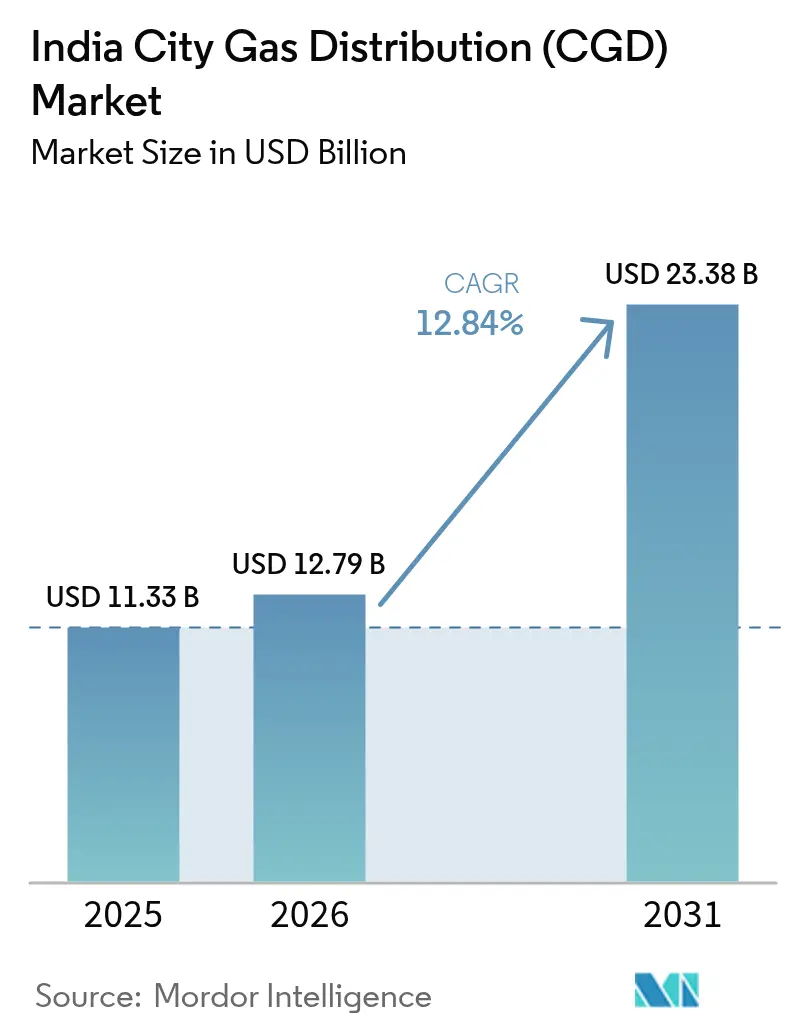
The India City Gas Distribution (CGD) Market size in 2026 is estimated at USD 12.79 billion, growing from 2025 value of USD 11.33 billion with 2031 projections showing USD 23.38 billion, growing at 12.84% CAGR over 2026-2031.
India's City Gas Distribution infrastructure has witnessed substantial expansion as part of the nation's broader energy transition strategy. As of March 2023, the country's CGD network encompasses 5,665 CNG stations and serves over 11 million domestic connections, demonstrating significant infrastructure development. The government's ambitious vision to transform India into a gas-based economy aims to increase natural gas's share in the energy mix from 6% to 15% by 2030, driving unprecedented growth in CGD infrastructure development. The Petroleum and Natural Gas Regulatory Board (PNGRB) has authorized 295 geographical areas across 27 states and UTs, covering approximately 88% of the country's geographical area and 98% of its population.
The industrial sector continues to dominate natural gas consumption through the CGD network, with recent data showing industrial users consuming approximately 12.1 MMSCMD compared to 2.5 MMSCMD in residential and 0.67 MMSCMD in commercial sectors. This consumption pattern reflects the growing adoption of natural city gas as a cleaner fuel alternative in industrial processes, particularly in sectors such as steel manufacturing, textiles, and food processing. The government's focus on reducing industrial emissions and promoting sustainable manufacturing practices has been a key factor in driving this industrial consumption pattern.
Significant developments in regional City Gas Distribution infrastructure are reshaping the market landscape. In June 2023, Megha City Gas Distribution Private Limited achieved a milestone by inaugurating its 100th CNG station at Keesara, Rangareddy district in Telangana, with plans to expand to 400 CNG stations and 200,000 PNG connections nationwide by 2024. Additionally, in March 2023, the Tamil Nadu government appointed TIDCO as a nodal agency to develop a comprehensive policy for accelerating CGD projects, aiming to provide 2.28 lakh domestic connections and 2,785 CNG filling stations across all 38 districts.
The City Gas Distribution network in India is being supported by strategic infrastructure development initiatives. The government plans to expand the national CNG refilling network to 17,700 stations by 2030, covering both urban and rural areas. This expansion is complemented by the development of gas pipeline infrastructure, with India currently having 21,715 km of operational natural gas pipelines, 14,240 km under construction, and 34,135 km of authorized pipelines. This comprehensive infrastructure development approach is creating a robust foundation for sustainable market growth and improved accessibility to distribution of natural gas in India across various sectors.
Note: Market size and forecast figures in this report are generated using Mordor Intelligence’s proprietary estimation framework, updated with the latest available data and insights as of 2026.
India City Gas Distribution (CGD) Market Trends and Insights
Rising Demand for CNG-Powered Vehicles
The increasing adoption of CNG companies in India vehicles has been a significant driver for the city gas distribution market, particularly in the commercial transport sector. As of 2022, CNG-only vehicle sales reached 296,997 units, while petrol/CNG hybrid vehicle sales stood at 405,913 units, jointly accounting for 1.37% and 1.88% of all automobile sales, respectively. The three-wheeler transport segment dominates the CNG-only vehicle market, representing the largest share of sales, followed by light goods vehicles, demonstrating strong commercial sector adoption. This trend is supported by CNG's superior fuel efficiency, lower maintenance costs due to cleaner burning characteristics, and enhanced safety features in collision scenarios, making it particularly attractive for commercial fleet operators looking to maximize profitability.
The government's active promotion of CNG vehicles through various incentives and policies has further accelerated market growth. For instance, in May 2022, the West Bengal government announced the waiver of registration fees and additional taxes for CNG vehicle purchases until March 2024, making them more financially attractive to potential buyers. The infrastructure development has kept pace with this growing demand, with the country having 4,898 CNG stations as of August 2022, and ambitious plans to expand the network to 17,700 stations by 2030, covering both urban and rural areas. This expansion is particularly significant as CNG vehicles help reduce environmental impact, with each CNG sale replacing approximately 2,250 kiloliters of petrol daily, according to industry estimates. The combination of economic benefits, government support, and environmental advantages positions CNG vehicles as a viable alternative in India's transportation sector, driving sustained growth in the CGD sector.
Moreover, the CNG market size in India is expected to grow significantly as CNG gas companies in India continue to invest in infrastructure and technology. This growth is further supported by the expansion of the gas distribution network, which is crucial for meeting the rising demand for CNG-powered vehicles.
Segment Analysis
CNG Segment in India City Gas Distribution Market
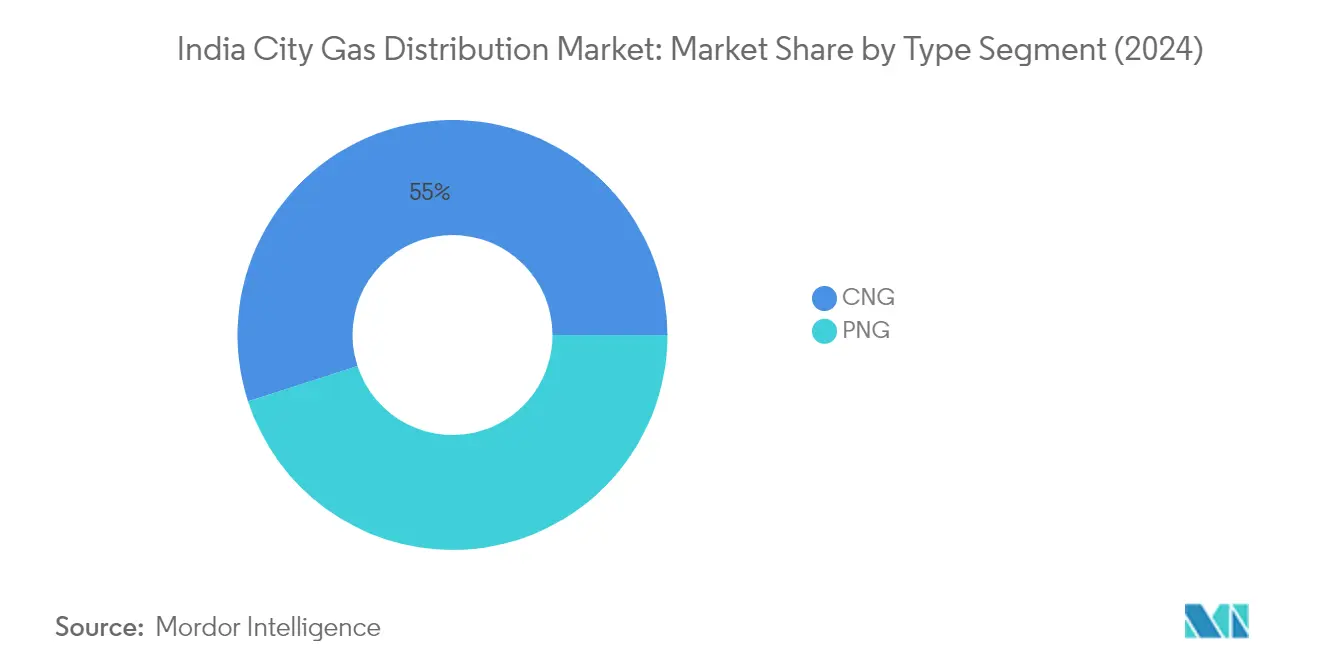
Compressed Natural Gas (CNG) has emerged as the dominant segment in India's city gas distribution market, commanding approximately 54.38% of the total market share in 2025. The segment's prominence is primarily driven by the increasing adoption of CNG vehicles across the country, particularly in the commercial transport sector, where rising prices of refined oil products have incentivized the switch to CNG-fired vehicles. As of March 2023, India has established a robust network of 5,665 CNG stations, with Gujarat leading the infrastructure development, followed by Uttar Pradesh. The government's mandate for stricter emission standards for new internal combustion engine (ICE) vehicles and the Cabinet Committee on Economic Affairs' approval of a new domestic natural gas pricing plan in April 2023, which reduced CNG costs by approximately 10% across the country, have further strengthened this segment's market position. CNG companies in India are pivotal in this transition, contributing to the segment's growth.
PNG Segment in India City Gas Distribution Market
Pipeline Natural Gas (PNG) represents the fastest-growing segment in India's city gas distribution market, projected to expand at approximately 14.46% annually from 2025 to 2031. This remarkable growth trajectory is supported by the government's aggressive expansion of PNG infrastructure through various bidding rounds under the Petroleum & Natural Gas Regulatory Board (PNGRB). The completion of work allocated in the 11th and 11A bidding rounds is expected to significantly boost PNG connectivity across 295 geographical areas, covering about 88% of the country's geographical area and 98% of its population. The segment's growth is further catalyzed by increasing industrial demand, where PNG serves as a cleaner alternative to traditional fuels, and rising domestic connections driven by its cost-effectiveness and environmental benefits compared to LPG. PNG companies in India are instrumental in driving this expansion, ensuring widespread access to cleaner energy.
Segment Analysis: End User
Automotive Segment in India City Gas Distribution Market
The automotive segment dominates the India city gas distribution network, accounting for approximately 54% of the total market share in 2024. This significant market position is primarily driven by the increasing adoption of CNG vehicles across the country, particularly in major metropolitan areas. The segment's dominance is further strengthened by various government initiatives promoting CNG as an alternative fuel source, including mandates for CNG-operated taxis in regions like the National Capital Region (NCR). The automotive sector's growth is also supported by the expanding network of CNG filling stations, which reached over 5,665 stations across India as of March 2023. Major automobile manufacturers like Maruti and Hyundai are actively contributing to this growth by expanding their CNG vehicle portfolios, with projections suggesting that CNG vehicles could represent up to 50% of total vehicle sales in India by 2030.
Industrial Segment in India City Gas Distribution Market
The industrial segment represents the second-largest share in the CGD market, with significant potential for expansion across various manufacturing sectors. This segment primarily utilizes natural gas for heating purposes in industries such as steel manufacturing, tea processing, and brick production. The growth in this segment is being driven by the increasing number of small and medium-scale industries, supported by government initiatives such as the Emergency Credit Line Guarantee Scheme (ECLGS) and various financial assistance programs. The industrial sector's expansion is also facilitated by the government's push towards cleaner fuel alternatives and the implementation of stricter emission norms for industrial operations. Gas distribution companies play a crucial role in facilitating this transition to cleaner energy sources.
Remaining Segments in End User Segmentation
The residential and commercial segments, while smaller in market share, play crucial roles in the overall CGD market ecosystem. The residential segment is experiencing steady growth through the expansion of PNG connections to households, offering advantages such as uninterrupted gas supply and lower maintenance costs compared to traditional LPG systems. The commercial segment, primarily comprising hotels, restaurants, and other business establishments, is witnessing increased adoption of PNG connections due to its cost-effectiveness and environmental benefits. Both segments are benefiting from the government's ongoing initiatives to expand the CGD network and increase PNG accessibility across urban and semi-urban areas.
Regulatory Landscape
India's city gas distribution (CGD) sector is regulated by the Petroleum and Natural Gas Regulatory Board (PNGRB) under the PNGRB Act, 2006. PNGRB oversight covers CGD network authorizations, technical and safety compliance, and tariff determination. Under the PNGRB CGD Authorization Regulations (2008, as amended including April 2025 amendments), each Geographical Area (GA) award is linked to a committed work program and timelines, with build-out obligations for pipelines, CNG stations, and PNG connections monitored by the regulator.
Policy and operational rules continue to evolve to support network rollout and standardize commercial terms. In March 2026, the Government of India issued the Natural Gas and Petroleum Products Distribution Order, 2026 (S.O. 1536(E)), aimed at streamlining permissions to enable faster last-mile pipeline and associated facilities development. For economic regulation, PNGRB uses unified tariff mechanisms for pipeline transportation and in February 2026 issued a Unified Tariff (UFT) order that adjusted tariff paths and ratios for major pipeline systems (including GAIL and GSPL), supporting more consistent transport charging across interconnected networks feeding CGD operations.
Value Chain Analysis
The CGD value chain begins with upstream and midstream gas availability and access, then moves through pipeline transportation (trunk and regional pipelines) into city gate stations. From there, gas is distributed via intra-city steel/MDPE pipeline networks and converted into CNG dispensing infrastructure. For priority segments such as CNG and PNG-domestic, sourcing is supported through the administered price mechanism (APM) allocation framework, while other demand is met through a mix of domestic supply and imported LNG-based sourcing. This makes price and availability management a core operating task for CGD entities.
Downstream execution centers on last-mile network build and customer acquisition. Government programs such as the National PNG Drive 2.0 (extended through June 2026) and operator-led acceleration initiatives, for example Indraprastha Gas Limited increasing the pace of daily PNG activations in Delhi-NCR during 2026, show how installation capacity, contracting of conversion work, and customer onboarding shape value realization. Network expansion also depends on rights-of-way, road-cut permissions, and adherence to PNGRB technical and safety standards. At the same time, supply-chain integration is widening, including GAIL's CBG-CGD synchronisation scheme that enables injection of compressed biogas into CGD networks and adds a parallel feedstock pathway alongside conventional natural gas.
Competitive Landscape
Top Companies in India City Gas Distribution Market
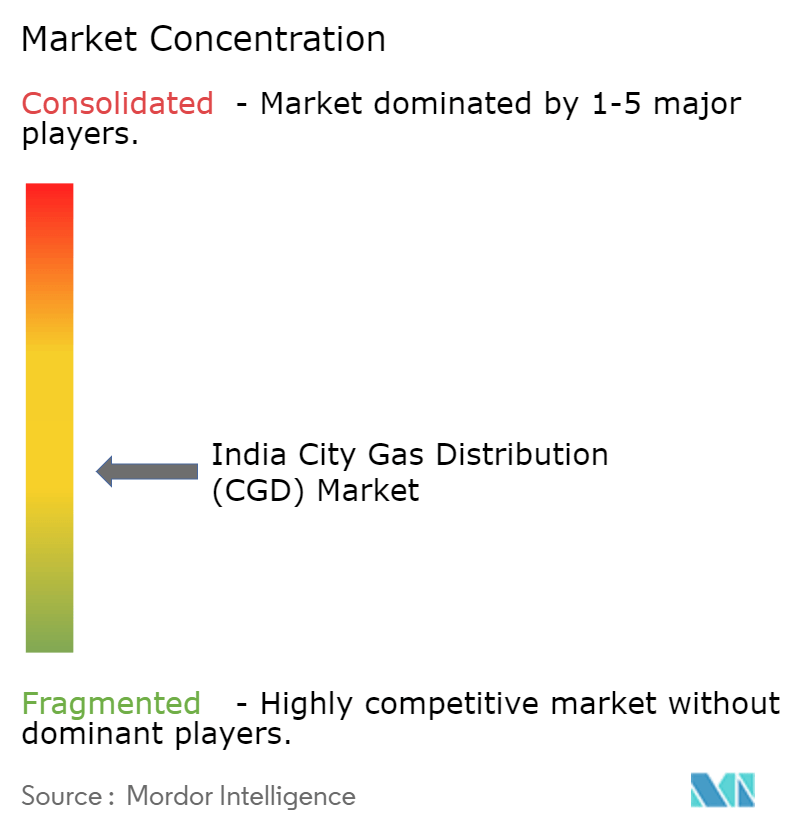
The Indian city gas distribution companies in India market is led by established players like Indraprastha Gas Limited, GAIL Gas Limited, Mahanagar Gas Ltd, and Adani Total Gas Ltd. These top gas distribution companies in India are focusing on expanding their geographical presence through strategic acquisitions and joint ventures to capture new territories and customer bases. Product innovation is primarily centered around developing advanced CNG/PNG infrastructure and implementing digital solutions for improved customer service. Operational agility is demonstrated through the hub-and-spoke distribution model, innovative gas supply methods including cryogenic cylinders, and composite dispensing units. Companies are also investing in backward integration by setting up manufacturing units for allied equipment like gas meters and compressors. The market is witnessing increased collaboration between public and private entities to develop city gas distribution networks across various geographical areas.
Public-Private Partnership Drives Market Growth
The Indian city gas distribution market exhibits a mix of public sector undertakings and private players, with a strong presence of government-backed companies through joint ventures. The market structure is characterized by regional monopolies where authorized entities have exclusive rights to operate in specific geographical areas. Many leading players are joint ventures between state-owned enterprises and private companies, combining public sector reliability with private sector efficiency. The market is witnessing increasing consolidation through strategic partnerships and acquisitions, as demonstrated by recent moves like Mahanagar Gas Limited's acquisition of Unison Enviro and the joint venture between Assam Gas Company and Oil India Limited.
The competitive landscape is evolving with the entry of new players through PNGRB's bidding rounds, though established players maintain their dominance through extensive infrastructure and experience. Market participants are increasingly forming strategic alliances to share resources, expertise, and infrastructure, particularly in new geographical areas. The industry is seeing a trend of vertical integration, with CGD companies expanding across the value chain from gas sourcing to end-user distribution. Companies are also diversifying into adjacent sectors like compressed biogas production and electric mobility to maintain a competitive advantage.
Innovation and Sustainability Drive Future Success
Success in the Indian city gas distribution market increasingly depends on technological innovation, operational efficiency, and environmental sustainability. Companies need to focus on developing smart infrastructure, implementing digital solutions for customer service, and optimizing their distribution networks to maintain a competitive advantage. Market players must also invest in renewable gas solutions and eco-friendly technologies to align with the government's clean energy objectives. Building strong relationships with automotive manufacturers, industrial customers, and residential developers is becoming crucial for maintaining market share. Companies need to develop robust risk management strategies to handle gas price volatility and supply chain disruptions.
New entrants can gain ground by focusing on underserved markets and developing innovative business models that address specific regional needs. Success factors include establishing efficient procurement strategies, developing strong local partnerships, and investing in customer service infrastructure. Companies must also prepare for potential regulatory changes, particularly around safety standards and pricing mechanisms. The ability to adapt to changing customer preferences, particularly in the automotive sector with the rise of electric vehicles, will be crucial. Future success will depend on companies' ability to balance expansion with operational efficiency while maintaining strong relationships with stakeholders across the value chain. The CGD business is poised for growth as companies adapt to these evolving market dynamics.
India City Gas Distribution (CGD) Industry Leaders
-
Indraprastha Gas Limited
-
Mahanagar Gas Ltd
-
GAIL Gas Limited
-
Gujarat Gas Ltd.
-
IndianOil-Adani Gas Pvt. Ltd.
- *Disclaimer: Major Players sorted in no particular order
Market Opportunities and Future Outlook
A primary opportunity is scaling PNG penetration through sustained connection drives and faster last-mile delivery. Government tracking shows 1.62 crore PNG domestic connections provided as of 31 January 2026 against a stated national target of 12.6 crore connections by 2032, and the reported daily installation rate moving beyond 9,000 connections supports contractor and operator capacity to expand conversion work. This creates scope to improve conversion capacity, standardize installation workflows, and reduce time-to-activate at the household and small-commercial level. PNGRB engagement on downstream appliances and safety, including its June 2024 roundtable on PNG stoves and retrofitted LPG stoves, also supports OEM alignment on burner specifications and safer retrofit pathways, which can improve conversion acceptance and reduce operational incidents.
On the supply and infrastructure side, larger named capex programs and corridor-led pipeline execution offer expansion platforms for CGD growth. BPCL's announced INR 25,000 crore plan (January 2026) for CGD build-out indicates continued investment in city networks, while GAIL's completion of the 694 km Mumbai-Nagpur Natural Gas Pipeline along the Samruddhi Mahamarg utility corridor provides a workable model for routing new pipelines with fewer land constraints. That approach can support new city gate feeds and network densification. A related opportunity is gas diversification within CGD systems through CBG injection programs, such as GAIL's synchronisation scheme, which can let CGD entities add local renewable gas supply options where producer ecosystems and injection infrastructure are in place.
Recent Industry Developments
- June 2026: THINK Gas reported completion of over 500 km of steel and MDPE pipeline network across the Kanchipuram and Chengalpattu Geographical Areas. The milestone strengthens last-mile readiness for adding PNG customers and CNG stations within its authorized areas, and it highlights execution pace as a differentiator in competitive bidding-era expansion.
- March 2026: The Government of India issued the Natural Gas and Petroleum Products Distribution (Through Laying, Building, Operation and Expansion of Pipelines and Other Facilities) Order, 2026 (S.O. 1536(E)). The order focuses on streamlining permissions and facilitating faster build-out of gas infrastructure, supporting quicker rollout of CGD pipelines and associated facilities across cities and residential clusters.
- June 2024: PNGRB held a stakeholder roundtable to assess the landscape for PNG stoves and retrofitted LPG stoves, involving CGD entities, academic institutions, and stove manufacturers. The discussions support appliance standardization and efficiency improvements that can reduce conversion friction for households and strengthen safety and compliance across expanding PNG networks.
Research Methodology Framework and Report Scope
Market Definition and Coverage
This market is defined as the revenue generated from city gas distribution (CGD) activities in India, where natural gas is delivered through local networks as Piped Natural Gas (PNG) and Compressed Natural Gas (CNG) to end users.
Scope exclusions: Upstream natural gas production, long distance transmission, and LNG terminal operations are excluded from this sizing unless they are billed as part of local CGD supply to end users.
Segmentation Overview
- Type
- Pipeline Natural Gas (PNG) Connections
- Compressed Natural Gas (CNG) Connections
- End User
- Automotive
- Residential
- Commercial
- Industrial
Data Sources, Market Sizing, and Validation
Desk Research
Desk research was used to build the basic fact base on gas demand, infrastructure rollout, and regulatory direction, which then guided how we set the demand pool and revenue boundaries. We relied on public sources such as PNGRB notifications and CGD authorization updates, the Petroleum Planning and Analysis Cell (PPAC) statistics, and releases from the Ministry of Petroleum and Natural Gas to track network expansion and policy targets.
To sense-check consumption direction and exposure to price swings, we also referred to company annual reports and investor presentations, audited financial statements, and credible business press coverage on tariff changes and CGD capex plans. For specific checks, we used paid subscriptions for company financials and intelligence, patent databases, and an import export shipment-level database to validate parts of the supply chain that influence delivered gas economics. These desk research sources are illustrative only, and other public references were used for data collection, cross-checking, and clarifying open questions.
Primary Interviews and Surveys
Primary work focused on validating how CGD revenue is recognized across PNG and CNG, how connection additions translate into billed volumes, and how margins change with gas sourcing mix and regulated pricing. Interviews and surveys covered operators, EPC and equipment ecosystem participants, and informed buyers across residential, commercial, industrial, and mobility demand, and the insights were rechecked across India to avoid one-state bias.
Distribution of primary research fieldwork respondents
| Company type | Respondent position |
|---|---|
| Top tier: 37% | CXOs: 13% |
| Mid tier: 48% | Functional/Unit leaders: 30% |
| Smaller Players: 15% | Managers: 57% |
Market-Sizing & Forecasting
The sizing model starts from a top-down demand reconstruction, where regulatory coverage and rollout pace are translated into addressable consumption for PNG and CNG, and then monetized using observed pricing and margin structures. To keep the totals realistic, we corroborated outputs with selective bottom-up checks such as sampled operator revenue build-ups, station and connection density checks, and indicative volume times average realized price calculations that were adjusted for mix.
Key inputs used in the model include PNG household connections added, CNG station count and throughput trends, authorized geographic area coverage, gas sourcing mix (domestic gas versus RLNG), and typical delivered price movement by customer class. Where data was thin for newly authorized areas, penetration and utilization curves were applied, then refined using interview feedback on ramp-up timelines and constraints.
For forecasting, scenario analysis was used to reflect differences in rollout speed, the gas price environment, and policy enforcement, and the final forecast path was kept aligned to the most consistent operator and regulator signals. Assumptions were documented at the variable level so the model can be repeated and updated with fresh disclosures.
Data Validation & Update Cycle
Outputs are validated through cross-checks across multiple independent signals, including regulator authorizations, operator disclosures, and observable network build indicators, and then variances are reviewed before sign-off. When a result moves outside expected ranges, the drivers are re-opened and respondents are re-contacted to confirm whether the shift is structural or temporary.
The report is refreshed annually, and interim updates are made when material events occur, such as major policy actions, large geographic area awards, or sharp input gas price changes. Before delivery, a final analyst pass is completed so the latest public updates are reflected in the numbers and commentary.
Mordor Intelligence's India City Gas Distribution Market Size Compared With Other Published Estimates
Published market sizes for India city gas distribution often do not match, even when the topic name looks the same, because the counted revenue pool and the year labeling can differ. Differences also show up when one estimate is built more from stated targets, while another is anchored to realized volumes and billed connections.
PNGRB authorization updates, reported PNG connection additions, and CNG station rollout are the evidence checks that keep Mordor Intelligence's estimate tied to billed CGD activity rather than broader value-chain spending that may not show up as distribution revenue in the same year.
Benchmark comparison
| Source | Market Size | Gaps in Research Methodology |
|---|---|---|
| Mordor Intelligence | USD 12.79 B (2026) | |
| Industry Publisher A | USD 12.45 B (2025) | This figure is stated for 2025 and appears to describe a broader CGD value chain view, which can blend distribution revenue with adjacent services and solutions, and it can also shift totals due to a different base year. |
| Industry Publisher B | USD 10.87 B (2024) | This estimate uses a 2024 base and a longer dated history window, and the model framing can be more conservative if penetration and throughput ramps are applied uniformly across newly covered areas rather than being adjusted by operator ramp-up realities. |
Taken together, the spread is mainly explained by year selection and how tightly the revenue boundary is drawn around realized PNG and CNG delivery. By keeping inputs traceable to rollout and consumption signals and validating with operator-side checks, our estimate stays easier to reproduce and update when new regulatory and company disclosures come out.
Key Questions Answered in the Report
How big is the India City Gas Distribution Market?
The India City Gas Distribution Market size is expected to reach USD 12.79 billion in 2026 and grow at a CAGR of 12.84% to reach USD 23.38 billion by 2031.
What is the current India City Gas Distribution Market size?
In 2026, the India City Gas Distribution Market size is expected to reach USD 12.79 billion.
Who are the key players in India City Gas Distribution Market?
Indraprastha Gas Limited, Mahanagar Gas Ltd, GAIL Gas Limited, Gujarat Gas Ltd. and IndianOil-Adani Gas Pvt. Ltd. are the major companies operating in the India City Gas Distribution Market.
What years does this India City Gas Distribution Market cover, and what was the market size in 2025?
In 2025, the India City Gas Distribution Market size was estimated at USD 11.33 billion. The report covers the India City Gas Distribution Market historical market size for years: 2019, 2020, 2021, 2022, 2023, 2024 and 2025. The report also forecasts the India City Gas Distribution Market size for years: 2026, 2027, 2028, 2029, 2030 and 2031.