
Market Overview
| Study Period | 2020 - 2031 |
|---|---|
| Forecast Data Period | 2026 - 2031 |
| Base Year Market Size (2025) | USD 123.99 Billion |
| Market Size (2026) | USD 134.8 Billion |
| Market Size (2031) | USD 204.76 Billion |
| Growth Rate (2026 - 2031) | 8.72 % |
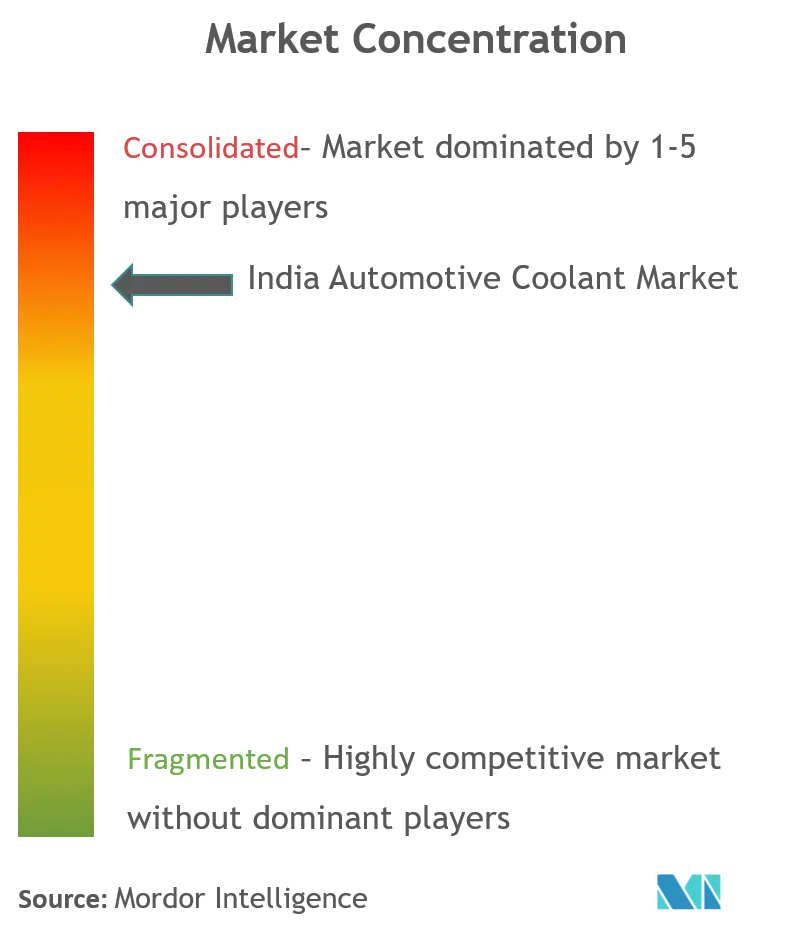
| Market Concentration | High |
Major Players *Disclaimer: Major Players sorted in no particular order Image © Mordor Intelligence. Reuse requires attribution under CC BY 4.0. | |
India Automotive Coolant Market Analysis by Mordor Intelligence
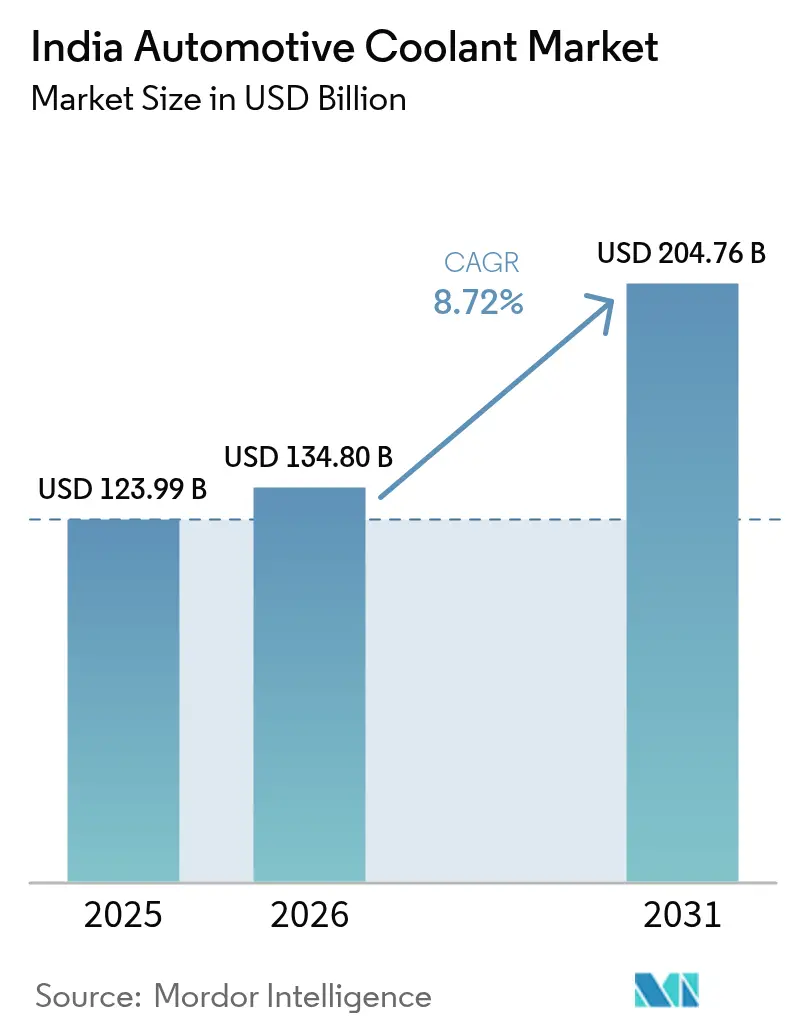
The India Automotive Coolant Market size was valued at USD 123.99 billion in 2025 and estimated to grow from USD 134.8 billion in 2026 to reach USD 204.76 billion by 2031, at a CAGR of 8.72% during the forecast period (2026-2031).
The India Automotive Coolant Market size is estimated at USD 123.99 billion in 2025, and is expected to reach USD 189.20 billion by 2030, at a CAGR of 8.82% during the forecast period (2025-2030).
- The COVID-19 outbreak impacted the market negatively, as the demand for automobiles during the lockdown period declined to almost zero for the first time. The production of vehicles was also halted in order to maintain the social distancing norms and prevent the spread of the virus. However, with the rising consumer demand for automobiles, combined with the restart of manufacturing activity, has resulted in a resurgence in the automotive coolant industry.
- With the growing demand for vehicles and government incentives to original equipment manufacturers (OEMs) to promote the Make in India initiative, several OEMs from across the world are investing heavily in the country to set up their production units to meet the local and global demand. The other factor acting as a market driver is the increasing average age of vehicles on the road.
- Ethylene glycol is the most preferred automotive coolant. However, it is highly toxic and requires careful disposal. Therefore, the coolant industry began manufacturing less toxic coolants. The passenger cars segment is expected to grow at a high rate due to the high demand for cars in the country.
Note: Market size and forecast figures in this report are generated using Mordor Intelligence’s proprietary estimation framework, updated with the latest available data and insights as of 2026.
India Automotive Coolant Market Trends and Insights
Increasing Investment in the Automobile Sector in the Country
- In order to keep up with the growing demand, several automakers have started investing heavily in various segments of the industry during the last few years. With the FDI policy for the automobile sector allowing 100% foreign domestic investment (FDI) under the automatic route, FDI equity inflows in the automobile industry are increasing at a high rate.
- Several global original equipment manufacturers (OEMs) are investing in the country either through joint ventures with established players or, after the relaxation of FDI norms, investing directly in setting up their own production units or enhancing the sales and dealership networks across the country. Some of the recent/planned investments and developments in the automobile sector in India are as follows:
- In February 2022, the government received an investment proposal worth INR 45,016 crores (USD 6.04 billion) from 20 automotive companies under the PLI Auto scheme. This scheme is expected to create an incremental output of INR 2,31,500 crore (USD 31.08 billion).
- The Indian government has outlined USD 7.8 billion for the automobile and auto component sector in Production-Linked Incentive (PLI) schemes under the Department of Heavy Industries.
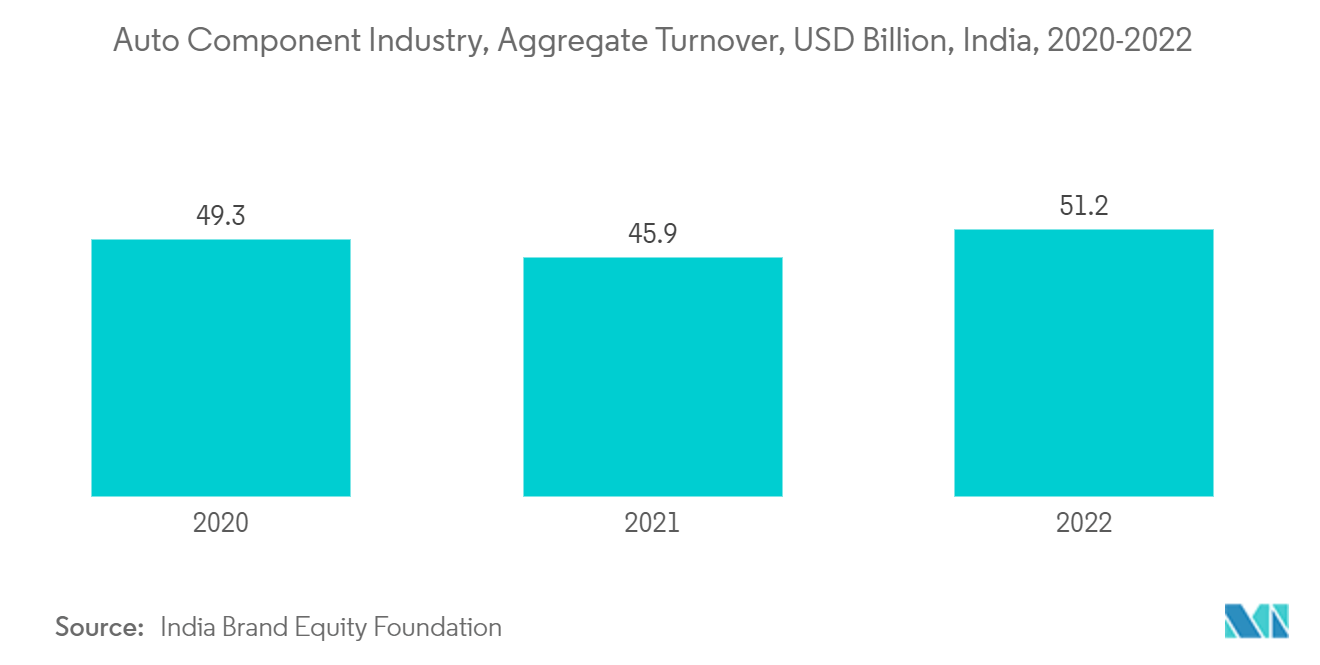
- With the growing investments in the automotive sector, the production of automobiles in the country is expected to ramp up to meet the growing demand. The trend is expected to continue during the forecast period.
Ethylene Glycol Segment Captures the Largest Market Share
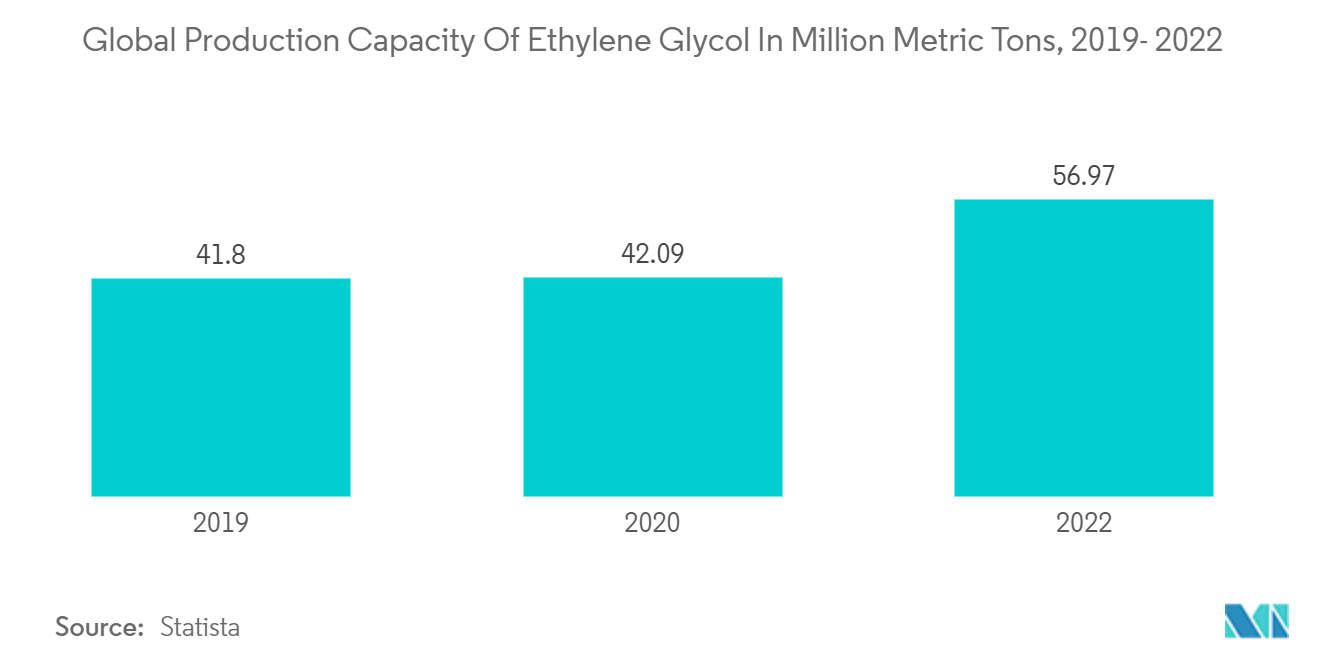
- Ethylene glycol is a toxic material that can lead to birth defects, reproductive damage, or even death. Thus, it requires very careful handling.
- It has many commercial and industrial applications, including anti-freeze and coolant. It prevents the car's engine from freezing in the winter and acts as a coolant to reduce overheating. Some of the ethylene glycol-based coolants available in India are:
- The Wuerth anti-freeze coolant is being adopted in Indian, Japanese, American, European, and Korean vehicles by various automakers. The color of the oil is green, and it is ethylene glycol based.
- The Euroils Euro Turbo Cool Coolant Concentrate Green with ethylene glycol base makes it ideal for radiators. The oil has an oil-to-water dilution ratio of 1:2. With the increasing adoption of ethylene glycol-based coolants in automobiles due to its cost advantage over propylene glycol, the segment is expected to grow at a high rate.
Regulatory Landscape
In India, product quality for antifreeze radiator coolants is anchored by Bureau of Indian Standards (BIS) specifications, notably IS 5759:2006, which sets performance requirements and test methods that manufacturers and buyers use as a common reference. BIS compliance for many chemical products is generally voluntary unless brought under mandatory enforcement through Quality Control Orders (QCOs) notified by the Department of Chemicals and Petrochemicals under the BIS Act, 2016, which keeps suppliers attentive to evolving conformity requirements.
On the vehicle system side, the Ministry of Road Transport and Highways (MoRTH) framework includes Automotive Industry Standards such as AIS-082 (issued under the Automotive Industry Standards Committee), which defines requirements for IC engine coolant hoses and links coolant performance to broader cooling-system integrity. For handling and import of coolant chemistries and additives, manufacturers and importers also operate under the Manufacture, Storage and Import of Hazardous Chemical Rules, 1989 (and amendments), which shape labeling and safety data practices. In addition, Government e-Marketplace (GeM) procurement specifications for engine coolant define technical parameters, steering institutional demand toward standardized formulations.
Competitive Landscape
The intensity of competitive rivalry is high due to the presence of domestic and international players in the market. Some of the major players in the automotive coolant market include India Oil Corp., Castrol, Exxon Mobil, and Valvoline. Additionally, some OEMs, like Audi, BMW, VW, and Suzuki, supply coolants under their own brands, further impacting the competitive landscape. For instance, India's largest passenger carmaker, Maruti Suzuki India (MSIL), launched Ecstar, Suzuki's global brand of lubricants, coolants, and car care products in the country.
India Automotive Coolant Industry Leaders
-
Indian Oil Corp. Ltd
-
Castrol Limited
-
ExxonMobil Corp.
-
Valvoline LLC
-
Motul
- *Disclaimer: Major Players sorted in no particular order
Market Opportunities and Future Outlook
EV penetration and high-heat management needs are widening the addressable space beyond conventional IC engine cooling, particularly after India recorded 4.4 million registered electric vehicles as of August 2024. Incentives for domestic vehicle and component manufacturing under the Department of Heavy Industries also continue to support capacity buildup, alongside the PLI-Auto framework and its January 13, 2026 amendment. The amendment updated BEV performance criteria alignment with PM E-DRIVE and FAME-II norms, raising the bar for thermal management performance across the value chain.
Regulatory and policy moves tied to durability and circularity are creating additional space around coolant formulation, compatibility, and end-of-life handling. NITI Aayog has highlighted the formalization of end-of-life vehicle (ELV) ecosystems and extended producer responsibility timelines (15 years for transport, 20 years for non-transport), which supports organized coolant collection, testing, and recycling services linked to dismantling and refurbishing networks. For materials and corrosion protection, the May 4, 2026 BIS CMVR Amendment No. 2 requiring AI-driven validation for automotive corrosion inhibitors (for tropical coastal environments) points to more data-backed qualification. This is pushing suppliers to strengthen testing and digital validation capabilities, which can also be used to differentiate coolant inhibitor packages and long-life formulations for Indian operating conditions.
Recent Industry Developments
- February 2026: ExxonMobil expanded its collaboration with Infosys to develop and deploy immersion cooling fluids for data centers. While this is outside conventional vehicle service fill, it strengthens local capability around advanced heat-transfer fluids and can spill over into higher-performance thermal management formulation and testing know-how in India.
- February 2026: Castrol India stated that it is running pilot projects for data center immersion cooling fluids with large hyperscalers in India. The pilots show active customer validation cycles for next-generation cooling liquids and reinforce the role of local application engineering in tailoring thermal fluids to Indian conditions.
- August 2024: Shell Lubricants launched e-thermal fluids for electric vehicles in India. This broadened the availability of EV-focused thermal management fluids and supported the transition from conventional engine coolants toward specialized fluids for electrified powertrain and electronics cooling needs.
Research Methodology Framework and Report Scope
Market Definition and Coverage
For this study, the market covers automotive coolants sold and used in India for passenger cars and commercial vehicles, across OEM fill and service replacement demand. We size the market in value terms based on coolant chemistry sold into the automotive engine cooling application.
Scope exclusions: We exclude non-automotive antifreeze uses, industrial heat transfer fluids, and adjacent auto fluids such as engine oils, brake fluids, and washer fluids.
Segmentation Overview
- Vehicle Type
- Passenger Cars
- Commercial Vehicles
- Chemical Type
- Ethylene Glycol
- Propylene Glycol
Data Sources, Market Sizing, and Validation
Desk Research
Desk work starts with mapping India vehicle activity that creates coolant demand, and then linking it to realistic replacement behavior and pricing. We used public datasets and official references such as Society of Indian Automobile Manufacturers (SIAM) statistics, Government of India transport road statistics, Central Pollution Control Board (emissions and compliance signals), and customs trade statistics from the Directorate General of Commercial Intelligence and Statistics.
Alongside this, we reviewed company annual reports and investor presentations to understand product mix, channel focus, and recent capacity or distribution moves. Patent and journal literature was used as a sense check on formulation shifts (ethylene glycol versus propylene glycol) and on typical service-life claims that can influence drain intervals. We also used a paid subscription for company financials and another for shipment-level import and export checks where HS-code mapping was workable. The sources listed here are illustrative, and many other public documents were also used for clarification, back-checks, and validation.
Primary Interviews and Surveys
Primary work was used to validate how coolants are bought and priced in India, especially the split between OEM fill, workshops, and retail-led replacement. We spoke with a mix of formulators, distributors, service-network stakeholders, and vehicle maintenance decision makers to confirm drain intervals, pack-size mix, and typical discounting patterns, and then we used these inputs to confirm the demand build and adjust assumptions where the desk view looked stretched.
Distribution of primary research fieldwork respondents
| Company type | Respondent position |
|---|---|
| Top tier: 38% | CXOs: 18% |
| Mid tier: 41% | Functional/Unit leaders: 31% |
| Smaller Players: 21% | Managers: 51% |
Market-Sizing & Forecasting
We built the market using a top-down demand reconstruction, where India vehicle parc and annual additions are translated into coolant consumption through service intervals and average fill and top-up volumes, and then valued using blended realized prices. That first pass was corroborated with selective bottom-up approximations, including sampled SKU price checks across channels and distributor-led volume ranges, which helped us tighten the totals and avoid over-counting parallel trade.
A few key inputs that shaped the model were vehicle parc by broad category, typical coolant drain interval by vehicle use, share of long-life formulations, average pack size mix in aftermarket purchases, and the spread between OEM-fill pricing and retail replacement pricing. When certain sub-pools did not have clean visibility, gaps were handled by using proxy ratios from similar vehicle cohorts and then rechecked through interviews until the implied per-vehicle consumption looked realistic.
For forecasting, scenario analysis was used so growth could be tied to vehicle production and sales momentum, shifts in coolant technology mix, and inflation-led price movement, and then refined based on the consensus ranges shared by industry participants. Where volatility was expected, like in glycol-linked input cost pass-through, the model was run with alternate pricing paths before a single central track was selected.
Data Validation & Update Cycle
Outputs were checked against independent signals such as vehicle parc trends, trade flows for relevant chemical inputs, and the implied per-vehicle coolant spend, and then reviewed for breaks that did not match how workshops actually behave. If a result looked unusual for a vehicle category or chemistry, we re-opened the assumption, revisited the supporting sources, and in some cases re-contacted respondents to confirm what changed.
Before sign-off, the model and write-up go through multi-step internal reviews so logic, units, and price-volume links stay consistent across years. Reports are refreshed annually, and interim updates are triggered when material events occur, such as sharp input cost changes, regulatory shifts, or major channel restructuring. Right before delivery, we do a fresh pass to make sure the final numbers reflect the latest available information.
Mordor Intelligence's India Automotive Coolant Market Size Compared Against Other Published Estimates
Published market sizes for automotive coolant in India can look far apart because the counted demand pool and the pricing basis are not always the same. Differences also show up when one source mixes coolant with adjacent thermal fluids, or when the year used for currency conversion and inflation treatment is not clearly stated.
The biggest gap drivers we saw were whether OEM factory fill is included along with replacement demand, whether the value is built from per-vehicle consumption and drain intervals versus just supplier revenues, and how ethylene glycol and propylene glycol mixes are priced over time. When these choices are not aligned, the same physical market can be reported as much smaller or much larger, especially in years where raw material pass-through changes quickly.
Benchmark comparison
| Source | Market Size | Gaps in Research Methodology |
|---|---|---|
| Mordor Intelligence | USD 123.99 B (2025) | |
| Trade Journal A | USD 63.00 M (2020) | This figure is based on an older year and is often presented as a narrow aftermarket-style view, which can miss OEM fill and does not fully reflect later price inflation and vehicle parc expansion. |
| Industry Portal B | USD 113.94 M (2025) | The estimate appears to center on passenger-car coolant only and can understate value if commercial vehicles, workshop top-ups, and channel-level price realization are not fully captured. |
The spread in the table mainly comes from time period alignment and what gets counted as automotive coolant demand in India, rather than from a single math step. When OEM fill plus replacement demand is valued using blended realized prices and then cross-checked against vehicle parc and service behavior, the resulting total becomes materially higher than narrow aftermarket-only snapshots, which is the approach applied here by Mordor Intelligence.
Key Questions Answered in the Report
How big is the India Automotive Coolant Market?
The India Automotive Coolant Market size is expected to reach USD 134.8 billion in 2026 and grow at a CAGR of 8.72% to reach USD 204.76 billion by 2031.
What is the current India Automotive Coolant Market size?
In 2026, the India Automotive Coolant Market size is expected to reach USD 134.8 billion.
Who are the key players in India Automotive Coolant Market?
Indian Oil Corp. Ltd, Castrol Limited, ExxonMobil Corp., Valvoline LLC and Motul are the major companies operating in the India Automotive Coolant Market.
What years does this India Automotive Coolant Market cover, and what was the market size in 2025?
In 2025, the India Automotive Coolant Market size was estimated at USD 123.99 billion. The report covers the India Automotive Coolant Market historical market size for years: 2019, 2020, 2021, 2022, 2023, 2024 and 2025. The report also forecasts the India Automotive Coolant Market size for years: 2026, 2027, 2028, 2029, 2030 and 2031.