
India Aroma Chemicals Market Size and Share
Market Overview
| Study Period | 2020 - 2031 |
|---|---|
| Forecast Data Period | 2026 - 2031 |
| Base Year Market Size (2025) | USD 323.62 Million |
| Market Size (2026) | USD 341.13 Million |
| Market Size (2031) | USD 444.52 Million |
| Growth Rate (2026 - 2031) | 5.41 % |
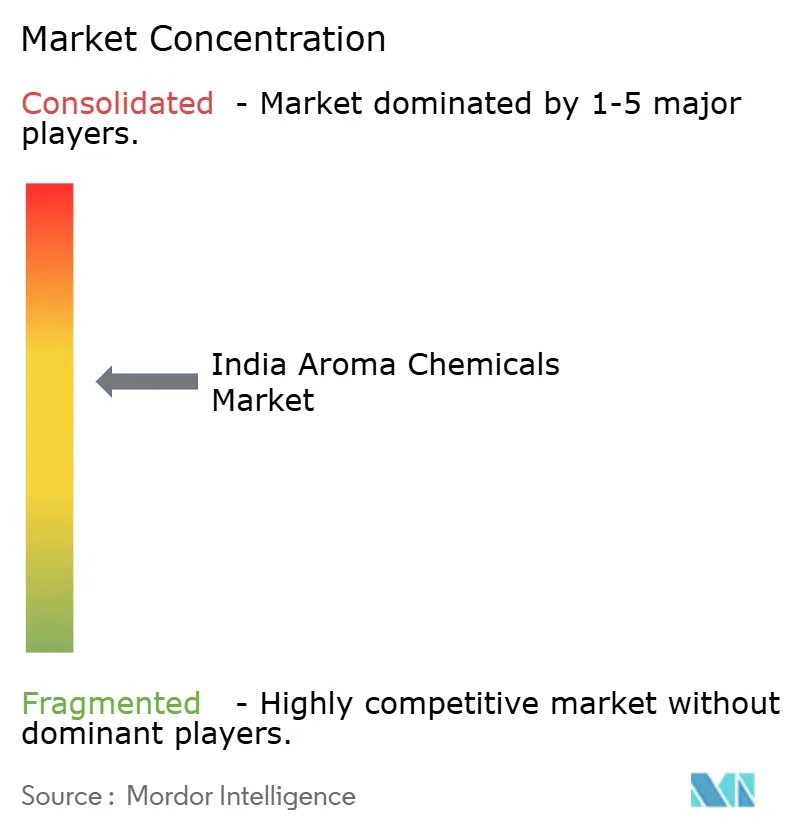
| Market Concentration | Medium |
Major Players *Disclaimer: Major Players sorted in no particular order Image © Mordor Intelligence. Reuse requires attribution under CC BY 4.0. | |
India Aroma Chemicals Market Analysis by Mordor Intelligence
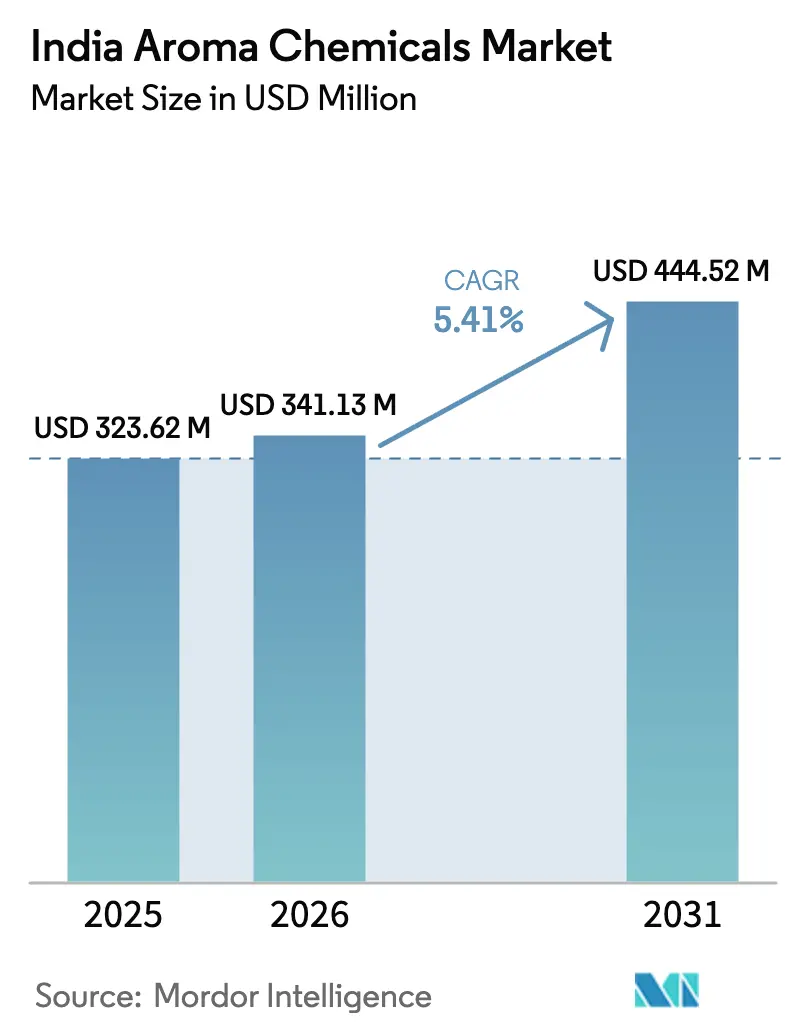
The India Aroma Chemicals Market size was valued at USD 323.62 million in 2025 and estimated to grow from USD 341.13 million in 2026 to reach USD 444.52 million by 2031, at a CAGR of 5.41% during the forecast period (2026-2031). This steady trajectory reflects rising premiumization in beauty, home care, and functional food categories that lean heavily on specialized molecules. Domestic producers benefit from Gujarat’s integrated petrochemical corridors and Maharashtra’s proximity to consumer-goods formulators, allowing reliable feedstock access and quick turnaround on bespoke orders. Demand is supported further by sustained exports of “Other Organic Compounds,” coupled with Production Linked Incentive schemes that reward capacity additions and technology upgrades. At the same time, tightening waste-management rules and volatile crude prices encourage investments in biotechnology and circular feedstocks that cushion cost swings while aligning with customer sustainability agendas.
Key Report Takeaways
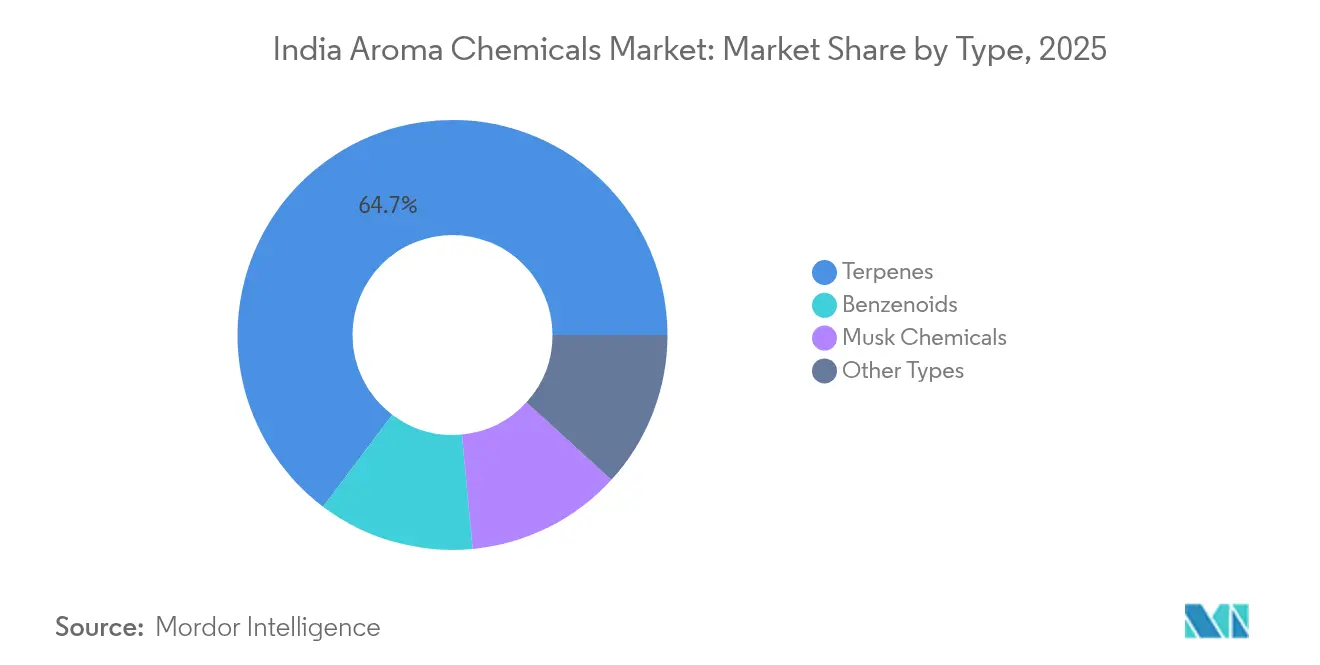
- By type, terpenes led with 64.72% revenue share of the India aroma chemicals market share in 2025; musk chemicals are projected to register the highest 5.94% CAGR through 2031.
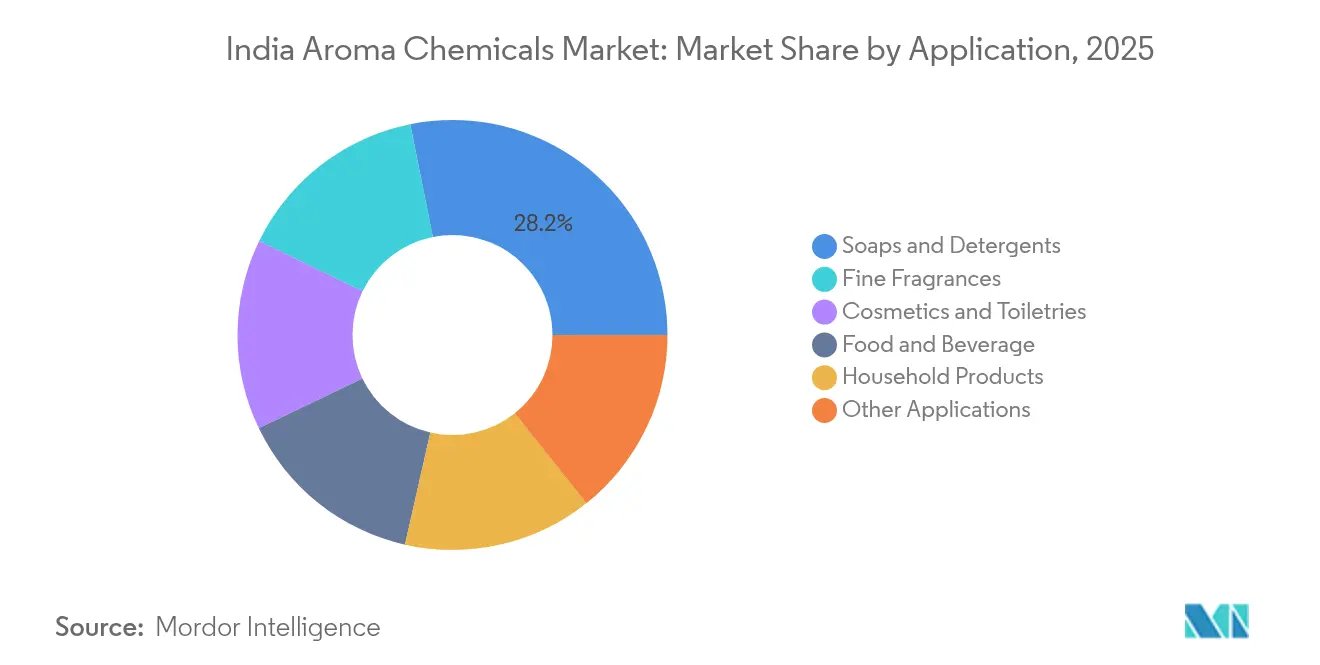
- By application, soaps and detergents accounted for 28.15% of the India aroma chemicals market size in 2025, while fine fragrances are advancing at a 5.98% CAGR through 2031.
Note: Market size and forecast figures in this report are generated using Mordor Intelligence’s proprietary estimation framework, updated with the latest available data and insights as of 2026.
Proportional positioning is established by comparing country level and regional contributions against the global total, including that of India. The aroma chemicals market share in our global report expresses these relative weights.
India Aroma Chemicals Market Trends and Insights
Drivers Impact Analysis*
| Driver | (~) % Impact on CAGR Forecast | Geographic Relevance | Impact Timeline |
|---|---|---|---|
| Rising demand from fine-fragrance formulators | +1.8% | National, with concentration in Mumbai, Delhi, Bangalore premium markets | Medium term (2-4 years) |
| Rapid growth of natural and "clean-label" personal-care brands | +1.2% | National, with early adoption in urban centers and tier-1 cities | Medium term (2-4 years) |
| Expansion of multifunctional home-care product lines | +0.8% | National, driven by rural penetration and urban premiumization | Long term (≥ 4 years) |
| Growing adoption of aroma chemicals in functional foods and beverages | +0.6% | National, with strength in Maharashtra, Tamil Nadu food processing hubs | Long term (≥ 4 years) |
| Synthetic-biology production scaling rare aroma molecules | +0.4% | Gujarat, Maharashtra manufacturing clusters with biotech capabilities | Long term (≥ 4 years) |
| Source: Mordor Intelligence | |||
Rising Demand from Fine-Fragrance Formulators
India’s fine-fragrance segment is growing at a 6.25% CAGR through 2030, outrunning other end uses as affluent consumers trade up to niche scents. Luxury beauty revenue is expected to reach USD 1.6 billion by 2028, signaling considerable headroom for complex aroma profiles requiring specialty terpenes, musks, and captive aldehydes. Givaudan’s South Asia arm recorded 20.9% like-for-like growth in 2024, while its Fragrance Ingredients division expanded 11.1%, underscoring sustained downstream pull for captive intermediates[1]. Mass players like Hindustan Unilever also emphasize fragrance-led SKU renovations, allowing domestic chemical suppliers to scale volume while moving up the value curve.
Rapid Growth of Natural and “Clean-Label” Personal-Care Brands
Clean-label momentum places biodegradable, botanically derived inputs over fossil-based synthetics in shampoos, lotions, and deodorants. Hindustan Unilever aims for 100% biodegradable ingredients by 2030, reshaping raw-material specifications and accelerating demand for terpene isolates from Indian flora. Symrise reached 95% biologically sourced raw materials in 2024, proving that large-scale natural supply chains can meet stringent quality thresholds. Indian extraction houses leverage abundant lemongrass, palmarosa, and mint feedstocks, positioning the India aroma chemicals market to capture premium volumes as global formulators search for traceable supply.
Expansion of Multifunctional Home-Care Product Lines
India’s liquid detergents, fabric conditioners, and surface cleaners rely on fragrance for scent and to signal cleaning efficacy and added benefits. Hindustan Unilever’s Home Care unit posted INR 21,900 crore revenue in FY 2024, with continued investment in premium aromatics for concentrated formats that must deliver olfactory punch at lower dosage. Quick-commerce channels now account for nearly 75% of e-grocery shipments, accelerating consumer trial of fragrance-enriched SKUs that command higher ticket sizes.
Growing Adoption in Functional Foods and Beverages
The USD 307.2 billion processed-food sector is projected to climb toward USD 470-535 billion by 2028, which widens the addressable opportunity for flavor molecules and masking agents. Food Safety and Standards Authority of India’s 2025 packaging code compels traceability, favoring established aroma-chemical suppliers with certified quality systems. Nutraceutical GST cuts to 5% starting September 2025 stimulate innovations in fortified snacks and drinks, often requiring tailored aromas to offset off-notes.
Restraints Impact Analysis*
| Restraint | (~) % Impact on CAGR Forecast | Geographic Relevance | Impact Timeline |
|---|---|---|---|
| Volatile petrochemical feedstock prices | -0.9% | National, with highest impact on Gujarat, Maharashtra manufacturing hubs | Short term (≤ 2 years) |
| Tightened allergen-labelling rules in Europe and North America | -0.7% | Export-oriented manufacturers, particularly Gujarat chemical clusters | Medium term (2-4 years) |
| Supply-chain risk for natural precursors | -0.6% | National, with concentration in botanical raw material sourcing regions | Medium term (2-4 years) |
| Source: Mordor Intelligence | |||
Volatile Petrochemical Feedstock Prices
Crude-linked raw materials dictate cost curves for benzenoids and aldehydes, creating margin pressure when oil spikes. Although India plans to raise petrochemical capacity from 257 MMTPA to 310 MMTPA by 2028, near-term fluctuations continue to unsettle working-capital cycles, especially for smaller processors lacking long-term contracts. Integrated players with captive naphtha crackers in Gujarat enjoy relative insulation and can leverage scale economies to sustain exports.
Tightened Allergen-Labelling Rules in Europe and North America
EU regulations now compel detailed disclosure for 80+ fragrance allergens, raising analytical testing and documentation costs. Indian exporters must update Safety Data Sheets and invest in trace-level quantification equipment or risk losing contracts from global FMCG (fast-moving consumer goods) majors. Compliance burdens may accelerate consolidation as niche producers struggle with overheads.
*Our forecasts treat driver/restraint impacts as directional, not additive. The impact forecasts reflect baseline growth, mix effects, and variable interactions.
Segment Analysis
By Type: Terpenes Dominate Through Natural Advantage
The India aroma chemicals market size for terpenes exceeded two-thirds of the overall value in 2025, reflecting dependable access to lemongrass, palmarosa, and mint crops in Uttar Pradesh, Rajasthan, and Tamil Nadu. Scale in steam distillation plus backward linkages with essential-oil exporters reduces unit costs, enabling competitive pricing in both domestic and overseas tenders. Benzenoids remain integral for volume exports, leveraging Gujarat’s refinery integration for toluene and benzene derivatives. Musk chemicals command higher margins because of consistent performance in fine fragrances, and their 5.94% CAGR signals the wallet shift toward premium olfactory compounds. Atul Ltd extends its portfolio with perfumery-grade geraniol isolated from palmarosa, illustrating synergy between natural extraction and synthetic upgrades.
Price-sensitive soap formulators still drive bulk terpene orders, yet emerging biotech routes for rare lactones could tilt value toward specialty molecules over time. ISO-driven quality norms plus Bureau of Indian Standards benchmarks reinforce India’s export credibility, sustaining market access to Europe, the United States, and Japan. Forward integration into reaction-controlled derivatives such as linalyl acetate helps hedge raw-material volatility and deepens customer stickiness.

By Application: Fine Fragrances Accelerate Amid Premiumization
Fine fragrances posted the highest 5.98% CAGR, fed by rising disposable income and retail expansion of niche perfume boutiques across metros. Although soaps and detergents hold 28.15% of the India aroma chemicals market share, the incremental revenue slope is steeper in premium spray and roll-on formats that command 3-5 times higher per-kilogram fragrance cost. Cosmetics and toiletries manufacturers boost olfactory signatures to fend off me-too products, pushing demand for captive aldehydes and proprietary accords. Food and beverage users integrate vanilla, citrus, and spice notes to elevate functional drinks and fortified snacks, widening the end-market base.
Household products, especially fabric conditioners, rely on long-lasting encapsulated scent boosters, driving adoption of polymer-bound aroma microcapsules. The India aroma chemicals market size tied to those encapsulated systems is projected to expand with quick-commerce adoption, which skews toward premium sachets and small packs that promise heightened sensory payoff.
Geography Analysis
Gujarat and Maharashtra collectively account for roughly 70% of India's Aroma Chemicals market capacity, benefiting from refinery integration, port access, and experienced talent pools. Ankleshwar, Dahej, and Vapi clusters in Gujarat offer common effluent treatment plants and shared utilities, shortening the time to market for greenfield units. The state contributes 50% of India’s overall chemical output and 33% of electronics-grade specialty chemicals, giving aroma manufacturers a robust ecosystem for feedstock and ancillary services. Maharashtra hosts Privi Speciality Chemicals near Mumbai’s shipping lanes, catering to premium global clients that demand shorter lead times and extensive technical documentation.
Southern states leverage biotechnology and agricultural diversity. Tamil Nadu houses fermenter capacity to switch between pharmaceutical APIs and aroma molecules, allowing agile production of yeast-derived terpenes. Karnataka nurtures a start-up ecosystem around synthetic biology, supported by venture capital and state incentives for clean chemistry. Northern belts such as Uttar Pradesh supply lemongrass and palmarosa oils that feed into terpene synthesis, while Odisha and Andhra Pradesh lure investment through coastal chemical parks with logistics tax breaks.
Export patterns reflect regional specialization: Gujarat plants focus on high-volume benzenoid shipments to detergent formulators in Southeast Asia and the Middle East, whereas Maharashtra units export narrow-cut musks and aldehydes to European perfumers. Emerging clusters in the east target ASEAN duty advantages under trade agreements, indicating a gradual diffusion of capacity beyond the western seaboard. Regulatory factors also influence siting decisions; Gujarat’s Petroleum, Chemicals & Petrochemicals Investment Region offers simplified environmental clearances, while stricter coastal zone norms in other states may extend project timelines.
Mordor Intelligence examines the aroma chemicals market across diverse other regional markets as well, including North America, Europe, and Asia.
Value Chain Analysis
The India aroma chemicals value chain begins with hydrocarbon feedstocks (for benzenoids, aldehydes, and other intermediates) concentrated around Gujarat and Maharashtra petrochemical corridors, alongside botanical feedstocks (lemongrass, palmarosa, mint, and other essential-oil crops) sourced from multiple agricultural belts that supply terpene isolates and derivatives. Midstream activities include essential-oil extraction and fractional distillation, followed by chemical synthesis and hydrogenation or oxidation steps. For a subset of molecules, manufacturing increasingly incorporates biotechnology-enabled routes, with established chemical zones supporting production through shared utilities and effluent-treatment infrastructure. Quality assurance, analytical testing, and documentation become decisive for export-oriented lots, especially when downstream brand owners request traceability and allergen-related dossiers.
Downstream, aroma chemicals are supplied to domestic and multinational fragrance and flavor houses, FMCG formulators (soaps and detergents, home care, and cosmetics), and food and beverage manufacturers, with bulk logistics, containerized exports, and distributor networks supporting demand. Commercialization is also shaped by linkages with public R&D bodies and farmer integration, including CSIR programs such as CSIR-CIMAP and CSIR-IIIM, alongside the CSIR Aroma Mission framework that supports lab-to-field transfer for aromatic crops and processing know-how. Industry connection platforms such as the Aroma Industry-Farmer Meet at the CSIR Innovation Complex, Mumbai (09 May 2026) show how buyer-seller sessions are used to improve raw-material availability, promote technology adoption, and shorten the path from farm output to industrial aroma ingredients.
Competitive Landscape
The Indian Aroma Chemicals market is consolidated. Process technology and sustainability are emerging battlegrounds. Players adopt continuous-flow reactors, solvent-recovery loops, and bio-based feedstocks to meet brand-owner decarbonization targets. Government incentives through Production Linked Incentive schemes accelerate capacity build-outs, driving roughly 12% CAGR across specialty chemicals. Export competitiveness hinges on consistent quality certifications (ISO 9001, FSSC 22000) and robust Responsible Care implementation. Firms with integrated backward linkages and in-house R&D lines can swiftly tailor molecules to shifting allergen-labeling norms, comforting global FMCG customers seeking dependable, compliant supply.
India Aroma Chemicals Industry Leaders
-
International Flavors & Fragrances Inc.
-
BASF
-
Symrise
-
dsm-firmenich
-
Givaudan
- *Disclaimer: Major Players sorted in no particular order
Market Opportunities and Future Outlook
A key whitespace is deeper conversion of India-grown essential oils into higher-value aroma molecules and tailored derivatives. This shifts supply beyond commodity terpene isolates toward perfumery and functional applications that require tighter specifications and higher consistency. Programs under the CSIR Aroma Mission (often framed as AROMA 4.0) provide a pathway to scale aromatic-crop technologies and processing know-how into commercial supply chains. Coordination in 2026 through forums such as the Scientist-Industry Meet at CSIR-CIMAP, Lucknow (07 January 2026) and the Aroma Industry-Farmer Meet at the CSIR Innovation Complex, Mumbai (09 May 2026) helps processors and ingredient makers secure raw-material streams, align agronomy and post-harvest practices, and reduce the time from pilot work to routine manufacturing.
Opportunity also sits in expanding application-lab capabilities, creative centers, and localized manufacturing footprints that speed up co-development for India-focused and export SKUs. International players have been building India-facing infrastructure, including IFFs announced scent creative center in Mumbai (planned to be operational by H1 2026) and its expansion activity in Andhra Pradesh. Givaudan and Privi have also commissioned a fragrance ingredients facility at Mahad (operations started in October 2024) to add value-added output and scale over subsequent years. With tighter overseas allergen disclosure requirements and rising compliance and traceability expectations from domestic packaged-food and personal-care brands, Indian producers have room to differentiate through stronger analytics, documentation readiness, and product stewardship backed by standardized supply programs and higher-spec manufacturing.
Recent Industry Developments
- May 2026: IFF announced a ₹3,366 crore investment for a greenfield enzyme manufacturing facility at IFFCO Kisan SEZ in Nellore, Andhra Pradesh. The expansion of local aroma-chemical-related production supports India-based supply for enzyme-driven aroma processes and adds resilience through scale-up within the region.
- May 2026: BASF India Limited released audited annual results for FY 2025-2026, noting resilience in the chemicals portfolio amid pricing pressures. The disclosure points to profitability under pricing constraints, which can influence India-focused investment planning for aroma chemicals.
- April 2026: BASF announced the official launch of world-scale plants for menthol and linalool in Ludwigshafen, Germany. The launch increases global supply of key aroma compounds and strengthens BASF's position in global aroma chemicals alongside supply chain stability.
Research Methodology Framework and Report Scope
Market Definition and Coverage
For this study, the market is defined as the revenue earned from aroma chemicals sold into India for making fragrance and flavor formulations that are used across personal care, home care, and food related products.
Scope exclusions: This sizing excludes finished fragrances, essential oils and natural extracts sold as-is, and contract manufacturing services that do not involve aroma chemical sales.
Segmentation Overview
- By Type
- Terpenes
- Benzenoids
- Musk Chemicals
- Other Types
- By Application
- Soaps and Detergents
- Cosmetics and Toiletries
- Fine Fragrances
- Household Products
- Food and Beverage
- Other Applications
Data Sources, Market Sizing, and Validation
Desk Research
Desk work started with mapping India aroma chemicals demand using public chemistry and trade indicators, then aligning it with the end use build in the country. Inputs relied on official trade statistics such as India customs data and UN Comtrade, along with government releases from the Ministry of Chemicals and Fertilizers and the Department for Promotion of Industry and Internal Trade.
To keep assumptions anchored to real product handling, we also reviewed standards and safety references such as BIS notifications, select peer reviewed papers on fragrance ingredients, and association updates connected to the chemical and consumer goods ecosystem, plus annual reports, investor presentations, and reputed business press. For cross checks on company scale and product mix, paid subscriptions for company financials and intelligence, patent databases, and shipment level import export views were used where relevant. The sources listed here are illustrative only, and many other public and paid references were used to collect data, validate assumptions, and clarify open questions.
Primary Interviews and Surveys
Primary work was used to turn desk signals into sizing inputs, especially for India specific mix, pricing logic, and channel structure. We spoke with manufacturers, distributors, formulators, and downstream buyers so that demand drivers and substitution patterns could be checked and then applied consistently across the model. Interviews covered major producing and consuming states, and we also included export oriented viewpoints to confirm how local supply connects to regional demand cycles.
Distribution of primary research fieldwork respondents
| Company type | Respondent position |
|---|---|
| Top tier: 32% | CXOs: 17% |
| Mid tier: 50% | Functional/Unit leaders: 34% |
| Smaller Players: 18% | Managers: 49% |
Market-Sizing & Forecasting
Sizing was built using a mix of top down and bottom up checks. On the top down side, production and trade data were used to reconstruct apparent consumption in India, then adjusted using how much aroma chemical content typically sits inside key downstream categories. The total was stress tested using selective bottom up approximations such as sampled supplier revenue splits, channel checks with distributors, and volume by price builds for commonly traded molecules.
Key inputs used in the model included import export movement of fragrance and flavor intermediates, capacity additions and utilization talkpoints from industry participants, typical pricing bands by molecule families, the share of domestic versus imported supply, and demand pull from personal care, home care, and processed food growth. Where direct volume signals were missing, gaps were handled through proxy indicators such as consistent trade classifications, known substitution behavior between natural and synthetic notes, and interview led normalization of yield and loss factors. Forecasts were generated using scenario analysis supported by short time series smoothing on price and demand indicators, and the scenario weights were finalized after primary feedback on expected customer conversions and feedstock cost pass through.
Data Validation & Update Cycle
Validation was done through cross checks for logical consistency across demand, supply, and price. We compared model outputs to independent signals such as trade direction changes, capacity commissioning timelines, and downstream product output trends, and then investigated sharp variances before final sign off.
A multi step review was followed, including peer review of assumptions and back checks on unit math and currency conversions. When large deviations surfaced during interviews or desk updates, callbacks were triggered to confirm the driver and to reset the assumption with a clear rationale. Reports are refreshed annually, with interim updates when material events occur, and a final pre delivery review is done so clients receive the most current view.
Mordor Intelligence's India Aroma Chemicals Market Size Compared Against Other Published Estimates
Published market sizes for India aroma chemicals often differ because the counted boundary can shift between ingredient sales versus broader fragrance ingredient baskets, and because base years and currency timing are not always aligned. Differences in how exports, captive consumption, and contract manufacturing are treated also tend to widen the spread.
Trade movement patterns, capacity commissioning checks, and price band validation from distributor and formulator conversations are the evidence used to anchor Mordor Intelligence at the aroma chemical sales level, which keeps adjacent items like finished blends and natural extracts from being mixed into the same total.
Benchmark comparison
| Source | Market Size | Gaps in Research Methodology |
|---|---|---|
| Mordor Intelligence | USD 323.62 M (2025) | |
| Industry Publisher A | USD 276.10 M (2023) | Uses an earlier base year and a different forecast window, which can understate later demand inflections from new capacity and premiumization, and it does not clearly separate aroma chemicals from broader fragrance ingredient value. |
| Industry Publisher B | USD 291.30 M (2025) | Reports a nearby 2025 value but provides limited detail on how imports, exports, and captive internal transfers are netted, which can shift totals depending on whether only external sales are counted. |
The table shows that the largest gap is usually created by scope edges and timing, not by a single math step. By keeping the total tied to observable trade and capacity signals and by applying consistent pricing and consumption rules, the estimate stays easier to reproduce and to explain across use cases such as planning, sourcing, and investment.
Key Questions Answered in the Report
How large is the India aroma chemicals market in 2026?
The India aroma chemicals market size is USD 341.13 million in 2026 and is on track to reach USD 444.52 million by 2031.
What is the growth rate for aroma chemicals used in Indian fine fragrances?
Fine fragrances are advancing at a 5.98% CAGR, outperforming traditional soap and detergent applications.
Which product type holds the highest share in 2025?
Terpenes dominate with 64.72% of the India aroma chemicals market share thanks to abundant botanical feedstocks.
Where are most aroma-chemical plants located in India?
Gujarat and Maharashtra host about 70% of capacity, leveraging integrated petrochemical hubs and port logistics.
How are regulatory changes overseas affecting Indian exporters?
Stricter allergen-labeling rules in the EU and North America raise testing costs, favoring manufacturers with advanced analytical capabilities.