
Independent Artists Market Size and Share
Independent Artists Market Analysis by Mordor Intelligence
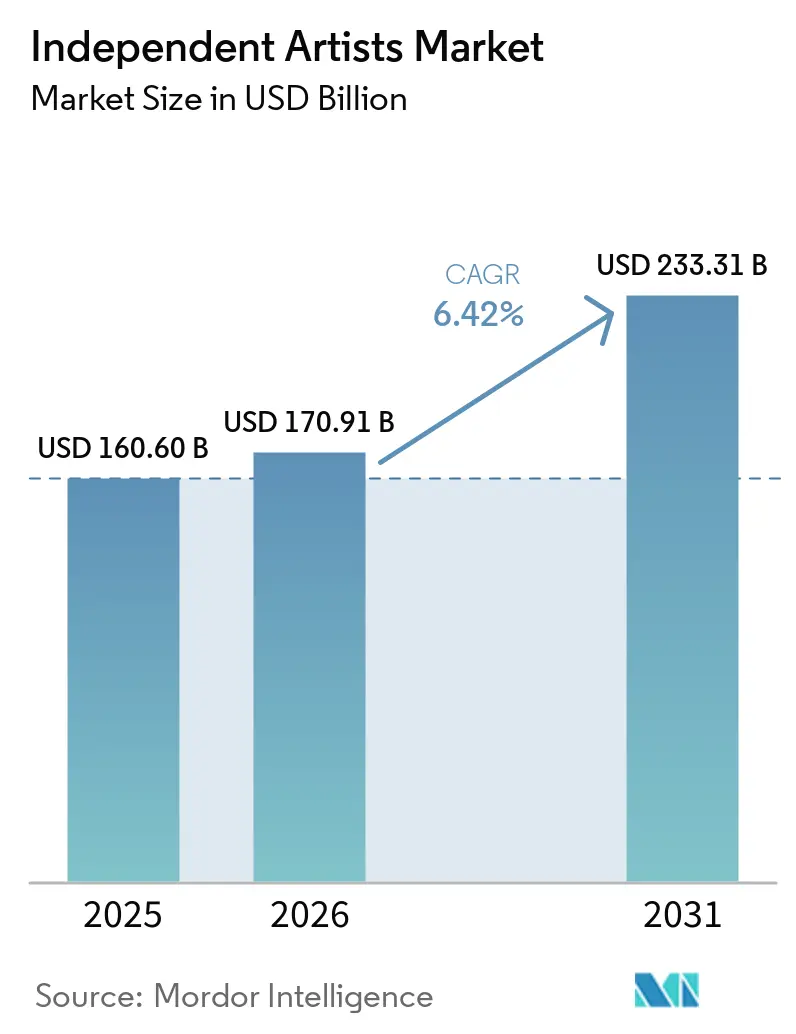
The independent artists market size is expected to increase from USD 170.9 billion in 2026 to USD 181.9 billion in 2027 and reach USD 244.3 billion by 2032, growing at a CAGR of 6.08% over 2027-2032.
AI-assisted music creation, recurring fan payments and ticketed concert viewing create more ways to build a commercial offer around an independent recording. In the United Kingdom, vinyl demand gives independent repertoire a physical product to sell alongside digital listening. Broader artist-service portfolios can connect these opportunities with distribution, development support and publishing administration, making the provider's role consequential beyond delivering a release. Fees and differentiated royalty rules constrain what artists retain, so the central commercial task is converting audience engagement into income that can sustain additional work.
Key Report Takeaways
- By revenue stream, streaming held a 41.27% independent artists market share in 2026, while the merchandise and physical formats segment is forecast to grow fastest at an 8.11% CAGR over 2027-2032.
- Across distribution channels, digital streaming platforms accounted for a 37.14% share of the independent artists market size in 2026, and physical / retail is forecast to grow fastest at an 8.5% CAGR over 2027-2032.
- Among genres, hip-hop / rap led with a 33.9% share in 2026, while electronic / dance is the fastest-growing segment at a 7.7% CAGR over 2027-2032.
- Geographically, North America held the largest share at 42.46% in 2026, with Europe forecast to grow fastest at a 6.95% CAGR over 2027-2032.
Note: Market numbers in this report are based on Mordor Intelligence's proprietary estimation framework, which combines nine months of actuals with Q4 projections for base year 2026.
Market Trends and Insights
Drivers Impact Analysis of Independent Artists Market*
| Driver | (~) % Impact on CAGR Forecast | Geographic Relevance | Impact Timeline |
|---|---|---|---|
| Creator-centric royalty reforms on DSPs | +1.8% | Across all of France | Medium term (2-4 years) |
| AI-enabled production and marketing tools | +2.4% | The United States | Short term (≤ 2 years) |
| Subscription fan-clubs and superfan monetization | +2% | The United Kingdom | Medium term (2-4 years) |
| Live-streamed concerts and virtual venues | +1.5% | The Toronto area | Medium term (2-4 years) |
| Emergence of Web3 ownership frameworks | +0.3% | North America and Europe | Long term (≥ 4 years) |
| Expansion of indie-service platforms | +0.9% | United States, Brazil, France, Germany, United Kingdom and Mexico | Short term (≤ 2 years) |
| Source: Mordor Intelligence | |||
Creator-centric royalty reforms on DSPs
Royalty reform can link the commercial value of a recording more closely to how listeners engage with it. Deezer's artist-centric model replaced its market-centric model for all paid streaming in France, with the first distribution covering streams from the first quarter of 2025.[1] In that October 6, 2025, publishing-rights distribution, streams by artists with at least 1,000 monthly streams from at least 500 unique users counted twice in the royalty calculation. Streams following a specific search or coming from a personalized or editorial playlist also counted twice in royalty weighting. Deezer reported that 85% of its partners were on its Artist-Centric Payment System in its FY2025 results. Deezer's rules in that French distribution favored artists meeting the audience threshold and recordings attracting active rather than passive listening, giving audience development a specific royalty-allocation incentive.
AI-enabled production and marketing tools
AI tools can support independent artists through both the creation of recordings and the work of bringing releases to listeners. In Ditto Music's 2026 survey of 5,039 active, self-releasing artists across 112 countries, all of whom had released music with Ditto, 47% reported using AI in music-making.[2] On a multiple-response question, 50% of respondents who used AI in marketing reported regular or occasional use in marketing or business strategy. Within the US survey subgroup, respondents aged 55 and older were almost 3 times as likely as 18-to-24-year-olds to use AI in music-making. Pairing AI-assisted production with release marketing can broaden the reach of self-released recordings and the opportunities for artists, including older musicians, to earn from them.
Subscription fan-clubs and superfan monetization
Recurring fan subscriptions can give album discovery a direct payment mechanism and a reason for listeners to return. Bandcamp launched Clubs with 4 curated clubs in September 2025, offering a USD 13 monthly subscription with a new curator-selected digital album each month. The offer included artist-focused content and community listening parties, which artists could occasionally join. Subscribers could keep featured recordings in their collections after canceling. For a featured artist, the club places a recording in front of paying subscribers seeking curator-led discovery, which ties exposure to a recurring fee.
Live-streamed concerts and virtual venues
Independent Canadian band Metric livestreamed its Toronto concert exclusively on Veeps on June 6, 2025. Ticket holders could rewatch that performance for 7 days after purchase. For an independent act, this format can address geographically dispersed listeners and fans whose schedules prevent them from watching a live broadcast. Selling access to one recorded performance can serve different viewing occasions, extending the commercial audience beyond the people who attend the venue.
Restraints Impact Analysis of Independent Artists Market*
| Restraint | (~) % Impact on CAGR Forecast | Geographic Relevance | Impact Timeline |
|---|---|---|---|
| Rising platform fees and two-tier licensing | -1.2% | European music markets | Short term (≤ 2 years) |
| Algorithmic discovery bias toward majors | -0.8% | United Kingdom, Portugal and Sweden | Long term (≥ 4 years) |
| Inflation-driven touring cost spikes | -0.5% | European music markets | Short term (≤ 2 years) |
| Fragmented rights-administration complexity | -0.3% | United States and United Kingdom | Medium term (2-4 years) |
| Source: Mordor Intelligence | |||
Rising platform fees and two-tier licensing
Fees and differentiated royalty rules can reduce what an independent artist retains from fan payments and streaming activity. From August 5, 2025, Patreon charged new paid-membership pages a 10% fee on creator earnings, replacing its 8% Pro and 12% Premium plans for new pages. Continuously published existing pages could retain legacy pricing, while payment processing and applicable taxes were additional charges. IMPALA's June 2025 report said streaming demonetization thresholds and royalty boosts were stripping revenue from independent labels and niche genres, disproportionately affecting classical, jazz, regional and non-English repertoire. New membership pages pay the platform fee on every fan payment, and niche catalogs lose revenue on streams that fall below demonetization thresholds.
Algorithmic discovery bias toward majors
Unclear recommendation systems can make playlist discovery a weak foundation for an independent artist's release strategy. In its February 2026 report, IMPALA said algorithmic and editorial systems could favor past hits, global repertoire and significant label catalogs, constraining visibility and attention in European music. Where streaming platforms used preferential treatment or bundled deals, the association reported higher barriers to scale and visibility for European independent music companies. These conditions separate technical release availability from a credible opportunity to reach unfamiliar listeners. The commercial consequence can be a delayed commitment to playlist-led promotion when an artist cannot assess the likely discovery benefit.
*Our forecasts treat driver/restraint impacts as directional, not additive. The impact forecasts reflect baseline growth, mix effects, and variable interactions.
Independent Artists Market Segment Analysis
By Revenue Stream:
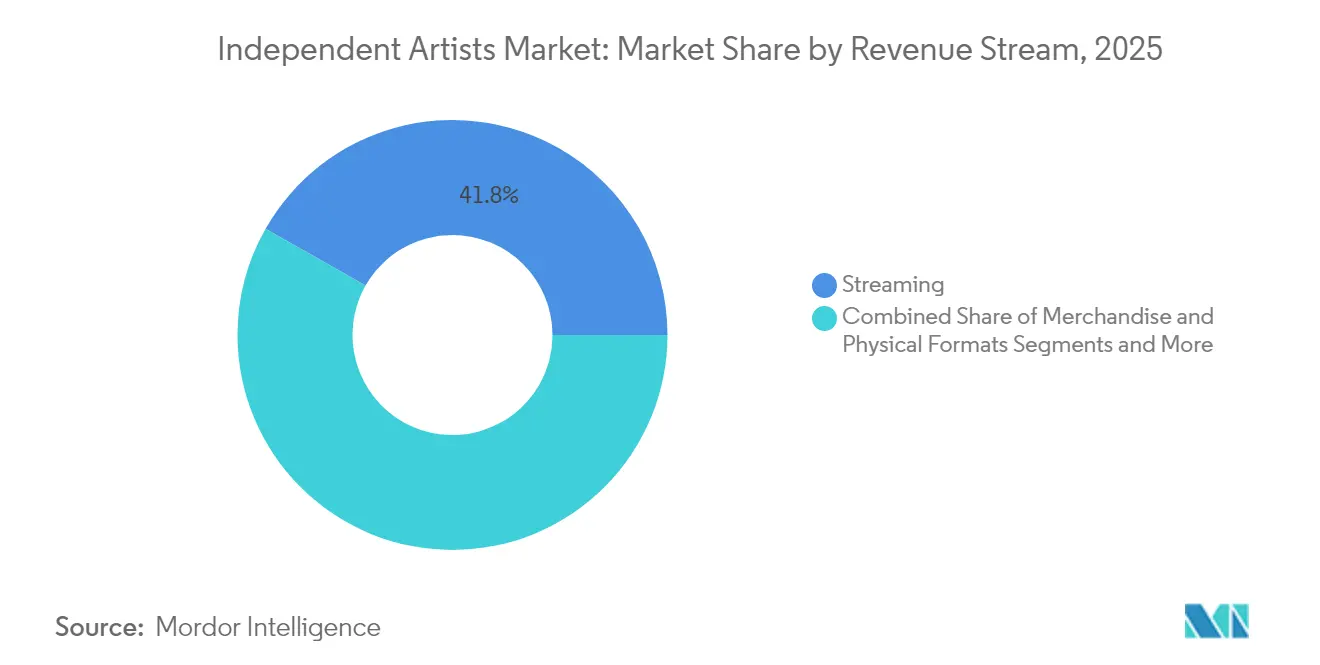
Streaming Scale and Physical Ownership Support Different EarningsStreaming accounted for a 41.27% share of the independent artists market size in 2026. Spotify reported that independent artists and labels generated roughly half of its more than USD 11 billion in music-industry payouts in 2025.[3] More than one-third of artists generating at least USD 10,000 in Spotify royalties that year self-released their music through independent distributors or had begun their careers that way. Distributors that serve self-releasing artists work within a royalty pool large enough to reward artists who began as DIY.
Merchandise and physical formats form the fastest-growing segment, with an 8.11% CAGR forecast over 2027-2032. Independent releases accounted for 34.5% of UK vinyl LP sales in 2025, according to BPI. Independent-signed Arctic Monkeys, Fontaines D.C. and Radiohead also ranked among the country's 10 best-selling vinyl artists that year. This presence connects independent repertoire with substantial demand for a physical recording and with artists capable of reaching leading positions within that format. Physical-release services can address commercially established catalogs through editions listeners buy and keep, giving artists a product opportunity alongside the consumption of recordings through digital access.

By Distribution Channel:
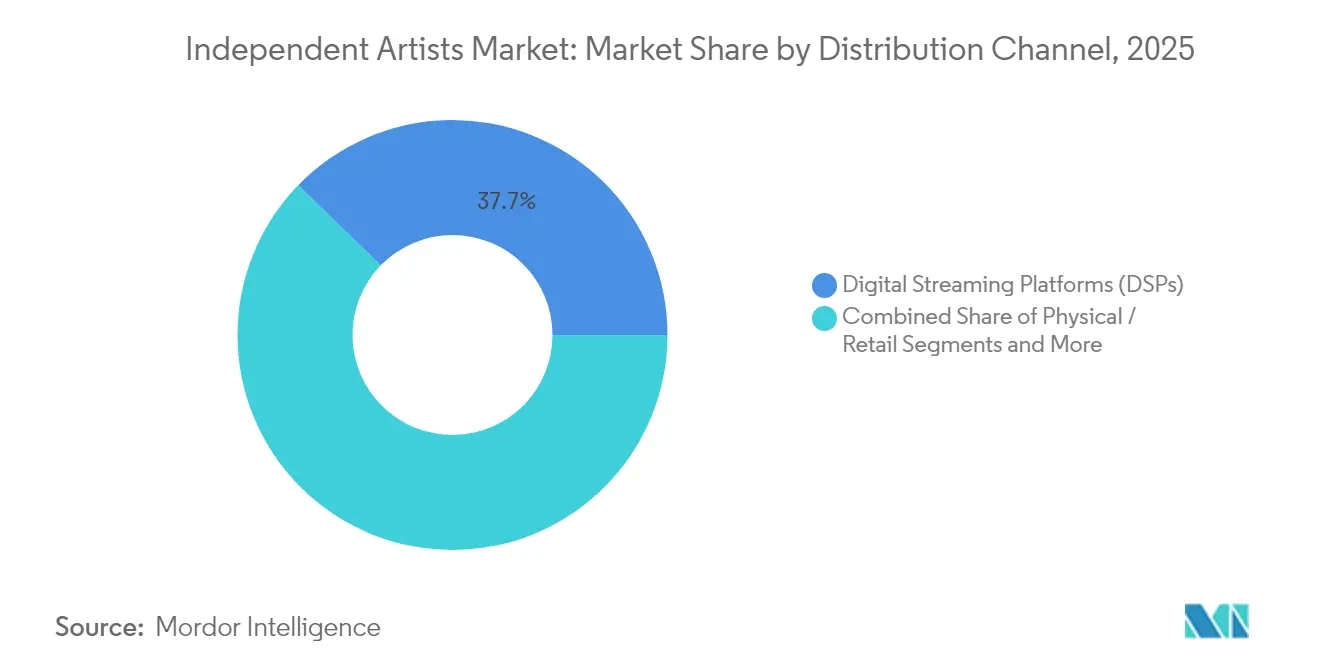
Platform Reach and Store Access Shape Release EconomicsDigital streaming platforms (DSPs) represented a 37.14% independent artists market share in 2026. Spotify reported 777 million monthly active users across its global platform in Q2 2026, up 12% year over year. That audience scale makes DSP availability commercially significant for independent releases seeking listeners beyond an artist's existing fan relationships. Spotify also counted 300 million Premium subscribers globally in that quarter. With Premium subscribers below half of monthly active users, turning potential platform reach into paying fan relationships requires more than delivering an independent release.
The physical / retail channel is the fastest-growing segment, with an 8.5% CAGR forecast over 2027-2032. UK brick-and-mortar stores increased their share of physical music sales by nearly one-third from 2021 to 41.2% in 2025. Home delivery accounted for more than half of physical music sales in the country in 2025. The store-share gain signals a redistribution within physical sales, making the route to the buyer consequential for artists choosing how to offer their recordings. Retail access becomes commercially material even for a physical-release strategy that also serves a larger home-delivery customer base, giving distribution partners distinct roles in reaching paying listeners.
By Genre:
Hip-Hop Album Demand Meets Independent Electronic ReleasesHip-hop / rap was the largest segment, with a 33.9% share in 2026. Roc Nation Distribution reported that Clipse's fully independent rap album “Let God Sort Em Out” generated 118,000 US equivalent album units in its first week of release in 2025. Luminate also identified hip-hop among the genres dominating US independent on-demand audio streaming share in 2025 year to date. The same album reached No. 2 on Billboard's Top Rap Albums chart in its first week, showing that a fully independent release can compete for a leading chart position in the genre.
Electronic / dance is the fastest-growing segment, with a 7.7% CAGR forecast over 2027-2032. In the first half of 2026, Dance / Electronic gained 0.51 percentage points of US on-demand audio share, the largest genre gain on that measure. House producer and DJ Chris Lake released Chemistry as a fully independent, self-funded album in 2025. Beatport included Lake among its 10 best-selling house artists of 2025. These examples connect greater genre share in listening with self-funded releases and a specialized retail channel, giving independent electronic projects different routes to commercial demand.
Geography Analysis
North America Independent Artists Market
North America accounted for a 42.46% share of the independent artists market size in 2026. IFPI reported that the United States and Canada added more than USD 400 million to global recorded-music revenue in 2025. In US recorded-music data, the RIAA reported 111.1 million premium paid-subscription units in the first half of 2026, up 5.5% from the first half of 2025. An expanding paid-subscription base gives independent releases a route to repeated listening within an existing payment relationship. Artist services can build on that structure by supporting continued catalog discovery between releases, keeping their commercial offer tied to the use of recordings over time.
Europe Independent Artists Market
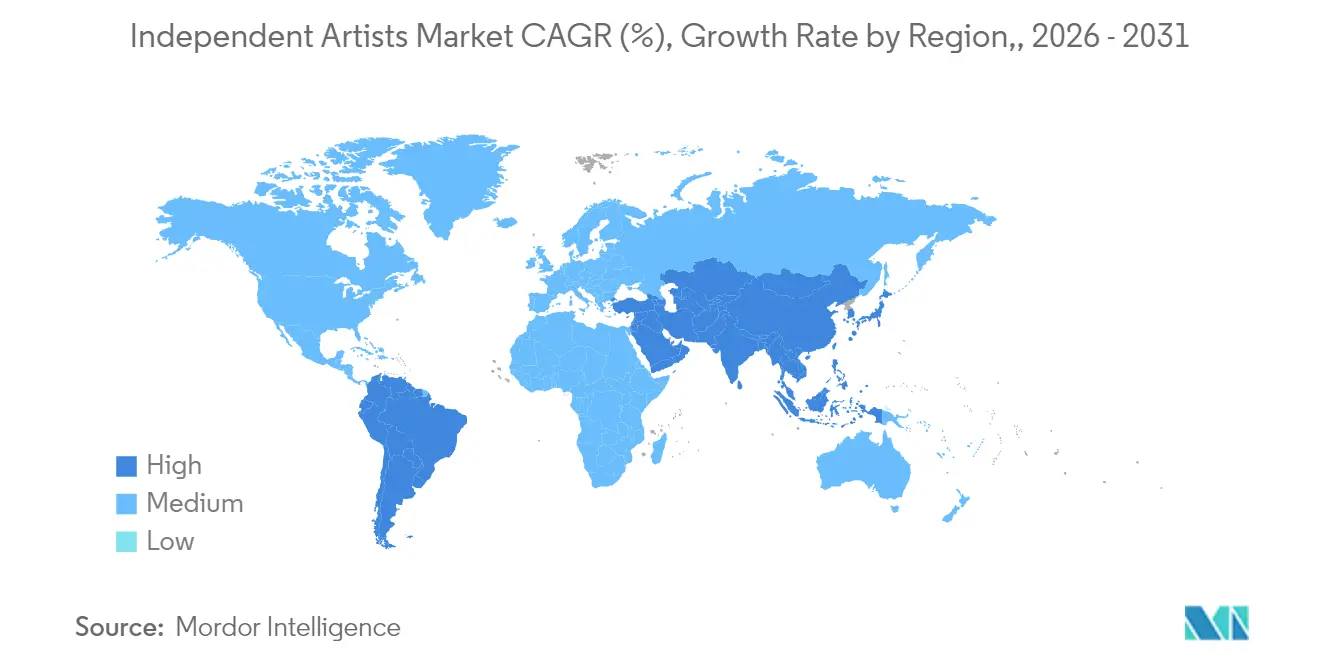
Europe is forecast to be the fastest-growing geography, with a 6.95% CAGR over 2027-2032. IFPI reported that European recorded-music revenue grew 5.6% in 2025 while the region maintained its position as the second largest. UK collecting society PRS for Music, which represents songwriters, composers and publishers, reported that revenue from European use of its members' music increased 7.9% in 2025, keeping Europe its largest international market. An international collection channel can give participating creators access to income across European territories, making rights administration beyond a home audience commercially relevant to independent repertoire development.
South America's independent repertoire has a substantial platform role in Brazil, where independent artists and labels generated a larger share of Spotify royalties than the platform's global average of about half in 2025. Asia-Pacific has a different physical-format context, with Asia ranking as the largest region for physical recorded-music revenue in 2025. The Middle East and Africa region combines the Middle East and North Africa's streaming-dominated recorded-music business with growing Sub-Saharan African recordings revenue in 2025. On July 8, 2026, Warner Music Group announced an expansion of ADA, its independent distribution and label-services division, across Europe, the Middle East and Africa. That broader service footprint could help connect different local revenue models with independent releases, while the format of paying demand determines which capabilities are commercially relevant.
Regulatory Framework and Outlook
The comparison examines selected jurisdictions from the perspective of independent artist-songwriters licensing their own musical works for digital use. The US framework provides a blanket mechanical license for specified digital uses, administered through the Mechanical Licensing Collective under the Music Modernization Act. The UK framework sets minimum governance, transparency and conduct standards for collective management organizations, with monitoring and enforcement by the Intellectual Property Office. The relevant commercial distinction is how licensing is administered and what oversight supports the handling of musical-work income.
Regulatory Table of Independent Artists Market
| Decision factor | United States | United Kingdom |
|---|---|---|
| Primary authority | U.S. Copyright Office, with Mechanical Licensing Collective administration | Intellectual Property Office |
| Key instruments or direction | Music Modernization Act, Title I | Collective Management of Copyright (EU Directive) Regulations 2016 |
| Commercial effect | Blanket mechanical licensing for specified digital uses of nondramatic musical works | Collective administration subject to governance and transparency standards |
| Current policy attractiveness | High | Medium |
| Future direction of policy attractiveness | No change | No change |
| Source: Mordor Intelligence | ||
The US judgment reflects an established blanket mechanical licensing route, with continuity supported by the 2026 continuation of the administering entities' designations and the next review beginning in January 2029. UK collective administration combines IPO-enforced, light-touch governance, transparency and conduct standards with the 2023 removal of annual transparency-report audit requirements for smaller collective management organizations. For a songwriter using collective administration, minimum oversight with lighter auditing of smaller organizations supports a Medium rating for accountability over income handling. The UK government's March 2026 copyright-and-AI report supports No change alongside operative collective-management rules, stating that copyright would remain unchanged absent new legislation while the government monitored effects on right holders, developers and users.
Value Chain Stages
The comparison follows release delivery, paid listening and fan commerce to show where service providers can earn from independent recordings. TuneCore combines delivery, rights management and payment collection, placing its artist service between a recording and digital stores. Monetization then involves different customer relationships, including Spotify's Premium subscriptions and Veeps' music-and-merchandise storefront.
Value Chain Analysis Table of Independent Artists Market
| Primary activity | Key participants | Value capture | Bottleneck | Resilience response |
|---|---|---|---|---|
| Release delivery and administration | Music distributors such as TuneCore | Annual distribution subscriptions | Coordinating delivery and payment collection across stores | Consolidate release administration and payment records |
| Paid digital listening | Streaming platforms such as Spotify | Premium subscription payments | Converting access into a continuing paid relationship | Develop paid listening benefits that encourage renewal |
| Fan commerce | Music and merchandise storefronts such as Veeps | Vinyl and artist-merchandise sales | Connecting interest in a performance with a separate product purchase | Place merchandise purchasing alongside live and on-demand viewing |
| Source: Mordor Intelligence | ||||
Supplier earnings arise at different points because distribution sells an artist service, while paid listening and merchandise address fan demand. The commercial distinction is consequential for artists who choose between paying for release access and adding services around the eventual listener transaction. A distributor expanding into fan commerce could participate in more of a recording's commercial life, while also taking on the separate task of converting listeners into product buyers.
Competitive Landscape
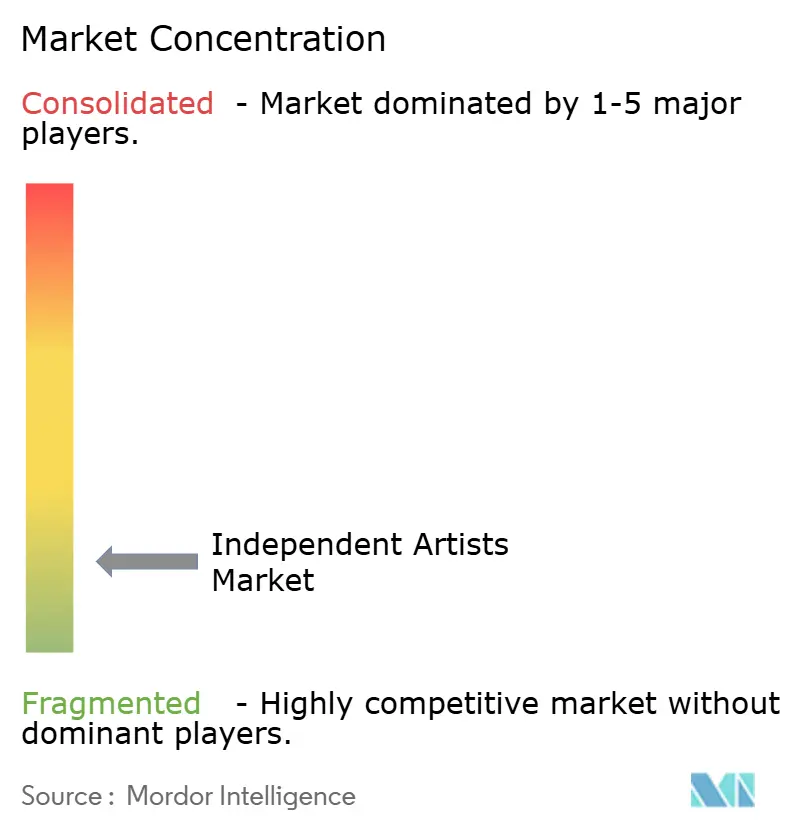
Competition is moderately fragmented, with portfolio integration illustrated by Virgin Music Group's acquisition of Downtown Music Holdings, completed on February 20, 2026. Believe's 2025 publishing offer addressed artists, independent songwriters and publishers, while DistroKid handles digital distribution and royalty collection. AWAL supplies artist-development and worldwide distribution services, while CD Baby distributes recordings through digital partners and was included in the acquired Downtown portfolio. UnitedMasters combines music distribution with tools supporting artists' careers. The competitive distinction for artists is the combination of administration, delivery and development available through a particular service relationship, alongside its connections to a larger music group.
On February 19, 2026, Sony Music-owned AWAL partnered with independent Italian distributor Artist First. Artist First's roster was offered development support and access to AWAL's worldwide distribution services, connecting the partnership with both artist reach and career development. On October 29, 2025, DistroKid introduced Direct, a merchandise storefront for members with a DistroKid release that turns release artwork into print-on-demand products and handles printing, shipping and customer support. The storefront extends DistroKid's member relationship from release delivery into merchandise fulfillment. The AWAL and Artist First arrangement gives artist-development providers a route through another distributor's existing relationships, making roster access a commercial complement to the technical ability to distribute a release worldwide.
On March 27, 2026, BeatStars announced Believe Music Publishing as its new global publishing-administration partner, with the partnership set to begin April 1, 2026. Publishing administration expands the relevant customer relationship to the songwriter's repertoire, extending service work beyond the delivery of a particular recording. The likely direction is deeper competition over the administration and development of independent repertoire, with distribution access serving as one part of a broader commercial relationship.
Independent Artists Industry Leaders
-
Believe
-
DistroKid
-
AWAL
-
CD Baby
-
UnitedMasters
- *Disclaimer: Major Players sorted in no particular order
Independent Artists Market Companies Covered in this Report
- AWAL
- Believe
- DistroKid
- TuneCore
- CD Baby
- UnitedMasters
- Empire
- Symphonic Distribution
- Ditto Music
- Stem
- Amuse
- Virgin Music Group
- Downtown Music Holdings
- The Orchard
- Bandcamp
- Patreon
- SoundCloud
- Bandzoogle
- Artist Growth
- Songtradr
- Kobalt AWAL Core
- ReverbNation
- LANDR
- Spinnup*
Key Opportunities for Market Participants
The opportunities compare additional performance formats, audiovisual releases and direct purchases as ways for independent artists to monetize listener demand. Spotify's June 2026 beta introduced direct uploads of live performances, studio sessions, covers and official music videos for participating artists. Videos longer than 30 seconds can earn royalties and may be chart-eligible, with viewing limited to Premium users in supported beta markets. On August 31, 2026, TIDAL removed its 10% platform fee from US artists' direct music and merchandise sales, with payment-processing fees payable and merchandise stores in beta.
Market Opportunities Table of Independent Artists Market
| Opportunity | Why now | Buyer / lead segment | Recommended play | Main barrier | Likely beneficiaries |
|---|---|---|---|---|---|
| Monetize filmed live performances | New direct video-upload beta | Independent performers participating in the beta | Offer a filmed performance as an additional royalty-bearing release | Restricted beta participation | Participating performers and Spotify |
| Develop audiovisual recording catalogs | Studio sessions and official videos qualify for the upload route | Independent recording artists participating in the beta | Build a sequence of studio and official-video releases | Premium-only viewing in supported markets | Participating recording artists and Spotify |
| Expand direct music purchases | TIDAL eliminated its platform charge for US artist sellers | US independent artists selling music directly | Connect an artist's paying fans with a direct music offer | Payment-processing deductions remain | US artist sellers and TIDAL |
| Source: Mordor Intelligence | |||||
The central opening is extending a listener relationship into an additional paid format or a direct purchase. TIDAL's fee removal was live for US music sellers in August 2026, while Spotify's upload route was limited to participating beta artists. That difference favors developing a direct-purchase offer for eligible US sellers without waiting for admission to the separate video beta.
Recent Industry Developments in Independent Artists Market
- Sep 2026: Spotify launched Fresh Finds Forward, a program designed to give approximately 10,000 emerging independent artists each year resources, community and support for long-term growth.
- Aug 2026: TIDAL removed its 10% platform fee from US artists' direct music and merchandise sales, with payment-processing fees payable and merchandise stores in beta.
Independent Artists Market Report Scope and Research Methodology
Market Definition and Coverage
The independent artists market measures annual global revenue generated when independent artists monetize music recordings, performances, fan relationships, merchandise, and associated rights. It covers artist-attributable receipts across sales channels, genres, and geographies.
Scope exclusions: Revenues attributable to artists contracted to traditional record labels, income unrelated to independent artist content monetization including unrelated endorsements, sales of recording, production, or distribution tools and services, and revenue from non-music creator content are excluded.
Segments Covered in This Report
- By Revenue Stream
- Streaming
- Live Performances
- Merchandise and Physical Formats
- Direct Fan Subscriptions
- Licensing and Sync
- By Distribution Channel
- Digital Streaming Platforms (DSPs)
- Direct-to-Fan Marketplaces
- Social / UGC Platforms
- Physical / Retail
- By Genre
- Pop
- Hip-Hop / Rap
- Electronic / Dance
- Rock and Alternative
- Other Genres (Jazz, Classical, etc.)
- By Geography
- North America
- Canada
- United States
- Mexico
- South America
- Brazil
- Peru
- Chile
- Argentina
- Rest of South America
- Asia-Pacific
- India
- China
- Japan
- Australia
- South Korea
- South East Asia (Singapore, Malaysia, Thailand, Indonesia, Vietnam, Philippines)
- Rest of Asia-Pacific
- Europe
- United Kingdom
- Germany
- France
- Spain
- Italy
- BENELUX (Belgium, Netherlands, Luxembourg)
- NORDICS (Denmark, Finland, Iceland, Norway, Sweden)
- Rest of Europe
- Middle East and Africa
- United Arab Emirates
- Saudi Arabia
- South Africa
- Nigeria
- Rest of Middle East and Africa
- North America
Data Sources, Market Sizing, and Validation
Desk Research
Desk research draws on public sources such as IFPI's Global Music Report, RIAA's U.S. Revenue Database, IMPF's Global Market View, the National Endowment for the Arts and Bureau of Economic Analysis arts account, and Spotify Loud & Clear to map recorded-music formats, rights collections, independent artist pathways, wider arts activity, and platform payouts to the market's artist-attributable revenue streams. Those sources provide independent signals on demand, geography, monetization routes, rights flows, and participation, while their different measures remain separate from the market total.
Company annual reports and 10-K filings, investor materials, platform and distributor announcements, reputable music trade press, arts statistics, rights organizations, regulatory records, and patent filings can clarify recognition of artist receipts, service fees, release terms, demand conditions, and changes in the routes to monetization. These named sources are not exhaustive, and further sources inform collection, validation, and clarification.
Primary Interviews and Surveys
Global interviews would cover independent artists and artist managers, distributors, streaming and direct-to-fan services, live and merchandise channels, and music-rights organizations, with executives, functional leaders, and operating managers addressing their respective revenue streams. Analysts would use respondent evidence to test secondary-source interpretation and variable assumptions, clarify where receipts are recognized, and identify missing country or channel data. Where published observations remain sparse, a similar market's observable ratios can serve as a proxy for triangulation and review by respondents familiar with that market.
Distribution of primary research fieldwork respondents
| Company type | Respondent position | Region |
|---|---|---|
| Top tier: 30% | CXOs: 15% | APAC: 40% |
| Mid tier: 50% | Functional/Unit leaders: 35% | EMEA: 34% |
| Smaller Players: 20% | Managers: 50% | Americas: 26% |
Market-Sizing & Forecasting
A top-down estimate starts with global artist-attributable music monetization and allocates receipts across the revenue streams and geographies in the study. Selective bottom-up checks, such as sampled artist-attributable ticket receipts and merchandise price times units sold, test whether the implied totals are plausible. Core indicators include streaming royalty flows, live performance receipts, merchandise and physical music sales, fan-subscription activity, and licensing and synchronization income, with release and audience trends used to interpret how these streams change. Evidence from public market data, company disclosures, channel observations, and respondent checks supports the revenue-stream shares, while the same counted receipts are classified by distribution channel, genre, and geography without adding those classifications to the total.
Scenario analysis carries expected changes in paid listening, touring activity, fan spending, and rights licensing through the 2027-2032 forecast, with region-specific assumptions tied to local evidence. When country or channel observations are incomplete, analysts can use comparable-market ratios and explicit price or participation proxies, then check the resulting estimate against the global demand pool and available sampled channel roll-ups. Respondent input can test individual drivers and assumptions without replacing measured evidence.
Data Validation & Update Cycle
Analysts triangulate the model against independent signals such as recorded-music receipts, platform royalty disclosures, rights collections, live activity, and company reporting, and check that regional and revenue-stream patterns agree with the source definitions. Anomaly and variance checks flag inconsistent growth, shares, or implied artist receipts for source review and multi-step analyst review. An unresolved point triggers re-contact with a relevant respondent or a fresh check of the underlying source before sign-off. The evidence is refreshed annually, interim review is triggered by material changes to platform payouts, touring, or rights rules, and analysts make a fresh pre-delivery pass against the latest available information.
Mordor Intelligence's Independent Artists Market Size Compared With Other Published Estimates
Published estimates can differ in the transactions and products they count and the inputs used to model demand. The independent artists market measures annual global revenue generated when independent artists monetize music recordings, performances, fan relationships, merchandise, and associated rights.
Key Gap Drivers include the study's defined coverage and market-specific modeling choices. Core indicators include streaming royalty flows, live performance receipts, merchandise and physical music sales, fan-subscription activity, and licensing and synchronization income, with release and audience trends used to interpret how these streams change.
Benchmark comparison
| Source | Market Size | Gaps in Research Methodology |
|---|---|---|
| Mordor Intelligence | USD 181.9 B (2027) | |
| Global Consultancy A | USD 216.7 B (2025) | At its 2025 base, this estimate is 19.1% above this report's 2027 value of USD 181.9 B, 2 years later. The estimate includes independent art companies and theatre, dance, and opera activity alongside music, extending beyond artist-attributable music monetization. |
| Global Consultancy B | USD 244.6 B (2025) | At its 2025 base, this estimate is 34.5% above this report's 2027 value of USD 181.9 B, 2 years later. The forecast includes visual arts and performing companies, with its published recovery outlook supporting a higher total than music-only artist receipts. |
Mordor Intelligence's analysts triangulate the model against independent signals such as recorded-music receipts, platform royalty disclosures, rights collections, live activity, and company reporting, and check that regional and revenue-stream patterns agree with the source definitions.
Key Questions Answered in the Report
What is the Independent Artists market size and growth outlook?
The size is expected to reach USD 181.9 billion in 2027 and USD 244.3 billion by 2032, growing at a 6.08% CAGR over 2027-2032.
What is increasing independent artists' monetization opportunities?
AI tools and fan subscriptions create additional monetization routes. Ditto Music's 2026 survey found music-making AI use among 47% of active, self-releasing respondents who had released music with Ditto.
What is the largest revenue stream for independent artists?
Streaming was the largest revenue stream, with a 41.27% share in 2026.
Which companies provide independent music artist services?
Key providers include Believe, DistroKid, AWAL, CD Baby and UnitedMasters. CD Baby was included in the Downtown portfolio acquired by Virgin Music Group in February 2026.
What platform costs and rules reduce earnings for independent artists?
In June 2025, IMPALA reported streaming demonetization thresholds and royalty boosts stripping revenue from independent labels and niche genres. Patreon charged new creator membership pages a 10% earnings fee from August 5, 2025, plus processing and applicable taxes.
Which region leads independent-artist activity and which grows fastest?
North America held a 42.46% share in 2026, while Europe is forecast to grow at a 6.95% CAGR over 2027-2032.