
In Silico Clinical Trials Market Size and Share
Market Overview
| Study Period | 2020 - 2031 |
|---|---|
| Market Size (2026) | USD 4.16 Billion |
| Market Size (2031) | USD 5.93 Billion |
| Growth Rate (2026 - 2031) | 7.41 % |
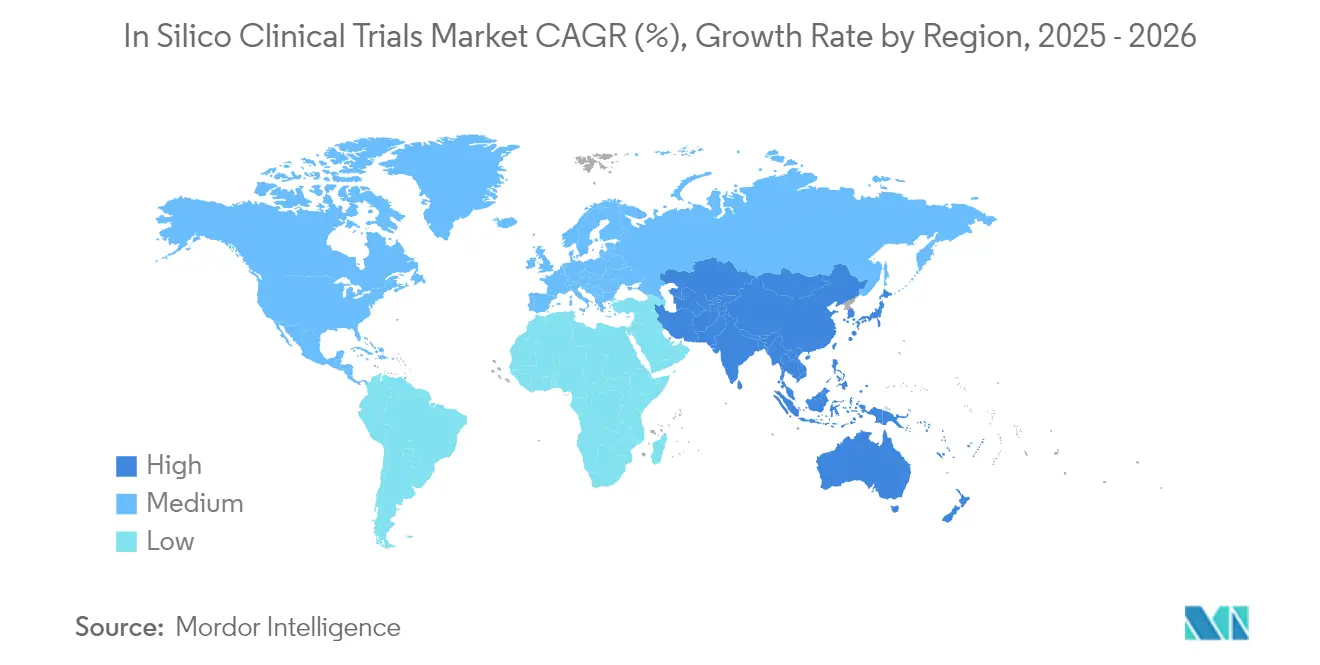
| Fastest Growing Market | Asia-Pacific |
| Largest Market | North America |
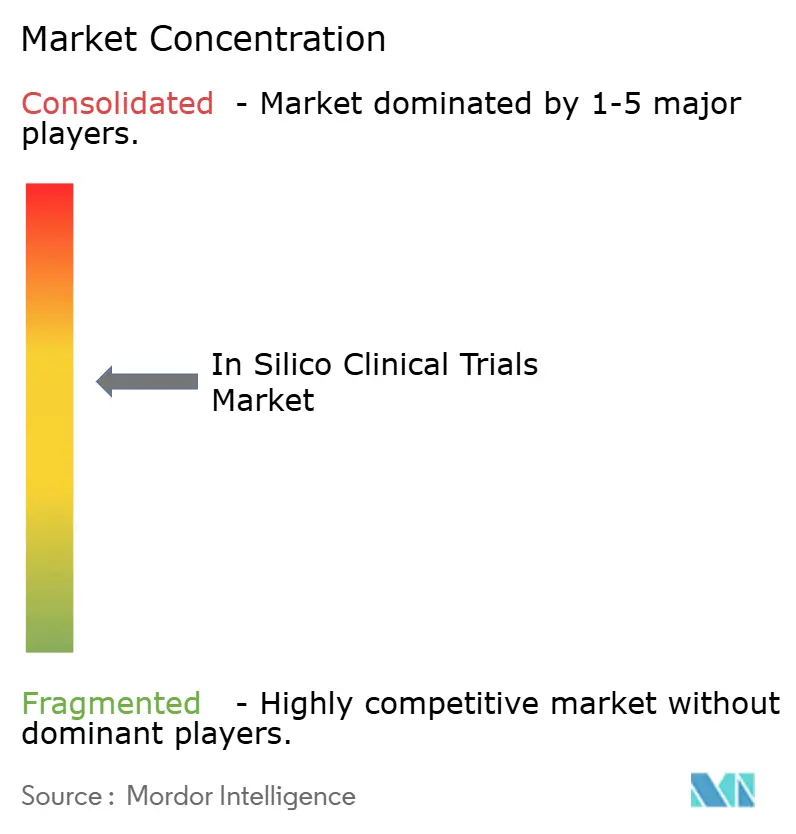
| Market Concentration | Medium |
Major Players *Disclaimer: Major Players sorted in no particular order Image © Mordor Intelligence. Reuse requires attribution under CC BY 4.0. | |
In Silico Clinical Trials Market Analysis by Mordor Intelligence
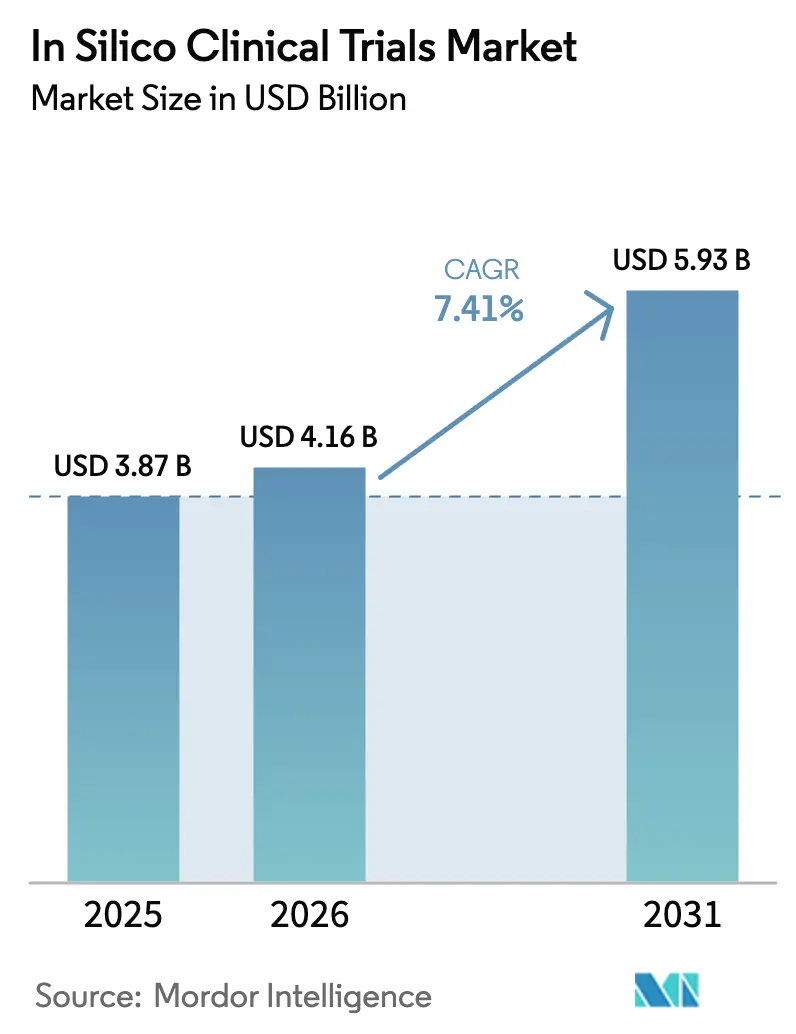
In-silico clinical trial market size in 2026 is estimated at USD 4.16 billion, growing from 2025 value of USD 3.87 billion with 2031 projections showing USD 5.93 billion, growing at 7.41% CAGR over 2026-2031. Regulatory agencies on both sides of the Atlantic have begun to accept virtual evidence packets, enabling sponsors to replace or complement animal studies with high-fidelity computational models[1]. Cost pressures across pharmaceutical pipelines further accelerate adoption, because validated digital twins shorten development cycles and lower protocol amendments. The sustainability agenda, including the United States move to phase out animal testing for certain biologics, reinforces the shift toward simulated trials. Greater cloud, GPU and high-performance computing accessibility now lets mid-sized biotechnology firms run complex multi-omics models once reserved for large pharma. Precision-medicine programs that rely on patient-specific digital replicas provide an additional tail-wind, particularly in oncology and neurology where response variability is high.
Key Report Takeaways
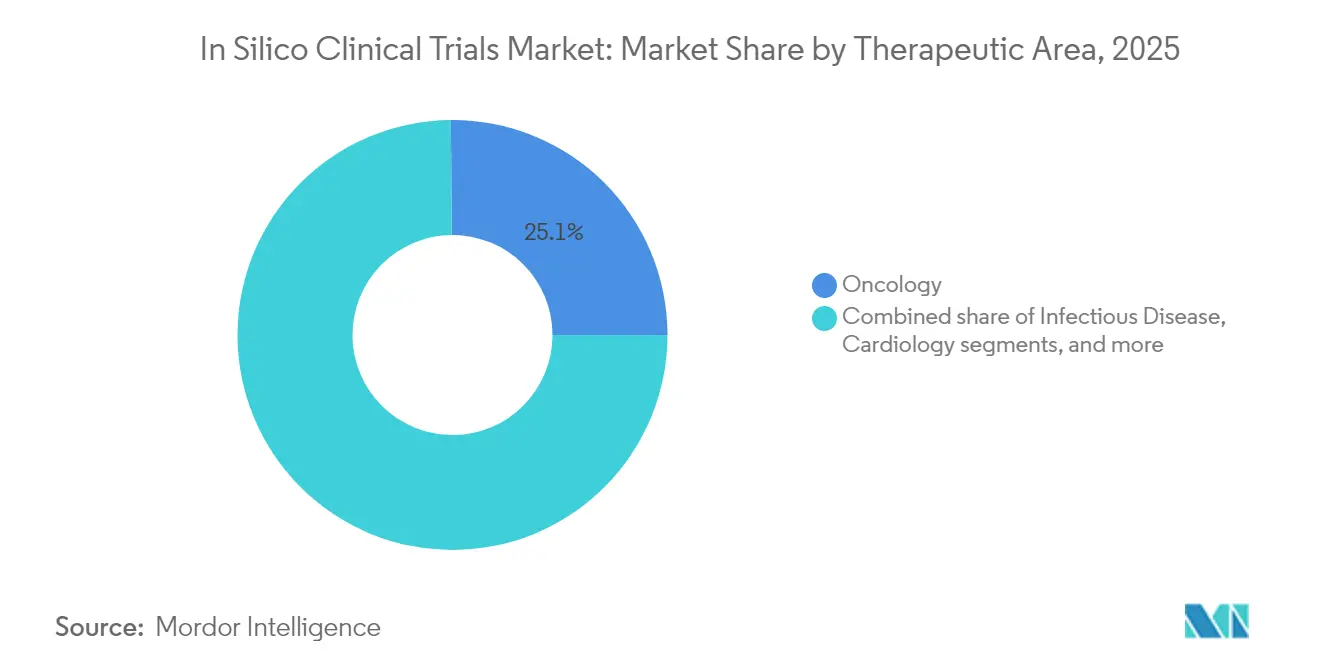
- By therapeutic area, oncology commanded 25.12% of the in-silico clinical trial market share in 2025, while neurology is projected to expand at a 15.11% CAGR through 2031.
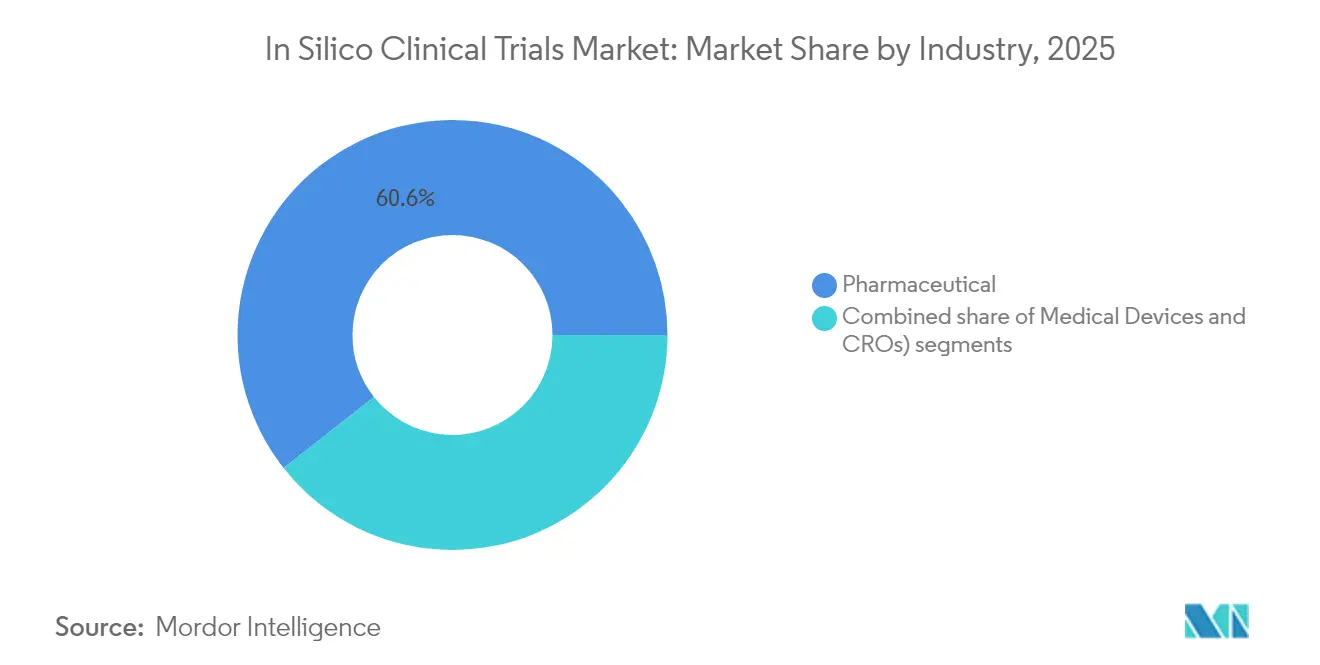
- By industry, the pharmaceutical segment held 60.62% share of the in-silico clinical trial market size in 2025; the medical-device segment is set to rise at a 13.96% CAGR to 2031.
- By phase, Phase II applications accounted for 34.32% of the in-silico clinical trial market size in 2025, whereas Phase I is poised for the fastest 13.52% CAGR to 2031 nature.com.
- By geography, North America led with 46.21% share of the in-silico clinical trial market in 2025, while Asia-Pacific is forecast to grow at 12.45% CAGR during the outlook period.
Note: Market size and forecast figures in this report are generated using Mordor Intelligence’s proprietary estimation framework, updated with the latest available data and insights as of 2026.
Market Trends and Insights
Drivers Impact Analysis of In Silico Clinical Trials Market*
| Driver | % Impact on CAGR Forecast | Geographic Relevance | Impact Timeline |
|---|---|---|---|
| Regulatory endorsement of in-silico evidence | +2.0% | North America and Europe lead; global ripple effect | Medium term (2-4 years) |
| Rising R&D cost pressure across pharma and med-tech | +1.8% | Strongest in United States; evident worldwide | Short term (≤ 2 years) |
| Pandemic-induced digital transformation in clinical development | +1.3% | Global, with rapid uptake in Asia-Pacific | Short term (≤ 2 years) |
| Accelerating adoption of precision medicine and digital twins | +1.6% | North America and Europe core; expanding in Asia-Pacific | Medium term (2-4 years) |
| Growing HPC and cloud-computing accessibility | +0.9% | Developed markets worldwide | Long term (≥ 4 years) |
| Sustainability mandates and 3R animal-reduction policies | +1.2% | Europe first mover; North America following; APAC emerging | Medium term (2-4 years |
| Source: Mordor Intelligence | |||
Regulatory Endorsement of In-Silico Evidence
The United States Food and Drug Administration recently broadened its computational modeling guidance, confirming that verified virtual evidence can support device 510(k) and biologic IND filings. European lawmakers echo the approach through the European Health Data Space Regulation, which enables cross-border data flows essential for large-scale virtual cohorts. Early applicants that submitted AI-generated dossiers reported shorter review cycles, signalling that regulators view model-based submissions as resource-efficient. Industry now invests in end-to-end validation workflows anchored in ASME V&V 40 principles, providing a repeatable route to credibility. As multiple jurisdictions converge on harmonised rules, sponsors gain confidence to allocate larger budgets to in-silico trial design.
Rising R&D Cost Pressure Across Pharma and Med-Tech
Total R&D expense required to bring a single novel drug to market has climbed above USD 1 billion, a 14-fold increase versus the 1960s. Companies respond by redirecting funds toward digital twin platforms that can simulate dose-response curves across thousands of virtual patients, cutting wet-lab screening cycles by up to 70%. Large pharma-device partnerships such as Charles River Laboratories and Sanofi demonstrate cost avoidance through virtual control groups, reducing animal use while maintaining statistical power. Medical-device manufacturers follow suit because computational stress testing eliminates multiple prototype iterations. Combined, these economics add more than a full percentage point to operating margins for early adopters.
Pandemic-Induced Digital Transformation in Clinical Development
COVID-19 compressed a decade of digital-trial innovation into two years, normalising remote data capture and hybrid site-less designs. The installed base of electronic patient-reported outcome tools and connected sensors now feeds real-time data streams into simulation engines, closing the loop between virtual models and physical outcomes. Governments in Japan and Singapore updated telehealth and e-consent rules, making it easier for sponsors to draw on region-wide patient pools. This infrastructure acts as a launch-pad for fully computational arms, because clean, structured data are readily available for model training and external validation.
Accelerating Adoption of Precision Medicine and Digital Twins
Stanford Medicine achieved an 85% predictive accuracy rate when simulating neuronal responses with an AI-enabled brain digital twin. Oncology institutions translate the same framework to tumour-specific avatars that test combination therapy safety before first-in-patient dosing. Mayo Clinic reports that cardiovascular digital twins reduce hospital readmissions by modelling device-tissue interactions ahead of surgery. As multi-omics datasets merge with electronic health records, sponsors gain a systems-biology view that drives targeted therapy development, underscoring why precision medicine is a structural driver.
Growing HPC and Cloud Computing Accessibility
Global cloud providers now offer exascale GPU clusters on a pay-per-use basis, letting small biotechnology firms run 100-million-cell agent-based simulations in days rather than months. Open-source libraries standardise model exchange formats, and marketplace APIs integrate seamlessly with eClinical software. The democratisation of compute capacity removes a historical entry barrier and supports the long-term growth trajectory.
Sustainability Mandates and 3R Animal-Reduction Policies
Europe’s 3R legislative agenda, reinforced by Germany’s 2024 Medical Data Integration Center initiative, obliges life-science companies to prioritise non-animal testing alternatives[2]. AstraZeneca reported a 25% decrease in clinical trial carbon emissions after embedding virtual arms into Phase II oncology studies. These public commitments spur peers to adopt digital twins to meet environmental targets.
Restraints Impact Analysis of In Silico Clinical Trials Market*
| Restraint | % Impact on CAGR Forecast | Geographic Relevance | Impact Timeline |
|---|---|---|---|
| Limited standardization of modeling methodologies | -1.4% | Global, fragmented rules across agencies | Medium term (2-4 years) |
| Data privacy and interoperability challenges | -1.1% | Europe leads privacy focus; worldwide interoperability gap | Short term (≤ 2 years) |
| Insufficient validation frameworks across regions | -1.0% | Varies by regulator; acute in emerging markets | Medium term (2-4 years) |
| Talent shortage in quantitative systems pharmacology | -0.8% | Global, most severe in small-to-mid biotech | Long term (≥ 4 years) |
| Source: Mordor Intelligence | |||
Limited Standardisation of Modelling Methodologies
Regulatory agencies encourage verification but have yet to agree on a single global framework. Sponsors therefore build parallel validation packages for the FDA, EMA and Japan’s PMDA, inflating timelines. While ASME V&V 40 and the TRIPOD+AI guideline provide structure, implementation varies by therapeutic area, forcing bespoke parameter checks for each filing. Smaller biotechnology firms find the resource burden heavy, which slows broader market penetration until harmonised assessment tools mature.
Data Privacy and Interoperability Challenges
GDPR interprets clinical-trial consent narrowly, creating uncertainty over secondary use of patient data in models. Hospitals employ heterogeneous record formats that undermine data pooling, prompting costly ETL pipelines. Federated-learning pilots in oncology demonstrate secure alternatives, yet high compute overhead and complex governance frameworks still deter many sponsors. Continued evolution of common models such as OMOP and FHIR will be required before seamless cross-border data flow becomes routine.
*Our forecasts treat driver/restraint impacts as directional, not additive. The impact forecasts reflect baseline growth, mix effects, and variable interactions.
In Silico Clinical Trials Market Segment Analysis
By Therapeutic Area:
Oncology Leadership Drives InnovationOncology held 25.12% of the in-silico clinical trial market in 2025, reflecting its dependence on multi-drug regimens that benefit from dose-optimisation in silico. The segment gains additional momentum from tumour genetic heterogeneity, which requires large synthetic cohorts to achieve statistical power. The in-silico clinical trial market size for oncology is projected to reach USD 1.71 billion by 2031, tracking a 6.78% CAGR as digital twins guide adaptive designs. Neurology is the fastest-growing discipline at a 15.11% CAGR, driven by Stanford’s visual-cortex digital twin that enables unlimited virtual experimentation. Beyond these two areas, infectious-disease models use AI to repurpose antivirals quickly, cardiology twins refine device implantation strategies, and metabolic-disease avatars personalise insulin and GLP-1 dosing.
Demand for virtual oncology stacks encourages CROs to develop oncology-specific libraries of immuno-genomic profiles, reducing time to model calibration. Neurology providers leverage data from brain-organoid experiments to increase biological fidelity, making virtual neuro-pharmacology more predictive. Together, these two therapeutic areas set the pace for future regulatory templates and commercial reimbursement frameworks.

By Industry:
Pharmaceutical Dominance Meets Device InnovationPharmaceutical companies captured 60.62% of the in-silico clinical trial market share in 2025, reflecting long-standing PK-PD modelling expertise and budgets that support proprietary platform builds. The in-silico clinical trial market size for medical-device developers is forecast to expand at 13.96% CAGR to 2031 as virtual bench tests replace physical prototypes for orthopaedic implants and cardiovascular stents. CRO partnerships proliferate because smaller biotech firms prefer outsourcing model development and regulatory write-ups. De-risked cost structures and faster first-patient-in timelines make in-silico proposals attractive during Series A fundraising rounds.
Device companies gain particular value when testing patient-specific implants. The FDA’s approval of the restor3d Total Talus Replacement, created from patient CT data, confirms that computational design meets safety thresholds. As CAD programs merge with finite-element models and clinical data, in-silico validation becomes a mainstream route to clearance.
By Phase:
Early-Stage Innovation AcceleratesPhase II applications constituted 34.32% of deployments in 2025, because virtual cohorts excel at powering efficacy-driven dose selection. Sponsors report that synthetic control arms reduce enrolment by 20% without compromising significance. Phase I usage is rising fastest at 13.52% CAGR, buoyed by AI-designed compounds that carry pre-computed toxicity profiles into first-in-human studies. The in-silico clinical trial market size dedicated to Phase I could surpass USD 579 million by 2031 as regulators phase out animal testing for monoclonal antibodies. Phase III and IV efforts remain exploratory, mainly focusing on long-term safety extrapolation and post-market device surveillance with real-world data feeds.
Acceleration at the earliest phase reflects a philosophical shift toward design-make-test cycles that minimise late-stage attrition. Quantum computing prototypes promise further gains by solving highly complex Schrödinger equations faster, paving the way for ultra-high-resolution safety modelling.
Geography Analysis
North America in Silico Clinical Trials Market
North America retained 46.21% share in 2025 thanks to clear FDA guidance, extensive venture capital and strong supercomputing infrastructure. Recursion, Tempus and Insilico Medicine each raised nine-figure rounds to scale drug-discovery digital twins, reflecting investor confidence. The agency’s plan to discontinue animal tests for certain biologics accelerates local demand, and academic hubs from Boston to the Bay Area serve as technology incubators. Canada supports the ecosystem with national AI superclusters that subsidise compute credits for health-tech startups.
APAC in Silico Clinical Trials Market
Asia-Pacific is the fastest-growing region, expected to log a 12.45% CAGR through 2031. China’s central government prioritises AI drug discovery under its latest Five-Year Plan, and Insilico Medicine secured USD 110 million Series E funding to expand Shanghai-based operations. Japan’s PMDA issued guidance that aligns with FDA model-validation tenets, streamlining dual submissions for global sponsors. Korea and Taiwan leverage robust electronic health-record penetration to furnish de-identified data for real-world model tuning. Overall, favourable reimbursement reforms and large treatment-naïve patient pools make the region an attractive site for hybrid trials that merge digital twins with streamlined physical arms.
Europe in Silico Clinical Trials Market
Europe advances steadily, supported by the European Health Data Space initiative that will open anonymised registries across member states. Germany’s Medical Data Integration Center now connects 34 university hospitals, giving researchers access to a federated repository for cardiac, oncology and rare disease datasets. Sustainability and 3R ambitions add non-economic drivers; the Netherlands already mandates virtual evidence for high-risk device revisions when validated models exist. UK regulators, post-Brexit, pilot an agile review service for AI-augmented dossiers, aiming to recapture clinical-research leadership. Together these moves solidify Europe as the second-largest regional cluster for in-silico clinical trial adoption.
Regulatory Landscape
Regulatory acceptance is strengthening around formal expectations for model-informed drug development and documented model credibility. In January 2026, ICH finalized the M15 guideline on General Principles for Model-Informed Drug Development (MIDD). This gives sponsors a more harmonized reference for how computational modeling and simulation evidence is described and assessed across ICH regions, including requirements to define context of use and document analyses through structured planning and reporting (for example, Model Analysis Plan and Model Analysis Report artifacts). In the United States, the FDA continues to position modeling and simulation as submission-relevant evidence, with an April 2026 federal notice also seeking input on a pilot tied to AI use in early-phase decision-making.
In Europe, the EMA supports uptake through qualification pathways for novel methodologies, including digital technology-based methodologies. Applicants can seek scientific advice and qualification opinions that reduce regulatory friction for in-silico approaches in later interactions. Across jurisdictions, regulators increasingly emphasize verification, validation, and uncertainty characterization (including alignment to established credibility frameworks used in regulated modeling). That emphasis raises expectations for traceability, governance, and reproducibility in virtual cohort generation and digital twin use within clinical development.
Competitive Landscape
The market shows moderate concentration, with an active M&A cycle aimed at building integrated discovery-to-validation stacks. Recursion’s USD 688 million merger with Exscientia combined complementary phenotypic-screening and generative-chemistry engines to create a vertically integrated platform. Platform players pursue dual strategies: securing exclusive pharma partnerships while maintaining a SaaS model for long-tail biotech customers. Entry barriers rise around validated data assets more than proprietary algorithms, so firms with large multimodal datasets enjoy durable advantages.
Strategic partnerships dominate competitive dynamics. Tempus AI’s purchase of Deep 6 AI enhances natural-language processing to locate protocol-eligible patients in electronic records, reducing recruitment lags. Harbour BioMed works with Insilico Medicine to apply generative AI to antibody discovery, a template other mid-cap biopharma companies follow to extend pipelines without internal modelling teams. CROs expand in-silico offerings, with Worldwide Clinical Trials partnering with Medidata to couple eSource capture with virtual-patient simulators. These alliances indicate a shift from siloed technology to ecosystem playbooks.
Disruptors target niche pain points. Quantum-simulation startups provide femtosecond-scale molecular-dynamics models that promise to solve edge-case toxicity issues. Federated-learning vendors tackle privacy roadblocks by letting hospitals train models locally while sharing only gradients. As the regulatory landscape clarifies, differentiation will rely on documented model accuracy and audit trails rather than black-box novelty. Over time, the field is likely to coalesce around a handful of credentialed platforms interoperating through open standards.
In Silico Clinical Trials Industry Leaders
-
Dassault Systèmes
-
Certara
-
InSilicoTrials Technologies
-
Novadiscovery
-
Insilico Medicine
- *Disclaimer: Major Players sorted in no particular order
In Silico Clinical Trials Market Companies Covered in this Report
- Dassault Systemes
- Certara
- InSilicoTrials Technologies
- Novadiscovery
- Insilico Medicine
- Clarivate
- GNS Healthcare
- Immunetrics
- Evotec
- Abzena
- Simulation Plus
- Ansys
- Virtonomy
- Schrdinger
- Altair Engineering
- Physiomics Plc
- Voxel Pharma
- Concentra Analytics
- IBM Research (DeepQ)
- QSP Insights
Market Opportunities and Future Outlook
A key white-space opportunity sits between regulatory-ready model credibility packages and day-to-day operational deployment inside sponsor development teams. ICH M15 (finalized in January 2026) and EMA qualification routes for novel and digital methodologies are pushing sponsors toward standardized documentation, audit trails, and repeatable workflows. This creates room for vendors that package modeling, validation, and submission support together, rather than selling point tools. It also reflects constraints in the market, including limited standardization and cross-region validation burden, where platforms that operationalize credibility assessment and map into regulatory narratives can shorten internal cycles for pharma and med-tech teams.
Hybrid trial architectures also provide a concrete commercialization lane, combining remote data capture and structured clinical data with simulation engines to support virtual arms, virtual control groups, or protocol optimization. In oncology and other high-variability areas already central to in-silico adoption, provider ecosystems are forming around end-to-end data-to-model pipelines. In that context, InSilicoTrials leading the ARPA-H funded CARDIOVERSE virtual heart initiative (up to USD 30 million, announced December 2025) signals public funding and institutional alignment behind validated organ-level models for safety assessment. On the company side, Insilico Medicine continued expanding partnerships in 2026, including collaborations announced in July 2026 with Bora Pharmaceuticals and Takeda around its Pharma.AI platform.
Recent Industry Developments in In Silico Clinical Trials Market
- March 2026: Certara reported that the US FDA accepted Simcyp Simulator PBPK modeling predictions to support the NDA for asciminib (Scemblix), replacing ten human clinical pharmacology studies. The decision reflects regulator confidence in validated in-silico evidence to reduce conventional study burden and supports a broader role for PBPK and virtual trials in submission strategies.
- December 2025: InSilicoTrials announced it will lead CARDIOVERSE with The Jackson Laboratory, an initiative funded by up to USD 30 million from ARPA-H to develop virtual heart models for cardiac drug safety assessment. The program frames a government-backed validation effort that can accelerate adoption of organ-level digital twins across early development and safety decision-making.
- October 2024: Dassault Systemes published the ENRICHMENT Playbook, a guide for using virtual twins in medical device clinical trials developed through a five-year collaboration with the US FDA. The playbook outlines practical pathways for integrating virtual evidence into device evaluation, supporting wider use of simulation in trial design and regulatory interactions.
In Silico Clinical Trials Market Report Scope and Research Methodology
Market Definition and Coverage
This market covers revenue earned from software platforms and specialized services used to design, validate, and run virtual patient cohorts that inform clinical safety or efficacy decisions across clinical phases.
Scope exclusions: We exclude in-silico drug discovery tools and preclinical-only modeling work that is not applied to clinical trial phase decision-making.
Segments Covered in This Report
- By Therapeutic Area
- Oncology
- Infectious Disease
- Cardiology
- Neurology
- Diabetes
- Other Therapeutic Areas
- By Industry
- Pharmaceutical
- Medical Devices
- Contract Research Organisations (CROs)
- By Phase
- Phase I
- Phase II
- Phase III
- Phase IV & Post-Market
- Geography
- North America
- United States
- Canada
- Mexico
- Europe
- Germany
- United Kingdom
- France
- Italy
- Spain
- Rest of Europe
- Asia-Pacific
- China
- Japan
- India
- Australia
- South Korea
- Rest of Asia-Pacific
- Middle East & Africa
- GCC
- South Africa
- Rest of Middle East & Africa
- South America
- Brazil
- Argentina
- Rest of South America
- North America
Data Sources, Market Sizing, and Validation
Desk Research
Desk research started by mapping where virtual cohorts are used in regulated development work, and how spend typically shows up across sponsors and outsourced partners. We reviewed public clinical trial activity signals and standards, such as ClinicalTrials.gov listings, US FDA guidance and publications on model-informed development, and peer-reviewed journals that publish validation approaches for patient-level simulations.
To keep inputs grounded in market reality, we also used sources such as World Health Organization trial registries, OECD health and innovation indicators, and websites of relevant scientific and industry associations that discuss modeling, simulation, and digital evidence. Company annual reports, investor decks, and press releases were used to confirm product direction, partnerships, and the mix of software versus service revenue, then supplemented with paid database subscriptions for company financials and patent databases to cross-check activity levels and product focus. These desk research sources are illustrative only, and we also used other public and paid sources for data collection, validation, and clarification during the study.
Primary Interviews and Surveys
Primary work was used to pressure-test what actually gets budgeted as an in-silico clinical trial engagement, and how adoption differs by trial phase, therapeutic area, and regulated use cases. We spoke with a mix of sponsors, contract research organizations, modeling and simulation specialists, and solution delivery leaders across APAC, EMEA, and the Americas, so pricing logic and utilization assumptions could be corrected where desk signals were not specific enough.
Distribution of primary research fieldwork respondents
| Company type | Respondent position | Region |
|---|---|---|
| Top tier: 36% | CXOs: 16% | APAC: 50% |
| Mid tier: 43% | Functional/Unit leaders: 34% | EMEA: 30% |
| Smaller Players: 21% | Managers: 50% | Americas: 20% |
Market-Sizing & Forecasting
Sizing was built using a top-down and bottom-up approach, where trial activity and development spend signals were first translated into an addressable pool and then reconciled with supplier-side reality checks. The top-down path used indicators like the number of active interventional trials by phase, the share of trials where modeling and simulation is used for protocol design or evidence support, and the typical spend per program for virtual cohort work, which are then adjusted by region and by adoption maturity.
To keep totals realistic, we corroborated selective bottom-up approximations, such as sampled average selling prices for software subscriptions, typical service day rates, and estimated annual throughput per delivery team, followed by checks against publicly reported revenue splits and hiring intensity. The most common gaps show up when smaller service providers bundle simulation with broader clinical operations, so our model separates the in-silico portion using interview-based allocation factors. For forecasting, we used scenario analysis with a light regression overlay, where drivers like regulatory acceptance of model-informed evidence, changes in trial complexity, and the pace of digital twin usage influence adoption and price progression in a traceable way.
Data Validation & Update Cycle
Validation was done through cross-checking the model outputs against independent signals, including trial starts by phase, disclosed R&D efficiency programs, and product release patterns that indicate real deployment levels. When a country or therapeutic area showed an outlier jump, we re-checked unit assumptions, converted currencies using consistent timing, and revisited the interview notes to confirm whether the change was structural or a one-off contract.
Before sign-off, the work goes through multi-step analyst review, where calculations are re-built and key assumptions are challenged with fresh checks from public sources. Reports are refreshed annually, and interim updates are triggered when material events occur, such as major regulatory guidance changes or step-changes in platform adoption. Right before delivery, we do a final pass so clients receive the most current view that can be explained back to clear inputs.
Mordor Intelligence's In Silico Clinical Trial Market Size Compared Against Other Published Estimates
Published market values for in-silico clinical trials can look far apart because the market label is still used differently across studies, and the underlying activity is not reported in one standardized line item. The biggest differences usually come from what is counted as an eligible use case, how software and services are priced over time, and whether forecasts assume conservative or aggressive regulatory pull-through.
In our checks, the spread is often explained by whether adjacent areas are included, such as in-silico drug discovery, preclinical-only modeling, or broad clinical trial technology bundles that are not tied to virtual patient cohorts used in clinical phases. Differences can also show up from using trial counts without adjusting for adoption penetration by phase, mixing list pricing with realized pricing, and applying currency conversions from different time points, which can shift the total even when volumes are similar. The table shows that the cleanest separation comes from counting only clinical phase virtual cohort work and excluding preclinical-only modeling, a scope choice applied by Mordor Intelligence.
Benchmark comparison
| Source | Market Size | Gaps in Research Methodology |
|---|---|---|
| Mordor Intelligence | USD 4.16 B (2026) | |
| Global Data Publisher A | USD 3.81 B (2025) | This estimate appears to anchor the base year earlier and may include broader digital trial tooling language, which can understate near-term scale if later-year adoption and price updates are not rolled forward consistently. |
| Industry Newswire B | USD 3.81 B (2025) | Newswire summaries often reuse a single headline number with limited visibility into penetration by phase and realized pricing, and they can mix software, services, and adjacent real-world data enablement without clearly isolating virtual cohort trial simulation. |
Overall, the benchmark differences are largely timing and scope related rather than a disagreement that the market is growing steadily. By tying totals to trial-phase usage, adoption penetration, and a practical software versus service pricing logic, we keep the estimate explainable and repeatable with clear adjustment levers.
Key Questions Answered in the Report
How large is the in-silico clinical trial space today and where is it heading?
The segment was valued at USD 4.16 billion in 2026 and is projected to reach USD 5.93 billion by 2031, advancing at a 7.41% CAGR.
Which therapeutic area currently generates the greatest revenue?
Oncology contributes the most, accounting for 25.12% of 2025 revenues because complex combination regimens gain high predictive value from virtual patient simulations.
Why are Phase I virtual studies gaining traction so quickly?
The FDA decision to phase out animal toxicology tests for monoclonal antibodies lets AI-designed compounds enter first-in-human studies with computational safety profiles, driving a 13.52% CAGR for Phase I applications through 2031.
What is the primary regulatory catalyst behind adoption?
Formal FDA guidance that accepts verified virtual evidence for device 510(k) and biologic IND submissions provides clarity and lowers traditional barriers to investment in computational modelling.
Which region is expanding at the fastest rate?
Asia-Pacific is forecast to grow at 12.45% CAGR as China, Japan and South Korea roll out supportive digital-health policies and leverage large electronic health-record datasets.
How do sustainability goals influence virtual trial uptake?
EuropeÕs 3R mandates and corporate carbon-reduction targets encourage sponsors to replace physical control arms with digital twins, reducing both animal use and trial-related emissions without compromising study integrity.