
Impregnating Resins Market Size and Share
Market Overview
| Study Period | 2021 - 2031 |
|---|---|
| Market Size (2026) | USD 1.95 Billion |
| Market Size (2031) | USD 2.5 Billion |
| Growth Rate (2026 - 2031) | 5.04 % |
| Fastest Growing Market | Asia-Pacific |
| Largest Market | Asia-Pacific |
| Market Concentration | Medium |
Major Players *Disclaimer: Major Players sorted in no particular order Image © Mordor Intelligence. Reuse requires attribution under CC BY 4.0. | |
Impregnating Resins Market Analysis by Mordor Intelligence
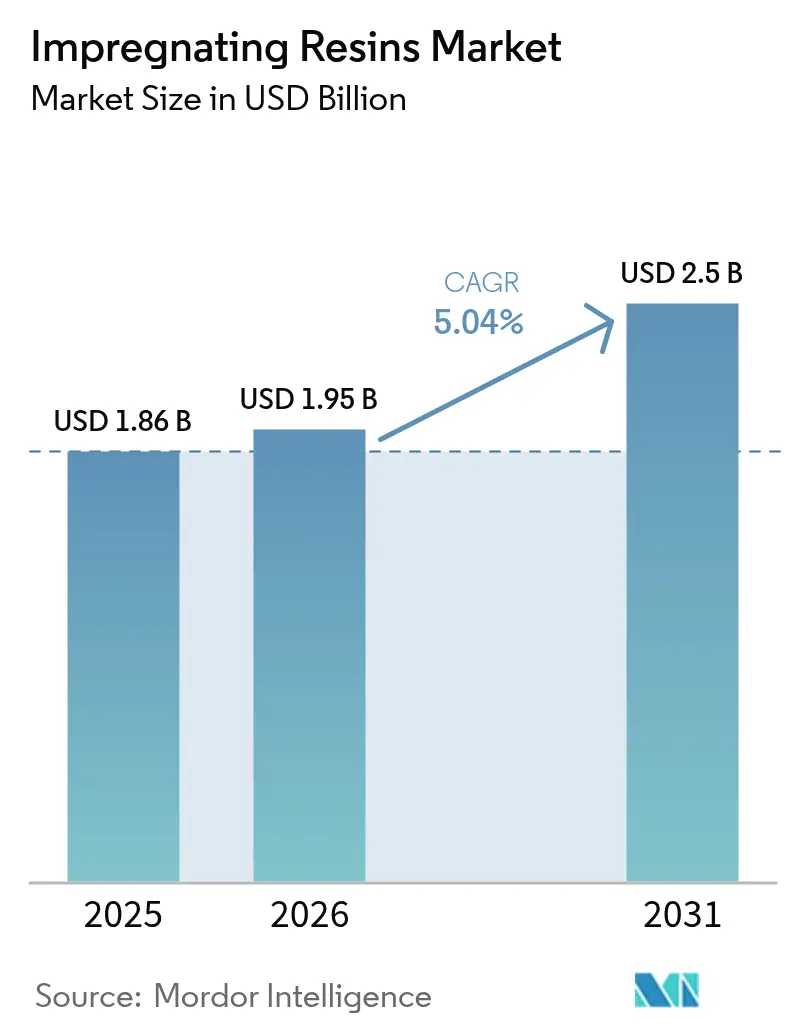
The Impregnating Resins Market size is expected to increase from USD 1.86 billion in 2025 to USD 1.95 billion in 2026 and reach USD 2.5 billion by 2031, growing at a CAGR of 5.04% over 2026-2031. End-users are racing to meet stricter motor-efficiency mandates, scale solvent-free production lines that comply with hazardous-air-pollutant ceilings, and localize supply chains for electrified vehicles and semiconductor fabs across the Asia-Pacific. Rapid growth in permanent-magnet synchronous motors, data-center cooling equipment, and offshore wind generators is lifting demand for Class H and Class C polyester-imide and epoxy systems. The U.S. Environmental Protection Agency’s metal HAP limit for new coating facilities is accelerating the phase-out of toluene- and xylene-based varnishes, while the European Commission’s Euro 7 regulation is pushing automakers toward higher-temperature traction-motor insulation. Capital intensity remains a hurdle, a single automated vacuum-pressure impregnation (VPI) line tops USD 5 million, but emerging contract impregnation hubs in Southeast Asia are reducing entry barriers for small manufacturers.
Key Report Takeaways
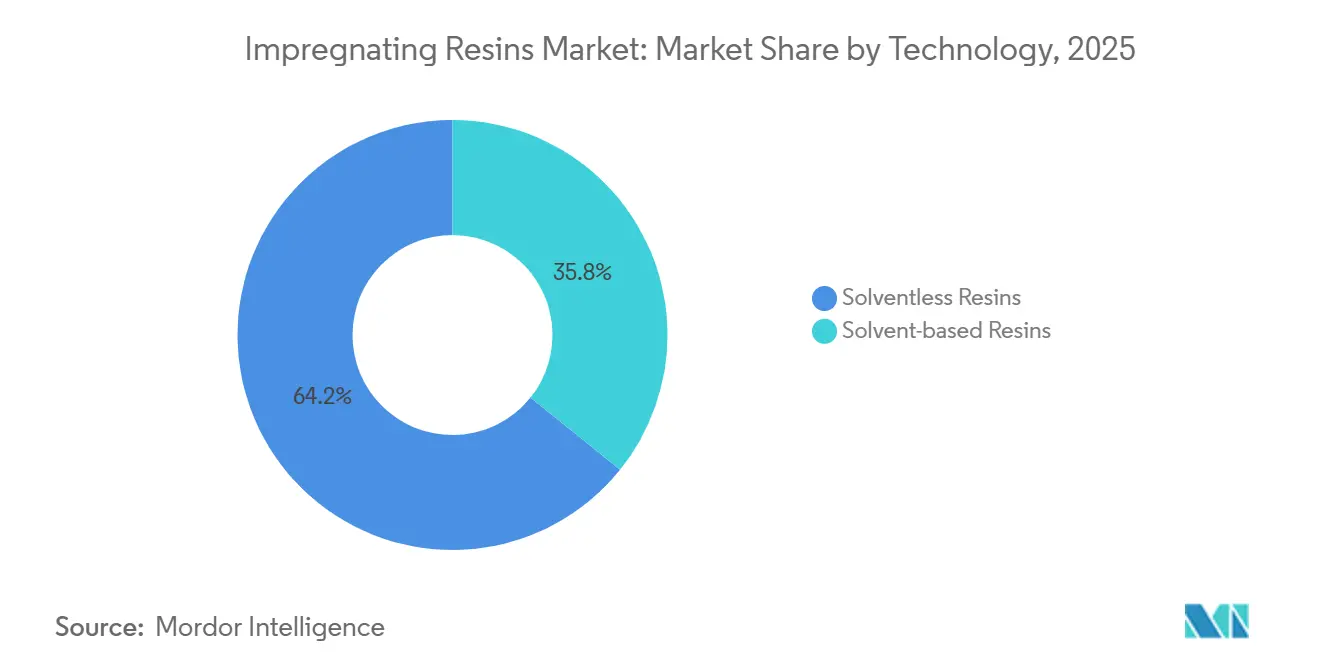
- By technology, solventless formulations held 64.23% of impregnating resins market share in 2025 and are on track for a 5.15% CAGR through 2031.
- By resin type, the Other Resins category commanded 38.67% share of the impregnating resins market size in 2025, while epoxy is projected to expand at a 5.12% CAGR between 2026 and 2031.
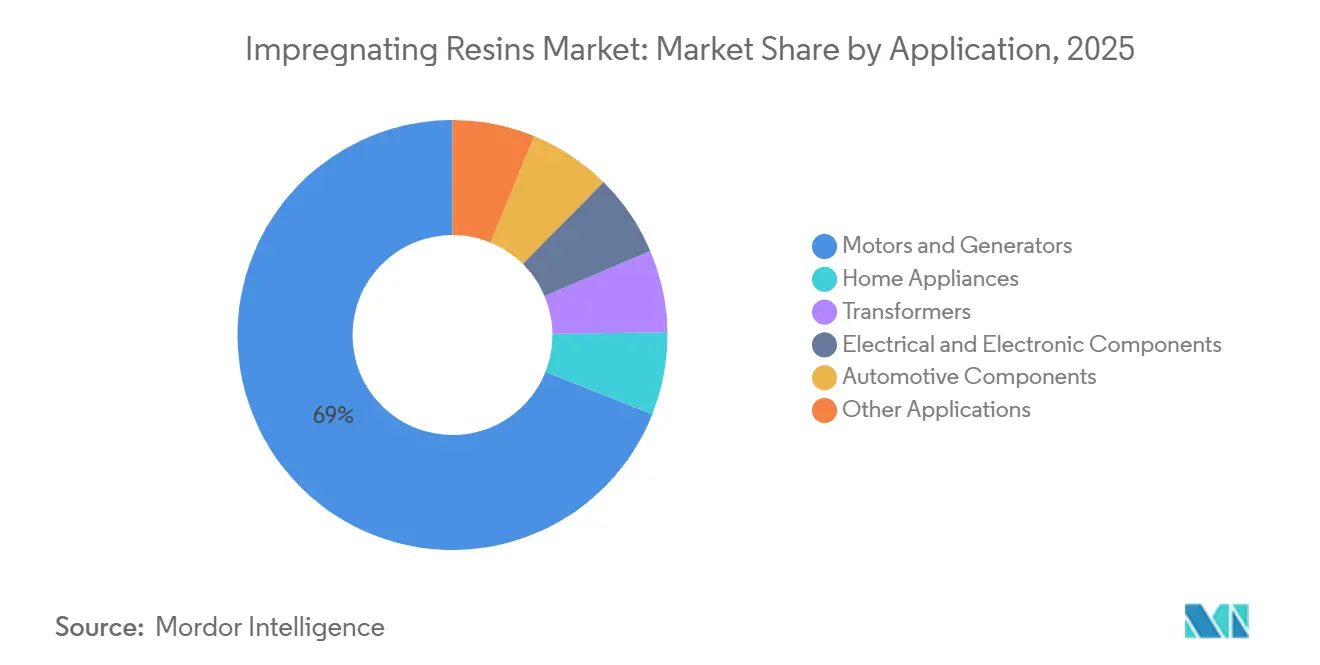
- By application, motors and generators accounted for 68.98% share of the impregnating resins market size in 2025 and are advancing at a 5.06% CAGR through 2031.
- By geography, Asia-Pacific led with 41.24% impregnating resins market share in 2025 and is forecast to grow at a 5.14% CAGR to 2031.
Note: Market size and forecast figures in this report are generated using Mordor Intelligence’s proprietary estimation framework, updated with the latest available data and insights as of 2026.
Market Trends and Insights
Drivers Impact Analysis of Impregnating Resins Market*
| Drivers | (~) % Impact on CAGR Forecast | Geographic Relevance | Impact Timeline |
|---|---|---|---|
| Surging Demand for High-Efficiency Electric Motors | +1.8% | Global, notably EU, China, North America | Medium term (2-4 years) |
| OEM Shift toward Solvent-Free Impregnation Processes | +1.3% | North America, EU, spill-over to APAC | Short term (≤ 2 years) |
| Grid-Scale Wind-Turbine Installation Growth | +0.6% | Europe, North America, Chinese coastal provinces | Long term (≥ 4 years) |
| EV Traction-Motor Production Acceleration | +1.1% | China, South Korea, Japan, North America, EU | Medium term (2-4 years) |
| Miniaturization of Consumer Electronics | +0.5% | Japan, South Korea, Taiwan, China, Southeast Asia | Long term (≥ 4 years) |
| Source: Mordor Intelligence | |||
Surging Demand for High-Efficiency Electric Motors
Escalating minimum energy-performance standards are shrinking permissible motor losses and forcing OEMs to adopt VPI to eliminate voids that spark partial discharge. The European Ecodesign Directive requires IE3 efficiency for ≥0.75 kW motors, while China’s GB 18613-2020 is aligned with IEC 60034-30-1 efficiency classes. Slot-fill factors above 70% and concentrated permanent-magnet hot spots are pushing resin performance toward glass-transition temperatures of 180 °C. Compliance with IEC 60034-18-41 partial-discharge testing embeds VPI as a prerequisite, locking in long-term resin consumption as global motor fleets shift to IE4 and IE5.
OEM Shift toward Solvent-Free Impregnation Processes
Metal HAP ceilings of 0.0079 grains per dry standard cubic foot for new U.S. coating facilities make solvent-based varnishes uneconomical unless paired with thermal oxidizers. Europe’s Industrial Emissions Directive and China’s Blue-Sky Action Plan mirror these caps. New solventless chemistries cut cure cycles from six hours to under ninety minutes on automated trickle-impregnation lines. Wacker Chemie’s SILRES H62 C cures at room temperature within twenty-four hours, removes post-bake ovens, and slashes plant energy use by roughly 40%.
Grid-Scale Wind-Turbine Installation Growth
Global wind additions hit 117 GW in 2024, and cumulative capacity is expected to top 1,200 GW by 2030. Modern 8-15 MW offshore generators operate at up to 6.6 kV, demanding Class H or Class C epoxy or polyester-imide insulation. Retrofits of 15- to 20-year-old onshore units across Europe and North America extend service life, creating a secondary market for on-site impregnation services that can requalify generators without lifting rotors, accelerating resin demand beyond new-build volumes[1].
EV Traction-Motor Production Acceleration
Pulse-width-modulated inverters induce voltage spikes near 1,200 V and high switching frequencies, intensifying insulation stress. Federal incentives under the U.S. Inflation Reduction Act, combined with China’s dual-credit scheme, are co-locating traction-motor assembly with domestic impregnation capacity. Distributed windings that rely on full VPI are displacing hairpin designs in several vehicle platforms, cementing epoxy and polyester-imide requirements for Class H performance.
Restraints Impact Analysis of Impregnating Resins Market*
| Restraint | (~) % Impact on CAGR Forecast | Geographic Relevance | Impact Timeline |
|---|---|---|---|
| VOC and HAP Regulatory Tightening | –0.9% | North America, EU, China, India | Short term (≤ 2 years) |
| Price Volatility of Bisphenol-A and Styrene Feedstocks | –0.7% | Asia-Pacific, Europe, global spot markets | Medium term (2-4 years) |
| Capital-Intensive Vacuum-Pressure Equipment | –0.4% | India, Southeast Asia, Latin America | Long term (≥ 4 years) |
| Source: Mordor Intelligence | |||
VOC and HAPS Regulatory Tightening
Compliance with updated U.S. EPA and EU emission standards obliges legacy plants to install oxidizers that cost USD 0.8–1.5 million each, squeezing margins and delaying expansions. Small motor shops lacking in-house formulation expertise face high validation costs to switch to solventless systems, often resorting to contract impregnation that inflates unit costs. European anti-dumping duties of up to 40.8% on Chinese epoxy imports further elevate raw-material prices, adding complexity for regional OEMs[2].
Price Volatility of Bisphenol-A and Styrene Feedstocks
Bisphenol-A spot prices in Asia oscillated by nearly 50% during 2024-2025 as phenol oversupply combined with outages at epichlorohydrin facilities. Contract styrene prices on the U.S. Gulf Coast swung by USD 550 per ton over the same period. Such variability can erase 150-200 basis points of profitability for motor OEMs and discourages long-term resin supply agreements, postponing capacity expansion.
*Our forecasts treat driver/restraint impacts as directional, not additive. The impact forecasts reflect baseline growth, mix effects, and variable interactions.
Impregnating Resins Market Segment Analysis
By Technology:
Solventless Formulations Extend Compliance LeadershipSolventless resins captured 64.23% of the impregnating resins market share in 2025 and are forecast to grow at 5.15% through 2031. Their exothermic cure eliminates solvent evaporation, shortens cycle time, and bypasses multi-million-dollar thermal oxidizers mandated under 40 CFR Part 63, Subpart HHHHH. Energy savings reach 40% compared with conventional bake-and-cure lines, making solventless systems attractive even in geographies with modest electricity tariffs. Trickle-impregnation machines that marry solventless chemistry with automated winding handling are spreading from large motor OEMs to contract shops, compressing takt times to under ninety minutes.
Solvent-based varnishes persist in retrofit lines and developing markets where emission enforcement is patchy. An installed base of legacy tanks and ovens, often amortized years ago, cushions operating budgets. Yet, as imported replacement solvents face tighter customs checks and rising taxes, converters are budgeting capex for solventless upgrades in the 2027-2029 window, aligning with planned motor model changes.
By Resin Type:
Epoxy Poised for Fastest Growth on Electronics UptakeEpoxy volumes are projected to rise at a 5.12% CAGR, the highest among resin types, even though Other Resins commanded 38.67% share in 2025. Low dielectric loss, robust adhesion to copper, and compatibility with automated dispensing make epoxy the preferred choice for fine-pitch windings and semiconductor underfill. Emerging 48-V mild-hybrid vehicles further amplify demand for Class H epoxy insulation that survives inverter-induced spikes.
Polyester resins remain entrenched in cost-sensitive appliance motors, while polyester-imides address high-voltage wind-turbine and traction-motor duty cycles. Silicone systems are gaining ground in battery encapsulation, owing to flame-retardant chemistry and resistance to thermal cycling. Polyurethanes occupy a niche in outdoor generators that face moisture ingress, offering flexibility that mitigates delamination under thermal shock.
By Application:
Motors and Generators Retain Volume LeadershipMotors and generators accounted for 68.98% of the impregnating resins market share in 2025 and are expected to advance at a 5.06% CAGR to 2031. Higher slot-fill factors in IE4 and IE5 machines, combined with thinner air gaps, raise winding temperatures and accelerate the adoption of Class H and Class C systems. Electric-vehicle traction motors intensify these requirements with inverter-driven voltages up to 1,200 V and switching frequencies above 10 kHz, making full VPI indispensable.
Transformers, especially dry types for urban substations, represent a steady growth avenue as utilities seek fire-safe alternatives to oil-filled units. Appliance motors, from refrigerator compressors to washing-machine drives, continue to transition from dip-and-bake to trickle impregnation to meet U.S. Department of Energy efficiency thresholds. Inductors, solenoids, and other electronics components consume low-viscosity epoxy grades capable of penetrating sub-0.1 mm gaps, supporting the miniaturization of consumer devices.

Geography Analysis
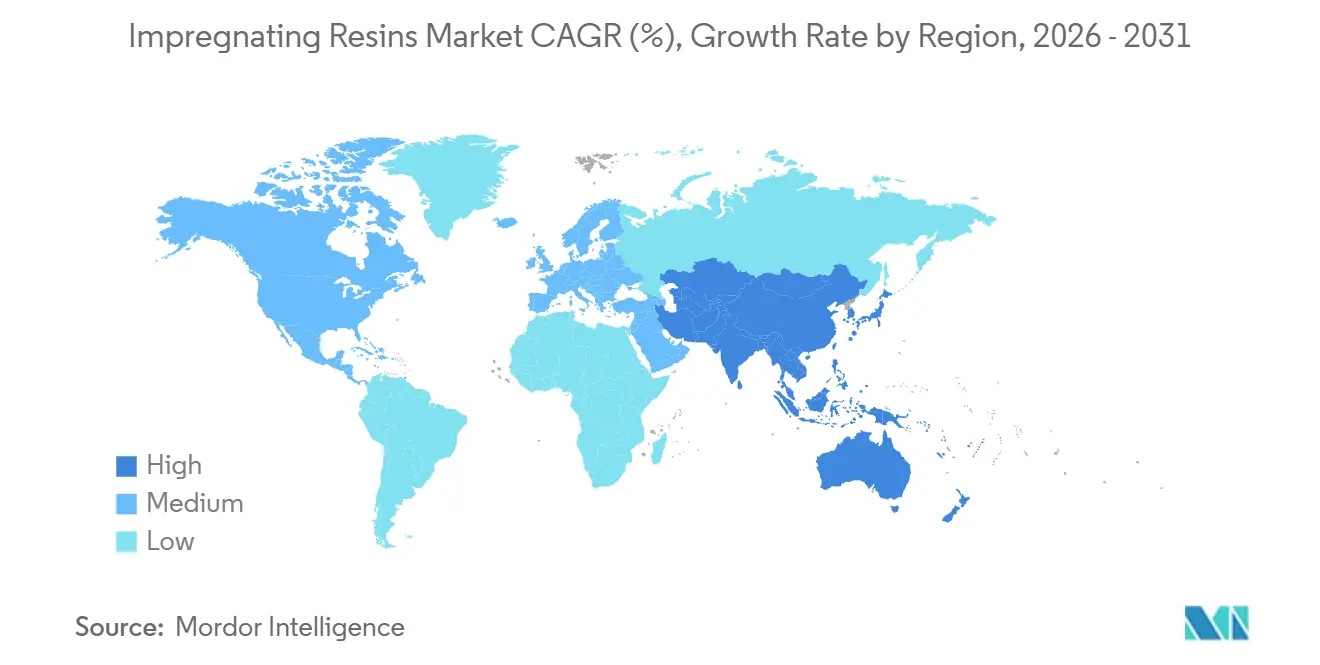
APAC Impregnating Resins Market
Asia-Pacific held 41.24% impregnating resins market share in 2025 and is set to grow at a 5.14% CAGR through 2031. China’s dual-credit policy yielded 10.2 million new-energy vehicles in 2024 and targets a 50% NEV sales mix by 2035, anchoring large-scale traction-motor demand. India’s Production-Linked Incentive schemes earmark USD 2.3 billion for electronics and USD 10 billion for semiconductor fabs, catalyzing local consumption of polyester-imide and epoxy grades. Japan’s subsidy program covers up to 50% of fab construction costs, building a domestic supply chain for low-chloride epoxy underfill compatible with advanced packaging. South Korean chipmakers are standardizing fast-cure epoxy for system-in-package modules, while Thailand and Vietnam offer multi-year tax holidays that attract contract impregnation houses, balancing regional capacity.
North America Impregnating Resins Market
North America leverages USD 369 billion in clean-energy incentives under the Inflation Reduction Act, which ties consumer tax credits to domestic content thresholds. Automakers have announced tens of billions in capex for traction-motor assembly lines in Michigan, Kentucky, and Tennessee, all specifying solventless epoxy formulations that satisfy the U.S. EPA’s HAP ceiling. Canada’s Strategic Innovation Fund and Mexico’s near-shoring inflows round out a regional corridor that localizes resin sourcing under USMCA’s 75% regional-value rules.
Europe Impregnating Resins Market
Europe is guided by the Green Deal’s 2035 zero-emission target and Euro 7 standards, accelerating Class H traction-motor insulation in Germany, France, and Italy. Offshore wind build-outs in the North Sea and Baltic Sea are driving Class C epoxy adoption for 15 MW generators. Anti-dumping duties on Asian epoxy imports open share for domestic formulators, though recent plant closures constrain near-term solventless supply. Eastern Europe and Russia maintain polyester demand for rail and oil-field motors, despite geopolitical headwinds.
South America and MEA Impregnating Resins Market
South America’s growth centers on Brazil’s 2.3 million-unit automotive output, which is pivoting to flex-fuel hybrids. Chile’s electrified copper mines and Colombia’s renewable auctions are introducing Class H requirements for heavy-duty generators. The Middle East and Africa add incremental demand via megaprojects such as Saudi Arabia’s NEOM and South Africa’s grid-modernization, though currency volatility impacts import economics for specialty resins.
Regulatory Landscape
Environmental and chemical-management rules are tightening around solvent emissions and substance risk management, accelerating the shift toward solventless impregnation and higher-performance insulation systems. In the United States, the U.S. Environmental Protection Agency (EPA) continues TSCA risk evaluation activity relevant to resin chemistries and inputs, including its December 2024 release of formaldehyde conditions of use documentation and forward-looking 2026 Unified Agenda items that shape compliance planning for formulators and downstream users.
In Europe, REACH remains the central framework for registration, restrictions, and communication duties, with ongoing policy work that includes SEAC review activity related to PFAS restrictions (including use cases that can touch impregnation agents) and other substances under risk management assessment. Alongside chemical policy, test and qualification standards continue to define market access: IEC 60370:2018 remains a key reference for thermal endurance testing of insulating resins and varnishes for impregnation, while ISO methods for binder testing have been updated, including ISO 11908:2025 (amino resins) and the January 2026 publication of EN ISO 11909:2026 for polyisocyanate resins, which updates analytical test practices.
Value Chain Analysis
The value chain starts with petrochemical and specialty-chemical feedstocks (notably epoxy backbones and hardeners, polyester and polyester-imide intermediates, silicone modifiers, reactive thinners, and additives), followed by formulation and batch reactor production requiring tight temperature control and QA for electrical properties. Finished impregnating resins are qualified to insulation and endurance requirements (for example, IEC 60370:2018 test procedures and IEC 60085 thermal class expectations in many customer specs), then supplied either in bulk tank-wagon formats to large motor/generator plants or in drums and pails to repair and rewind channels and contract impregnation shops.
Downstream, resin demand is pulled by OEM motor and generator production, traction-motor and inverter-driven electrification programs, wind generators, transformers, and electronics components requiring low-viscosity penetration and controlled cure. Supply chain performance is constrained by shelf-life management for solvent-free grades (commonly 6 to 12 months) and by validation lead times for custom formulations; standard grades often move on multi-week lead times while custom grades can extend longer due to testing and customer qualification. Regional dependency on imported precursors (including epoxy resins and hardeners in parts of Europe) and volatility in key inputs such as bisphenol-A and styrene can propagate cost and availability swings across the chain, prompting larger off-takers to use strategic inventory buffers and dual sourcing.
Competitive Landscape
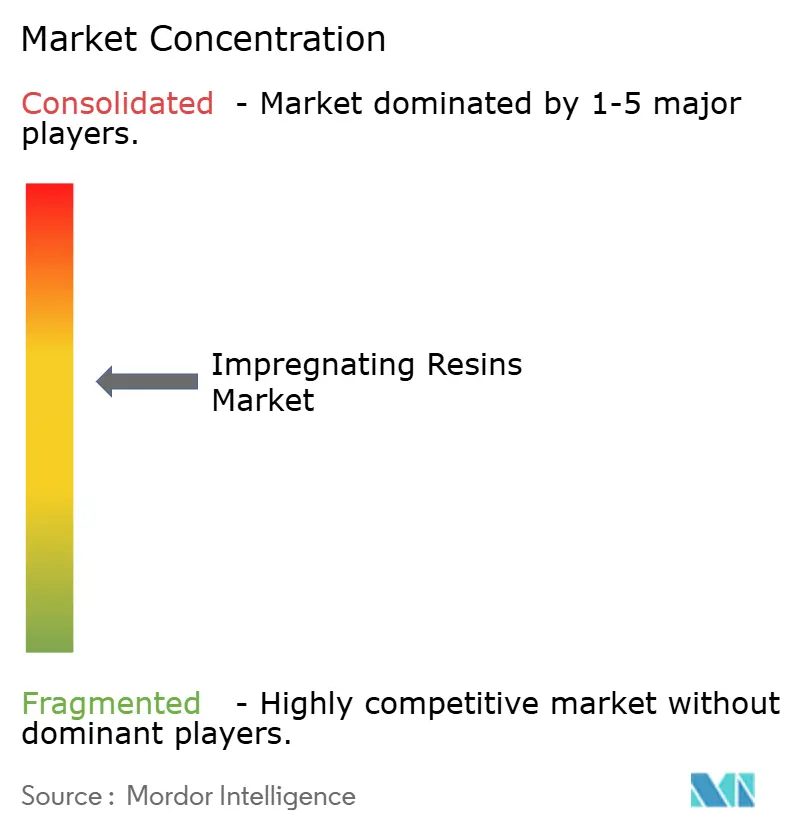
The impregnating resins market is moderately consolidated. Innovation pipelines focus on ambient-cure epoxy-silicone hybrids, flame-retardant silicones with thermal conductivity above 1.5 W/m-K for EV battery packs, and ultra-low-viscosity epoxies for 5G power modules. Quality consistency remains a barrier for low-cost entrants: chloride contamination above 100 ppm disqualifies many formulations from automotive qualification. European anti-dumping tariffs shift cost advantages but also spur local capacity expansions from incumbents.
Impregnating Resins Industry Leaders
-
ALTANA (ELANTAS)
-
Von Roll
-
Axalta Coating Systems, LLC
-
Henkel AG and Co. KGaA
-
Huntsman International LLC
- *Disclaimer: Major Players sorted in no particular order
Impregnating Resins Market Companies Covered in this Report
- 3M
- AEV Group
- Axalta Coating Systems, LLC
- BASF
- Börger GmbH
- Chetak Manufacturing Company
- ALTANA (ELANTAS)
- Henkel AG and Co. KGaA
- Huntsman International LLC
- Momentive
- NIPPON RIKA INDUSTRIES CORPORATION
- Resonac Holdings Corporation
- Von Roll
- Wacker Chemie AG
Market Opportunities and Future Outlook
A clear whitespace is forming around localized capacity and services that shorten lead times for electrification-heavy end users while meeting solvent and hazard controls. The move away from solvent-based varnishes under VOC and HAP constraints (including the U.S. metal-HAP limit for new coating facilities referenced in the report context) creates room for suppliers that can deliver qualified solventless epoxy, polyester-imide, and hybrid systems at scale, as well as for contract impregnation hubs that help smaller motor shops transition without installing full in-house VPI lines (often cited as costing more than USD 5 million per automated line).
New capacity additions and end-market programs provide tangible evidence for targeted expansion in Asia-Pacific supply chains. In June 2026, Elantas Beck India (ALTANA/ELANTAS) approved an INR 56 crore investment to expand its Ankleshwar, Gujarat facility by 11,000 MTPA (from 35,000 to 46,000 MTPA), aligning with demand from power infrastructure, e-mobility, and industrial electrification where Class H and Class C insulation performance is increasingly specified. In parallel, country programs highlighted in the report context, such as India semiconductor and electronics incentives and Japan fab subsidies, reinforce opportunities for low-chloride epoxy and fast-cure systems used in electronics components and advanced packaging, while wind-turbine generator demand supports higher-temperature insulation systems and on-site retrofit impregnation service models.
Recent Industry Developments in Impregnating Resins Market
- June 2026: Elantas Beck India approved an INR 56 crore investment to expand impregnating resin and related insulation-material capacity at its Ankleshwar, Gujarat site by 11,000 MTPA, lifting total capacity from 35,000 to 46,000 MTPA with a stated 12-month project timeline. The additional capacity strengthens local supply for electrification-driven customers that require qualified solventless and high-temperature insulation systems. It also supports shorter regional lead times versus import-reliant sourcing for OEMs and contract impregnation houses.
- September 2024: Momentive launched a flame-retardant silicone resin for EV battery encapsulation delivering thermal conductivity above 1.5 W/m-K and dielectric strength of 20 kV/mm. The product aligns resin portfolios with EV electrification requirements where thermal management and dielectric robustness are purchased together as safety-critical attributes. This broadens competition between silicone and epoxy-silicone hybrids in high-voltage, high-heat applications adjacent to traction-motor insulation.
- May 2024: Wacker Chemie introduced SILRES H62 C, a silicone-modified epoxy that cures at room temperature within twenty-four hours, removes post-bake ovens, and meets IEC 60085 Class F requirements. Ambient-cure capability reduces energy use and floor-space needs, helping plants meet solvent and emissions constraints while improving takt time in impregnation operations. The launch also raises performance expectations for fast-cycle, solventless systems used by motor OEMs and contract impregnation shops.
Impregnating Resins Market Report Scope and Research Methodology
Market Definition and Coverage
For this study, the impregnating resins market is defined as the value of liquid resin systems used to impregnate porous electrical and industrial components so they gain insulation, mechanical strength, and protection after curing, across the covered geographies.
Scope exclusions: Excludes general-purpose casting and potting compounds that are not sold or specified for impregnation use cases.
Segments Covered in This Report
- By Technology
- Solventless Resins
- Solvent-based Resins
- By Resin Type
- Epoxy
- Polyester
- Polyester-imide
- Other Resin Types (Polyurethane, silicone, etc.)
- By Application
- Motors and Generators
- Home Appliances
- Transformers
- Electrical and Electronic Components
- Automotive Components
- Other Applications
- By Geography
- Asia-Pacific
- China
- India
- Japan
- South Korea
- Malaysia
- Thailand
- Indonesia
- Vietnam
- Rest of Asia-Pacific
- North America
- United States
- Canada
- Mexico
- Europe
- Germany
- United Kingdom
- France
- Italy
- Spain
- Nordic Countries
- Russia
- Rest of Europe
- South America
- Brazil
- Argentina
- Colombia
- Rest of South America
- Middle-East and Africa
- Saudi Arabia
- United Arab Emirates
- Qatar
- South Africa
- Nigeria
- Egypt
- Rest of Middle-East and Africa
- Asia-Pacific
Data Sources, Market Sizing, and Validation
Desk Research
Desk research is used to set the base structure of the model and keep assumptions grounded in what is publicly observable. We reviewed public sources such as US Census Bureau trade and manufacturing data, Eurostat industrial production series, UN Comtrade import and export data for resin-related HS codes, and International Energy Agency indicators linked to electrification and industrial activity.
Along with these, we used sources like company annual reports, investor presentations, and technical literature in peer-reviewed journals covering insulation systems and motor winding practices. Patent databases were also referenced to understand the direction of solventless systems, curing chemistries, and insulation performance needs. The desk sources mentioned are illustrative rather than exhaustive, and other public references were also used for data collection, validation checks, and research clarification.
Primary Interviews and Surveys
Primary work focused on validating what is consumed by the main application pools, especially motors and generators, transformers, and electrical and electronic components. Respondent input clarified which resin grades are treated as impregnation-specific in purchasing, and how conversion factors and price ranges differ by solvent-based versus solventless systems. We spoke with participants across resin manufacturing, formulators, and downstream users in APAC, EMEA, and the Americas, then aligned those findings with the desk model.
Distribution of primary research fieldwork respondents
| Company type | Respondent position | Region |
|---|---|---|
| Top tier: 33% | CXOs: 16% | APAC: 50% |
| Mid tier: 51% | Functional/Unit leaders: 33% | EMEA: 29% |
| Smaller Players: 16% | Managers: 51% | Americas: 21% |
Market-Sizing & Forecasting
Sizing was started with a top-down build where electrical equipment output and replacement demand were used to reconstruct the addressable impregnation demand pool. From there, application-level resin intensity factors were applied for common use cases, followed by mix splits for solvent-based and solventless technologies and for major chemistries used in impregnation.
To keep totals realistic, we corroborated the results with selective bottom-up checks, such as sampled price bands by resin system and region, channel checks on typical order sizes, and supplier-side volume sanity checks. Inputs that mattered most included motor and generator production trends, transformer installations, electrification-linked capex cycles, solvent and VOC compliance pressures, and typical resin system price progression by chemistry and formulation complexity.
Forecasts were produced using scenario analysis, where end-market production outlooks and the pace of efficiency regulation were varied within reasonable ranges, then reviewed with industry respondents. Where bottom-up visibility was weaker for smaller countries, the gap was handled using proxy indicators like manufacturing output indices and import patterns, and then normalized back to regional totals.
Data Validation & Update Cycle
Validation was done by triangulating model outputs against multiple independent signals, including trade flows, industrial production direction, and application build rates discussed by interviewees. Outliers were flagged at country and application level, and then reviewed again to confirm that a unit conversion, price assumption, or mix split was not driving an unrealistic jump.
Before sign-off, the full model is checked in steps by an analyst, followed by a fresh variance review of key assumptions. Reports are refreshed annually, and interim updates are triggered when material events occur, such as sharp feedstock moves, regulatory changes impacting solvent systems, or a major shift in electrical equipment production.
Mordor Intelligence's Impregnating Resins Market Estimate Compared With Other Published Estimates
It is common to see different market values for impregnating resins, even when the same time period is being discussed, because publishers do not always count the same product boundaries and end-use linkages. Gaps also come from how prices are averaged across chemistries, how regional currency conversion is timed, and whether the latest electrical equipment output shifts are reflected.
Casting and potting compounds that are not specified for impregnation sit outside Mordor Intelligence's scope, and that single inclusion difference can pull totals up in some published figures. Another spread driver is how quickly solventless adoption is modeled, since aggressive penetration ramps can inflate forward values if they are not cross-checked against equipment qualification cycles and regional VOC rules.
Benchmark comparison
| Source | Market Size | Gaps in Research Methodology |
|---|---|---|
| Mordor Intelligence | USD 1.86 B (2025) | |
| Global Consultancy A | USD 1.69 B (2024) | Uses an earlier base year and a different chemistry framing that emphasizes formaldehyde-based resin categories, which can shift what is counted as impregnation grade versus adjacent electrical insulation materials. |
| Industry Publisher B | USD 1.98 B (2025) | May use a broader application mapping that can blend impregnation resins with nearby electrical insulation liquids, and the faster adoption curve assumed for solventless systems lifts the same-year value. |
The comparison shows that most of the variation is explained by product and application boundaries, plus how technology mix and average pricing are rolled forward. Using clear application demand anchors and then checking price and mix assumptions against what respondents see in procurement and production helps keep the estimate traceable and repeatable.
Key Questions Answered in the Report
What is the forecast value of the impregnating resins market by 2031?
The impregnating resins market is projected to reach USD 2.50 billion by 2031.
Which technology segment leads the global market?
Solventless formulations dominated with a 64.23% share in 2025 and maintain the highest growth outlook to 2031.
Why are epoxy resins growing faster than other types?
Low dielectric loss, strong copper adhesion, and compatibility with automated trickle lines position epoxy for the fastest 5.12% CAGR to 2031.
How do environmental regulations influence resin selection?
VOC and metal-HAP ceilings in the U.S., EU, and China effectively force OEMs to adopt solvent-free resins or install costly abatement systems.
Which region is expected to contribute the largest incremental demand?
Asia-Pacific, led by China, India, and Japan, is projected to add the most volume, aided by EV mandates and semiconductor investment.
What capital hurdle limits new entrants?
A full VPI line costs more than USD 5 million and requires extensive IEC 60085 testing, concentrating capacity among financially strong incumbents.