
Identity (ID) Verification Market Size and Share
Market Overview
| Study Period | 2020 - 2031 |
|---|---|
| Market Size (2026) | USD 15.78 Billion |
| Market Size (2031) | USD 26.8 Billion |
| Growth Rate (2026 - 2031) | 11.18 % |
| Fastest Growing Market | Asia-Pacific |
| Largest Market | North America |
| Market Concentration | Medium |
Major Players *Disclaimer: Major Players sorted in no particular order Image © Mordor Intelligence. Reuse requires attribution under CC BY 4.0. | |
Identity (ID) Verification Market Analysis by Mordor Intelligence
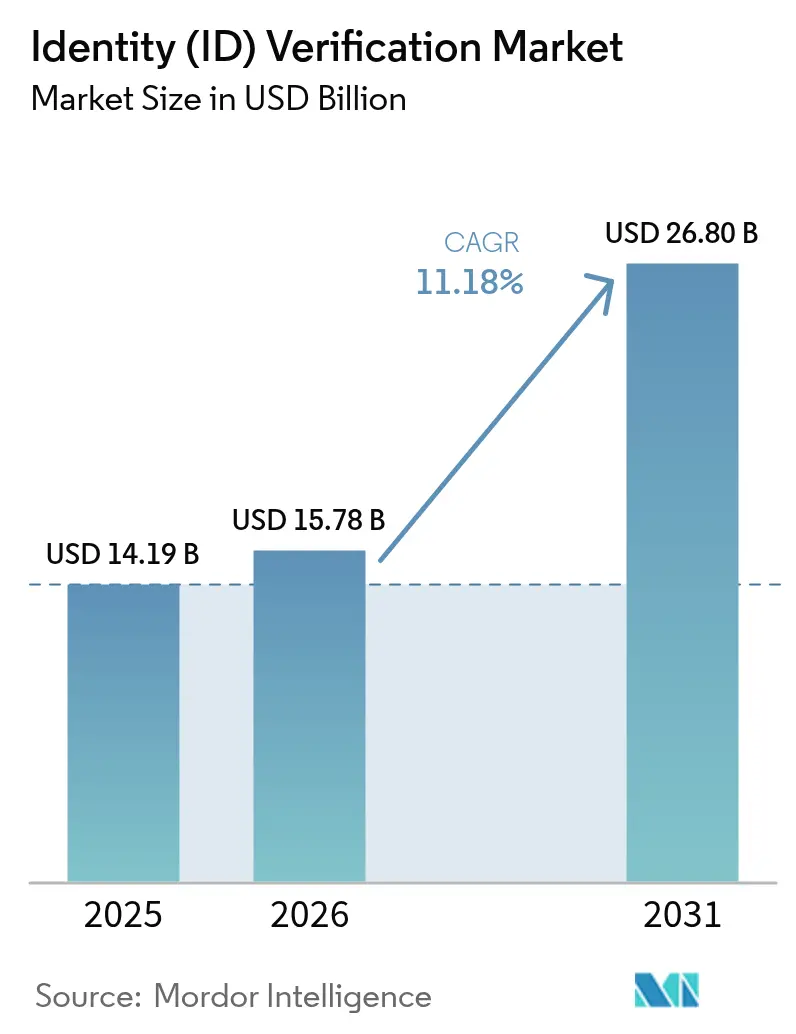
The identity verification market size is expected to grow from USD 14.19 billion in 2025 to USD 15.78 billion in 2026 and is forecast to reach USD 26.8 billion by 2031 at 11.18% CAGR over 2026-2031. The expansion reflects a decisive shift from checkbox compliance toward strategic security investment as enterprises confront AI-generated fraud, deepfake attacks, and rising regulatory fines. Deepfakes alone jumped 3,000%, compelling vendors to embed passive liveness and behavioral analytics directly into onboarding workflows. Cloud-native deployment, now the default choice for most new rollouts, accelerates innovation because model updates can be pushed instantly across global tenants. Meanwhile, demand for portable, privacy-preserving credentials is spurring pilots that link government-issued mobile driver’s licenses, verifiable credentials, and Web3 wallets into a single user journey. Consolidation is intensifying as full-stack security firms buy niche specialists to acquire AI document-forensics talent, yet no provider controls more than 15% revenue, leaving ample headroom for focused entrants that solve edge-case risks or industry-specific regulations.
Key Report Takeaways
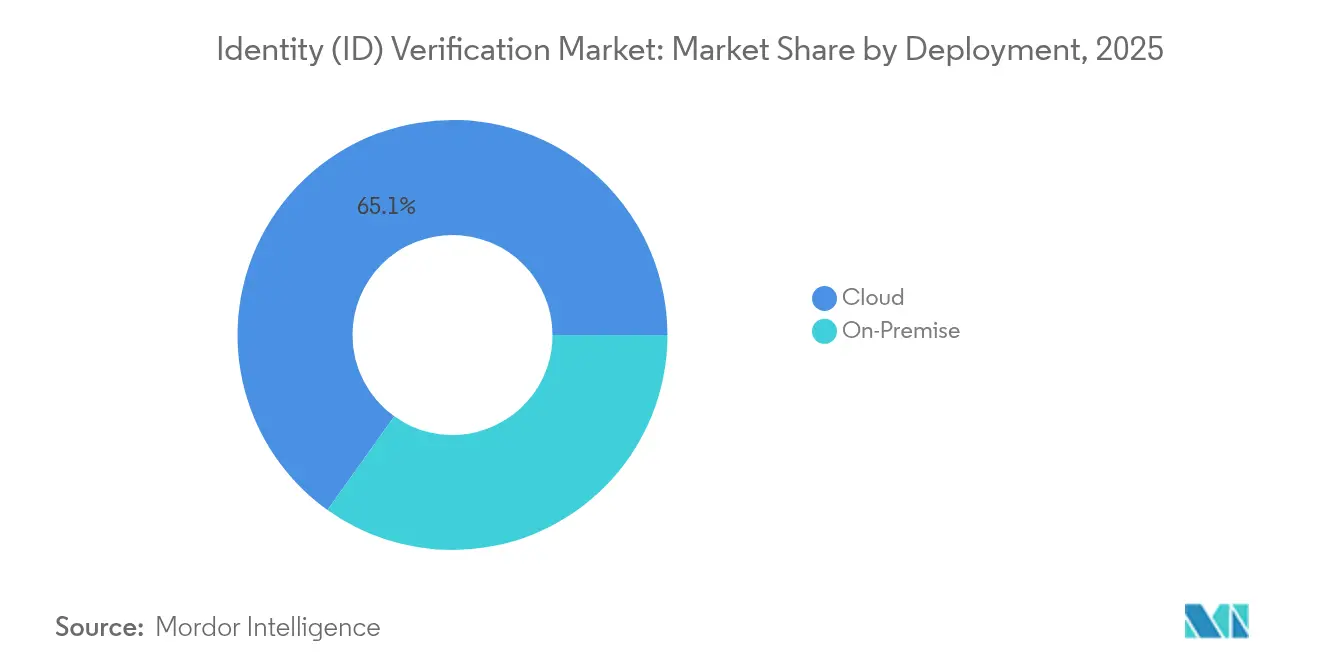
- By deployment model, cloud platforms held 65.12% of identity verification market share in 2025, and the same segment is projected to grow 12.72% CAGR through 2031.
- By solution type, biometric verification led with 35.84% revenue share in 2025; document-centric liveness detection is projected to grow at a 12.92% CAGR to 2031.
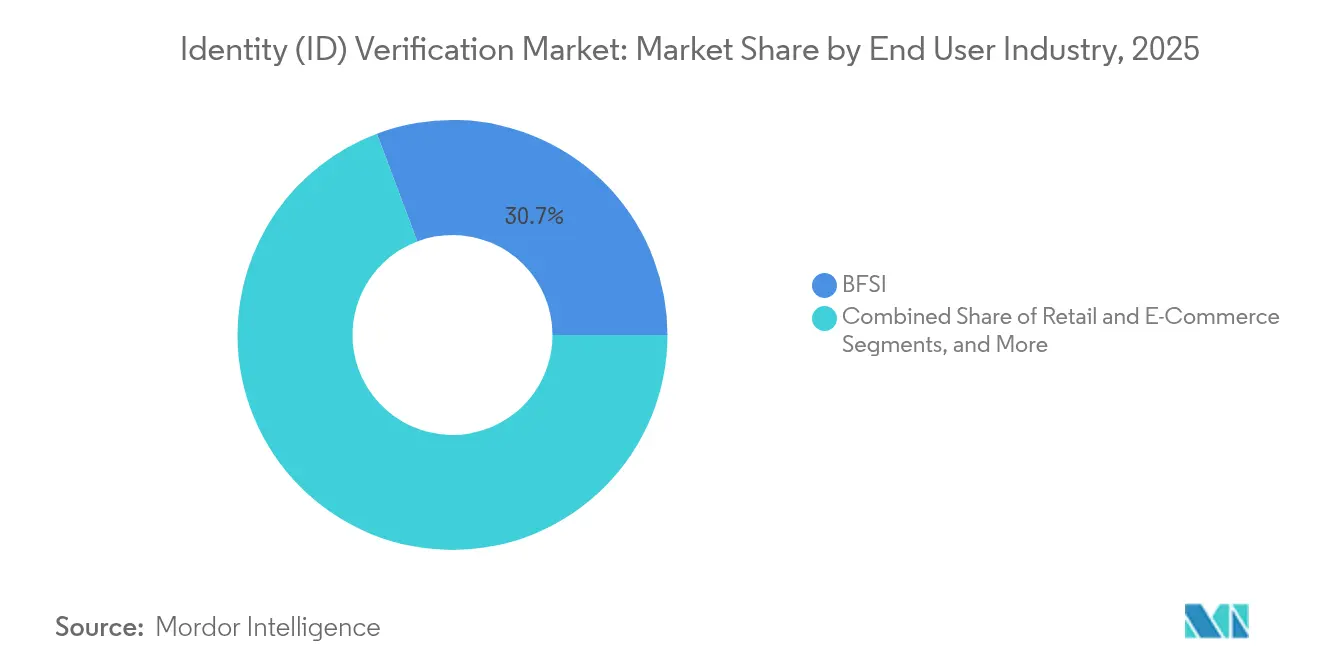
- By end-user industry, financial services retained 30.72% share of the identity verification market size in 2025, whereas gaming and gambling is advancing at an 11.24% CAGR.
- By organization size, large enterprises commanded 72.56% share of the identity verification market size in 2025, but SMEs record the fastest CAGR at 12.22%.
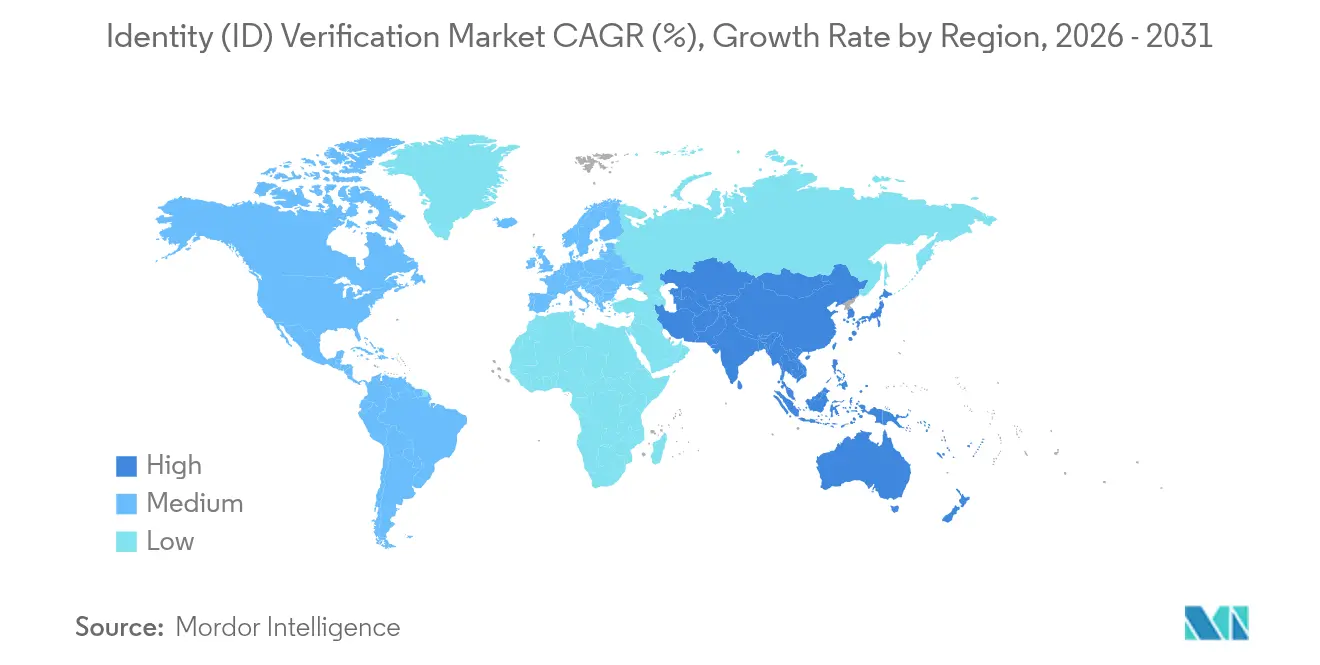
- By geography, North America accounted for 32.43% of identity verification market share in 2025, while Asia-Pacific posts the highest growth at 11.52% CAGR through 2031.
Note: Market size and forecast figures in this report are generated using Mordor Intelligence’s proprietary estimation framework, updated with the latest available data and insights as of 2026.
Market Trends and Insights
Drivers Impact Analysis of Identity (ID) Verification Market*
| Driver | (~) % Impact on CAGR Forecast | Geographic Relevance | Impact Timeline |
|---|---|---|---|
| Increasing cyber-fraud and regulatory fines | +2.80% | Global, with concentration in North America and EU | Medium term (2-4 years) |
| Surge in remote onboarding and e-KYC mandates | +2.10% | Global, led by Asia-Pacific emerging markets | Short term (≤ 2 years) |
| AI-driven accuracy improvements in document forensics | +1.90% | North America and EU, expanding to Asia-Pacific | Medium term (2-4 years) |
| Cross-border digital ID interoperability pilots | +1.40% | EU-US corridor, expanding to Asia-Pacific | Long term (≥ 4 years) |
| Fintech inclusion programmes in emerging markets | +1.20% | Asia-Pacific core, spill-over to MEA | Medium term (2-4 years) |
| Rise of verifiable credentials and Web3 identity wallets | +0.90% | North America and EU early adopters | Long term (≥ 4 years) |
| Source: Mordor Intelligence | |||
Increasing Cyber-Fraud and Regulatory Fines
Fraudulent account openings spiked to 2.1% of financial transactions in 2024, a sharp rise from 1.27% two years earlier.[1]An estimated 42.5% of detected fraud events now leverage generative AI, which forces banks to deploy multi-layer defences that spot synthetic IDs and deepfake voices in real time. Regulators are equally assertive: global institutions paid USD 6.6 billion in KYC-related penalties during 2023. The combined pressure of higher risk and higher fines is pushing buyers toward enterprise-grade orchestration platforms that integrate document forensics, biometric liveness, and continuous behavioural monitoring in a single API.
Surge in Remote Onboarding and e-KYC Mandates
Seventy-eight percent of APAC consumers deem digital identity checks essential before using new financial apps. Regulators are codifying that preference: the EU requires every member state to issue a Digital Identity Wallet within 24 months, effectively institutionalising electronic KYC. Organisations that automate verification cut service-desk handle times by up to 45 seconds, as a top-10 US bank confirmed after rolling out voice authentication. Network effects then arise when verified credentials become transferable across providers, halving repeat onboarding friction and reinforcing platform scale advantages.
AI-Driven Accuracy Improvements in Document Forensics
State-of-the-art algorithms now analyse 16,000-plus global ID templates and reach 99.9% match accuracy in under two seconds. Computer vision engines inspect texture, font, and hologram placement, while behavioural biometrics verify that the user’s micro-expressions align with document metadata. Providers that embed these functions report a 60% reduction in false positives without sacrificing fraud-catch rates.[2] The result is real-time adjudication that scales from banking to tele-health without manual review queues.
Cross-Border Digital ID Interoperability Pilots
EU–US working groups are harmonising wallet formats so that citizens can reuse a single credential on both sides of the Atlantic.[3] Early pilots connect European wallets to Brazilian and Ukrainian services, hinting at a future network of interoperable APIs that compress onboarding timelines for multinational enterprises. Vendors able to present compliance artefacts for multiple jurisdictions simultaneously enjoy lower sales-cycle friction and faster rollouts for global merchants.
Restraints Impact Analysis of Identity (ID) Verification Market*
| Restraint | (~) % Impact on CAGR Forecast | Geographic Relevance | Impact Timeline |
|---|---|---|---|
| Fragmented global regulatory standards | -1.70% | Global, particularly affecting cross-border operations | Medium term (2-4 years) |
| Deepfake and generative-AI spoofing threats | -1.30% | Global, concentrated in high-value transaction sectors | Short term (≤ 2 years) |
| High integration cost for legacy core systems | -1.10% | North America and EU enterprise markets | Medium term (2-4 years) |
| Data-sovereignty barriers limiting cloud roll-outs | -0.80% | EU, China, Russia regulatory jurisdictions | Long term (≥ 4 years) |
| Source: Mordor Intelligence | |||
Fragmented Global Regulatory Standards
KYC rules vary not only by country but sometimes by banking supervisor inside the same region, forcing platforms to run parallel verification flows and data-residency architectures. The United States stresses portability, whereas EU GDPR pushes localisation, complicating unified cloud deployments. In Asia, Japan insists on FSA licences while South Korea demands bank partnerships for cryptocurrency exchanges. As compliance teams juggle this patchwork, expansion timetables lengthen and operating costs rise.
Deepfake and Generative-AI Spoofing Threats
Commodity toolkits can mint near-perfect counterfeit passports for USD 30, a reality that keeps security teams in a permanent arms race Avallone. Nine of ten off-the-shelf verification engines still misclassify sophisticated deepfakes, according to red-team tests. To remain viable, vendors must layer face-mapping, voice-anti-spoof, and device-fingerprinting without degrading user experience, a delicate balance that inflates R&D budgets and lowers short-run margins.
*Our forecasts treat driver/restraint impacts as directional, not additive. The impact forecasts reflect baseline growth, mix effects, and variable interactions.
Identity (ID) Verification Market Segment Analysis
By Deployment:
Cloud Infrastructure Drives ScalabilityCloud deployment captured 65.12% identity verification market share in 2025 and is expanding at a 12.72% CAGR as firms prefer elastic consumption to capital-heavy servers. The identity verification market size associated with cloud deployments is projected to reach USD 18.7 billion by 2031, reflecting rapid API adoption among digital banks and gig-economy platforms. Continuous model updates, centralised threat-intel sharing, and zero-downtime patching position cloud as the reference architecture. On-premise remains mandatory only where statutes mandate local data processing, yet even those jurisdictions accept cloud when providers open certified regional centres.
Resilience is another driver. Mastercard analyses 143 billion annual transactions to update anomaly-scoring routines that instantly benefit every tenant. Cloud hubs also simplify integration with verifiable credentials and mobile driver’s licenses, cutting project timelines from months to weeks. As edge data centres proliferate, latency concerns fade, allowing cloud adoption even for biometric video streams that demand sub-second round-trip times.

By Solution Type:
Biometric Authentication Becomes StandardBiometric engines held 35.84% of identity verification market share in 2025 and post a 12.86% CAGR through 2031, outpacing document-only approaches. The identity verification market size tied to biometric modalities is forecast to surpass USD 10.1 billion by 2031, driven by passive liveness that operates invisibly in background video frames. Vendors blend facial, voice, and behavioural signals to deliver continuous authentication, narrowing the attack surface for account takeover.
Document checks will persist yet increasingly act as a secondary step. Providers like Aware release real-time synthetic-media detection that flags GPU-rendered artefacts invisible to the naked eye Aware. Financial institutions deploying multi-modal biometrics report 250% accuracy gains, which lowers manual review cost and boosts customer conversion. Knowledge-based questions and static database lookups now serve niche use cases such as low-risk age gating.
By End-User Industry:
Gaming Sector Leads GrowthFinancial services dominated revenue with a 30.72% cut in 2025, yet gaming and gambling record the strongest growth at 11.24% CAGR to 2031. Operators must validate age, prevent money laundering, and comply with safer-gambling statutes in multiple jurisdictions. The identity verification market size for gaming is forecast to nearly double by 2031 as new markets legalise online wagering.
Retail and e-commerce add momentum as merchants combat chargebacks, while tele-health incumbents adopt facial liveness to protect electronic prescriptions. Telecom carriers employ biometric SIM registration to curb device fraud, following mandates in markets such as India and Nigeria. The convergence of sector regulations creates multi-tenant demand for configurable verification orchestration.
By Organization Size:
SMEs Drive Adoption VelocityLarge corporations represented 72.56% revenue in 2025 thanks to complex global compliance footprints. However, SMEs are growing fastest at 12.22% CAGR because API-first tools let them deploy bank-grade checks without in-house teams. Consumption pricing aligns cost with transaction volume, easing cash-flow constraints for start-ups.
Self-service dashboards and no-code workflow builders mean an online retailer can integrate facial liveness in less than a day. Instacart’s shopper onboarding illustrates the trend: thousands of gig workers are vetted each week with automated doc and selfie checks that scale elastically. As marketplaces prioritise trust, SME demand ensures a long tail of incremental volume for providers.
Geography Analysis
North America Identity (ID) Verification Market
North America retained 32.43% identity verification market share in 2025, buoyed by aggressive fraud enforcement and early biometric rollouts. The United States plans nationwide mobile driver’s license acceptance at TSA checkpoints from May 2025, signalling federal confidence in digital credentials. Canada’s open-banking roadmap further accelerates cross-platform identity portability.
APAC Identity (ID) Verification Market
Asia-Pacific stands out with 11.52% CAGR, propelled by Singapore’s fintech sandbox, India’s Aadhaar-linked payment rails, and Japan’s FSA crypto rules. Trulioo reached a 90% business-verification rate after opening its Singapore hub, illustrating demand for regional KYC APIs. Rising smartphone penetration and real-time payment schemes make APAC the largest incremental revenue pool over the forecast horizon.
Regulatory Landscape
Regulation is tightening around assurance levels, remote onboarding controls, and the admissibility of digital credentials, which increases baseline requirements for identity proofing in regulated onboarding flows. In the United States, the Department of Homeland Security advanced REAL ID enforcement for federal purposes ahead of the May 7, 2025 deadline, reinforcing higher-confidence document verification in access and onboarding journeys. In parallel, NIST updated federal digital identity guidance with SP 800-63-4 (published August 2025), setting refreshed expectations for identity proofing and authentication that vendors and relying parties use to benchmark controls.
In Europe, eIDAS 2.0 implementation is creating technical obligations that shape product roadmaps for verification, liveness, and attribute checks. The European Commission adopted Implementing Regulation (EU) 2025/1566 on identity and attribute verification for qualified trust services, and Implementing Regulation (EU) 2026/798 on technical specifications for remote onboarding to European Digital Identity Wallets (April 2026). The EU Digital Identity Wallet availability requirement by December 2026 further increases the need for wallet-ready onboarding, interoperability support, and data minimization aligned with EU trust services expectations.
Competitive Landscape
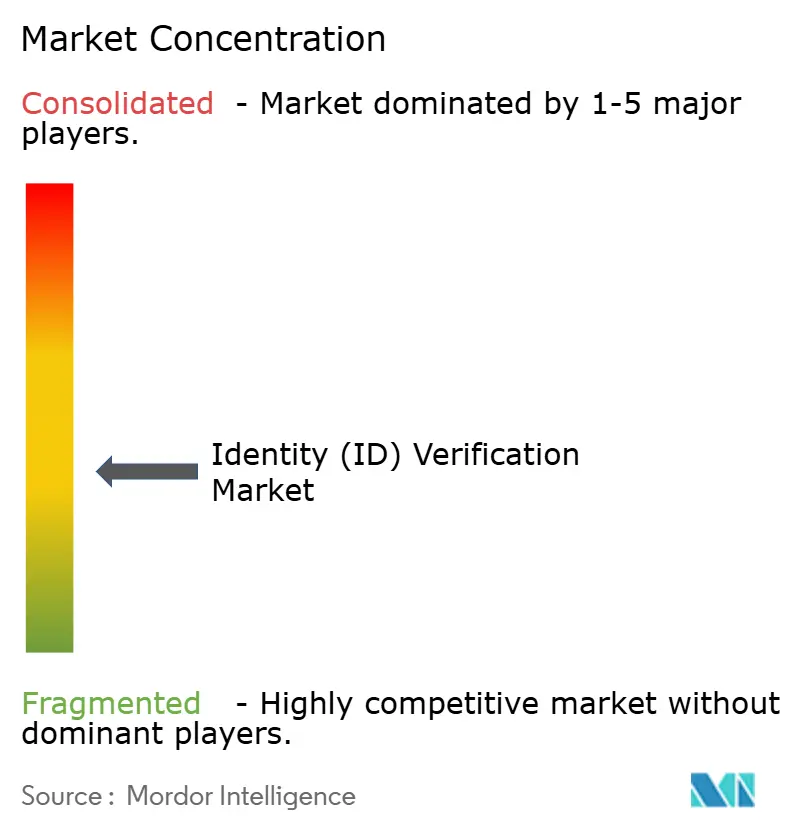
The identity verification market is fragmented: the five largest vendors collectively control well under 40% revenue. Mastercard combines a 143 billion-transaction network with its Identity Attribute Verification API to position as a cross-industry trust layer. Pure-play specialists such as Onfido, Jumio, and Veriff differentiate through proprietary computer-vision engines that verify thousands of global documents. Partnerships remain decisive; Mastercard teamed with Trulioo to accelerate SME onboarding for payment facilitators, while Sumsub joined the Mastercard Engage program to extend fraud protection to embedded-finance providers.
Acquisition activity underscores the premium on AI document forensics. Entrust finalised a USD 400 million purchase of Onfido in April 2025, integrating passive liveness with its identity-centric access suite. LexisNexis Risk Solutions bought IDVerse in February 2025 to gain 16,000-document template coverage and deepfake detection. Socure’s USD 136 million acquisition of Effectiv in December 2024 combined real-time transaction monitoring with digital ID proofing, creating a unified fraud decision engine.
Identity (ID) Verification Industry Leaders
-
Mastercard
-
Onfido
-
GBG (Idology)
-
Intellicheck
-
Jumio
- *Disclaimer: Major Players sorted in no particular order
Identity (ID) Verification Market Companies Covered in this Report
- Mastercard
- Onfido
- GBG (Idology)
- Intellicheck
- Jumio
- Trulioo
- Mitek Systems
- Veriff
- IBM
- AuthenticID
- Experian
- TransUnion
- LexisNexis Risk Solutions
- Pindrop
- ComplyCube
- Nuance Communications
- Thales Group
- IDEMIA
- Okta
- Ping Identity
- Equifax
- NEC Corporation
- Acuant
- Persona
Market Opportunities and Future Outlook
Enterprise buyers are funding programs to close gaps exposed by AI-generated fraud and to operationalize higher-assurance onboarding under evolving standards. This creates whitespace for vendors that combine document forensics, passive liveness, device intelligence, and continuous risk signals in a single workflow. Demand is also showing up in public-sector and large-scale deployments that use risk-based screening rather than static checks, including the US Department of Education introducing real-time, risk-based identity screening for the FAFSA process with support from Socure (April 2026). These implementations tend to pull budgets toward orchestration, auditability, and configurable decisioning that can be reused across multiple user journeys.
Digital credential acceptance and interoperability are also turning into procurement requirements as governments and ecosystems formalize wallet frameworks and remote onboarding specifications. The EU mandate for member states to provide Digital Identity Wallets by December 2026, supported by implementing rules such as Implementing Regulation (EU) 2026/798 and (EU) 2025/1566, is creating near-term integration work for relying parties that must accept wallet-based attributes and meet defined onboarding controls. Vendors that support a single integration path across physical IDs, emerging digital IDs, and verifiable credentials, while aligning to regional assurance profiles and data-residency constraints, have a clearer path to multi-country rollouts and cross-border use cases without maintaining fragmented, country-by-country verification stacks.
Recent Industry Developments in Identity (ID) Verification Market
- July 2026: BOYLE Sports implemented Jumio for age and identity verification. The deployment strengthens onboarding controls for regulated online gambling while keeping verification flows integrated into a single provider stack.
- October 2025: Mastercard expanded its commercial partnership with Smile ID to scale digital identity solutions across Africa, including a minority investment. The move broadens distribution for identity services through Mastercard partnerships and supports localization across diverse national ID ecosystems.
- April 2024: Entrust completed its acquisition of Onfido to add AI-powered identity verification to its identity-centric security portfolio. The deal accelerated consolidation as larger security vendors integrated specialist document and biometric verification capabilities into broader access and fraud platforms.
Identity (ID) Verification Market Report Scope and Research Methodology
Market Definition and Coverage
For this study, the identity verification market covers tools and services used to confirm a person or business is genuine during onboarding and ongoing access, using document checks, biometric matching, and database validations across digital and physical channels.
Scope exclusions: We exclude pure identity and access management administration and hardware-only biometrics unless they are sold mainly for identity verification workflows.
Segments Covered in This Report
- By Deployment
- On-premise
- Cloud
- By Solution Type
- Document / ID Verification
- Biometric Verification
- Authentication and Liveness
- Others
- By End-user Industry
- Financial Services (BFSI)
- Retail and E-commerce
- Government and Public Sector
- Healthcare
- Telecom and IT
- Others
- By Organization Size
- Large Enterprises
- Small and Medium Enterprises (SMEs)
- By Geography
- North America
- United States
- Canada
- Mexico
- South America
- Brazil
- Argentina
- Rest of South America
- Europe
- Germany
- United Kingdom
- France
- Italy
- Spain
- Rest of Europe
- Asia-Pacific
- China
- Japan
- India
- South Korea
- Southeast Asia
- Rest of Asia-Pacific
- Middle East and Africa
- Middle East
- Saudi Arabia
- United Arab Emirates
- Turkey
- Rest of Middle East
- Africa
- South Africa
- Nigeria
- Egypt
- Rest of Africa
- Middle East
- North America
Data Sources, Market Sizing, and Validation
Desk Research
Desk research was used to set the demand context and to anchor assumptions that can be checked outside company claims. We leaned on public and official references such as NIST Digital Identity Guidelines, EU eIDAS and related regulatory updates, the World Bank Global Findex Database for account ownership trends, OECD digital economy statistics, and US FTC identity theft and fraud reporting summaries.
We also reviewed product documentation, audited financial statements, annual reports, and investor presentations to understand how identity verification revenue is described and where it sits inside larger software lines. News coverage, court and enforcement actions, and government procurement notices were used to sense shifts in compliance pressure and fraud patterns. Where needed, paid subscriptions covering company financials and news, plus a patent database, helped validate corporate activity, feature direction, and funding cycles. These sources are illustrative only, and many other public references were used for collection, cross-checking, and clarification.
Primary Interviews and Surveys
Primary work focused on interviews and short surveys with solution providers, system integrators, and large buyers in regulated industries, so pricing logic and adoption timing were not inferred only from secondary material. For a global view, we balanced inputs across APAC, EMEA, and the Americas, and we rechecked key assumptions with follow-up outreach when deployment mix, fraud rates, or compliance timelines appeared to shift.
Distribution of primary research fieldwork respondents
| Company type | Respondent position | Region |
|---|---|---|
| Top tier: 33% | CXOs: 12% | APAC: 42% |
| Mid tier: 47% | Functional/Unit leaders: 35% | EMEA: 36% |
| Smaller Players: 20% | Managers: 53% | Americas: 22% |
Market-Sizing & Forecasting
Sizing starts with a top-down build where digital onboarding volumes and compliance-led verification needs are reconstructed by region, and then translated into spend using realistic verification frequency and price points. To keep the model practical, we rely on a small set of inputs that can be tracked every year, such as digital account openings in BFSI and telecom, e-commerce user growth, fraud and identity theft complaint direction, verification pass and retry patterns, and the cloud versus on-premise deployment mix.
Those totals are then corroborated with selective bottom-up approximations, including sampled vendor revenue disclosures where available, channel checks on typical price per verification (document, biometric, and database lookups), and implied volumes from large end-user programs. When a supplier does not disclose identity verification as a separate line, we estimate the relevant share using product mix cues and customer references, and we pressure-test the assumption in interviews. For forecasting, scenario analysis is used around regulatory enforcement pace, generative AI driven fraud pressure, and digital onboarding intensity, with the near-term trajectory cross-checked against expert consensus on price trends and automation adoption.
Data Validation & Update Cycle
Validation is done through repeated consistency checks across regions, deployment types, and end-user demand signals, and results are compared against independent indicators like digital transaction growth and reported fraud trends. When a data point creates an outlier shift, the inputs are revisited, the math is re-run, and follow-up calls are used to confirm whether the change is real or timing-related.
Before sign-off, the model and assumptions go through multi-step analyst reviews, including variance checks versus prior editions and cross-segment roll-up checks so totals match the defined scope. Reports are refreshed annually, and interim updates are made if material events occur, such as major regulatory deadlines or sharp changes in fraud patterns. Right before delivery, a fresh review pass is completed so clients receive the most up-to-date view that can be traced back to the defined variables.
Mordor Intelligence's Identity Verification Market Size Measured Against Other Published Estimates
Published market sizes for identity verification can look far apart even when the topic label is the same, because each publisher chooses its own scope boundaries, base year, and pricing logic. Differences also come from how much of adjacent areas like broader authentication, identity platforms, and managed compliance services are counted inside the number.
Key gap drivers usually include whether the model ties spend to verifications completed (volume-led) or to broader security budgets (budget-led), how price per check is assumed to move as automation improves, and whether currency conversion is kept consistent across regions. Another recurring driver is refresh cadence, since a fast shift in digital onboarding or fraud intensity can change near-term growth, and older assumptions can overstate or understate the run rate.
Benchmark comparison
| Source | Market Size | Gaps in Research Methodology |
|---|---|---|
| Mordor Intelligence | USD 15.78 B (2026) | |
| Global Consultancy A | USD 15.02 B (2025) | Uses an earlier base year and a longer forecast window, and often blends adjacent identity security spend with verification-specific revenue, which can shift the starting level versus a verification-led demand pool. |
| Regional Consultancy B | USD 11.08 B (2024) | Anchors the estimate on 2024 sizing and applies a more conservative growth path, and it can undercount newer digital onboarding programs where verification volumes ramp quickly after regulatory or fraud-driven triggers. |
The table shows a spread that is mainly explained by the year chosen for the starting point and what gets treated as in-scope identity verification revenue. In Mordor Intelligence's model, the total is tied to verification and validation use cases across key end users and regions, and adjacent identity management spending is not pulled in unless it is directly part of a verification workflow. With clear inputs like onboarding volumes, deployment mix, and price per check that can be re-tested, the result stays easy to track and repeat when the market changes.
Key Questions Answered in the Report
What is the current size of the identity verification market?
The market is valued at USD 15.78 billion in 2026 and is projected to reach USD 26.8 billion by 2031.
Which deployment model is growing fastest?
Cloud platforms dominate with 65.12% share in 2025 and are expanding at a 12.72% CAGR through 2031.
Why is Asia-Pacific considered the growth engine?
Regulatory harmonisation, mobile-first banking, and large-scale fintech adoption push APAC to an 11.52% CAGR, the highest regional growth rate.
What drives consolidation in this market?
Vendors seek AI-powered document authentication talent and global document coverage, prompting acquisitions such as Entrust-Onfido and LexisNexis-IDVerse.