
Hydrogen Truck Market Size and Share
Market Overview
| Study Period | 2019 - 2031 |
|---|---|
| Market Size (2026) | USD 3.23 Billion |
| Market Size (2031) | USD 8.22 Billion |
| Growth Rate (2026 - 2031) | 20.54 % |
| Fastest Growing Market | Asia-Pacific |
| Largest Market | Europe |
| Market Concentration | Medium |
Major Players *Disclaimer: Major Players sorted in no particular order Image © Mordor Intelligence. Reuse requires attribution under CC BY 4.0. | |
Hydrogen Truck Market Analysis by Mordor Intelligence
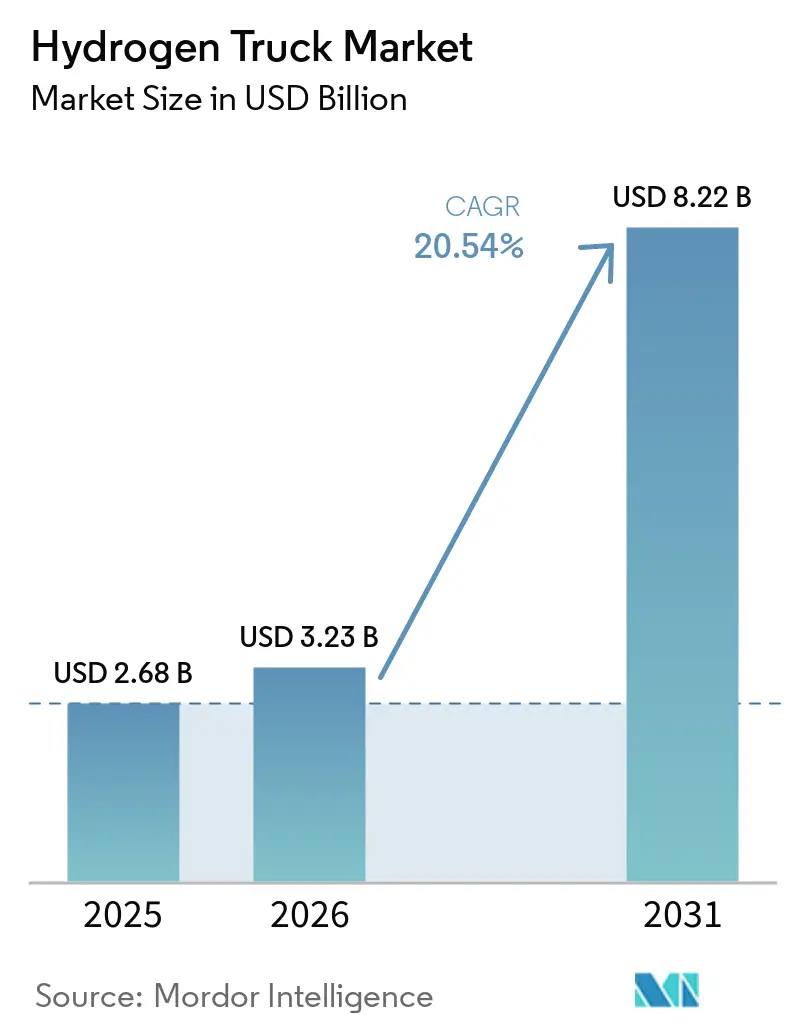
The hydrogen truck market size was valued at USD 2.68 billion in 2025 and is expected to reach USD 3.23 billion in 2026 and USD 8.22 billion by 2031, growing at a CAGR of 20.54% over 2026-2031. The hydrogen truck market is moving ahead because heavy-duty freight decarbonization has become a structural requirement, with the EU tightening CO2 rules for new heavy-duty vehicles and pushing OEMs to commit capital to hydrogen platforms rather than treat them as side programs. Cost conditions are also improving, as the U.S. Department of Energy continues to target clean hydrogen production at USD 2/kg by 2026 and USD 1/kg by 2031, which supports the commercial case for the hydrogen truck market, where fuel cost remains the main barrier to parity[1]“Medium and Heavy-Duty Decarbonization,” U.S. Department of Energy, energy.gov. The hydrogen truck market is also benefiting from the fact that long-haul operators still face range, payload, and downtime constraints with battery-electric trucks on demanding duty cycles, while fuel cell trucks are already showing durable real-world performance in commercial freight use. Corridor buildout, shipper-backed freight contracts, and leasing structures that shift residual-value risk away from fleet buyers are widening the practical opportunity set for the hydrogen truck market in Europe, North America, and selected Asia-Pacific routes. Competition remains active but not closed, because first movers in vehicles, infrastructure, and transport-as-a-service still have room to shape standards, capture corridor traffic, and lock in fleet relationships before broader scaling begins across the hydrogen truck market.
Key Report Takeaways
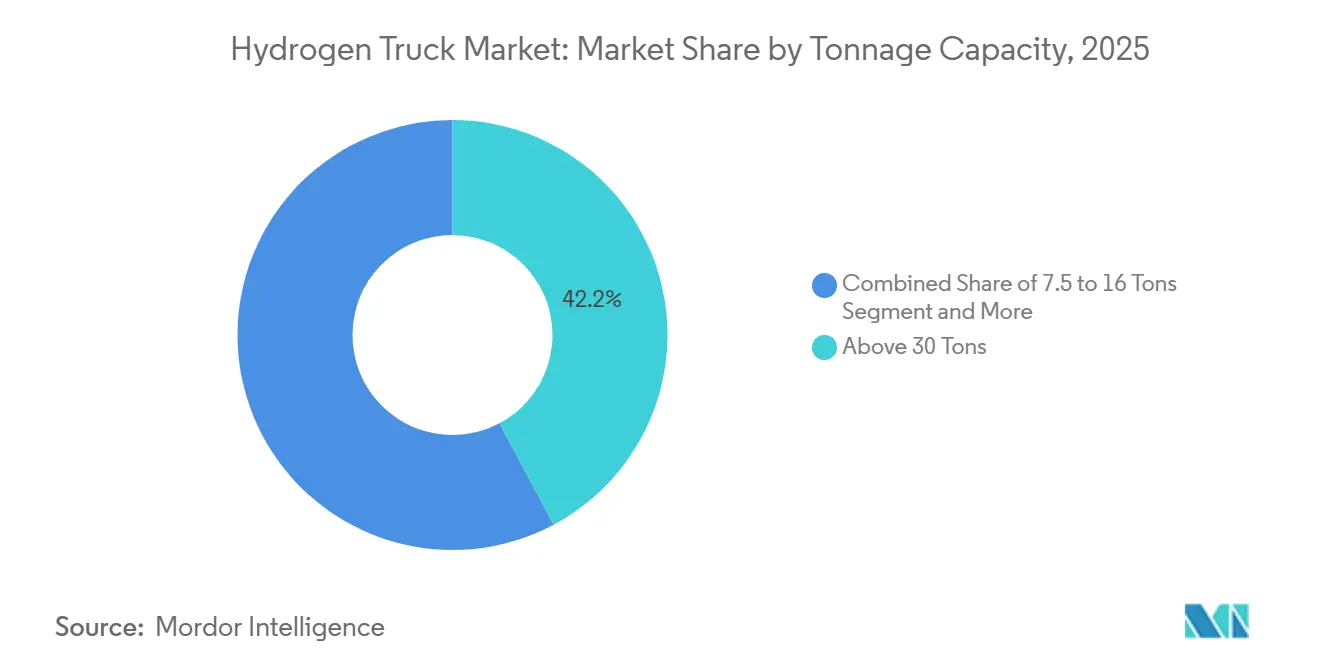
- By tonnage capacity, above 30 Tons held 42.15% of the hydrogen truck market share in 2025 and is projected to expand at a 26.75% CAGR through 2031.
- By range, 300-500 miles accounted for 54.33% of the hydrogen truck market size in 2025, while above 500 miles is forecast to grow at a 33.45% CAGR through 2031.
- By application, Logistics captured 57.04% of revenue in 2025, while Mining is projected to advance at a 30.26% CAGR through 2031.
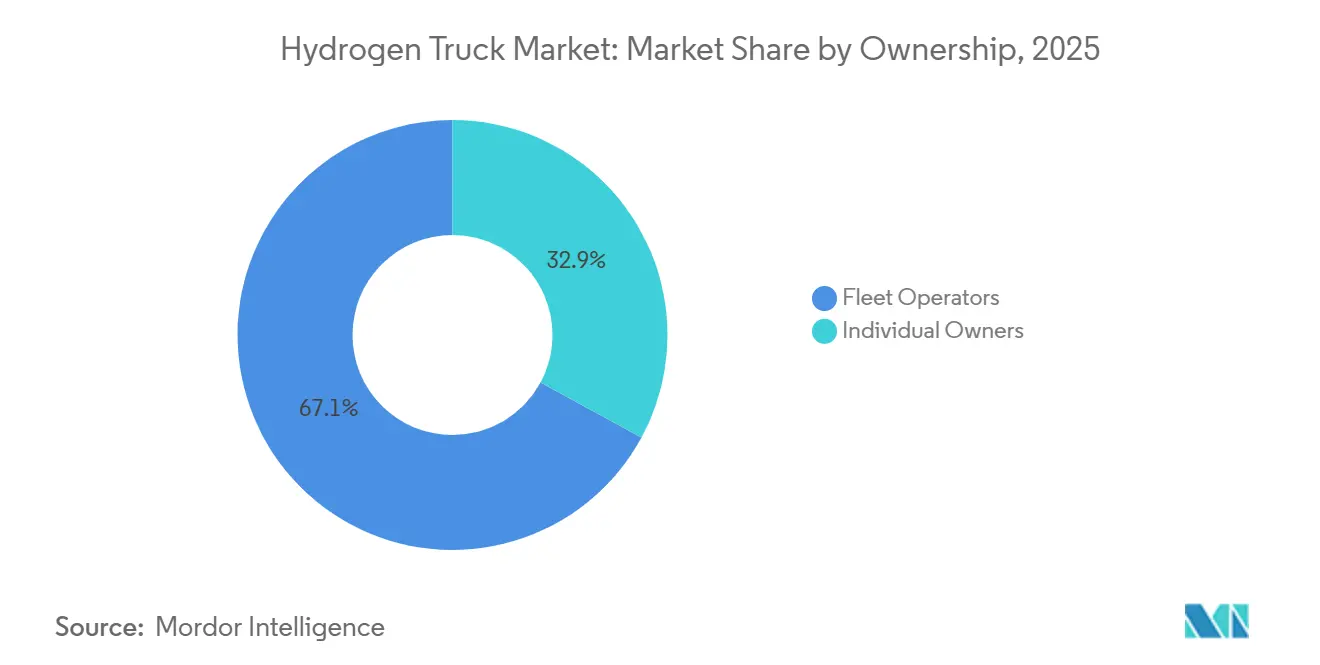
- By ownership, Fleet Operators represented 67.12% of revenue in 2025 and also recorded the highest projected CAGR at 28.14% through 2031.
- By body type, Box Trucks led with 38.05% revenue share in 2025, while Tankers are forecast to grow at a 26.31% CAGR through 2031.
- By geography, Europe led with 45.11% revenue share in 2025, while Asia-Pacific is projected to expand at a 24.65% CAGR through 2031.
Note: Market size and forecast figures in this report are generated using Mordor Intelligence’s proprietary estimation framework, updated with the latest available data and insights as of January 2026.
Market Trends and Insights
Drivers Impact Analysis of Hydrogen Truck Market*
| Driver | (~) % Impact on CAGR Forecast | Geographic Relevance | Impact Timeline |
|---|---|---|---|
| Green-Hydrogen LCOH Decline | +5.2% | Global, with early gains in renewable-rich hubs across MENA, Iberia, and APAC | Medium term (2-4 years) |
| Expansion of Zero-Emission Corridors | +4.8% | North America, Europe, and China corridor systems | Medium term (2-4 years) |
| Limitations for Long-Haul Duty Cycles | +3.1% | Global, strongest in North America and continental Europe | Short term (≤ 2 years) |
| Clean-Fuel Procurement Mandates | +2.9% | North America and Europe, with spillover into export corridors | Medium term (2-4 years) |
| Renewable-Energy Curtailment Monetization | +2.0% | APAC, Europe, MENA, and selected U.S. renewable regions | Long term (≥ 4 years) |
| OEM Leasing Models | +1.7% | North America and Europe, with early extension into Canada and South Korea | Short term (≤ 2 years) |
| Source: Mordor Intelligence | |||
Rapid Decline in Green-Hydrogen LCOH (Levelized Cost of Hydrogen)
The hydrogen truck market is becoming more viable because clean hydrogen cost targets are no longer framed only as distant ambitions, with the U.S. Department of Energy now pushing toward USD 2/kg by 2026 and USD 1/kg by 2031 through scale, efficiency, and lower renewable electricity input costs. That shift matters because fuel cost sits at the center of truck operating economics, and even partial progress on delivered hydrogen price can materially narrow the cost gap that has limited wider rollout in the hydrogen truck market. The hydrogen truck market is also seeing a clear geographic split, since renewable-rich regions can move faster toward workable economics than areas where electricity remains expensive or volatile, which means commercial adoption is likely to cluster first around low-cost power rather than spread evenly by country. This pattern strengthens the case for captive routes and corridor planning, because operators with access to favorable local hydrogen production can reach more stable fleet economics earlier than operators that depend on trucked-in supply from higher-cost regions. As a result, the hydrogen truck market is likely to reward project developers that pair vehicles with local production and dispensing rather than treat hydrogen sourcing as a separate downstream issue. It also means early unsubsidized wins are more likely to come from a handful of advantaged logistics zones than from national rollouts across full highway networks.
Expansion of Zero-Emission Freight Corridors
The hydrogen truck market is gaining support from corridor-based deployment models because governments are increasingly planning infrastructure around freight density and route logic rather than relying on scattered public stations that cannot support heavy-duty utilization. In the United States, the National Zero-Emission Freight Corridor Strategy targets 12,000 miles of the National Highway Freight Network in its first phase, which gives the hydrogen truck market a clearer infrastructure roadmap for Class 7 and Class 8 operations on high-volume routes. In Europe, AFIR requires hydrogen stations at regular intervals along the TEN-T core network by 2030, and consortium-led deployments are beginning to match that policy framework with vehicle and station commitments[2]“Alternative Fuels Infrastructure Regulation,” European Parliament, europarl.europa.eu. The hydrogen truck market benefits from this approach because route certainty reduces the risk of idle assets, raises station utilization, and lets fleets match vehicle procurement to known refueling access instead of waiting for universal coverage. It also changes the commercial decision for operators, since the best first move is often to secure service on a viable corridor rather than simply choose a vehicle model. That is why corridor ownership, station partnerships, and freight aggregation are becoming as important as truck hardware in the hydrogen truck market.
BEV-Range Limitations for Long-Haul Duty Cycles
The hydrogen truck market continues to find its clearest fit in long-haul and heavy-load applications where battery-electric trucks still face operational tradeoffs on payload, turnaround time, and route flexibility. California’s NorCAL ZERO project showed that Hyundai fuel cell trucks could log nearly 450,000 miles in port operations without major powertrain failures, which supports the argument that hydrogen systems are already usable in demanding freight environments rather than only in pilot conditions [3]“NorCAL ZERO Final Assessment,” California Energy Commission, energy.ca.gov. The contrast with battery-electric heavy trucks remains important, because Volvo’s 700 km range improvement still sits below the distance needs of many multi-shift routes, while Daimler’s hydrogen platform is designed to exceed 1,000 km in heavy-duty use. The hydrogen truck market, therefore, draws strength not from replacing battery-electric trucks everywhere but from filling the duty cycles where charging downtime, vehicle weight, and route uncertainty remain hard constraints. That distinction is commercially important because it lets OEMs and fleets focus investment on the applications where hydrogen can defend a clear use case. It also explains why the hydrogen truck market is strongest in tractor-trailer, port, mining, and corridor freight rather than in shorter urban routes.
Clean-Fuel Procurement Mandates from Global Shippers
The hydrogen truck market is also being pushed forward by freight buyers, because large shippers are turning carbon targets into contract conditions that affect how logistics providers build fleets and choose corridors. Hyundai’s XCIENT deployments with logistics operators in Europe and the fleet’s cumulative mileage show that shipper-backed activity is already moving beyond symbolic trials and into repeat operations on regular routes. The hydrogen truck market benefits because committed shipper volumes help station developers finance assets that would otherwise struggle to attract capital if demand were left to open-market chance alone. When a major freight customer guarantees throughput on a route, vehicle deployment, station utilization, and hydrogen supply contracts all become easier to structure. That makes procurement mandates more than a demand signal, because they become a mechanism that aligns infrastructure with fleet scale. In the hydrogen truck market, this is one of the clearest ways commercial demand is starting to solve a problem that policy support alone could not resolve.
Restraints Impact Analysis of Hydrogen Truck Market*
| Restraint | (~) % Impact on CAGR Forecast | Geographic Relevance | Impact Timeline |
|---|---|---|---|
| Limited Public Refueling Network | -4.5% | Global, with the greatest gap outside the core demonstration regions | Medium term (2-4 years) |
| Higher TCO Versus Diesel | -3.1% | Eastern Europe, South America, South and Southeast Asia, Sub-Saharan Africa | Medium term (2-4 years) |
| Powertrain Durability Unknowns | -1.8% | Global, strongest in finance-sensitive fleet procurement | Medium term (2-4 years) |
| H₂ Price Volatility | -1.6% | Global, especially where hydrogen relies on grey or blue supply | Short term (≤ 2 years) |
| Source: Mordor Intelligence | |||
Limited Public H₂ Refueling Network Density
The hydrogen truck market still faces its most immediate barrier in station density, because the number of heavy-duty hydrogen refueling points remains far below the level needed for broad route flexibility. In Europe, the public network for commercial vehicles is still thin, and the reconfiguration of older passenger-focused stations into truck-suitable formats has reduced available locations in some areas before the next wave of investment fully arrives. In the United States, federal planning documents still imply a very large infrastructure buildout over time, which shows how wide the current gap remains between policy ambition and operational access. The hydrogen truck market is further slowed by uncertainty over refueling formats, because incompatible approaches for gaseous and liquid hydrogen create hesitation for investors deciding which assets to fund. This means the issue is not only the number of stations, but also whether fleets can trust those stations to match future vehicle platforms. Until that confidence improves, the hydrogen truck market will keep favoring captive fleets and closed corridors over open-access national networks.
Higher TCO Versus Diesel in Low-Subsidy Regions
The hydrogen truck market remains exposed to cost pressure in regions where subsidies, carbon pricing support, and low-cost hydrogen supply are not yet strong enough to offset high vehicle and fuel costs. The Global Hydrogen Mobility Alliance estimated fuel cell truck TCO at EUR 1.63/km (approximately USD 1.73/km) against EUR 0.95/km (approximately USD 1.01/km) for diesel in a 40-tonne reference case, which shows that parity still depends on major reductions in both pump price and vehicle price [4]“Market Activation Strategy,” Global Hydrogen Mobility Alliance, globalh2mobilityalliance.org. That burden becomes heavier in lower-support regions because insurance, maintenance access, and residual-value assumptions also remain harder to manage than they are in mature demonstration markets. The hydrogen truck market, therefore, advances fastest where public support, fleet scale, and local hydrogen availability work together, while smaller operators in low-subsidy geographies face a weaker business case. This is why adoption remains concentrated in California, Germany, the Netherlands, and a few other early clusters rather than moving uniformly across all transport markets. Until those nonfuel cost lines improve, the hydrogen truck market will keep showing a strong dependence on policy architecture and bundled-service models.
*Our forecasts treat driver/restraint impacts as directional, not additive. The impact forecasts reflect baseline growth, mix effects, and variable interactions.
Hydrogen Truck Market Segment Analysis
By Tonnage Capacity:
Heavy Haulers Set the Commercial BaselineAbove 30 Tons accounted for 42.15% of the hydrogen truck market size in 2025 and is projected to record the fastest CAGR of 26.75% through 2031. This position reflects the clearest operating fit in the hydrogen truck market, because long-haul and high-gross-weight freight places the greatest value on rapid refueling, route continuity, and preserved payload. Research on powertrain weight tradeoffs shows that hydrogen systems impose a smaller weight penalty than battery packs in the heaviest vehicle classes, which matters directly for container haulage, bulk freight, and line-haul tractor use. Daimler Truck’s small-series commitment for its hydrogen heavy truck reinforces that the above-30-ton class is where manufacturers see the strongest path to series economics and operational relevance. In practical terms, the hydrogen truck market becomes easier to justify when each vehicle covers long daily distances, carries high-value or weight-sensitive loads, and avoids extended charging downtime.
The 16-30 Tons segment remains commercially important because it serves mixed-cycle operations in construction logistics, regional distribution, and tipping work, where route variability makes fast refueling attractive. The hydrogen truck industry also benefits from this middle band because many fleet operators can pilot hydrogen there before moving into full long-haul tractor deployment. By contrast, the 7.5-16 Tons and 3.5-7.5 Tons ranges still face a weaker immediate case, since shorter urban and regional cycles are easier to electrify with depot charging. That does not remove them from the hydrogen truck market, but it does place them behind heavier classes in the current investment queue. Safety and certification requirements under UNECE hydrogen vehicle rules also continue to shape storage design, integration choices, and commercialization pace across all tonnage classes.


By Range:
Mid-Range Dominates but Long-Range Redefines the UpsideThe 300-500 miles category held 54.33% of the hydrogen truck market size in 2025, while above 500 miles is set to expand at a 33.45% CAGR through 2031. The current lead of the 300-500 miles bracket reflects the structure of today’s corridor buildout, where infrastructure is limited but predictable enough to support regional freight networks with planned refueling intervals. The faster growth of the Above 500 miles segment shows where the hydrogen truck market is expected to generate its next wave of value, especially as liquid and high-density storage solutions mature for very long routes. Daimler’s NextGenH2 platform is designed for more than 1,000 km of range with liquid hydrogen, which directly supports the case for expanding hydrogen into full long-haul service rather than keeping it inside regional corridors. Elemental Trucks’ commercial introduction of a 63.5-tonne hydrogen Class 8 vehicle in Canada also points to growing confidence that longer-range freight operations can be addressed with commercially offered products rather than only prototypes.
The Below 300 miles segment remains relevant in port drayage, waste, and urban logistics, where route regularity and local air-quality rules support zero-emission adoption even when hydrogen economics are not yet ideal. Still, that lower-range bracket faces stronger competition from battery-electric platforms because charging can often be centralized at depots with predictable return schedules. The hydrogen truck market is therefore seeing a split in which lower-range use cases support early demonstration and compliance needs, while higher-range use cases carry the larger future growth pool. As corridor density improves, some demand is likely to move upward from the mid-range category into longer-range vehicles because fleets value schedule resilience and lower refueling frequency. That progression would keep the hydrogen truck market centered on the transport applications where hydrogen’s range advantage is hardest to replace.
By Application:
Logistics Anchors Revenue, Mining Drives GrowthLogistics captured 57.04% of the hydrogen truck market share in 2025, while Mining is forecast to grow at a 30.26% CAGR through 2031. Logistics leads because it combines the strongest current demand signals in the hydrogen truck market, including shipper decarbonization pressure, port-related clean transport targets, and route structures that support corridor fueling. Hyundai Motor Group’s HTWO Logistics activity in Georgia showed that hydrogen trucks can be embedded into plant-linked logistics systems at a meaningful operating scale, with 21 XCIENT trucks handling nearly half of inbound and outbound plant movements. This application is especially important because recurring freight volumes, fixed operating windows, and known route lengths reduce uncertainty for both fleets and station investors. As a result, logistics remains the revenue anchor of the hydrogen truck market even while other applications grow from smaller bases.
Mining is growing faster because remote sites, multi-shift operations, and limited grid access make battery charging less practical and raise the value of fast refueling with zero local emissions. Adani’s deployment of a hydrogen fuel cell mining truck in India and Fortescue’s testing of a hydrogen-powered Liebherr haul truck in Australia show that mine operators are now treating hydrogen as a practical decarbonization route for heavy off-road hauling rather than a distant concept. Construction, agriculture, utility, and other niche segments remain earlier in their adoption path, but public procurement pressure and industrial decarbonization rules are giving them a clearer route to commercial pilots. That broadens the hydrogen truck industry beyond pure road freight and adds more end-use diversity to the forecast period. The result is a market where logistics delivers current scale, while mining expands the ceiling for where hydrogen-powered heavy vehicles can create value.
By Ownership:
Fleet Operators Command Scale, Individuals Require Different EconomicsFleet Operators held 67.12% of the hydrogen truck market size in 2025 and are projected to post the fastest CAGR at 28.14% through 2031. This dual lead reflects a basic reality in the hydrogen truck market, since scale is needed to negotiate hydrogen supply, absorb training and maintenance costs, and justify dedicated or semi-dedicated refueling investment. Hyroad Energy’s 113-truck deployment model at the Port of Long Beach shows how large fleet ownership can be combined with truck-as-a-service, maintenance support, software, and fuel supply under one operating framework. Large fleet buyers also create the data volumes that lenders, insurers, and OEMs need to price risk more effectively. That makes fleet operators the natural early adopters in the hydrogen truck market, not only because they buy more trucks, but because their scale lowers uncertainty for the entire ecosystem.
Individual Owners account for a notable share of the market, yet their economics remain harder because they usually lack leverage on fuel contracts, service access, and residual-value protection. HTEC’s trial leasing offer in Canada directly addresses that gap by giving smaller operators access to vehicles without requiring a full long-term capital commitment. Over time, the spread of flexible leasing could narrow the difference between fleet and individual adoption, especially if insurance and secondary-market conditions improve. For now, though, the hydrogen truck market remains structurally tilted toward larger operators that can aggregate demand and spread risk over bigger route networks. That dynamic is one of the main reasons ownership concentration remains higher here than in many conventional truck categories.
By Body Type:
Box Trucks Lead, Tankers Represent the Fastest-Shifting OpportunityBox Trucks accounted for 38.05% of the hydrogen truck market share in 2025, while Tankers are expected to grow at a 26.31% CAGR through 2031. Box trucks lead because urban delivery, cold-chain movement, and low-emission zones create direct pressure for cleaner vehicles in routes where freight density is high and public visibility is greater. The Nippon Gases Deutschland and HOYER deployment of a hydrogen-powered dry-ice logistics truck in Germany showed that hydrogen can support temperature-sensitive transport where diesel-based auxiliary systems have traditionally been part of the operating setup. This keeps box trucks prominent in the hydrogen truck market because they combine compliance needs, route regularity, and visible environmental benefit in a format fleets can trial relatively quickly. The segment also benefits from city-level policy pressure in Europe, where low-emission freight requirements are shaping fleet renewal decisions more directly than in many other regions.
Tankers are growing faster because industrial gas, chemicals, and energy logistics allow companies to match vehicle demand with captive hydrogen supply and predictable route planning. Air Liquide’s use of MAN hydrogen trucks for delivery operations in Rotterdam is a strong example, since it links fuel supply, vehicle utilization, and customer service within the same commercial network. That circular model reduces utilization risk for stations and gives the tanker segment an advantage that more open-market freight applications do not always have. Flatbed, refrigerated, and tipper formats are also moving forward, but they remain more pilot-led and less structurally anchored today. In the hydrogen truck market, tanker growth stands out because it shows how value-chain integration can speed adoption even when public infrastructure is still limited.
Geography Analysis
Europe Hydrogen Truck Market
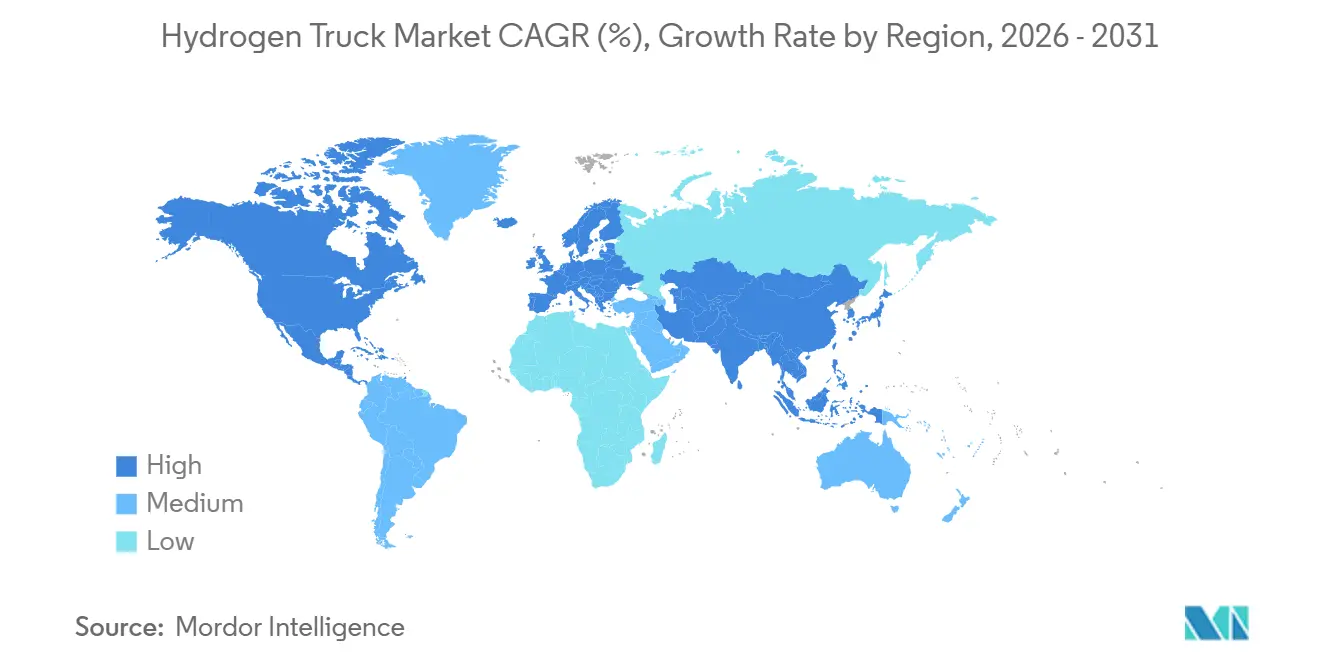
Europe represented 45.11% of the hydrogen truck market size in 2025, which made it the leading regional bloc in current revenue terms. Europe leads because policy support is layered rather than isolated, with AFIR setting station requirements on core corridors while RED III strengthens the push toward renewable hydrogen use in the broader economy. That policy depth matters for the hydrogen truck market because fleets, OEMs, and fuel suppliers can all make investment decisions against a clearer regulatory path. Germany remains central through station funding and fleet support, while lower net hydrogen pricing for selected commercial users has brought the economics closer to workable utilization levels for truck operators. France is adding real fleet operating evidence through Hyliko, while Spain’s lower-cost renewable hydrogen potential positions southern Europe as an increasingly important supply anchor for the region’s future cost curve.
APAC Hydrogen Truck Market
Asia-Pacific is the fastest-growing region in the hydrogen truck market, with a projected CAGR of 24.65% through 2031. China is advancing through an ecosystem model that ties demonstration clusters, public incentives, fleet buildout, and mileage accumulation together rather than leaving adoption to open-market competition, and those clusters had already promoted more than 20,000 fuel cell vehicles by the end of 2025. XCMG’s durability progress and continued strength in new-energy heavy trucks also support the region’s scale story, because commercial credibility in the hydrogen truck market depends on real operating proof as much as on policy commitments. South Korea remains important through Hyundai’s integrated HTWO approach, which spans production, fueling, and vehicle deployment across multiple countries and extends Asia-Pacific influence into export markets such as Uruguay. India is still early, but mining deployment and techno-economic debate are moving the hydrogen truck market from concept discussion into structured project evaluation.
The Americas and MEA Hydrogen Truck Market
North America entered a clearer commercial phase in 2026 as corridor planning, port operations, and integrated fleet models began to align more visibly. California remains the center of gravity for the hydrogen truck market in the region, with Hyroad Energy’s large Port of Long Beach deployment and Toyota’s linked supply arrangement creating one of the most concrete operating examples in the United States. Federal corridor strategy adds longer-term structure, especially along Interstate 5 and other major freight routes where utilization density can support staged infrastructure rollout. Canada is emerging through heavy-truck launches and lease-based access, while South America and the Middle East and Africa remain earlier-stage regions where project activity is visible but large-scale adoption still depends on future station buildout and dependable hydrogen supply.

Competitive Landscape
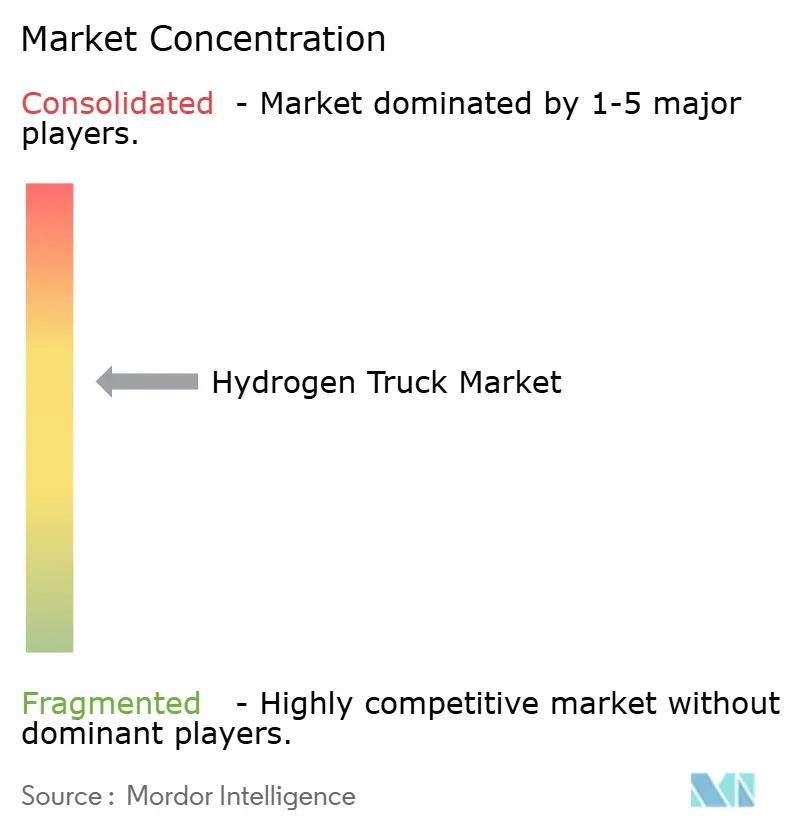
The hydrogen truck market remains moderately fragmented, with a small group of OEMs accounting for most visible commercial deployments while a wider set of infrastructure, fuel, finance, and service providers compete around them. Hyundai holds a first-mover advantage through XCIENT deployments and the scale of its HTWO platform, which gives it a more integrated operating footprint than many rivals across the current hydrogen truck market. Daimler Truck, Volvo Group, and Toyota are building a strong counterweight through Cellcentric, which shows that competition is shifting from isolated truck programs toward shared fuel cell platforms with broader industrial backing. That move is strategically important because it combines commercial vehicle scale with long-standing fuel cell know-how and raises the likelihood of more standardized heavy-duty technology paths. It also suggests that future leadership in the hydrogen truck market will depend on depth across manufacturing, systems integration, and fuel ecosystem partnerships rather than on vehicle assembly alone.
The competitive white space is strongest in bundled service models, because fleets still need fuel access, financing, maintenance, digital fleet support, and residual-value protection in one package rather than through separate vendors. Hyroad Energy’s model in California and Hyliko’s approach in France both point to a version of the hydrogen truck market where the winning commercial offer is a managed operating solution rather than a truck sale by itself. Scania’s pilot partner strategy also fits this pattern, since it uses real freight customers to gather operational data before scaling commercial supply more aggressively. These strategies matter because the hydrogen truck market still needs learning loops from actual route data, not only engineering validation. In effect, companies that can shorten that learning cycle while keeping customer risk low are gaining a durable competitive advantage.
A second layer of competition is forming around certification, technology standards, and fuel architecture. Safety standards such as ISO 23273 and the ongoing evolution of global technical rules continue to shape who can enter the hydrogen truck market credibly and at what cost. Volvo’s 2026 hydrogen combustion testing and Daimler’s liquid hydrogen development show that the market is still open on powertrain pathways, even though fuel cell trucks remain the core commercial narrative. That diversity keeps the hydrogen truck market innovative, but it also delays full standardization in infrastructure and asset planning. Over the next few years, companies that can align vehicle technology with dependable fueling, financing, and service support are likely to outperform peers that remain strong in only one part of the value chain.
Hydrogen Truck Industry Leaders
Hyundai Motor Company
Daimler Truck AG
Toyota Motor Corporation
Volvo Group
Dongfeng Motor Corporation
- *Disclaimer: Major Players sorted in no particular order
Hydrogen Truck Market Companies Covered in this Report
- Hyundai Motor Company
- Daimler Truck AG
- Toyota Motor Corporation
- Volvo Group
- Scania AB
- MAN Truck and Bus SE
- Iveco Group
- Kenworth (Paccar Inc.)
- Renault Trucks
- Quantron AG
- Tata Motors Limited
- FAW Jiefang
- SAIC Motor Corp., Ltd.
- Dongfeng Motor Corporation
- Foton Motor Co.

Recent Industry Developments in Hydrogen Truck Market
- May 2026: Toyota Motor North America and Hyroad Energy announced at ACT Expo 2026 the deployment of 40 hydrogen fuel cell Class 8 trucks in Southern California, with Toyota supplying hydrogen via refueling infrastructure under development in Ontario, California.
- May 2026: Volvo Trucks announced global product launches, including the start of on-road testing of hydrogen combustion engine heavy-duty trucks in Europe, with a commercial launch targeted before 2030.
- April 2026: In a significant move for China's cold-chain logistics, Weishi Energy and Yutong Group have deployed 300 hydrogen-powered refrigerated light trucks in Zhengzhou, marking one of the country's most prominent forays into cold-chain fuel cell technology.
- March 2026: Hyundai Motor Group deployed an eight-truck XCIENT Fuel Cell Class 8 fleet in Uruguay under the Kahirós Project, South America's first hydrogen fuel cell heavy-duty truck fleet operation.


Global Hydrogen Truck Market Report Scope
The scope includes segmentation by tonnage capacity (3.5 to 7.5 tons, 7.5 to 16 tons, 16 to 30 tons, and above 30 tons), range (below 300 miles, 300–500 miles, and above 500 miles), application (logistics, construction, agriculture, mining, utility, and others), ownership (fleet operators and individual owners), and body type (flatbed, box truck, refrigerated, tanker, and tipper). The analysis also covers regional-level segmentation, including North America, South America, Europe, Asia-Pacific, the Middle East, and Africa. Market size and growth forecasts are presented by value in USD and by volume in units.
| 3.5 to 7.5 Tons |
| 7.5 to 16 Tons |
| 16 to 30 Tons |
| Above 30 Tons |
| Below 300 miles |
| 300 to 500 miles |
| Above 500 miles |
| Logistics |
| Construction |
| Agriculture |
| Mining |
| Utility |
| Others |
| Fleet Operators |
| Individual Owners |
| Flatbed |
| Box Truck |
| Refrigerated |
| Tanker |
| Tipper |
| North America | United States |
| Canada | |
| Rest of North America | |
| South America | Brazil |
| Argentina | |
| Rest of South America | |
| Europe | United Kingdom |
| Germany | |
| Spain | |
| Italy | |
| France | |
| Russia | |
| Rest of Europe | |
| Asia-Pacific | India |
| China | |
| Japan | |
| South Korea | |
| Rest of Asia-Pacific | |
| Middle East and Africa | United Arab Emirates |
| Saudi Arabia | |
| Turkey | |
| Egypt | |
| South Africa | |
| Rest of Middle East and Africa |
| By Tonnage Capacity | 3.5 to 7.5 Tons | |
| 7.5 to 16 Tons | ||
| 16 to 30 Tons | ||
| Above 30 Tons | ||
| By Range | Below 300 miles | |
| 300 to 500 miles | ||
| Above 500 miles | ||
| By Application | Logistics | |
| Construction | ||
| Agriculture | ||
| Mining | ||
| Utility | ||
| Others | ||
| By Ownership | Fleet Operators | |
| Individual Owners | ||
| By Body Type | Flatbed | |
| Box Truck | ||
| Refrigerated | ||
| Tanker | ||
| Tipper | ||
| By Geography | North America | United States |
| Canada | ||
| Rest of North America | ||
| South America | Brazil | |
| Argentina | ||
| Rest of South America | ||
| Europe | United Kingdom | |
| Germany | ||
| Spain | ||
| Italy | ||
| France | ||
| Russia | ||
| Rest of Europe | ||
| Asia-Pacific | India | |
| China | ||
| Japan | ||
| South Korea | ||
| Rest of Asia-Pacific | ||
| Middle East and Africa | United Arab Emirates | |
| Saudi Arabia | ||
| Turkey | ||
| Egypt | ||
| South Africa | ||
| Rest of Middle East and Africa | ||


Key Questions Answered in the Report
What is the current value of the hydrogen truck market?
The hydrogen truck market is valued at USD 3.23 billion in 2026. It is forecast to reach USD 8.22 billion by 2031 at a 20.54% CAGR.
Which region leads global adoption of hydrogen-powered trucks?
Europe led with 45.11% share in 2025. Its lead is supported by corridor rules, renewable hydrogen policy, and active fleet support programs.
Which segment is growing fastest by application?
Mining is the fastest-growing application with a 30.26% CAGR through 2031. Remote operations, heavy haul cycles, and limited grid access support this growth.
Which ownership model is leading adoption?
Fleet operators lead with 67.12% share in 2025 and also post the fastest growth at 28.14% CAGR. Their scale helps secure fuel contracts, financing, and service support that smaller buyers usually cannot match.
Page last updated on:


 Your data is secure and never sold or shared.


