
Hydrogen Peroxide Market Size and Share
Market Overview
| Study Period | 2021 - 2031 |
|---|---|
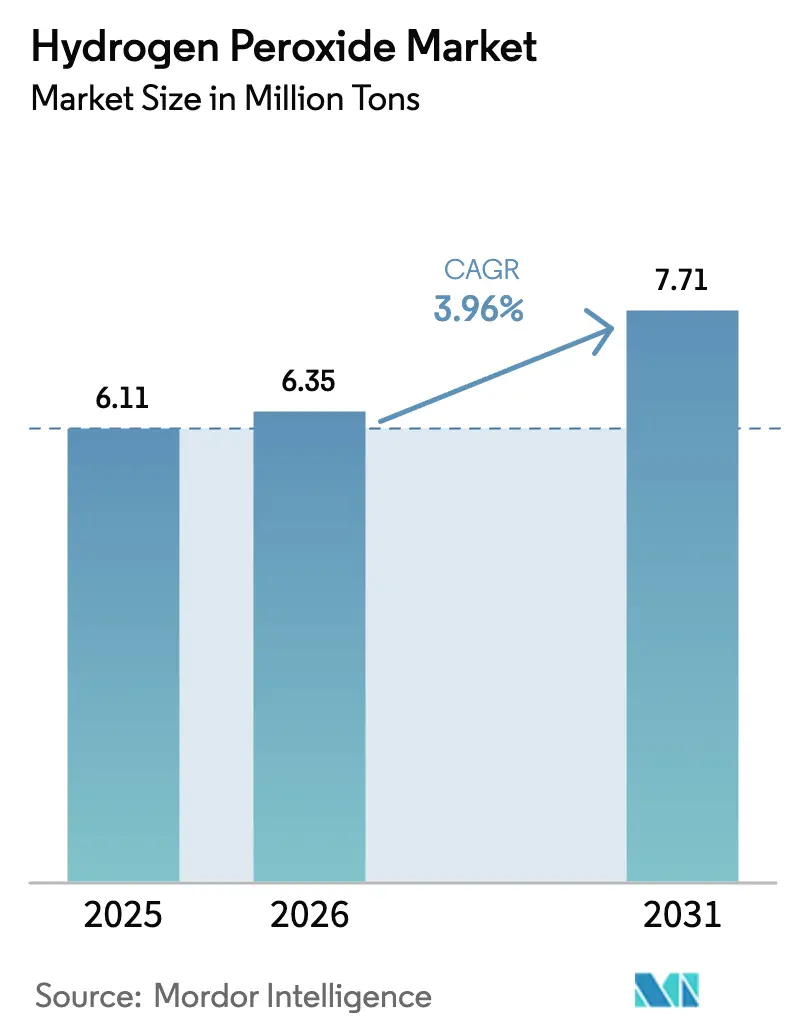
| Market Volume (2026) | 6.35 Million tons |
| Market Volume (2031) | 7.71 Million tons |
| Growth Rate (2026 - 2031) | 3.96 % |
| Fastest Growing Market | Asia Pacific |
| Largest Market | Asia Pacific |
| Market Concentration | Medium |
Major Players *Disclaimer: Major Players sorted in no particular order Image © Mordor Intelligence. Reuse requires attribution under CC BY 4.0. | |
Hydrogen Peroxide Market Analysis by Mordor Intelligence
The Hydrogen Peroxide Market size is expected to increase from 6.11 Million tons in 2025 to 6.35 Million tons in 2026 and reach 7.71 Million tons by 2031, growing at a CAGR of 3.96% over 2026-2031. Momentum rests on four structural themes. First, semiconductor clean-room demand for ultra-high-purity grades commands price premiums that more than triple commodity bleaching prices, lifting average margins even as volume grows slowly. Second, on-site electro-oxidation systems allow water utilities to avoid hauling hazardous drums, cutting delivered cost by up to 30% and widening the hydrogen peroxide market into mid-tier municipalities. Third, hospitals are locking vaporized hydrogen-peroxide (VHP) devices into infection-control protocols, embedding predictable daily consumption. Fourth, producers able to validate low-carbon feedstocks secure premiums of 15%–20% from pulp mills and consumer-goods brands pursuing net-zero roadmaps. These shifts sit alongside legacy bleaching, which still supplies most tonnage but now grows below the market average because recycled fiber and enzyme pretreatments reduce dosage needs. Competitive intensity is moderate: five global suppliers control a little over 40% of capacity, yet more than 400 regional plants in Asia compete on freight advantage and low overhead.
Key Report Takeaways
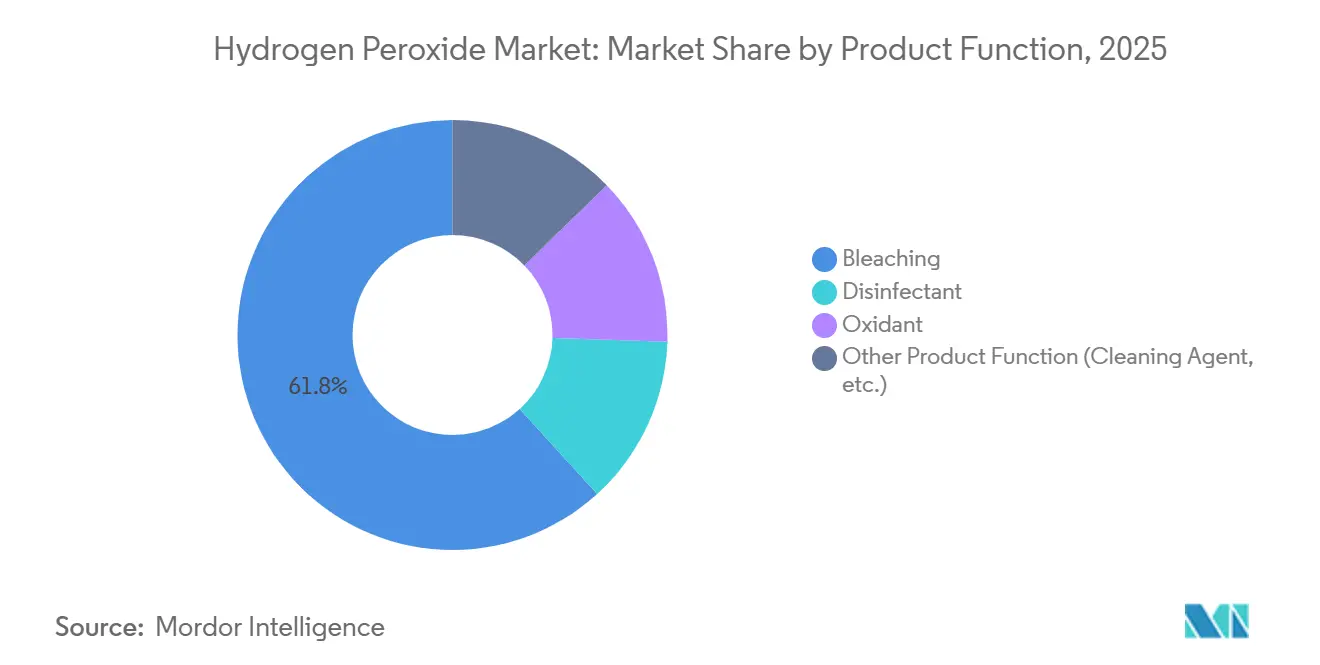
- By product function, bleaching led with 61.76% volume share in 2025, while disinfectants are forecast to expand at a 4.44% CAGR to 2031.
- By grade, the industrial segment held 42.27% of the hydrogen peroxide market share in 2025, while high-purity grades are advancing at a 5.31% CAGR through 2031.
- By concentration/form, aqueous solutions commanded 79.95% share of the hydrogen peroxide market size in 2025; powder and granular adducts are expected to rise at a 4.38% CAGR to 2031.
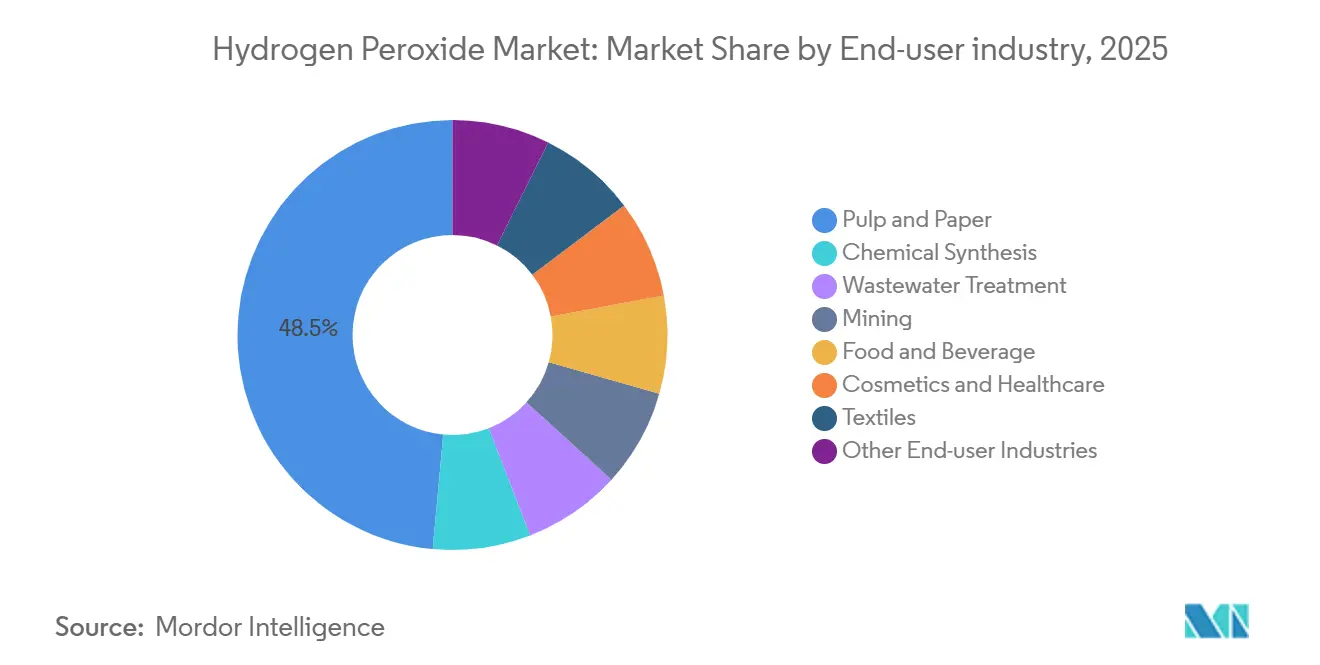
- By end-user industry, pulp and paper accounted for 48.54% share of the hydrogen peroxide market size in 2025, whereas wastewater treatment is growing the fastest at 4.29% CAGR.
- By geography, Asia-Pacific dominated with a 52.28% share of the hydrogen peroxide market in 2025 and is progressing at a 4.33% CAGR through 2031.
Note: Market size and forecast figures in this report are generated using Mordor Intelligence’s proprietary estimation framework, updated with the latest available data and insights as of January 2026.
Market Trends and Insights
Drivers Impact Analysis of Hydrogen Peroxide Market*
| Driver | (~) % Impact on CAGR Forecast | Geographic Relevance | Impact Timeline |
|---|---|---|---|
| Surging ultra-high-purity H₂O₂ demand in sub-5 nm semiconductor fabs | +0.80% | Asia-Pacific (Taiwan, South Korea, Japan), spill-over to North America (Arizona, Texas) | Medium term (2-4 years) |
| Sharp rise in onsite electro-oxidation systems for decentralized wastewater treatment | +0.60% | Global, with early adoption in water-stressed APAC (India, Middle East) and EU municipalities | Short term (≤ 2 years) |
| Capacity expansion of recycled-fiber pulp mills in SE-Asia | +0.70% | Southeast Asia core (Indonesia, Vietnam, Thailand), spill-over to Malaysia | Medium term (2-4 years) |
| Growth of HPPO (hydrogen-peroxide-to-propylene-oxide) plants in Europe and China | +0.50% | China (Shandong, Jiangsu, Henan), Europe (Germany, Netherlands), North America (US Gulf Coast) | Medium term (2-4 years) |
| Healthcare infection-control mandates boosting VHP sterilization equipment sales | +0.50% | North America, Europe, Asia-Pacific hospital networks | Short term (≤ 2 years) |
| Low-carbon H₂O₂ routes (renewable H₂ and PEM electrolysis) gaining ESG premiums | +0.40% | Nordic countries, Germany, Netherlands; pilot projects in Australia | Long term (≥ 4 years) |
| Source: Mordor Intelligence | |||
Surging Ultra-High-Purity H₂O₂ Demand In Sub-5 nm Semiconductor Fabs
Leading chipmakers have tightened metal limits to below 10 parts-per-trillion for wafer cleaning, a ten-fold reduction from 7 nm nodes. Solvay doubled electronic-grade output at Zhenjiang in 2025 to meet this bar, while Mitsubishi Gas Chemical expanded in Japan to serve new lines in Arizona and Texas[1]. Spot prices above USD 2.50 per kilogram, three times bleaching-grade levels, more than offset the niche’s sub-3% volume share. Evonik’s Leshan joint venture will come on stream in 2026, adding 30 kilotons of specialty capacity and securing the firm majority ownership for know-how control. Trade-tension risks linger because extreme-ultraviolet tool export restrictions could stall fabs outside Northeast Asia, concentrating demand geographically and raising supply-chain exposure. Suppliers that meet ISO 14644 Class 1 clean-room protocols enjoy switching-cost protection that discourages late entrants.
Sharp Rise In On-Site Electro-Oxidation For Decentralized Wastewater Treatment
Containerized units that make hydrogen peroxide from air and water at the treatment plant reduce transport risk and shorten supply chains. BASF put a 54 MW proton-exchange-membrane electrolyzer online in 2025 at Ludwigshafen, using green hydrogen for pilot advanced-oxidation reactors serving German industrial parks[2]. In India, textile clusters adopted the technology after the pollution regulator set micropollutant limits in 2025. Delivered cost falls 20%–30% when haulage exceeds 500 km, yet the capital of about USD 1.5 million for a 100 m³ h⁻¹ skid limits uptake to cities above 50,000 people. Electro-oxidation degrades pharmaceuticals, PFAS, and dye molecules that conventional biology cannot, giving operators a route to meet tighter discharge standards without major civil works.
Healthcare Infection-Control Mandates Boosting VHP Sterilization
The U.S. FDA formalized VHP room disinfection guidance in 2024, and the European Medicines Agency followed in 2025, translating clinical best practice into mandatory policy. Each 500-bed hospital now consumes 1.5–2.5 kilograms of 35% peroxide daily when protocols run continuously. Nouryon launched Eka HP Puroxide in 2025, offering a 40% lower carbon footprint and targeting hospital purchasers under Scope 3 pressure. Asian hospital construction, which will add 1.2 million beds between 2026 and 2030, embeds VHP piping at the design phase, locking demand for two decades. ISO 14937 validation requirements raise switching costs, making hydrogen peroxide the incumbent chemistry in terminal disinfection.
Low-Carbon H₂O₂ Routes Attracting ESG Premiums
Evonik partnered with VoltH2 in 2025 to install a 50 MW electrolyzer in the Netherlands, aiming for a product with carbon intensity below 0.5 kg CO₂-e kg⁻¹ and willing buyers paying 15%–20% premiums. The conventional anthraquinone route emits 1.8–2.2 kg CO₂-e kg⁻¹ owing to coal-tar feedstock and steam usage. Nordic tissue producers already hold offtake contracts for low-carbon grades, while Australia’s Hydrogen Headstart program offers production credits that could feed exports to Asia after 2028. Proton-exchange-membrane units cost roughly double alkaline cells per kilowatt but ramp faster, capturing negatively priced wind power during oversupply. Early adopters enjoy brand benefits and may pre-empt pending carbon-border taxes on high-emission imports.
Restraints Impact Analysis of Hydrogen Peroxide Market*
| Restraint | (~) % Impact on CAGR Forecast | Geographic Relevance | Impact Timeline |
|---|---|---|---|
| EU "explosives-precursor" tightening lifts distribution costs for >35% grades | -0.30% | Europe (EU27 + UK), cascading to Middle East and North Africa importers | Short term (≤ 2 years) |
| Anthraquinone feedstock volatility linked to coal-tar supply disruptions | -0.40% | Global, acute in China and India reliant on coal-chemical complexes | Medium term (2-4 years) |
| High-purity logistics (ppb metal limits) require costly single-use canisters | -0.20% | Global, concentrated in Asia-Pacific and North America electronics hubs | Medium term (2-4 years) |
| Process safety upgrades (LOPA/SIL) raising CAPEX for new ≥70% plants | -0.20% | Global, particularly affecting new-entrant projects in Asia-Pacific and Middle East | Long term (≥ 4 years) |
| Source: Mordor Intelligence | |||
EU Explosives-Precursor Tightening Lifts Distribution Costs For >35 wt% Grades
Regulation 2019/1148 requires end-user vetting, secure storage, and transaction reports for hydrogen peroxide above 35 wt%, lifting logistics cost by EUR 0.11–0.17 kg⁻¹. Arkema spent EUR 3.2 million on compliance upgrades at its Jarrie site, an outlay that trimmed book value by 18% in 2024. Many small textile and cosmetics buyers have downshifted to 35 wt% grades to avoid paperwork, eroding high-margin drum sales. Customs checks now delay re-exports via Antwerp and Rotterdam, prompting a 12% drop in European shipments of >35 wt% peroxide to North Africa and the Gulf since 2024. Asian producers exempt from the rule have gained share in these destinations.
Anthraquinone Feedstock Volatility Tied To Coal-Tar Disruptions
Anthracene prices rose 35% in 2025 after Shanxi and Inner Mongolia curtailed coking operations for winter air-quality targets, lifting variable costs by roughly 3 percentage points at plants lacking vertical integration. Gujarat Alkalies passed through a 6% price rise to Indian pulp mills in 2025, but smaller suppliers were squeezed when anthracene climbed above USD 1,800 t⁻¹. Evonik and BASF are partly insulated by captive feedstock, yet 400 independent Asian plants buy on spot terms and face profit swings. China’s dual-carbon roadmap foresees further coal-to-chemicals rationalization, implying structurally tighter anthracene supply to 2030. Research into lignin-based anthraquinone is underway, but no commercial demonstration plant has yet proven cost parity.
*Our forecasts treat driver/restraint impacts as directional, not additive. The impact forecasts reflect baseline growth, mix effects, and variable interactions.
Hydrogen Peroxide Market Segment Analysis
By Product Function:
Disinfectant Momentum Outpaces Legacy BleachingBleaching still supplied 61.76% of 2025 volume, anchored in pulp mills that consume 8–12 kg per air-dried ton, yet growth trails as recycled fiber and enzyme pretreatments curb dosage. Disinfectant usage, by contrast, rises at a 4.44% CAGR because food processors, beverage fillers, and municipal water plants favor peroxide to avoid chlorinated by-products. Oxidants play a key role, particularly in HPPO propylene oxide synthesis, which aligns with polyurethane demand in insulation and automotive seating applications. Additionally, the use of oxidants in cleaning agents for semiconductor and pharmaceutical cleanrooms is influenced by purity requirements and pricing dynamics. The hydrogen peroxide market benefits from water-scarce regions opting for peroxide disinfection, which neither salts supply nor risks chlorate violation.
Disinfectant growth is most pronounced in South Asia and the Middle East, where desalinated water systems need a chlorine-free pathogen barrier. Bleaching remains robust in Southeast Asia, where 12 new recycled-fiber pulp mills started between 2024 and 2025. Textile mills pivot to enzymatic bleach bath setups that reduce peroxide input, trimming the hydrogen peroxide market share of fabric finishing. HPPO demand received a structural lift from LyondellBasell’s 470 kiloton plant in Houston, locking in 188 kilotons of contract offtake. Electronics cleaning gains modest volume but high value, as a single 5 nm fab can generate peroxide revenue equivalent to many pulp lines.

By Grade:
High-Purity Formulations Capture Technology PremiumsIndustrial Grade (35–50%) held a 42.27% share in 2025, serving pulp, textile, and wastewater. Chip fabs, pharma synthesis, and aerospace monopropellants support high-purity grades above 50 wt%'s growth. Standard grades below 35 wt% fill swimming-pool and household needs where metal tolerance is lenient, and the cost per kilogram is low. Solvay’s Zhenjiang expansion added 25 kilotons of photovoltaic-grade product with phosphorus and boron below 0.1 ppb, underscoring the margin available when contamination specs align with solar-cell efficiency targets.
Evonik’s Leshan project will add 30 kilotons of electronic-grade peroxide in 2026, confirming the hydrogen peroxide market size upside in the high-purity tier. Industrial-grade share erodes slowly as pulp mills install oxygen delignification, cutting usage per ton. Standard-grade growth is flat in mature economies but 6% in India and ASEAN, where household disinfection remains a growth habit post-pandemic. The cost barrier to enter the high-purity arena is steep: fluoropolymer-lined ISO containers and real-time ICP-MS monitoring add USD 0.10 kg⁻¹ to logistics, while clean-room bottling lines cost USD 8–12 million each.
By Concentration/Form:
Powder Adducts Ride Cold-Water Detergent TrendAqueous Solution (less than or equal to 70%) commands 79.95% of shipments because the anthraquinone loop naturally yields 50%–70% peroxide, and transport rules tighten above 70%. Powder adducts—chiefly sodium percarbonate—advance at a 4.38% CAGR as detergent makers move to cold-wash formulations to cut household energy bills. Anhydrous peroxide above 90 wt% remains a micro-volume aerospace niche under military handling controls.
Evonik doubled granulation capacity in Ningbo in 2024 to feed Asian detergent plants that are phasing out borate-bearing sodium perborate. Aqueous growth levels off as large users install vacuum concentrators on-site, upgrading delivered 50 wt% to 70 wt% and saving freight. The hydrogen peroxide market sees tension between customers wanting higher active-oxygen content and insurers warning of escalating hazard classes over 70 wt%. For most industries, 70 wt% marks the economic and regulatory ceiling.
By End-User Industry:
Wastewater Treatment Emerges As Growth PriorityPulp and paper remained the top end-user at 48.54% of 2025 volume, yet wastewater plants led growth at 4.29% CAGR on the back of new micropollutant rules in India, the EU, and Gulf states. Chemical synthesis, centered on HPPO and epoxidation of vegetable oils, expands with polyurethane foam demand. Mining applications grow as peroxide replaces cyanide in gold leaching near sensitive watersheds. Food and beverage firms use dilute peroxide for aseptic pack sterilization and produce washing.
Textiles’ share slides as mills adopt ozone and enzymes, while cosmetics hold steady. Electronics punch above because ultra-pure pricing is three times commodity levels. The hydrogen peroxide market aligns with long-lived pulp mills whose bleaching sequences cost USD 40–60 million to overhaul, locking demand for decades, whereas wastewater and mining provide the next frontier for volume growth as regulations tighten.
Geography Analysis
APAC Hydrogen Peroxide Market
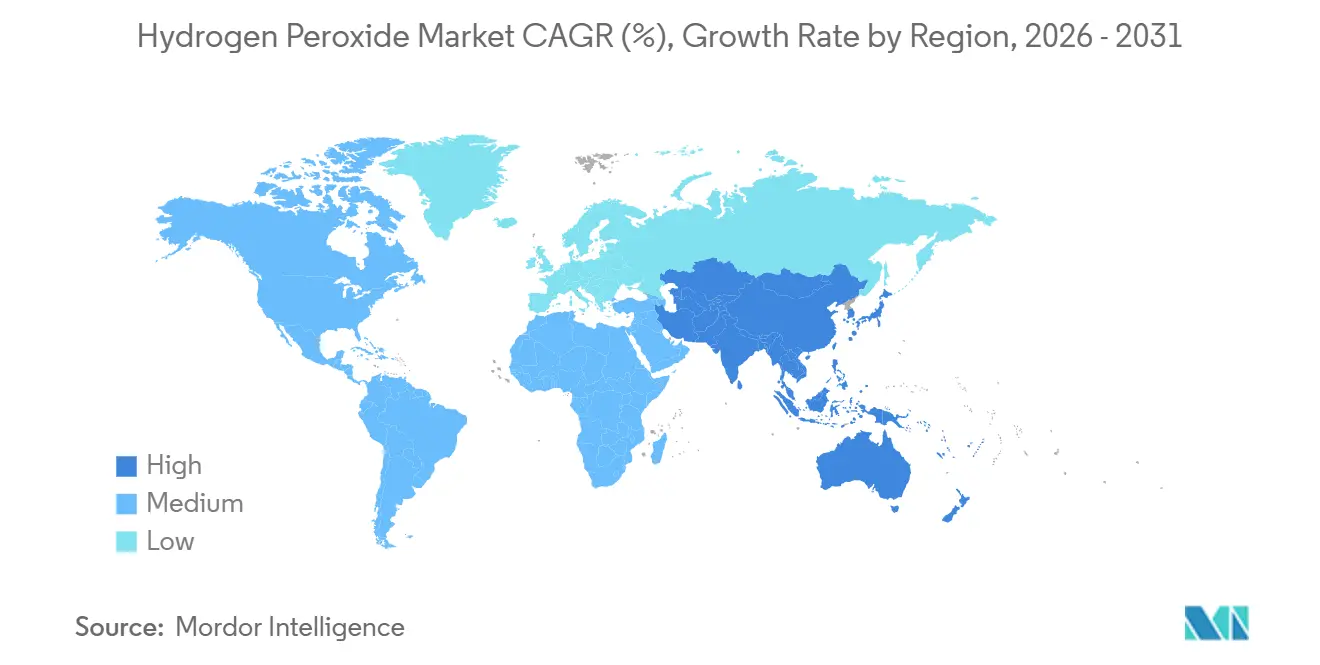
Asia-Pacific controlled 52.28% of the 2025 volume and is forecast to post a 4.33% CAGR to 2031. China remains a leading producer, but increasing anthracene costs and coal-tar restrictions have significantly raised production expenses since early 2025. India is witnessing steady growth, driven by rising demand for pharmaceutical intermediates, textile bleaching, and compliance with new municipal standards. Japan and South Korea are supporting high-purity demand through the establishment of new semiconductor fabrication facilities, with local chemical suppliers already meeting stringent metal limit certifications. Meanwhile, Indonesia, Vietnam, and Thailand have introduced recycled-fiber pulp lines in recent years, reinforcing regional demand for bleaching applications.
North America and Europe Hydrogen Peroxide Market
In North America, LyondellBasell’s Houston HPPO unit and Dow’s Freeport plant together commit 250–280 kilotons of captive offtake, stabilizing merchant pricing. Ultra-pure supply chains now link Solvay’s Deer Park site with Arizona fabs by dedicated ISO tanks. Europe is shifting to low-carbon grades; BASF’s 54 MW electrolyzer at Ludwigshafen feeds renewable hydrogen into peroxide loops. EU Regulation 2019/1148 lifts logistics cost for >35 wt% strengths, prompting some customers to downgrade concentration or import from Asia.
South America and MEA Hydrogen Peroxide Market
South America sees annual growth, tied to Brazil’s eucalyptus-pulp expansions and Argentina’s mining projects that test cyanide-free peroxide leaching. The Middle East and Africa post growth albeit from a small base under 180 kilotons. Saudi wastewater upgrades and South African gold mines drive incremental demand. Overall, the hydrogen peroxide market sees Asia dominating volume, while Europe and North America host margin-rich niches in electronics and low-carbon supply.
Mordor Intelligence provides coverage of the hydrogen peroxide market across other key regional markets, including North America, Asia, and Europe, each with their regulatory frameworks and demand patterns. Detailed country-level analysis extends to India incorporating local coverage and market participation, as required.
Regulatory Landscape
Hydrogen peroxide regulation is tightening around biocidal use, safety handling, and trade controls, with the EU as a key bellwether. In Europe, Regulation (EU) 2019/1148 continues to treat higher-strength hydrogen peroxide as an explosives precursor, increasing distribution compliance requirements for concentrations above 35 wt% and encouraging buyers to shift toward 35 wt% products for easier procurement. Separately, the EU biocides framework under Regulation (EU) No 528/2012 moved further toward Union-wide authorization in 2026, reducing reliance on country-by-country national authorizations for eligible hydrogen peroxide biocidal product families.
Outside Europe, regulators are also influencing trade flows and downstream acceptance. In the United States, the FDA updated 21 CFR 173.356 in September 2025 for hydrogen peroxide used as a secondary direct food additive, supporting clarity for food-contact and processing applications. In trade policy, Pakistan extended anti-dumping duties in April 2026 on hydrogen peroxide imports from multiple origins, reinforcing the role of local production and altering landed-cost economics for exporters. Meanwhile, the UK maintained an autonomous tariff suspension for hydrogen peroxide under commodity code 2847000000 through December 31, 2028, lowering input costs for bulk industrial imports.
Value Chain Analysis
Merchant hydrogen peroxide supply is anchored in anthraquinone auto-oxidation plants that rely on upstream aromatics-derived working solutions, hydrogen, air, and catalysts, followed by purification, concentration, and stabilization steps to meet end-use specifications. Feedstock volatility (notably coal-tar linked anthracene and related intermediates) affects variable cost exposure for non-integrated producers, while integrated players buffer swings through captive sourcing and process optimization. A clear split exists between commodity grades for bleaching and disinfection and specialty, electronic-grade material where ultra-low metals and dedicated packaging lines increase qualification and operating complexity.
Midstream, producers package and move product through bulk tankers, ISO tanks, drums, and intermediate bulk containers, with logistics and storage rules tightening as concentration increases, effectively capping many merchant movements at less than or equal to 70%. Downstream channels are increasingly segmented: pulp and paper and wastewater typically source in bulk with local tank farms and service support, while semiconductors, photovoltaics, and pharma require qualified clean handling, single-use or dedicated containers, and validated supply chains. Recent capacity actions illustrate this bifurcation, including Solvay doubling electronic-grade capacity at Zhenjiang in 2025 and Evonik and Fuhua completing construction of a specialty-grade facility in Leshan in April 2026. New entrants such as Engro Polymer and Chemicals commissioned a 28,000 tpa plant in Pakistan in 2025 using licensed technology to serve regional demand.
Competitive Landscape
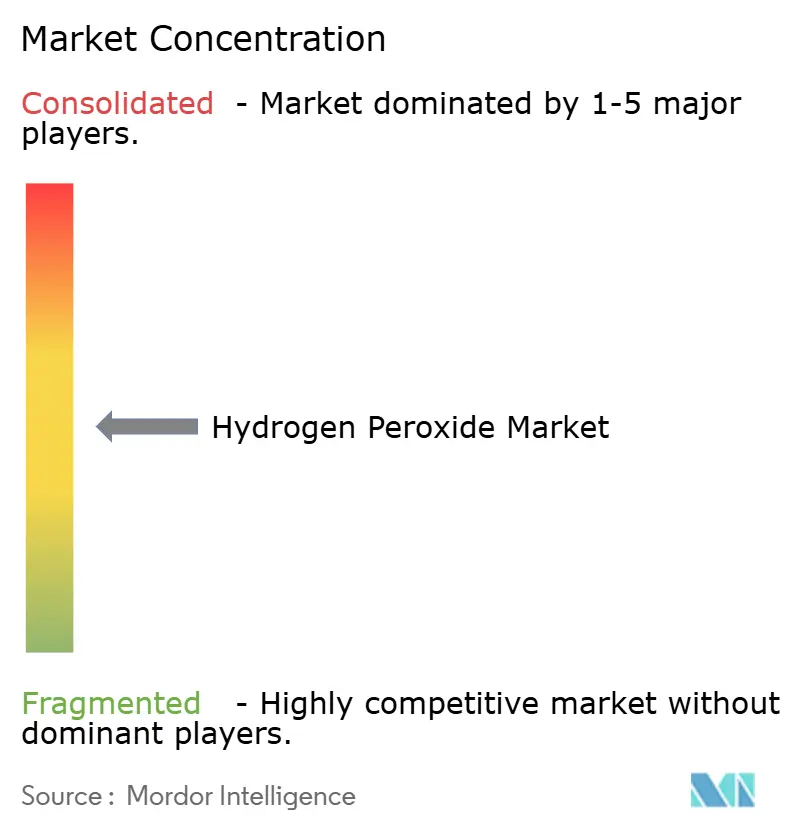
The Hydrogen Peroxide market is moderately consolidated. Vertical integration into anthraquinone and captive propylene-oxide shields these leaders from feedstock swings. Evonik’s contract with Pingmei Shenma for a 200-kiloton plant in 2025 and Solvay’s Huatai solar-grade venture exemplify technology licensing as a capital-light revenue stream. The hydrogen peroxide market values reliability and technical service. Suppliers with local tank farms and quick response teams win pulp and semiconductor contracts. Price competition is sharp in standard grades, where e-commerce channels broaden their reach.
Hydrogen Peroxide Industry Leaders
-
Evonik Industries AG
-
Mitsubishi Gas Chemical Company Inc.
-
Solvay
-
Arkema
-
Nouryon
- *Disclaimer: Major Players sorted in no particular order
Hydrogen Peroxide Market Companies Covered in this Report
- Arkema
- BASF
- Chang Chun Group
- Dow
- Engro Corporation Limited.
- Evonik Industries AG
- FMC Corporation
- Guangdong Zhongcheng Chemicals Inc.
- Gujarat Alkalies & Chemicals Limited
- Hodogaya Chemical Co. Ltd.
- Indian Peroxide Ltd.
- Kemira
- Kingboard Chemical Holdings Ltd.
- Luxi Chemical Group
- Mitsubishi Gas Chemical Company Inc.
- National Peroxide Ltd.
- Nippon Paper Chemicals Co. Ltd.
- Nouryon
- OCI Peroxygens LLC
- PQ Corporation
- Qingdao LaSheng Co. Ltd.
- Sichuan Hebang Biotechnology Co. Ltd.
- Solvay
- Thai Peroxide Company Ltd.
Market Opportunities and Future Outlook
High-purity hydrogen peroxide is a key whitespace where producers capture value through qualification, proximity, and reliability rather than sheer tonnage. Concrete investment signals include Solvay doubling electronic-grade hydrogen peroxide capacity at Zhenjiang in September 2025, Evonik and Fuhua completing construction of a 20,000 tpa specialty-grade plant at Leshan in April 2026, and Gujarat Alkalies and Chemicals Ltd (GACL) approving investment in May 2026 for a 5,000 tpa high-purity plant at Dahej targeting semiconductor and solar applications. These moves point to a shift toward localized, electronics-adjacent supply where contamination limits and packaging discipline create durable supplier lock-in.
A second opportunity band sits in distributed and lower-carbon supply models that reduce transport risk and Scope 3 emissions for large industrial users. On-site and satellite production concepts, such as Solvay’s myH2O2 model (used by Peroxidos do Brasil for the Arauco Sucuriu pulp mill supply chain), align with customers seeking assured delivery while limiting hazardous freight movements. Longer-horizon technology optionality is also expanding through academic advances in direct synthesis routes (electrosynthesis and photocatalysis), which target alternatives to the energy-intensive anthraquinone route. Commercialization remains limited, but R&D progress supports differentiated, modular production concepts where renewable electricity availability and water quality constraints are favorable.
Recent Industry Developments in Hydrogen Peroxide Market
- April 2026: Evonik and Fuhua completed construction of a specialty-grade hydrogen peroxide plant in Leshan, China, designed to supply higher-value applications such as electronics and photovoltaics. The project strengthens regional availability of specialty material near fast-growing end-use clusters and supports tighter customer qualification needs. Bringing new specialty capacity online also reinforces the ongoing segmentation between commodity bleaching supply and premium, specification-driven grades.
- October 2025: Peroxidos do Brasil (a Solvay joint venture) announced construction of a myH2O2 satellite hydrogen peroxide plant in Inocencia, Brazil, to supply the Arauco Sucuriu pulp mill project. The satellite model reduces long-haul transport of hazardous chemicals and improves supply security for large, continuous-consumption pulp operations. It also illustrates how producers defend share by embedding supply assets into customer projects rather than competing only on delivered price.
- April 2024: Evonik introduced certified carbon-neutral hydrogen peroxide in Europe under its Way to GO2 certificate. The offering supports customer decarbonization programs by enabling Scope 3 emission reductions tied to purchased chemicals. It also raises competitive pressure on suppliers to provide auditable sustainability attributes alongside traditional performance and safety documentation.
Hydrogen Peroxide Market Report Scope and Research Methodology
Market Definition and Coverage
For this study, the hydrogen peroxide market covers merchant sales of hydrogen peroxide solutions supplied to external customers for industrial and institutional uses, tracked as volumes delivered across major regions and end-use demand pools.
Scope exclusions: Captive hydrogen peroxide produced and consumed within integrated chemical complexes (for on-site propylene oxide or caprolactam chains) is excluded from the market numbers.
Segments Covered in This Report
- By Product Function
- Disinfectant
- Bleaching
- Oxidant
- Other Product Function (Cleaning Agent, etc.)
- By Grade
- Standard Grade (less than 35% w/w)
- Industrial Grade (35–50%)
- High-Purity Grade (more than 50%)
- By Concentration / Form
- Aqueous Solution (less than or equal to 70%)
- Anhydrous (more than 90%)
- Powder/Granular Adducts (Perborate and Percarbonate)
- By End-user Industry
- Pulp and Paper
- Chemical Synthesis
- Wastewater Treatment
- Mining
- Food and Beverage
- Cosmetics and Healthcare
- Textiles
- Other End-user Industries (Electronics and Semiconductors, Transportation, Aseptic Packaging, and Rocketry)
- By Geography
- Asia-Pacific
- China
- India
- Japan
- South Korea
- Malaysia
- Thailand
- Indonesia
- Vietnam
- Rest of Asia-Pacific
- North America
- United States
- Canada
- Mexico
- Europe
- Germany
- United Kingdom
- France
- Italy
- Spain
- NORDIC Countries
- Turkey
- Russia
- Rest of Europe
- South America
- Brazil
- Argentina
- Colombia
- Rest of South America
- Middle East and Africa
- Saudi Arabia
- Qatar
- United Arab Emirates
- South Africa
- Egypt
- Nigeria
- Rest of Middle East and Africa
- Asia-Pacific
Data Sources, Market Sizing, and Validation
Desk Research
Desk work starts by building the demand picture and the supply picture side by side. We rely on public, non-paywalled sources such as chemical trade associations, national statistics offices, customs and trade portals for import export flows, environmental agencies that publish wastewater and emissions indicators, and peer-reviewed journals that describe grade and concentration handling.
To keep assumptions realistic, we also review company annual reports, investor presentations, and plant announcements in reputed press, and we check shipment level import export databases and patent databases through paid subscriptions where it helps validate capacity adds and route shifts. The desk sources are then used to set ranges for utilization, delivered concentration mix, and end-use splits before these are pressure-tested through interviews. This list is not exhaustive, and many other sources were referred to for data collection, validation, and research clarification.
Primary Interviews and Surveys
Fieldwork focuses on manufacturers, distributors, and large end users that buy hydrogen peroxide for pulp and paper, water treatment, chemical synthesis, mining, and institutional disinfection. We use interviews and structured surveys to confirm delivered concentration patterns, contract versus spot buying behavior, and regional price movement so the model stays aligned with real trade practice across APAC, EMEA, and the Americas.
Distribution of primary research fieldwork respondents
| Company type | Respondent position | Region |
|---|---|---|
| Top tier: 35% | CXOs: 18% | APAC: 43% |
| Mid tier: 46% | Functional/Unit leaders: 28% | EMEA: 32% |
| Smaller Players: 19% | Managers: 54% | Americas: 25% |
Market-Sizing & Forecasting
Sizing is built using a top-down approach where production and trade indicators are used to reconstruct merchant availability by region, and then allocated into end-use demand pools based on usage intensity and operating activity. In parallel, results are corroborated with selective bottom-up checks, such as sampled supplier volume roll-ups, channel feedback on bulk movements, and spot-checked delivered price ranges, which are then used to adjust totals where gaps show up.
Key inputs include announced capacity and debottlenecking timelines, estimated operating rates for major plants, import export movements for hydrogen peroxide solutions, delivered concentration mix (for example, common industrial strengths versus higher grades), and demand signals from pulp and paper output and wastewater treatment activity. For forecasting, we use scenario analysis where these variables are stepped forward with expert consensus on utilization recovery, application growth, and price normalization, and then converted into a consistent volume outlook. Where data is thin in smaller importing countries, proxy rules are applied using trade intensity and nearby consumption patterns, and the proxies are rechecked with interview feedback.
Data Validation & Update Cycle
Outputs are validated through a multi-step set of checks that compare model totals with independent signals such as regional trade balances, capacity utilization realism, and end-use activity direction. When a variance looks abnormal, the assumptions that drive it are reviewed, and re-contact is triggered with relevant respondents to confirm whether the change is real or a data timing issue.
Before sign-off, another analyst reviews the math and the logic for consistency across regions and years, and then we run currency and unit consistency checks so year-on-year comparisons stay clean. Reports are refreshed annually, and interim updates are made when material events occur, such as major plant outages, new capacity starts, or policy moves that change industrial demand. Right before delivery, a final pass is completed so the client receives the most current view.
Mordor Intelligence's Hydrogen Peroxide Market Size Versus Other Published Estimates
Published market sizes for hydrogen peroxide often differ because the market can be measured in volume or in value, and because each publisher makes its own choices on concentration handling, pricing timing, and what is treated as merchant versus captive supply. Differences also show up when estimates are not refreshed after major capacity changes or when currency conversion is applied using a different reference month.
In a refresh-led read of the market, the biggest swings usually come from how fast average selling prices are updated for bulk versus higher-grade material, and whether trade-based checks are used to catch outlier growth rates. When quarterly price movement is validated against capacity utilization and import export shifts, and then translated into the reporting currency at a consistent point in time, the resulting 2026 tonnage line stays stable across regions, which is the discipline used in Mordor Intelligence.
Benchmark comparison
| Source | Market Size | Gaps in Research Methodology |
|---|---|---|
| Mordor Intelligence | USD 6.35 M (2026) | |
| Regional Consultancy A | USD 1.43 B (2024) | Value-based sizing appears to use revenue for packaged or formulated product baskets in parts of the chain, which can undercount bulk industrial tonnage if merchant volumes are not rebuilt from trade and capacity indicators. |
| Industry Publisher B | USD 5.80 B (2025) | A broader value scope is implied, and the estimate can move materially based on the chosen ASP path and the currency conversion timing, especially when higher-grade volumes are priced using generalized assumptions. |
The table shows that the widest spread is driven by value versus volume framing and by how pricing is refreshed through the year. By keeping scope boundaries clear, applying repeatable price and currency timing rules, and checking totals against independent trade and utilization signals, the estimate becomes easier to trace and easier to replicate for planning.
Key Questions Answered in the Report
How large will global demand for hydrogen peroxide be by 2031?
The hydrogen peroxide market size is forecast to reach 7.71 million tons by 2031, advancing at a 3.96% CAGR from 2026.
Which region contributes the most volume to hydrogen peroxide consumption?
Asia-Pacific leads the hydrogen peroxide market with more than 52% of world tonnage in 2025 and is expanding at a 4.33% CAGR.
What is driving the fastest growth segment in end-use applications?
Wastewater treatment is the fastest rising end-user, growing at a 4.29% CAGR as regulators mandate advanced oxidation to remove micropollutants.
Why are high-purity grades priced at a premium?
Semiconductor and pharmaceutical customers require metal contamination below parts-per-billion levels, and the specialized clean-room bottling and fluoropolymer logistics justify premiums exceeding 200% over commodity grades.
How are producers addressing sustainability in manufacturing?
Leading suppliers install green-hydrogen electrolyzers and certify low-carbon peroxide, capturing premiums of up to 20% from pulp and consumer-goods clients under net-zero targets.