
Hydrogel Market Size and Share
Market Overview
| Study Period | 2021 - 2031 |
|---|---|
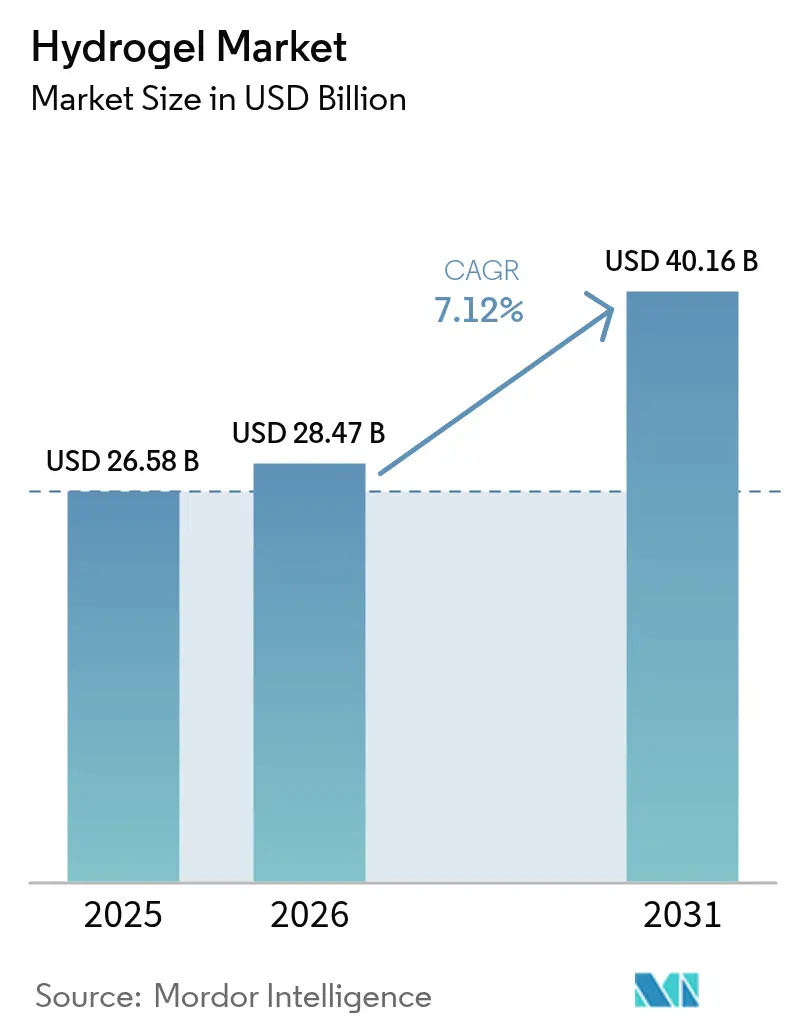
| Market Size (2026) | USD 28.47 Billion |
| Market Size (2031) | USD 40.16 Billion |
| Growth Rate (2026 - 2031) | 7.12 % |
| Fastest Growing Market | Asia Pacific |
| Largest Market | Asia Pacific |
| Market Concentration | Medium |
Major Players *Disclaimer: Major Players sorted in no particular order Image © Mordor Intelligence. Reuse requires attribution under CC BY 4.0. | |
Hydrogel Market Analysis by Mordor Intelligence
The Hydrogel Market size is projected to be USD 26.58 billion in 2025, USD 28.47 billion in 2026, and reach USD 40.16 billion by 2031, growing at a CAGR of 7.12% from 2026 to 2031. End-use demand is pivoting from commodity absorbents toward precision-engineered matrices that merge sensing, drug release, and biodegradability. Semi-crystalline grades hold dominant revenue because tunable mechanical strength secures hospital formulary preference in wound care. Amorphous formulations are expanding fastest as pharmaceutical developers seek rapid-dissolution patches and injectable depots that accelerate therapeutic onset. Polyacrylate remains the incumbent in hygiene products, yet polyacrylamide is gaining traction among water-stressed agricultural economies where 400-fold water uptake offers a lifeline for drip-irrigation systems. Regionally, Asia-Pacific leads the hydrogel market thanks to capacity additions in China and policy-linked subsidies in India that embed hydrogels into soil-moisture mandates.
Key Report Takeaways
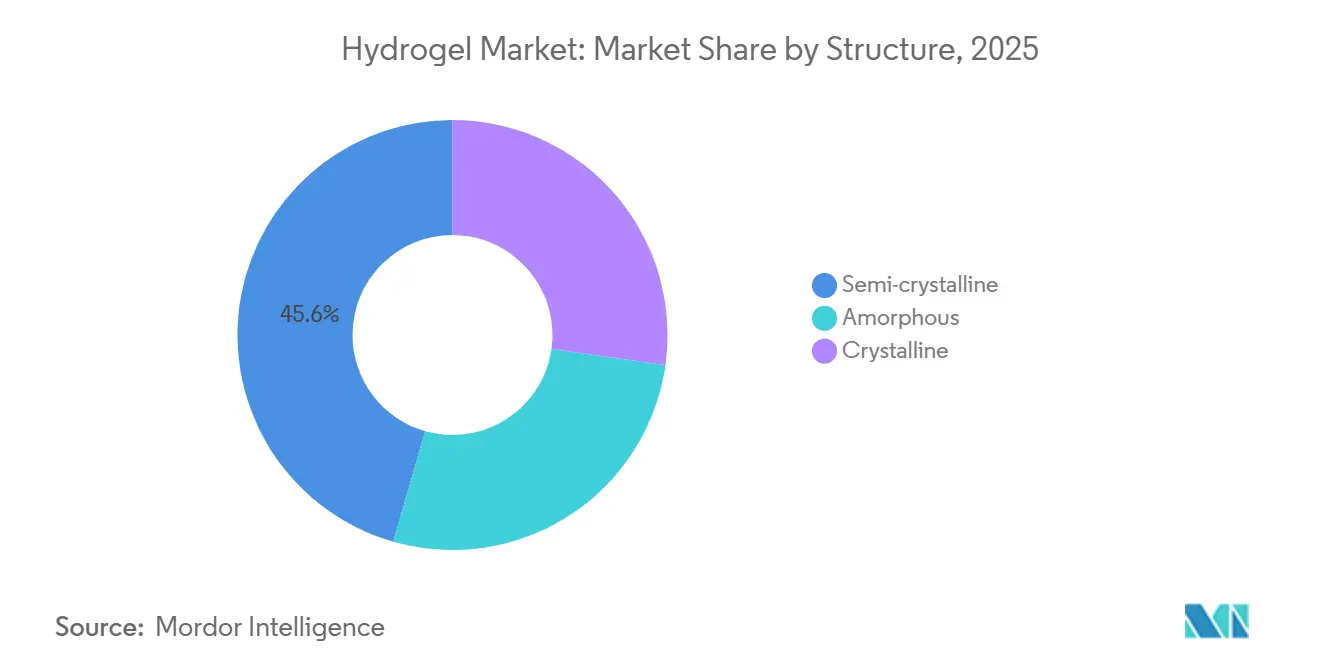
- By structure, semi-crystalline grades held 45.56% of the hydrogel market share in 2025, while amorphous grades are tracking an 8.01% CAGR through 2031.
- By material, polyacrylate captured 25.33% revenue in 2025, whereas polyacrylamide is forecast to expand at a 7.58% CAGR to 2031.
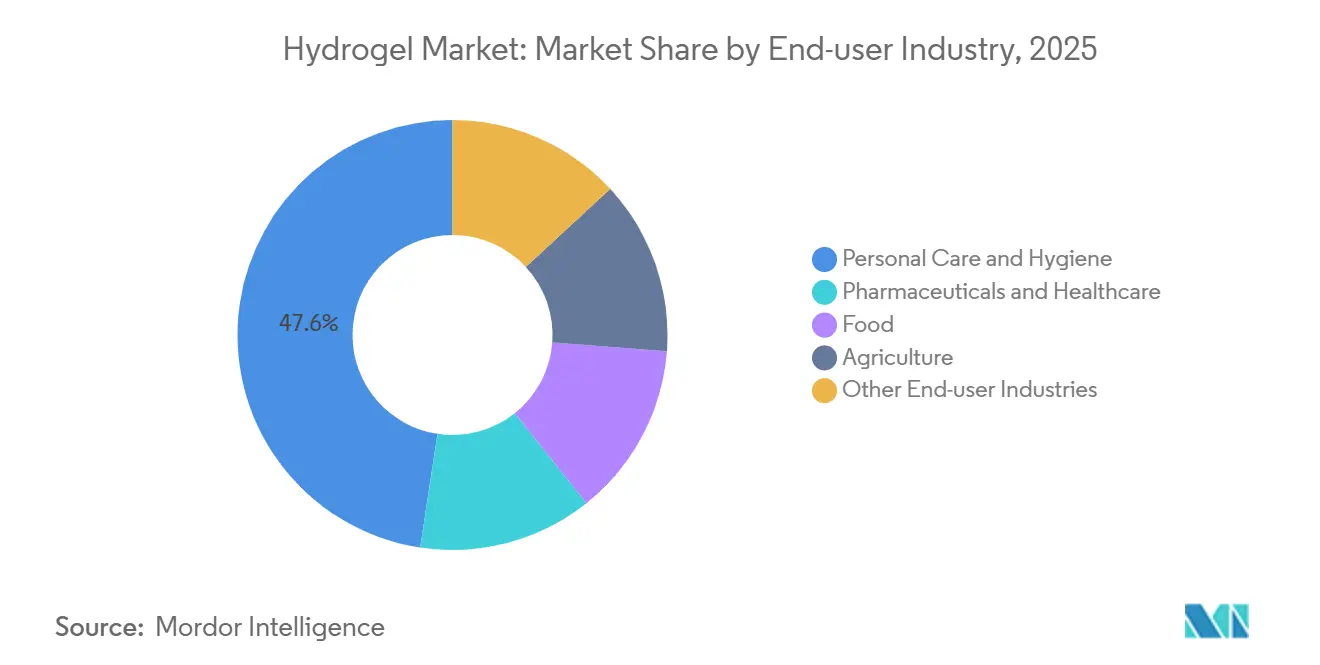
- By end-user industry, personal care and hygiene commanded 47.61% of the hydrogel market size in 2025, and pharmaceuticals and health care are advancing at a 7.79% CAGR through 2031.
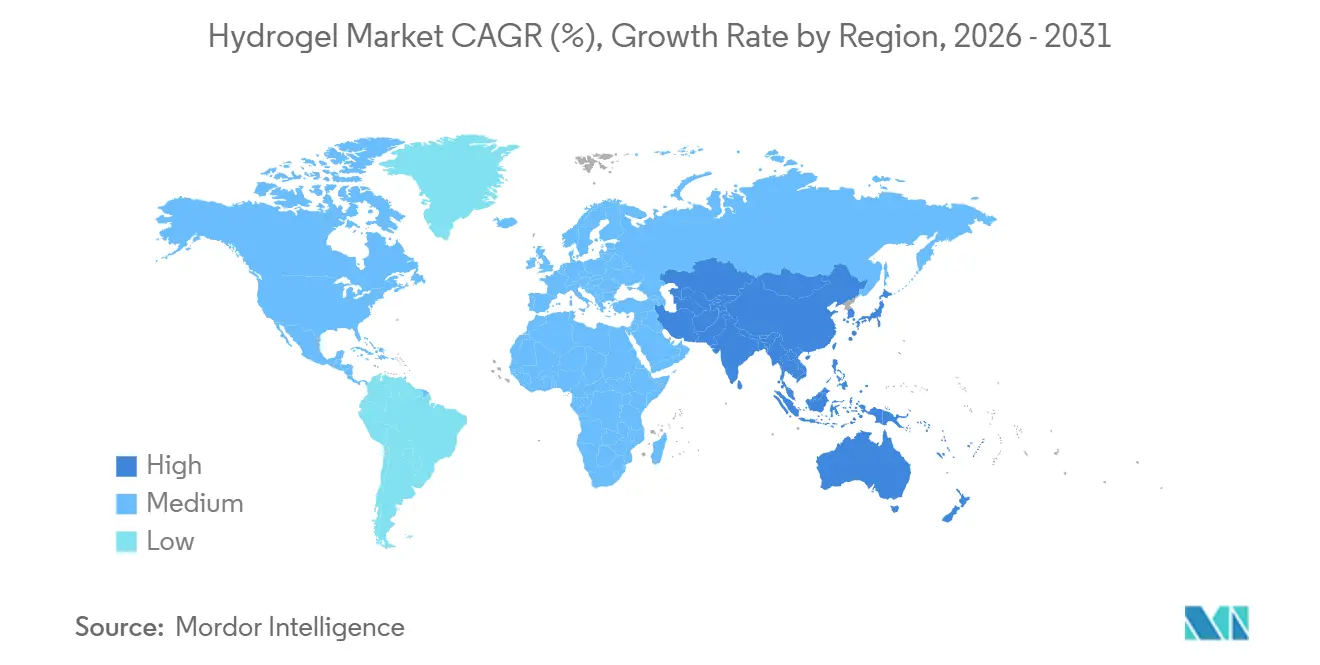
- By geography, Asia-Pacific contributed 41.10% revenue in 2025 and is projected to climb at an 8.02% CAGR through 2031.
Note: Market size and forecast figures in this report are generated using Mordor Intelligence’s proprietary estimation framework, updated with the latest available data and insights as of 2026.
Market Trends and Insights
Drivers Impact Analysis of Hydrogel Market*
| Drivers | (~) % Impact on CAGR Forecast | Geographic Relevance | Impact Timeline |
|---|---|---|---|
| Expanding use in disposable hygiene products | +1.8% | Global, with concentration in Asia-Pacific (China, India) and Latin America | Medium term (2-4 years) |
| Growing demand for silicone-hydrogel contact lenses | +1.5% | North America, Europe, Japan, South Korea | Short term (≤ 2 years) |
| Regulatory push for water-saving agricultural inputs | +1.3% | Asia-Pacific (India, ASEAN), Middle East and Africa, South America (Brazil) | Long term (≥ 4 years) |
| Proliferation of conductive hydrogel sensors for wearable electronics | +1.2% | North America, Europe, Japan | Medium term (2-4 years) |
| 4D-printed smart hydrogel implants for minimally-invasive therapies | +1.0% | North America, Europe | Long term (≥ 4 years) |
| Source: Mordor Intelligence | |||
Expanding Use in Disposable Hygiene Products
Global consumption of hydrogels was primarily driven by diaper and feminine-care products. Notably, the Asia-Pacific region accounted for a significant portion of this volume, fueled by rising incomes and a shift towards premium ultra-thin formats. In a strategic move, Chinese manufacturers achieved a reduction in basis weight by increasing crosslink density. This innovation led to thinner cores, resulting in reduced packaging costs and enhanced comfort. Under Beijing's Healthy China 2030 initiative, a target has been set for rural households to have access to hygienic menstrual products. To support this goal, significant investments are being funneled into new polyacrylate production lines. Meanwhile, Europe's Extended Producer Responsibility regulations are accelerating a shift towards cellulose-hydrogel blends. These blends, which decompose within 90 days, position bio-based suppliers advantageously for future gains. As a result of these dynamics, the demand for hygiene-grade hydrogels is witnessing robust growth. This growth persists despite a slip in unit prices, a consequence of overcapacity in China.
Growing Demand for Silicone-Hydrogel Contact Lenses
Silicone-hydrogel designs represented a significant portion of the soft lenses dispensed in 2025, reflecting prescriber preference for oxygen transmissibility over 100 Dk/t[1]. Revenue momentum rests on water-gradient technology that preserves surface water content while embedding silicone channels to maintain comfort during extended wear. Japan cleared two UV-blocking silicone-hydrogel disposables in 2025, tapping pediatric and myopia-control niches that grow steadily. ISO 18369 now requires public disclosure of oxygen permeability, modulus, and lipid-deposition metrics, accelerating the retirement of legacy hydrogels. China is simultaneously expanding orthokeratology for children; silicone-hydrogel ortho-k lenses already own a notable share of pediatric prescriptions, underlining cross-regional adoption potential.
Regulatory Push for Water-Saving Agricultural Inputs
India’s flagship irrigation program allocates significant funding in 2025-26, covering a portion of spending only when farmers deploy hydrogel soil conditioners that cut irrigation cycles. Rajasthan field trials showed cotton yields climb while water use fell per hectare. Brazil’s water authority made hydrogel use mandatory in drought-prone sugarcane zones, creating a guaranteed domestic market. FAO’s climate-smart guidelines list hydrogels as a Tier 1 adaptation tool, unlocking multilaterals’ funding. Certification under ISO 17556 for biodegradability is fast becoming a license to operate, especially as African regulators curb imports of non-degradable polyacrylamide.
Proliferation of Conductive Hydrogel Sensors for Wearable Electronics
In 2025, conductive hydrogel electrodes made their mark by being integrated into millions of wearables, surpassing the performance of traditional rigid Ag/AgCl contacts. This advancement achieved a significant reduction in skin-electrode impedance. Highlighting the efficacy of these innovations, a monitor showcased its durability with an impressive mean absolute relative difference over a span of days, all without the need for recalibration. In a move that underscores the industry's momentum, a recent draft FDA guidance has streamlined biocompatibility data requirements, effectively slashing months off start-up launch timelines. Meanwhile, patent filings for stretchable circuits surged, with tech giants fortifying their portfolios, particularly in the realms of flexible displays and haptic layers. Such advancements not only enhance the hydrogel market's appeal, extending its reach beyond traditional fitness trackers, but also revolutionize monitoring for neonates and the elderly, areas previously hindered by rigid devices that caused pressure ulcers.
Restraints Impact Analysis of Hydrogel Market*
| Restraints | (~) % Impact on CAGR Forecast | Geographic Relevance | Impact Timeline |
|---|---|---|---|
| Competition from foam and alginate dressings | -0.9% | Global, particularly North America and Europe | Short term (≤ 2 years) |
| Regulatory scrutiny on micro-plastic shedding and landfill impact | -0.7% | Europe, North America, with spillover to APAC | Medium term (2-4 years) |
| ESG pressure over high energy-intensity hydrogel manufacturing | -0.5% | Global, strongest in Europe and North America | Long term (≥ 4 years) |
| Source: Mordor Intelligence | |||
Competition from Foam and Alginate Dressings
In 2025, polyurethane foams secured a significant share of the advanced wound-care market, surpassing hydrogels. Clinicians leaned towards foams for treating heavily exuding ulcers. Meanwhile, calcium alginates gained traction in hemostasis, benefiting from faster clotting times that influenced operating-room practices. A review highlighted comparable healing rates between foams and hydrogels, diminishing the latter's price advantage. Silicone-border foams, requiring nursing attention only once every five days, offered a significant edge amid prevalent staffing shortages. Hydrogel manufacturers, incorporating silver or iodine for enhanced infection control, face a tighter competitive margin, especially outside burn centers and oncology wards, due to the added costs.
Regulatory Scrutiny on Micro-Plastic Shedding and Landfill Impact
Europe’s chemical watchdog estimates that each diaper releases microplastic particles, with a significant portion of these particles escaping treatment plants and entering waterways[2]. France has proposed a mandate to label microplastic content on hygiene products by 2027, a move that could provoke a backlash from consumers. In California, a ban is already in place for agricultural hydrogels that don't achieve sufficient mineralization within a specified timeframe. This effectively sidelines conventional polyacrylamide in the state's soil-amendment market. Reformulating to starch-grafted copolymers incurs additional raw material costs and requires certification under ISO 17556. Furthermore, fragmented national definitions of “biodegradable hydrogel” complicate compliance for multinational corporations.
*Our forecasts treat driver/restraint impacts as directional, not additive. The impact forecasts reflect baseline growth, mix effects, and variable interactions.
Hydrogel Market Segment Analysis
By Structure:
Mechanical Tunability Anchors Semi-Crystalline DominanceSemi-crystalline grades generated 45.56% of 2025 revenue, leveraging tensile moduli ranging from low values in wound dressings to higher values in cartilage scaffolds. These advantages stemmed from precise adjustments in crosslink density and crystalline domain size. Meanwhile, amorphous variants clock an 8.01% CAGR, as drug-delivery experts pursue the rapid diffusion rates that semi-crystalline matrices hinder. The hydrogel market is set to see a significant uptick for amorphous formulations in transdermal patches. At the same time, semi-crystalline compositions maintain their foothold in agriculture, where they outperform their amorphous counterparts by releasing water over a span of several days. Crystalline hydrogels remain a niche player, as their brittleness leads to high rejection rates, limiting their market share. Regulatory endorsements are boosting the adoption of amorphous variants, spurring investments in non-invasive therapeutic pipelines.
On the commercial front, suppliers are strategically blending structures, merging amorphous domains for enhanced permeability with micro-crystalline regions for superior load-bearing capabilities. This blend commands a premium in the orthopedic implant market. Asian suppliers are ramping up capacity, recognizing the paramount importance of mechanical performance in the burgeoning wound-care sector. In contrast, African agronomists favor semi-crystalline powders for drip irrigation, valuing their extended field life. This diverse structural landscape creates distinct value pools, allowing vendors to safeguard their margins even amidst commodity price fluctuations.

By Material:
Polyacrylate Incumbency Confronts Polyacrylamide in Water-Stressed RegionsIn China, polyacrylate accounted for 25.33% of the 2025 market value, solidifying its position as the cost leader. Yet polyacrylamide’s 7.58% growth aligns with water scarcity policies, especially given its impressive absorption capacity. Although silicone chemistry constitutes a small percentage of the hydrogel market by volume, it commands a substantial share of the market's value. This premium is largely due to oxygen-permeable lenses, underscoring the industry's tilt towards lucrative medical applications. In Europe, bio-derived cellulose and chitosan are steadily gaining traction in the biodegradable diaper market, bolstered by the introduction of a wood-pulp hydrogel. However, heightened purification costs, necessary to ensure residual acrylamide stays within FDA thresholds, are squeezing margins, particularly for non-integrated polyacrylamide suppliers.
Looking ahead, the hydrogel industry is poised for a split: while cost-effective polyacrylate will gravitate towards mega-plants with large capacities, high-performance silicone and bio-based variants will flourish, bolstered by strong intellectual property protections. Meanwhile, mid-tier polyacrylamide producers, lacking breakthroughs in biodegradability, face the dual threats of shrinking margins and potential buyouts.
By End-User Industry:
Personal-Care Volume Versus Pharmaceutical ValueIn 2025, personal care and hygiene accounted for a 47.61% share of tonnage, driven by a growing infant population in the Asia-Pacific and Africa regions, where diaper usage remains relatively low. Meanwhile, pharmaceuticals and healthcare, leveraging the high prices of implantable devices and antimicrobial dressings, are growing at a 7.79% CAGR with a smaller share of the volume. While agricultural soil conditioners made up a considerable part of the hydrogel market's tonnage, their value remained subdued due to subsidies that keep farm-gate prices low. However, food applications, like hydrogel coatings used on fruits, contribute to steady growth.
As the margin gap widens, suppliers are adjusting their strategies: Ashland and DSM are moving away from bulk hygiene, focusing instead on ISO 13485-certified medical-grade lines that boast higher gross margins. In contrast, Chinese producers are opting for mergers, aiming for feedstock integration to safeguard their commodity share. With a rising demand for premium healthcare, the divergence among end-users is set to shape the hydrogel market's strategy.
Geography Analysis
APAC Hydrogel Market
Asia-Pacific anchored 41.10% of global demand in 2025 and is projected to expand at an 8.02% CAGR through 2031. China invests heavily in polyacrylate and silicone-hydrogel clusters in Jiangsu and Guangdong, bolstering supply security and asserting cost leadership. India witnesses a diaper boom, attracting substantial plant investments from major companies, effectively sidestepping import duties. Japan's contact-lens sector pivots to daily disposable silicone-hydrogels in light of new health guidelines. Meanwhile, South Korea advances conductive hydrogel electrodes for smartwatch ECG functionalities. ASEAN initiatives are subsidizing hydrogels in drought-stricken rice regions, boosting regional market adoption.
North America Hydrogel Market
North America accounted for a significant share of revenue in 2025, driven by the FDA's nod to multiple hydrogel devices leveraging the expedited 510(k) pathway. Medicare's reimbursement for advanced dressings spurs hospital uptake. However, Canada introduces value-based tenders emphasizing cost-per-healed-wound, steering suppliers towards clinical outcome validation. In Mexico, state tax credits for avocado producers using hydrogels not only conserve stressed aquifers but also carve out an agri-hydrogel niche in the NAFTA region.
Europe Hydrogel Market
Europe, holding a notable share of demand, is characterized by stringent biodegradability standards, pushing purchases towards cellulose and starch-grafted chemistries. The EU's Medical Device Regulation eases compliance hurdles, favoring established players with regulatory acumen in wound care. Post-Brexit, companies face dual filings under MHRA, elongating market entry for newcomers. In the Nordics, utilities are testing hydrogel-based phase-change systems for district heating, hinting at a broader thermal-storage potential.
South America and MEA Hydrogel Market
South America, with a modest share, sees Brazil's sugarcane initiative conserving significant volumes of water annually. While Argentina grapples with higher unsubsidized prices dampening uptake, government-led pilots might tap into this dormant demand. The Middle East and Africa, together contributing a small share, spotlight Saudi Arabia's boost to hydrogel-driven greenhouse projects and South Africa's distribution of conditioners to drought-stricken maize farmers, albeit with logistical challenges.
Regulatory Landscape
Hydrogel regulation is split between chemical-substance compliance and end-use device oversight, with medical and hygiene applications carrying the highest documentation burden. In the United States, many hydrogel wound dressings fall under 21 CFR 878.4022 as Class I devices (with exemptions under specified conditions). Higher-risk hydrogel devices and delivery matrices commonly use FDA pathways such as 510(k), with biocompatibility expectations aligned to ISO 10993-1 and quality controls under 21 CFR 820.
In Europe, medical device hydrogels are governed by Regulation (EU) 2017/745 (MDR). Risk-based classification can extend to Class III for certain injectable or implant-adjacent uses, which increases clinical evaluation and post-market follow-up requirements relative to the US substantial-equivalence approach. On the chemicals side, REACH (EC) No 1907/2006 requires substance registration with the European Chemicals Agency (ECHA) above 1 tonne per year per company. Tightening attention to microplastic shedding and biodegradability definitions is raising compliance requirements for hygiene and agricultural grades, alongside ISO 17556 testing used in biodegradability claims in several end markets.
Value Chain Analysis
The hydrogel value chain starts with petrochemical and bio-based feedstocks, including acrylic acid derivatives for polyacrylate, acrylamide routes for polyacrylamide, and natural polymers such as alginate, gelatin, chitosan, collagen, and starch inputs. It then moves through formulation additives (crosslinkers, humectants, antimicrobials) and into end products such as diaper SAP cores, wound dressings, contact lenses, flowable matrices, and agricultural soil conditioners. Manufacturing has been shifting from batch chemical synthesis toward scalable processes like continuous twin-screw extrusion to control crosslinking and purity, while irradiation or photo-crosslinking is used to shorten cycle times and reduce chemical residues for medical and wearable-interface applications.
Downstream, value capture is stronger in device-grade production that can meet ISO 13485 and ISO 10993 expectations for hospital and other regulated channels. By contrast, commodity hygiene and agriculture rely more on scale, feedstock integration, and distribution reach. Key bottlenecks include the raw material cost share in bio-based routes and the certification workload for biodegradability and microplastic-related claims, which can delay qualification with brand owners and public programs. Some recent techno-economic work also points to localized starch-based production as an alternative supply strategy where logistics and import compliance constrain access to specialty grades.
Competitive Landscape
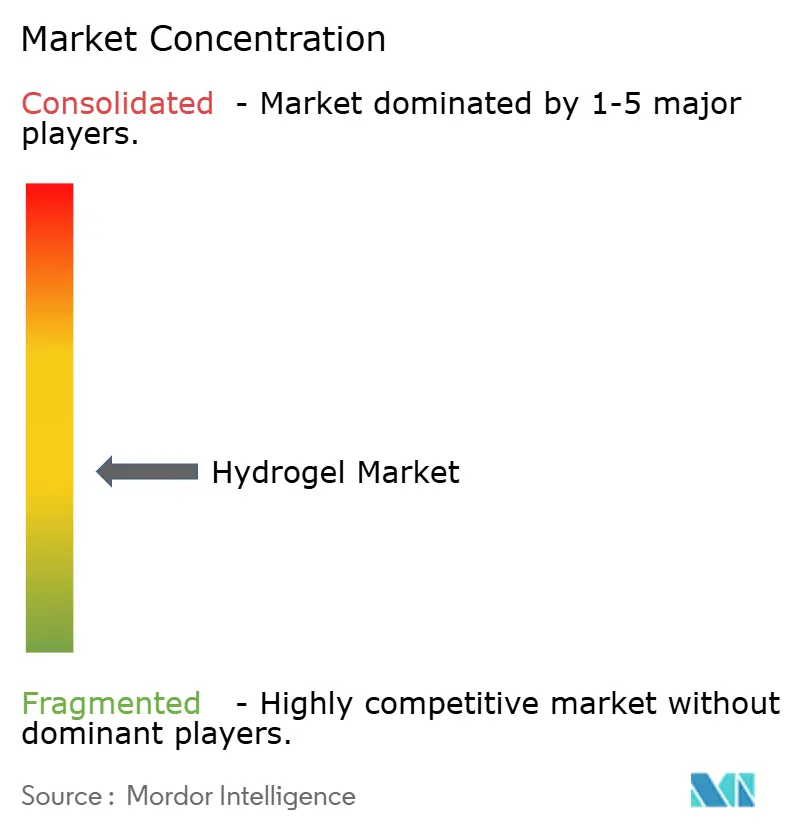
The hydrogel market remains moderately fragmented. Compliance with ISO 10993 and ISO 13485 becomes table stakes for hospital tenders, advantaging multinational incumbents over cash-constrained start-ups. Emerging university spin-outs feed the pipeline. Bulk hygiene players in China backward-integrate into acrylic acid to buffer feedstock volatility, whereas Western specialists forward-integrate into finished devices to capture value from proprietary coatings. This bifurcation suggests mid-tier formulators lacking either scale or IP will face consolidation pressures before 2030.
Hydrogel Industry Leaders
-
3M
-
Smith+Nephew
-
Johnson and Johnson
-
Coloplast Ltd
-
Convatec
- *Disclaimer: Major Players sorted in no particular order
Hydrogel Market Companies Covered in this Report
- 3M
- Alcon
- Ashland
- Axelgaard Manufacturing Co., Ltd.
- Cardinal Health
- Coloplast Ltd
- Convatec
- CooperVision
- DSM
- Essity Health & Medical
- Hannox International Corp.
- HOYA Corporation
- Johnson and Johnson
- Mölnlycke Health Care AB
- PAUL HARTMANN AG
- Sekisui Kasei
- Smith+Nephew
Market Opportunities and Future Outlook
White-space is expanding around higher-function hydrogels that combine moisture retention with interface requirements such as air permeability, durable adhesion to wet tissue, and tunable mechanics for long-wear use in biomedical settings. In July 2026, MIT reported a viscoelastic phase separation approach that maintains high water content while improving air permeability, aligning with demand signals in advanced wound care and skin-worn sensors where occlusion and maceration constrain wear time. At the same time, lab work on bonding soft hydrogels to stretchable polymer backings and AI-assisted design of super-adhesive, self-healing hydrogels points to a technology roadmap aimed at better fixation, comfort, and durability in dynamic environments such as sweat, motion, and underwater exposure.
Commercial whitespace is reinforced by active regulatory throughput for hydrogel-based devices, which supports new entrants and category extensions beyond traditional dressings. In January 2026, FDA activity included a formally filed PMA for Rejoni Inc.'s Juveena Hydrogel System for intrauterine adhesions, and a separate 510(k) clearance for a hydrogel device for temporary external control of moderate to severe bleeding. June 2026 also brought another 510(k) clearance for a flowable extracellular matrix hydrogel for wound management. Alongside ongoing adoption in silicone-hydrogel contact lenses and policy-linked agricultural programs that condition subsidies on hydrogel use, these milestones create identifiable lanes for suppliers to move up the value curve through medical-grade manufacturing, differentiated chemistries such as bio-based and low-shedding options, and application-specific formats including flowable, injectable, layered dressings, and conductive interfaces.
Recent Industry Developments in Hydrogel Market
- June 2026: Alafair Biosciences launched VersaCoat Flowable Hydrogel, a hyaluronic acid and alginate hydrogel positioned for soft-tissue protection in orthopedic surgery. The launch broadens hydrogel use in procedure-adjacent applications where ease of delivery and tissue compatibility influence surgeon adoption and supplier differentiation.
- July 2025: Hannox International Corp. introduced Hannox Wound Hydrogel, a sterile dressing for managing chronic and post-operative wounds, bedsores, and ulcers. The product reinforces competitive intensity in wound care where moisture balance, bacterial barrier performance, and exudate handling drive formulary placement.
- November 2024: Alcon released PRECISION7, a weekly replacement silicone hydrogel contact lens featuring the ACTIV-FLO System. Weekly-replacement innovation supports a mid-wear modality that competes with daily disposables on comfort and cost, keeping silicone-hydrogel material performance central to lens portfolio strategy.
Hydrogel Market Report Scope and Research Methodology
Market Definition and Coverage
This market covers revenues generated from hydrogel materials and hydrogel-based forms that are supplied into end uses such as healthcare, personal care and hygiene, agriculture, and other industrial uses, across major regions.
Scope exclusions: We do not count adjacent non-hydrogel substitutes like foams, alginates, hydrocolloids, or conventional films that do not use a hydrogel matrix.
Segments Covered in This Report
- By Structure
- Semi-crystalline
- Amorphous
- Crystalline
- By Material
- Polyacrylate
- Polyacrylamide
- Silicone
- Other Materials
- By End-user Industry
- Personal Care and Hygiene
- Pharmaceuticals and Healthcare
- Food
- Agriculture
- Other End-user Industries
- By Geography
- Asia-Pacific
- China
- India
- Japan
- South Korea
- ASEAN Countries
- Rest of Asia-Pacific
- North America
- United States
- Canada
- Mexico
- Europe
- Germany
- United Kingdom
- France
- Italy
- Russia
- NORDIC Countries
- Rest of Europe
- South America
- Brazil
- Argentina
- Rest of South America
- Middle East and Africa
- Saudi Arabia
- South Africa
- Rest of Middle East and Africa
- Asia-Pacific
Data Sources, Market Sizing, and Validation
Desk Research
Desk research helps set the market structure and the key demand pools before the model is built. We reviewed public statistics and technical references that indicate hydrogel usage and production trends, including US FDA device databases and product clearances for wound care formats, US International Trade Commission trade data for relevant polymer inputs, and patent databases to track new hydrogel chemistries and delivery formats.
We also used sources such as peer-reviewed journals covering polymer science and biomedical materials, national statistics offices where end-use output can be proxied (for example, hygiene and medical supplies), and association websites that publish guidance on wound care and medical materials. Company annual reports, filings, and investor decks were then used to understand product mix, regional exposure, and capacity additions. We also referenced paid subscriptions for company financials and intelligence, news and financials, and patent databases to cross-check timelines and coverage. These are illustrative sources only, and many other public references were used for collection, validation, and clarification.
Primary Interviews and Surveys
Primary interviews and surveys were used to pressure-test desk assumptions and to close gaps around pricing, formulation mix, and end-use adoption, particularly where public data is not consistent by country. We spoke with a mix of hydrogel material suppliers, converters, and downstream users, then validated results across APAC, EMEA, and the Americas so regional demand signals were not over or under stated.
Distribution of primary research fieldwork respondents
| Company type | Respondent position | Region |
|---|---|---|
| Top tier: 36% | CXOs: 13% | APAC: 52% |
| Mid tier: 48% | Functional/Unit leaders: 32% | EMEA: 29% |
| Smaller Players: 16% | Managers: 55% | Americas: 19% |
Market-Sizing & Forecasting
The core sizing starts with a top-down build, where end-use demand pools are reconstructed using a mix of healthcare and hygiene consumption indicators, agriculture water-retention usage signals, and the split of hydrogel forms used in each application. Once this ceiling is set, we corroborate it with selective bottom-up approximations, such as sampled supplier revenues by region, channel checks for wound care and hygiene formats, and simple ASP times volume checks where unit measures are available.
Key inputs used in the model include hydrogel penetration in wound care dressings and contact lens related uses, the mix of material types like polyacrylate, polyacrylamide, and silicone-based variants, regional pricing differences driven by formulation and packaging, and the pace of adoption in agriculture where soil conditioning and water stress are key demand triggers. Where company reporting is not clean by hydrogel line, gaps are handled through product mix splits validated in interviews and then applied consistently across regions.
For forecasting, scenario analysis is used to keep assumptions realistic, and growth paths are anchored to a small set of variables that respondents can validate, such as healthcare procedure volumes affecting wound care demand, hygiene product output trends, and agriculture acreage under water stress. By doing this, the forecast stays explainable and repeatable, and it can still be updated quickly when one of the leading indicators shifts.
Data Validation & Update Cycle
Outputs are checked against independent signals before sign-off, so the final totals align with known end-use activity and observed pricing ranges. Variance checks are run at the region and application level, and when a country result looks off against trade or demand indicators, the assumptions are revisited and the math is rebuilt.
A multi-step internal review is followed, and experts are re-contacted when there is a material mismatch in adoption rates, material mix, or price movement. Reports are refreshed annually, with interim updates when major events occur that can move demand or pricing. Before delivery, a final pass is completed so clients receive the most current view available at that time.
Mordor Intelligence's Hydrogel Market Size Compared Against Other Published Estimates
Published hydrogel market estimates can look far apart, even when they discuss similar end uses, because the scope line and the year choice are not always the same. Differences also come from how pricing is treated across forms (amorphous gels versus semi-crystalline formats) and whether older base-year mixes are carried forward without fresh checks.
Non-hydrogel wound dressings like foams and hydrocolloids sit outside Mordor Intelligence's scope here, which is one practical reason this study can land below estimates that bundle the broader advanced wound care basket into a single total.
Benchmark comparison
| Source | Market Size | Gaps in Research Methodology |
|---|---|---|
| Mordor Intelligence | USD 26.58 B (2025) | |
| Industry Report A | USD 36.22 B (2025) | Often presented as a wider materials and applications roll-up, with higher 2025 totals driven by broader inclusion of downstream finished products and less separation between hydrogel and adjacent dressing formats. |
| Industry Association B | USD 23.40 B (2023) | Uses an earlier base year and a longer forecast window, and the total can be pushed lower when inflation and later ASP resets are not fully reflected in the starting point. |
The spread mainly comes from scope and base-year alignment rather than a single math step. By keeping the market tied to clearly defined hydrogel materials and forms, then cross-checking totals with end-use demand signals and interview-based price ranges, the final number stays transparent and easier to reconcile over time.
Key Questions Answered in the Report
What is the projected value of the hydrogel market in 2031?
It is forecast to reach USD 40.16 billion by 2031, from USD 28.47 billion, registering a 7.12% CAGR.
Which segment currently leads hydrogel demand by structure?
Semi-crystalline grades led with 45.56% revenue share in 2025.
How do hydrogels support water-saving agriculture?
Polyacrylamide conditioners absorb up to 500 times their weight, cutting irrigation frequency.
What regulatory challenge faces hygiene-grade polyacrylates in Europe?
Proposed microplastic-content labeling and biodegradability mandates could force reformulation by 2028.