
Hyaluronic Acid Based Dermal Fillers Market Size and Share
Market Overview
| Study Period | 2020 - 2031 |
|---|---|
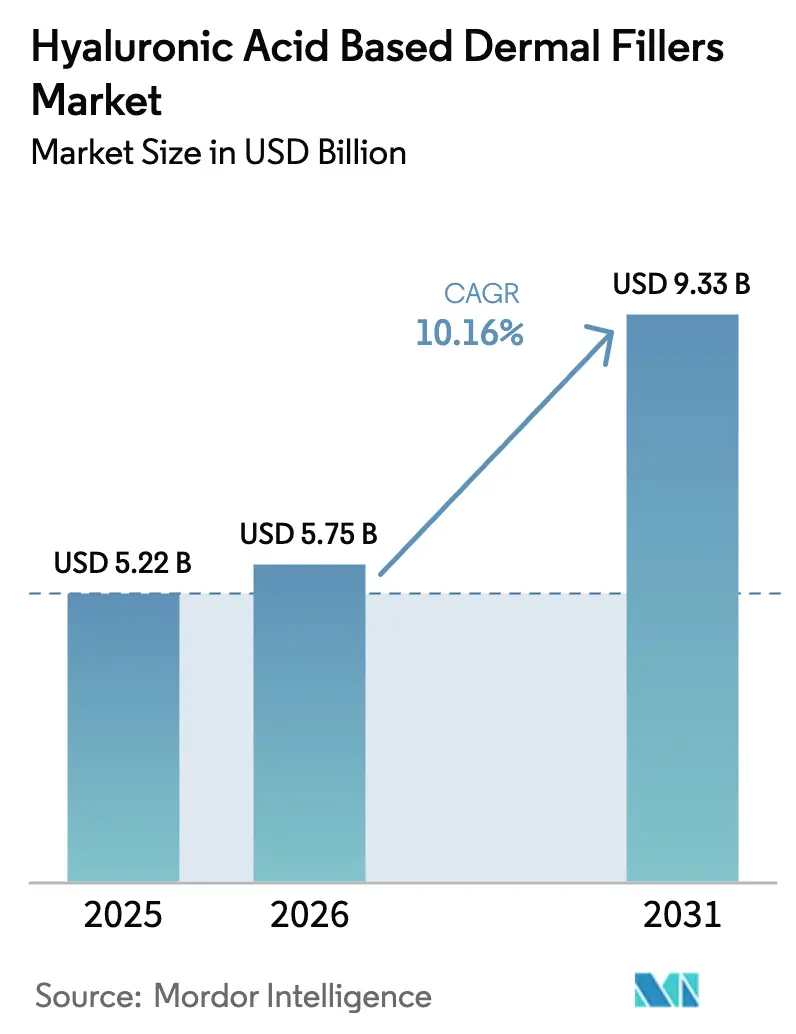
| Market Size (2026) | USD 5.75 Billion |
| Market Size (2031) | USD 9.33 Billion |
| Growth Rate (2026 - 2031) | 10.16 % |
| Fastest Growing Market | Asia Pacific |
| Largest Market | North America |
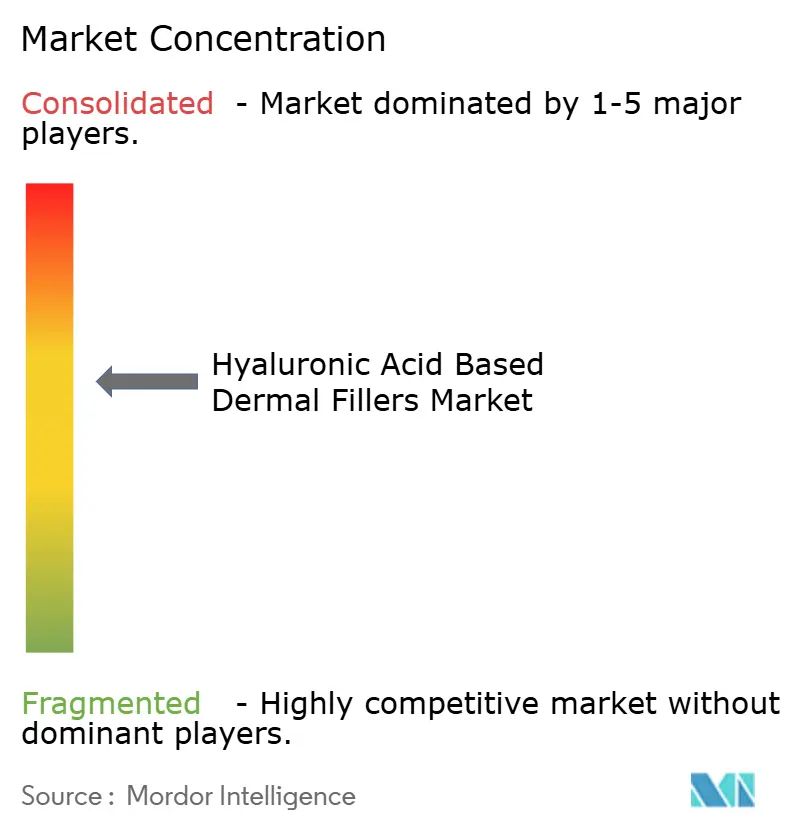
| Market Concentration | Medium |
Major Players *Disclaimer: Major Players sorted in no particular order Image © Mordor Intelligence. Reuse requires attribution under CC BY 4.0. | |
Hyaluronic Acid Based Dermal Fillers Market Analysis by Mordor Intelligence
The Hyaluronic Acid Based Dermal Fillers Market size is projected to be USD 5.22 billion in 2025, USD 5.75 billion in 2026, and reach USD 9.33 billion by 2031, growing at a CAGR of 10.16% from 2026 to 2031.
Uptake is fueled by a widening base of aging consumers who prefer quick office treatments, steady procedural innovation that extends filler longevity, and the rise of male and millennial “pre-juvenation” patients. Price pressure is intensifying as Asia-Pacific entrants ship lower-cost brands into mature regions, yet higher treatment volumes have more than offset fee compression in North America. Manufacturers are broadening their portfolios with thermoresponsive gels and skin boosters, while clinics court recurring revenue through maintenance-based protocols that promote quarterly touch-ups rather than once-a-year bulk injections. Consolidation among suppliers of pharmaceutical-grade hyaluronic acid is helping stabilize input costs and improve purity controls.
Key Report Takeaways
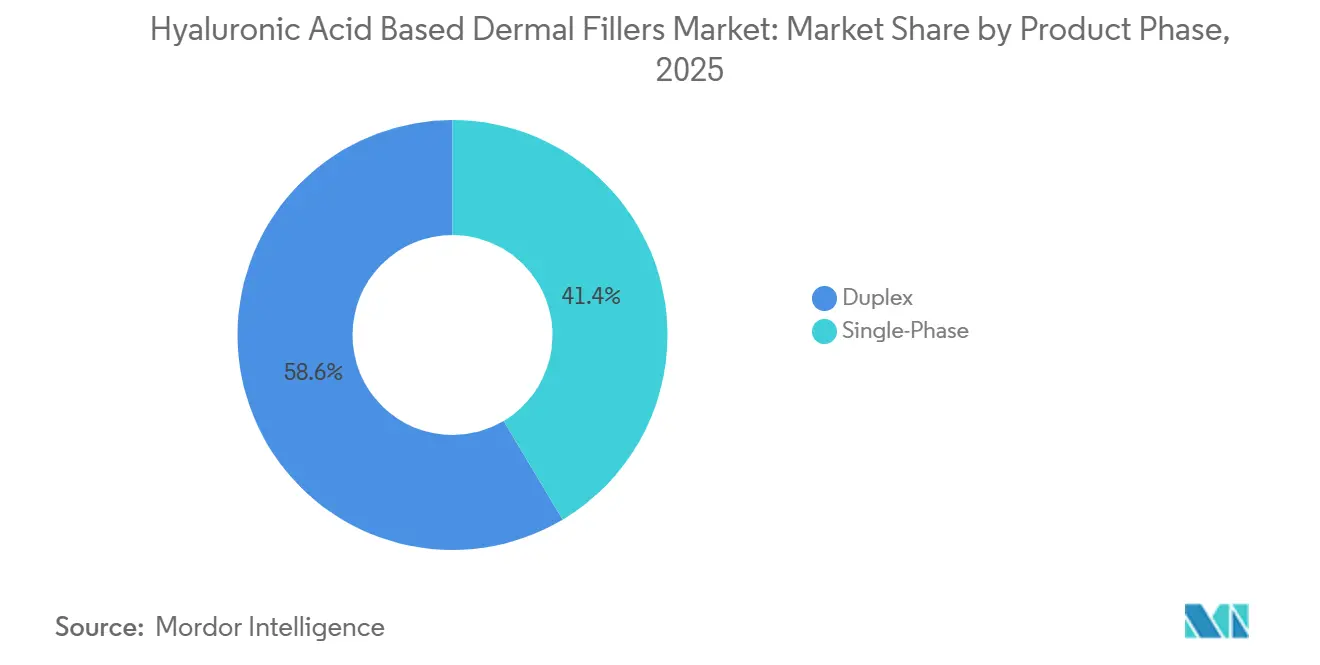
- By product phase, duplex formulations led with 58.56% Hyaluronic Acid Based Dermal Fillers market share in 2025, while single-phase gels are forecast to advance at an 11.25% CAGR to 2031.
- By application, wrinkle correction held 35.53% of revenue in 2025; lip augmentation is on track for a 12.85% CAGR through 2031.
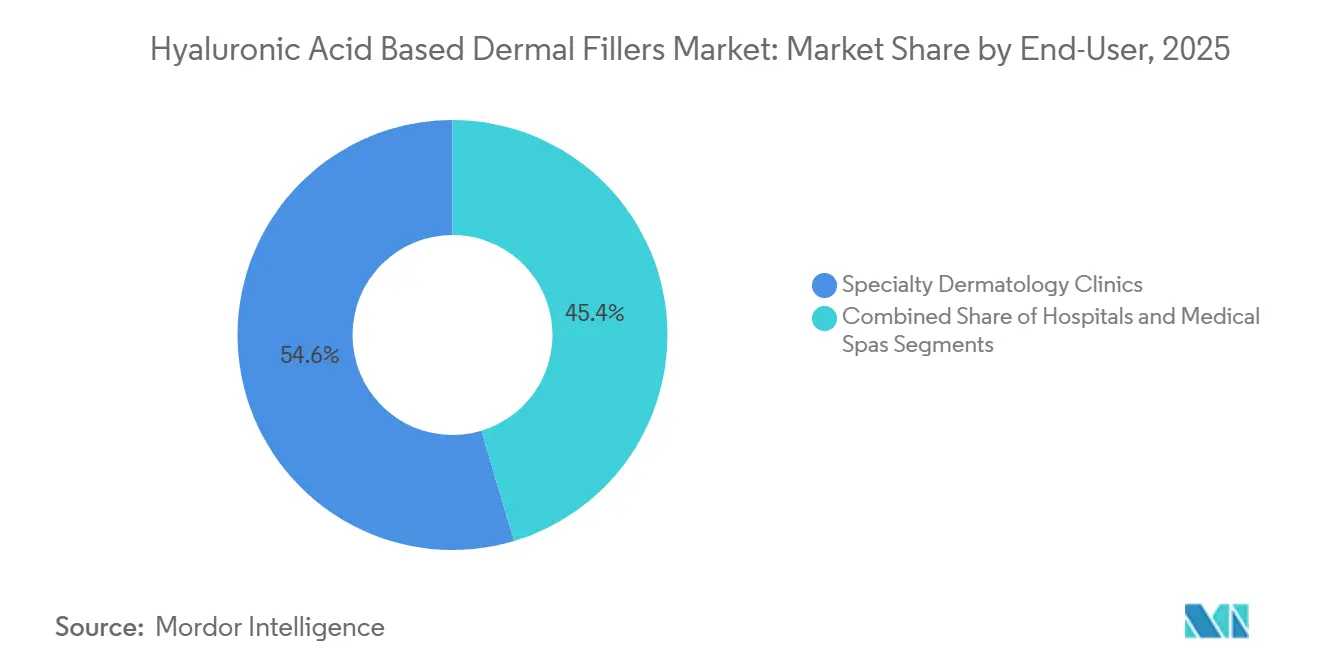
- By end-user, specialty dermatology clinics dominated with 54.63% revenue in 2025, whereas medical spas are poised for an 11.87% CAGR to 2031.
- By ingredient source, animal-derived fillers retained 45.13% share in 2025; fully-synthetic variants are expected to grow at an 11.7% CAGR to 2031.
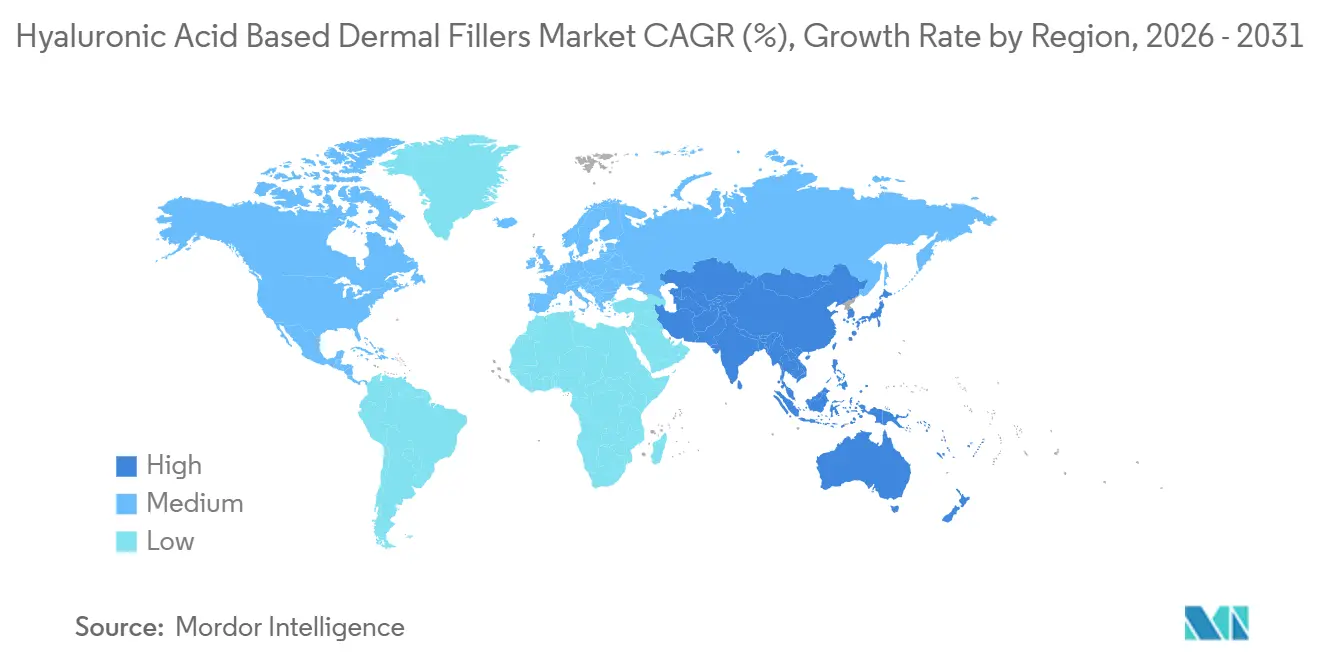
- By geography, North America contributed 42.13% of 2025 revenue, and Asia-Pacific is projected to post a 12.21% CAGR through 2031.
Note: Market size and forecast figures in this report are generated using Mordor Intelligence’s proprietary estimation framework, updated with the latest available data and insights as of January 2026.
Market Trends and Insights
Drivers Impact Analysis of Hyaluronic Acid Based Dermal Fillers Market*
| Driver | (~) % Impact on CAGR Forecast | Geographic Relevance | Impact Timeline |
|---|---|---|---|
| Rising demand for minimally-invasive aesthetic procedures among aging populations | +2.5% | Global, concentrated in North America, Europe, urban Asia-Pacific | Medium term (2 – 4 years) |
| Rapid product innovation in cross-linking chemistry extending filler longevity | +2.0% | North America and Europe, spillover to Asia-Pacific | Long term (≥ 4 years) |
| Expansion of male & millennial “pre-juvenation” consumer segments | +1.8% | North America, Europe, Asia-Pacific | Short term (≤ 2 years) |
| Emergence of micro-droplet skin-booster HA treatments | +1.5% | Global, early uptake in Europe and Asia-Pacific | Medium term (2 – 4 years) |
| Tariff-driven localization of bacterial-fermentation capacity | +1.2% | Asia-Pacific core, secondary in North America & Europe | Long term (≥ 4 years) |
| Source: Mordor Intelligence | |||
Rising Demand for Minimally-Invasive Aesthetic Procedures Among Aging Populations
Demographic aging is expanding the candidate pool for fillers, and the 40-54 cohort accounted for 50% of U.S. procedures in 2024. Procedure counts climbed to 5.33 million in 2024 even as average fees slid to USD 715, confirming that convenience outweighs cost concerns for many patients. Regulatory allowances for medical-spa injections in North America and Europe are widening access, while maintenance-oriented “tweakments” support quarterly visit schedules and repeat revenue. The result is a steady cadence of injections that benefits both product suppliers and clinics.
Rapid Product Innovation in Cross-Linking Chemistry Extending Filler Longevity
Manufacturers have shifted from BDDE to PEGDE and auto-crosslinked polymer platforms that improve durability and reduce soluble fractions, with reaction thresholds above 130 mg/mL yielding better clinical performance gels. Thermoresponsive hydrogels that pass through 34-gauge needles at forces under 72 N lessen injection pain. Animal-free production strains from Novozymes and engineered Corynebacterium have produced titers of 45 g/L, lowering fermentation cost and encouraging local manufacturing.
Expansion of Male & Millennial “Pre-Juvenation” Consumer Segments
Seventy-five percent of plastic surgeons noted more sub-30 clientele in 2024, with many seeking subtle enhancement over correction. Online visibility of aesthetic results sets conservative norms - ideal lip ratios, for instance, favor upper-to-lower height of 20 - 25%. Manufacturers have refined packaging, as seen in Merz’s upgraded BELOTERO syringe earning 93% user approval.
Emergence of Micro-Droplet Skin-Booster HA Treatments Opening New Maintenance-Therapy Streams
Approvals of SKINVIVE and RHA Redensity highlight a class aimed at hydration and skin quality rather than volume. Protocols call for multiple sessions and periodic upkeep, creating dependable revenue for providers and broadening the Hyaluronic Acid Based Dermal Fillers market beyond wrinkle reduction alone. Strategic launches such as Galderma’s Restylane VOLYME in China indicate geographic tailoring of new offerings.
Restraints Impact Analysis of Hyaluronic Acid Based Dermal Fillers Market*
| Restraint | (~) % Impact on CAGR Forecast | Geographic Relevance | Impact Timeline |
|---|---|---|---|
| High out-of-pocket cost versus short durability | -1.5% | Global, most acute in Asia-Pacific & Latin America | Short term (≤ 2 years) |
| Heightened regulatory scrutiny & adverse-event reporting | -1.0% | North America & Europe, rising in Asia-Pacific | Medium term (2 – 4 years) |
| Supply-chain impurity controls raising COGS | -0.8% | Global, heavier in Asia-Pacific & Europe | Long term (≥ 4 years) |
| Source: Mordor Intelligence | |||
High Out-of-Pocket Cost Versus Short Durability
Fillers last 6–18 months, and repeat fees accumulate quickly. Although U.S. prices slipped to USD 715, cost remains a deterrent, especially in regions where insurance coverage is absent. China’s aggressive competition has pushed retail prices to as low as CNY 200, hurting margins. Multinationals exit low-margin segments, as evidenced by LG Chem’s sale of YVOIRE.
Heightened Regulatory Scrutiny & Adverse-Event Reporting
Rare vascular complications prompt detailed labeling, with tenderness documented in up to 76% of FDA trials[1]. The European MDR now classifies fillers as Class III devices, elongating approval cycles and raising evidence thresholds. Post-market surveillance adds recurrent costs that smaller firms struggle to absorb, nudging the Hyaluronic Acid Based Dermal Fillers market toward better-capitalized players.
*Our forecasts treat driver/restraint impacts as directional, not additive. The impact forecasts reflect baseline growth, mix effects, and variable interactions.
Hyaluronic Acid Based Dermal Fillers Market Segment Analysis
By Product Phase:
Duplex Formulations Anchor Deep-Tissue ProceduresDuplex gels accounted for 58.56% of 2025 revenue, giving the Hyaluronic Acid Based Dermal Fillers market size its structural backbone in cheek, chin, and jawline jobs. Their biphasic composition confers an elastic modulus above 200 Pa, enabling them to hold shape under compression. Single-phase gels, however, will post the swiftest 11.25% CAGR due to their smoother rheology, which suits superficial corrections and skin boosters.
Thermoresponsive single-phase variants, injectable via ultra-fine needles, further lower pain thresholds and shorten chair time. Regulatory traction is building; Juvederm Voluma XC’s 2024 temple label expansion validated duplex safety in vascular-rich zones[2].
By Application:
Lip Augmentation Sets the Growth PaceWrinkle correction still ruled with 35.53% revenue in 2025, but lip augmentation will outstrip it at a 12.85% CAGR as social media aesthetics normalize fuller yet balanced lips. Teoxane RHA 3 gained an expanded FDA indication in 2023, opening regulated pathways for lip-specific lines.
Volume restoration for mid-face and chin, along with scar remediation, is expanding steadily, propelled by broader reconstructive uses. Research underpins subtlety: lip ratios above 30% upper-to-lower height were deemed unaesthetic by 88% of respondents, guiding injector training and shaping consumer expectations inside the Hyaluronic Acid-Based Dermal Fillers market.
By End-User:
Medical Spas Capture Volume, Clinics Retain Complex CasesSpecialty dermatology clinics held 54.63% of 2025 sales, but medical spas will enjoy an 11.87% CAGR as state rules permit nurse-led injections under physician oversight. Hyaluronic Acid-Based Dermal Fillers market share consolidation is evident as group purchasing agreements enable spas to negotiate bulk discounts.
Clinics counter by emphasizing board-certified expertise for high-risk zones, while hospitals remain niche, largely serving reconstructive needs. Revance surpassed 7,000 active aesthetic accounts by late-2023, many located in med-spa settings, illustrating the channel’s purchasing clout.

By Ingredient Source:
Fully-Synthetic Options Gain Favor Amid Purity MandatesAnimal-derived fillers still occupied 45.13% of revenue in 2025, yet fully-synthetic formats will climb at 11.7% CAGR as regulators tighten contaminant limits. Engineered Corynebacterium hit 45 g/L titers at high molecular weight, dropping cost below legacy rooster-comb extraction.
Investments like HTL’s EUR 12 million sterile line and Lifecore’s USD 150 million capacity boost show supply chains moving closer to Western demand centers, a shift likely to stabilize the Hyaluronic Acid-Based Dermal Fillers market against tariff shocks.
Geography Analysis
North America Hyaluronic Acid Based Dermal Fillers Market
North America delivered 42.13% of 2025 sales, strengthened by 5.33 million U.S. procedures in 2024 despite fee declines, reflecting volume-driven growth. Medical-spa permissiveness broadens access, while FDA approvals of EVOLYSSE FORM and SMOOTH add competitive depth. Canada’s adoption of Restylane SHAYPE for body contouring and Mexico’s growing tourism trade signal spillover potential.
APAC Hyaluronic Acid Based Dermal Fillers Market
Asia-Pacific is set for a 12.21% CAGR to 2031, propelled by China’s streamlined NMPA approvals, South Korea’s price-competitive clinics, and Japan’s aging yet aesthetics-aware demographic. Beijing IMEIK’s USD 190 million purchase of RegenBiotech highlights strategic consolidation. Bloomage’s export sales exceeding domestic revenue in 2024 prove the region’s capacity to serve global demand.
Europe, Middle East and LATAM Hyaluronic Acid Based Dermal Fillers Market
Europe retains a sizeable slice, but MDR-driven evidence demands lengthen launch timelines, advantaging entrenched brands. Galderma’s Restylane VOLYME launch across major EU markets in 2024 shows continued appetite for high-performance gels. The Middle East, buoyed by GCC wealth and medical tourism, and Latin America, led by Brazil’s aesthetic culture, round out growth nodes, though regulatory heterogeneity complicates rollouts.
Regulatory Landscape
Hyaluronic acid (HA) dermal fillers are regulated as high-risk medical devices in major markets, influencing clinical evidence requirements, labeling, and post-market monitoring. In the United States, the US Food and Drug Administration (FDA) oversees HA fillers as medical devices and they typically require Premarket Approval (PMA), which keeps the focus on controlled clinical data and adverse-event reporting for new products and new indications.
In Europe, Regulation (EU) 2017/745 (EU MDR) tightened pathways for aesthetic injectables. This includes products captured under Annex XVI where conformity assessment applies even without a medical purpose. Compliance increasingly depends on standardized biological safety assessment (for example, ISO 10993-1:2025), along with stronger traceability and surveillance. On March 9, 2026, the European Commission reported that an EU market surveillance campaign tested 17 HA-based dermal filler samples across 9 countries, with 4 (23%) found non-compliant due to labeling/marking/instructions gaps. The MDR shift also increases operational requirements through systems such as EUDAMED, expanding ongoing documentation and vigilance obligations for manufacturers and distributors.
Competitive Landscape
AbbVie’s Allergan Aesthetics, Galderma, Merz, and Teoxane control a significant percentage of revenue, while Chinese firms—IMEIK, Bloomage, Haohai—erode price points with high-volume capacity. LG Chem’s 2025 divestiture of YVOIRE underscores margin pressure in commoditized tiers. Revance’s extended distribution pact with Teoxane locks in minimum purchases through 2029, revealing the Hyaluronic Acid-Based Dermal Fillers industry’s reliance on channel synergies[3].
Technology differentiators include thermoresponsive gels and hybrid HA-biostimulator blends aimed at longer persistence. Lifecore’s 38% capacity add and HTL’s French sterile line embody a shift toward localized, GMP-compliant supply chains that can navigate stricter impurity rules. Market entry barriers rise with each regulatory tightening, nudging the field toward mid-concentration and favoring players that can finance post-market studies and global compliance.
Hyaluronic Acid Based Dermal Fillers Industry Leaders
-
Galderma S.A.
-
LG Chem Ltd.
-
AbbVie Inc. (Allergan Aesthetics)
-
Merz Pharma GmbH & Co. KGaA
-
Teoxane S.A.
- *Disclaimer: Major Players sorted in no particular order
Hyaluronic Acid Based Dermal Fillers Market Companies Covered in this Report
- Abbvie
- Anika Therapeutics
- Beijing IMEIK Technology Development
- BioPlus
- Bloomage Biotechnology Corp.
- Croma-Pharma GmbH
- Galderma
- Haohai Biological Technology Co.
- Humedix (Cleviel)
- JW Pharmaceutical (Q.O.Fill)
- LG Chem
- Medytox
- Merz Pharma
- Prollenium Medical Technologies Inc.
- Revance Therapeutics
- SciVision Biotech
- Sinclair Pharma Ltd.
- Teoxane Laboratories
Read Analysis of Hyaluronic Acid Based Dermal Fillers Companies
Market Opportunities and Future Outlook
Opportunity is expanding through differentiated indications and treatment paradigms that move HA beyond classic wrinkle correction into skin quality and specialized anatomic use cases. US FDA actions in 2026 reflect this shift: SKINVIVE by JUVEDERM gained approval for reduction of horizontal neck lines (a new labeled use for an HA injectable), while RHA Dynamic Volume received FDA approval for cheek augmentation and correction of midface contour deficiencies before entering commercial availability, reinforcing midface restoration as a high-value clinical segment.
A second whitespace is emerging in geography- and channel-specific portfolio build-outs, where regulatory progress supports entry of premium lines into new markets, and where training plus ergonomic improvements reduce injector friction. In Europe, Evolus commercially launched its Estyme injectable HA gel collection after EU MDR certification, while the European Commission has also indicated stricter enforcement through cross-country product testing campaigns, raising the premium on compliant labeling and robust IFUs for cross-border distribution. In Asia-Pacific, Galderma expanded the Restylane portfolio in Japan with launches of OBT technology HA injectables (Restylane Defyne and Refyne), illustrating how localized approvals and tailored offerings can support incremental clinic adoption and help defend price tiers against lower-cost entrants.
Recent Industry Developments in Hyaluronic Acid Based Dermal Fillers Market
- June 2026: AbbVie (Allergan Aesthetics) announced US FDA approval of SKINVIVE by JUVEDERM for reduction of horizontal neck lines. The labeled expansion into neck aesthetics formalizes a new HA use case and gives clinics a regulated option to address "tech-neck" demand within established injection workflows.
- November 2025: Galderma received US FDA clearance for Restylane Lyft with Lidocaine for chin augmentation in US adults. The approval strengthens portfolio breadth in structured lower-face shaping and supports premium positioning through specific, on-label indications.
- October 2024: AbbVie (Allergan Aesthetics) made JUVEDERM VOLUMA XC available nationwide in the United States for moderate to severe temple hollowing after its earlier FDA approval. Wider availability increases competitive intensity in high-risk facial zones where training, technique, and product performance differentiation shape brand choice.
Hyaluronic Acid Based Dermal Fillers Market Report Scope and Research Methodology
Market Definition and Coverage
For this study, the market covers revenues generated from hyaluronic acid based dermal fillers that are injected for facial aesthetic correction and contouring, across clinical and non-clinical settings, and reported in USD at the manufacturer and distributor selling level.
Scope exclusions: We exclude botulinum toxin, collagen or calcium hydroxylapatite fillers, fat grafting procedures, and post-procedure skincare products that are not hyaluronic acid dermal fillers.
Segments Covered in This Report
- By Product Phase
- Single-Phase
- Duplex
- By Application
- Wrinkle Correction
- Scar Treatment
- Volume Restoration
- Lip Augmentation
- Others
- By End-User
- Hospitals
- Specialty Dermatology Clinics
- Medical Spas
- By Ingredient Source
- Animal-Derived
- Non-Animal Fermentation
- Fully-Synthetic
- By Geography
- North America
- United States
- Canada
- Mexico
- Europe
- Germany
- United Kingdom
- France
- Italy
- Spain
- Rest of Europe
- Asia-Pacific
- China
- Japan
- India
- South Korea
- Australia
- Rest of Asia-Pacific
- Middle East & Africa
- GCC
- South Africa
- Rest of Middle East & Africa
- South America
- Brazil
- Argentina
- Rest of South America
- North America
Data Sources, Market Sizing, and Validation
Desk Research
Desk work starts by building a clean view of procedure demand and clinical adoption signals, and then checking them against supply side capacity and trade movements. We refer to public sources such as the American Society of Plastic Surgeons (ASPS) procedure statistics, the International Society of Aesthetic Plastic Surgery (ISAPS) annual survey, and select government health portals that publish outpatient and dermatology utilization indicators.
For market boundaries and safety context, we also review regulator communications and databases such as the US FDA device and safety updates, along with peer reviewed dermatology and aesthetic medicine journals that discuss HA filler usage, complications, and indications. Company annual reports, investor presentations, earnings call transcripts, and reputable press help us map product portfolios, distribution reach, and pricing direction. We then use a paid subscription for company financials and a paid patent database selectively to cross-check timelines and innovation activity. These examples are illustrative only, and many other public sources were reviewed for data collection, clarification, and validation.
Primary Interviews and Surveys
Primary checks are done with a mix of filler manufacturers, distributors, clinic procurement teams, and practicing dermatology and aesthetics professionals. This ensures the clinical volume logic and selling price assumptions stay realistic. We also test regional differences across APAC, EMEA, and the Americas, since procedure mix and patient willingness to pay can shift the average syringe value and the use rate per treatment plan.
Distribution of primary research fieldwork respondents
| Company type | Respondent position | Region |
|---|---|---|
| Top tier: 26% | CXOs: 21% | APAC: 45% |
| Mid tier: 53% | Functional/Unit leaders: 33% | EMEA: 31% |
| Smaller Players: 21% | Managers: 46% | Americas: 24% |
Market-Sizing & Forecasting
Sizing starts from a top-down demand pool built using aesthetic procedure volumes and the share of procedures that typically use HA fillers. The demand pool is then translated into syringe level consumption and value. To keep the model grounded, we corroborate totals with selective bottom-up checks like a sampled ASP multiplied by estimated syringe volume by major application areas, plus channel checks on distributor markups and clinic reorder patterns.
Key inputs that move the model include injectable aesthetic procedure growth, HA filler utilization per procedure (syringes per session), average selling price movement by geography, the shift toward specialty dermatology clinics and medical spas, and the balance between single-phase and duplex products that can change pricing. Where country level inputs are thin, we bridge gaps using regional procedure intensity proxies and then re-test the implied price and volume with interview feedback.
For forecasting, we mainly use scenario analysis supported by a light multivariate regression view, where procedure growth, disposable income trends, and regulatory or safety related shocks are the drivers that get stressed and normalized. Assumptions are kept visible so a client can trace each year back to procedure volume, unit use, and pricing logic.
Data Validation & Update Cycle
Outputs are checked through triangulation across procedure statistics, interviewed volume ranges, and the implied price per syringe by country. Large variances are flagged for rework. When a region shows a sharp jump, we look for explainers such as reimbursement changes, new product launches, safety alerts, or clinic channel expansion, and we re-contact sources if the jump cannot be explained by a clear signal.
Before sign-off, the model and narrative go through more than one analyst review, so arithmetic, currency conversion timing, and year-on-year logic are consistent. Reports are refreshed annually, and interim updates are made when material events change demand, pricing, or availability. A final pre-delivery pass is completed so clients receive the latest updated view.
Mordor Intelligence's Hyaluronic Acid Based Dermal Fillers Market Size Versus Other Published Estimates
Published market values for HA based dermal fillers can look different because each publisher draws its own lines around what counts as a filler sale and which year is treated as the starting point. Other common drivers are how pricing is averaged across geographies, how procedure volumes are converted into syringes, and how often assumptions are refreshed.
Procedure-volume benchmarks from aesthetic surgery societies and clinic reorder feedback are the checks that keep the Mordor Intelligence estimate tied to the HA filler syringe demand pool, rather than being widened by adjacent injectables or loosely defined facial aesthetics spend. Differences also come from whether figures are reported at manufacturer selling prices versus end-user prices, whether scar treatment and volume restoration are treated as core HA filler demand, and how currency conversion timing is handled for fast-growing APAC markets.
Benchmark comparison
| Source | Market Size | Gaps in Research Methodology |
|---|---|---|
| Mordor Intelligence | USD 5.22 B (2025) | |
| Global Consultancy A | USD 5.10 B (2024) | Uses a different base year and can blend HA filler demand with broader dermal filler usage without clearly standardizing syringe conversion per procedure, which shifts the implied volume pool. |
| Industry Publisher B | USD 4.83 B (2025) | Reported value appears more conservative due to pricing assumptions and channel level treatment, and the forecast structure suggests a different approach to regional ASP progression and inflation pass-through. |
Across the three figures, the spread is mostly explained by year selection, the way syringe demand is reconstructed from procedure activity, and how selling prices are normalized across regions. By keeping the market boundary tight and then validating the implied syringes and ASPs with real-world buying and usage signals, the final number stays traceable and repeatable for planning.
Key Questions Answered in the Report
How large is the Hyaluronic Acid-Based Dermal Fillers market today?
The market reached USD 5.75 billion in 2026 and is forecast to hit USD 9.33 billion by 2031.
What CAGR is expected for hyaluronic acid fillers between 2026 and 2031?
The compound annual growth rate is projected at 10.16%.
Which application segment will expand fastest through 2031?
Lip augmentation is forecast to grow at a 12.85% CAGR as social-media aesthetics drive demand.
Why are single-phase gels gaining momentum?
Their smooth rheology suits superficial wrinkle correction and skin-booster protocols, supporting an 11.25% CAGR outlook.
Which region offers the highest growth potential?
Asia-Pacific is projected to post a 12.21% CAGR, led by China, South Korea, and Japan.
What is driving regulatory scrutiny of fillers?
Reports of rare vascular occlusions and delayed inflammatory reactions have prompted agencies to mandate stricter safety labeling and post-market surveillance.