
HR Management Software (Personnel And Organization) Market Size and Share
Market Overview
| Study Period | 2020 - 2031 |
|---|---|
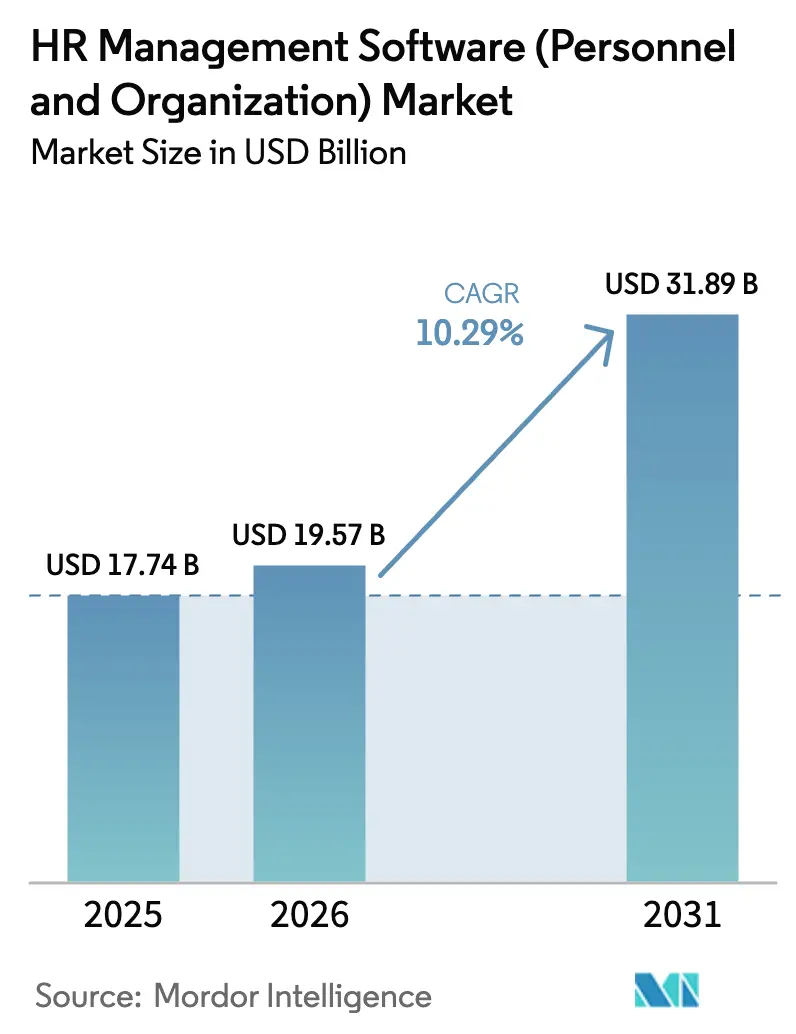
| Market Size (2026) | USD 19.57 Billion |
| Market Size (2031) | USD 31.89 Billion |
| Growth Rate (2026 - 2031) | 10.29 % |
| Fastest Growing Market | North America |
| Largest Market | North America |
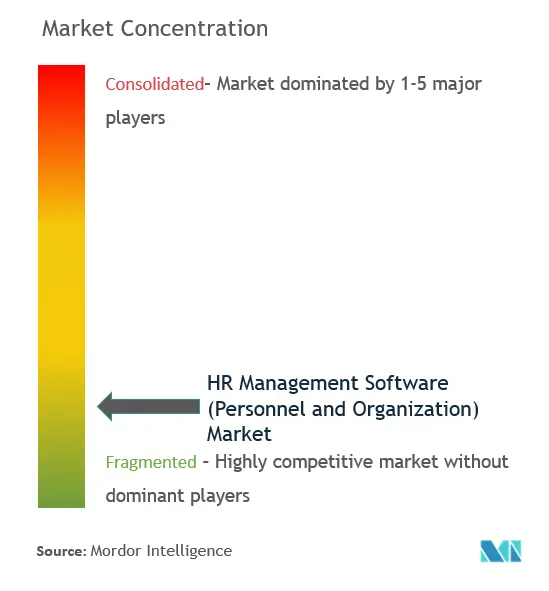
| Market Concentration | Low |
Major Players *Disclaimer: Major Players sorted in no particular order Image © Mordor Intelligence. Reuse requires attribution under CC BY 4.0. | |
HR Management Software (Personnel And Organization) Market Analysis by Mordor Intelligence
The HR management software market size is expected to grow from USD 17.74 billion in 2025 to USD 19.57 billion in 2026 and is forecast to reach USD 31.89 billion by 2031 at 10.29% CAGR over 2026-2031. Rising enterprise demand for cloud-native platforms, AI-powered automation, and modular architectures is sustaining double-digit growth even as economic headwinds persist. Vendors are prioritizing composable design principles that let customers swap in best-of-breed micro-services, easing upgrades and integration. Adoption is spreading quickly across emerging economies as government-backed SME digitization schemes lower barriers to entry. Competitive dynamics are shifting toward AI differentiation, prompting aggressive M&A as incumbents buy specialist players to secure talent and technology.
Key Report Takeaways
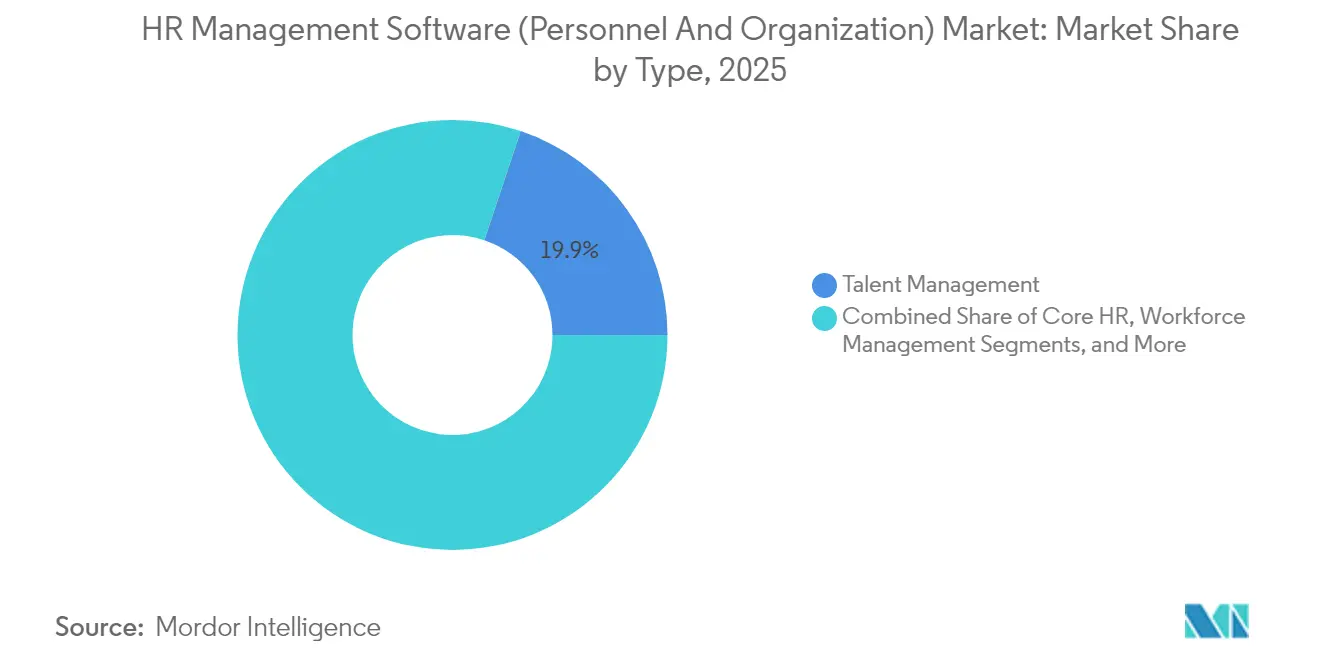
- By type, Talent Management accounted for 19.86% revenue share of the HR management software market in 2025, while Managed Cloud Services recorded the highest 11.31% CAGR through 2031.
- By deployment, cloud-based solutions captured 68.05% share in 2025, and hybrid models are expanding the fastest at a 12.14% CAGR.
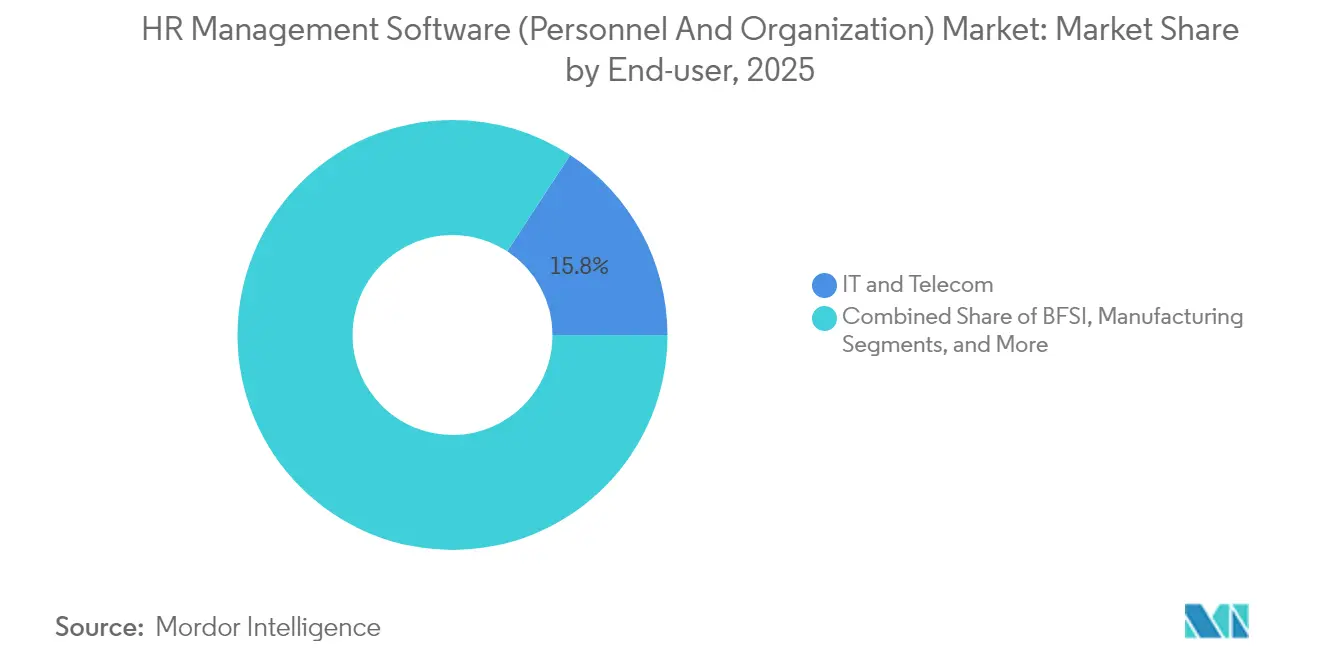
- By end-user, IT and Telecom led with 15.78% share in 2025; Healthcare is poised to grow at 11.41% CAGR through 2031.
- By organization size, large enterprises held a 52.63% share in 2025, yet SMEs are set to expand at a 11.53% CAGR.
- By geography, North America contributed 37.16% revenue in 2025, whereas the UAE is forecast to advance at a 12.54% CAGR.
Note: Market size and forecast figures in this report are generated using Mordor Intelligence’s proprietary estimation framework, updated with the latest available data and insights as of 2026.
Market Trends and Insights
Drivers Impact Analysis of HR Management Software (Personnel And Organization) Market*
| Driver | (~) % Impact on CAGR Forecast | Geographic Relevance | Impact Timeline |
|---|---|---|---|
| Advancement in cloud-native architecture and composable HR suites | 2.1% | Global, with early gains in North America and EU | Medium term (2-4 years) |
| Generative-AI copilots accelerating HR automation | 1.8% | North America and EU core, spill-over to APAC | Short term (≤ 2 years) |
| SMB digitisation wave in emerging economies | 1.2% | APAC core, spill-over to MEA and South America | Long term (≥ 4 years) |
| Post-pandemic hybrid work permanentisation | 0.9% | Global, with concentration in developed markets | Medium term (2-4 years) |
| Rise of skills-based hiring and internal talent marketplaces | 1.1% | North America and EU, expanding to APAC | Medium term (2-4 years) |
| ESG-linked human-capital disclosure mandates | 0.8% | EU core, expanding to North America and APAC | Long term (≥ 4 years) |
| Source: Mordor Intelligence | |||
Advancement in Cloud-Native Architecture and Composable HR Suites
Composable HR design lets firms assemble micro-services without full-stack replacements, cutting integration debt and time-to-value. Enterprises such as Coca-Cola European Partners have layered API-first talent modules on legacy payroll cores to modernize gradually. The MACH Alliance framework (micro-services, API-first, cloud-native SaaS, headless) underpins most new suite roadmaps, allowing faster updates and lower vendor-lock-in. Vendors respond by exposing granular REST APIs and low-code tooling, which shorten implementation cycles for distributed teams. The shift strengthens upgrade revenue and encourages multi-module up-sell as customers plug in analytics, learning, or scheduling add-ons when budgets allow.
Generative-AI Copilots Accelerating HR Automation
Vendors embed large language and large action models to auto-draft job descriptions, screening questions, and even promotion cases at scale. UKG’s Bryte AI Agents orchestrate multi-step workflows—such as gathering peer feedback and authorizing compensation changes—without manual intervention. Workday reports 75% of customers testing its Talent Optimizer bots to surface internal mobility matches[1]. Early adopters credit AI with cutting time-to-hire by 30% while improving candidate experience metrics. As regulations tighten, explainable-AI dashboards are bundled to evidence fairness and reduce litigation risk.
SMB Digitization Wave in Emerging Economies
Government stimulus and mobile-first platforms propel HR software uptake among small firms across Indonesia, India, and the Gulf. Employment Hero’s expansion into Canada via its Humi acquisition illustrates vendor confidence in an underserved SME base seeking payroll, compliance, and benefits modules on a single subscription[2]. Cloud deployment eliminates on-premise hardware spending, while localized content (Arabic portals, GST-ready payroll, bilingual support) unlocks additional cohorts. Analysts expect emerging-market SMEs to represent more than half of all new HR SaaS logos by 2030, resetting pricing and implementation norms globally.
Post-Pandemic Hybrid Work Permanentization
Remote and onsite schedules now coexist permanently, raising demand for real-time scheduling, well-being analytics, and mobile self-service. AI-driven shift bidding increases flexibility, an attribute cited by 63% of Gen Z workers as critical to retention. Retailers and logistics providers deploy algorithmic labor forecasting to trim overtime while honoring employee preferences. Continuous performance feedback tools replace annual reviews, leveraging chat interfaces that capture micro-goals and coaching notes. Vendors incorporating video onboarding and virtual coach bots report higher module attach rates among distributed teams.
Restraints Impact Analysis of HR Management Software (Personnel And Organization) Market*
| Restraint | (~) % Impact on CAGR Forecast | Geographic Relevance | Impact Timeline |
|---|---|---|---|
| Heightened data-sovereignty regulations (e.g., EU-CSRD) | -1.4% | Europe, North America, APAC | Medium term (2-4 years) |
| AI-bias litigation and algorithmic audit costs | -0.7% | North America, Europe, APAC | Short term (≤ 2 years) |
| Escalating vendor lock-in costs | -0.5% | Global | Long term (≥ 4 years) |
| ERP-HCM integration debt in legacy environments | -0.6% | North America, Europe | Medium term (2-4 years) |
| Source: Mordor Intelligence | |||
Heightened Data-Sovereignty Regulations (EU-CSRD)
The Corporate Sustainability Reporting Directive obligates enterprises to disclose up to 17 workforce metrics, forcing HR systems to build granular tracking and assurance layers[3]. Multinationals must harmonize data models across subsidiaries, increasing configuration complexity and TCO. Vendors respond with regional hosting, secure data lakes, and out-of-the-box CSRD templates, yet implementation timelines stretch as legal teams vet cross-border data flows.
AI-Bias Litigation and Algorithmic Audit Costs
The EU AI Act and parallel U.S. state statutes require bias audits, candidate notification, and explainability for AI-driven recruitment engines. Compliance adds legal reviews, third-party testing, and continuous monitoring expenses. Smaller vendors risk market exit or white-label reliance on certified engines, accelerating consolidation around providers with mature governance stacks.
*Our forecasts treat driver/restraint impacts as directional, not additive. The impact forecasts reflect baseline growth, mix effects, and variable interactions.
HR Management Software (Personnel And Organization) Market Segment Analysis
By Type:
Talent Management Drives InnovationTalent Management generated the largest 19.86% slice of the HR management software market in 2025 as enterprises prioritized skills-based hiring and internal mobility. The HR management software market size for Talent Management is projected to expand further as AI matching elevates time-to-productivity metrics. Implementation of talent marketplaces by firms such as Salesforce achieved 90% profile completion rates, proving engagement. Managed Cloud Services posted the quickest 11.31% CAGR, reflecting demand for integrated hosting, upgrades, and compliance wrapped into subscription pricing. Core HR and Payroll remain foundational, anchoring suite expansion into analytics and well-being.
Growing reliance on advanced recruiting algorithms bolsters Applicant Tracking and Recruiting and Sourcing modules. Learning and Development gains momentum as reskilling budgets rise to close digital skill gaps. Vendors bundle blended-learning paths with talent marketplace recommendations, driving cross-sell. Smaller categories such as employee wellness and people analytics enrich the ecosystem, capitalizing on open APIs within composable stacks.

By Deployment:
Hybrid Models Gain MomentumCloud options accounted for 68.05% revenue in 2025, thanks to scalability and fast updates. However, hybrid adoption is surging at a 12.14% CAGR as organizations safeguard highly sensitive data behind private firewalls while exploiting public-cloud innovation for less regulated workflows. The HR management software market share for hybrid still trails cloud, yet momentum signals a maturing buyer appetite for configurable deployment.
On-premise persists in tightly regulated verticals, but vendors now supply containerized editions that align with composable principles. Enhanced zero-trust security, data-residency controls, and sovereign-cloud partnerships attract European public-sector agencies. Integration adapters streamline data movement between legacy ERP instances and SaaS micro-services, mitigating disruption risks for phased migrations.
By End-User:
Healthcare Accelerates AdoptionIT and Telecom retained a 15.78% share in 2025, reflecting tech firms’ early SaaS uptake and large employee bases. Healthcare is forecast to deliver an 11.41% CAGR, the fastest among verticals, as hospitals modernize credentialing, shift scheduling, and compliance reporting amid persistent staff shortages. The HR management software market size for Healthcare is expected to expand rapidly as patient-safety mandates elevate workforce transparency.
Retail and E-commerce amplifies AI scheduling to handle seasonal peaks; BFSI bolsters risk-aware hiring modules; manufacturing leverages OT-IT convergence to embed shop-floor labor analytics. Public-sector digital-government agendas spur adoption, while transportation and education seek specialized credential tracking.
By Organization Size:
SME Growth MomentumLarge enterprises controlled 52.63% revenue in 2025, driven by global rollouts of multi-module suites. Yet SMEs will grow at 11.53% CAGR as cloud subscriptions and low-code configurability reduce setup costs. Vendors introduce starter packs that cover payroll, leave, and compliance, then upsell talent or analytics as firms scale. The HR management software market size for SMEs is set to narrow the historical gap with large-enterprise spend.
Implementation partners create pre-built templates for common local regulations, cutting go-live times from months to weeks. Tier-two cities in APAC and MEA add first-time buyers, incentivized by tax credits and fintech integrations.
Geography Analysis
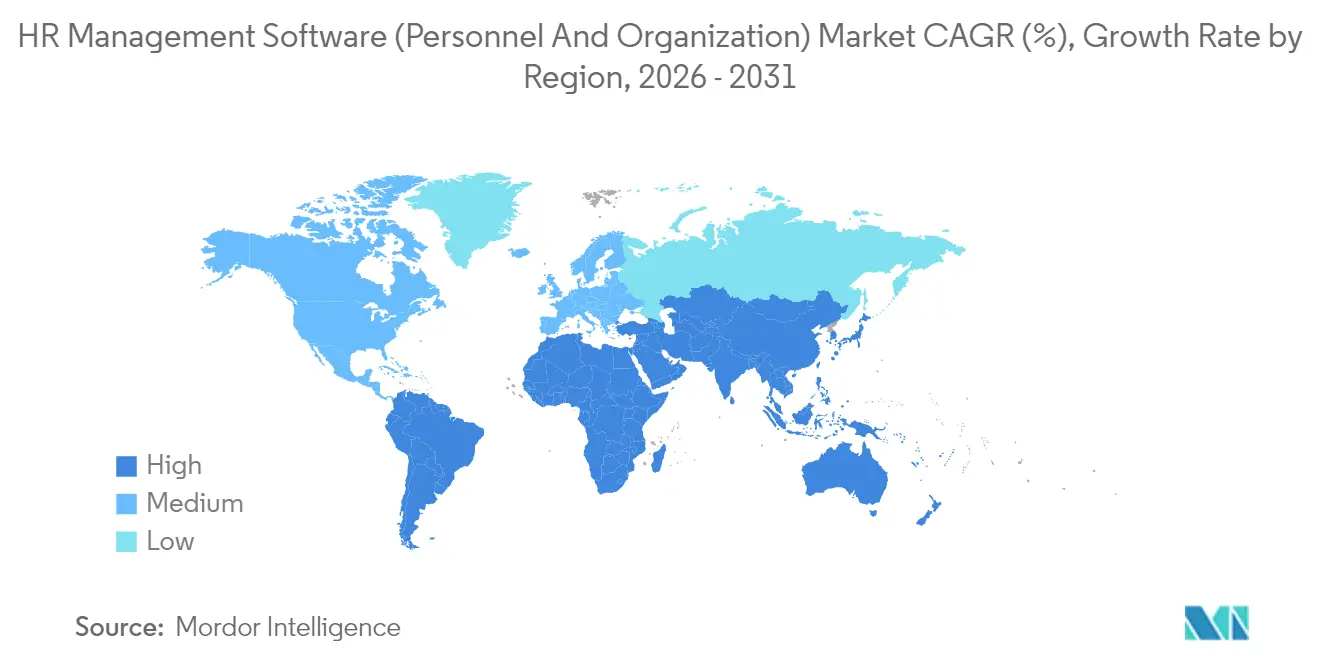
North America HR Management Software (Personnel and Organization) Market
North America generated 37.16% of HR management software market revenue in 2025, buoyed by early SaaS maturity, sizable IT budgets, and regulatory catalysts such as SEC human-capital reporting. Vendors headquartered in the region, notably Workday and Oracle, reinvest heavily in AI R&D, sustaining product leadership and reinforcing regional dominance. A robust ecosystem of implementation partners accelerates enterprise adoption cycles.
APAC HR Management Software (Personnel and Organization) Market
Asia-Pacific is the second-largest contributor and maintains the highest absolute gains outside North America. SME digitization across India, Indonesia, and Malaysia fuels new-logo growth, while Japan and Australia upgrade legacy on-premise suites to cloud. National data-sovereignty rules drive interest in hybrid deployments, prompting hyperscalers to open local availability zones that comply with residency laws. The HR management software market share for Asia-Pacific is rising as domestic vendors localize UX and language support.
EMEA and South America HR Management Software (Personnel and Organization) Market
The Middle East shows standout momentum, with the UAE forecast at a 12.54% CAGR through 2031. Government initiatives under Vision 2030 and rising private-sector diversification projects boost demand for payroll localization, bilingual self-service, and leave management aligned with local labor law. Europe’s growth moderates yet remains sizable; stringent GDPR and CSRD regulations spur demand for compliant analytics and audit trails. South America and Africa deliver early-stage expansion, propelled by cloud infra investments and fintech-HR synergies.
Regulatory Landscape
Regulation is tightening around HR platforms that embed AI in employment decisions. The EU AI Act (Regulation (EU) 2024/1689) classifies several employment-use cases (including recruitment, selection, performance evaluation, and termination support) as high-risk, bringing obligations such as technical documentation, logging and record-keeping, transparency to affected persons, human oversight, and registration in an EU database. The high-risk regime becomes fully applicable on August 2, 2026. Earlier AI Act milestones also affect HR software supply chains, including general-purpose AI provider obligations from August 2, 2025 and prohibited-practice and AI-literacy provisions from February 2, 2025.
Human-capital disclosure and privacy regimes further shape data design, auditability, and hosting choices for global deployments. EU CSRD workforce disclosures push vendors to provide pre-built reporting templates and assurance-ready audit trails, while GDPR and data-residency requirements reinforce interest in regional hosting and hybrid deployments. For standardized human-capital reporting, ISO 30414 is increasingly used as a common framework to structure workforce metrics across systems of record and analytics layers.
Value Chain Analysis
The value chain spans product engineering and data foundations through implementation and ongoing managed operations. Upstream, vendors and their AI/model partners build core HRIS (system of record), payroll and benefits, talent management, recruiting/ATS, learning, workforce management, and people analytics, with growing emphasis on API-first modularity. Middleware and iPaaS providers, along with identity and security layers, sit between HR suites and enterprise systems to orchestrate integrations and enforce governance.
Downstream, system integrators, VARs, and specialist consultancies configure workflows, localize compliance, migrate data, and manage change for end users. Payroll and compliance specialists deliver statutory expertise that is frequently embedded through integrations with ERP/HCM backbones. Partnerships such as ADP with SAP illustrate how multi-country payroll delivery and compliance content are packaged into cloud offerings, with service partners supporting rollout across regions and subsidiaries. Customer value realization is increasingly tied to automation outcomes, including faster hiring, fewer payroll exceptions, and improved scheduling adherence, supported by analytics and reporting standards such as ISO 30414.
Competitive Landscape
Competitive intensity is moderate, with incumbent suite providers facing nimble challengers specializing in AI and vertical depth. SAP, Oracle, and Workday leverage extensive R&D budgets and global sales networks to sustain top-tier positions. SAP augmented its SuccessFactors recruiting stack via the planned SmartRecruiters acquisition, adding high-volume hiring capability.[4] Oracle focuses on embedded generative-AI features across Fusion HCM, while Workday’s revenue climbed to USD 2.21 billion in Q4 2025, a 15% year-over-year gain.
Disruptors including HiBob, Factorial, and Deel scale rapidly by targeting mid-market multi-national subsidiaries with consumer-grade UX and local compliance packs. HiBob’s triple-digit ARR growth attracted significant PE funding that will bankroll APAC entry.[5] Vertical specialists such as Symplr (healthcare) and Proliant (hospitality) build defensible positions through domain IP and integrations with sector-specific tools.
M&A remains a core strategy; Paychex’s USD 4.1 billion Paycor purchase broadens its reach into mid-market HCM, while Employment Hero’s acquisition of Humi accelerates North American expansion. Vendors with robust AI governance toolkits gain advantage amid tightening regulations, leading some smaller players to white-label certified engines instead of developing proprietary models.
HR Management Software (Personnel And Organization) Industry Leaders
-
SAP SE
-
UKG Inc.
-
Workday, Inc.
-
ADP, Inc.
-
Oracle Corporation
- *Disclaimer: Major Players sorted in no particular order
HR Management Software (Personnel And Organization) Market Companies Covered in this Report
- SAP SE
- Oracle Corporation
- Automatic Data Processing, Inc. (ADP)
- Workday, Inc.
- UKG Inc.
- Ceridian HCM Holding Inc.
- Accenture plc
- International Business Machines Corporation (IBM)
- PwC International Limited
- Mercer LLC
- Cegid SA
- Cezanne HR Ltd.
- BambooHR LLC
- Cornerstone OnDemand, Inc.
- Gusto, Inc.
- TriNet Zenefits
- Zoho Corporation Pvt. Ltd.
- PeopleStrong Technologies Pvt. Ltd.
- SumTotal Systems, LLC
- Sage Group Plc
Read Analysis of HR Management Software (Personnel And Organization) Companies
Market Opportunities and Future Outlook
A major opportunity centers on compliance-grade, agentic automation across recruiting, payroll, and workforce management as regulations and audit scrutiny rise. The EU AI Act timeline to August 2, 2026 creates whitespace for vendors that can operationalize high-risk controls (documentation, logging, transparency, and human oversight) inside HR workflows, rather than positioning them as external governance add-ons. This has shown up in product roadmaps that emphasize embedded agents and guided actions, including SAP SuccessFactors innovations around Joule-orchestrated experiences and workforce upskilling assistance.
Integration-led modernization is another active area as enterprises keep a system of record while layering in best-of-breed modules via API normalization and orchestration. Workday expanding its partnership ecosystem with Google Cloud to bring HR and finance agents into daily workflows reinforces the shift toward HR delivered through broader enterprise AI and workflow platforms. In payroll, multi-country and compliance-heavy deployments continue to favor ecosystem plays, with partnerships such as ADP and SAP focused on cloud-based global payroll experiences that reduce fragmentation across subsidiaries and regions.
Recent Industry Developments in HR Management Software (Personnel And Organization) Market
- July 2026: Rippling launches Data Cloud to consolidate company-wide data, link to worker identity, and enable AI-powered analytics. The launch expands cross-enterprise HR data capabilities and enables AI-driven insights across HRMS deployments. The action strengthens data governance and accelerates AI-enabled decision making in large organizations.
- June 2026: Phenom partners with ServiceNow to connect Phenom AI agents to ServiceNow AI Platform for automated hiring tasks. The partnership gives HR teams a unified automation layer bridging recruiting with IT service workflows. It broadens the scope of autonomous HR processes and enhances workflow automation across enterprise HR.
- May 2026: SAP SE announces autonomous HCM innovations at SAP Sapphire, including Joule-orchestrated agents and a Workforce Upskilling Assistant. The innovations advance AI-enabled HR and talent management within SAP SuccessFactors. They signal a shift toward agentic HR platforms and autonomous enterprise capabilities.
HR Management Software (Personnel And Organization) Market Report Scope and Research Methodology
Market Definition and Coverage
This market is defined as the revenue earned from software used to manage employee records and organization structures across the employee lifecycle, typically sold as subscriptions or licenses with related support services.
Scope exclusions: Spending that sits fully outside HR admin workflows, such as standalone ERP finance modules or general IT service outsourcing, is not counted.
Segments Covered in This Report
- By Type
- Core HR
- Talent Management
- Workforce Management
- Payroll and Compensation
- Learning and Development
- Applicant Tracking System
- Recruiting and Sourcing
- Others
- By Deployment
- Cloud-Based
- On-Premise
- Hybrid
- By End-User
- IT and Telecom
- BFSI
- Manufacturing
- Retail and E-commerce
- Public Sector
- Healthcare
- Transportation and Logistics
- Education
- Professional Services
- Others
- By Organization Size
- Large Enterprises
- Small and Medium Enterprises (SMEs)
- By Geography
- North America
- United States
- Canada
- Mexico
- Europe
- Germany
- United Kingdom
- France
- Russia
- Rest of Europe
- Asia-Pacific
- China
- Japan
- India
- South Korea
- Australia
- Rest of Asia-Pacific
- Middle East and Africa
- Middle East
- Saudi Arabia
- United Arab Emirates
- Rest of Middle East
- Africa
- South Africa
- Egypt
- Rest of Africa
- Middle East
- South America
- Brazil
- Argentina
- Rest of South America
- North America
Data Sources, Market Sizing, and Validation
Desk Research
Desk research starts by mapping what drives adoption and budget release in HR teams, then converting that into measurable signals that can be tracked each year. We lean on public sources that help explain the demand pool and compliance needs, such as U.S. Bureau of Labor Statistics employment data, Eurostat labor indicators, OECD labor market statistics, and World Bank enterprise and digital adoption datasets.
To understand how buyers prioritize HR systems, we also use sources such as U.S. SEC filings, annual reports, investor presentations, association publications, and trusted technology and business press. In addition, we use paid company financials and intelligence, and a separate paid source for news and financials, to keep product and pricing moves current without relying on a single announcement. The desk sources mentioned are illustrative and not exhaustive, and many other public documents were reviewed for data collection, validation, and clarification.
Primary Interviews and Surveys
Primary work confirms how HR teams buy and deploy these tools, and pressure tests pricing, renewal behavior, and migration timing from on-premise to cloud. We spoke with a spread of software providers, implementation partners, and HR leaders across major regions, then used follow-up checks to close gaps where desk inputs were thin.
Distribution of primary research fieldwork respondents
| Company type | Respondent position | Region |
|---|---|---|
| Top tier: 29% | CXOs: 12% | APAC: 42% |
| Mid tier: 54% | Functional/Unit leaders: 34% | EMEA: 32% |
| Smaller Players: 17% | Managers: 54% | Americas: 26% |
Market-Sizing & Forecasting
Sizing is built using a top-down and bottom-up approach that starts from the addressable workforce and employer base, then converts that into software spending using adoption and price inputs that can be evidenced. The top-down path is reconstructed through enterprise counts by size, payroll and HR administration intensity by industry, and penetration of digital HR systems by region, which are translated into annual spending ranges.
Those totals are corroborated with selective bottom-up approximations, including sampled subscription price points, typical module attach rates, and channel checks on implementation and support revenue share. When vendor revenue reporting is bundled across wider suites, gaps are handled by allocating only the personnel and organization portion using product mix cues from disclosures and interview feedback.
Forecasts are developed using scenario analysis supported by a multivariate regression view of the main drivers, so changes in employment levels, cloud migration pace, compliance complexity, and replacement cycles can be reflected in a repeatable way. A short set of assumptions is refreshed each cycle, such as average contract length, seat based pricing progression, and the share of buyers adding org management features, before results are finalized.
Data Validation & Update Cycle
Outputs are checked in several steps so unusual jumps are not accepted without explanation. We compare model totals against independent signals such as HR IT budget commentary, workforce growth trends, and cloud subscription mix, and then review variances by region and organization size before sign-off.
If large gaps show up, analysts re-contact relevant respondents and re-check key assumptions like penetration, average pricing, and deployment mix to ensure the change is real and not a data artifact. Reports are refreshed annually, with interim updates when material events occur, and a final pre-delivery review is completed so clients receive the latest updated view.
Mordor Intelligence's Hr Management Software Personnel and Organization Market Sizing Compared With Other Published Estimates
Published market sizes for HR management software can differ because the boundary of what gets counted is not always the same, and because pricing and adoption are treated differently across models. Differences can also reflect how quickly assumptions are refreshed, particularly when subscription pricing, bundling, and cloud migration timing shift within a year.
By tracking module-level inclusion rules and refreshing penetration and ASP assumptions with current interview checks, Mordor Intelligence keeps the total tied to personnel and organization workflows, rather than folding in adjacent talent or payroll-only spending, which can move the headline number up or down depending on how others draw the line.
Benchmark comparison
| Source | Market Size | Gaps in Research Methodology |
|---|---|---|
| Mordor Intelligence | USD 19.57 B (2026) | |
| Global Consultancy A | USD 18.10 B (2026) | Uses a narrower product boundary that emphasizes core HR record-keeping, and applies conservative cloud migration timing which reduces near-term subscription revenue. |
| Industry Association B | USD 21.90 B (2026) | Includes a wider basket that can pull in adjacent HR tech spend and services, and uses higher implied price growth from list pricing without consistent discount and renewal checks. |
The spread across estimates is mainly explained by scope edges and how pricing and adoption are updated year to year. A model that separates personnel and organization functionality from adjacent categories, and then cross-checks price and penetration inputs with real buyer behavior, tends to produce a steadier number that can be traced back to clear variables and repeatable steps.
Key Questions Answered in the Report
What is the current HR Management Software (Personnel and Organization) Market size?
The HR Management Software (Personnel and Organization) Market is projected to register a CAGR of 10.29% during the forecast period (2026-2031)
Who are the key players in HR Management Software (Personnel and Organization) Market?
SAP SE, UKG Inc., Workday, Inc., ADP, Inc. and Oracle Corporation are the major companies operating in the HR Management Software (Personnel and Organization) Market.
Which is the fastest growing region in HR Management Software (Personnel and Organization) Market?
The UAE is estimated to grow at the highest CAGR of 12.54% over the forecast period (2026-2031).
Which region has the biggest share in HR Management Software (Personnel and Organization) Market?
In 2025, the North America accounts for the largest market share in HR Management Software (Personnel and Organization) Market.
What years does this HR Management Software (Personnel and Organization) Market cover?
The report covers the HR Management Software (Personnel and Organization) Market historical market size for years: 2019, 2020, 2021, 2022, 2023 and 2024. The report also forecasts the HR Management Software (Personnel and Organization) Market size for years: 2026, 2027, 2028, 2029, 2030 and 2031.