
Market Overview
| Study Period | 2020 - 2031 |
|---|---|
| Forecast Data Period | 2026 - 2031 |
| Base Year Market Size (2025) | USD 10.26 Billion |
| Market Size (2026) | USD 10.79 Billion |
| Market Size (2031) | USD 13.92 Billion |
| Growth Rate (2026 - 2031) | 5.22 % |
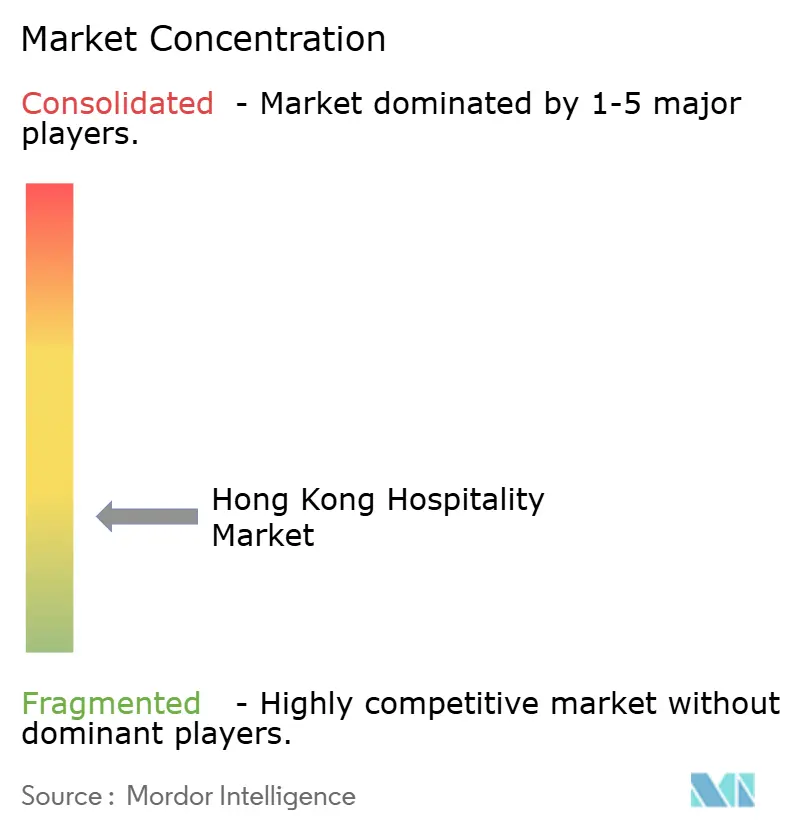
| Market Concentration | Low |
Major Players *Disclaimer: Major Players sorted in no particular order Image © Mordor Intelligence. Reuse requires attribution under CC BY 4.0. | |
Hong Kong Hospitality Market Analysis by Mordor Intelligence
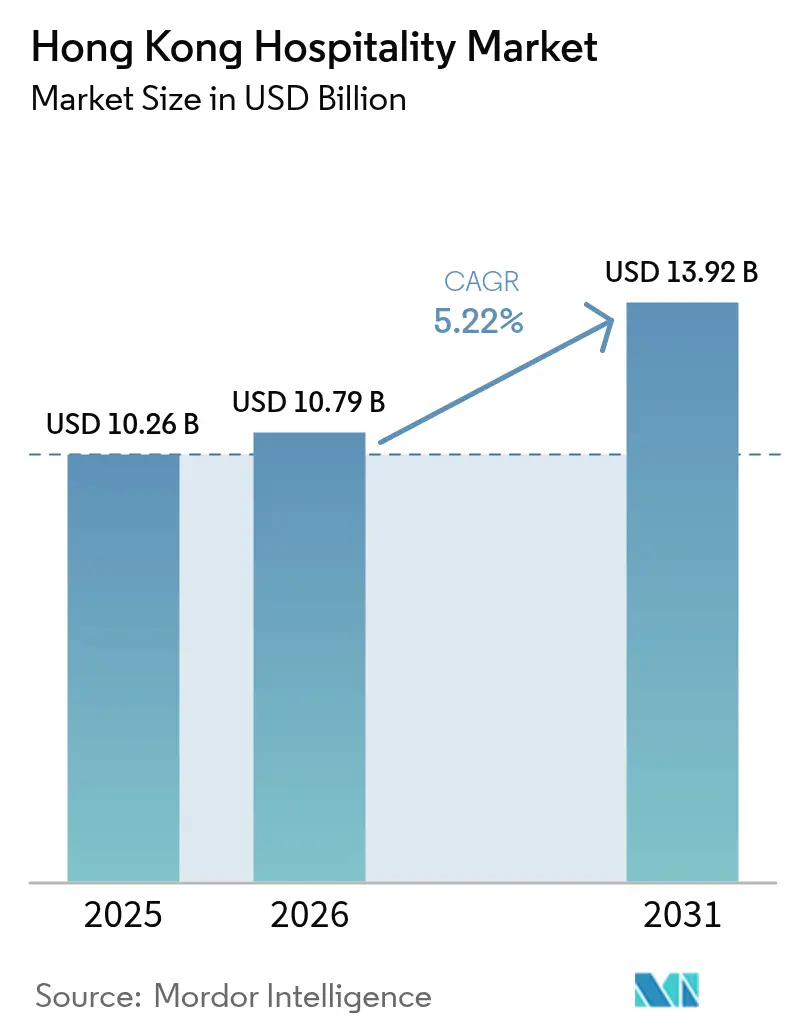
The Hong Kong Hospitality Market size was valued at USD 10.26 billion in 2025 and estimated to grow from USD 10.79 billion in 2026 to reach USD 13.92 billion by 2031, at a CAGR of 5.22% during the forecast period (2026-2031).
The reopening of borders with mainland China facilitated a swift recovery in visitor arrivals, which approached 2019 levels by late 2024. This rebound drove premium hotel average daily rates to pre-pandemic levels during key holiday periods, such as the Lunar New Year in 2025. Government capital spending exceeding HKD 30 billion (USD 3.86 billion) on sport, culture, and transit nodes, most prominently Kai Tak Sports Park and the USD 13 billion Sky Topia airport precinct, adds fresh demand generators while easing geographic concentration risk[1]. Hoteliers simultaneously accelerate mobile-first direct-booking engines, diversify toward halal-certified and pet-inclusive offerings, and embed smart-room technologies to manage wage inflation and labour shortages. These structural upgrades, coupled with resurgent international MICE activity and policy incentives such as the Tourism Industry 2.0 blueprint, anchor the next growth leg for the Hong Kong hospitality market.
Key Report Takeaways
- By type, chain hotels held 62.37% of the Hong Kong hospitality market share in 2024, whereas independent hotels are predicted to post a 6.21% CAGR through 2031.
- By accommodation class, luxury properties accounted for 38.37% of the Hong Kong hospitality market size in 2024, while service apartments are forecast to grow fastest at a 6.98% CAGR to 2031.
- By booking channel, OTAs contributed 45.64% of the Hong Kong hospitality market share in 2024 value, yet direct digital channels are expected to accelerate at a 9.89% CAGR to 2031.
- By geography, Kowloon controlled 35.74% of the Hong Kong hospitality industry share in 2024, whereas Lantau Island is projected to record the highest 5.98% CAGR between 2026 and 2031.
Note: Market size and forecast figures in this report are generated using Mordor Intelligence’s proprietary estimation framework, updated with the latest available data and insights as of 2026.
Market Trends and Insights
Drivers Impact Analysis of Hong Kong Hospitality Market*
| Driver | (~) % Impact on CAGR Forecast | Geographic Relevance | Impact Timeline |
|---|---|---|---|
| Greater Bay Area Integration Increasing Cross-Border Visitor Mobility | 1.10% | Greater Bay Area connectivity corridors | Short term (≤ 2 years) |
| Luxury Retail Ecosystem Supporting High-Spending Tourism Demand | 0.80% | Central and Kowloon luxury districts | Short term (≤ 2 years) |
| Financial Services Hub Generating Premium Corporate Accommodation Needs | 0.70% | Central, Admiralty financial business hubs | Medium term (2–4 years) |
| West Kowloon and Cultural District Development Expanding Tourism Offerings | 0.60% | West Kowloon cultural precinct | Medium term (2–4 years) |
| Compact Urban Tourism Model Supporting High-Value Short-Stay Visits | 0.50% | Hong Kong Island and Kowloon tourism | Short term (≤ 2 years) |
| Smart City Adoption Improving Hospitality Service Efficiency | 0.40% | Kai Tak smart hospitality developments | Long term (≥ 4 years) |
| Source: Mordor Intelligence | |||
Greater Bay Area Integration Increasing Cross-Border Visitor Mobility
Hong Kong’s integration into the Guangdong–Hong Kong–Macao Greater Bay Area (GBA) is expanding cross-border mobility and supporting accommodation demand. Hong Kong SAR Government records showed cumulative passenger movements via the Hong Kong–Zhuhai–Macao Bridge exceeded 100 million as of 2025. Mainland China recorded 369 million border crossings in H1 2026, including 147 million by residents of Hong Kong, Macao, and Taiwan, up 8.1% year-on-year. The Southbound Travel for Guangdong Vehicles scheme, expanded in 2026, covered all nine mainland GBA cities, with extension to all 21 Guangdong cities planned by Q1 2027. The government is working with hotels and tourism operators on accommodation and parking packages to convert day-trippers into overnight visitors. HKTB, Guangdong, Macao, and MTR are also promoting multi-destination and high-speed rail tourism products.
Luxury Retail Ecosystem Supporting High-Spending Tourism Demand
Hong Kong’s luxury retail hubs in Central, Tsim Sha Tsui, and Causeway Bay continue to drive hotel demand by attracting high-value visitors who spend more per trip and support upper-upscale hotel revenue. Non-Mainland visitors to Hong Kong accounted for about 12.1 million of the 49.9 million arrivals in 2025 and spent about 20% more per trip than Mainland visitors[2]. PolyU SHTM found that overnight visitors spent an average of HKD 9,300 (USD 1,195.29) per trip, about three times the spending of day-trippers, with luxury purchases strengthening hotel-linked expenditure. K11 MUSEA reported a 1.25-fold rise in tourist spending during Labour Day Golden Week 2026, while luxury brand sales nearly doubled. HKTB’s 2026 work plan allocated HKD 1.66 billion (USD 0.21 billion), with three-quarters of the funding targeting high-value business and long-haul visitors.
Financial Services Hub Generating Premium Corporate Accommodation Needs
Hong Kong’s role as an international financial center, supported by a major stock exchange, deep capital markets, and global asset management, banking, and insurance firms, sustains demand for corporate accommodation and reduces the upper-upscale hotel segment’s reliance on leisure travel. Overnight visitor spending HKD 5,490 (USD 705.61) per capita, with higher-yield MICE (meetings, incentives, conferences, and exhibitions) tourists outperforming this baseline by approximately 36%. Recent Hong Kong Tourism Board (HKTB) data indicates that over 70% of inbound overnight arrivals originate from the Chinese Mainland. In comparison, short-haul Asian markets account for roughly 18% and long-haul markets for nearly 10%. To bolster future pipelines, HKTB has secured over 60 large-scale international business events to draw premium business travelers. This sustained baseline of corporate activity, coupled with structural factors like the conversion of older hotel stock into student housing, maintains solid pricing power. Colliers and JLL market data tracking show that top-tier "High Tariff A" luxury and upper-upscale hotels achieved an average daily rate (ADR) of HKD 2,452 (USD 315.15) in early 2026, up 12.3% year on year.
West Kowloon and Cultural District Development Expanding Tourism Offerings
The West Kowloon Cultural District (WestK), a 40-hectare waterfront arts and culture precinct along Victoria Harbour, is strengthening Hong Kong’s cultural tourism demand through experience-led attractions that complement the city’s hospitality ecosystem. The precinct recorded more than 17 million visits in 2025, up 13% from 2024, with Mainland Chinese and overseas travelers accounting for about 60–70% of visitors to M+ and the Hong Kong Palace Museum (HKPM). M+ recorded over 2.6 million visits in 2025, supported by Picasso for Asia - A Conversation, which attracted more than 200,000 visitors[3]. Tourists accounted for over 60% of M+ visitors and over 75% of HKPM visitors. WestK PAC is scheduled to open in 2027. WKCDA signed twelve international MoUs in March 2026. Sun Hung Kai Properties is developing Artist Square Towers, with 62,500 sq m of office space, retail, dining, and entertainment facilities.
Restraints Impact Analysis of Hong Kong Hospitality Market*
| Restraint | (~) % Impact on CAGR Forecast | Geographic Relevance | Impact Timeline |
|---|---|---|---|
| Heavy Dependence on Visitors from Mainland China Creates Demand Concentration Risk | −0.9% | Border and urban tourism dependence | Short term (≤ 2 years) |
| Limited Land Availability Restricts Hotel Supply Expansion and Increases Development Complexity | −0.7% | Hong Kong urban supply constraints | Long term (≥ 4 years) |
| Intense Competition from Other Asian Destinations Pressures Pricing Power | −0.6% | Regional MICE competition pressures | Medium term (2–4 years) |
| High Operating Costs and Labor Constraints Affect Hotel Profitability | −0.7% | Central and Kowloon operating costs | Medium term (2–4 years) |
| Source: Mordor Intelligence | |||
Heavy Dependence on Visitors from Mainland China Creates Demand Concentration Risk
Mainland Chinese visitors accounted for 76% of Hong Kong visitor arrivals in both 2024 and 2025, exposing the hospitality sector to policy, economic, geopolitical, and behavioral shifts within a single source market. The WTTC Research Briefing on Hong Kong (April 2026) describes this dominance as “structurally weakened.” Mainland visits grew 11% in 2025, but overnight arrivals remained 23.4% below 2018 levels (15.2 million versus 19.9 million), reflecting more day trips and same-day border crossings that reduced hotel room-night revenue. The briefing also notes “reverse trend risk,” as Hong Kong resident trips to the Mainland rose 24.3% from 2018, led by Shenzhen, Chongqing, Hangzhou, and Guangzhou. PolyU SHTM research states that Mainland Chinese tourists “cannot be viewed as a single market segment,” with spending varying by trip purpose, accommodation, and destination characteristics. From January to May 2026, Mainland arrivals accounted for 76.6% of visitors, while Taiwan accounted for 3.0%. Hong Kong and Shanghai Hotels CEO Benjamin Vuchot said Greater China was expected to see uneven demand in early 2026 due to geopolitical tensions and a slower long-haul recovery.
Limited Land Availability Restricts Hotel Supply Expansion and Increases Development Complexity
Hong Kong’s structural land scarcity continues to constrain hotel supply expansion, limiting the market’s ability to add room inventory as demand recovers. The Hong Kong Development Bureau acknowledged a short- to medium-term land shortfall of about 800 hectares and noted that major projects typically require 10–15 years to study, plan, design, and implement, with additional delays due to external uncertainties. As of Q1 2026, the hospitality market comprises 333 licensed hotels with about 93,500 operational room keys and a limited development pipeline. Renovations at Mandarin Oriental, the Landmark, Mandarin Oriental Hong Kong, and The Peninsula Hong Kong are further reducing active inventory as demand grows. The resumption of the 3% Hotel Accommodation Tax from January 2025 and ad hoc hotel-site identification show a reactive approach to hospitality land supply. Bay Street Hospitality identified a USD 2.2 billion conversion pipeline, indicating that new capacity is mainly coming from commercial asset repositioning rather than greenfield development.
*Our forecasts treat driver/restraint impacts as directional, not additive. The impact forecasts reflect baseline growth, mix effects, and variable interactions.
Hong Kong Hospitality Market Segment Analysis
By Type:
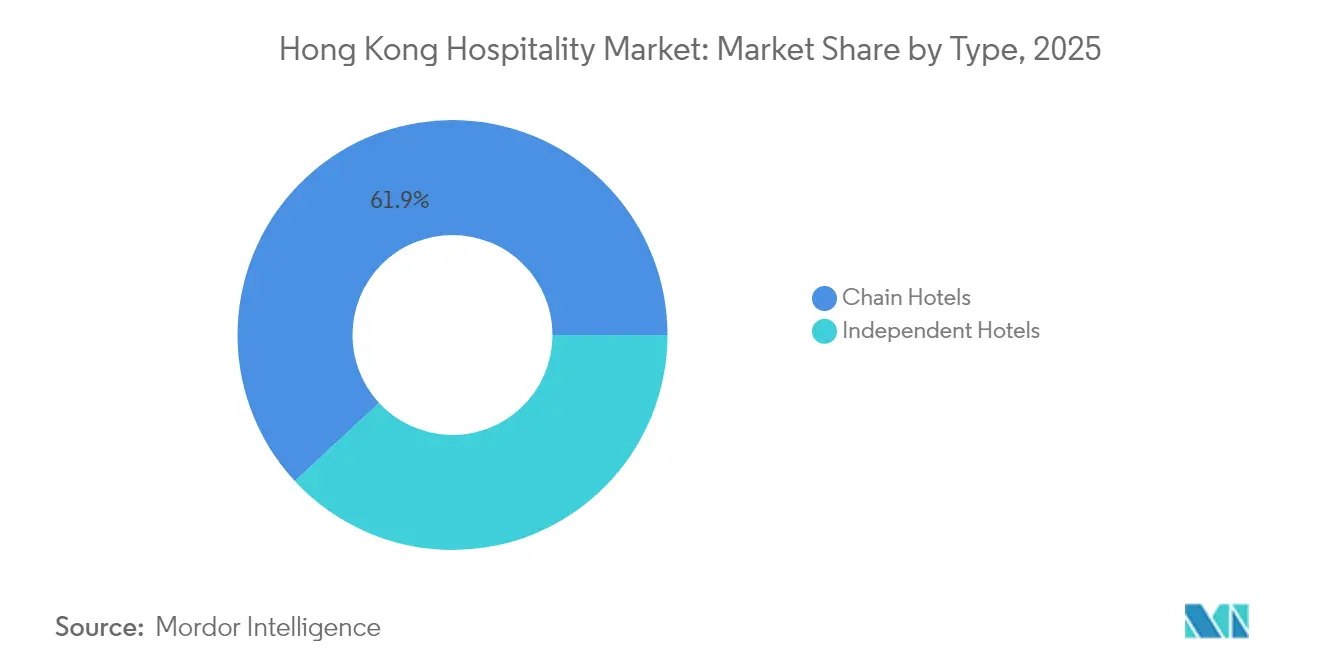
Chain Hotels Consolidate Leadership Through Scale AdvantageIn 2025, chain-affiliated properties contributed 61.89% of room revenue in Hong Kong, with a projected CAGR of 6.16%. This performance underscores the competitive advantage of established brands within the hospitality market. International hotel chains leverage extensive loyalty programs and corporate-negotiated rates to secure higher occupancy levels and achieve a more diversified guest mix compared to independent operators. For example, JW Marriott Hong Kong consistently outperforms nearby unbranded competitors in weekday occupancy rates and generates higher food and beverage revenue through exclusive member-focused dining promotions.
Operational scale provides chain-affiliated properties with procurement advantages, enabling them to negotiate region-wide contracts for essentials such as linens and enterprise software, which enhances operating margins. Standardized digital solutions, including mobile keys, AI-driven guest preference systems, and cloud-based property management platforms, further accelerate innovation across chain portfolios. In contrast, independent hotels face rising customer acquisition costs as OTA algorithms increasingly favor established brands with strong performance histories. Many independents are affiliating with soft-brand collections to retain their unique identity while accessing global marketing resources. Asset-light management models continue to drive growth, with recent launches of lifestyle brands like Mondrian and Regent conversions reflecting property owners’ preference for chain alignment to mitigate risks exposed during the pandemic. Independent properties that remain competitive often occupy niche segments, such as heritage buildings, wellness retreats, or co-living spaces, where distinctive positioning supports premium pricing and shields them from market commoditization.

By Accommodation Class:
Service Apartments Lead Extended-Stay DemandService-apartment inventory is on track for a 6.87% CAGR to 2031, the fastest among all classes in the Hong Kong hospitality market. Mainland tech firms second staff for multi-month stints during IPO roadshows, while global consulting teams prefer residential amenities such as in-unit laundry and kitchenettes that lower meal-per-diem costs. Shama and Oakwood demonstrate higher RevPAR spreads compared to similar four-star operators, driven by longer average guest stays and optimized housekeeping operations, which position them as attractive investments for private-equity firms.
Luxury hotels remain the largest revenue slice at 38.05% thanks to high-net-worth preferences from mainland China, Indonesia, and the Philippines for harbour-view suites, Michelin dining, and personal-luxury shopping access. The Four Seasons advanced refurbishment of its spa floors and rooftop infinity pool in 2024 to preserve ADR leadership. Budget and economy hotels struggle under twin pressures of soaring utilities and wage escalation, prompting some owners to pivot toward mid-scale renovations or co-living formats. The Hong Kong hospitality market, therefore, bifurcates upscale and extended-stay segments that thrive on experiential and functional differentiation, while undifferentiated low-end stock consolidates or exits.
By Booking Channel:
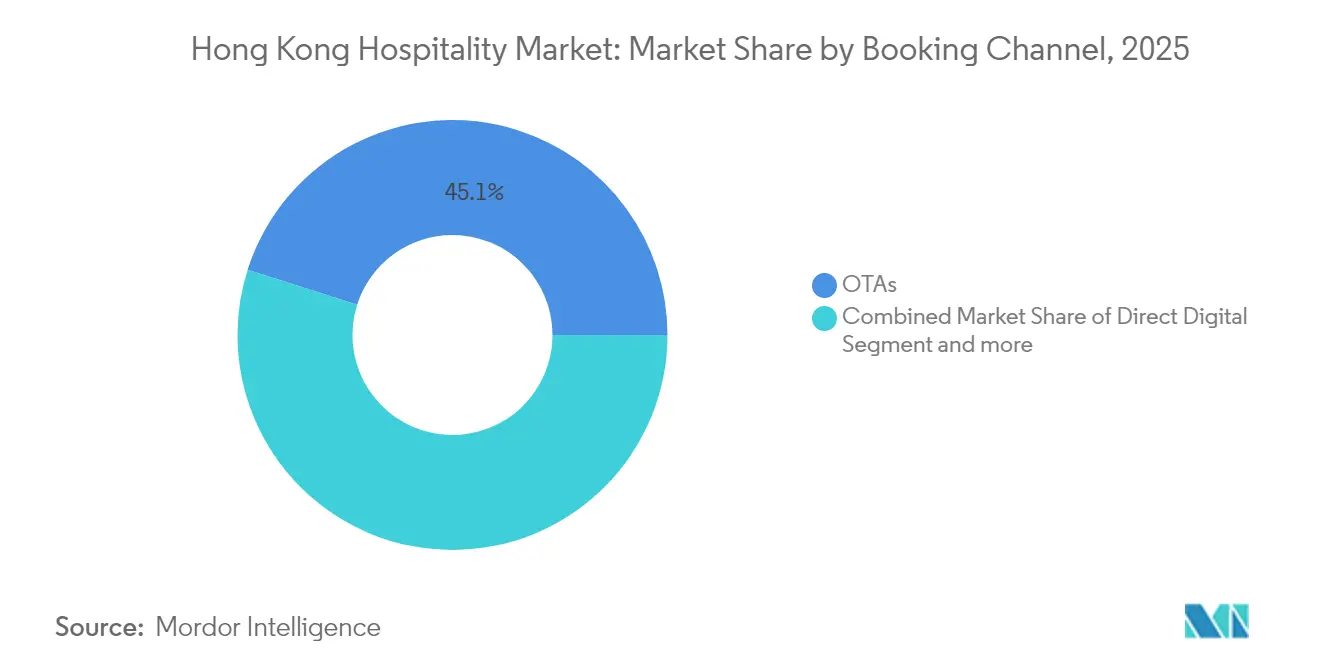
Direct Digital Rises Despite OTA DominanceOnline Travel Agencies (OTAs) currently dominate 45.09% of the transaction value within the market. However, direct digital reservations are projected to expand at a CAGR of 9.76%, reflecting operators' focused strategies to enhance profitability and recover margins. Hotel chains are increasingly adopting advanced loyalty platforms that integrate features such as gamified point accrual systems, biometric authentication for secure access, and frictionless payment solutions like one-click Apple Pay. These technological advancements are driving a substantial increase in mobile app bookings, particularly among younger consumer segments, highlighting a shift in booking preferences and the growing importance of digital engagement strategies.
Corporate and MICE portals furnish stable mid-week occupancy, while wholesale and traditional agents maintain a beachhead in escorted-group niches, especially among Tier-3 mainland cities with lower digital penetration. Nevertheless, the gravitational pull toward mobile-driven user journeys is unmistakable, and algorithmic ancillary bundling, airport transfer upsells, and spa credits enrich unit economics. The Hong Kong hospitality market’s shifting channel mix compels continuous data-science investments to personalize price fences and loyalty perks.
Geography Analysis
Kowloon produced 35.33% of room revenue in 2025, defending primacy through the triad of shopping (Harbour City, K11 Musea), culture (West Kowloon Cultural District), and MTR connectivity linking five radial lines. Hotels along Canton Road routinely fill with cross-border shoppers, while convention-centre clusters near Hung Hom drive weekday business blocks. In 2024, as the aviation industry worked toward restoring capacity, five-star hotels in Tsim Sha Tsui demonstrated consistent occupancy levels. This performance underscores the robust and sustained demand within Hong Kong's hospitality sector, even amidst ongoing recovery efforts in the travel and tourism market.
Lantau Island is poised for a 5.89% CAGR as mega-projects redraw its visitor map. Skytopia’s opening phases in 2026-2027 pair a high-rise business district with an immersive entertainment boulevard adjacent to Hong Kong International Airport, elongating passenger stopovers and diverting MICE groups to new expo halls. Kai Tak Sports Park activates East Kowloon spillover demand too, but Lantau hotels capitalize on larger footprints, resort pools, and family-suite layouts unavailable in densely built core districts. Hong Kong Island retains a premium cachet owing to its financial-district adjacency; flagship properties in Central command the market’s highest ADRs. New Territories hotels leverage lower land rents to build expansive ballrooms targeted at association conferences, while Outlying Islands like Cheung Chau cater to wellness retreats and eco-tourism seeker groups. Together, the geographic mosaic diversifies exposure, underpinning the long-run sustainability of the Hong Kong hospitality market.
Competitive Landscape
The Hong Kong hospitality market is highly fragmented, with the top five operators holding more than one-fourth aggregate share, granting nimble independents room to experiment. Marriott International has strategically enhanced its market presence by introducing the 820-room Park Lane Hong Kong Autograph Collection. This development bolsters its luxury-lifestyle segment in Causeway Bay while leveraging the expansive reach of Bonvoy's membership network[4]. Shangri-La accelerates ESG investments—solar thermal rooftop arrays, AI-driven food-waste reducers, to appeal to corporate RFPs mandating science-based emission targets. The Peninsula brand upgrades its proprietary guest-experience app with carbon-footprint calculators and real-time local event tips, differentiating on service intimacy.
Emergent players carve micro-segments: Ovolo Hotels courts millennials through plant-based F&B, all-inclusive mini-bar policies, and pet-welcome packages that fuel social-media virality. ONYX leases repositioned Grade-A office floors for Shama-branded serviced apartments, capitalizing on hybrid work demand. Technology adoption becomes the arms race: AI revenue-management platforms automate demand forecasting and generate room-type-level dynamic price fences, while guest-facing robots deliver amenities, reducing labour exposure.
Access to capital will shape consolidation. Budget-hotel owners facing utilities and payroll pressure evaluate franchising or asset sales to chain flags that promise margin uplift via central procurement. Conversely, elevated land values constrain greenfield pipeline growth, increasing the allure of asset-light management deals for international chains. These crosscurrents maintain competitive dynamism and opportunity across the Hong Kong hospitality market.
Hong Kong Hospitality Industry Leaders
-
The Hongkong & Shanghai Hotels Ltd (Peninsula)
-
Shangri-La Hotels & Resorts
-
Mandarin Oriental International Ltd
-
Marriott International
-
Hilton Worldwide
- *Disclaimer: Major Players sorted in no particular order
Hong Kong Hospitality Market Companies Covered in this Report
- The Hongkong & Shanghai Hotels Ltd (Peninsula)
- Shangri-La Hotels & Resorts
- Mandarin Oriental International Ltd
- Marriott International
- Hilton Worldwide
- Accor Group
- InterContinental Hotels Group (IHG)
- Hyatt Hotels Corp
- Ovolo Hotels
- Harbour Plaza Hotels & Resorts
- Dorsett Hospitality International
- Regal Hotels International
- Rosewood Hotel Group (New World Dev.)
- Swire Hotels
- Nina Hospitality
- L’hotel Group
- Sino Hotels
- Langham Hospitality Group
- Four Seasons Hotels & Resorts
- Wharf Hotels (Marco Polo)
Recent Industry Developments in Hong Kong Hospitality Market
- January 2025: The Park Lane Hong Kong Autograph Collection officially opened, adding 820 rooms, two specialty restaurants, and a sky-garden bar to the premium inventory on Hong Kong Island.
- January 2025: Miramar Hotel and Investment announced the acquisition of a unit from Henderson Land Development in Hong Kong for HKD 3.12 billion (USD 400.75 million). The company intends to develop a hotel and commercial complex on the acquired property. The transaction, involving Solution Right, strategically located in Hong Kong's Tsim Sha Tsui district, reflects a positive trajectory in the recovery of the local tourism industry post-pandemic.
- November 2024: ONYX Hospitality Group, a leading Southeast Asian hotel and serviced apartment management company, is expanding its Shama brand internationally. Recent openings include Shama Hub Qiantang in Hangzhou, China, Shama Hub Metro South in Hong Kong, and Shama Suasana in Johor Bahru, Malaysia. The company also plans further developments in Malaysia, Laos, and Thailand.
- November 2024: Emperor Entertainment Hotel completed the divestment of its serviced-apartment portfolio for USD 35.4 million, reflecting strategic portfolio optimization as the company focuses on core hotel operations.
Hong Kong Hospitality Market Report Scope
A complete background analysis of the Hospitality Industry in Hong Kong, which includes an assessment of the industry associations, overall economy, and emerging market trends by segments, significant changes in the market dynamics, and market overview is covered in the report.
Segmentation Overview
By Type
| Chain Hotels |
| Independent Hotels |
By Accommodation Class
| Luxury |
| Mid & Upper-Mid-scale |
| Budget & Economy |
| Service Apartments |
By Booking Channel
| Direct Digital |
| OTAs |
| Corporate / MICE |
| Wholesale & Traditional Agents |
By Geographic Region
| Hong Kong Island |
| Kowloon |
| New Territories |
| Lantau Island |
| Outlying Islands |
| By Type | Chain Hotels |
| Independent Hotels | |
| By Accommodation Class | Luxury |
| Mid & Upper-Mid-scale | |
| Budget & Economy | |
| Service Apartments | |
| By Booking Channel | Direct Digital |
| OTAs | |
| Corporate / MICE | |
| Wholesale & Traditional Agents | |
| By Geographic Region | Hong Kong Island |
| Kowloon | |
| New Territories | |
| Lantau Island | |
| Outlying Islands |
Key Questions Answered in the Report
What is the Hong Kong hospitality market size in 2026?
It totals USD 10.79 billion in 2026 and is projected to reach USD 13.92 billion by 2031.
How fast will the market grow through 2031?
Revenue is expected to increase at a 5.22% CAGR over 2026-2031.
Which accommodation class is expanding fastest?
Service apartments lead with a forecast 6.87% CAGR tied to extended-stay demand from business travellers.
Which district generates the most hotel revenue?
Kowloon commands 35.33% share due to its retail, cultural, and convention assets.
How prominent are mobile direct bookings today?
Mobile channels already contribute more than 40% of online hotel sales and are growing quickly as apps integrate AI personalization.
What structural challenges face operators?
Key issues include labour shortages, rising wage and utility costs, and new competing supply across the Greater Bay Area.