
Hospital Asset Tracking And Inventory Management Systems Market Size and Share
Market Overview
| Study Period | 2020 - 2031 |
|---|---|
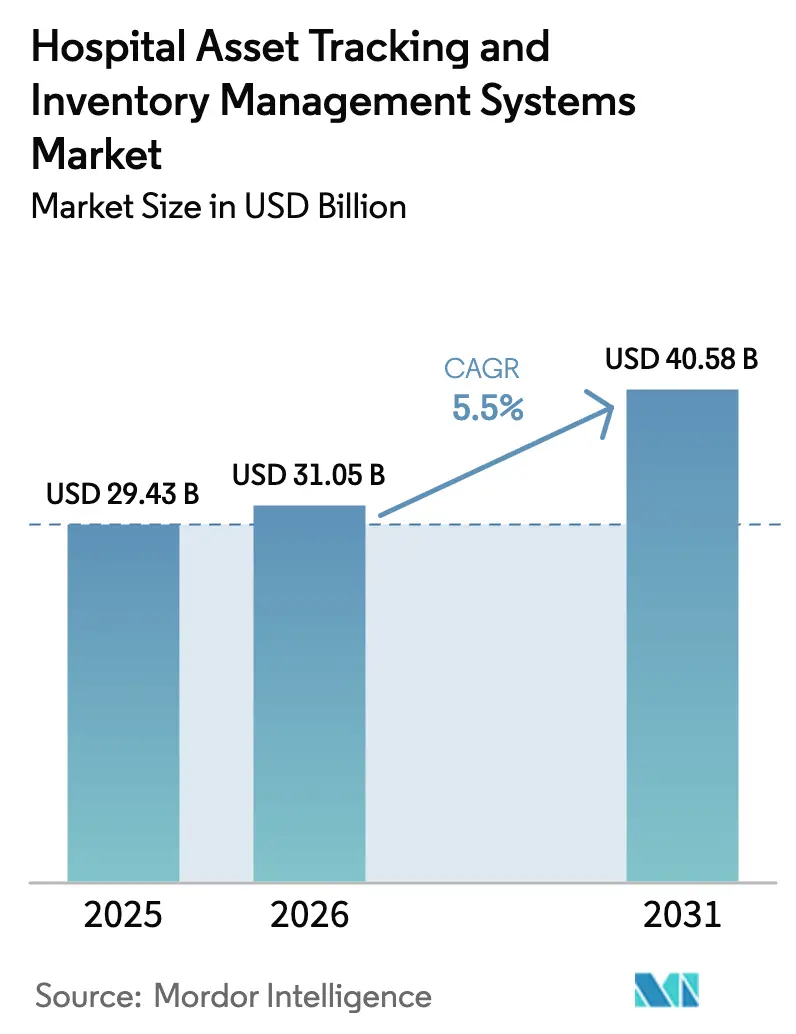
| Market Size (2026) | USD 31.05 Billion |
| Market Size (2031) | USD 40.58 Billion |
| Growth Rate (2026 - 2031) | 5.50 % |
| Fastest Growing Market | Asia-Pacific |
| Largest Market | North America |
| Market Concentration | Medium |
Major Players *Disclaimer: Major Players sorted in no particular order Image © Mordor Intelligence. Reuse requires attribution under CC BY 4.0. | |
Hospital Asset Tracking And Inventory Management Systems Market Analysis by Mordor Intelligence
The hospital asset tracking and inventory management systems market size is projected to expand from USD 29.43 billion in 2025 and USD 31.05 billion in 2026 to USD 40.58 billion by 2031, registering a CAGR of 5.5% between 2026 and 2031. Hospitals are moving from labor-intensive searches toward predictive analytics because FDA Unique Device Identification (UDI) rules now demand machine-readable labeling on every class of device, pushing facilities to adopt RFID and RTLS platforms at scale.[1] Integrated delivery networks exploit hybrid-cloud RTLS to benchmark asset turns across campuses, while AI-powered maintenance modules originally developed for aviation are cutting unplanned downtime on imaging suites by one-third. Capital spending on 5G-enabled smart hospitals in China and digital health incentives in India sustain a robust pipeline of new deployments that offsets slower replacement sales in North America. Competitive intensity is increasing as pure-play RTLS specialists target surgical-instrument tracking niches left open by broad-portfolio conglomerates.
Key Report Takeaways
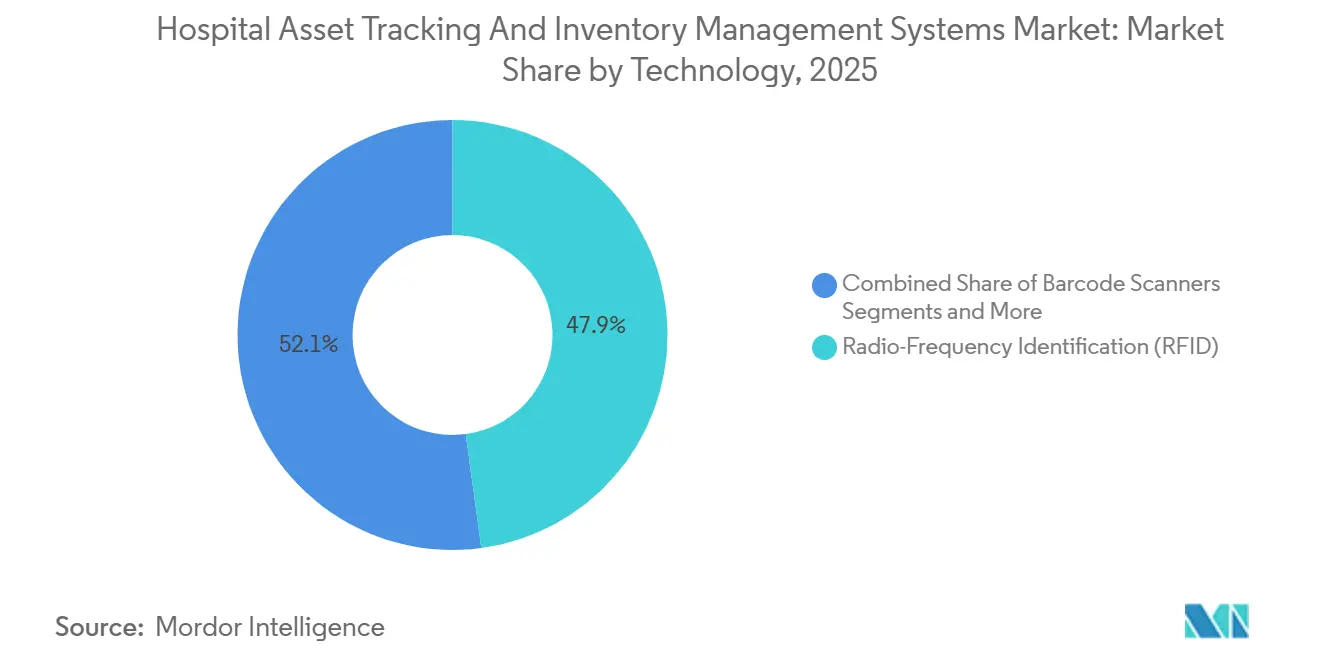
- By technology, RFID led with 47.87% revenue share in 2025, while RTLS is advancing at a 6.34% CAGR through 2031.
- By component, hardware accounted for 42.45% of the hospital asset tracking and inventory management systems market size in 2025; software & analytics is projected to grow at 6.41% CAGR to 2031.
- By product type, mobile equipment held 61.26% of the hospital asset tracking and inventory management systems market share in 2025, whereas fixed equipment is expanding at 6.54% CAGR through 2031.
- By application, device & instruments tracking comprised 44.41% share in 2025, and patient & visitor tracking is rising at a 6.66% CAGR to 2031.
- By end-user, hospitals captured 69.94% revenue in 2025, but ambulatory surgical centers are growing at 6.49% CAGR over the forecast horizon.
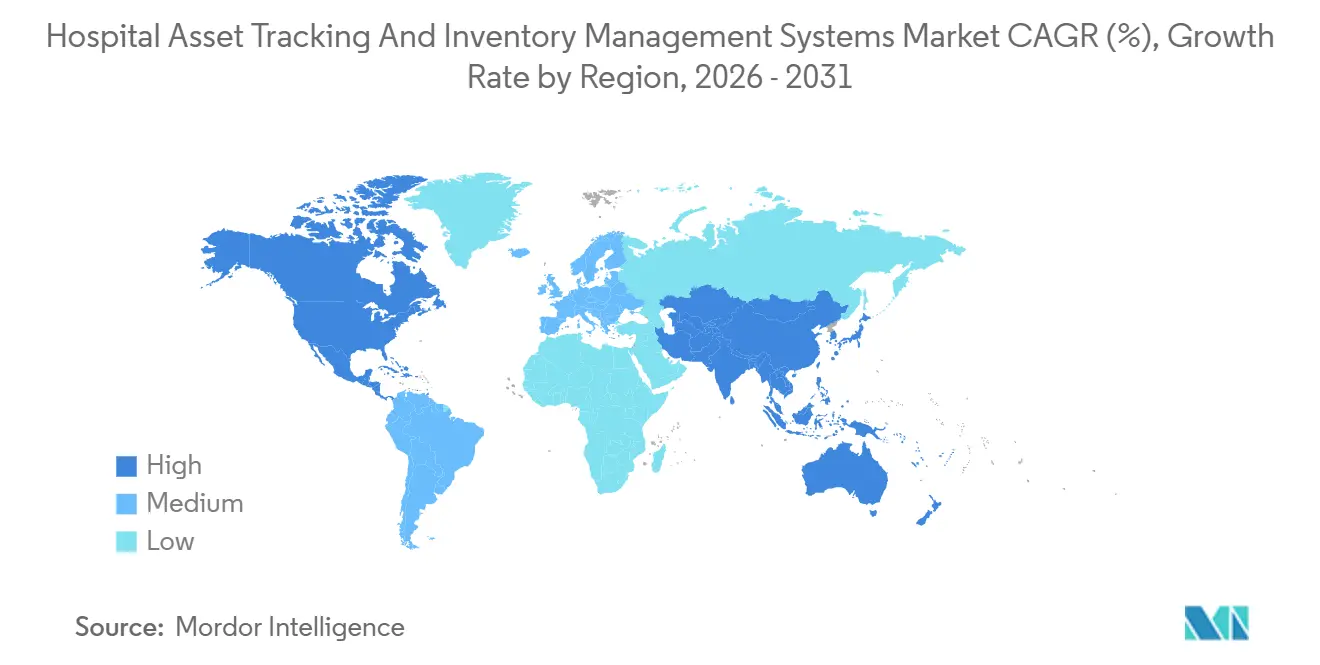
- By geography, North America commanded 40.78% market share in 2025, while Asia-Pacific registers the fastest CAGR at 6.71% to 2031.
Note: Market size and forecast figures in this report are generated using Mordor Intelligence’s proprietary estimation framework, updated with the latest available data and insights as of January 2026.
Market Trends and Insights
Drivers Impact Analysis of Hospital Asset Tracking And Inventory Management Systems Market*
| Driver | (~) % Impact on CAGR Forecast | Geographic Relevance | Impact Timeline |
|---|---|---|---|
| Rising adoption of RFID & RTLS across hospital settings | +1.2% | Global, led by North America & APAC | Medium term (2-4 years) |
| Need to optimize asset utilization & inventory accuracy | +1.0% | Global | Short term (≤ 2 years) |
| Growing smart-hospital infrastructure spending | +0.9% | APAC core, spill-over to MEA | Long term (≥ 4 years) |
| Regulatory push for device traceability & patient safety | +0.8% | North America & EU | Short term (≤ 2 years) |
| AI-driven predictive-maintenance analytics adoption | +0.6% | North America, Western Europe, select APAC hubs | Medium term (2-4 years) |
| Hybrid-cloud RTLS enabling multi-site benchmarking | +0.5% | Global, strongest in multi-facility IDNs | Medium term (2-4 years) |
| Source: Mordor Intelligence | |||
Rising Adoption of RFID & RTLS Across Hospital Settings
Passive RFID tags now cost under USD 0.10 each, allowing entire campuses to be tagged economically. RWJBarnabas Health’s 85,000-tag rollout across 12 New Jersey hospitals cut search time by 72% and recovered USD 4.2 million in misplaced equipment, validating the return on investment. Active RTLS delivers sub-meter accuracy required in surgical suites, as shown by Newcastle upon Tyne Hospitals NHS Foundation Trust where instrument-tray errors dropped 41% after ultra-wideband deployment. Bluetooth Low Energy tags, consuming 60% less power, offer 3-meter precision at one-third the cost of ultra-wideband, widening the adoption funnel.[2] The collective effect is accelerated replacement of barcodes that demand line-of-sight and manual scans, steps clinicians routinely skip during peak workloads.
Need to Optimize Asset Utilization & Inventory Accuracy
Typical mobile-equipment utilization hovers between 40% and 60%, leaving billions in idle assets locked in storage closets. RTLS coupled with demand-forecast algorithms lifts utilization beyond 75% by dynamically reallocating ventilators and pumps according to real-time ward needs. Khoo Teck Puat Hospital integrated RTLS with ERP in 2024, trimming mobile-equipment inventory by 22% and redirecting SGD 3.8 million to patient-care projects. Automated logs also shore up compliance with the Joint Commission’s 2025 safety goals that require documented location and maintenance status for life-support devices. Audit failures tied to manual logs run at 30%, a risk hospitals now mitigate through continuous telemetry rather than periodic paper checks.[3]
Growing Smart-Hospital Infrastructure Spending
China’s 14th Five-Year Plan earmarked CNY 120 billion (USD 16.8 billion) for smart-hospital builds, mandating asset-tracking capability in every tertiary public facility by end-2025. India’s Digital Health Incentive Scheme allocates INR 500 million (USD 6 million) grants per state for RFID registries linked to Ayushman Bharat Digital Mission reimbursement workflows. Saudi Arabia’s Vision 2030 dedicates SAR 12 billion (USD 3.2 billion) to digital hospitals with RTLS specified as mandatory infrastructure. These programs compel vendors to provide HL7 FHIR connectors and cloud-agnostic data lakes to qualify for public tenders, laying groundwork for price competition once subsidy cycles end.
Regulatory Push for Device Traceability & Patient Safety
The FDA UDI rule, fully enforced since September 2024, obliges hospitals to log device identifiers, shifting liability for recall tracking from manufacturers to providers unable to prove chain-of-custody. EU MDR imposes similar mandates and adds post-market surveillance requirements, forcing institutions to store multi-year performance logs. Japan’s PMDA provided a 24-month compliance window in 2025 for GS1-compatible tracking, extending regulatory pressure into Asia. A single untracked implant failure averages USD 1.2 million in settlements, a financial threat that now tips cost-benefit analyses decisively in favor of campus-wide RTLS.
Restraints Impact Analysis of Hospital Asset Tracking And Inventory Management Systems Market*
| Restraint | (~) % Impact on CAGR Forecast | Geographic Relevance | Impact Timeline |
|---|---|---|---|
| High installation & maintenance costs | -0.7% | Global, acute in emerging markets | Short term (≤ 2 years) |
| Data security & privacy concerns | -0.4% | North America & EU | Medium term (2-4 years) |
| Battery-life management of active tags | -0.3% | Global | Medium term (2-4 years) |
| RF signal interference in device-dense wards | -0.2% | Global, most acute in surgical suites | Short term (≤ 2 years) |
| Source: Mordor Intelligence | |||
High Installation & Maintenance Costs
A 300-bed hospital spends USD 800,000–1.5 million for RTLS hardware and software, then USD 150,000–250,000 annually on support, a barrier that stalls projects in cash-constrained settings. Smaller Indian private chains often favor bed expansion over RTLS because occupancy gains offer faster payback. Zebra’s 2025 “tracking-as-a-service” spreads payments over five years, slashing upfront outlay by 60% and making the technology accessible to mid-tier providers. Subscription economics also guarantee vendors an annuity stream, reshaping competition around lifetime value rather than hardware margin.
Data Security & Privacy Concerns
The U.S. Office for Civil Rights fined two hospitals USD 3.8 million in 2024 for unencrypted RTLS streams that exposed patient movements to eavesdropping. Germany’s BSI guidance now mandates end-to-end encryption and role-based access, adding 15%–20% to project cost but becoming a prerequisite for procurement. Zero-trust architectures and anomaly-detection algorithms are emerging, yet many deployments still leave optional security toggles disabled due to cost pressures.
*Our forecasts treat driver/restraint impacts as directional, not additive. The impact forecasts reflect baseline growth, mix effects, and variable interactions.
Hospital Asset Tracking And Inventory Management Systems Market Segment Analysis
By Technology:
RTLS Extends Beyond RFID’s Installed BaseRFID generated 47.87% of 2025 revenue, yet RTLS is growing fastest at 6.34% CAGR as hospitals value real-time snapshots over static counts, propelling the hospital asset tracking and inventory management systems market forward. Passive RFID remains unmatched for consumables and pharmacy kits because tags cost USD 0.08–0.15 and need no batteries, maintaining hardware share even as software margins compress. However, the inability of passive systems to deliver live coordinates restricts their usefulness in emergency departments where equipment shifts every 20 minutes. RTLS fills that capability gap with triangulation algorithms that refresh locations every few seconds and can trigger nurse-call workflows automatically when requests are logged.
Regulatory backdrop shapes the mix: FDA UDI and EU MDR require machine-readable identifiers but stop short of mandating real-time tracking, leaving RTLS as a discretionary upgrade justified by operational ROI rather than compliance. Geography also tilts preferences. North American systems favor Wi-Fi RTLS piggybacking on dense wireless networks, whereas European hospitals lean toward ultra-wideband to avoid interference with telemetry bands. Asia-Pacific splits between low-cost RFID in public sectors and RTLS in premium private chains, with China’s smart-hospital mandate expected to accelerate RTLS penetration.

By Component:
Software & Analytics Capture Value from Commodity HardwareHardware contributed 42.45% of 2025 revenue, but software & analytics is expanding at 6.41% CAGR, claiming higher gross margins as hospitals pursue actionable insights, underscoring the hospital asset tracking and inventory management systems market size premium on data services. Commoditization of tags and sensors shifted manufacturing to Southeast Asia, compressing vendor margins to 30%–40%. In contrast, software subscriptions command 65%–75% margins because they deliver predictive maintenance, demand forecasting, and seamless EHR integration.
Interoperability mandates amplify software demand. The 21st Century Cures Act opened standardized APIs for asset-location feeds, enabling third-party analytics to ingest RTLS data without custom coding. Philips capitalized through IntelliSpace Connect, a cloud lake that blends asset, patient, and financial data to reveal previously hidden cost drivers like delayed discharges tied to missing wheelchairs. Services—installation, training, managed operations—scale in line with hardware rollout, but vendors increasingly bundle them under subscription models to smooth revenue.
By Product Type:
Fixed Equipment Tracking Accelerates with High-Value Imaging SuitesMobile equipment held 61.26% of 2025 revenue as infusion pumps, ventilators, and wheelchairs move constantly, making manual logs impractical. Fixed equipment tracking is rising at 6.54% CAGR as imaging suites, surgical robots, and hybrid ORs cost USD 1 million-plus each, justifying granular utilization monitoring. Siemens embeds RFID in MRI scanners to log operating hours, feeding cloud dashboards that schedule preventive maintenance and auto-order spares, a model central to outcome-based service contracts.
Consumables tracking grows modestly but remains important. RFID cabinets in cath labs cut implant waste by 30%, saving USD 2 million-plus annually in large hospitals. Geography affects the mix: mature North American systems round out digital twins by tagging fixed assets, while resource-constrained emerging markets concentrate on mobile fleets where the operational payoff is immediate.

By Application:
Patient & Visitor Tracking Repurposes Pandemic InfrastructureDevice & instruments tracking delivered 44.41% revenue in 2025, yet patient & visitor tracking is climbing at 6.66% CAGR as facilities reuse contact-tracing wearables for fall prevention and infant-abduction alerts. Tan Tock Seng Hospital’s BLE wristbands cut fall injuries by 28% in 2025 by alerting nurses when high-risk patients left beds unsupervised. Visitor-flow analytics at Massachusetts General shaved 12 minutes off average wait times by routing arrivals to less busy desks, proving experiential gains translate to throughput.
Staff tracking and environmental monitoring also advance. Nurse RTLS spots bottlenecks that drain productive hours, though privacy fears temper adoption. Cold-chain monitoring expanded post-Pfizer vaccine, and now covers blood products and organ transports, widening the addressable scope.
By End-User:
Ambulatory Surgical Centers Pursue Hospital-Grade EfficiencyHospitals captured 69.94% revenue in 2025, yet ambulatory surgical centers are growing at 6.49% CAGR as same-day procedures rise and centers seek hospital-grade utilization without jumbo IT budgets. SCA Health’s 2025 RFID rollout reduced instrument-delay cases by 53%, adding 1.2 procedures per OR daily, boosting revenue without expanding footprint.
Long-term care facilities embrace RTLS to mitigate chronic understaffing, with Genesis pilot sites cutting search time 65% and freeing two nurse hours per shift. The “Others” segment—urgent care, labs, home health—remains nascent but gains impetus as value-based care extends acute-level KPIs into outpatient settings.
Geography Analysis
North America Hospital Asset Tracking and Inventory Management Systems Market
North America held 40.78% market share in 2025, buoyed by integrated delivery networks that spread RTLS cost across multi-state footprints and by full FDA UDI enforcement that made digital registries non-negotiable. EHR penetration north of 95% enables plug-and-play RTLS integrations, yet growth moderates as campuses shift from first installs to incremental expansions. Canada presses ahead with CAD 180 million funding for 76 hospitals, while Mexico pilots RFID in 20 IMSS facilities, illustrating continental diffusion beyond the United States.
APAC Hospital Asset Tracking and Inventory Management Systems Market
Asia-Pacific is the velocity leader at 6.71% CAGR, propelled by China’s CNY 120 billion smart-hospital mandate covering 2,800 tertiary facilities and India’s reimbursement-linked RFID requirement under Ayushman Bharat, which compels asset registries for payment eligibility. Apollo Hospitals validated RTLS ROI by trimming equipment capex 19% across 71 sites in 2024, influencing private peers. South Korea’s 2025 Smart Hospital Certification attaches reimbursement bonuses to RTLS adoption, while Australia’s private hospital chains adopt asset tracking to compete on throughput metrics.
Europe, Middle East and South America Hospital Asset Tracking and Inventory Management Systems Market
Europe shows mid-tier growth as Germany’s EUR 4.3 billion Hospital Future Act funds RFID eligibility, and NHS England diverts GBP 1.2 billion toward digital instead of bricks-and-mortar expansion. France’s Ma Santé 2022 extends digital registry mandates through 2025, tying performance-based payments to RTLS adoption. The Middle East accelerates under Saudi Vision 2030’s SAR 12 billion allocation and UAE construction codes that obligate RTLS in all new hospitals. South America lags but private Brazilian chains deploy RTLS to differentiate on quality amid public budget constraints.
Regulatory Landscape
Device traceability rules remain a core compliance anchor for hospital asset tracking and inventory management deployments. In the United States, the FDA Unique Device Identification (UDI) system (21 CFR Part 830, published in the Federal Register) requires UDIs in both human-readable and AIDC formats on medical device labels, which creates the upstream requirement for hospital-side scanning, inventory capture, recall management, and adverse event reporting workflows.
In Europe, Regulation (EU) 2017/745 (EU MDR) establishes a UDI-based framework to improve device traceability and post-market surveillance, increasing the need for hospitals to maintain auditable device-identification and use records across procurement, inventory, and clinical systems. Supplier qualification is also reinforced through medical-device quality management expectations such as ISO 13485:2016, which underpins traceability and controlled storage and distribution practices, influencing how hospitals write tenders and how RTLS and RFID vendors present compliance-ready implementations.
Value Chain Analysis
The value chain spans tag and sensor and reader hardware suppliers (RFID, BLE, UWB, and Wi-Fi RTLS), middleware and location engines, and application-layer platforms that connect to hospital ERP, EHR, and CMMS environments. Interoperability standards, including GS1 identifiers such as GTIN and GLN and EDI patterns used in healthcare, shape how manufacturers, distributors, and providers exchange product and location data. Implementation and managed services partners then handle site surveys, infrastructure deployment, and ongoing tag lifecycle operations.
Downstream, adoption is increasingly tied to digital supply chain ecosystems and cloud data layers rather than isolated point solutions. This increases the importance of integration platforms and cloud partners in practice. Examples include Owens & Minor partnering with Google Cloud to enhance its QSight clinical inventory management platform (September 2024), Swisslog Healthcare and BD aligning robotic medication management with BD Pyxis Logistics software (December 2024), and Medline collaborating with Microsoft to build AI-enabled supply chain capabilities (October 2024), followed by an Azure-based solution with health systems such as Northwestern Medicine and Providence (September 2025). These moves point to connected control-tower architectures that unify purchasing, clinical usage, and inventory visibility, while integration into heterogeneous hospital IT stacks remains a common bottleneck.
Competitive Landscape
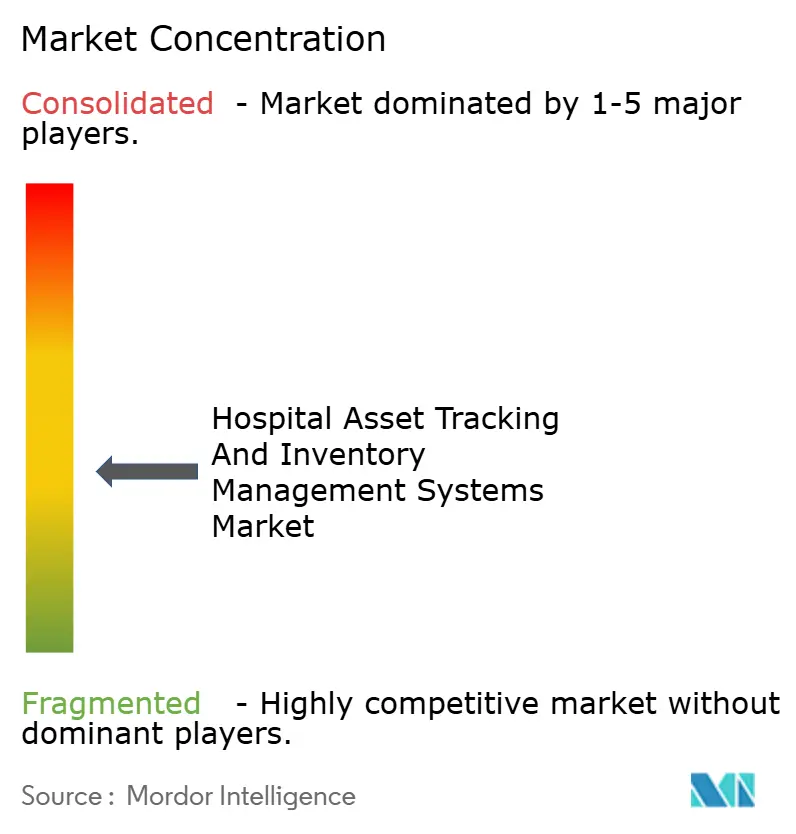
Moderate concentration defines the hospital asset tracking and inventory management systems market, with the top five—GE Healthcare, Philips, Siemens Healthineers, Zebra Technologies, and Stanley Healthcare—jointly at 38% share, leaving white space for specialists. Conglomerates bundle asset-tracking modules into imaging or patient-monitoring deals, leveraging installed bases, whereas pure-plays like CenTrak and Impinj compete on battery life, accuracy, and open APIs. Patent filings around energy-harvesting tags and anomaly-detection models rose sharply in 2024, signaling an innovation race aimed at lowering maintenance burdens and enhancing predictive capabilities.
Strategic focus pivots to recurring revenue. Zebra’s 2025 tracking-as-a-service bundles hardware, software, and refreshes into a five-year subscription, cutting capital barriers by 60% and locking in account stickiness. Philips’ 2024 Capsule acquisition augments middleware that connects bedside devices to EHR, giving Philips end-to-end visibility from asset to outcome. Software-only entrants like Qorvo deploy ultra-wideband RTLS on commodity Wi-Fi 6E access points, undercutting legacy players by 30%-plus on total cost of ownership.
Regulatory compliance becomes a selling point: vendors with ISO 13485 and HIPAA-compliant clouds win risk-averse health-system RFPs, while uncertified rivals are relegated to pilots. Regional specialists carve niches: Borda Technology excels in surgical-instrument tracking with sub-30 centimeter ultra-wideband accuracy, and Sonitor dominates ultrasound RTLS for RF-sensitive theaters.
Hospital Asset Tracking And Inventory Management Systems Industry Leaders
-
Stanley Healthcare
-
Zebra Technologies Corp
-
GE Healthcare
-
Siemens Healthineers
-
Philips Healthcare
- *Disclaimer: Major Players sorted in no particular order
Hospital Asset Tracking And Inventory Management Systems Market Companies Covered in this Report
- AiRISTA Flow
- Awarepoint Corporation
- Borda Technology
- CenTrak
- Cybra
- Elpas Solutions
- GE Healthcare
- Honeywell International
- Impinj Inc.
- Jadak – A Novanta Company (ThingMagic)
- Midmark
- Koninklijke Philips
- Qorvo
- Siemens Healthineers
- Sonitor Technologies
- Stanley Healthcare (Securitas Healthcare)
- TeleTracking Technologies
- Versus Technology
- Vizzia Technologies
- Zebra Technologies
Market Opportunities and Future Outlook
A major opportunity centers on standards-driven traceability programs that turn UDI and MDR compliance into operational workflows, particularly when hospitals link AIDC capture to procurement, inventory, and clinical documentation rather than treating UDI as a standalone scanning task. The market also shows whitespace in turnkey integration layers that normalize GS1-based identifiers, reconcile location data with CMMS and EHR records, and make audit-ready chain-of-custody processes practical for device and instrument tracking at scale.
Another opportunity is the convergence of location visibility with broader operational platforms as providers and vendors push RTLS data into patient flow, workforce, and supply chain systems. Recent activity supports this direction, including Zebra Technologies introducing its Orchestrated Care approach at HIMSS26 (March 2026) and the Zebra Technologies and Aiva Health partnership enabling hands-free nurse workflows on Zebra devices and badges (April 2026). In parallel, health-system programs that bundle clinical engineering with enterprise RTLS deployments, such as GE HealthCare expanding its collaboration with Carilion Clinic to implement Encompass RTLS and an Advanced Asset Management Program (June 2026), reinforce demand for integrated, service-backed solutions that combine tracking, utilization analytics, and maintenance outcomes.
Recent Industry Developments in Hospital Asset Tracking And Inventory Management Systems Market
- June 2026: GE HealthCare expanded its clinical engineering collaboration with Carilion Clinic, adding Encompass RTLS and an Advanced Asset Management Program to strengthen medical equipment visibility. The initiative links tracking with lifecycle management to standardize utilization and maintenance workflows across a provider environment. It also raises competitive pressure on standalone RTLS vendors by packaging location services with clinical engineering services.
- April 2026: Zebra Technologies and Aiva Health announced a partnership to enable hands-free nurse workflows using voice-powered clinical software on Zebra mobile computers and wearable badges. By reducing manual interactions while staff locate equipment and complete workflow steps, the partnership connects mobility hardware with the operational layer of asset and inventory management. It broadens the addressable use cases for tracking platforms beyond search-and-find into bedside workflow automation.
- December 2024: Swisslog Healthcare and BD announced a co-marketing agreement combining Swisslog robotic medication management with BD Pyxis Logistics software to automate pharmacy inventory processes in US hospitals. The linkage between automation hardware and inventory software strengthens the point-of-use inventory segment where accuracy and availability affect procedure readiness. It also signals continued investment in end-to-end medication and supplies tracking rather than isolated cabinet-level upgrades.
Hospital Asset Tracking And Inventory Management Systems Market Report Scope and Research Methodology
Market Definition and Coverage
This market covers the systems hospitals use to identify, locate, and manage equipment and inventory inside facilities. That includes the enabling tags and readers, location tools, and the supporting software that runs tracking and inventory workflows.
Scope exclusions: it does not count general hospital IT that is not used for locating assets or managing inventory levels. Examples are standalone billing, EHR, or general security access control systems.
Segments Covered in This Report
- By Technology
- Radio-Frequency Identification (RFID)
- Real-Time Location Systems (RTLS)
- Barcode Scanners
- Ultrasound & Infrared Tags
- Bluetooth Low Energy (BLE)
- By Component
- Hardware
- Software & Analytics
- Services
- By Product Type
- Mobile Equipment
- Fixed Equipment
- Other Inventories
- By Application
- Device and Instruments Tracking
- Staff & Supplies Tracking
- Patient & Visitor Tracking
- Environmental & Condition Monitoring
- By End-User
- Hospitals
- Ambulatory Surgical Centres
- Long-Term Care Facilities
- Others
- By Geography
- North America
- United States
- Canada
- Mexico
- Europe
- Germany
- United Kingdom
- France
- Italy
- Spain
- Rest of Europe
- Asia-Pacific
- China
- Japan
- India
- Australia
- South Korea
- Rest of Asia-Pacific
- Middle East and Africa
- GCC
- South Africa
- Rest of Middle East and Africa
- South America
- Brazil
- Argentina
- Rest of South America
- North America
Data Sources, Market Sizing, and Validation
Desk Research
Desk research started with public healthcare and medical device data to frame the demand environment and the main policy triggers. Sources used included FDA pages on device identification and related implementation guidance, WHO health system indicators, OECD health statistics, and national health ministry publications that discuss hospital digitization and procurement priorities.
We also reviewed hospital operations and supply chain references such as AHRMM materials, peer reviewed articles on RFID, RTLS, and barcode performance in clinical settings, and patents to understand how tracking approaches are evolving. For company level context, we used annual reports, investor decks, and reputable press, and we supplemented with paid databases for company financials, news and financials, and patent coverage, so we could cross-check revenue exposure and product footprints. These examples are not exhaustive, and many other public and paid sources were used for data collection, validation, and clarification.
Primary Interviews and Surveys
Primary interviews and surveys focused on validating what is actually purchased and deployed inside hospitals, and how budgets split between hardware, software, and ongoing services. Respondent coverage included hospital supply chain teams, biomedical engineering, IT, and solution providers across major regions, and we used their input to confirm adoption levels by technology (RFID, RTLS, and barcode) and by asset type such as mobile equipment and fixed equipment.
Distribution of primary research fieldwork respondents
| Company type | Respondent position | Region |
|---|---|---|
| Top tier: 36% | CXOs: 13% | APAC: 44% |
| Mid tier: 50% | Functional/Unit leaders: 42% | EMEA: 35% |
| Smaller Players: 14% | Managers: 45% | Americas: 21% |
Market-Sizing & Forecasting
Sizing was built using a top-down and bottom-up approach. We reconstructed hospital demand pools from facility counts, digitization readiness, and typical spending patterns for tracking and inventory tools, then checked totals against supplier-side signals. In practice, we first mapped likely install and replacement cycles for core technologies (RFID, RTLS, and barcode), and then applied realistic attach rates by asset classes such as mobile equipment, fixed equipment, and other inventories.
Key inputs that shaped the model included hospital bed capacity and procedure intensity (used as a proxy for asset utilization), UDI-related compliance activity that can accelerate tracking adoption, the share of hospitals moving to automated inventory workflows, typical tag and reader consumption per facility, and the software and services share that expands once sites scale beyond pilots. Where bottom-up rollups were used, they relied on sampled price bands and shipment or deployment cues from interviews, and gaps were handled by using region-specific adoption ranges and conservative scaling factors that were re-checked with respondents.
Forecasts were produced using scenario analysis, since adoption and refresh timing can shift with capital budget cycles and policy pushes. We built base, conservative, and high cases around changes in hospital digitization funding, average selling price progression, and the speed of RTLS expansion, then reconciled the final path to the most repeatable view shared by primary experts.
Data Validation & Update Cycle
Validation was done through multiple checks so the estimates stay consistent with real-world hospital activity. Model outputs were compared against independent signals such as hospital procurement patterns discussed in interviews, regional healthcare spending trends, and the implied mix between hardware, software analytics, and services. Outliers were reviewed before sign-off.
If a region showed an unexpected jump, we reopened assumptions and re-contacted respondents to confirm what changed, such as a shift from barcode to RTLS or a one-time replacement wave. Reports are refreshed annually, and interim updates are triggered when material events occur, including new regulations, major reimbursement or funding moves, or large technology shifts. Before delivery, a final check is performed so clients receive the most recently updated view within the same scope and model logic.
Mordor Intelligence's Hospital Asset Tracking and Inventory Management Systems Market Size Compared With Other Published Estimates
Published market sizes for hospital asset tracking and inventory management systems can look far apart, even when the topic name sounds similar. The gap usually comes from how each study treats what is included in scope, which year is used as the anchor, and how strongly assumptions are tested with hospital-side buyers versus supplier-side narratives.
Some estimates expand the market to include broader healthcare asset management software outside hospitals, or they bundle adjacent digital workflow tools that do not directly support locating assets or counting inventory. Mordor Intelligence counts RFID, RTLS, and barcode scanner related systems, plus the supporting software analytics used specifically for hospital asset and inventory tracking, and it avoids adding unrelated enterprise IT spend that would inflate the total.
Benchmark comparison
| Source | Market Size | Gaps in Research Methodology |
|---|---|---|
| Mordor Intelligence | USD 31.05 B (2026) | |
| Global Consultancy A | USD 34.80 B (2026) | Uses a wider healthcare asset management definition that can include non-hospital settings and general asset lifecycle modules, which lifts the spend pool beyond tracking and inventory workflows. |
| Trade Journal B | USD 27.40 B (2026) | Often focuses on hardware led RTLS and tagging revenues and applies narrower service assumptions, which can undercount software analytics and ongoing support attached to scaled deployments. |
The spread in the table is mainly explained by what gets bundled into the addressable spend and how software and services are treated over time. By tying the total to clear hospital use cases, technology adoption rates, and a practical software-to-hardware mix that was checked in interviews, the final number stays easier to trace and repeat.
Key Questions Answered in the Report
How large is the hospital asset tracking and inventory management systems market in 2026?
It is valued at USD 31.05 billion in 2026 and is forecast to grow at a 5.50% CAGR to reach USD 40.58 billion by 2031.
Which technology segment is expanding most quickly?
Real-Time Location Systems record the fastest CAGR at 6.34% through 2031.
Why are ambulatory surgical centers investing in asset tracking?
ASCs rely on high case turnover and have cut instrument-delay events by more than 50% after RFID adoption, boosting daily procedure volume.
What drives Asia-Pacific growth?
Smart-hospital mandates in China and reimbursement-linked digital registries in India push adoption, resulting in a 6.71% regional CAGR.
How are vendors addressing high upfront costs?
Subscription models such as Zebra’s tracking-as-a-service lower capital outlays by bundling hardware, software, and refreshes into multi-year contracts.
What role does predictive maintenance play?
AI modules forecast equipment failures weeks ahead, reducing imaging downtime by roughly one-third and supporting outcome-based service contracts.