
Market Overview
| Study Period | 2020 - 2031 |
|---|---|
| Market Size (2026) | USD 39.18 Billion |
| Market Size (2031) | USD 50.07 Billion |
| Growth Rate (2026 - 2031) | 5.03 % |
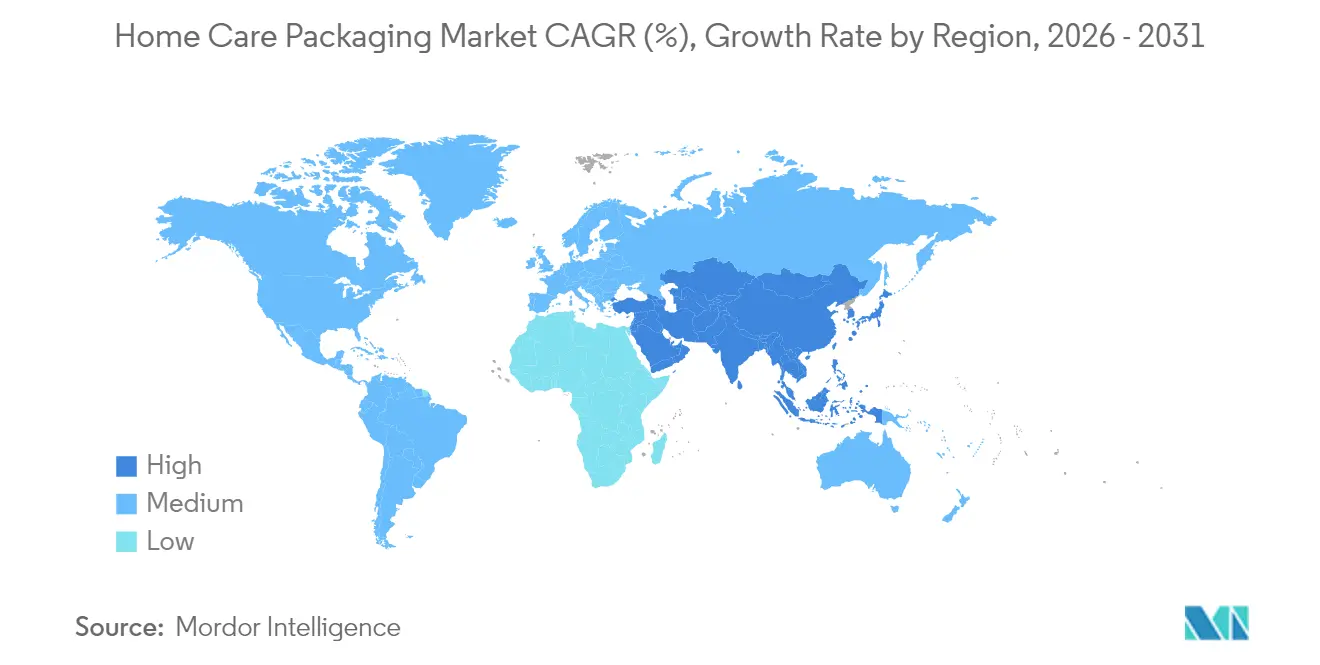
| Fastest Growing Market | Asia-Pacific |
| Largest Market | Asia-Pacific |
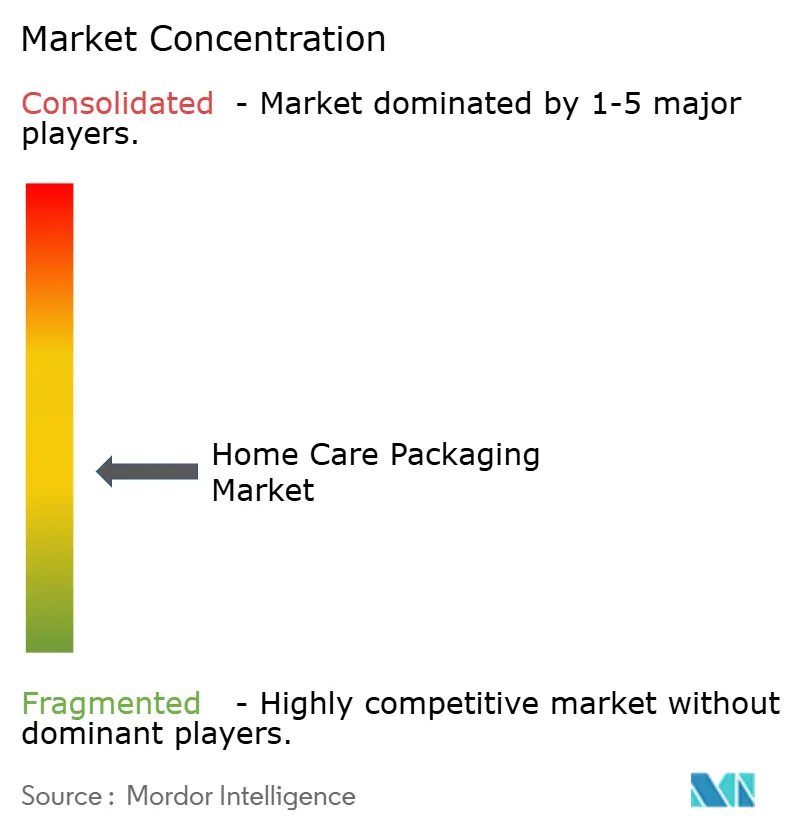
| Market Concentration | Medium |
Major Players *Disclaimer: Major Players sorted in no particular order Image © Mordor Intelligence. Reuse requires attribution under CC BY 4.0. | |
Home Care Packaging Market Analysis by Mordor Intelligence
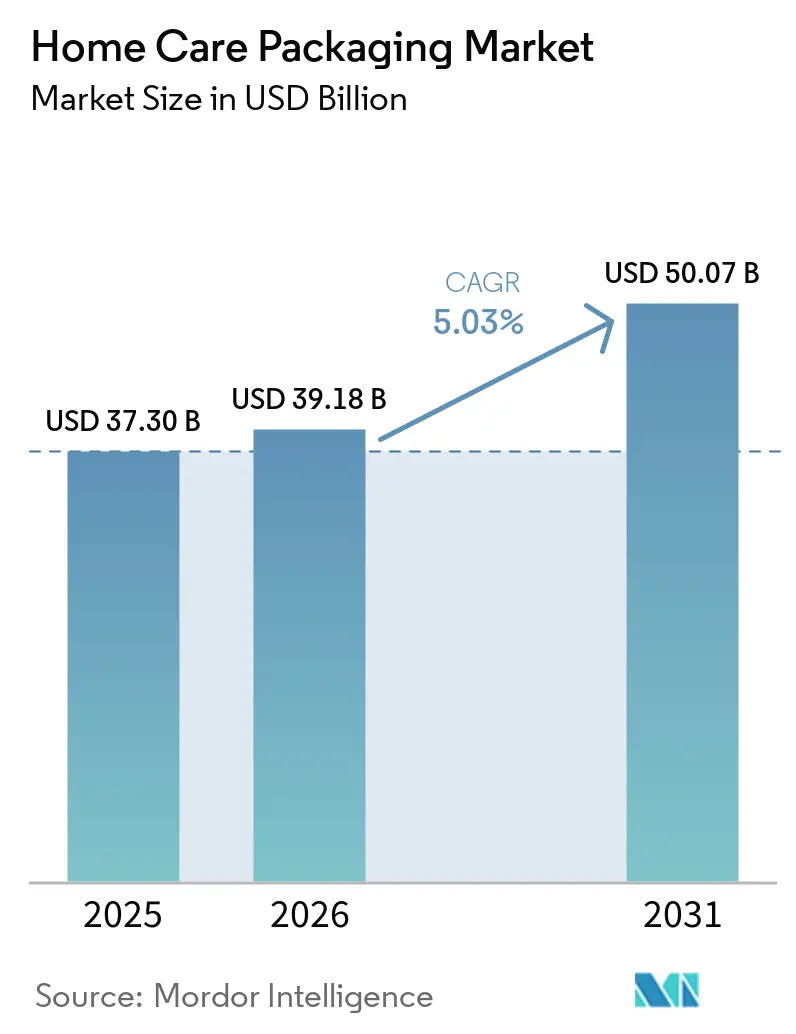
The home care packaging market size in 2026 is estimated at USD 39.18 billion, growing from 2025 value of USD 37.3 billion with 2031 projections showing USD 50.07 billion, growing at 5.03% CAGR over 2026-2031. This expansion reflects steady demand for hygiene products, widening e-commerce penetration, and policy support for sustainable solutions. Momentum is reinforced by the European Union’s Packaging and Packaging Waste Regulation, effective February 2025, which requires all packs to be recyclable by 2030.[1]Hazel O'Keeffe, “The New EU Packaging and Packaging Waste Regulation – Highlights and Challenges Ahead,” PackagingLaw.com, packaginglaw.com Material-price swings, especially in polyethylene and polypropylene, add cost volatility yet stimulate lightweighting and bio-based innovation. Asia-Pacific retains dominance thanks to urbanisation and rising disposable incomes, while the Middle East posts the quickest regional growth on the back of economic diversification. Corporate consolidation—illustrated by Amcor’s USD 8.4 billion takeover of Berry Global—signals a push for scale as producers tackle raw-material inflation and looming Extended Producer Responsibility (EPR) fees.
Key Report Takeaways
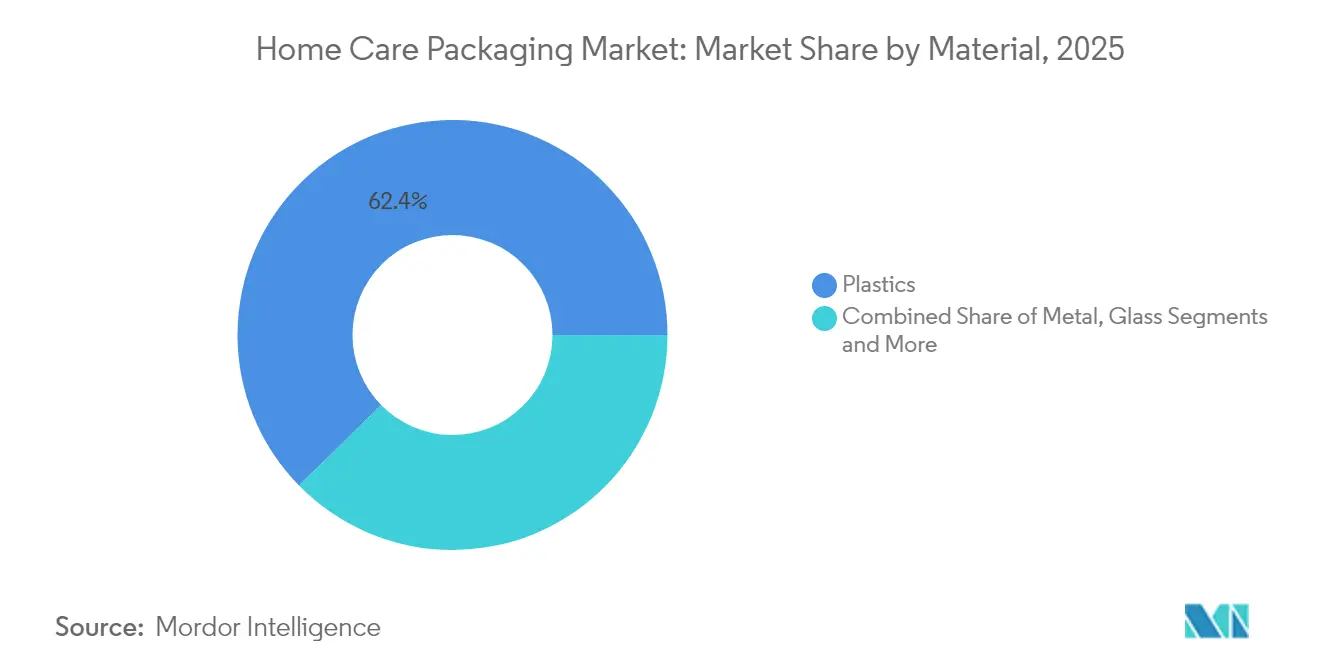
- By material, plastics led with 62.35% of home care packaging market share in 2025; bioplastics are projected to climb at a 11.55% CAGR to 2031.
- By packaging type, bottles and rigid containers held 46.40% revenue in 2025, while refill pouches and dispensing systems are set to expand at a 9.42% CAGR through 2031.
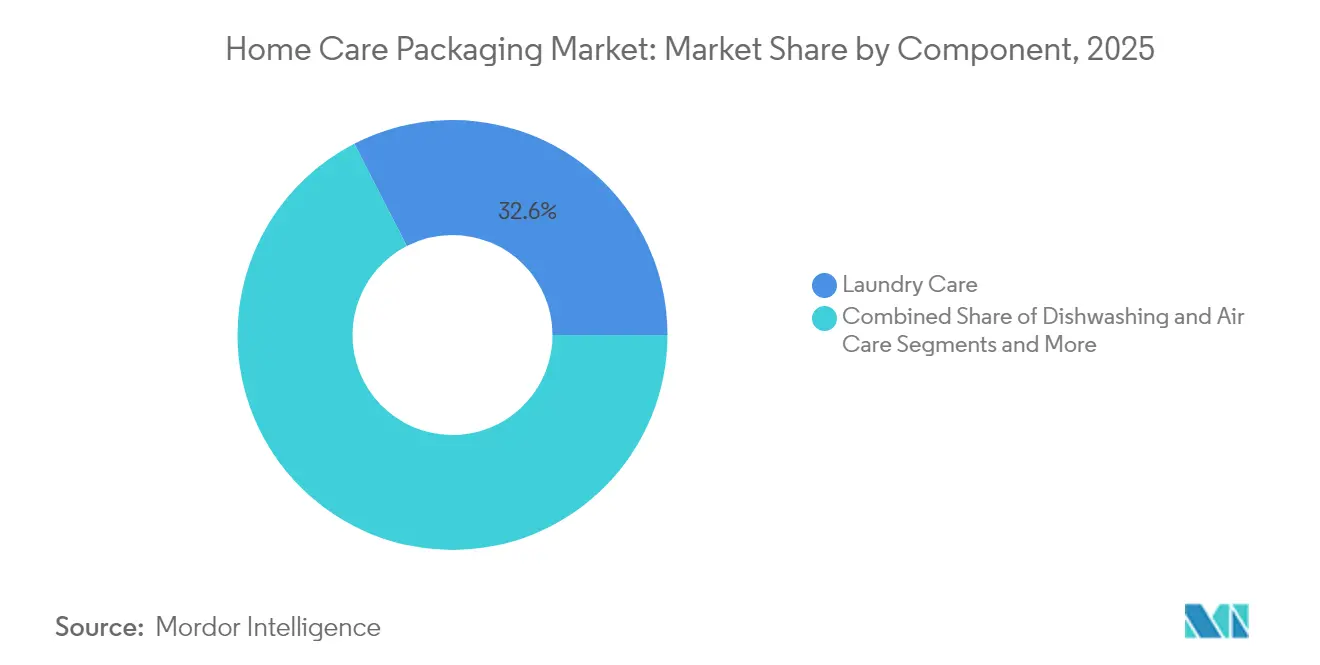
- By product category, laundry care captured 32.55% of the home care packaging market size in 2025; air care is the fastest-growing segment with an 7.88% CAGR between 2026-2031.
- By form factor, liquids dominated with 45.05% share of the home care packaging market size in 2025; capsules and tabs will rise at an 10.43% CAGR over the forecast horizon.
- Regionally, Asia-Pacific accounted for 38.45% of the home care packaging market share in 2025, while the Middle East is forecast to record a 7.41% CAGR to 2031.
Note: Market size and forecast figures in this report are generated using Mordor Intelligence’s proprietary estimation framework, updated with the latest available data and insights as of 2026.
Market Trends and Insights
Drivers Impact Analysis of Home Care Packaging Market*
| Driver | (~) % Impact on CAGR Forecast | Geographic Relevance | Impact Timeline |
|---|---|---|---|
| Rising premiumisation and brand-led SKU proliferation | +1.2% | Global (North America, APAC) | Medium term (2-4 years) |
| Circular-economy mandates for recyclable mono-material packs | +0.8% | Europe, North America expanding to APAC | Long term (≥ 4 years) |
| E-commerce boom accelerating demand for shatter-proof formats | +0.9% | Global (North America, APAC) | Short term (≤ 2 years) |
| Urban Asian households favouring single-dose convenience packs | +0.6% | APAC core, spill-over to MEA | Medium term (2-4 years) |
| IoT-enabled smart dispensers and refill ecosystems | +0.4% | North America & EU, pilots in APAC | Long term (≥ 4 years) |
| Source: Mordor Intelligence | |||


Rising Premiumisation and Brand-Led SKU Proliferation
Demand for upscale cleaning products drives packaging innovation beyond functional containment. Brands deploy advanced barriers, smart closures, and distinctive aesthetics to justify higher price points. Tide evo fiber tiles, launched in 2024, replace plastic with a dissolvable six-layer fiber structure and target premium shoppers.[2]Melissa Griffen, “Plastic Packaging Eliminated with New Tide Detergent Tiles,” Packaging World, packworld.com Strong growth in Middle East beauty spending fuels similar expectations for home care packs. Manufacturers of dispensing and specialty closures benefit, as evidenced by Silgan’s significant sales growth. Premiumization simultaneously promotes smaller, design-rich formats and boosts margin resilience against resin cost swings. The trend cuts across developed and emerging markets, reshaping shelf competition within the home care packaging market.
Circular-Economy Mandates for Recyclable Mono-Material Packs
Regulators push producers toward designs that enable straightforward recycling. The EU’s PPWR stipulates 100% recyclability by 2030 and 30% recycled content for single-use plastic beverage bottles, compelling shifts to mono-material structures. Unilever’s paper-based detergent bottle underscores how corporate R&D aligns with looming quotas. Sixty-three countries now run formal EPR schemes, moving disposal costs from municipalities to producers and rewarding design-for-recycling approaches. Converters positioned in mono-material films gain pricing power, whereas multi-layer barrier suppliers must retool or face declining order books. Over the long term, compliance investments are expected to stabilise and support the broader home care packaging market trajectory.
E-commerce Boom Accelerating Demand for Shatter-Proof Formats
Online retail channels require packs capable of surviving extra handling, temperature swings, and longer distribution cycles. Returnable transport packaging in Asia-Pacific is projected to experience significant growth during the forecast period. Packaging lightweighting reduces shipping costs, yet rising corrugated prices push converters to optimize designs. Damage-resistant flexible films, reinforced PET bottles, and dual-purpose secondary packs gain traction. Personal care packaging, closely related to the home care packaging market, has expanded substantially, with a significant share of sales generated online. The requirement for omnichannel readiness accelerates demand for shatter-proof solutions within the home care packaging market.
Urban Asian Households Favouring Single-Dose Convenience Packs
Smaller living spaces, busy lifestyles, and heightened hygiene awareness propel single-dose formats in Asia. Unit-dose laundry capsules minimise wastage and ease storage, matching the needs of Japan’s 7.2 million caregiving households forecast for 2024. Water-soluble films, precise dispensing caps, and compact rigid containers underpin growth. Higher per-unit margins compensate for lower volumes, appealing to brands seeking value growth in the home care packaging market. As convenience culture spreads to Southeast Asia and the Middle East, unit-dose popularity is likely to broaden beyond laundry into dish- and surface-care segments. Machinery suppliers focused on small-format filling lines, thus encountering new revenue streams.
Restraints Impact Analysis of Home Care Packaging Market*
| Restraint | (~) % Impact on CAGR Forecast | Geographic Relevance | Impact Timeline |
|---|---|---|---|
| Petro-chemical resin price volatility | -0.7% | Global (North America, Europe) | Short term (≤ 2 years) |
| Extended-producer-responsibility fees in Europe | -0.3% | Europe expanding to North America | Medium term (2-4 years) |
| Scarcity of food-grade PCR resin for brand pledges | -0.4% | Global, developed markets | Long term (≥ 4 years) |
| Source: Mordor Intelligence | |||
Petro-chemical Resin Price Volatility
Fluctuating polyethylene and polypropylene prices compress converter margins and complicate pricing strategy. PE registered several 5 ¢/lb hikes in 2024 - 2025 due to outages and feedstock spikes. PET saw a 1.1% jump after Tropical Storm Alberto disrupted supply. Smaller converters lack hedging tools, forcing cost-pass through or margin erosion in the home care packaging market. Volatility accelerates interest in lightweighting and alternative substrates. Converters able to shift to bio-based or recycled inputs faster can cushion against fossil-fuel price swings.
Extended-Producer-Responsibility Fees in Europe
EPR rules recast packaging economics by assigning waste-management costs to producers. France mandates detailed consumer information, while Spain requires sorting symbols on packs. These fees increase overall packaging expenditures. Oregon and Colorado have introduced similar frameworks, signaling broader global adoption. Brands must invest in compliance databases and redesign hard-to-recycle formats. Although these requirements create near-term cost pressure and affect profitability, they drive long-term alignment with circular-economy goals and support healthier growth prospects for the home care packaging industry.
*Our forecasts treat driver/restraint impacts as directional, not additive. The impact forecasts reflect baseline growth, mix effects, and variable interactions.
Home Care Packaging Market Segment Analysis
By Material:
Bioplastics Gain Ground Amid Plastic DominancePlastics captured 62.35% of the home care packaging market share in 2025, underlining their entrenched role in cost-effective, barrier-rich applications. The segment continues to leverage mature supply chains and versatile processing techniques. However, bioplastics, propelled by a 11.55% CAGR, increasingly command design conversations as regulators and brands prioritise renewable feedstocks.
Paper and paperboard regain relevance through high recycling rates and lower carbon footprints, yet weight and moisture sensitivity keep them from mainstream liquid detergents. Metal retains niche importance in pressurised aerosols, and glass sees marginal use due to breakage risks in e-commerce. Bioplastics’ momentum spurs investment in PLA and PHA resins, with converters trialling mono-material films that still meet oxygen-barrier demands. As recycled-content mandates tighten, compatibilised blends of PCR and bio-based inputs can bolster supply stability and cost competitiveness for the home care packaging market.


By Packaging Type:
Refill Systems Disrupt Rigid ContainersBottles and rigid containers accounted for 46.40% of the home care packaging market size in 2025, reflecting legacy production lines and consumer familiarity with traditional formats. Lightweight HDPE and PET bottles remain prevalent thanks to excellent drop-impact resistance and brand-billboard capability. Yet refill pouches and dispensing systems, expanding at a 9.42% CAGR, are redefining value propositions through material savings and circular-loop convenience. Aptar’s recyclable airless bottle for dermocosmetics and B-CAP’s eco dosing cap demonstrate how innovation modernises even established formats.
Pouches deliver logistics efficiencies, shaving freight weight and cubic volume, crucial for e-commerce profitability. Reusable dispensers coupled with lightweight refill sachets reduce life-cycle emissions, resonating with EPR fee structures. Meanwhile, metal cans and stick packs maintain roles in specialty cleaners requiring specific delivery modes. Across all types, converters integrate QR codes for recycling instructions, aiming to ease consumer participation in circular schemes and boost compliance metrics that underpin the future growth of the home care packaging market.
By Product Category:
Air Care Accelerates in a Laundry-Led MarketLaundry care secured 32.55% of the home care packaging market size in 2025, bolstered by frequent-use cycles and brand loyalty. Capsules, concentrated liquids, and refill packs permeate the segment, while P&G’s Tide evo tiles hint at a plastic-free future. Air care, tracking an 7.88% CAGR to 2031, capitalises on fragrance innovation and heightened indoor-air-quality focus. Scent booster revenues in Europe alone are forecast to reach EUR 3 billion by 2028.
Dishwashing, surface, and toilet cleaners post steady gains via compact concentrates and antimicrobial claims. Insecticides confront tighter regulations, spurring a shift to bio-actives and child-safe closures. Cross-category functionality emerges, with products combining cleaning, fragrance, and sanitising benefits, placing new performance demands on barrier films and vented caps. These dynamics keep pack developers busy sustaining differentiation within the competitive home care packaging market.
By Form Factor:
Capsules Challenge Liquid SupremacyLiquids represented 45.05% of the home care packaging market share in 2025, anchored by established filling infrastructure and consumer familiarity. Yet capsules and tabs, advancing at 10.43% CAGR, offer spill-free handling and exact dosing, limiting overuse while elevating unit economics. Water-soluble polyvinyl alcohol films eliminate secondary waste, aligning with sustainability pledges. Powder, gel, and foam formats hold niche relevance for heavy-duty cleaners and cling applications. Smart freshness sensors embedded in caps or sachets provide real-time quality assurance, enhancing value perception.
Continuous-thread from liquids to capsules accelerates demand for high-precision dosing equipment and moisture-barrier pouches. Form factor diversity also helps brands segment price tiers, keeping entry-level SKUs accessible while upselling premium convenience packs. This breadth supports revenue stability and encourages ongoing R&D investment inside the home care packaging market.
Geography Analysis
APAC Home Care Packaging Market
Asia-Pacific dominated with 38.45% home care packaging market share in 2025, reflecting rapid urbanisation, e-commerce growth, and middle-class expansion in China, India, and Southeast Asia. China’s forthcoming rules for recycled food-contact plastics will set new compliance benchmarks regionally. Japan’s ageing society drives demand for easy-open packs and single-dose detergents suited to smaller households. Investment in regional packaging machinery is forecast to surpass USD 18 billion by 2024, underpinning scale-up for converters.
Middle East Home Care Packaging Market
The Middle East is the fastest-growing territory, with a 7.41% CAGR through 2031, supported by premiumisation in Gulf Cooperation Council markets. Regional beauty and personal-care outlays—from which spillover demand for upscale home-care packs emerges—will hit USD 47 billion by 2027. Hot climates necessitate barrier enhancements and UV-stable pigments, shaping supplier specifications. Saudi Arabia’s 34.6% share of GCC pharmaceutical sales highlights parallel opportunities for hygienic primary packs.
North America, Europe and LATAM Home Care Packaging Market
North America and Europe remain pivotal yet face tightening regulatory nets. The EU PPWR alone drives redesign budgets for global brand owners. Meanwhile, Oregon and Colorado introduce EPR schemes by July 2025, broadening producer-funded recycling models. Latin America shows emerging promise: higher raw-material costs push paper-pack prices up in 2025, signalling market maturation fastmarkets.com. Collectively, region-specific rules and consumer behaviours maintain nuanced growth paths across the home care packaging market.

Regulatory Landscape
Regulation is shifting toward recyclability-by-design, recycled-content use, and producer responsibility, with Europe setting the tightest requirements for home care packaging. The EU Packaging and Packaging Waste Regulation (PPWR, Regulation (EU) 2025/40) entered into force on 11 February 2025, and core provisions apply from 12 August 2026, moving compliance from planning into operational enforcement timelines across bottles, pouches, cartons, and dispensing components used for home care products.
Beyond EU-wide rules, implementation is supported by Commission guidance and further standardization work, including a Commission deadline of 12 February 2026 to request European standardisation bodies to develop an EU-wide standard for home compostability. The PPWR also sets harmonised labelling milestones (notably 12 August 2028 for harmonised material-composition labelling, subject to implementing acts) and permits member states to require home-compostability in the absence of harmonised standards, which can widen fragmentation in packaging specifications and complicate SKU rationalization across the region.
Competitive Landscape
Industry consolidation is reshaping rivalry. Amcor’s integration of Berry Global forms a USD 24 billion revenue leader and captures anticipated USD 650 million in synergies. 2024 also saw Smurfit Kappa agree to buy WestRock for USD 12.7 billion and International Paper acquire DS Smith for USD 7.2 billion, illustrating a quest for scale and geographic breadth. These deals enable procurement leverage, wider technology portfolios, and stronger bargaining power against fluctuating resin costs—advantages critical in the home care packaging market.
Technology capability increasingly separates leaders from followers. Silgan’s purchase of Weener Packaging, boosting its dispensing-solution pipeline, led to a 22% year-on-year sales jump in Q4 2024. Patent filings for connected dispensers, automated inventory systems, and recyclable airless pumps underscore R&D intensity. Companies able to merge smart functionalities with recyclability gain first-mover edge.
Resource security and recycling capacity emerge as battlegrounds. Scarcity of food-grade PCR propels pre-buy contracts and joint ventures with recyclers. Firms investing in advanced sorting technologies or chemical recycling will lock in circular-economy readiness. White-space opportunities exist in bio-based barrier coatings, closed-loop refill infrastructures, and AI-driven predictive maintenance for filling lines, offering pathways to differentiation within the home care packaging industry.
Home Care Packaging Industry Leaders
Amcor PLC
Sonoco Products Company
Ball Corporation
RPC Group
Winpak Ltd
- *Disclaimer: Major Players sorted in no particular order
Home Care Packaging Market Companies Covered in this Report
- Amcor plc
- Ball Corporation
- RPC Group (Berry Global)
- Winpak Ltd
- Aptar Group Inc.
- Sonoco Products Company
- Silgan Holdings
- Constantia Flexibles GmbH
- DS Smith plc
- Can-Pack SA
- ProAmpac LLC
- Berry Global Group
- Mondi plc
- Huhtamaki Oyj
- Smurfit Kappa Group
- Sealed Air Corp.
- WestRock Company
- Albea Group
- Gerresheimer AG
- Tetra Pak

Market Opportunities and Future Outlook
Compliance-driven redesign is creating whitespace in mono-material refill packaging, paper-based structures for concentrates and unit-dose formats, and dispensing systems designed around recyclability. Brand actions in 2026 provide current evidence of this shift: Reckitt moved Finish dishwashing tablets in Australia to a 75% paper-based, kerbside recyclable pack (April 2026), while Kao Industrial (Thailand) commercialized a mono-material, 100% recyclable refill bag for Magiclean Floor Cleaner with SCGP, SCGC, and Dow (June 2026). These moves support demand for heat-sealable recyclable films, barrier coatings that fit mono-material recycling streams, and conversion capacity tailored to refill and concentrate SKUs.
Carton-based and hybrid renewable/PCR polymer structures are also gaining traction in home care, alongside more complex closures that enable premiumisation without breaking recyclability requirements. Orkla Home and Personal Care broadened its Klar detergent rollout in Elopak D-Pak cartons using a mix of post-consumer recycled polyethylene and bio-circular polyethylene (June 2026), and P&G introduced Tide evo detergent tiles in recyclable paper packaging (February 2026). With PPWR applying from 12 August 2026 and tightening packaging design and substance restrictions, suppliers that can qualify compliant materials, inks/adhesives, and dispensing components across regions can find near-term entry points via reformulation and packaging revalidation programs at global brand owners.
Recent Industry Developments in Home Care Packaging Market
- June 2026: Reckitt launched a 75% paper-based, kerbside recyclable pack for Finish dishwashing tablets in Australia, replacing plastic-heavy formats for a high-velocity home care SKU. The move expands the use case for paper-based structures and coating/adhesive systems that maintain barrier and shelf performance while meeting recyclability expectations.
- May 2026: Amcor announced continuation of production for bespoke 2 kg and 3 kg refillable containers used by Ocado Retail in the UK reusable packaging project, including everyday categories such as washing liquid. Extending the pilot supports scale learning on durable-container specifications, cleaning/return logistics, and refill-format interoperability for home care products.
- December 2024: Smurfit WestRock invested USD 40 million in a plant expansion in Warwick, Quebec. The added capability supports supply for corrugated and paper-based packaging formats used across home care distribution, including e-commerce-ready secondary packaging.


Home Care Packaging Market Report Scope and Research Methodology
Market Definition and Coverage
This market covers packaging used to store, protect, dispense, and ship home care products like laundry care, dishwashing, surface and toilet cleaners, air care, insecticides, and polishes, measured in value terms for primary packs and related secondary packs.
Scope exclusions: Industrial and institutional bulk packs above 10-liter capacity are excluded.
Segments Covered in This Report
- By Material
- Plastics
- Paper and Paperboard
- Metal
- Glass
- Bioplastics
- By Packaging Type
- Bottles and Rigid Containers
- Pouches and Bags
- Cartons and Corrugated Boxes
- Metal Cans and Aerosols
- Refill Pouches and Dispensing Systems
- Stick Packs and Sachets
- By Product Category
- Laundry Care
- Dishwashing
- Surface and Toilet Cleaners
- Air Care
- Insecticides
- Polishes and Specialty Cleaners
- By Form Factor
- Liquids
- Powders
- Capsules/Tabs
- Gels
- Sprays/Foams
- By Geography
- North America
- United States
- Canada
- Mexico
- South America
- Brazil
- Argentina
- Rest of South America
- Europe
- United Kingdom
- Germany
- France
- Italy
- Spain
- Russia
- Rest of Europe
- Asia-Pacific
- China
- Japan
- India
- South Korea
- Australia and New Zealand
- Rest of Asia-Pacific
- Middle East
- Israel
- Saudi Arabia
- United Arab Emirates
- Turkey
- Rest of Middle East
- Africa
- South Africa
- Egypt
- Nigeria
- Rest of Africa
- North America
Data Sources, Market Sizing, and Validation
Desk Research
Desk research was used to set the outer boundaries of demand and keep assumptions realistic before we moved into interviews. We reviewed public references such as UN Comtrade and national customs portals for trade direction, the US EPA and the European Commission for packaging and chemical labeling context, and sources like the World Bank and OECD for macro indicators linked with home care consumption.
To connect packaging demand with end-use activity, we also read packaging association releases and sustainability roadmaps, along with annual reports, investor decks, and reputable press coverage from packaging converters and home care product owners. For cross-checking company footprints and estimated packaging exposure, we used paid subscriptions focused on company financials and intelligence, news and financials, and an import-export shipment-level database where it helped validate flows of packaging materials and formats. The sources listed here are illustrative only, and many other public documents and datasets were also referenced for data collection, validation, and research clarification.
Primary Interviews and Surveys
Primary work centered on interviews and surveys with packaging producers, material suppliers, converters, and downstream stakeholders that purchase or specify packs for home care brands. Inputs were gathered across APAC, EMEA, and the Americas, so the model reflects local format preferences, regulatory pressure points, and observed price movement patterns, and then the assumptions were triangulated back to the desk indicators.
Distribution of primary research fieldwork respondents
| Company type | Respondent position | Region |
|---|---|---|
| Top tier: 27% | CXOs: 18% | APAC: 41% |
| Mid tier: 54% | Functional/Unit leaders: 38% | EMEA: 36% |
| Smaller Players: 19% | Managers: 44% | Americas: 23% |
Market-Sizing & Forecasting
Sizing was built using a top-down demand reconstruction, where home care consumption signals are converted into packaging value using pack-format mix and typical material intensity, followed by price mapping at the format and material level. The total was then corroborated with selective bottom-up approximations, mainly checks against supplier and converter revenue exposure and sampled ASP x volume calculations for common formats such as bottles, pouches, and metal cans, which helped us adjust outliers.
Key inputs used in the model included home care category volumes (laundry, dishwashing, surface cleaners, air care, and insecticides), pack-format shares (rigid versus flexible, and refill penetration), resin and paper price direction, lightweighting and recycled content targets that affect material usage, and e-commerce shipment mix that changes secondary packaging needs. Where direct volume signals were thin for a sub-region or niche format, proxy variables like household spending and trade-linked material availability were applied and then retested in interviews.
Forecasts were produced using scenario analysis supported by variable-level outlooks gathered from industry participants. The scenarios were anchored to expected shifts in refill adoption, sustainability compliance timelines, and packaging price progression by material. We kept the model steps repeatable so the totals can be explained and stress-tested with clear inputs rather than hidden adjustments.
Data Validation & Update Cycle
Outputs were checked through triangulation across three layers: category demand signals, packaging mix assumptions, and implied pricing, so extreme jumps were flagged early. Variance checks were run by region and by major format, and anomalies triggered a second look at the underlying drivers, followed by targeted re-contacts with respondents when needed.
Before sign-off, the model and narrative go through multi-step analyst reviews so the logic matches what is happening on the ground and in public data. The report is refreshed annually, and interim updates are made when material events occur, such as major regulation changes or sharp raw material price swings. Right before delivery, an analyst completes a fresh pass so clients receive the latest updated view.
Mordor Intelligence's Homecare Packaging Market Size Versus Other Published Estimates
Published market values for homecare packaging often differ because each publisher defines home care product coverage in its own way, and then counts packaging layers differently across primary and secondary packs. Differences also show up when one model uses detailed pack-format mix and pricing by material, and another uses broader packaging totals with fewer adjustment steps.
Industrial and institutional bulk packs above 10-liter capacity sit outside Mordor Intelligence's scope, and totals can look higher when those large-format uses are blended into the same demand pool. The spread also comes from whether refill pouches are valued as a standalone format versus being grouped into flexible packaging as a whole, how fast resin and paper price changes are carried forward, and whether the market is refreshed only on a fixed calendar versus being re-checked after major raw material moves.
Benchmark comparison
| Source | Market Size | Gaps in Research Methodology |
|---|---|---|
| Mordor Intelligence | USD 39.18 B (2026) | |
| Industry Publisher A | USD 45.17 B (2025) | Uses an earlier base year and appears to apply wider home care coverage across products and packaging layers, which can raise the starting value before later-year mix and price assumptions are applied. |
| Industry Publisher B | USD 33.92 B (2026) | Starts from a lower 2026 value that likely reflects tighter inclusion of formats or more conservative material price progression assumptions across plastics and paper-based packaging. |
Taken together, the figures mainly diverge because of scope edges, base-year alignment, and how packaging mix and material pricing are translated into value. When the same set of demand drivers is carried through consistent conversion steps and then reviewed against interview feedback, the market size becomes easier to replicate and explain year to year.


Key Questions Answered in the Report
What is the current size of the home care packaging market?
The market is valued at USD 39.18 billion in 2026 and is projected to reach USD 50.07 billion by 2031 at a 5.03% CAGR.
Which region leads the home care packaging market?
Asia-Pacific accounts for 38.45% of global revenue owing to urbanisation, rising incomes, and rapid e-commerce growth.
Why are refill pouches growing faster than rigid bottles?
Refill pouches cut material use, align with circular-economy regulations, and support IoT-enabled dispenser systems, propelling a 9.42% CAGR over 2026-2031.
How do EPR fees affect packaging producers?
Extended Producer Responsibility shifts waste-management costs to brands, raising packaging spend by 2-5% yet incentivising recyclable mono-material designs.
What challenges surround recycled content in home care packs?
Limited availability of food-grade PCR, lengthy regulatory approvals, and higher costs—20-40% above virgin resin—hamper fulfilment of public sustainability pledges.
Page last updated on:


 Your data is secure and never sold or shared.


