
Market Overview
| Study Period | 2020 - 2031 |
|---|---|
| Market Size (2026) | USD 363.58 Billion |
| Market Size (2031) | USD 545.69 Billion |
| Growth Rate (2026 - 2031) | 8.46 % |
| Fastest Growing Market | Asia Pacific |
| Largest Market | North America |
| Market Concentration | Medium |
Major Players *Disclaimer: Major Players sorted in no particular order Image © Mordor Intelligence. Reuse requires attribution under CC BY 4.0. | |
Home Healthcare Market Analysis by Mordor Intelligence
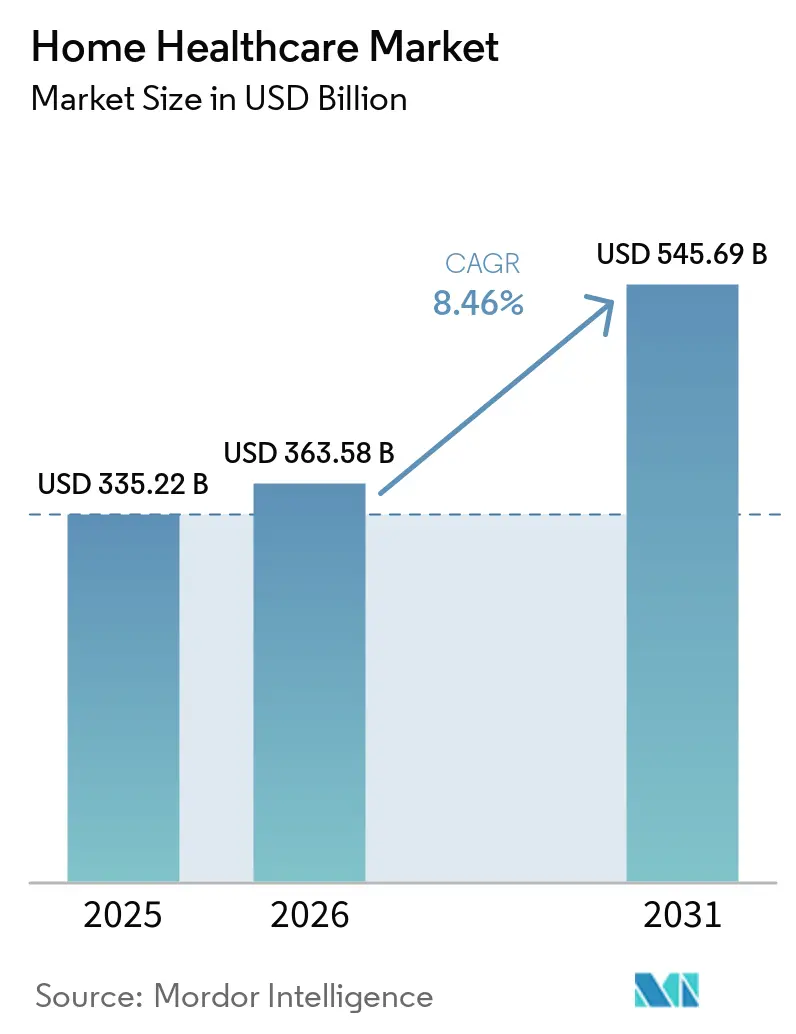
The Home Healthcare Market size was valued at USD 335.22 billion in 2025 and is estimated to grow from USD 363.58 billion in 2026 to reach USD 545.69 billion by 2031, at a CAGR of 8.46% during the forecast period (2026-2031).
This growth profile reflects a convergence of aging populations, favorable reimbursement reforms, and reliable connected-device ecosystems that shift acute and chronic care into residential settings. Equipment continues to anchor revenues, yet an accelerating mix shift toward software platforms and data subscriptions signals a maturing digital layer that agencies and payers increasingly view as essential infrastructure for value-based contracting. Device miniaturization and edge computing lower the cost of in-home diagnostics, widening access in emerging economies while easing bandwidth constraints in rural North America and Europe. At the same time, hospital-at-home programs allow hospitals to bill inpatient rates for care delivered in living rooms, creating a direct incentive for integrated delivery networks to bundle devices, skilled nursing, and telehealth into single episodes of care. Competitive intensity remains moderate to high as incumbents defend share with FDA-cleared algorithms, while venture-backed entrants exploit open APIs and modular sensors to undercut on price without compromising clinical accuracy.
Key Report Takeaways
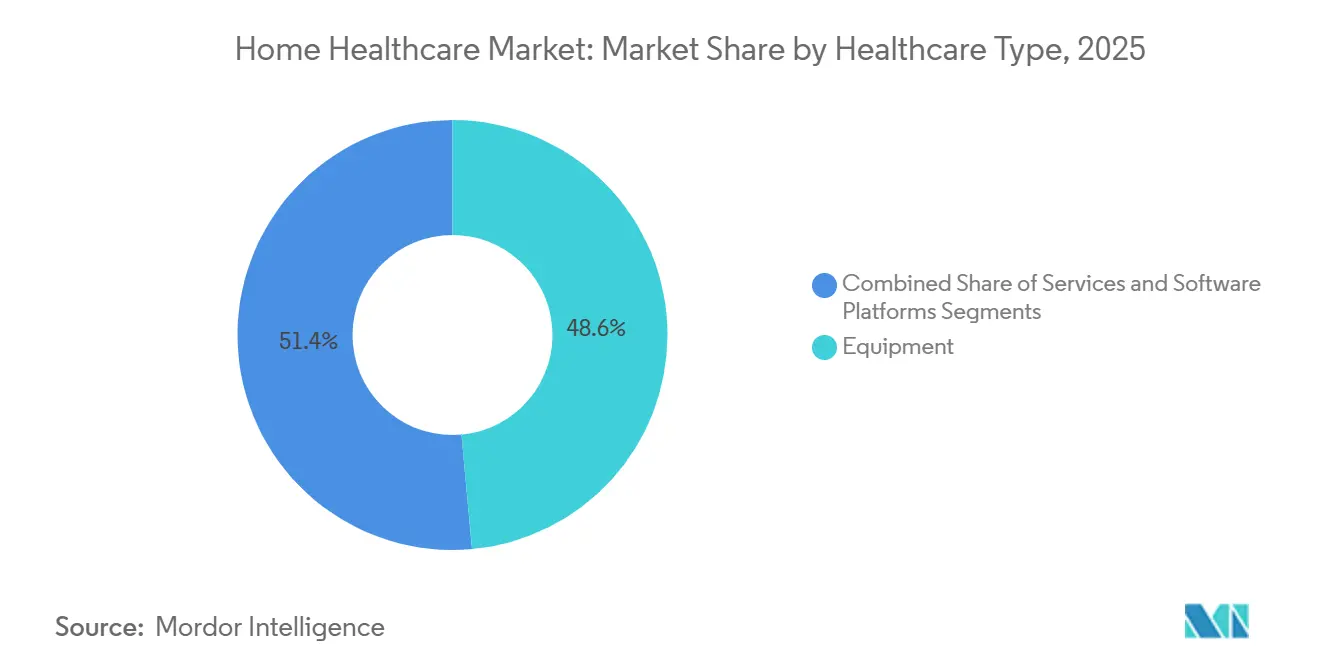
- By healthcare type, Equipment led with 48.56% of home healthcare market share in 2025. Software Platforms are forecast to deliver the fastest segment expansion, advancing at a 12.25% CAGR to 2031.
- By indication, Cardiovascular conditions commanded 26.53% of the 2025 revenue mix, whereas Diabetes is projected to grow at a 10.85% CAGR through 2031.
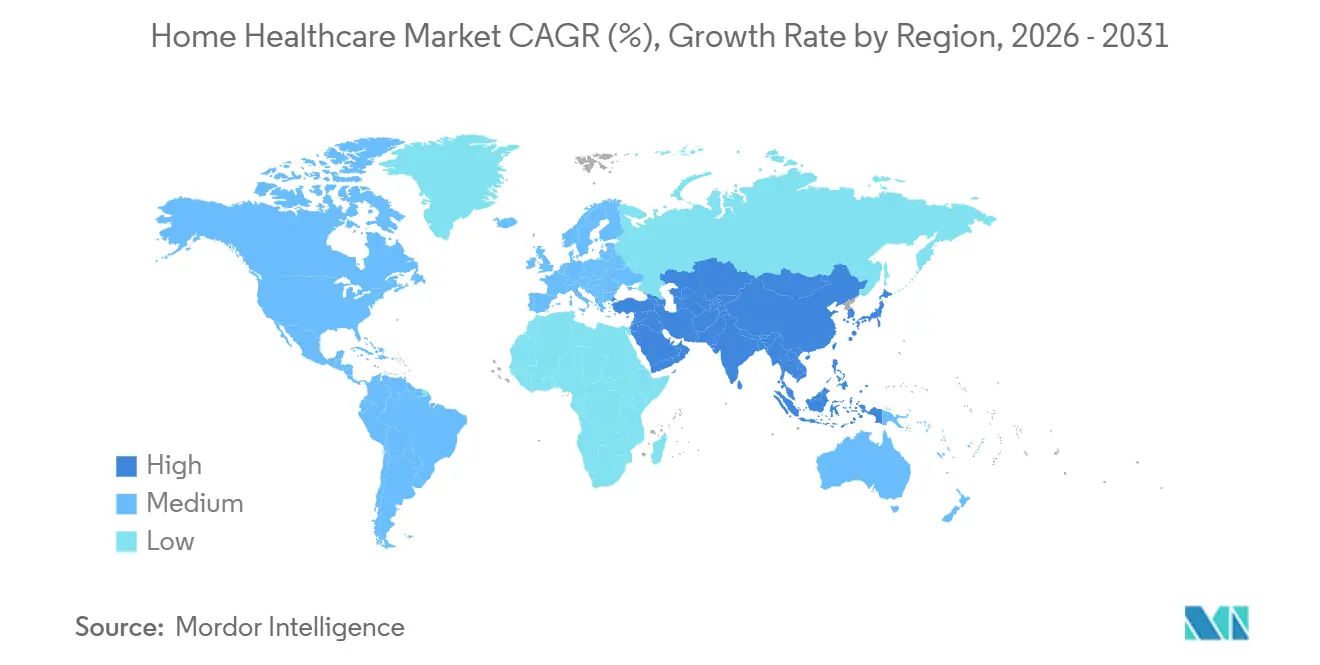
- By geography, North America retained a 42.13% revenue share in 2025, while Asia-Pacific is on track for a 9.51% CAGR between 2026 and 2031.
Note: Market size and forecast figures in this report are generated using Mordor Intelligence’s proprietary estimation framework, updated with the latest available data and insights as of January 2026.
Market Trends and Insights
Drivers Impact Analysis of Home Healthcare Market*
| Driver | (~) % Impact on CAGR Forecast | Geographic Relevance | Peak Impact |
|---|---|---|---|
| Aging populations driving chronic-care demand | +2.1% | Global, concentrated in Japan, Germany, Italy, South Korea | Long term (≥ 4 years) |
| Reimbursement expansion for remote monitoring | +1.8% | North America & EU | Medium term (2-4 years) |
| AI-enabled devices boost proactive home care | +1.5% | North America, Western Europe, APAC urban hubs | Medium term (2-4 years) |
| Shift to "hospital-at-home" models | +1.3% | United States, United Kingdom, Australia | Short term (≤ 2 years) |
| Edge-computing IoT lowers in-home device costs | +0.9% | Global, early adoption in China, India, Southeast Asia | Long term (≥ 4 years) |
| Miniaturized lab-on-chip diagnostics enter home | +0.7% | North America, EU, APAC advanced economies | Long term (≥ 4 years) |
| Source: Mordor Intelligence | |||
Aging Populations Driving Chronic-Care Demand
The World Health Organization estimates that 1.4 billion people will be aged 60 plus by 2030, with 80% residing in low- and middle-income nations where institutional long-term care remains limited. Each added year of life expectancy beyond 75 correlates with three to five additional years of chronic-disease management that is less costly when delivered at home than in skilled-nursing facilities. Japan already spends heavily on community-based integrated care under its long-term care insurance scheme, providing a template for other super-aged societies. In China, the 14th Five-Year Plan mandates a 15-minute radius for elderly community services in urban areas, driving local demand for portable diagnostics and telemedicine that link township clinics to tertiary centers. As similar demographic pivots unfold across Europe and North America, the home healthcare market benefits directly from scaled, policy-backed patient migration out of acute settings.
Reimbursement Expansion for Remote Monitoring
The Centers for Medicare & Medicaid Services permanently added CPT codes 99453, 99454, 99457, and 99458, reimbursing providers for device setup, data transmission, and monthly physiologic review, thus normalizing remote-patient monitoring across urban and rural settings alike[1]. Commercial insurers such as UnitedHealthcare and Humana now pay 85-90% of in-office rates for similar services, closing the margin gap that once hindered physician adoption. The shift converts hardware into a recurring revenue model whereby manufacturers subsidize devices and earn subscription fees, mirroring consumer-wearable economics yet underpinned by clinical-grade accuracy and FDA oversight, strengthening opportunities in the home healthcare market.
AI-Enabled Devices Boost Proactive Home Care
Between 2024 and 2025, the FDA cleared eight algorithms embedded in home-use devices, including Apple Watch atrial fibrillation detection, Eko low-ejection-fraction screening, and Insulet’s Omnipod 5 for automated insulin delivery. Edge processors now let devices run inference locally, trimming latency from seconds to milliseconds and addressing privacy concerns inherent in cloud transmissions. Early results are compelling: ResMed’s Smart Comfort AI cut apnea events and raised therapy adherence by 18 percentage points after its December 2025 clearance.
Shift to Hospital-at-Home Models
CMS’s Acute Hospital Care at Home waiver allows more than 300 hospitals to bill full DRG rates for services delivered in residences, producing 20% lower 30-day readmissions and higher patient satisfaction than traditional admissions. The United Kingdom’s National Health Service similarly targets a 15% reduction in emergency-department crowding through virtual wards that monitor 10,000 concurrent patients. The model blurs equipment and service boundaries, pressuring standalone agencies to integrate vertically or accept subcontractor status.
Restraints Impact Analysis of Home Healthcare Market*
| Restraint | (~) % Impact on CAGR Forecast | Geographic Relevance | Peak Impact |
|---|---|---|---|
| Shortage of skilled home-care clinicians | -1.4% | North America, Western Europe, Australia | Short term (≤ 2 years) |
| Cyber-security & privacy threats to medical IoT | -0.9% | Global, acute in North America & EU | Medium term (2-4 years) |
| Reimbursement rate uncertainty for agencies | -0.7% | United States, fragmented in emerging markets | Short term (≤ 2 years) |
| Lithium-battery supply risk for critical devices | -0.5% | Global, supply-chain bottlenecks in APAC manufacturing hubs | Medium term (2-4 years) |
| Source: Mordor Intelligence | |||
Shortage of Skilled Home-Care Clinicians
The United States faces a projected 78,000-nurse deficit by 2026, and home-health-aide turnover tops 65% in several states, limiting agencies’ capacity to accept new patients even as demand rises. Median aide pay of USD 13.50 per hour lags other service sectors, forcing agencies to raise wages 12-18% since 2024, compressing margins that averaged 3-5% pre-pandemic.
Cyber-Security & Privacy Threats to Medical IoT
In 2024 the FDA required software bills of materials and vulnerability management plans for all networked devices after researchers cataloged 127 exploitable flaws across common insulin pumps and glucose monitors[2]. HIPAA penalties reach USD 1.5 million per breach, pushing smaller manufacturers toward partnerships or exits as compliance costs consume up to 12% of R&D budgets.
*Our forecasts treat driver/restraint impacts as directional, not additive. The impact forecasts reflect baseline growth, mix effects, and variable interactions.
Home Healthcare Market Segment Analysis
By Healthcare Type:
Equipment Anchors Revenue, Software AcceleratesEquipment represented 48.56% of the home healthcare market in 2025, spotlighting the capital intensity of therapeutic gear such as ventilators, dialysis systems, and insulin pumps. Therapeutic equipment revenues gain from Medicare’s policy that reimburses home dialysis at 80-90% of in-center rates, enlarging the home healthcare market size for renal-care technology by routing high-acuity procedures into domestic environments. Diagnostic and monitoring devices become more affordable; fingerstick glucometer average selling prices fell 25% between 2023 and 2025 as continuous glucose monitors captured share, compressing margins for legacy products. Mobility assist equipment faces direct-to-consumer pressure that widens geographic reach but thins distributor profits.
Services constitute the second-largest 2025 slice, yet staffing deficits force agencies to triage high-acuity cases while technology offsets some labor gaps through remote vitals monitoring and tele-therapy. Hospice and palliative care expand steadily as Medicare’s hospice benefit lowers financial barriers, and tele-homecare volumes stay elevated under permanent billing codes. Software platforms, though starting from a smaller base, are forecast to post a 12.25% CAGR through 2031 as electronic visit verification and open FHIR APIs become prerequisites for payer contracts. The FDA’s Software as a Medical Device framework adds regulatory hurdles yet confers clinical credibility that hastens commercial adoption.

By Indication:
Cardiovascular Leads, Diabetes SurgesCardiovascular conditions held 26.53% of home healthcare market share in 2025, aided by validated home blood-pressure cuffs, implantable loop recorders, and AI-enabled electrocardiogram patches that let clinicians titrate therapy remotely. Remote heart-failure monitoring programs reduce 30-day readmissions by up to 30%, making value-based bundles financially attractive for insurers. Meanwhile, diabetes is on track for a 10.85% CAGR, the fastest among tracked indications, thanks to continuous glucose monitors and closed-loop pumps whose mean absolute relative differences now sit below 10%, meeting replacement thresholds for fingerstick calibration. The FDA’s 2025 clearance of Omnipod 5 for Type 2 diabetes enlarged the addressable user base by an order of magnitude, intensifying competition among pump manufacturers.
Respiratory disorders, including sleep apnea, gain from cloud-connected CPAP machines that upload adherence data to satisfy Medicare’s usage rules, while oncology infusion at home reduces hospital facility fees by 40-60% and limits immunocompromised patients’ exposure to pathogens. Wound-care revenue grows with rental models for negative-pressure systems, and neurology is emerging as smartphone-based digital therapeutics prove effective as adjuncts to physical therapy.
Geography Analysis
North America Home Healthcare Market
North America commanded 42.13% of 2025 revenue, powered by 52% Medicare Advantage penetration and CMS waivers that reimburse inpatient-level services rendered at home. Yet clinician shortages constrain capacity: certified-aide turnover exceeds 65%, and agencies often cap referrals, slowing potential expansion despite payer demand. Canada’s funding for home care remains under 4% of total health expenditure, and Mexico’s telemedicine pilots are creating incremental device demand as coverage extends into rural states.
APAC Home Healthcare Market
Asia-Pacific is forecast to lead growth at 9.51% CAGR through 2031, propelled by Japan’s super-aged demographic profile and Kaigo Hoken reforms that fund comprehensive in-home services[3]. China mandates proximal community care, while India’s Production Linked Incentive scheme subsidizes local device manufacturing, slicing retail prices for basic monitors by up to 30%. South Korea and Australia experiment with outcome-tied payment models that reward agencies for avoiding readmissions rather than maximizing visit counts.
Europe Home Healthcare Market
Europe sustains meaningful share, with the United Kingdom’s virtual wards and Germany’s fast-track reimbursements for digital therapeutics broadening access. France’s hospitalisation à domicile handled 120,000 patients in 2024, predominantly for intravenous antibiotics and chemotherapy, underscoring the region’s advanced policy backing. Italy and Spain offer limited public reimbursement, producing a two-tier landscape in which affluent households fund private care while others rely on informal caregivers.
MEA and South America Home Healthcare Market
Smaller yet accelerating markets include the Gulf Cooperation Council states, which invest sovereign capital into smart-home monitoring, and South Africa, where private insurers pilot remote monitoring for HIV adherence. Brazil’s Programa Melhor em Casa treated 200,000 patients in 2024 but remains unevenly distributed, indicating latent demand for devices and software in underserved northern regions.
Regulatory Landscape
Regulation in home healthcare increasingly ties reimbursement eligibility to data integrity, quality reporting, and cybersecurity controls. In the United States, CMS made the Calendar Year 2026 Home Health Prospective Payment System (HH PPS) final rule effective January 1, 2026, and home health agencies continue to operate under federal Conditions of Participation (42 CFR Part 484) with CMS certification and compliance oversight. CMS also expanded program integrity actions in 2026, implementing a six-month nationwide moratorium on new Medicare enrollment for home health agencies effective May 13, 2026, signaling tighter scrutiny of provider entry alongside ongoing Home Health Quality Reporting Program requirements, including maintaining at least a 90% quality reporting compliance rate.
Outside the US, home care quality frameworks are being formalized through both standards and licensing. ISO published ISO 25557:2026 (Ageing societies, care quality for older persons at home and in care facilities), providing a reference point for service design and auditability across aging-care pathways. In the Middle East, the Dubai Health Authority regulates home healthcare services under Law No. 6 of 2018 and links standalone home healthcare licensing to international accreditation expectations, which raises compliance requirements for agencies and embedded device and software workflows used in patient homes.
Competitive Landscape
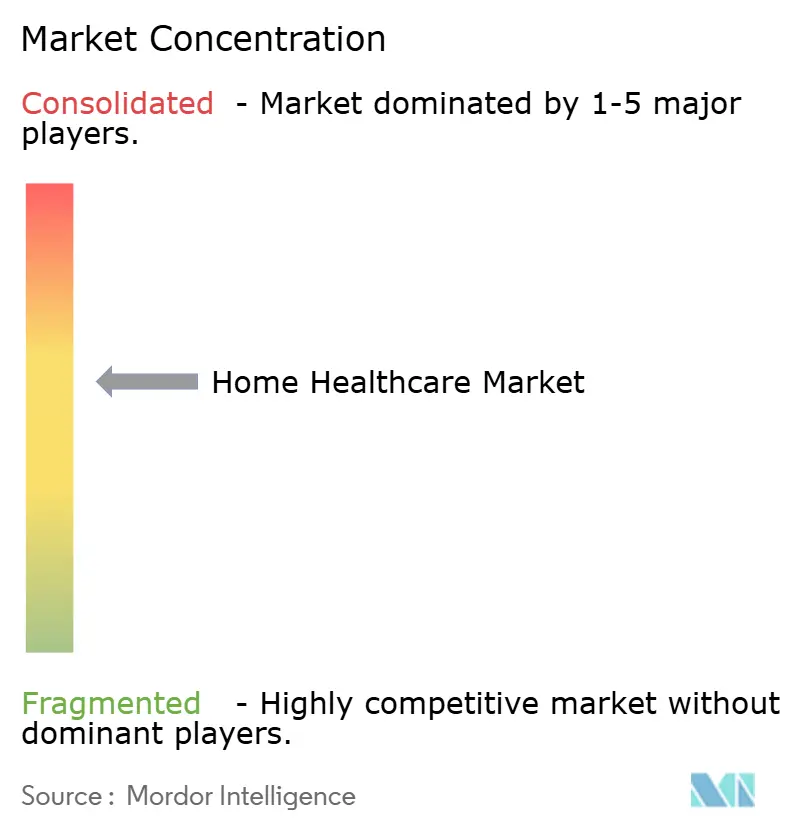
The home healthcare market features moderate-to-high fragmentation. Global device manufacturers, Abbott, Medtronic, Philips, ResMed, Fresenius Medical Care, command high-margin therapeutic niches by coupling proprietary sensors to subscription analytics and consumable supply chains. Integrated payers such as Optum and Humana accelerate vertical consolidation, acquiring agencies to lock in referral flows and expand value-based care footprints. Software start-ups exploit the 21st Century Cures Act’s interoperability mandate to unbundle legacy electronic health records, offering lightweight scheduling, billing, and electronic visit verification modules that sync through FHIR APIs.
Patent filings cluster around AI-driven prediction, energy harvesting for battery life extension, and modular sensor boards that support multi-analyte testing, indicating a transition from single-purpose devices to diagnostic hubs. Compliance overhead becomes a competitive moat; the FDA’s cybersecurity guidance elevates cost structures, favoring incumbents able to amortize spending across broad portfolios. Digital adoption remains uneven: North American and European agencies integrate remote monitoring to satisfy payer metrics, whereas many Asia-Pacific and Latin American operators still depend on manual workflows, yielding a two-speed market where tech-forward players capture value-based contracts and laggards compete mainly on price.
Home Healthcare Industry Leaders
-
Abbott Laboratories
-
Medtronic plc
-
Koninklijke Philips N.V.
-
ResMed Inc.
-
Fresenius Medical Care AG & Co. KGaA
- *Disclaimer: Major Players sorted in no particular order
Home Healthcare Market Companies Covered in this Report
- Abbott Laboratories
- Amedisys Inc.
- Bayada Home Health Care
- Beijing Jiuzhou Tongbang
- Cardinal Health
- CareCentrix Inc.
- Coloplast
- Drive DeVilbiss Healthcare
- Fresenius
- GE HealthCare Technologies Inc.
- Homage Pte Ltd.
- Home Instead Inc.
- Honor Technology
- Invacare
- Kindred at Home (Humana)
- Koninklijke Philips
- LHC Group Inc.
- Linde plc
- Mckesson
- Medtronic
- Omron Healthcare Co., Ltd.
- Resmed
- Sunrise Medical
Market Opportunities and Future Outlook
Payer policy and provider operating models are creating whitespace for platforms that reduce labor intensity and improve documentation quality in the home. CMS reimbursement mechanics for remote monitoring continue to support recurring, software-led monetization, while platform consolidation is targeting automation and workflow efficiency: in April 2026, LivTech acquired Alora Healthcare Systems to integrate AI-powered EMR and automation into post-acute care technology stacks, and in May 2026, Integrated Home Care Services acquired Dina Care to combine utilization management with AI-enabled care coordination. These steps point to ongoing demand for interoperable administration, care coordination, and RPM SaaS layers that help agencies meet reporting requirements, support value-based contracting, and manage clinician shortages.
Scale-building and geographic density also stand out as execution challenges, particularly for hospital-at-home and home health referral flows that require reliable multi-site coverage. In May 2026, Kinderhook Industries closed its acquisition of Enhabit, a home health and hospice provider with 251 home health locations across 35 states, and in June 2026, Deaconess Associations Incorporated (DAI) announced an agreement to acquire 31 home health and hospice agencies from HCA Healthcare across eight states. Alongside hospital-at-home technology deployments by major medtech players, this deal cadence supports opportunities for device OEMs, distributors, and software vendors to bundle monitoring hardware, logistics, and documentation tools into standardized kits for multi-region operators and integrated delivery networks.
Recent Industry Developments in Home Healthcare Market
- May 2026: Philips announced that a consortium led by Philips, with partners Cuviva and Vingmed, was selected by Region Stockholm to deliver technology for a hospital-at-home initiative designed to support up to 15,000 patients annually. The selection reinforces procurement momentum for enterprise-grade remote monitoring and virtual care infrastructure that extends acute pathways into the home.
- February 2026: Medtronic Diabetes announced expanded US access milestones for its MiniMed 780G system, including Medicare access and additional FDA clearances that broaden insulin and indication compatibility when paired with an Abbott sensor. The update strengthens the case for integrated, reimbursable diabetes management ecosystems that shift monitoring and therapy optimization into residential settings.
- December 2025: Philips partnered with Southern NSW Local Health District in Australia to deploy the Respiree wearable monitoring solution to support Hospital in the Home services. The rollout supports broader adoption of continuous monitoring workflows that enable earlier discharge and ongoing escalation management outside traditional facilities.
Home Healthcare Market Report Scope and Research Methodology
Market Definition and Coverage
This market counts the value of medical care and related support delivered at a patient's home, covering in-home clinical services and the connected devices and tools that enable care in the residence.
Scope exclusions: We exclude short-stay hospital-at-home programs that are funded and recorded as inpatient episodes.
Segments Covered in This Report
- By Healthcare Type
- Equipment
- Therapeutic Equipment
- Insulin Delivery Devices
- Home IV Equipment
- Home Dialysis Equipment
- Ventilators & Nebulizers
- CPAP & BiPAP Devices
- Diagnostic & Monitoring Equipment
- Blood-glucose Monitors
- BP Monitors
- Pulse-oximeters
- ECG & Holter Monitors
- Digital Thermometers
- Mobility Assist Equipment
- Wheelchairs
- Walkers & Rollators
- Mobility Scooters
- Therapeutic Equipment
- Services
- Skilled Nursing
- Physical Therapy
- Occupational Therapy
- Speech Therapy
- Hospice & Palliative
- Personal (Unskilled) Care
- Respiratory Therapy
- Tele-homecare & Telehealth
- Software Platforms
- Agency Administration
- Clinical/EHR Platforms
- Remote-patient Monitoring SaaS
- Equipment
- By Indication
- Cardiovascular
- Diabetes
- Respiratory
- Cancer
- Wound-care
- Neurological Disorders
- By Geography
- North America
- United States
- Canada
- Mexico
- Europe
- Germany
- United Kingdom
- France
- Italy
- Spain
- Rest of Europe
- Asia-Pacific
- China
- Japan
- India
- South Korea
- Australia
- Rest of Asia-Pacific
- Middle East & Africa
- GCC
- South Africa
- Rest of Middle East & Africa
- South America
- Brazil
- Argentina
- Rest of South America
- North America
Data Sources, Market Sizing, and Validation
Desk Research
Desk work starts with building the demand context and the care delivery rules that shape what can be counted as home healthcare across countries. We rely on public sources such as the World Health Organization, OECD Health Statistics, Centers for Medicare and Medicaid Services, and national health ministries for spending and service baselines.
To convert that context into workable inputs, we also review provider and manufacturer disclosures, annual reports, investor presentations, and audited filings, and then cross-check with reputable press and association publications. For market structure signals, we use paid subscriptions focused on company financials and intelligence, news and financials, patent databases, and an import and export shipment-level database where device flows help sanity-check device-side demand. These desk research sources are illustrative, and many other public and paid references were also used for data collection, validation, and clarification.
Primary Interviews and Surveys
Primary work focuses on validating what is actually delivered in the home, how service lines are priced, and how fast adoption is moving for remote monitoring and therapy at home. We speak with a mix of care providers, device and supply stakeholders, payor-side experts, and industry participants across APAC, EMEA, and the Americas so assumptions from desk work can be challenged, corrected, and then aligned to a consistent market scope.
Distribution of primary research fieldwork respondents
| Company type | Respondent position | Region |
|---|---|---|
| Top tier: 27% | CXOs: 15% | APAC: 52% |
| Mid tier: 55% | Functional/Unit leaders: 33% | EMEA: 30% |
| Smaller Players: 18% | Managers: 52% | Americas: 18% |
Market-Sizing & Forecasting
Sizing starts with a top-down build where health spending and care delivery indicators are used to reconstruct the in-home care demand pool, and then the share that can be served through home healthcare is applied country by country. To keep the outputs realistic, results are corroborated with selective bottom-up checks like sampled device shipments multiplied by average selling prices, channel discussions on recurring consumables, and a limited roll-up of provider revenue pools where disclosures are available.
Inputs used in the model include the aging population base, chronic disease burden that drives long-duration care, home care reimbursement and coverage signals, utilization patterns for skilled nursing and therapy visits, and adoption levels for remote patient monitoring devices. Where a direct data point is missing in a country, we fill gaps using proxy ratios from comparable markets and then re-check the implied per patient or per capita values so the estimate does not drift.
For forecasting, we use scenario analysis supported by a light multivariate regression layer, where demand drivers like demographics and chronic care prevalence are combined with expert views on reimbursement direction and technology adoption. The final forecast is then adjusted when the implied growth conflicts with practical capacity constraints, such as home nurse availability and service delivery limits in certain markets.
Data Validation & Update Cycle
Validation is done through triangulation across independent signals, where modeled totals are compared with country level healthcare spend context, device demand markers, and provider-side growth narratives from interviews. Outliers are flagged, and the assumptions behind pricing, utilization, and coverage are reworked until the variance becomes explainable in plain terms.
Before sign-off, the work goes through multi-step analyst reviews that check arithmetic integrity, year alignment, currency conversion timing, and whether inclusions and exclusions were applied consistently across regions. Reports are refreshed annually, and interim updates are triggered when material policy shifts, reimbursement changes, or major care model changes show up. Right before delivery, a fresh review pass is completed so clients receive the latest updated view.
Mordor Intelligence's Home Healthcare Market Size Compared Against Other Published Estimates
Published market sizes for home healthcare often vary because the term can be used for different care settings, different product baskets, and different pricing bases. Differences also show up when one estimate is anchored on a specific base year, while another leans more on forecast-year assumptions.
The main gap comes from whether hospital-at-home inpatient episodes and adjacent home care activities are counted inside the same revenue pool, which changes the total before any growth math is applied. In line with Mordor Intelligence's scope rules, we keep inpatient-funded pilots outside the market while focusing on in-residence clinical services and enabling devices valued in consistent-year dollars.
Benchmark comparison
| Source | Market Size | Gaps in Research Methodology |
|---|---|---|
| Mordor Intelligence | USD 305.60 B (2024) | |
| Global Consultancy A | USD 416.40 B (2024) | This estimate uses a broader revenue scope that can bundle wider home care and remote or virtual care solutions, and it is less explicit about excluding inpatient-coded hospital-at-home spending, which lifts the starting-year total. |
| Industry Publisher B | USD 343.00 B (2024) | The scope appears to include a wider mix of therapeutic, testing, and mobility products plus multiple service lines, and differences in pricing basis and currency timing can raise the market size even when the care setting remains at-home. |
Across the three figures, the spread is mainly explained by what gets counted as home-delivered healthcare versus adjacent categories, and by how pricing and currency timing are handled in the base year. By keeping the scope rules explicit and re-checking totals against practical utilization and reimbursement signals, our estimate stays traceable to clear variables and repeatable steps.
Key Questions Answered in the Report
What is the projected value of the home healthcare market by 2031?
The market is forecast to reach USD 545.69 billion by 2031, reflecting an 8.46% CAGR over the period.
Which segment is expanding fastest within home-based care offerings?
Software platforms, used for administration, EHR integration, and remote monitoring, are projected to grow at a 12.25% CAGR through 2031.
Why is Asia-Pacific the quickest-growing region?
Policy reforms in Japan and China, coupled with India's device manufacturing incentives, are driving a 9.51% CAGR for the region from 2026 to 2031.
What primary factor restrains service capacity in North America?
A projected shortage of 78,000 registered nurses by 2026 and high home-health-aide turnover restrict agency expansion despite rising demand.
How do hospital-at-home programs affect acute care delivery costs?
Early U.S. pilots show 20% fewer 30-day readmissions and higher patient satisfaction, signaling potential cost savings and quality gains for payers and providers.