
Herpes Simplex Virus Treatment Market Size and Share
Market Overview
| Study Period | 2020 - 2031 |
|---|---|
| Market Size (2026) | USD 3.09 Billion |
| Market Size (2031) | USD 4.41 Billion |
| Growth Rate (2026 - 2031) | 7.37 % |
| Fastest Growing Market | Asia Pacific |
| Largest Market | North America |
| Market Concentration | Medium |
Major Players *Disclaimer: Major Players sorted in no particular order Image © Mordor Intelligence. Reuse requires attribution under CC BY 4.0. | |
Herpes Simplex Virus Treatment Market Analysis by Mordor Intelligence
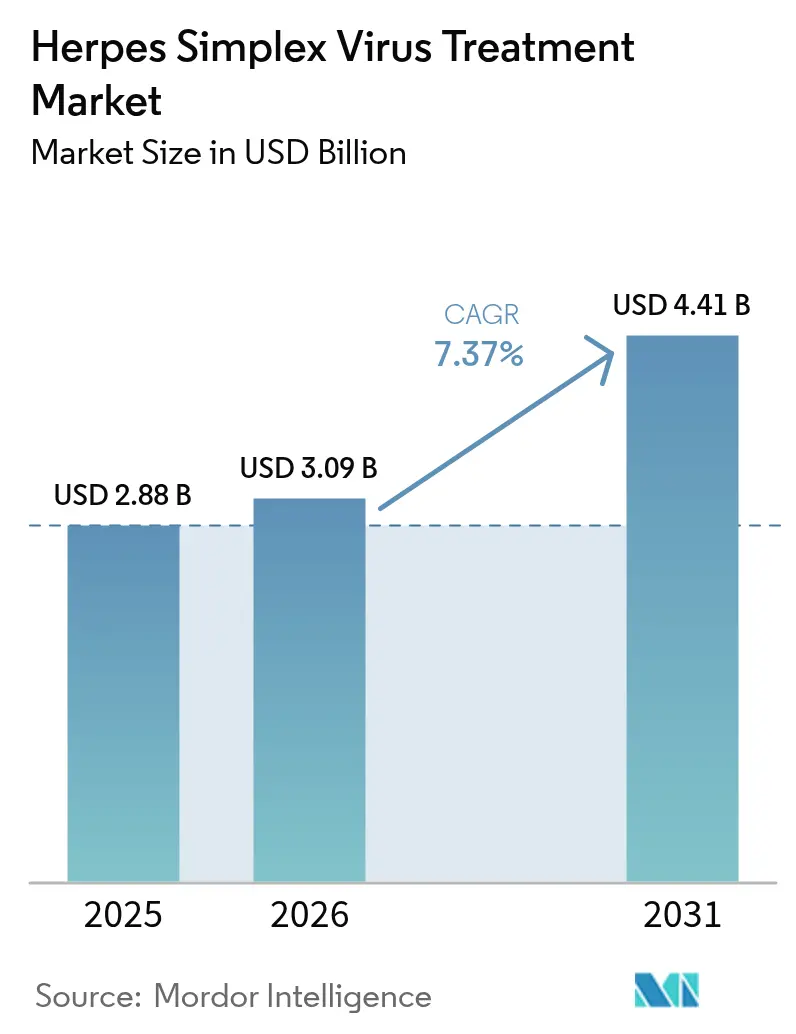
The herpes simplex virus treatment market size in 2026 is estimated at USD 3.09 billion, growing from 2025 value of USD 2.88 billion with 2031 projections showing USD 4.41 billion, growing at 7.37% CAGR over 2026-2031. Demand is being sustained by the dual spread of HSV-1, which remains ubiquitous, and HSV-2, whose faster incidence growth is tied to improved diagnostics and rising sexual-health awareness. Increasing acyclovir resistance in immunocompromised patients is pushing R&D toward helicase-primase inhibitors and gene-editing modalities. At the same time, telemedicine platforms are reducing stigma-driven care delays, lifting prescription volumes for first-line antivirals and topical over-the-counter (OTC) options. Investment momentum is strongest around long-acting oral candidates, CRISPR-enabled curatives, and topical innovations that promise once-daily dosing.
Key Report Takeaways
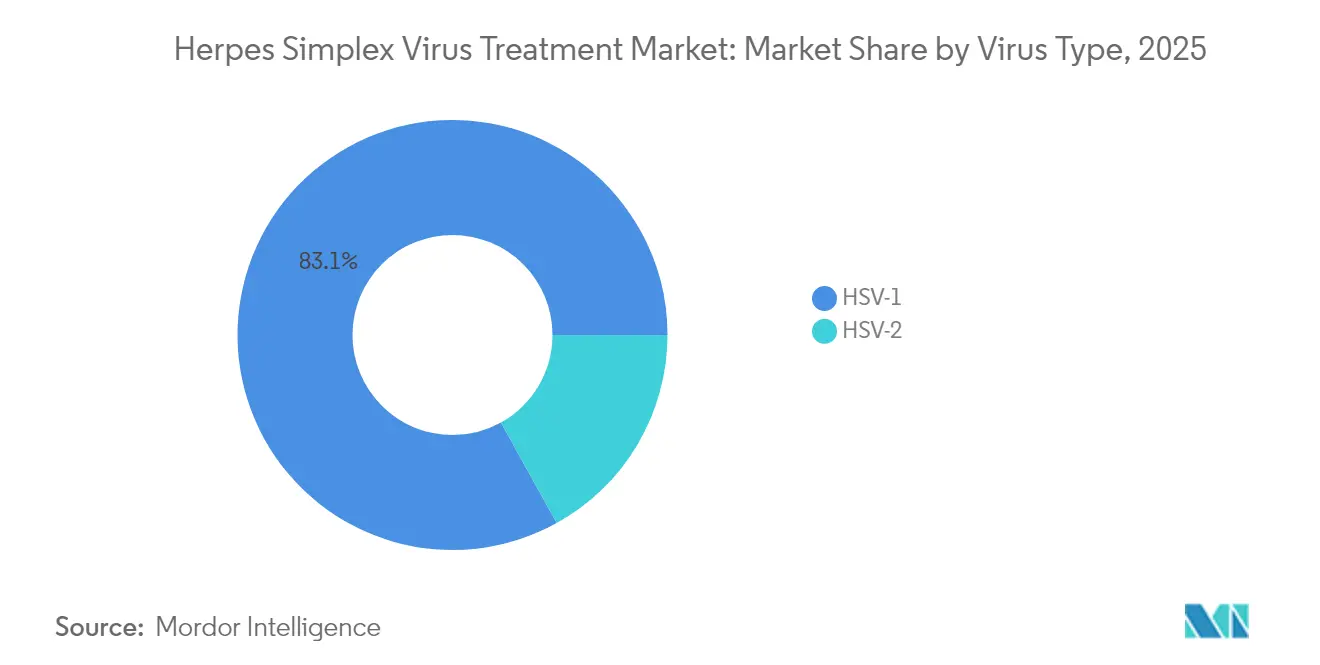
- By virus type, HSV-1 led with 83.05% revenue share in 2025, while HSV-2 is projected to expand at a 9.21% CAGR through 2031.
- By drug, valacyclovir captured 28.78% share in 2025; acyclovir is set to post a 5.55% CAGR over 2026-2031.
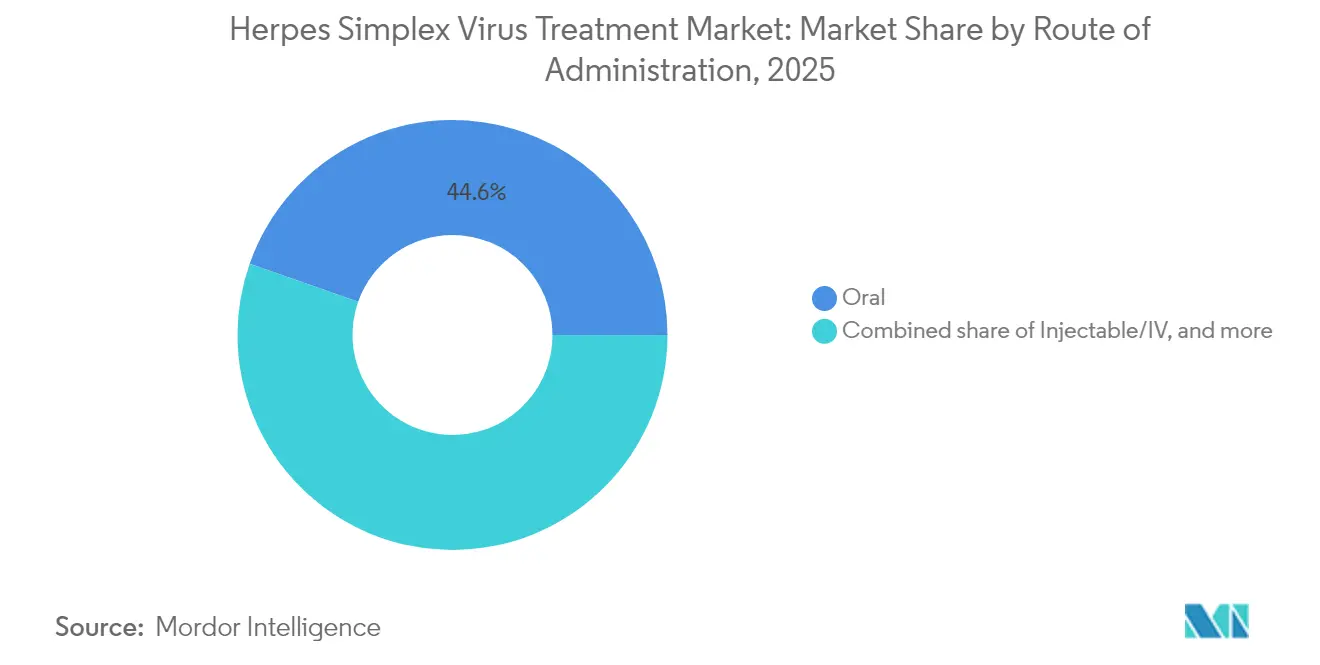
- By route of administration, the oral segment accounted for 44.62% share of the Herpes Simplex Virus Treatment market size in 2025 and is advancing at a 7.02% CAGR through 2031.
- By distribution channel, retail pharmacies and drug stores held 44.75% share in 2025, while online pharmacies are forecast to register the fastest 10.95% CAGR during 2026-2031.
- By geography, North America commanded 31.98% of the Herpes Simplex Virus Treatment market share in 2025, whereas Asia Pacific is poised to grow at a 8.71% CAGR to 2031.
Note: Market size and forecast figures in this report are generated using Mordor Intelligence’s proprietary estimation framework, updated with the latest available data and insights as of 2026.
Market Trends and Insights
Drivers Impact Analysis of Herpes Simplex Virus Treatment Market*
| Drivers Impact Analysis | (~) % Impact on CAGR Forecast | Geographic Relevance | Impact Timeline |
|---|---|---|---|
| Acyclovir resistance reaching 14% in immunocompromised cohorts | +1.3% | North America, Europe | Medium term (2-4 years) |
| Telemedicine adoption lifting HSV prescription volumes by double-digits | +1.1% | Global | Short term (≤ 2 years) |
| OTC corridor expansion for low-dose topicals | +0.6% | North America, Asia Pacific | Short term (≤ 2 years) |
| CRISPR-based programs showing >99.99% viral DNA reduction in preclinical models | +2.4% | Global | Long term (≥ 4 years) |
| Collaboration between sexual-health apps & pharma enhancing patient adherence | +0.5% | Global | Short term (≤ 2 years) |
| Federal NIH funding spike for mRNA-based HSV vaccines boosting U.S. clinical pipeline | +1.0% | North America | Long term (≥ 4 years) |
| Source: Mordor Intelligence | |||
Rising Acyclovir Resistance Fuels Demand for New Mechanisms
Resistance rates to acyclovir now reach 14% among immunocompromised patients, compared with <1% in healthy adults. Mutations in the UL23 thymidine-kinase gene drive this trend, prompting drug developers to test helicase-primase inhibitors such as pritelivir and ABI-5366. The CHARMD database has catalogued the accelerating mutation spectrum, underlining the need to diversify antiviral targets. A citizen petition filed with the FDA seeks expanded access to pritelivir, illustrating clinician urgency[1].
Telemedicine Shortens Time-To-Treatment and Boosts Prescription Counts
Virtual platforms such as Lemonaid Health and Wisp provide discreet consultations that bypass stigma barriers. Patients secure same-day scripts for valacyclovir suppressive therapy or outbreak packs, often completing the care loop in under 24 hours. The format is especially valuable for uninsured users who avoid in-office visits; early data from telehealth providers show a double-digit year-on-year jump in HSV consultations, which translates to higher antiviral volumes and more consistent adherence.
OTC Switches Widen the Retail Funnel
Docosanol-based OTC creams generated USD 1.6 billion in 2021 sales and continue to expand thanks to self-care trends. Roughly half of cold-sore sufferers prefer non-prescription remedies, boosting shelf-space allocation in retail chains. Theralase’s photodynamic topical Ruvidar™ healed HSV-1 lesions in animal models after once-daily application, signalling pipeline competition within the OTC corridor.
CRISPR-Enabled Programs Reshape the Long-Term Vision
Excision BioTherapeutics reported a >99.99% cut in latent viral DNA and near elimination of shedding in rabbit keratitis studies with its EBT-104 construct. Fred Hutch researchers achieved >90% clearance of latent HSV-1 using multiplexed gRNAs delivered via AAV vectors. The NIH has placed curative strategies at the core of its 2023-2028 HSV research roadmap, ensuring multi-year funding continuity[2].
Restraints Impact Analysis of Herpes Simplex Virus Treatment Market*
| Restraints Impact Analysis | (~) % Impact on CAGR Forecast | Geographic Relevance | Impact Timeline |
|---|---|---|---|
| EMA viral-load endpoint demands extend pivotal trials by 18-24 months | −0.8% | Europe | Medium term (2-4 years) |
| Generic penetration eroding brand margins in mature settings | −0.7% | North America, Europe | Short term (≤ 2 years) |
| Persistent social stigma curtailing testing uptake | −0.6% | Middle East & Africa | Long term (≥ 4 years) |
| Cold-chain logistics constraints limiting vaccine rollout | −0.5% | Rural Asia Pacific | Medium term (2-4 years) |
| Source: Mordor Intelligence | |||
Stringent EMA Virologic Benchmarks Prolong Approvals
European regulators now insist on durable suppression metrics in HSV trials, a bar that requires prolonged follow-up and larger cohorts. Assembly Biosciences must first complete Phase 1b shedding-rate read-outs for ABI-5366 before entering pivotal studies, extending launch timing by roughly two years[3]. Smaller biotech firms face capital-intensive extensions that can stall programs or push them toward partnership deals.
Wide Generic Availability Compresses Brand Economics
Acyclovir and valacyclovir lost exclusivity years ago, and in the United States most prescriptions are filled with generics priced at single-digit USD per day. This price ceiling discourages incremental reformulations and redirects investment toward differentiated modalities such as vaccines or biologics. GSK, for example, is repositioning resources after pausing its subunit vaccine candidate GSK3943104 following disappointing Phase 2 data.
*Our forecasts treat driver/restraint impacts as directional, not additive. The impact forecasts reflect baseline growth, mix effects, and variable interactions.
Herpes Simplex Virus Treatment Market Segment Analysis
By Virus Type:
HSV-1 Prevalence Anchors Demand While HSV-2 Drives Incremental GrowthThe Herpes Simplex Virus Treatment market size for HSV-1 is underpinned by 3.7 billion carriers, making it the dominant treatment universe. Although many infections are subclinical, periodic reactivations sustain topical-therapy sales and motivate suppressive oral prescriptions among high-outbreak patients. Education campaigns in Asia and Africa are lifting recognition of ocular and neonatal sequelae, which historically went untreated.
HSV-2, while infecting a smaller absolute pool of 846 million adults, generates stronger forward momentum because the virus remains a co-factor in HIV acquisition and produces more symptomatic recurrences. Rising syndromic testing uptake among sexually transmitted infection (STI) clinics in South-East Asia enriches the diagnosis funnel, translating to faster prescription growth. Clinical associations now recommend starting suppressive therapy after the second annual episode, an update that widens eligibility.

By Drug:
Nucleoside Analogs Stay Central as Long-Acting Candidates EnterFirst-line therapy continues to revolve around valacyclovir, whose favorable bioavailability profile supports twice-daily dosing, a key adherence advantage over five-times-daily acyclovir tablets. In practice, prescribers reserve famciclovir for patients with mild renal impairment because it maintains efficacy at lower renal-clearance thresholds.
Pipeline attention is shifting toward helicase-primase inhibitors, led by ABI-1179 and ABI-5366, which showed plasma half-lives of about four days in early studies. A weekly-pill schedule could materially raise adherence and reduce pill burden for chronic suppressive users. Gene-editing therapeutics may eventually displace chronic antivirals, but consensus among investigators places curative timelines at least five years out, given delivery-vector and immunogenicity hurdles.
By Route Of Administration:
Oral Remains Preferred, Injectable and Topical Carve NichesOral regimens dominate the Herpes Simplex Virus Treatment market, mirroring patient preferences for convenient self-administered options. Tablets enable rapid systemic exposure needed during prodromal phases, which is crucial for suppressing replication before vesicle eruption. Hospitals reserve IV formulations for severe disseminated disease or neonatal herpes, situations requiring high systemic acyclovir levels delivered under close renal monitoring.
Topical solutions target labial outbreaks and supplemental lesion care. Ruvidar is among next-generation creams in development, leveraging photodynamic activation to accelerate lesion clearance after once-daily application. Ophthalmic gels remain a micro-market focused on herpes keratitis, where corneal scarring risk necessitates rapid local virus suppression.
By Distribution Channel:
Brick-And-Mortar Leads, E-Pharmacy AcceleratesRetail chains handle the majority of herpes antiviral scripts because patients can secure therapy immediately after virtual or in-person consults. Pharmacists increasingly offer point-of-care counseling on prophylactic dosing, especially for women contemplating pregnancy.
Online pharmacies, linked tightly with telemedicine portals, are the fastest-advancing channel in the Herpes Simplex Virus Treatment market. Automated prescription fulfillment and discreet packaging align with consumer expectations of privacy. API integrations that push e-prescriptions directly into mail-order workflows shorten the time between diagnosis and drug receipt to ≤48 hours in most urban zip codes.
Geography Analysis
North America Herpes Simplex Virus Treatment Market
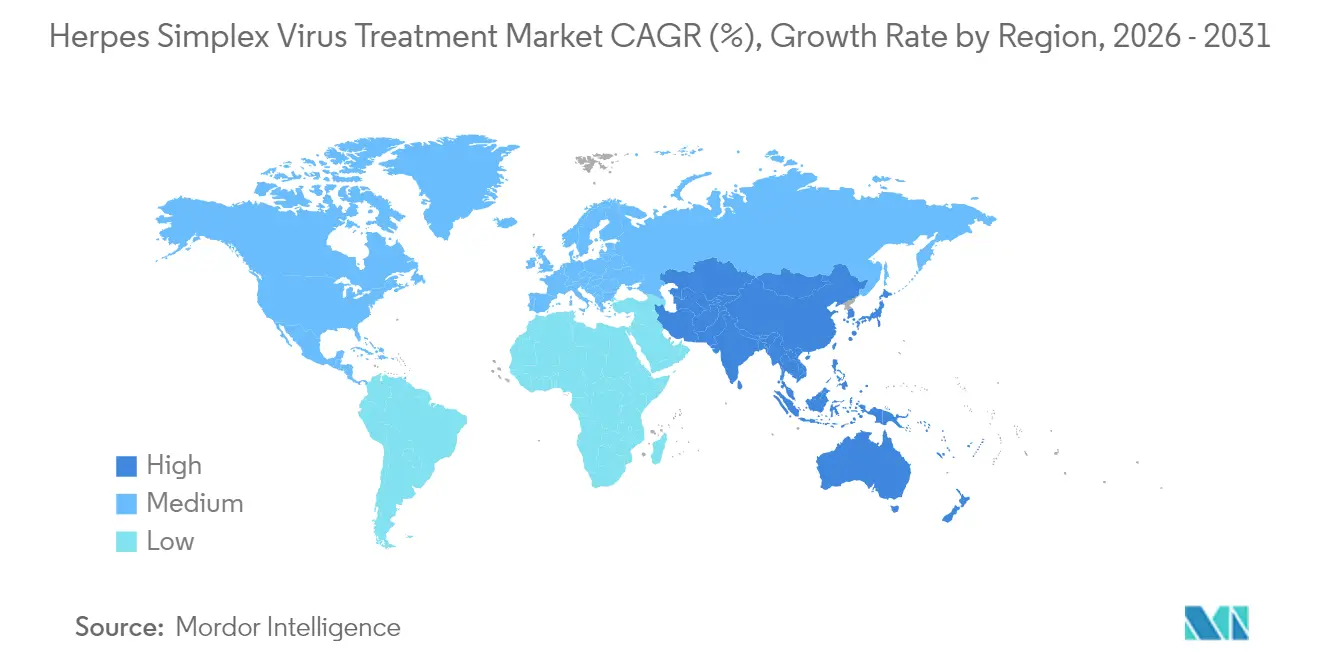
North America remains the revenue leader in the Herpes Simplex Virus Treatment market because of high insurance coverage, widespread HSV testing and large specialty-care networks. The NIH’s 2023-2028 strategic plan earmarks multi-year grants for curative approaches, reinforcing a deep discovery pipeline. Generic pricing pressure persists, but branded spend holds steady among suppressive-therapy users seeking convenience packs that bundle refills with telehealth follow-ups.
APAC Herpes Simplex Virus Treatment Market
Asia Pacific is the fastest-growing territory. Urban populations in China and India are turning to smartphone-based teleconsultations for STI management, partly offsetting the shortage of infectious-disease specialists. Local manufacturers produce low-cost acyclovir and valacyclovir, but multinational firms are scaling co-marketing deals to introduce branded long-acting tablets as disposable incomes climb. Government-backed public-health campaigns have also broadened HSV awareness, lifting testing rates in tertiary hospitals.
Europe Herpes Simplex Virus Treatment Market
Europe represents a mature but innovation-oriented landscape. EMA requirements lengthen trial timelines, yet the region hosts advanced virology labs focusing on ApoE-mediated viral-cell interactions and next-generation capsid inhibitors. Cost-effectiveness protocols drive high generic use, but national systems reimburse premium-priced options where superior suppression or adherence data exist.
Regulatory Landscape
HSV therapeutics remain regulated primarily as antivirals for episodic and suppressive use, with established nucleoside analogs such as acyclovir, valacyclovir (Valtrex), and famciclovir supported by long-standing FDA-approved labeling (as reflected in DailyMed monographs) and broad generic availability across major markets. In April 2026, the FDA granted Priority Review to AiCuris Anti-infective Cures AG for the pritelivir NDA in treatment-resistant HSV infections, with a PDUFA target date in Q4 2026. This indicates regulators are using expedited pathways where refractory disease in immunocompromised patients creates a clear unmet need.
In Europe, the EMA framework continues to rely heavily on nationally authorized product oversight and pharmacovigilance tools (for example, PSUSA processes for valaciclovir and related referral documentation). The regulatory emphasis on safety monitoring and endpoint rigor remains a key part of lifecycle management for widely used antivirals. For innovation programs, regulators are tracking multiple development streams in parallel, including non-nucleoside oral antivirals and immunization candidates, as seen in clinical-trial registry activity for candidates such as Assembly Biosciences ABI-5366 and an HSV-2 mRNA vaccine study listed by Changchun BCHT Biotechnology Co. This aligns with the report’s view that virologic benchmarks and longer follow-up requirements can extend development timelines in some jurisdictions.
Competitive Landscape
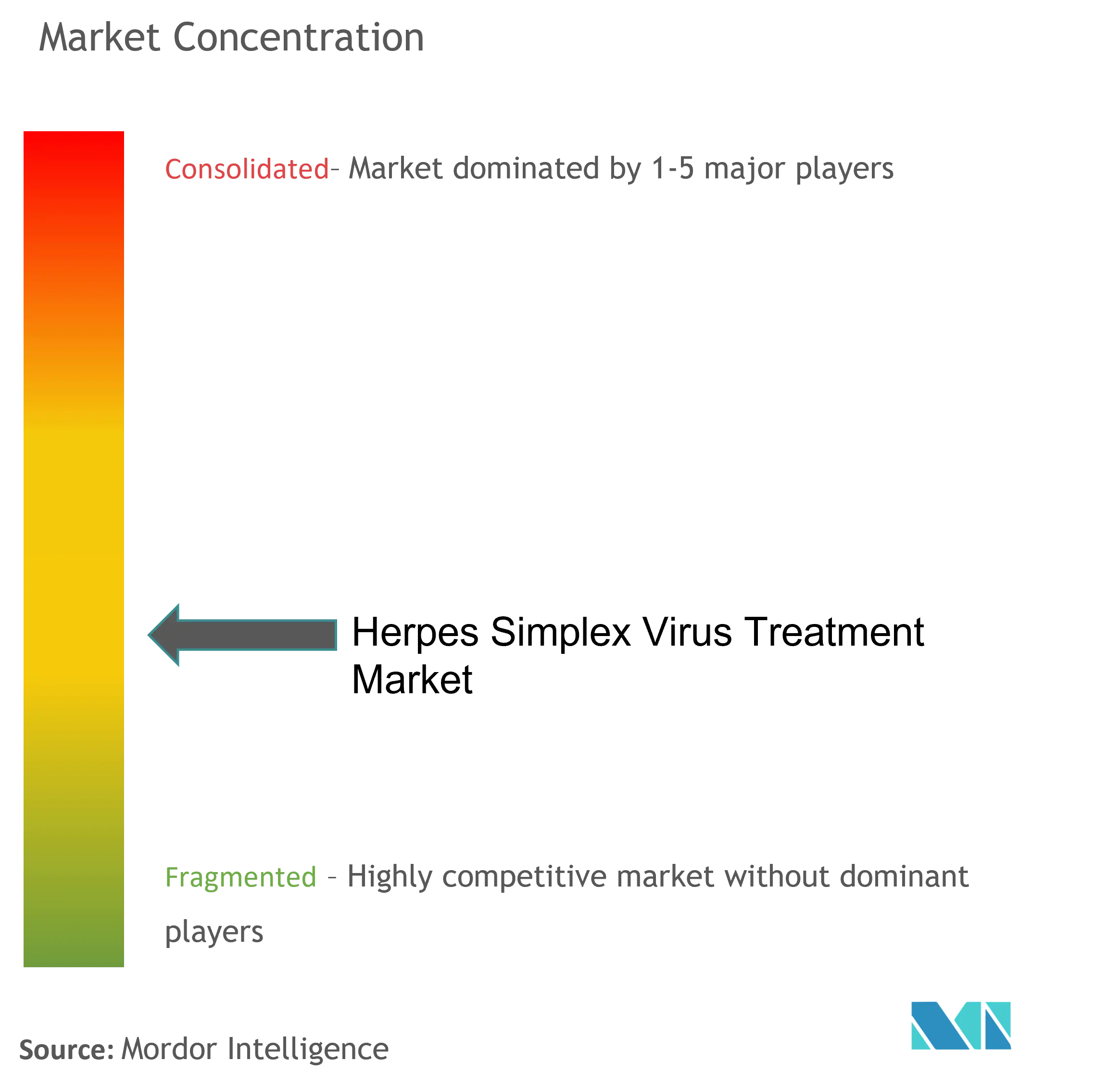
Market concentration remains moderate. GlaxoSmithKline retains a leading antiviral franchise but is reallocating resources toward next-generation biologics after halting further investment in its HSV-2 therapeutic vaccine candidate. Teva and Viatris dominate volume through extensive generic portfolios, leveraging global distribution networks to capture price-sensitive segments. Novartis ranks highest in the 2024 Access to Medicine Index for broadening treatment access in lower-income regions.
Biotechnology entrants are intensifying competition. Excision BioTherapeutics is advancing CRISPR-based curative constructs and has secured FDA orphan-drug designation for its ocular program, ensuring seven-year market exclusivity upon approval. Assembly Biosciences’ helicase-primase pipeline targets weekly oral dosing, a differentiation lever that could re-set patient adherence expectations. Moderna and BioNTech are applying validated mRNA platforms to prophylactic vaccines, adding a preventive dimension to the competitive field.
Strategic collaboration activity is rising. Assembly Biosciences inked an R&D pact with Gilead to co-develop long-acting antivirals, gaining milestone-based funding and option payments. GSK and Novartis have issued tiered-pricing commitments in selected African markets, improving availability of suppressive therapy. Meanwhile, academic-industry alliances—such as Fred Hutch linking with private-sector vector manufacturers—are accelerating translational gene-editing studies.
Herpes Simplex Virus Treatment Industry Leaders
-
GlaxoSmithKline plc
-
Teva Pharmaceutical Industries Ltd.
-
Viatris Inc.
-
Novartis AG
-
Fresenius SE & Co. KGaA
- *Disclaimer: Major Players sorted in no particular order
Herpes Simplex Virus Treatment Market Companies Covered in this Report
- GlaxoSmithKline
- Teva Pharmaceutical Industries
- Viatris
- Novartis
- Fresenius
- Glenmark Pharmaceuticals
- Zydus Lifesciences Ltd.
- Emcure Pharmaceuticals
- Apotex
- AiCuris
- Agenus
- Moderna
- Rational Vaccines Inc.
- Sun Pharmaceuticals Industries
Market Opportunities and Future Outlook
A near-term commercialization whitespace is visible in refractory and treatment-resistant HSV in immunocompromised patients, where nucleoside analog resistance is most consequential and where a differentiated mechanism can still find adoption despite generic price ceilings. AiCuris moving pritelivir through a pivotal Phase 3 evidence base and into FDA Priority Review in April 2026 creates a concrete pathway for a new oral class (helicase-primase inhibition) to enter clinical practice. If that occurs, it can expand premium segments beyond commodity acyclovir and valacyclovir.
Another opportunity corridor sits at the intersection of access, privacy, and dispensing workflows. The report already points to telemedicine-led prescribing and fast-growing online pharmacy fulfillment as demand shapers, which supports adherence-oriented offerings such as outbreak packs, refills synchronized to virtual follow-ups, and patient-support tools integrated into e-prescribing. On the innovation side, clinical registry activity for long-acting oral candidates, including Assembly Biosciences ABI-1179 and ABI-5366 studies, alongside early-stage HSV-2 mRNA vaccine research listed on ClinicalTrials.gov, indicates sustained pipeline breadth. Even though vaccines and gene-editing cures remain outside market sizing, these programs still shape partnering, trial infrastructure, and payer and clinician attention toward differentiated endpoints and dosing convenience, which can later translate into commercially relevant antiviral lifecycle strategies.
Recent Industry Developments in Herpes Simplex Virus Treatment Market
- June 2026: Innovative Molecules GmbH announced first patient dosed in a Phase 2a clinical trial of adibelivir (IM-250) for recurrent genital herpes. Advancing into Phase 2a increases competitive pressure on legacy nucleoside analogs by reinforcing helicase-primase inhibition as an active non-nucleoside development track for recurrent disease management.
- April 2026: AiCuris Anti-infective Cures AG reported that the US FDA granted Priority Review for the pritelivir NDA for refractory HSV infection in immunocompromised patients, with a PDUFA target date in Q4 2026. The expedited review elevates pritelivir as a potential differentiated option for drug-resistant cases and sharpens focus on regulatory-grade endpoints for novel mechanisms.
- October 2024: Fred Hutch researchers demonstrated feasibility of an HSV gene-drive concept, adding momentum to curative and transmission-interruption research directions. While gene-editing approaches sit outside market sizing, the work influences longer-term R&D prioritization and partnership activity around next-generation HSV control strategies.
Herpes Simplex Virus Treatment Market Report Scope and Research Methodology
Market Definition and Coverage
This market covers the value of medicines used to treat herpes simplex virus (HSV) infections, including therapies used for outbreak treatment and suppressive use across HSV-1 and HSV-2, across major care settings and pharmacy channels.
Scope exclusions: It does not include diagnostic kits, herbal or nutraceutical OTC remedies, and pipeline vaccines or curative approaches such as gene-editing programs.
Segments Covered in This Report
- By Virus Type
- HSV-1
- HSV-2
- By Drug
- Acyclovir
- Valacyclovir
- Famciclovir
- Other Drugs
- By Route of Administration
- Oral
- Injectable / IV
- Topical / Dermal
- Ocular
- By Distribution Channel
- Hospital Pharmacies
- Retail Pharmacies & Drug Stores
- Online Pharmacies
- Geography
- North America
- United States
- Canada
- Mexico
- Europe
- Germany
- United Kingdom
- France
- Italy
- Spain
- Rest of Europe
- Asia-Pacific
- China
- Japan
- India
- Australia
- South Korea
- Rest of Asia-Pacific
- Middle East & Africa
- GCC
- South Africa
- Rest of Middle East & Africa
- South America
- Brazil
- Argentina
- Rest of South America
- North America
Data Sources, Market Sizing, and Validation
Desk Research
Desk work starts by anchoring the HSV disease and treatment context, then linking it to measurable demand and supply signals. We typically use public epidemiology and treatment guidance sources such as the World Health Organization, the US CDC, and national health ministries to align on infection burden and standard antiviral use patterns.
To reduce the risk of over-relying on one data stream, additional checks are pulled from sources such as the US FDA drug databases and labeling updates, clinical-trial registries, and peer-reviewed journals for prescribing and resistance discussion. Where relevant for antivirals, we also review customs or trade statistics. Company filings, investor presentations, and reputable press are used to track portfolio changes, generic entry timing, and channel shifts, and then a paid subscription for company financials and patent intelligence is used selectively to fill gaps. The sources listed here are illustrative, and other public references are reviewed for data capture, cross-checks, and clarification.
Primary Interviews and Surveys
Primary work is used to sanity-check volumes, price ranges, and how demand splits between suppressive therapy versus episodic treatment, particularly where public data is not granular. We spoke with stakeholders across manufacturers, distributors, pharmacy channel participants, and clinicians, and we balanced inputs across key regions so assumptions could be adjusted for local access, generic penetration, and reimbursement realities.
Distribution of primary research fieldwork respondents
| Company type | Respondent position | Region |
|---|---|---|
| Top tier: 31% | CXOs: 14% | APAC: 43% |
| Mid tier: 49% | Functional/Unit leaders: 36% | EMEA: 35% |
| Smaller Players: 20% | Managers: 50% | Americas: 22% |
Market-Sizing & Forecasting
The market is sized using a top-down demand pool build that starts from HSV prevalence and the treated cohort, then narrows by diagnosis rates, treatment-seeking behavior, and typical antiviral use for suppressive and episodic regimens. After the demand pool is shaped, it is converted into value using route-specific unit assumptions and average selling price (ASP) ranges by major molecule families.
To keep totals realistic, we corroborate with selective bottom-up approximations, including sampled country roll-ups using volume proxies, channel checks across hospital, retail, and online pharmacies, and a small set of supplier and distributor revenue cues where disclosures exist. Key model inputs include HSV-1 and HSV-2 patient pools, frequency of outbreaks that drives refill behavior, generic penetration and substitution pace, route mix (oral versus topical versus IV and ocular), and country-level pricing and reimbursement constraints that influence ASP progression over time.
Forecasting is run using scenario analysis supported by simple multivariate regression on a few stable drivers, such as treated prevalence trend, generic share expansion, and price erosion patterns, and then adjusted using what experts expect for guideline changes and access improvements. Where bottom-up inputs are missing for smaller countries, gaps are handled through proxying from comparable markets based on population, income band, and access to antivirals, before reconciling back to regional totals.
Data Validation & Update Cycle
Validation is done in layers so errors from one source do not carry through to the final numbers. We compare model outputs with independent signals such as treatment volume direction from clinicians, generic timing and molecule-level shifts from regulatory updates, and pricing ranges observed across channels, and then any outliers are reviewed and corrected before sign-off.
A second analyst review is used to re-check key assumptions, unit conversions, and currency handling, and then unusual variances trigger re-contact with selected primary respondents. Reports are refreshed annually, and interim updates are made when material events occur, such as major label updates, important reimbursement changes, or sudden shifts in supply. Before delivery, a fresh review pass is completed so clients receive the latest updated view.
Mordor Intelligence's Herpes Simplex Virus Treatment Market Sizing Compared With Other Published Estimates
Published market sizes for HSV treatment often vary, even when the topic sounds the same, because groups count different therapy buckets and apply different pricing and currency rules. The result is that two estimates can both look reasonable, while still landing apart in the stated base year.
In our refresh-led process, the spread is usually explained by when exchange rates are applied, how ASPs are adjusted for generic erosion and channel mix, and whether the data checks are re-run after key year-end updates. This is where Mordor Intelligence aligns the currency timing and price logic to the same cutoff used for the treated-cohort and volume assumptions.
Benchmark comparison
| Source | Market Size | Gaps in Research Methodology |
|---|---|---|
| Mordor Intelligence | USD 2.88 B (2025) | |
| Trade Publisher A | USD 2.55 B (2025) | Uses factory-gate revenue logic and may understate value where downstream channel mix and pharmacy-level markups meaningfully lift realized selling prices across regions. |
| Global Publisher B | USD 2.47 B (2023) | Anchors the base year earlier and may blend vaccine-related value pools into the treatment view in some cuts, which can shift timing and the implied growth path versus antiviral-only counting. |
Across the three figures, the biggest drivers are the base year chosen, what gets counted as treatment versus adjacent modalities, and how pricing is translated into USD at a given cutoff. When those items are controlled, the market can be traced back to a repeatable set of patients, utilization, and molecule-level ASP assumptions.
Key Questions Answered in the Report
What is driving current growth in the Herpes Simplex Virus Treatment market?
Rising acyclovir resistance, expanded telemedicine access and investment in gene-editing candidates are the primary catalysts.
How large is the Herpes Simplex Virus Treatment market today?
Recent company data place the market at USD 3.09 billion in 2026 with a forecast to reach USD 4.41 billion by 2031, a 7.37% CAGR over 2026-2031.
Which drug class is most prescribed for genital herpes?
Valacyclovir retains the widest use because twice-daily dosing achieves high plasma levels with reliable safety.
Are curative therapies close to commercial reality?
CRISPR-based programs have shown >99% latent-virus reduction in preclinical models, but human efficacy proof and delivery optimization remain multi-year hurdles.
Why are online pharmacies gaining share in herpes treatment distribution?
They dovetail with virtual consultations, offering discreet, rapid medication delivery that appeals to patients seeking privacy and convenience.
How do European regulatory requirements differ from the United States?
The EMA demands longer demonstration of sustained viral suppression, lengthening trial durations by up to two years relative to FDA pathways.