
Helicopter Services Market Size and Share
Market Overview
| Study Period | 2020 - 2031 |
|---|---|
| Market Size (2026) | USD 34.34 Billion |
| Market Size (2031) | USD 52.24 Billion |
| Growth Rate (2026 - 2031) | 8.72 % |
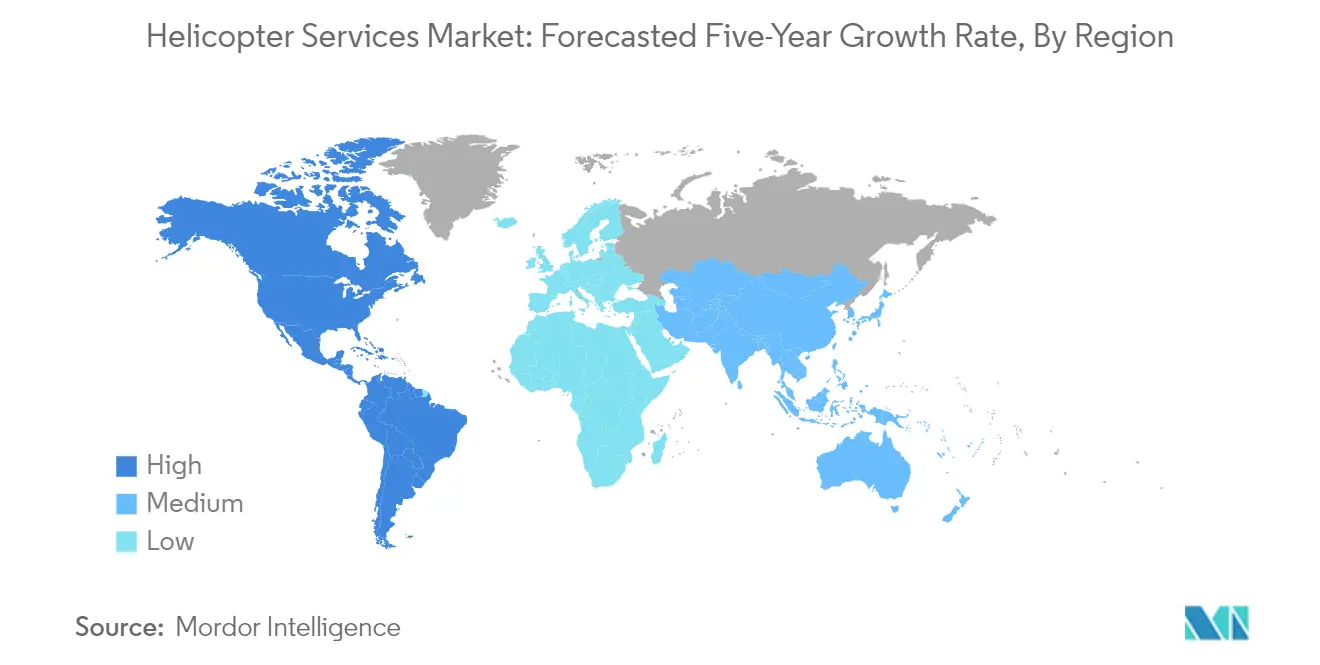
| Fastest Growing Market | Latin America |
| Largest Market | North America |
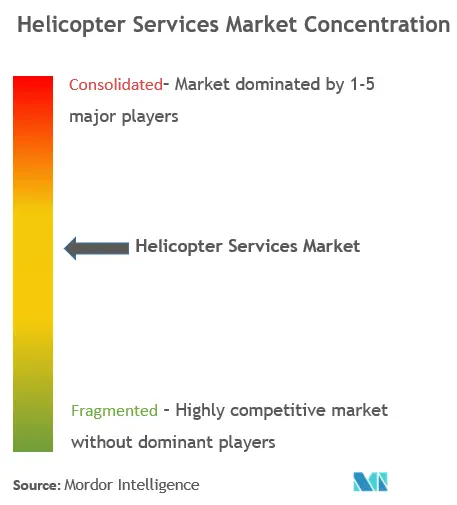
| Market Concentration | Medium |
Major Players *Disclaimer: Major Players sorted in no particular order Image © Mordor Intelligence. Reuse requires attribution under CC BY 4.0. | |
Helicopter Services Market Analysis by Mordor Intelligence
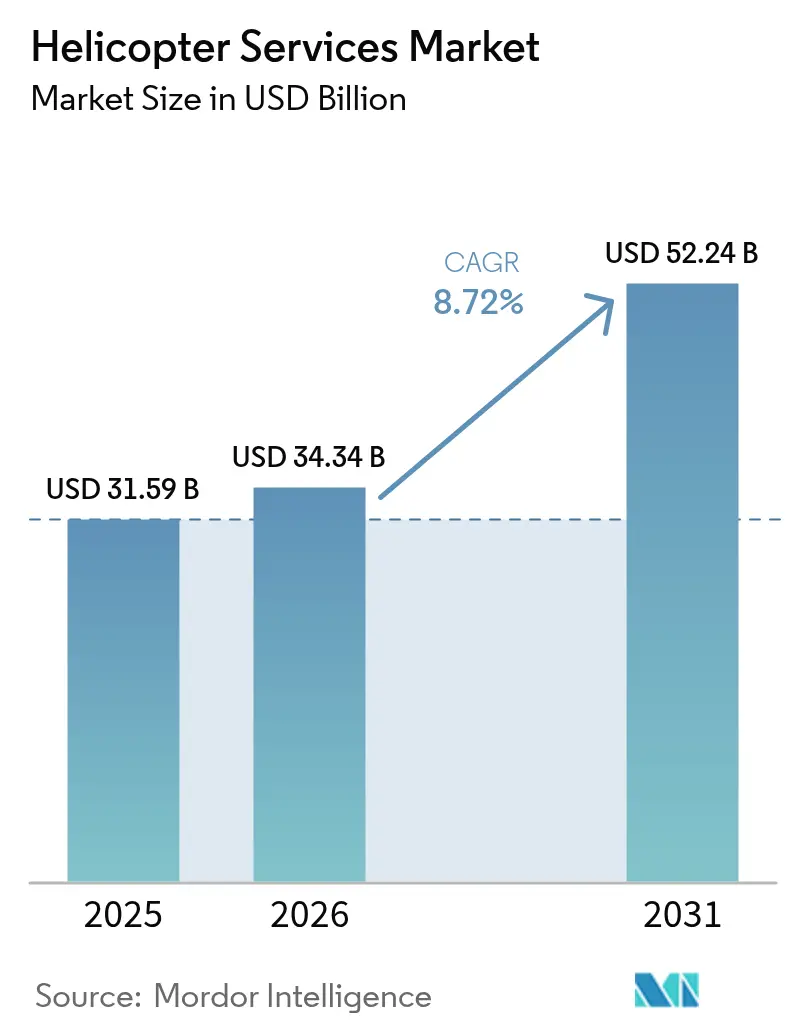
Helicopter Services Market size in 2026 is estimated at USD 34.34 billion, growing from 2025 value of USD 31.59 billion with 2031 projections showing USD 52.24 billion, growing at 8.72% CAGR over 2026-2031.
The helicopter services industry is experiencing significant transformation driven by technological advancements and changing market dynamics. The sector has witnessed substantial fleet modernization efforts, with operators increasingly adopting advanced avionics systems, enhanced safety features, and more fuel-efficient helicopters. This evolution is reflected in the current global fleet composition, which includes over 4,871 dedicated air ambulance helicopters equipped with state-of-the-art medical facilities and advanced life support systems. The integration of next-generation helicopter avionics, control and display units, and new terminal information systems has become paramount for operators seeking to maintain competitive advantages in the market.
The industry is witnessing a notable shift towards sustainable energy projects, particularly in the offshore wind sector. Helicopter transportation is becoming increasingly vital for wind farm construction, maintenance, and crew transfer operations, especially as wind farms move further offshore into deeper waters. This trend is particularly evident in the commercial helicopter and business aviation segment, which currently maintains a fleet of 7,122 helicopters globally, serving various industrial and commercial applications. The expansion of offshore wind projects has created new opportunities for helicopter operators to diversify their service offerings beyond traditional oil and gas support operations.
A significant industry development has been the emergence of urban air mobility concepts and their potential impact on traditional helicopter services. While the helicopter services sector remains a key enabler for the budding Urban Air Mobility (UAM) sector, operators are actively adapting their business models to accommodate these evolving market demands. The leisure charter segment, which currently operates over 11,037 helicopters worldwide, is particularly focused on developing innovative service offerings to maintain market relevance amidst these technological transitions.
The industry faces increasing competition from unmanned aerial vehicles (UAVs) in certain applications, prompting helicopter operators to focus on specialized services where their capabilities remain unmatched. The cargo transport segment, supported by approximately 1,358 dedicated cargo carrier helicopters globally, continues to demonstrate the unique value proposition of helicopter logistics in specialized logistics operations. Operators are responding to this challenge by emphasizing their ability to handle complex missions in challenging environments, particularly in areas where drone operations face regulatory or technical limitations. This strategic positioning has helped maintain the helicopter services industry's competitive edge in high-value, specialized operations while adapting to the evolving technological landscape.
Note: Market size and forecast figures in this report are generated using Mordor Intelligence’s proprietary estimation framework, updated with the latest available data and insights as of 2026.
Market Trends and Insights
PROJECTED REBOUND IN TRAVEL AND TOURISM INDUSTRY
The global helicopter services industry is witnessing significant growth driven by the robust recovery in the travel and tourism sector, particularly in the leisure charter and business travel segments. The expansion of businesses, a surge in government initiatives for developing meetings, incentives, conferences, and events (MICE) segments, and the growth of businesses in emerging markets are creating substantial opportunities for helicopter service providers. These factors are complemented by rising disposable incomes globally, which are enabling more travelers to opt for premium transportation options like helicopter tourism for both leisure and business purposes.
The industry is experiencing increased demand for aerial sightseeing, tourism-related charter services, and corporate travel solutions as businesses shift away from virtual meetings to in-person interactions. Helicopter operators are expanding their service offerings to capitalize on this trend, with companies introducing innovative solutions such as helicopter tourism packages and corporate charter services. For instance, helicopter tour operators are now offering diverse packages ranging from short city tours to extended multi-destination experiences, catering to the growing demand for unique and premium travel experiences.
INCREASING PREVALENCE OF DISASTERS AND THE GROWING NEED FOR RAPID EMERGENCY RESPONSE
The rising frequency and intensity of natural disasters, coupled with the growing need for rapid helicopter emergency services, is significantly driving the demand for helicopter medical services globally. This trend is evidenced by recent developments in the emergency medical services sector, such as the Norwegian Air Ambulance's contract award to Airbus in November 2023 for three H135s and two five-bladed H145s for emergency medical missions in Denmark. Similarly, Gama Aviation's launch of HEMS in December 2023, involving a USD 70 million contract for four Airbus H145 helicopters, demonstrates the increasing investment in emergency response capabilities.
The helicopter emergency medical services sector has witnessed substantial technological advancements, with modern aircraft being equipped with advanced medical equipment and staffed by skilled medical crews. Between 2019 and 2023, approximately 268 helicopters were deployed globally for various emergency and medical services, highlighting the growing importance of aerial medical transport. The ability of helicopters to access remote areas, reduce response times, and provide critical care during transport has made them an essential component of modern emergency response systems, particularly in regions with challenging terrain or limited ground infrastructure.
GROWTH IN THE DEEPER OFFSHORE DRILLING ACTIVITIES
The expansion of offshore drilling activities into deeper waters and more remote locations is creating substantial demand for offshore helicopter services in the energy sector. As oil and gas companies move towards deeper offshore regions in search of new reserves, the need for reliable helicopter transportation services for crew changes, equipment transport, and emergency response has increased significantly. This trend is particularly evident in regions where traditional shallow-water resources are becoming depleted, pushing exploration and production activities into more challenging deepwater environments.
The integration of offshore helicopter services in offshore wind energy projects is also emerging as a significant driver for the market. This is exemplified by the April 2022 contract awarded to HeliService International Inc. by Orsted and Eversource for helicopter crew change operations in their Northeast United States offshore wind projects, utilizing Leonardo AW169 helicopters. The growing focus on renewable energy sources, particularly offshore wind farms, is creating new opportunities for helicopter service providers, as these installations require regular maintenance, crew transfers, and emergency response capabilities, often in challenging marine environments far from shore.
Helicopter Services Market Segment Analysis
Air Ambulance Segment in Helicopter Services Market
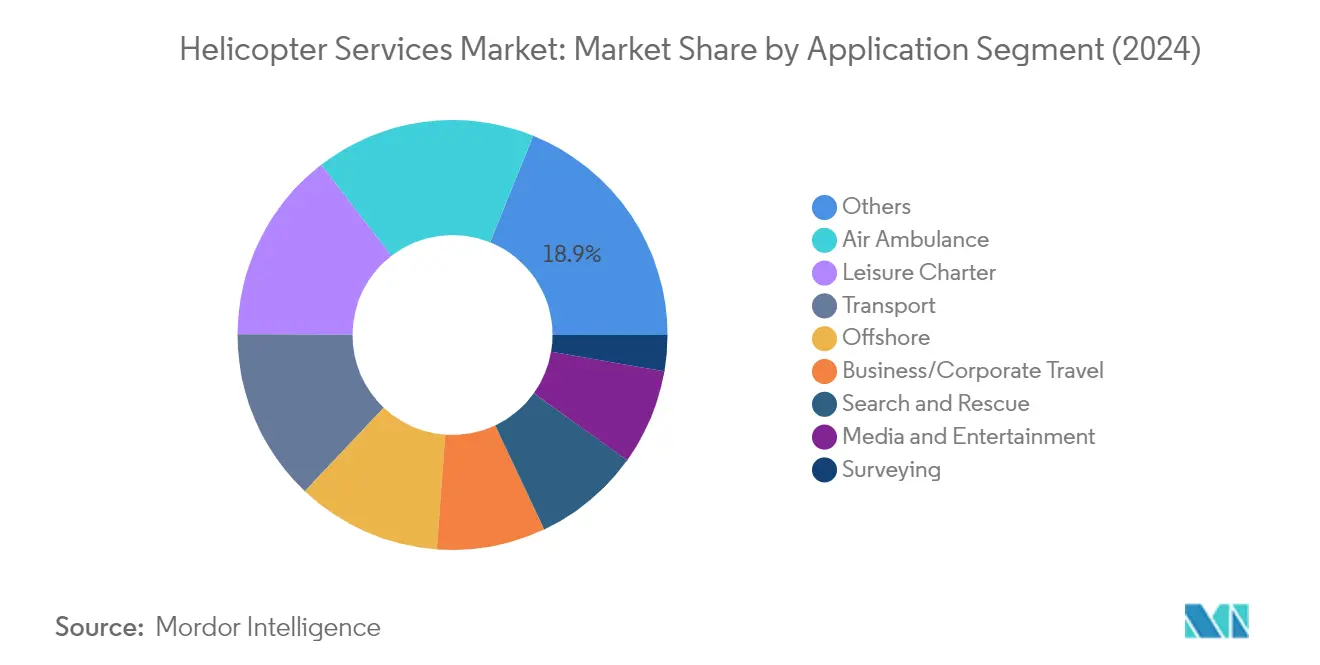
The Air Ambulance segment has emerged as a dominant force in the helicopter medical services market, commanding approximately 16.92% market share in 2025. This segment's prominence is driven by increasing demand for improved emergency healthcare services and the growing adoption of helicopter medical services globally. The current fleet of air ambulance helicopters stands at 4,871 units, with North America and Europe being the regions with the largest number of air ambulance helicopters. The segment's growth is further supported by greater insurance coverage for air ambulance facilities and a rising governmental focus on enhancing emergency care standards. Additionally, the Asia Pacific region is witnessing steady growth due to the rising adoption of advanced healthcare infrastructure and a growing number of multispecialty hospitals requiring rapid emergency response capabilities.
Leisure Charter Segment in Helicopter Services Market
The Leisure Charter segment is experiencing remarkable growth in the helicopter charter market, projected to grow at approximately 22.15% during 2026-2031. This exceptional growth is driven by several factors, including the increase in per capita income levels of the middle-class population, the availability of better infrastructure in emerging markets, the introduction of low-cost membership programs, and the proliferation of charter companies into smaller markets. The segment's expansion is particularly notable in the Asia-Pacific region, which has grown at a rapid pace due to significant demand from China, Oceania, and several Southeast Asian countries. Charter service providers are actively expanding their operations in emerging markets to capitalize on growth opportunities, introducing innovative services such as end-to-end personalized air charter services with dedicated relationship managers and customized amenities.
Remaining Segments in Application Segmentation
The helicopter services market encompasses several other significant segments, including Business/Corporate Travel, Search and Rescue, Transport, Media and Entertainment, Surveying, and Offshore operations. The Business/Corporate Travel segment serves high-net-worth individuals and corporations, while Search and Rescue operations focus on emergency response and disaster management. The Transport segment caters to cargo carriers and scheduled transport services, while Media and Entertainment serves the film and broadcasting industry. The Surveying segment specializes in aerial mapping and inspection services, and the Offshore segment primarily supports oil and gas exploration activities. Each of these segments contributes uniquely to the market's diversity, serving specific industry needs and maintaining steady growth trajectories based on their respective market dynamics.
Helicopter Services Market Geography Segment Analysis
North America Helicopter Services Market
North America represents a mature helicopter services market, characterized by advanced infrastructure and diverse applications across emergency medical services, offshore operations, and corporate transport. The United States and Canada form the backbone of this regional market, with both countries maintaining sophisticated networks of heliports and comprehensive regulatory frameworks. The region benefits from a strong presence of major helicopter services operators and extensive use in sectors ranging from emergency medical services to offshore oil and gas operations.
The United States dominates the North American helicopter services market with approximately 76.55% market share in 2025. The country maintains the largest fleet of emergency medical service helicopters and corporate aircraft in the region. The market is particularly strong in regions like the Gulf of Mexico for offshore operations and major urban centers for corporate transport. The country's robust infrastructure includes numerous heliports, maintenance facilities, and training centers, supporting a wide range of services from air ambulance operations to corporate transportation.
Canada emerges as the fastest-growing market in North America, with a projected growth rate of approximately 12.54% during 2026-2031. The country's vast geographical expanse and remote locations drive significant demand for helicopter services, particularly in areas with limited ground transportation access. Canadian operators are increasingly investing in modern helicopter fleets to serve the growing offshore energy sector, emergency medical services, and resource exploration activities. The country's commitment to developing its offshore wind energy sector and expanding emergency medical services in remote regions continues to create new opportunities for helicopter service providers.
Europe Helicopter Services Market
Europe represents a sophisticated helicopter services market, with a strong emphasis on offshore energy operations, emergency medical services, and corporate transport. The region benefits from advanced aviation infrastructure and stringent safety regulations, with key markets including Russia, the United Kingdom, Germany, and France. The European market is characterized by its mature offshore wind energy sector and well-established emergency medical services networks, particularly in countries like Germany and the United Kingdom.
Russia maintains its position as the largest helicopter services market in Europe, commanding approximately 28.74% of the regional market share in 2025. The country's vast territory and significant oil and gas operations drive substantial demand for helicopter services. Russia's helicopter fleet serves diverse applications, from offshore operations in the Arctic region to corporate transport and emergency medical services, supported by a well-established domestic helicopter manufacturing industry.
The United Kingdom demonstrates the highest growth potential in the European region, with a projected growth rate of approximately 11.62% during 2026-2031. The country's strong presence in offshore wind farm operations and North Sea oil and gas activities continues to drive demand for helicopter services. The UK's commitment to expanding its offshore wind energy capacity and maintaining robust search and rescue operations creates sustained demand for helicopter services, supported by advanced infrastructure and regulatory frameworks.
APAC Helicopter Services Market
The Asia-Pacific region represents a dynamic and rapidly evolving helicopter services market, encompassing diverse economies from developed markets like Japan and South Korea to emerging powerhouses like China and India. The region demonstrates significant variation in market maturity and application focus, with countries like China emphasizing corporate transport while others like Indonesia focus on offshore operations. The presence of numerous island nations and expanding offshore energy sectors creates unique opportunities for helicopter service providers.
China stands as the dominant force in the Asia-Pacific helicopter services market, leveraging its large economy and expanding corporate sector. The country's helicopter services industry benefits from ongoing infrastructure development and increasing adoption across various sectors, particularly in corporate transport and emergency medical services. The government's support for general aviation development and the gradual opening of low-altitude airspace continue to create new opportunities for service providers.
Indonesia emerges as the fastest-growing market in the Asia-Pacific region, driven by its archipelagic geography and expanding energy sector. The country's unique topography, comprising over 17,000 islands, creates natural demand for helicopter services in areas where conventional transportation is impractical. The government's focus on improving connectivity between islands and developing offshore energy resources continues to drive growth in helicopter services demand.
MEA Helicopter Services Market
The Middle East & Africa region presents a diverse helicopter services market landscape, characterized by strong demand from oil and gas operations in the Gulf countries and emerging opportunities in Africa. Saudi Arabia leads the regional market, benefiting from extensive oil and gas operations and increasing corporate transport demand, while South Africa shows the fastest growth potential, driven by expanding emergency medical services and corporate transport sectors. The region's challenging terrain and vast distances make helicopter services essential for various applications, from offshore operations to emergency medical transport.
LATAM Helicopter Services Market
Latin America demonstrates significant potential in the helicopter services market, with Brazil emerging as both the largest and fastest-growing market in the region. The region's helicopter services industry is characterized by diverse applications, from offshore oil and gas operations to urban air mobility in major cities. Mexico also maintains a significant presence in the market, particularly in offshore operations and corporate transport. The region's challenging geography and infrastructure limitations continue to drive demand for helicopter services across various applications.
Competitive Landscape
Top Companies in Helicopter Services Market
The helicopter services market features prominent players like Bristow Group, CHC Group, PHI Inc., Air Methods Corp., and Babcock International Group leading the industry. These companies are increasingly focusing on fleet modernization and technological integration to enhance operational efficiency and safety standards. Strategic partnerships and collaborations with technology providers are becoming more common to incorporate advanced avionics systems and predictive maintenance capabilities. Companies are also expanding their geographical footprint through strategic acquisitions and joint ventures, particularly in emerging markets across the Asia-Pacific and Middle East regions. The industry is witnessing a trend toward diversification of service offerings, with providers expanding beyond traditional oil and gas support into emergency medical services, search and rescue operations, and corporate transport. Operators are investing in specialized training programs and safety certifications to maintain a competitive advantage and meet evolving regulatory requirements.
Market Structure Shows Dynamic Competitive Environment
The helicopter services industry exhibits a relatively consolidated structure at the global level, dominated by large multinational corporations with extensive fleet networks and diverse service portfolios. These major players benefit from economies of scale, established relationships with oil and gas companies, and comprehensive maintenance, repair, and overhaul (MRO) capabilities. Regional markets, however, often feature strong local players who leverage their market knowledge and established customer relationships to maintain competitive positions. The industry has witnessed significant merger and acquisition activity, particularly following economic downturns, as companies seek to consolidate their market position and achieve operational synergies.
Market dynamics are characterized by high barriers to entry due to substantial capital requirements, stringent regulatory compliance needs, and the importance of established safety records and operational expertise. The competitive landscape is further shaped by long-term contracts with key clients, particularly in the offshore energy sector, which creates stable revenue streams for established players. Regional specialists often maintain strong positions in specific market segments such as emergency medical services or corporate transport, while global players leverage their broad service offerings and geographical presence to serve multinational clients across multiple regions.
Innovation and Adaptability Drive Future Success
Success in the helicopter services market increasingly depends on operators' ability to adapt to changing market conditions and evolving customer requirements. Companies must focus on operational efficiency through fleet optimization, route planning, and maintenance scheduling to maintain profitability in a competitive environment. The adoption of digital technologies for enhanced safety monitoring, customer service, and operational management is becoming crucial for market leadership. Providers must also diversify their service offerings and customer base to reduce dependence on any single industry sector, particularly given the cyclical nature of the oil and gas industry.
Market participants need to address the growing threat of substitution from drone services in certain applications while maintaining focus on core competencies where helicopters remain irreplaceable. Regulatory compliance and safety standards continue to be critical success factors, with operators needing to invest in regular training and safety management systems. The ability to form strategic partnerships with technology providers, maintenance organizations, and complementary service providers will become increasingly important for maintaining competitive advantage. Companies must also consider environmental sustainability in their operations, as this factor gains importance in client decision-making and regulatory frameworks. Additionally, the helicopter maintenance services sector plays a crucial role in ensuring operational reliability and safety, further solidifying the industry's competitive edge.
Helicopter Services Industry Leaders
-
Air Methods Corporation
-
PHI Group, Inc.
-
Abu Dhabi Aviation
-
Babcock Scandinavian Air Ambulance (Babcock International Group)
-
Bristow Group Inc.
- *Disclaimer: Major Players sorted in no particular order
Helicopter Services Market Companies Covered in this Report
- Acadian Air Med Services (Acadian Companies)
- Air Methods Corporation
- Heli-union
- Abu Dhabi Aviation
- Emsos Medical Pvt. Ltd.
- Bristow Group Inc
- LUXEMBOURG AIR RESCUE ASBL
- PHI Group, Inc.
- Babcock Scandinavian Air Ambulance (Babcock International Group)
- CHC Group LLC
Market Opportunities and Future Outlook
Fleet modernization and replacement activity is creating new room for operators and OEM-aligned service providers across EMS, offshore, and corporate transport, particularly when newer platforms and upgraded avionics support dispatch reliability and mission capability. Industry signals include GAMA reporting preliminary 2025 rotorcraft billings of USD 4.7 billion, up 5.5% YoY. Operators are also expanding installed capacity for maintenance and completions, including Helicopter Services Inc. expanding its David Wayne Hooks Memorial Airport footprint to 25,000 square feet with dedicated sheet metal, composites, and avionics areas (completed June 2025).
In this context, emergency medical services and specialized mission operations remain a key opportunity as large operators extend fleet roadmaps and maintain OEM relationships that improve supply assurance and lifecycle support. A recent anchor is the March 2026 framework contract between ADAC Luftrettung and Airbus covering H135, H140, and H145 helicopters, which supports fleet standardization and training commonality for HEMS fleets and reinforces the role of light twins in EMS missions. Supply-chain resilience is also emerging as a differentiator, with providers pre-procuring aircraft to deliver turnkey, mission-ready solutions, such as Helicopter Services Inc. announcing the acquisition of three Airbus H125 helicopters for 2026 delivery to mitigate lead-time constraints and support customer deployment schedules.
Recent Industry Developments in Helicopter Services Market
- March 2026: ADAC Luftrettung and Airbus signed a long-term framework contract covering H135, H140, and H145 helicopters. The agreement supports fleet standardization and reinforces OEM-backed renewal cycles in the HEMS segment, where availability, commonality, and lifecycle support influence operator procurement decisions.
- November 2025: Abu Dhabi Aviation signed a multi-year agreement with Honeywell Aerospace to streamline avionics repair and overhaul logistics for AW139 helicopters across the Middle East and Africa, running through 2029. The deal strengthens regional MRO continuity for a widely used offshore and utility platform and supports faster turnaround for operators managing high aircraft utilization.
- May 2024: Abu Dhabi Aviation formed the ADA Group under ADQ Aviation and Aerospace Services LLC as part of a broader realignment that includes assets such as Etihad Engineering, AMMROC, and GAL. This consolidation supports more integrated aviation services and can improve maintenance and support coordination across civil and government rotorcraft operations.
Helicopter Services Market Report Scope and Research Methodology
Market Definition and Coverage
For this methodology, the market covers paid helicopter operations delivered as a service, where an operator provides the aircraft, crew, and flight activity to an end user for a defined mission.
Scope exclusions: We exclude the sale of helicopters and parts, and we also exclude most in-house flying that is not billed as a third-party service.
Segments Covered in This Report
- Application
- Air Ambulance
- Business and Corporate Travel
- Search and Rescue
- Leisure Charter
- Transport
- Media and Entertainment
- Surveying
- Offshore
- Other Applications
- Geography
- North America
- United States
- Canada
- Europe
- Germany
- United Kingdom
- France
- Russia
- Rest of Europe
- Asia-Pacific
- India
- China
- Japan
- South Korea
- Indonesia
- Malaysia
- Rest of Asia-Pacific
- Latin America
- Brazil
- Mexico
- Rest of Latin America
- Middle-East and Africa
- Saudi Arabia
- United Arab Emirates
- South Africa
- Turkey
- Rest of Middle-East and Africa
- North America
Data Sources, Market Sizing, and Validation
Desk Research
We started with public aviation and macro sources that explain demand drivers and operating constraints, and then we connected them to revenue pools by service use case. Common inputs came from sources such as the International Civil Aviation Organization (ICAO), the International Air Transport Association (IATA), and the World Bank for macro indicators that influence premium travel, offshore logistics, and emergency services demand.
To anchor supply and operating conditions, we also referenced sources such as the US Federal Aviation Administration (FAA) and the European Union Aviation Safety Agency (EASA) for fleet context, safety and operations guidance, and licensing realities that can cap usable capacity. Where relevant, we reviewed accident and safety trend summaries from bodies such as the National Transportation Safety Board (NTSB), and offshore activity indicators from government energy statistics portals (for example, oil and gas production and offshore project pipelines) to sense-check offshore flight demand. News coverage, investor presentations, and company filings were used to understand contract structures (hourly versus availability-based) and pricing drivers, and a paid subscription for company financials and intelligence helped fill gaps where public disclosures were limited. These desk research sources are illustrative only, and we also consulted additional public references for data collection, cross-checks, and clarification.
Primary Interviews and Surveys
Primary work focused on validating what drives billed hours and achievable pricing, because these two items can shift totals quickly across applications like offshore transport, air ambulance, and charter. We spoke with operator-side leaders, aviation consultants, and procurement stakeholders from end-use sectors, and then used follow-up checks to confirm utilization and downtime patterns, plus how contracts are priced across major regions that actively use helicopter services.
Distribution of primary research fieldwork respondents
| Company type | Respondent position | Region |
|---|---|---|
| Top tier: 34% | CXOs: 17% | APAC: 42% |
| Mid tier: 49% | Functional/Unit leaders: 36% | EMEA: 36% |
| Smaller Players: 17% | Managers: 47% | Americas: 22% |
Market-Sizing & Forecasting
Sizing was built using top-down and bottom-up logic in one connected model. On the top-down side, we reconstructed the revenue pool by linking application demand indicators to expected helicopter service intensity, which is then translated into billed flight hours and average realized rates by major mission type.
Key inputs included active helicopter fleet and mission capability mix, typical utilization (billed hours per aircraft) by application, contract type split (hourly versus availability-based), fuel and maintenance cost pass-through practices that affect realized pricing, and offshore energy and emergency response activity markers that drive peak demand. Since coverage and reporting quality vary by country, we corroborated totals using selective bottom-up approximations, including operator revenue roll-ups where available, sampled hourly rate ranges discussed in interviews, and volume validation through checks on contract awards and announced fleet deployments. Where local data points were missing, we used conservative proxy utilization and pricing ranges based on comparable markets, and then re-tested them with primary feedback before finalizing.
For forecasting, scenario analysis was used so the base case stays tied to observable drivers such as offshore project cycles, air medical demand stability, and corporate travel recovery. The forward curve was adjusted only after respondents confirmed the direction and practical limits of utilization and rate movements.
Data Validation & Update Cycle
We checked the model through multiple layers so results stayed consistent with real operating conditions. Outputs were compared against independent signals, including fleet deployment updates, contract announcements, and application-level activity trends. When large variances appeared, we reviewed the underlying assumption until the specific driver behind the mismatch was identified.
Before sign-off, an analyst review pass is completed for arithmetic, unit consistency, currency handling, and year alignment, followed by a reasonableness check across regions and major use cases. Reports refresh annually, and interim updates are triggered when material events occur, such as regulation shifts, sudden changes in offshore activity, or meaningful operator capacity changes. Right before delivery, we run a final review sweep so clients receive the most current view available at that time.
Mordor Intelligence's Helicopter Services Market Size Versus Other Published Estimates
Published totals for helicopter services can diverge even when the titles look similar, because the market lines are drawn differently and the underlying math inputs are not always refreshed on the same schedule. Differences also come from how each study treats offshore activity cycles, utilization assumptions, and the timing used for currency conversion.
Fleet counts, application-level billed-hour ranges validated in interviews, and contract pricing benchmarks are the evidence points that keep Mordor Intelligence tied to paid helicopter service revenue rather than adjacent aviation spend, which can shift published totals upward when those items are included.
Benchmark comparison
| Source | Market Size | Gaps in Research Methodology |
|---|---|---|
| Mordor Intelligence | USD 34.34 B (2026) | |
| Industry Portal A | USD 31.59 B (2025) | Uses an earlier sizing year and a shorter horizon, and the build appears to lean more on trend extension than re-validating utilization and realized hourly pricing by application for the updated year. |
| Industry Publisher B | USD 127.60 B (2024) | The figure is difficult to reconcile with services-only revenue, indicating adjacent items like helicopter sales, MRO spending, or broader aviation services may be blended into scope, along with aggressive pricing progression. |
The table shows that scope boundaries and input discipline are the main drivers of the spread, not just different forecasting curves. By keeping the model traceable to billed hours and realized rates, and then cross-checking against fleet and contract signals, the final total remains repeatable when assumptions are updated.
Key Questions Answered in the Report
How big is the Helicopter Services Market?
The Helicopter Services Market size is expected to reach USD 34.34 billion in 2026 and grow at a CAGR of 8.72% to reach USD 52.24 billion by 2031.
What is the current Helicopter Services Market size?
In 2026, the Helicopter Services Market size is expected to reach USD 34.34 billion.
Who are the key players in Helicopter Services Market?
Air Methods Corporation, PHI Group, Inc., Abu Dhabi Aviation, Babcock Scandinavian Air Ambulance (Babcock International Group) and Bristow Group Inc. are the major companies operating in the Helicopter Services Market.
Which is the fastest growing region in Helicopter Services Market?
Latin America is estimated to grow at the highest CAGR over the forecast period (2026-2031).
Which region has the biggest share in Helicopter Services Market?
In 2026, the North America accounts for the largest market share in Helicopter Services Market.
What years does this Helicopter Services Market cover, and what was the market size in 2025?
In 2025, the Helicopter Services Market size was estimated at USD 34.34 billion. The report covers the Helicopter Services Market historical market size for years: 2019, 2020, 2021, 2022, 2023 and 2024. The report also forecasts the Helicopter Services Market size for years: 2026, 2027, 2028, 2029, 2030 and 2031.