
Helicopter Blades Market Size and Share
Market Overview
| Study Period | 2019 - 2031 |
|---|---|
| Market Size (2026) | USD 1.32 Billion |
| Market Size (2031) | USD 1.62 Billion |
| Growth Rate (2026 - 2031) | 4.18 % |
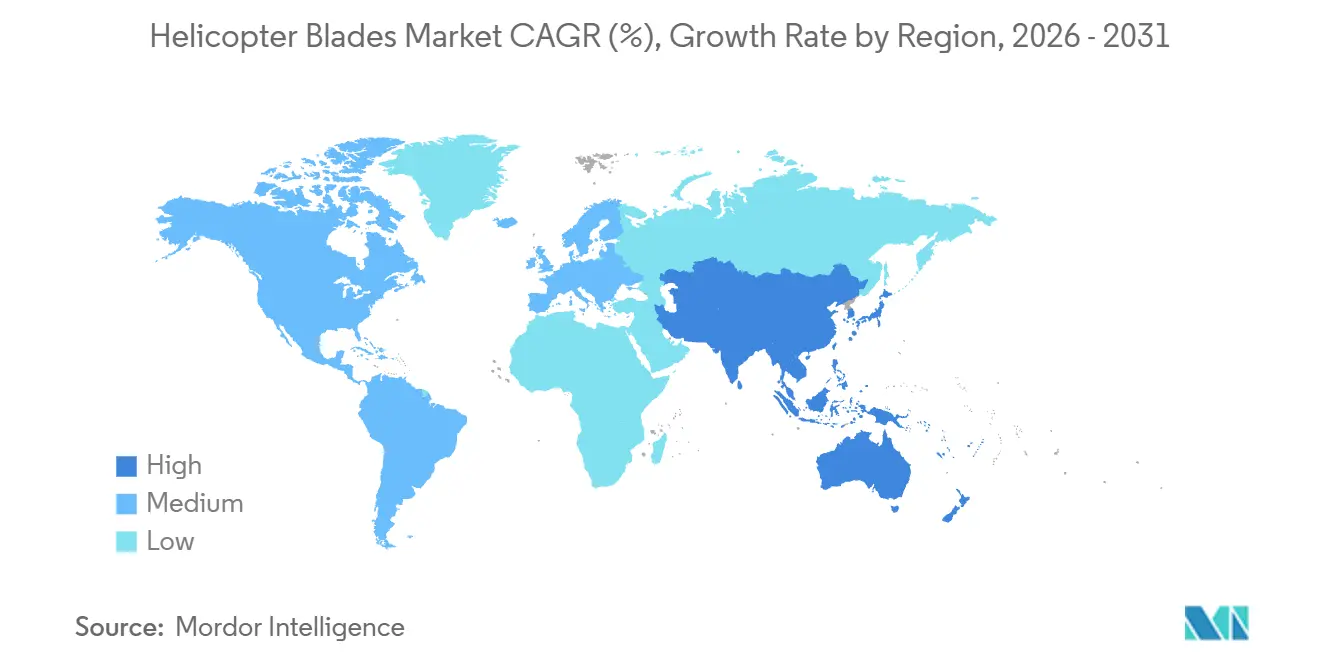
| Fastest Growing Market | Asia-Pacific |
| Largest Market | North America |
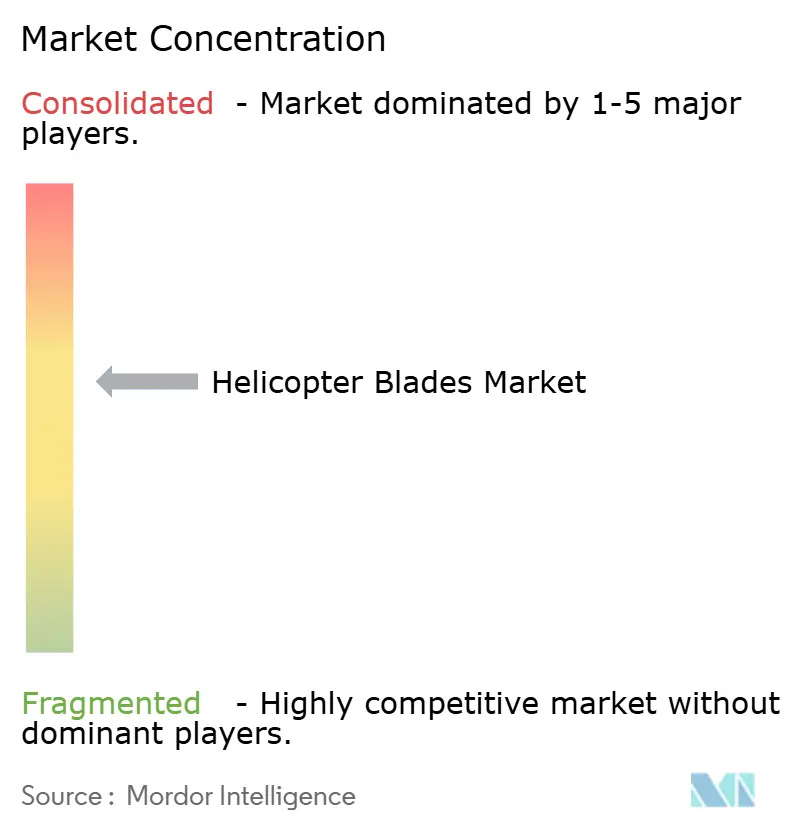
| Market Concentration | Medium |
Major Players *Disclaimer: Major Players sorted in no particular order Image © Mordor Intelligence. Reuse requires attribution under CC BY 4.0. | |
Helicopter Blades Market Analysis by Mordor Intelligence
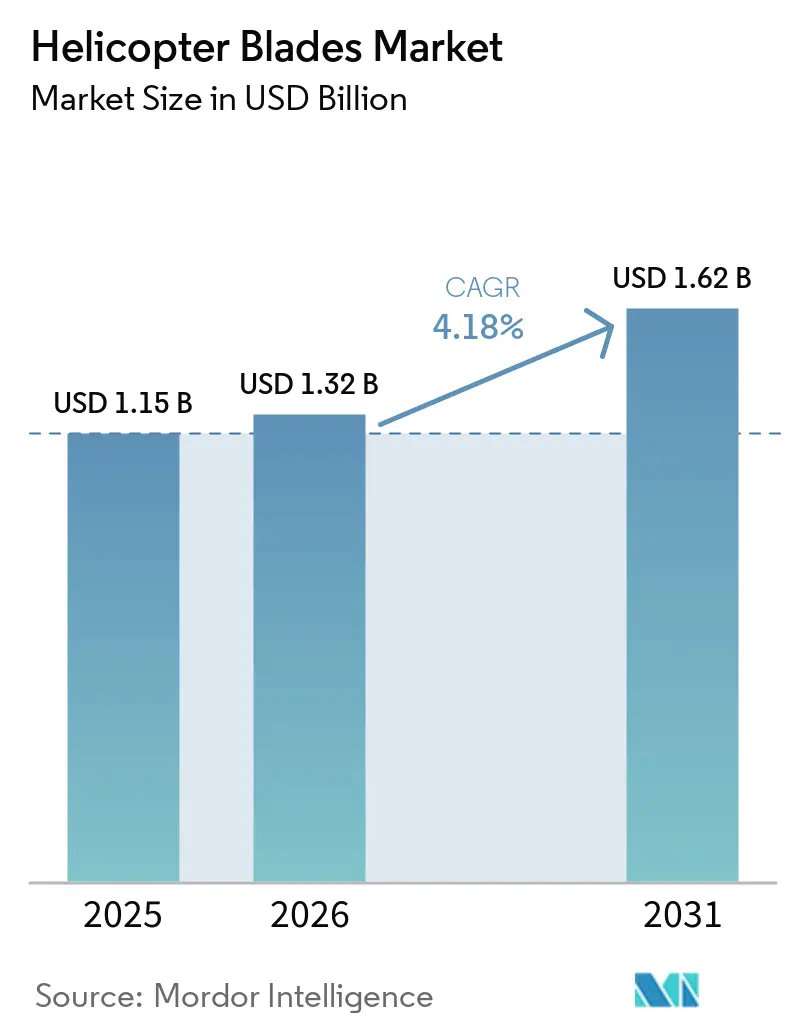
The helicopter blades market size is projected to increase from USD 1.15 billion in 2025 to USD 1.32 billion in 2026 and reach USD 1.62 billion by 2031, growing at a CAGR of 4.18% over 2026-2031. Demand is being supported by military modernization, civil fleet activity, and replacement needs across operating fleets. Advanced composite designs are increasingly relevant as operators seek lower weight, longer service intervals, and greater fatigue resistance. Certification requirements also favor suppliers that can combine blade design, testing, and ongoing airworthiness support. The helicopter blades market is also being shaped by digital monitoring systems, which link physical hardware with condition data. These systems can help operators plan maintenance, although longer blade life can moderate replacement volumes over time.
Key Report Takeaways
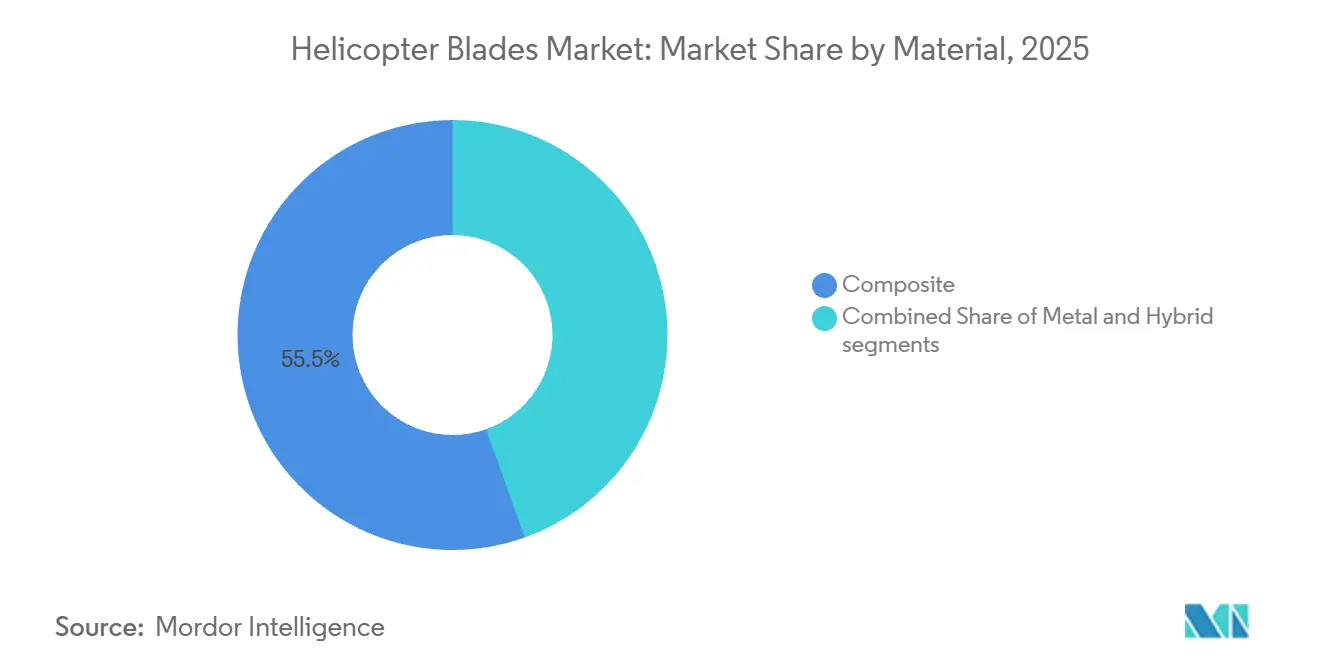
- By material, composites held 55.45% of revenue in 2025, while hybrid blades are forecast to grow at a 6.95% CAGR through 2031.
- By blade location, main rotor blades held 71.38% of revenue in 2025, while tail rotor blades are forecast to grow at a 6.91% CAGR through 2031.
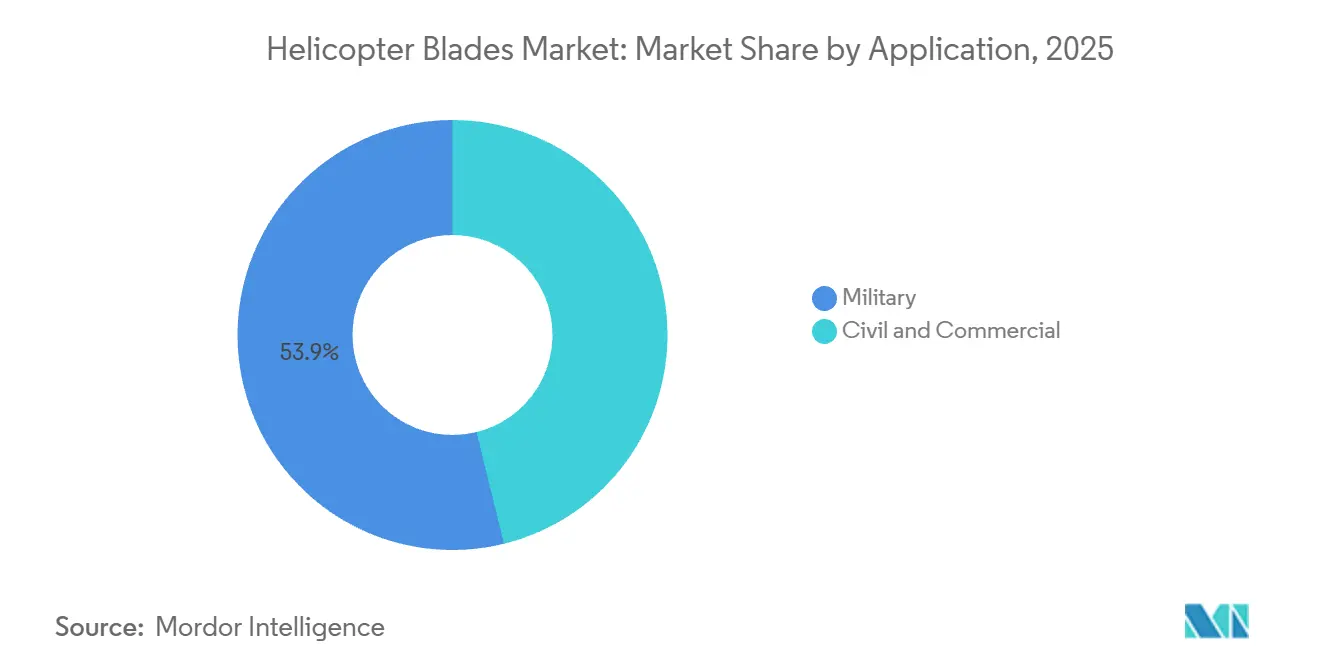
- By application, military applications held 53.85% of revenue in 2025, while civil and commercial applications are forecast to grow at a 7.85% CAGR through 2031.
- By helicopter class, light helicopters held 48.18% of revenue in 2025, while medium helicopters are forecast to grow at a 7.23% CAGR through 2031.
- By fit, linefit held 79.29% of revenue in 2025, while retrofit is forecast to grow at an 8.48% CAGR through 2031.
- By geography, North America held 37.48% of revenue in 2025, while Asia-Pacific is projected to grow at an 8.89% CAGR through 2031.
Note: Market size and forecast figures in this report are generated using Mordor Intelligence’s proprietary estimation framework, updated with the latest available data and insights as of January 2026.
Market Trends and Insights
Drivers Impact Analysis of Helicopter Blades Market*
| Driver | (~) % Impact on CAGR Forecast | Geographic Relevance | Impact Timeline |
|---|---|---|---|
| Future Vertical Lift and next-generation military rotorcraft programs driving advanced blade demand | +0.80% | North America and NATO Europe | Long term (≥ 4 years) |
| Growth in composite blade retrofit programs for civil and utility helicopter fleets | +0.70% | Global, concentrated in North America and Europe | Medium term (2-4 years) |
| Modernization of military helicopter fleets driving demand for upgraded rotor blade technologies | +0.60% | Global, with growing procurement in Asia-Pacific and the Middle East and Africa | Medium term (2-4 years) |
| Noise and environmental regulations accelerating adoption of advanced swept-tip blade designs | +0.50% | Europe and North America | Short term (≤ 2 years) |
| Rising offshore, search-and-rescue, and public service helicopter operations increasing blade utilization | +0.50% | North America and Europe, with spillover to Asia-Pacific and the Middle East and Africa | Short term (≤ 2 years) |
| Adoption of digital twin and structural health monitoring to extend blade life cycles | +0.40% | Global, with early adoption in North America and Europe | Medium term (2-4 years) |
| Source: Mordor Intelligence | |||
Growth in Composite Blade Retrofit Programs for Civil and Utility Helicopter Fleets
Composite retrofit programs are expanding the scope of replacement beyond standard material substitution. FAA Supplemental Type Certification and Parts Manufacturer Approval can enable an approved replacement to address both maintenance and airworthiness concerns simultaneously. Van Horn Aviation received FAA STC/PMA approval for its AS350 composite tail rotor in February 2025 after a 4-year development program. The company stated that the design addresses 4 existing Airworthiness Directives, has a 4,800-hour service life, and can reduce maintenance costs by 25% over the blade life. This type of offering can make a retrofit decision more attractive for operators of older platforms.[1]
Composite repair capability is also moving into institutional maintenance settings. Corpus Christi Army Depot launched the first organic composite blade repair program for US Army Black Hawk M-model blades in February 2026, in partnership with Sikorsky. The depot supports full overhaul, structural repair, and complex reinforcement work, with nondestructive testing used throughout the process. This program indicates that composite repair is becoming part of standard depot maintenance rather than a specialist service. It may reduce dependence on OEM replacement parts in some military programs. The helicopter blades market will continue to benefit where operators have aging metal-blade fleets and access to certified replacement options.
Future Vertical Lift and Next-Generation Military Rotorcraft Programs Driving Advanced Blade Demand
Military acquisition programs are creating a long-term demand base for new blade designs. The US Army’s Future Long-Range Assault Aircraft program received USD 1.26 billion in FY2025 for research, development, testing, and evaluation. The MV-75 target cruise speed of 280 knots and unrefueled range of 1,700 nautical miles require blade geometry and material systems that differ from those used on the UH-60 Black Hawk. The Army also funded 26 UH-60 helicopters in FY2025 under a five-year production contract. This preserves demand for established Black Hawk blade systems while the newer program proceeds.
NATO’s Next Generation Rotorcraft Capability program adds a separate European development path. Airbus, Leonardo, and Sikorsky submitted Concept Study 5 proposals in late 2025. Tiltrotor and compound-rotor approaches require distinct structures and manufacturing methods. Existing composite tooling and certification records may not transfer directly across these architectures. This creates separate research streams within the helicopter blades market and raises the value of proven design capability.
Noise and Environmental Regulations Accelerating Adoption of Advanced Swept-Tip Blade Designs
Noise requirements are pushing rotorcraft developers toward blade designs that reduce acoustic output at its source. Swept tips, active-twist concepts, and improved aerodynamic profiles can reduce noise and vibration without relying solely on flight-path restrictions. DLR completed a wind tunnel campaign for its Smart Twisting Active Rotor project at the end of 2025. The work recorded noise reductions of up to 7 dB during landing descent, vibration reductions above 50%, and rotor-efficiency gains under high load.
EASA CS-27 Amendment 10 and CS-29 Amendment 12, both active in 2024, reinforce proof-of-structure and continuing-integrity expectations. These standards provide a basis for validating the reliability of newer rotor systems. Advanced blade designs must show that their performance gains do not reduce structural safety or maintenance visibility. The helicopter blades industry is therefore developing products that address acoustic, vibration, and airworthiness requirements together. Suppliers that can validate both hardware and supporting data are better positioned to participate in these programs.
Adoption of Digital Twin and Structural Health Monitoring to Extend Blade Life Cycles
Digital monitoring is becoming more relevant to blade maintenance planning. EASA issued ED Decision 2024/009/R in December 2024 to provide acceptable means of compliance for vibration health monitoring systems on large rotorcraft. The decision was in response to a safety recommendation following a 2016 North Sea Sikorsky S-92A accident. It gives manufacturers a clearer route to integrate monitoring into continued airworthiness programs. This favors suppliers that can provide reliable condition data alongside blade assemblies.
NLR and PhotonFirst announced the development of an optical-fiber helicopter structural health and usage monitoring system at the Paris Air Show in June 2025. These capabilities can support predictive maintenance and help operators assess blade condition more accurately. They can also extend service life when the data supports continued safe operation. A longer life can reduce replacement frequency, but it also creates service and data opportunities for established suppliers in the helicopter blades market.
Restraints Impact Analysis of Helicopter Blades Market*
| Restraint | (~) % Impact on CAGR Forecast | Geographic Relevance | Impact Timeline |
|---|---|---|---|
| Stringent FAA and EASA certification and fatigue testing requirements increasing development costs | -0.60% | North America and Europe, with global validation effects | Long term (≥ 4 years) |
| Carbon-fiber material supply volatility and trade tariff exposure | -0.50% | Global, most acute in North America and Europe | Medium term (2-4 years) |
| High manufacturing and replacement costs of advanced composite rotor blades | -0.50% | Global | Long term (≥ 4 years) |
| Limited composite blade repair and MRO expertise in emerging markets | -0.40% | Asia-Pacific, South America, and the Middle East and Africa | Medium term (2-4 years) |
| Source: Mordor Intelligence | |||
Stringent FAA and EASA Certification and Fatigue-Testing Requirements Increasing Development Costs
Composite blade approval under FAA Part 27 or Part 29 and EASA CS-27 or CS-29 requires extensive evidence. The process can include material coupon work, full-scale fatigue tests, acoustic testing, and conformance flight testing. Van Horn Aviation took 4 years to complete the development and approval process for its AS350 replacement tail rotor. This timeline can be difficult for independent suppliers when the target aircraft is approaching a mid-life update or a production transition. The cost and duration favor suppliers with existing type-certificate relationships and established test capability.
EASA’s Continued Integrity Verification Program also extends the focus beyond initial approval. The program addresses whether assumptions used to establish critical-part reliability remain valid throughout a helicopter’s operational life. FAA and EASA bilateral validation can reduce duplicated work for some cross-border programs. However, it does not remove the initial domestic approval burden. Additional national validations can also add procedural work. These requirements can delay market entry and raise the capital needed to participate in the helicopter blades market.
Carbon-Fiber Material Supply Volatility and Trade-Tariff Exposure
Aerospace-grade carbon fiber is an important input for modern rotor blade structures. Qualified material systems cannot be replaced quickly because blade designs and approvals are tied to defined production processes. Supply disruptions or trade measures can therefore affect both cost and delivery schedules. The effect is most acute when the number of approved suppliers is limited. This risk is important for blade manufacturers using carbon fiber in load-bearing skins, spars, and structural reinforcement.
The helicopter blades market also faces practical limits in dual sourcing. Alternate materials must meet the aircraft manufacturer’s and regulator’s requirements before they can be used in production. That approval work can take longer than the disruption it is intended to address. Suppliers with approved inventories and stronger relationships with material producers have a relative advantage. Emerging markets may face additional exposure where local storage, repair, and testing infrastructure is limited. Higher input costs can also make composite replacements harder to justify for price-sensitive operators.
*Our forecasts treat driver/restraint impacts as directional, not additive. The impact forecasts reflect baseline growth, mix effects, and variable interactions.
Helicopter Blades Market Segment Analysis
By Material:
Composites Established, Hybrid Blades Entering Experimental ValidationComposites accounted for 55.45% of the helicopter blades market in 2025. Their position reflects the strength-to-weight performance needed in both civil and military rotorcraft. Composite structures can also support longer service intervals and greater corrosion resistance when properly inspected and maintained. Metal blades remain relevant in legacy fleets and in locations with limited composite repair capability. Their use is likely to remain tied to installed aircraft and familiar maintenance practices. Composite demand is supported by investment in blade production and repair capacity.
Hybrid blades are forecast to expand at a 6.95% CAGR from 2026 to 2031 from a near-zero commercial base. Research published by SAE in 2026 described a flax-fiber composite blade with a 3D-printed ASA Aero core as a geometrically equivalent replacement for a carbon-fiber reference blade. The work found that the core provided adequate compressive stiffness at curing temperatures and adhesion to epoxy laminates. Hybrid architectures are still in experimental validation rather than broad production. Their progress depends on whether manufacturers can shorten the path from material concept to a certifiable component. The helicopter blades industry remains centered on established composites while hybrid designs are assessed.

By Blade Location:
Main Rotor Anchors Revenue, Tail Rotor Retrofit Surging from Small BaseMain rotor blades accounted for 71.38% of the helicopter blades market share in 2025. They are larger, more complex, and generally carry higher selling prices than tail rotor blades. New helicopter deliveries also include main rotor assemblies as a standard part of the aircraft configuration. These factors keep the main rotor blades central to linefit revenue. Their structural importance makes the approval process particularly demanding.
Tail rotor blades are forecast to grow at a 6.91% CAGR from 2026 to 2031 from a small composite retrofit base. Van Horn Aviation’s February 2025 FAA-approved AS350 tail rotor addresses four Airworthiness Directives and provides a stated 4,800-hour service life. The case shows how a tail rotor replacement can combine compliance, maintenance, and service-life considerations. Main rotor systems are also receiving attention through active monitoring of twist and vibration. Tail rotor replacements can add up quickly, and a certified alternative can improve the economics of older aircraft.
By Application:
Military Leads, Civil and Commercial Operations RecoveringMilitary applications held 53.85% of revenue in 2025. Procurement and sustainment programs for platforms such as the UH-60 Black Hawk, AH-1Z Viper, and H225M Caracal support the segment. The US Army’s USD 1.26 billion in FY2025 FLRAA research, development, test, and evaluation funding also supports future demand for military blades. Military customers require long qualification cycles and dependable maintenance support. This provides a durable demand base for certified suppliers.
Civil and commercial applications are forecast to grow at a 7.85% CAGR from 2026 to 2031 from a constrained 2025 base. Offshore energy, search-and-rescue, public-service, and utility activities increase aircraft utilization and maintenance needs. Operators in these roles often have defined readiness requirements and cannot defer blade maintenance for long periods. Offshore fleet additions also create linefit demand before the aircraft enter service. The helicopter blades market can benefit from these operations when flight activity converts into predictable inspection, repair, and replacement work.
By Helicopter Class:
Light Segment Dominates, Medium Platforms Supporting Offshore DemandLight helicopters represented 48.18% of revenue in 2025. Civil utility, law enforcement, emergency medical services, and training operations support their use. Bell 206 and Airbus AS350-type platforms have a large installed base for civil blade replacements. Independent blade suppliers often focus on these aircraft because the fleets have clear aftermarket needs. The breadth of operating missions supports recurring demand even when new aircraft deliveries vary.
Medium helicopters are forecast to expand at a 7.23% CAGR from 2026 to 2031 from a small base. AW139, AW189, H175, and S-92 platforms are used in offshore transport and search-and-rescue missions. These aircraft offer the range and payload needed for deeper-water operations. Heavy helicopters remain important in logging, firefighting, and military lift roles, but their blade designs are highly platform-specific. Medium-class fleet activity can increase linefit and later maintenance demand across the helicopter blades market.
By Fit:
Linefit Commands Revenue, Retrofit Building Structural MomentumLinefit held 79.29% of revenue in 2025. Original equipment manufacturers typically select blade systems when a helicopter is built and certified. This process supports long supply relationships and fixes technical specifications early in the aircraft life cycle. Linefit suppliers benefit from recurring production demand, service agreements, and access to maintenance data. The concentration of new helicopter production gives original equipment manufacturers an advantage in this channel.
Retrofit is forecast to grow at an 8.48% CAGR from 2026 to 2031. Composite upgrades for aging metal-blade fleets and depot-level repair programs support the segment. Corpus Christi Army Depot’s composite repair program reflects a broader shift toward structured support for composite components. STC and PMA processes can help approved independent replacement programs enter multiple jurisdictions. Retrofit growth depends on certification, maintenance capability, and total operating cost benefits.
Geography Analysis
North America Helicopter Blades Market
North America held 37.48% of revenue in 2025. The region has a large military rotorcraft fleet and a mature civil base across offshore energy, search and rescue, law enforcement, and emergency medical services. The US Army’s FY2025 funding for FLRAA and continued UH-60 production will support military demand through the late 2020s. Corpus Christi Army Depot’s February 2026 composite repair program may reduce dependence on original equipment manufacturer replacements over time.
Europe Helicopter Blades Market
Europe plays a strong role in technological development and regulatory direction in the helicopter blades market. EASA requirements influence structural proof, continued integrity, and vibration monitoring for rotorcraft. The region also supports North Sea search-and-rescue and offshore activity. These missions require dependable aircraft availability and regular maintenance planning. European suppliers can benefit from pairing composite production with compliance and monitoring support.[2]
APAC, South America and MEA Helicopter Blades Market
Asia-Pacific is the fastest-growing region, with an 8.89% CAGR, driven by defense modernization, offshore energy operations, and public search-and-rescue programs, all of which support the outlook. India produces rotor blades for indigenous platforms and participates in coproduction programs. China, South Korea, and Japan are expanding medium-helicopter fleets for maritime patrol, disaster response, and offshore activities. Composite repair infrastructure remains limited in many parts of the region, which limits retrofit adoption but creates an opportunity for service networks. South America has a smaller demand base centered on Brazil’s pre-salt offshore activity. At the same time, the Middle East and Africa benefit from defense procurement, offshore activity, and resource-sector helicopter utilization.
Regulatory Landscape
Helicopter rotor blades are regulated as critical rotorcraft structures under FAA 14 CFR Part 27/29 and EASA CS-27/CS-29, which impose high-burden compliance on fatigue, damage tolerance, and environmental effects for both linefit and retrofit blade designs. The certification pathway is reinforced by guidance such as FAA advisory material for Part 27 compliance and EASA certification memoranda that shape acceptable means of compliance for critical parts, keeping approval timelines and non-recurring engineering costs elevated for advanced composite blades.
Recent regulator actions point to tighter scrutiny of advanced architectures that intersect with rotor blade certification. The FAA Rotorcraft Issues Lists published in Q4 2025 and Q1 2026 flagged gaps in standards for fly-by-wire flight control systems and composite structures, often requiring special conditions and additional issue paper resolution under Part 27/29. In Europe, EASA continued post-certification oversight through airworthiness actions, including AD 2026-0029 affecting Airbus Helicopters tail rotor drive-related components, with compliance required by 12 March 2026 and reinforcing ongoing integrity verification expectations across rotorcraft critical parts throughout service life.
Value Chain Analysis
The helicopter blades value chain starts with aerospace-grade inputs, including carbon fiber and resin systems for composite blades and specialty alloys for metal and hybrid constructions, followed by prepreg preparation, layup or automated fiber placement, curing, machining, balancing, erosion protection, and final assembly. OEMs such as Airbus, Bell, Leonardo, Boeing, and Sikorsky anchor demand through linefit integration and configuration control, while Tier suppliers and material providers (including Hexcel and Toray in carbon-fiber ecosystems) support qualification, process control, and repeatability for certified rotor structures.
Aftermarket channels are a major value capture point, covering spares distribution, repair development, and FAA/EASA-certified MRO work, including inspection, reconditioning, and composite repair. Capacity and lead-time constraints are being addressed through localization and manufacturing process changes: Airbus Helicopters expanded its blade repair hub in Grand Prairie, Texas (announced August 2025) to lift output and reduce turnaround time for North American operators, and Sikorsky reported additive manufacturing adoption at its Stratford campus (November 2025) to cut lead times for selected parts. Operators and MROs also use mitigation tactics such as part-outs of serviceable aircraft to maintain availability of dynamic components when new-blade and repair queues lengthen.
Competitive Landscape
The helicopter blades market is moderately concentrated, with Airbus, Bell Textron Inc., Lockheed Martin Corporation, and Erickson Incorporated capturing an estimated more than 50% of linefit revenue. Their long-term aircraft programs combine blade supply, propulsion integration, maintenance services, and technical data. This can lock blade specifications in early and make switching difficult during the aircraft's life cycle. The helicopter blades industry also includes tier suppliers that provide composite structures, skins, spars, cores, and related assemblies.
GKN Aerospace provides rotor blades for Black Hawk variants, including the HH-60W, UH-60M, and S-70. Kaman was the first manufacturer to produce an all-composite production rotor blade for the Bell AH-1 Cobra and has produced more than 5,000 blades.[3] These capabilities pose substantial barriers because blade-fabrication knowledge and overhaul processes take time to establish. At the same time, independent suppliers can compete in the aftermarket when their products obtain the required approval. Van Horn Aviation's FAA-approved AS350 tail rotor is an example of a certified composite alternative.
Manufacturing efficiency and digital support are key competitive areas in the helicopter blades market. Airbus Helicopters signed a letter of intent with Airborne in November 2025 to adopt automated ply placement and Kit by Light systems at its Le Bourget blade factory. The factory manufactures composite helicopter blades and hub structures for the Airbus range. DLR's active-twist rotor program is another example of a technology that could shape future expectations for blade performance. EASA's vibration health monitoring guidance offers an additional advantage for companies that can supply both physical blades and reliable condition data.
Helicopter Blades Industry Leaders
-
Lockheed Martin Corporation
-
Kaman Corporation
-
Erickson Incorporated
-
Bell Textron Inc. (Textron Inc.)
-
Airbus Helicopters (Airbus SE)
- *Disclaimer: Major Players sorted in no particular order
Helicopter Blades Market Companies Covered in this Report
- Airbus Helicopters (Airbus SE)
- Bell Textron Inc. (Textron Inc.)
- Lockheed Martin Corporation
- Leonardo S.p.A.
- Kaman Corporation
- The Boeing Company
- Hindustan Aeronautics Ltd.
- Russian Helicopters JSC
- MD HELICOPTERS LLC
- Erickson Incorporated
- Van Horn Aviation LLC
- Ducommun Incorporated
- GKN Aerospace Services Limited
- Advanced Technologies, Inc.
- CPI Aerostructures, Inc.
- Carson Helicopters, Inc.
Market Opportunities and Future Outlook
Manufacturing modernization and regionalization are creating whitespace in both linefit and aftermarket supply, particularly where lead times and repair capacity constrain fleet availability. Airbus breaking ground in February 2026 on a new 3,100 square meter rotor-focused factory at Marignane as part of a EUR 450 million site modernization program signals continued investment in higher-throughput rotor production and assembly, while Airbus and Tata Advanced Systems inaugurating an H125 final assembly line in Vemagal, India adds another industrial node that increases regional pull for qualified blade supply, repair, and process tooling.
Process and materials innovations also widen the opportunity set for suppliers that can certify new composite architectures and industrialize them at lower cycle times. UAVOS introduced core sintering manufacturing for composite rotor blades (April 2026) to improve geometric stability, and industry work on one-shot compression molding approaches targeting 20,000-hour time between overhauls aligns with operator demand for longer inspection intervals and reduced downtime. Digital manufacturing enablers such as CNC metrology adoption highlighted in tiltrotor blade production time reductions at Leonardo point to near-term demand for inspection systems, tooling, and quality workflows that reduce scrap and variability in swept-tip and complex-geometry blades.
Recent Industry Developments in Helicopter Blades Market
- June 2026: Bell Textron Inc. received a USD 43.2 million defense contract for advanced helicopter parts with performance extending to June 2030. The award reinforces multi-year demand visibility for dynamic component supply chains tied to US military rotorcraft priorities, supporting sustained industrial workloads and supplier qualification pipelines.
- August 2026: Helicopter manufacturer Sikorsky was awarded a contract worth approximately USD 107 million for additional work on the newest Marine One aircraft. The contract covers "the design, integration, and testing of the Power Margin Increment Two main rotor blades" for the VH-92A helicopter.
- August 2025: Airbus Helicopters announced an expansion of its blade repair hub in Grand Prairie, Texas, to increase capacity and reduce turnaround times for customers across the United States and Canada. The expansion strengthens localized aftermarket support for high-cycle civil and public service fleets and shifts more blade repair value capture into regional OEM-controlled service ecosystems.
- August 2024: Bell secured the USD 1.30 billion V-280 Valor contract for the US Army program that resets speed and range requirements for next-generation rotorcraft. The program raises performance and durability specifications for composite rotor blades and accelerates the focus on qualification across materials, manufacturing processes, and inspection methods used in advanced military rotor systems.
Helicopter Blades Market Report Scope and Research Methodology
Market Definition and Coverage
This market covers revenue earned from manufacturing and supplying helicopter rotor blades used on operational rotorcraft, counted across new builds and replacement demand. The sizing includes main rotor and tail rotor blades sold through OEM channels and aftermarket, in current USD terms.
Scope exclusions: We exclude fixed wing propellers, UAV or drone rotors, and non blade rotor hub or gearbox components from this sizing.
Segments Covered in This Report
- By Material
- Metal
- Composite
- Hybrid
- By Blade Location
- Main Rotor Blade
- Tail Rotor Blade
- By Application
- Civil and Commercial
- Military
- By Helicopter Class
- Light
- Medium
- Heavy
- By Fit
- Linefit
- Retrofit
- By Geography
- North America
- United States
- Canada
- Mexico
- Europe
- United Kingdom
- France
- Germany
- Italy
- Spain
- Rest of Europe
- Asia-Pacific
- China
- India
- Japan
- South Korea
- Rest of Asia-Pacific
- South America
- Brazil
- Rest of South America
- Middle East and Africa
- Middle East
- Saudi Arabia
- United Arab Emirates
- Rest of Middle East
- Africa
- South Africa
- Rest of Africa
- Middle East
- North America
Data Sources, Market Sizing, and Validation
Desk Research
Desk work starts with anchoring the rotorcraft demand pool and fleet activity, because blades are pulled by flight hours, maintenance cycles, and new helicopter deliveries. We used public aviation and defense sources such as FAA rotorcraft airworthiness and safety publications, EASA certification and continuing airworthiness notices, ICAO air transport statistics, and government defense budget documents and procurement releases.
To shape assumptions on materials and replacement cadence, we reviewed standards and technical references such as FAA advisory material on composite structures, published journal papers on rotorcraft aerodynamics and fatigue, and patent databases for blade design and erosion protection themes. We also used company filings, investor presentations, credible press coverage, and an import-export shipment-level database to sanity check trade flows for composite and metallic blade assemblies. The desk sources listed here are illustrative, and other public and internal references were also consulted for data collection, cross-checking, and clarification.
Primary Interviews and Surveys
Primary work was used to pressure-test blade replacement rates and pricing movement, since these vary by mission mix and operating conditions (for example offshore, SAR, and military training intensity). We spoke with a mix of OEM-facing stakeholders, MRO participants, and operators across major helicopter regions so gaps from desk research could be closed and assumptions could be aligned to what is happening in orders and overhauls.
Distribution of primary research fieldwork respondents
| Company type | Respondent position | Region |
|---|---|---|
| Top tier: 39% | CXOs: 18% | APAC: 40% |
| Mid tier: 43% | Functional/Unit leaders: 31% | EMEA: 36% |
| Smaller Players: 18% | Managers: 51% | Americas: 24% |
Market-Sizing & Forecasting
The core build uses top-down and bottom-up logic where rotorcraft fleet and utilization signals are translated into blade demand, and then priced using realistic average selling prices by blade position and material. Our model tracks a few practical inputs that can be updated each year, including active rotorcraft fleet size by region, annual deliveries by helicopter class, average flight hours by mission profile, scheduled overhaul intervals that drive blade change-outs, and the mix shift toward composite blades versus metal blades.
Once the demand pool is formed, totals are corroborated with selective bottom-up approximations, such as sampled blade ASPs from contracts and public disclosures, plus channel checks on retrofit volumes through major maintenance hubs. Where direct volume visibility is weak, especially in fragmented aftermarket routes, we use range-based assumptions tied to fleet age and utilization, then narrow the range using what interviewees see in shop throughput. For forecasting, scenario analysis is applied around three levers that experts highlighted, new helicopter procurement timing, defense readiness spending, and replacement intensity in harsh environments, and the final trajectory is smoothed to avoid unrealistic year-to-year jumps.
Data Validation & Update Cycle
Validation is done by checking whether modeled blade units and value trends align with independent signals such as rotorcraft delivery cycles, defense procurement announcements, and MRO activity indicators. When a region shows an unusual swing, we re-check the linked drivers (fleet, hours, replacement interval, and price) and then re-contact sources if the change cannot be explained cleanly.
Before sign-off, outputs are reviewed across multiple analyst passes so assumptions, math, and year labeling are consistent, and the narrative matches the numbers. The report is refreshed annually, and we also run interim updates when major events occur, such as a large platform award, a program delay, or a material supply disruption. Right before delivery, a final freshness check is completed so clients receive the most up-to-date view we can support.
Mordor Intelligence's Helicopter Blades Market Estimate Compared With Other Published Estimates
Published market sizes for helicopter blades often vary because each publisher picks a different scope and then applies different assumptions for replacement cadence and pricing inputs. Even when the same end market is discussed, the counted revenue can shift depending on whether the view is OEM-only, aftermarket-only, or a blended picture.
The main gap comes from how replacement blades are counted across main and tail rotor positions. Some estimates lean more on new helicopter deliveries and apply a broad average price. In Mordor Intelligence sizing, retrofit demand is tied back to fleet utilization and scheduled overhaul intervals, and the ASP path is adjusted by the composite versus metal mix instead of using one flat price curve.
Benchmark comparison
| Source | Market Size | Gaps in Research Methodology |
|---|---|---|
| Mordor Intelligence | USD 1.32 B (2026) | |
| Industry Research Publisher A | USD 0.67 B (2025) | Uses a different base-year setup and appears to weight the market toward a conservative demand pool, which can happen when utilization and replacement intervals are simplified and the aftermarket is under-counted. |
| Market Tracker B | USD 1.50 B (2024) | States a higher current value and a faster growth path, which can be driven by broader inclusion of adjacent rotorcraft parts or a more aggressive aftermarket assumption, along with different currency timing and price progression methods. |
Overall, the spread is explainable once you line up what gets counted and which demand signals are used to convert fleets into blade revenue. Our approach stays traceable to fleet activity, change-out timing, and realistic ASP ranges, so decision-makers can repeat the logic and adjust assumptions without breaking the model.
Key Questions Answered in the Report
What is the projected size of the helicopter blades market by 2031?
The helicopter blades market is forecast to reach USD 1.62 billion by 2031, rising from USD 1.32 billion in 2026 at a 4.18% CAGR.
Which blade material has the largest share?
Composite blades held 55.45% of revenue in 2025 because of their strength-to-weight performance and potential service-life benefits.
Why are composite blade retrofits growing?
Approved composite replacements can address airworthiness needs, increase service life, and reduce maintenance costs for older aircraft fleets.
Which end-use application leads demand?
Military applications held 53.85% of revenue in 2025, supported by procurement and sustainment programs for major rotorcraft platforms.
Which region is expanding fastest?
Asia-Pacific is the fastest-growing region through 2031, supported by defense modernization, offshore activity, and search-and-rescue fleet development.
How does structural health monitoring affect blade suppliers?
Monitoring supports predictive maintenance and continued airworthiness, which favors suppliers that can provide both approved hardware and reliable condition data.