
Healthcare Regulatory Affairs Outsourcing Market Size and Share
Market Overview
| Study Period | 2020 - 2031 |
|---|---|
| Market Size (2026) | USD 9.37 Billion |
| Market Size (2031) | USD 14.19 Billion |
| Growth Rate (2026 - 2031) | 8.65 % |
| Fastest Growing Market | Asia Pacific |
| Largest Market | North America |
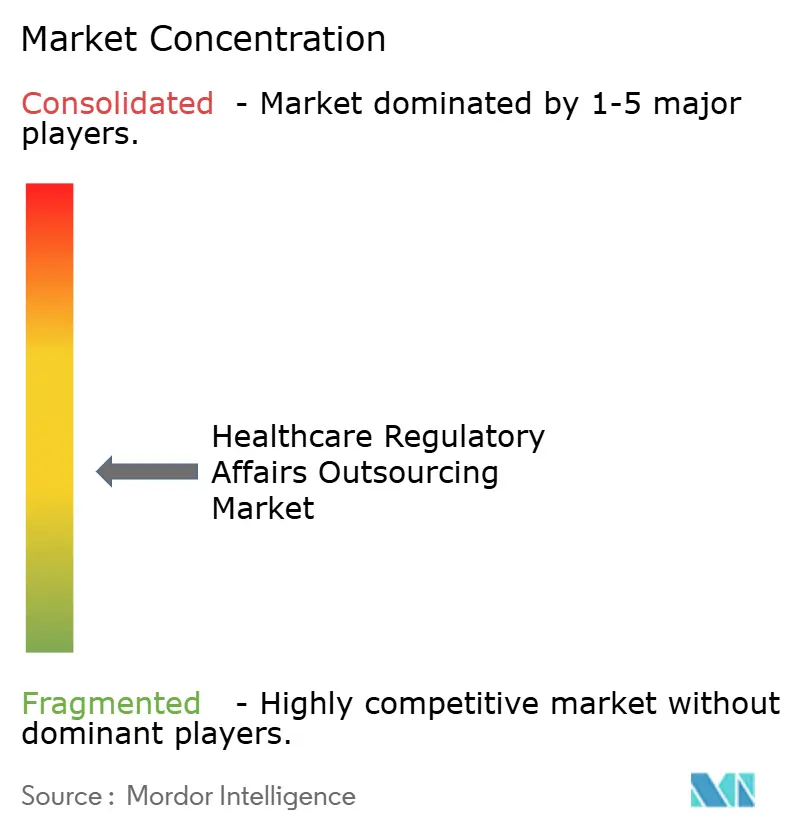
| Market Concentration | Medium |
Major Players *Disclaimer: Major Players sorted in no particular order Image © Mordor Intelligence. Reuse requires attribution under CC BY 4.0. | |
Healthcare Regulatory Affairs Outsourcing Market Analysis by Mordor Intelligence
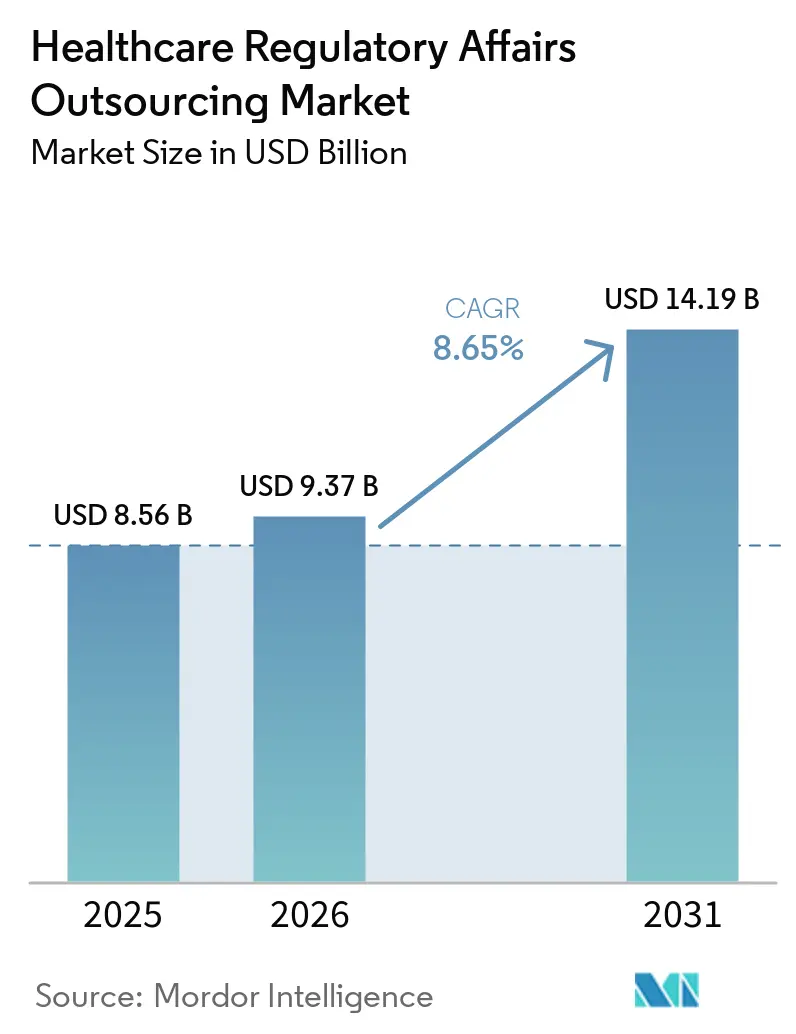
The Healthcare Regulatory Affairs Outsourcing Market size is expected to grow from USD 8.56 billion in 2025 to USD 9.37 billion in 2026 and is forecast to reach USD 14.19 billion by 2031 at 8.65% CAGR over 2026-2031.
The growth path mirrors rising demand from virtual biotechs that lack in-house regulatory capabilities, the migration of high-volume dossier preparation to specialized vendors, and ever-stricter global submission standards. Sponsors continue to prioritize speed-to-market over document production volume, a shift that explains why product registration and clinical trial applications are expanding faster than other services. At the same time, regulators require continuous real-world evidence, turning post-approval activities into a multiyear revenue stream for outsourcing providers. North America remains the anchor of revenue, yet the rise of multilingual hubs in India and China is reshaping the competitive landscape. Vendors that integrate AI into submission workflows compress cycle times, secure larger work packages, and differentiate themselves on value rather than labor cost.
Key Report Takeaways
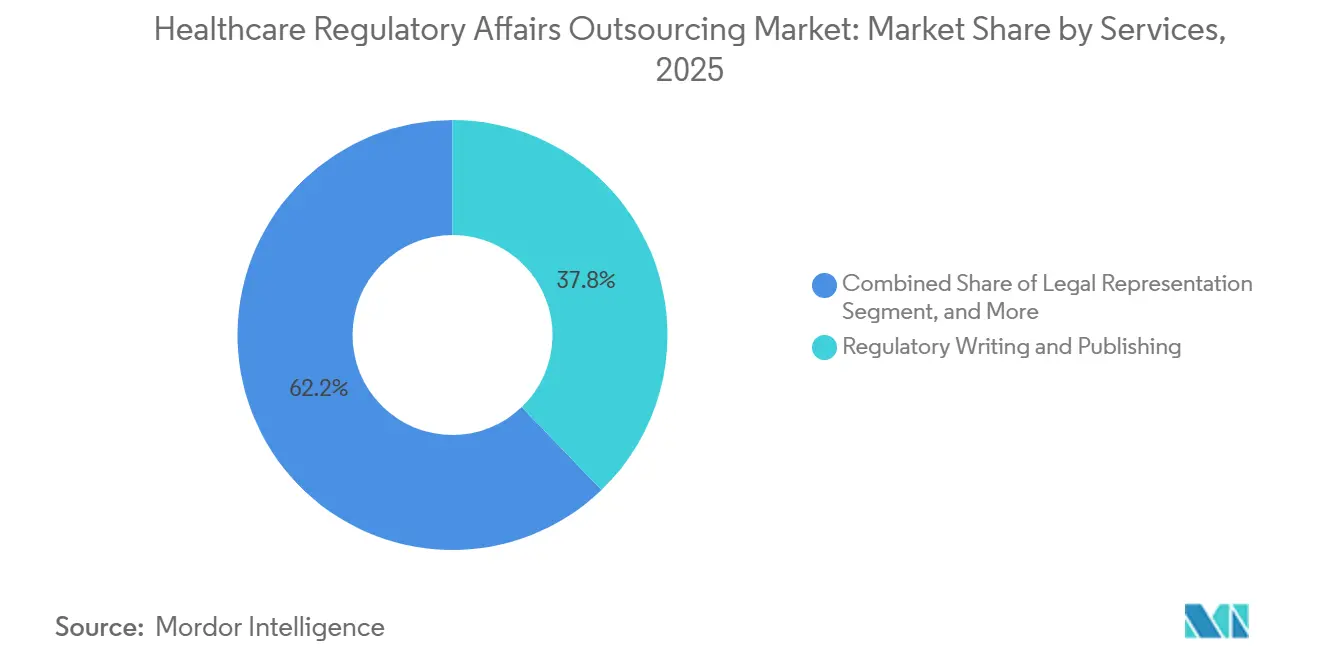
- By service, regulatory writing & publishing led with a 37.81% revenue share in 2025; product registration & clinical trial applications are projected to expand at an 11.66% CAGR through 2031.
- By product lifecycle stage, clinical-phase work held 44.73% of the healthcare regulatory affairs outsourcing market share in 2025, while post-approval & post-market services advanced at a 12.42% CAGR to 2031.
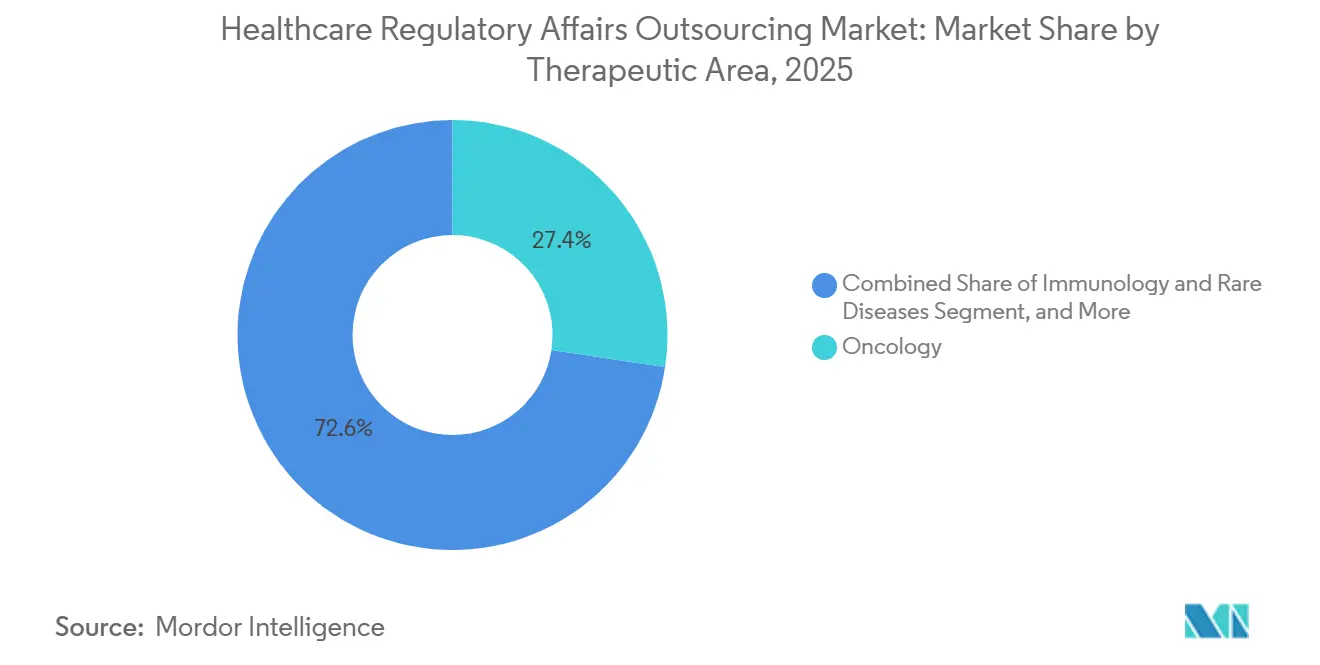
- By therapeutic area, oncology captured 27.38% of the spend in 2025; immunology & rare diseases grew fastest at a 10.19% CAGR through 2031.
- By end user, pharmaceutical companies accounted for 58.36% spending in 2025, whereas medical-device manufacturers recorded the highest projected CAGR at 9.36% through 2031.
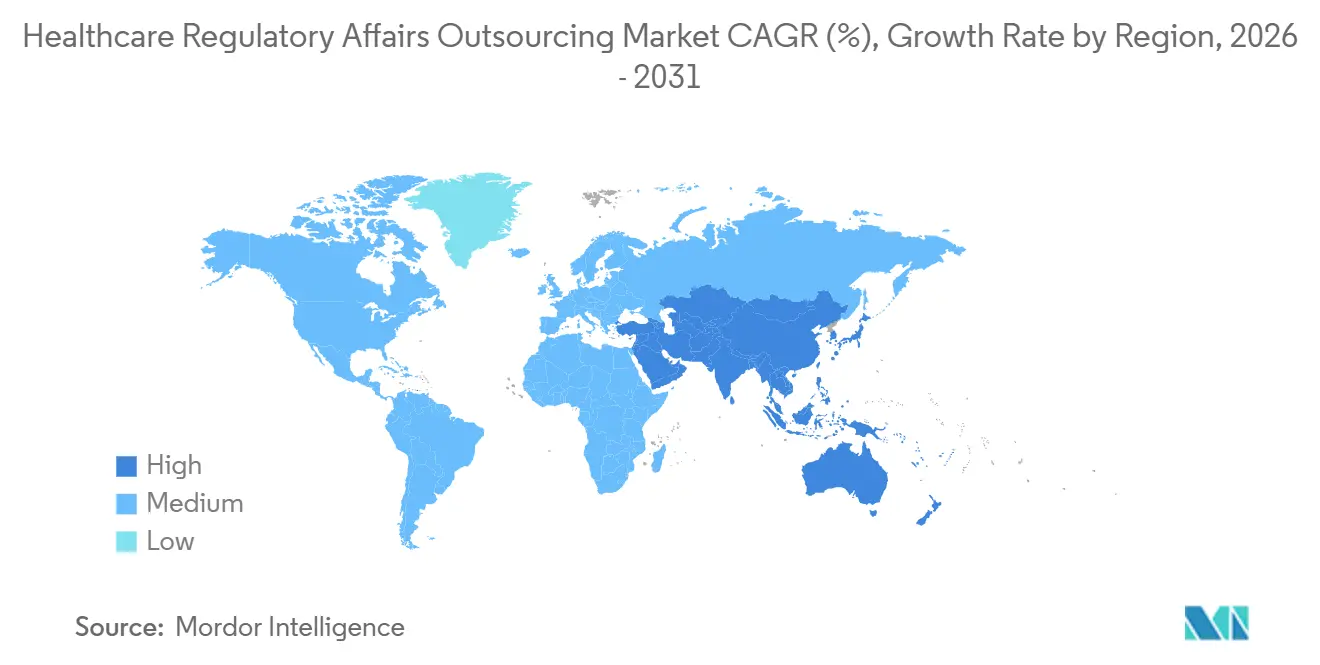
- By geography, North America accounted for 42.36% of the revenue in 2025; the Asia-Pacific region is the fastest-growing, with a 13.06% CAGR forecasted to 2031.
Note: Market size and forecast figures in this report are generated using Mordor Intelligence’s proprietary estimation framework, updated with the latest available data and insights as of January 2026.
Market Trends and Insights
Drivers Impact Analysis of Healthcare Regulatory Affairs Outsourcing Market*
| Driver | (~) % Impact on CAGR Forecast | Geographic Relevance | Impact Timeline |
|---|---|---|---|
| Increasing Number of Clinical Trials | +1.8% | Global, with concentration in North America, Europe, and emerging APAC hubs | Medium term (2-4 years) |
| Life-Science Companies Focusing on Core Competencies | +1.5% | Global, particularly strong in North America and Europe where virtual biotechs proliferate | Long term (≥4 years) |
| Growing Complexity of Global Regulatory Frameworks | +1.4% | Global, acute in markets with recent regulatory overhauls (EU MDR, China NMPA reforms) | Long term (≥4 years) |
| Expansion of Virtual/Small-Molecule Biotech Start-Ups | +1.3% | North America and Europe core, spillover to Israel and Singapore | Medium term (2-4 years) |
| AI-Driven Regulatory-Intelligence Adoption | +1.2% | North America and EU early adopters, gradual diffusion to APAC | Short term (≤2 years) |
| Emergence of Low-Cost Regulatory Hubs in Developing Countries | +1.1% | APAC core (India, China, Philippines), spillover to Eastern Europe and Latin America | Medium term (2-4 years) |
| Source: Mordor Intelligence | |||
Increasing Number of Clinical Trials
ClinicalTrials.gov listed 487,000 studies by December 2024, 6.2% higher than in 2023, and nearly half of the new trials involved oncology or rare diseases.[1] Each study generates IND submissions, protocol amendments, and safety narratives that sponsors prefer to externalize. The FDA’s Project Optimus requires oncology programs to include dose-optimization studies, adding layers of documentation that strain small teams. Decentralized models now encompass roughly 30% of Phase II and III protocols, which combine electronic consent and remote monitoring, inviting regulatory ambiguity that specialist vendors can better manage. Demand also rises for writers who can integrate digital biomarker data into dossiers. Together, these forces enlarge contract values and fortify the healthcare regulatory affairs outsourcing market.
Life-Science Companies Focusing on Core Competencies
Virtual biotechs often operate with lean staff, outsourcing every compliance task from pre-IND to post-market surveillance. Established pharmaceutical companies keep their strategies in-house but outsource high-volume activities, such as regional dossier adaptation, labeling revisions, and serialization updates. This bifurcation pushes vendors to support both premium advisory work and commoditized document assembly. Fee structures shift toward outcome-based pricing tied to approval milestones, rewarding providers able to deliver first-cycle approvals. As investors scrutinize regulatory readiness before funding rounds, early-stage companies engage consultants sooner, cementing outsourcing as a structural, not cyclical, choice.
Growing Complexity of Global Regulatory Frameworks
The EU Medical Device Regulation, fully implemented in 2024, expanded clinical evidence requirements and post-market obligations across the 27 member states. China’s National Medical Products Administration overhauled its electronic submission format the same year, tightening timelines and data-integrity checks. The FDA’s Real-World Evidence program authorizes observational data for label expansions yet offers limited design guidance, driving sponsors to experts who can craft defensible methodologies.[2] Japan introduced conditional approval for regenerative medicines, necessitating long-term follow-up studies that further expand the roles of vendors. Overlapping frameworks for software-as-a-medical-device and AI health tools introduce additional compliance layers, transforming regulatory navigation into a specialized profession that is often unavailable in most in-house groups.
AI-Driven Regulatory-Intelligence Adoption
Draft FDA guidance on AI-enabled drug-development tools, issued in May 2024, legitimized machine-learning models for protocol design and adverse-event prediction. Vendors responded by embedding natural-language processing that auto-compiles eCTD modules, cutting submission cycles by up to 40%. IQVIA’s Orchestrated Clinical Trials platform flags compliance gaps during protocol creation, shifting quality control upstream. The EMA’s IRIS portal requires structured data submissions, motivating sponsors to deploy AI tools that transform legacy PDFs into formats that are regulator-ready. Despite the promise, agencies have not finalized validation standards for AI-generated content, so sponsors hire consultants with dual expertise in data science and regulatory affairs. This premium-tier service fuels revenue growth in the healthcare regulatory affairs outsourcing market.
Restraints Impact Analysis of Healthcare Regulatory Affairs Outsourcing Market*
| Restraint | (~) % Impact on CAGR Forecast | Geographic Relevance | Impact Timeline |
|---|---|---|---|
| Data-Security & IP-Leak Risks | -0.9% | Global, acute in regions with cross-border data-transfer restrictions (EU GDPR, China PIPL) | Short term (≤2 years) |
| Lack of Global Process Standardisation | -0.7% | Global, particularly challenging for multinational sponsors managing multi-region submissions | Long term (≥4 years) |
| Escalating Cost of Specialised Regulatory Talent | -0.5% | North America and Western Europe, where competition for experienced professionals is intense | Medium term (2-4 years) |
| Rapid Policy Shifts in Digital Therapeutics | -0.4% | North America and EU, where regulatory frameworks for digital health are still maturing | Short term (≤2 years) |
| Source: Mordor Intelligence | |||
Data-Security & IP-Leak Risks
Sponsors must transfer confidential study data and formulation details to third parties; however, cross-border rules, such as the GDPR and China’s Personal Information Protection Law, impose heavy fines for breaches. Ransomware incidents that halted several regulatory submissions in 2024 highlighted vulnerability, prompting demand for SOC 2 Type II certifications and annual penetration tests. Intellectual property leakage is subtler: when one vendor serves competing sponsors in the same therapeutic class, strategic insights may unintentionally migrate. Contract negotiations now include detailed cyber controls, data residency clauses, and audit rights, adding time and cost to outsourcing deals and tempering segment growth. Vendors that invest early in zero-trust architectures, dedicated clean rooms, and strict conflict-management policies protect their revenue and client confidence.
Rapid Policy Shifts in Digital Therapeutics
The FDA issued 11 guidance documents in 2024 on clinical decision support and change-control for AI devices, but most remain draft, leaving compliance targets fluid. EU rules classify many digital therapeutics as Class II medical devices under the Medical Device Regulation; however, only 23 notified bodies were in existence by the end of 2024, creating an approval bottleneck.[3] Reimbursement pathways differ by country, adding commercial uncertainty. The expiration of the U.S. enforcement-discretion policy, which had waived premarket review for many low-risk health apps during the COVID-19 emergency, triggered a surge of retrospective submissions that overwhelmed both sponsors and vendors. Because frameworks evolve faster than internal teams can retrain, clients hire consultants only for short, tactical projects, which caps multi-year contract values and restrains some expansion of the healthcare regulatory affairs outsourcing market.
*Our forecasts treat driver/restraint impacts as directional, not additive. The impact forecasts reflect baseline growth, mix effects, and variable interactions.
Healthcare Regulatory Affairs Outsourcing Market Segment Analysis
By Services:
Document Production Anchors Revenue, Speed-to-Market Drives GrowthRegulatory Writing & Publishing generated the largest share, at 37.81%, in 2025, underscoring the persistent demand for compliant clinical study reports, investigator brochures, and eCTD dossiers that meet ICH formatting rules. Product Registration & Clinical-Trial Applications are projected to grow at an 11.66% CAGR through 2031, as sponsors seek to compress timelines by outsourcing parallel filings across multiple regions. The healthcare patent filing outsourcing market size allocated to Patent Analytics & Portfolio Management is projected to expand at a 13.2% CAGR through 2030 as companies rationalize large portfolios ahead of patent-cliff expiries. The FDA’s eCTD 4.0 mandate, effective January 2025, has intensified outsourcing among firms lacking the necessary systems or trained staff. Pricing remains highest for Regulatory Consulting assignments tied to modalities like CRISPR-edited therapies, where agency precedent is scarce and early scientific advice sessions demand senior experts. Legal Representation continues as a niche but high-margin activity for patents and exclusivity negotiations.
Labeling & Artwork Management is modest in size but grows steadily due to serialization mandates and multilingual packaging needs. Post-market and Lifecycle Management surges at a 12.42% CAGR, driven by the FDA Sentinel Initiative and EMA EudraVigilance requirements, which mandate continuous safety monitoring. Vendors offering real-time safety-signal detection and expedited periodic safety update reports win long-term contracts. Subscription-based regulatory intelligence, gap assessments, and mock inspections form Other Niche Services that expand during audit cycles or when new guidance emerges. The cumulative effect of these service trends maintains strong momentum in the healthcare regulatory affairs outsourcing market.

By Product-Lifecycle Stage:
Post-Approval Surge Reflects Regulatory VigilanceClinical-phase activities held 44.73% of spending in 2025, covering IND filings, protocol amendments, and safety updates. Post-approval and post-market work is forecast to grow at 12.42% CAGR to 2031 as regulators mandate confirmatory studies for accelerated approvals and impose stricter pharmacovigilance standards. The FDA granted accelerated approval to 15 oncology drugs in 2024, each requiring post-launch trials to sustain demand for external regulatory support. Registration-stage projects peak just before initial approval, but now involve iterative interactions as agencies adopt rolling reviews. EMA’s Regulatory Science Strategy emphasizes adaptive pathways, compelling sponsors to maintain dialogue even after dossier submission. The healthcare regulatory affairs outsourcing market size for post-approval commitments is therefore projected to expand more rapidly than traditional clinical-phase outsourcing over the forecast period.
Pre-clinical advisory, though smaller, is trending upward because sponsors value agency feedback early, seeking to avoid costly redesigns later. Continuous real-world evidence generation blurs lines between post-market and clinical operations, prompting clients to prefer integrated vendors that can nurture products across their lifespan.
By Therapeutic Area:
Rare Diseases Outpace Oncology’s Established LeadOncology accounted for 27.38% of the 2025 spend, as combination regimens and biomarker-driven trials made submissions more complex. Immunology & Rare Diseases, benefiting from 301 orphan drug designations in 2024, is projected to grow at a 10.19% CAGR. Surrogate endpoints accepted under orphan and breakthrough programs shorten timelines but demand nuanced benefit-risk narratives that few internal staff can craft. Infectious Disease programs gained fresh life under the Qualified Infectious Disease Product incentive, again enlarging document volume.
Cardio-metabolic therapies extend labels for GLP-1 agonists into obesity and liver disease, generating statistical complexities that push sponsors to external biostatisticians and writers. CNS & Neurology remains high-risk after multiple Alzheimer’s setbacks, yet any program reaching Phase III now involves heavy advisory engagement to align endpoints with agency expectations. Gene and cell therapies attract premium fees because vendors must address comparability, potency, and long-term safety questions unique to these modalities. Collectively, these dynamics ensure that therapeutic segmentation continues to drive depth in the healthcare regulatory affairs outsourcing market.
By End User:
Device Makers Accelerate as Pharma DominatesPharmaceutical companies accounted for 58.36% of 2025 revenue, reflecting their large pipelines and complex multi-region filings. Medical-device manufacturers are expected to show a 9.36% CAGR outlook to 2031, as the EU Medical Device Regulation and FDA Unique Device Identification rules introduce additional documentation burdens. Biotechnology companies, often operating virtually, outsource nearly every regulatory task, and their numbers continue to swell as venture investment persists. Contract Research and Manufacturing Organizations embed regulatory services into turnkey offers, compressing margins for standalone boutiques.
Combination products, such as drug-device autoinjectors, blur the jurisdictional boundary between CDER and CDRH, making dual-pathway expertise highly valuable. Device firms pursuing de novo classification rely on external strategists to present analytical and clinical data that meet the reasonable assurance standards. The cumulative complexity across end users underpins sustained expansion in the healthcare regulatory affairs outsourcing market.
Geography Analysis
North America and APAC Healthcare Regulatory Affairs Outsourcing Market
North America accounted for 42.36% of the revenue in 2025, supported by more than 5,000 active biotech startups and the FDA’s position as a global reference regulator. The Asia-Pacific region is forecast to grow at a 13.06% CAGR, reflecting India’s policy reforms and China’s aggressive digitalization of submissions, which lower entry barriers for localized vendors. India’s Central Drugs Standard Control Organisation approved 62 new drug applications in 2024, representing a 28% increase, which signals improved review efficiency. China processed more than 1,100 drug registrations in the same year, 80% from domestic players, further catalyzing local consulting demand.
The Americas, EMEA and Oceania Healthcare Regulatory Affairs Outsourcing Market
The Middle East & Africa are accelerating as Gulf Cooperation Council members harmonize drug pricing and registration processes, thereby lowering submission variability. South America remains fragmented, with Brazil’s ANVISA timelines diverging from those of Argentina’s ANMAT, allowing regional firms to maintain a dominant position. Mutual-recognition agreements between the FDA and regulators in the EU, Canada, and Australia streamline inspections, favoring global CROs equipped with standardized processes. These regional contrasts shape vendor expansion strategies in the healthcare regulatory affairs outsourcing market.
Regulatory Landscape
Regulatory affairs outsourcing demand is shaped by tightening submission, safety, and software oversight requirements across major agencies. In the United States, FDA activity across clinical decision support software updates (January 2026), updated cybersecurity expectations for medical devices (February 2026), and a July 2026 request for input on non-device software functions highlights expanding compliance workloads for digital health and connected device programs. Sponsors increasingly rely on specialist external teams to manage evolving interpretation and documentation.
In Europe, EMA applied revised EU variations guidance from 15 January 2026, affecting how marketing authorization holders categorize and document post-approval changes. The agency also advanced governance work linked to the new EU pharmaceutical legislation through 2026 workstreams. Alongside interoperability and structured-data pushes (for example, the US ONC 2026 SVAP cycle enabling voluntary adoption of updated certified health IT standards from August 29, 2026), these initiatives increase the volume and specificity of regulatory operations, from lifecycle change management to structured submission readiness. As a result, sponsors often route this work to outsourcing partners with multi-region expertise.
Value Chain Analysis
The value chain starts with sponsors (pharmaceutical, biotechnology, and medical-device manufacturers) defining regulatory strategy and evidence plans, then shifting into outsourced execution for high-volume and specialist work packages such as regulatory writing and publishing, eCTD compilation, product registration and clinical trial applications, and post-market safety and lifecycle maintenance. Full-service CROs (for example, IQVIA and ICON) and functional service providers (FSPs) increasingly coordinate document production, submission operations, and health authority interactions. Niche regulatory consultancies also support complex modalities, market-entry planning, and local affiliate activities.
Upstream, clinical and manufacturing partners, including CDMOs, supply CMC data and quality documentation that feed regulatory submissions. Downstream, pharmacovigilance systems and real-world evidence workflows support ongoing obligations under programs such as FDA Sentinel and EMA EudraVigilance. Technology vendors and internal platforms increasingly sit in the middle of the chain as agencies move toward structured and more digital submissions, while sponsors push for shorter cycle times. The main friction points remain specialist talent availability, cross-border data handling under frameworks such as GDPR and China PIPL, and the need to keep submission content audit-ready as AI-assisted authoring and compilation tools move into regulated processes.
Competitive Landscape
The healthcare regulatory affairs outsourcing market remains moderately fragmented. Full-service CROs such as IQVIA, Charles River Laboratories, and ICON integrate regulatory affairs into end-to-end development packages, leveraging operational data to speed submissions. Thermo Fisher Scientific’s USD 17.4 billion acquisition of PPD signaled the value of in-house regulatory talent for diversified life-science suppliers. Smaller consultancies differentiate themselves by specializing in rare diseases, cell- and gene-therapies, or AI-enabled submission platforms.
Technology adoption is the main competitive lever. ICON and Microsoft use generative AI to cut eCTD compilation time by 35%. Thermo Fisher’s PPD division launched a regulatory-intelligence dashboard that aggregates updates from 50 authorities, providing predictive review timelines that sponsors value. Vendors without digital tools face margin pressure as clients demand faster cycle times at lower cost. Mergers and acquisitions target boutique firms with geographic depth or software assets that streamline document processing. Despite consolidation, white-space exists in digital therapeutics and software-as-a-medical-device consulting, areas with few seasoned advisors yet rising submission volume, keeping competitive intensity stable.
Healthcare Regulatory Affairs Outsourcing Industry Leaders
-
IQVIA
-
Parexel International Corporation
-
ICON PLC
-
Charles River Laboratories
-
Labcorp
- *Disclaimer: Major Players sorted in no particular order
Healthcare Regulatory Affairs Outsourcing Market Companies Covered in this Report
- Accell Clinical Research
- Arriello
- Charles River
- CTI Clinical Trial & Consulting
- Freyr Solutions
- Genpact
- ICON
- IQVIA
- LabCorp
- MedPace
- Parexel International
- PharSafer Associates
- ProductLife Group
- Promedica International
- SGS Life Sciences
- Syneos Health
- Thermo Fisher Scientific (PPD)
- Veristat
- WuXi App Tec
Market Opportunities and Future Outlook
One near-term opportunity is compliance-ready automation that reduces regulatory operations cycle time while preserving traceability and auditability. FDA issued draft guidance in January 2025 on using AI to support regulatory decision-making for drugs and biologics, and EMA has published guiding principles for using large language models in regulatory science. Together, these developments offer vendors a clearer path to productize AI-enabled authoring, data extraction, and submission quality controls within regulated workflows, rather than relying on ad hoc tooling. Providers that combine AI-assisted document production with validated governance, versioning, and defensible data lineage are positioned to win larger, end-to-end work packages in regulatory writing and publishing, as well as product registration and clinical trial applications.
A second whitespace is integrated multi-jurisdiction support for software and digital health programs as oversight tightens and interoperability requirements expand. US ONC activity through the 2026 Standards Version Advancement Process supports updated standards for certified health IT beginning August 29, 2026. FDA also continued to refine software-related oversight in 2026, increasing the need for specialized regulatory interpretation, structured documentation, and post-market performance monitoring. In Europe, the interaction between medical device rules and emerging AI requirements raises the burden of lifecycle change control and technical documentation maintenance, which pushes sponsors to shift ongoing compliance work (including post-market and lifecycle management) to outsourcing partners able to operate across FDA, EMA, and other reference markets.
Recent Industry Developments in Healthcare Regulatory Affairs Outsourcing Market
- July 2026: ProPharma announced the deployment of a proprietary AI-assisted capability for developing Abbreviated New Drug Application (ANDA) submissions. The company formalized AI use in high-volume generics submission workflows, with a focus on consistency, traceability, and turnaround time. This also increases competitive pressure on regulatory writing and publishing providers to match technology-enabled compilation and quality controls.
- April 2026: Veristat announced an intended acquisition of Certara's Regulatory and Medical Writing business, adding more than 200 experts to its regulatory writing and submissions operations. The transaction increases Veristat's scale in outsourced work packages such as medical writing, dossier preparation, and submission management. It also supports broader bundled offerings designed to reduce vendor handoffs for sponsors across development and registration.
- September 2025: Parexel partnered with Weave Bio to integrate AI-native regulatory automation intended to accelerate submission processes through data extraction, authoring, review, and verification. The collaboration strengthens Parexel's ability to industrialize regulatory operations and compete on speed and first-pass quality in multi-region filings. It also reflects the shift toward platform-enabled delivery models in outsourced regulatory affairs.
Healthcare Regulatory Affairs Outsourcing Market Report Scope and Research Methodology
Market Definition and Coverage
This market covers third-party services used by life science companies to plan, prepare, submit, and maintain regulatory work across the product life cycle, including the documentation and interactions needed for approvals and ongoing compliance.
Scope exclusions: We exclude in-house regulatory headcount costs, internal quality operations, and purely legal dispute work that is not tied to regulatory submissions or regulated-market maintenance.
Segments Covered in This Report
- By Services
- Regulatory Consulting
- Legal Representation
- Regulatory Writing & Publishing
- Product Registration & Clinical-Trial Applications
- Labeling & Artwork Management
- Post-Market / Lifecycle Management
- Other Niche Services
- By Product-Lifecycle Stage
- Pre-Clinical
- Clinical (Phase I-III)
- Registration
- Post-Approval / Post-Market
- By Therapeutic Area
- Oncology
- Infectious Diseases
- Cardio-Metabolic
- CNS & Neurology
- Immunology & Rare Diseases
- Other Therapeutic Area
- By End User
- Pharmaceutical Companies
- Biotechnology Companies
- Medical-Device Manufacturers
- Contract Research & Manufacturing Organisations
- By Geography
- North America
- United States
- Canada
- Mexico
- Europe
- Germany
- United Kingdom
- France
- Italy
- Spain
- Rest of Europe
- Asia-Pacific
- China
- Japan
- India
- Australia
- South Korea
- Rest of Asia-Pacific
- Middle East & Africa
- GCC
- South Africa
- Rest of Middle East & Africa
- South America
- Brazil
- Argentina
- Rest of South America
- North America
Data Sources, Market Sizing, and Validation
Desk Research
Desk work started with mapping demand drivers that move outsourcing budgets, and then collecting public signals that can be checked year over year. We relied on non-paywalled sources such as the US FDA databases and guidance updates, the European Medicines Agency public information, the International Council for Harmonisation (ICH) guideline library, and OECD health statistics to understand regulatory workload and compliance direction.
To translate those signals into a workable value model, we also used company annual reports and investor presentations, reputable press, association publications, and selected peer-reviewed articles on regulatory timelines and dossier requirements. Where needed, paid subscriptions for company financials and news helped confirm business mix and outsourcing intensity for service providers that disclose it. The examples listed above are illustrative, and we also used other sources during data collection, validation, and clarifying questions in the study.
Primary Interviews and Surveys
Primary interviews and structured surveys were used to validate what is being outsourced, how pricing is evolving, and where demand is shifting by region. We spoke with regulatory affairs leads at sponsors, outsourced service delivery leaders, and operational managers to confirm assumptions on project mix (submissions, writing and publishing, registration support, and consulting) and typical engagement length across major geographies.
Distribution of primary research fieldwork respondents
| Company type | Respondent position | Region |
|---|---|---|
| Top tier: 32% | CXOs: 14% | APAC: 44% |
| Mid tier: 50% | Functional/Unit leaders: 27% | EMEA: 33% |
| Smaller Players: 18% | Managers: 59% | Americas: 23% |
Market-Sizing & Forecasting
Sizing was built using a top-down and bottom-up approach. First, we reconstructed the demand pool from regulated product activity and submission intensity, then cross-checked it against supplier-side revenue patterns. On the top-down side, we linked regulatory workload to outsourcing spend by tracking signals such as new drug and biologics approvals, active clinical trial volumes, the pace of labeling and variation filings, and the share of complex modalities that typically increase documentation effort.
Those demand indicators were then converted into value using variables such as the mix of services (consulting, legal representation tied to filings, regulatory writing and publishing, and registration and clinical trial applications), typical project duration, and the implied average pricing progression in major regions. Bottom-up checks were applied selectively through sampled provider revenue disclosures, discussions with channel contacts on project pricing, and sanity checks on volume times average fee for commonly outsourced deliverables. Where data gaps appeared, we used conservative ranges and narrowed them during interviews.
For forecasting, scenario analysis was used to represent different rates of regulatory change and outsourcing adoption. We then reconciled those scenarios to the consensus view from experts on the likely path of approval activity, trial starts, and compliance workload. When inputs moved in opposite directions, we kept the final trajectory stable by prioritizing variables that are repeatedly trackable and can be explained in a client call.
Data Validation & Update Cycle
Outputs were validated by comparing model totals against independent signals such as approval counts, publicly visible clinical trial activity, and observed outsourcing budget direction shared by interviewees. If a region or service line showed an unusual jump, we rechecked the driver series, reviewed currency conversion timing, and revisited pricing assumptions before accepting totals.
Each market build goes through multi-step internal review, where assumptions, intermediate calculations, and final totals are checked by another analyst before sign-off. Reports are refreshed annually, and interim updates are made when material events occur, such as major guidance changes or meaningful shifts in regulated product activity. Before delivery, we re-scan the latest public signals so clients get an updated view rather than a static snapshot.
Mordor Intelligence's Healthcare Regulatory Outsourcing Affairs Market Size Versus Other Published Estimates
Published market sizes for healthcare regulatory affairs outsourcing can look different even when the topic label is the same, since firms often bundle adjacent services and do not always align on the year used for currency and inflation treatment. Differences also show up when one study measures only outsourced regulatory affairs work, while another blends it with broader clinical and safety support that sits next to regulatory teams.
The largest gap drivers we see are scope boundaries and what gets counted as regulatory legal work, plus how service mix is priced as submissions get more complex. Some estimates include pharmacovigilance operations, medical writing beyond regulatory documents, or full CRO trial management, which can lift the headline value. Another common gap is how consulting, writing and publishing, and registration and clinical trial applications are separated and priced, with those service lines modeled as distinct buckets and then checked against approval activity and filing workload. This keeps the total anchored in Mordor Intelligence.
Benchmark comparison
| Source | Market Size | Gaps in Research Methodology |
|---|---|---|
| Mordor Intelligence | USD 8.56 B (2025) | |
| Global Consultancy A | USD 7.09 B (2024) | Uses an earlier base year and typically groups regulatory outsourcing under a narrower set of submission and compliance tasks, with limited clarity on whether writing and publishing and registration support are fully captured across regions. |
| Industry Bulletin B | USD 8.09 B (2025) | Often relies on a single headline growth path and broad service grouping, with less transparency on service-mix weighting and how average fees are adjusted by region and by complexity of filings. |
Across the three figures, the spread is mainly explained by what is included in scope, which year is used as the anchor, and how pricing is progressed for high-effort deliverables. Our approach keeps the number traceable to repeatable workload signals and a clear service mix, and then it is pressure-tested through interviews and cross-checks so the final market value stays practical for planning.
Key Questions Answered in the Report
What is the current value of the healthcare regulatory affairs outsourcing market?
The healthcare regulatory affairs outsourcing market stands at USD 9.37 billion in 2026.
What is the projected growth rate of the healthcare regulatory affairs outsourcing market?
It is forecast to expand at an 8.65% CAGR, reaching USD 14.19 billion by 2031.
Which service segment generates the highest revenue?
Regulatory writing & publishing leads, accounting for 37.81% of 2025 revenue.
Which region will see the fastest growth?
Asia-Pacific is projected to grow at a 13.06% CAGR through 2031.
Why are post-approval services gaining traction?
Regulators now demand continuous real-world evidence and intensified pharmacovigilance, driving a 12.42% CAGR in post-market outsourcing.