
Healthcare Quality Management Market Size and Share
Market Overview
| Study Period | 2020 - 2031 |
|---|---|
| Market Size (2026) | USD 2.02 Billion |
| Market Size (2031) | USD 3.97 Billion |
| Growth Rate (2026 - 2031) | 14.43 % |
| Fastest Growing Market | Asia Pacific |
| Largest Market | North America |
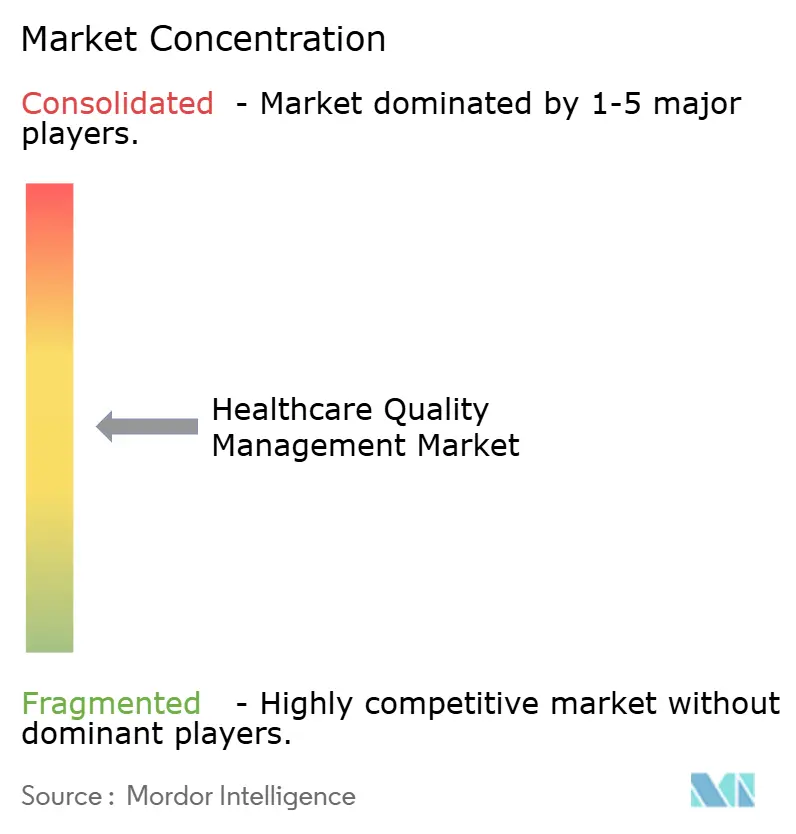
| Market Concentration | Medium |
Major Players *Disclaimer: Major Players sorted in no particular order Image © Mordor Intelligence. Reuse requires attribution under CC BY 4.0. | |
Healthcare Quality Management Market Analysis by Mordor Intelligence
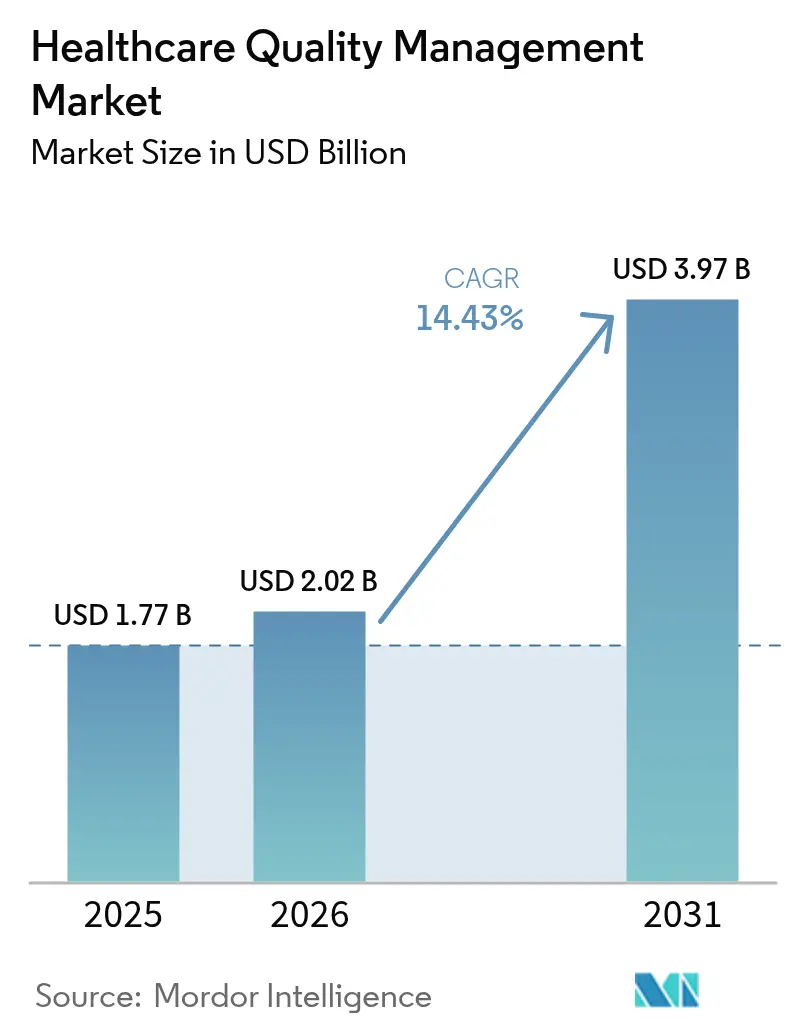
The Healthcare quality management market size was valued at USD 1.77 billion in 2025 and estimated to grow from USD 2.02 billion in 2026 to reach USD 3.97 billion by 2031, at a CAGR of 14.43% during the forecast period (2026-2031). This rapid expansion reflects a shift from retrospective compliance reporting toward predictive intelligence platforms that improve clinical outcomes and margins. Escalating electronic clinical quality-measure mandates, expanding value-based payment models, and rising volumes of structured and unstructured health data are pushing providers and payers to adopt integrated analytics suites. Cloud deployment now dominates as organizations trade capital outlays for subscription models that offer swift scalability and tighter cyber-resilience. AI-enabled population-health modules are gaining traction because they help identify high-risk cohorts, automate care-gap closure, and lower readmissions. Competitive intensity is increasing as electronic-health-record incumbents acquire or partner with AI-native firms to defend installed bases and meet growing interoperability requirements.
Key Report Takeaways
- By software type, Business Intelligence & Advanced Analytics led with 34.12% of Healthcare quality management market share in 2025, while Population-Health Quality Management is projected to expand at 16.28% CAGR to 2031.
- By mode of delivery, cloud-based solutions held 58.05% share of the Healthcare quality management market size in 2025 and Web-Hosted SaaS is advancing at 15.63% CAGR through 2031.
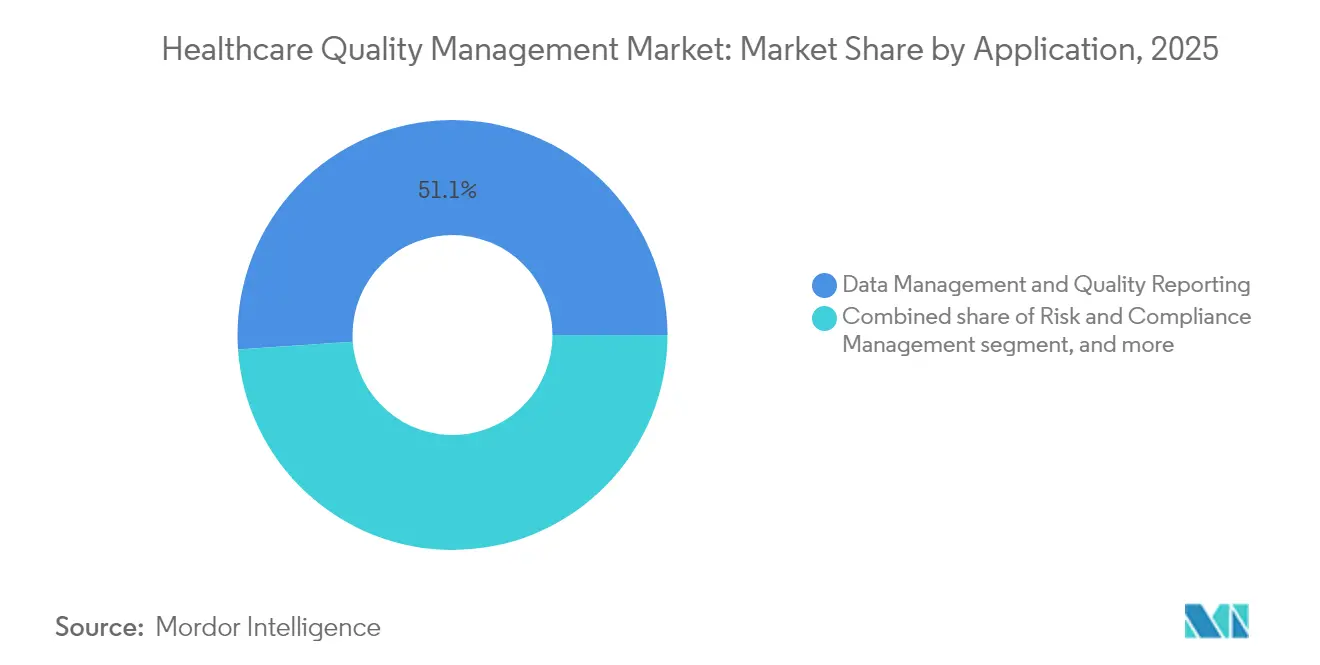
- By application, Data Management & Quality Reporting accounted for 51.08% share of the Healthcare quality management market size in 2025; Outcome & Cost Analytics is growing fastest at 16.07% CAGR to 2031.
- By end user, hospitals & integrated delivery networks controlled 60.89% of the Healthcare quality management market share in 2025, whereas payers & ACOs are set for a 17.33% CAGR during 2026-2031.
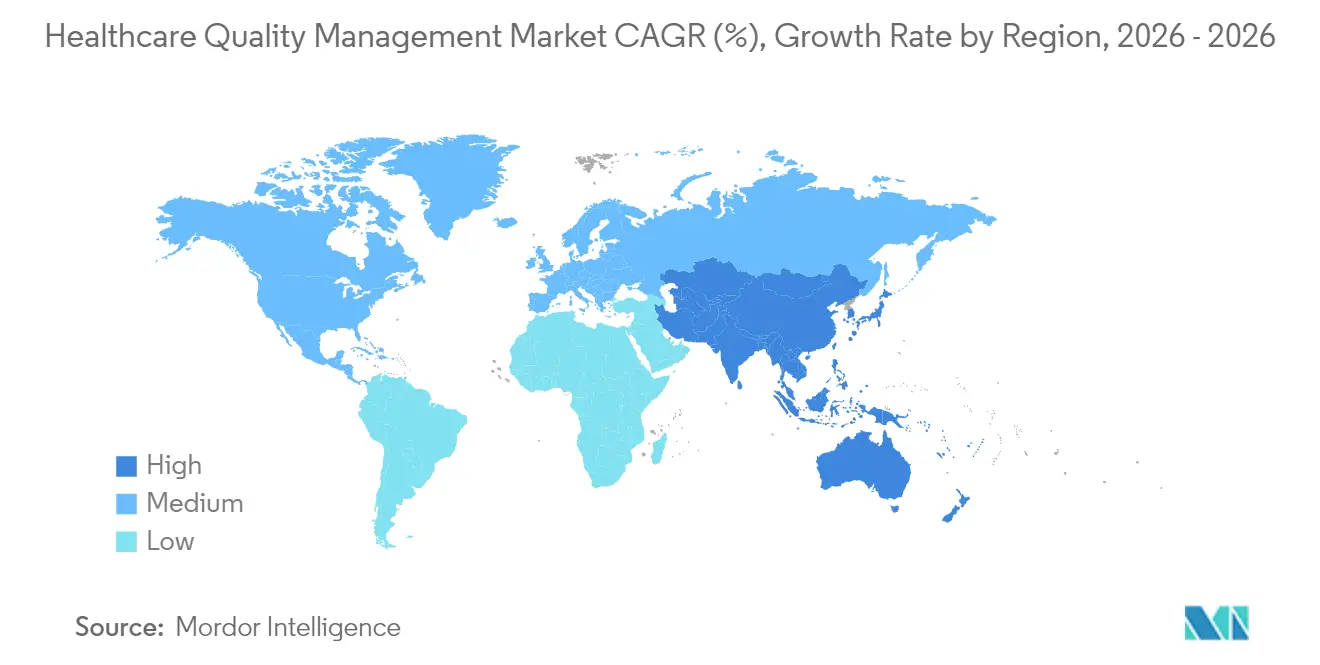
- By geography, North America remained dominant with 40.02% share in 2025, yet Asia-Pacific is forecast to rise at 15.52% CAGR to 2031.
Note: Market size and forecast figures in this report are generated using Mordor Intelligence’s proprietary estimation framework, updated with the latest available data and insights as of 2026.
Market Trends and Insights
Drivers Impact Analysis of Healthcare Quality Management Market*
| Driver | % Impact on CAGR Forecast | Geographic Relevance | Impact Timeline |
|---|---|---|---|
| Government Mandates And Incentives For Quality Reporting | +3.2% | North America & EU lead; global applicability | Short term (≤ 2 years) |
| Surge In Healthcare Data Volume And Complexity | +2.8% | Global | Medium term (2 – 4 years) |
| Aging Population And Chronic Disease Burden | +2.1% | Asia-Pacific core; spill-over to North America & EU | Long term (≥ 4 years) |
| Digital Transformation Of Provider Workflows | +2.5% | Global | Medium term (2 – 4 years) |
| Advancement Of Artificial Intelligence Analytics | +3.1% | North America & EU; expanding to Asia-Pacific | Short term (≤ 2 years) |
| Rise Of Consumer Transparency And ESG Accountability | +1.8% | North America & EU | Long term (≥ 4 years) |
| Source: Mordor Intelligence | |||
Government Mandates and Incentives for Quality Reporting
Regulators now embed financial carrots and sticks in reimbursement, compelling hospitals and accountable-care organizations to elevate reporting sophistication. The Centers for Medicare & Medicaid Services will expand accountable-care quality measures from 4 in 2025 to 11 in 2028, turning manual spreadsheets into high-risk liabilities[1]. Annual submission of six electronic clinical quality measures determines payment adjustments, pushing laggards toward modern platforms. Hospitals that ignore these rules risk both revenue loss and exclusion from value-based programs. The 21st Century Cures Act adds penalties for information blocking, making interoperable data flows a non-negotiable requirement. As a result, investment in end-to-end quality suites has shifted from discretionary to mission-critical budgeting.
Aging Population and Chronic Disease Burden
Noncommunicable diseases account for 74% of global deaths, creating multicomorbidity challenges that strain fee-for-service economics[2]. Asia-Pacific bears the heaviest demographic load, spurring investments in population-health quality platforms that orchestrate longitudinal care plans across providers. Value-based contracts place downside financial risk on outcomes, making proactive disease-management dashboards indispensable. Organizations deploying such systems see hospital-readmission reductions and per-patient cost savings, demonstrating that demographic pressure is fuelling sustained platform demand well into the next decade.
Advancement of Artificial-Intelligence Analytics
Predictive algorithms have moved from pilot projects to enterprise rollouts, with hospitals pairing historical data and real-time feeds to flag sepsis risk or equipment downtime. Wolters Kluwer’s AI-enabled decision-support modules exemplify embedded intelligence within clinician routines. Explainability is now mandatory under the federal HTI-1 rule, guiding vendors to surface algorithm logic in plain language. Providers deploying transparent AI report sharply lower readmissions and improved audit scores, substantiating the technology’s pivotal role in future growth.
Rise of Consumer Transparency and ESG Accountability
Patients demand clear outcome metrics while institutional investors screen environmental, social, and governance performance. Public scorecards and equity-focused initiatives pressure health systems to disclose quality indicators. Platforms that unify clinical, financial, and experience data therefore gain strategic relevance. Over time, ESG-driven procurement policies may reward vendors that capture and report metrics on health-equity interventions and carbon footprints.
Restraints Impact Analysis of Healthcare Quality Management Market*
| Restraints Impact Analysis | (~) % Impact on CAGR Forecast | Geographic Relevance | Impact Timeline |
|---|---|---|---|
| High implementation and integration costs | −2.1% | Global; strongest in emerging markets | Short term (≤ 2 years) |
| Data security and privacy concerns | −1.8% | Global; regulatory focus in North America & EU | Medium term (2 – 4 years) |
| Lack of interoperability standards | −1.5% | Global | Medium term (2 – 4 years) |
| Algorithmic bias and regulatory liability | −1.2% | North America & EU; rising attention in Asia-Pacific | Long term (≥ 4 years) |
| Source: Mordor Intelligence | |||
High Implementation and Integration Costs
Smaller providers struggle to fund platform rollouts when HIPAA security amendments alone require USD 9.3 billion nationwide in first-year compliance costs[3]. Linking new quality modules with legacy EHRs often extends timelines by up to two years and multiplies consulting fees. Total cost of ownership includes ongoing upgrades and user training that frequently double or triple initial license expenditure. As a result, some mid-tier systems revert to manual workarounds that eventually prove unsustainable, slowing market penetration in cost-sensitive regions.
Data Security and Privacy Concerns
Healthcare leads all industries in breach frequency and average incident cost, with cyberattacks up 239% from 2018 to 2023. Proposed rules require multi-factor authentication, encryption at rest, and routine vulnerability scans, raising the bar for vendors. Payers and providers must balance expansive data-sharing mandates with strict privacy controls, especially as AI engines demand access to complete longitudinal records. Two-thirds of organizations admit they are unprepared for tighter standards, delaying purchase decisions until security roadmaps mature.
*Our forecasts treat driver/restraint impacts as directional, not additive. The impact forecasts reflect baseline growth, mix effects, and variable interactions.
Healthcare Quality Management Market Segment Analysis
By Software Type:
Analytics Platforms Drive Intelligence EvolutionBusiness Intelligence & Advanced Analytics retained the largest footprint, reflecting fundamental demand for dashboards that fulfill reporting obligations. Population-Health Quality Management however is accelerating at 16.28% CAGR because payers and integrated networks need proactive risk-stratification tools. Vendors embed AI prediction into these modules, shifting the Healthcare quality management market from retrospective charts toward real-time intervention engines. Quality Reporting & Benchmarking suites remain vital for CMS compliance, while Clinical Risk & Patient-Safety platforms gain attention amid stricter accreditation rules.
The convergence trend favours unified stacks that merge visualization, predictive analytics, and safety surveillance. Wolters Kluwer’s UpToDate-powered AI Labs illustrates how decision support and quality analytics now coexist in one workflow. Hospitals adopting full-spectrum platforms report USD 13.3 million annual savings and rapid ROI, propelling further uptake. As AI transparency rules tighten, vendors with explainable models enjoy a competitive edge in the Healthcare quality management market.


By Mode of Delivery:
Cloud Migration Accelerates Platform AdoptionCloud-based deployment captured 58.05% of 2025 revenue, underscoring provider appetite for elastic infrastructure. Web-Hosted SaaS leads growth at 15.63% CAGR, highlighting movement toward subscription economics that sidestep capital budgets. Average annual health-system cloud spend has surpassed USD 38 million, signalling confidence in vendor-managed security and redundancy. On-premise implementations persist mainly where data-sovereignty law or legacy interfaces dictate local hosting.
Oracle Health’s pursuit of Qualified HIN status within TEFCA underscores the priority on secure information exchange across cloud backbones oracle.com. SaaS delivery also democratizes advanced analytics for rural and community hospitals that lack extensive IT staff. Consequently, cloud-native suppliers are poised to outpace legacy competitors in the Healthcare quality management market.
By Application:
Data Management Foundations Enable Advanced AnalyticsData Management & Quality Reporting formed the backbone in 2025 with 51.08% share, reflecting unavoidable regulatory workloads. Outcome & Cost Analytics is scaling fastest at 16.07% CAGR as executives seek visibility into margin performance. Risk & Compliance modules remain essential to navigate shifting rules, while Patient-Safety surveillance gains urgency amid zero-harm initiatives.
Health-system leaders increasingly favour integrated suites that fuse these applications. Vizient’s collaboration with Qualtrics combines patient-experience metrics with clinical outcomes, illustrating cross-domain convergence. Unified solutions reduce duplicate interfaces, lower training needs, and improve data trustworthiness, amplifying growth across the Healthcare quality management market.
By End User:
Payers Drive Value-Based Care TransformationHospitals and integrated delivery networks held 60.89% share in 2025 because CMS mandates directly affect inpatient reimbursement. Payers and accountable-care organizations however are advancing at 17.33% CAGR, propelled by shared-savings contracts that make quality performance financially material. Ambulatory and specialty clinics also invest as care gravitates toward outpatient settings.
ACO quality-measure counts will nearly triple by 2028, forcing payers to secure platforms that ingest multi-provider data streams. Innovaccer’s acquisition of Pharmacy Quality Solutions broadens access to 95% of community pharmacies, demonstrating payer focus on whole-ecosystem oversight. This dynamic cements payers as pivotal growth engines within the Healthcare quality management market.
Geography Analysis
North America Healthcare Quality Management Market
North America retained leadership at 40.02% revenue share in 2025, supported by rigorous CMS programs and large-scale IT budgets. Proposed HIPAA security amendments alone will drive billions in compliance spend, pressing even mid-size hospitals to modernize infrastructures. Canada and Mexico add momentum through federal digitization strategies, but the United States remains the anchor of regional demand.
APAC Healthcare Quality Management Market
Asia-Pacific is the fastest-growing territory at 15.52% CAGR to 2031, catalyzed by national digital-health blueprints across Australia, India, and Malaysia. Integrated primary-care technology investments combat high noncommunicable-disease prevalence, creating fertile territory for population-health modules. Cloud uptake lets emerging markets leapfrog on-premise constraints, further stimulating the Healthcare quality management market.
Europe Healthcare Quality Management Market
Europe shows steady expansion as interoperability and health-technology-assessment frameworks spread across the bloc. Germany’s Hospital Future Act, France’s MaSanté2022 plan, and the United Kingdom’s NHS digitization agenda all demand transparent outcome metrics. GDPR compliance shapes vendor roadmaps, favouring platforms with advanced consent and pseudonymization controls. Collectively, these dynamics sustain regional growth while raising the regulatory bar for global entrants.
Regulatory Landscape
In the United States, healthcare quality management platforms are closely tied to CMS quality programs and the annual refresh cycle for electronic clinical quality measures (eCQMs). For the 2026 reporting period, CMS updated eCQM specifications, value sets, and eligible-clinician measure tables, keeping requirements focused on structured submissions and on maintaining measure logic in line with federal guidance. CMS also issued 2026 plan year Quality Improvement Strategy (QIS) technical guidance for Qualified Health Plan (QHP) issuers under ACA Section 1311(g), extending quality strategy documentation and reporting obligations that favor configurable, audit-ready quality management workflows.
Regulatory pressure is also moving toward equity-focused quality governance. Under Medicare hospital Conditions of Participation for Quality Assessment and Performance Improvement (QAPI), a new requirement takes effect January 1, 2027: hospitals providing obstetrical services must use QAPI programs to assess and improve health outcomes and disparities. This adds expectations for stratified outcomes, disparity monitoring, and closed-loop improvement actions within quality suites. In Europe, MDR/IVDR compliance continues to raise quality-system rigor and documentation cadence, including Commission Implementing Regulation (EU) 2026/977, which sets standardized maximum timelines for conformity assessments and QMS audits by Notified Bodies, as well as the June 2026 publication of new harmonized standards in the Official Journal that updates expectations for labeling and quality documentation practices.
Competitive Landscape
Competition is moderate and intensifying. Legacy EHR suppliers such as Oracle Health and IBM Merative leverage installed bases to embed quality tools, while analytics specialists like Health Catalyst target best-of-breed replacement cycles. Strategy has tilted toward ecosystem building: Oracle Health joined forces with Cleveland Clinic and G42 to co-develop AI-enabled delivery models, signalling that partnerships can accelerate capability gaps.
M&A activity accelerates consolidation. RLDatix bought SocialClimb to marry patient-experience insights with safety workflows, whereas McKesson invested USD 3.34 billion across oncology platforms to create vertical quality stacks. Vendors differentiate through AI explainability, cloud architecture, and adherence to interoperability frameworks such as TEFCA. Those unable to modernize face attrition as procurement teams gravitate toward integrated, standards-ready platforms.
White-space persists in ambulatory-care quality management and high-growth emerging markets. Agile SaaS vendors offering modular pricing can penetrate these niches faster than bulky incumbents. Meanwhile, alliances like the Joint Commission-NAHQ partnership elevate accreditation thresholds, tightening entry requirements but rewarding firms that can document compliance. Overall, technology depth and ecosystem breadth now outweigh brand tenure in determining share gains within the Healthcare quality management market.
Healthcare Quality Management Industry Leaders
-
Oracle
-
Optum, Inc.
-
Merative
-
Premier Inc.
-
RLDatix
- *Disclaimer: Major Players sorted in no particular order
Healthcare Quality Management Market Companies Covered in this Report
- Oracle
- Optum
- Merative
- Premier
- Mckesson
- RLDatix
- Health Catalyst
- CitiusTech
- Nuance (Microsoft)
- Dolbey Systems
- Medisolv
- Clarity Group
- Riskonnect Inc.
- Press Ganey
- Quantros Inc.
- Wolters Kluwer Health
- Flatiron Health
- MedeAnalytics
- Koninklijke Philips
Market Opportunities and Future Outlook
Mandatory and standards-driven programs create scope for platforms that automate end-to-end quality operations across episode accountability, payer quality reporting, and hospital QAPI governance. CMS TEAM is a mandatory five-year model running from January 1, 2026, to December 31, 2030 in selected Core-Based Statistical Areas, which increases demand for solutions that connect episode cost and outcome analytics, care-gap closure, and measure submission in a single workflow for hospitals and partners. In parallel, the January 1, 2027 QAPI requirement for obstetrical services to assess and improve outcomes and disparities expands the need for tools that operationalize stratified measurement, improvement cycles, and documentation across multi-facility systems.
Interoperability and data-standard upgrades also open practical opportunities for vendors that keep certification and implementation guides current while reducing integration burden. ONC actions in 2026, including Draft USCDI Version 7 (January 2026) and the 2026 SVAP approved standards (June 2026), along with the window for certified health IT developers to adopt SVAP standards for certification criteria starting August 2026, support demand for quality platforms built around USCDI-aligned data models and FHIR-based workflows. This is further reinforced by CMS requirements to use 2026 eCQM specifications and structured submission formats (for example, QRDA) during the 2026 reporting period, which favors cloud-delivered suites that can update measure logic quickly, validate data completeness, and streamline submission readiness for providers and payer-sponsored quality programs.
Recent Industry Developments in Healthcare Quality Management Market
- June 2026: Sagility acquired CareSeed to expand AI-led quality operations, adding NCQA-certified HEDIS quality reporting and medical record review capabilities. The combination broadens payer-facing quality reporting capacity while tightening turnaround times for chart retrieval, abstraction, and gap closure workflows. It also strengthens Sagility's positioning in Medicare Advantage performance programs where operational scale and measure compliance drive financial outcomes.
- April 2026: Medisolv acquired Health Elements AI to enhance clinical data capture from medical records for quality reporting and clinical registries. The deal adds automation for extracting and structuring quality-relevant data elements, reducing manual abstraction and accelerating measure readiness across hospital and ambulatory settings. The acquisition supports Medisolv's effort to pair registry workflows with AI-assisted documentation and reporting accuracy.
- November 2024: Veradigm introduced Ambient Scribe, an AI tool designed to automate clinical documentation while capturing quality metrics during encounters. Embedding quality-data capture at the point of care reduces downstream charting burden and improves completeness of measure numerator and denominator fields. The launch signals a product direction where documentation automation and quality reporting converge into a single clinician workflow.
Healthcare Quality Management Market Report Scope and Research Methodology
Market Definition and Coverage
This market covers software-led healthcare quality management tools and related service modules used to capture, analyze, report, and act on quality indicators across providers and payers to support safer care and compliance.
Scope exclusions: We do not count generic enterprise quality tools used outside healthcare or one-off consulting projects delivered without a licensed digital platform.
Segments Covered in This Report
- By Software Type
- Business Intelligence & Advanced Analytics
- Quality Reporting & Benchmarking Suites
- Clinical Risk & Patient-Safety Management
- Provider Performance & Productivity Improvement
- Population-Health Quality Management
- By Mode Of Delivery
- Cloud-Based
- Web-Hosted (SaaS)
- On-Premise
- By Application
- Data Management & Quality Reporting
- Risk & Compliance Management
- Outcome & Cost Analytics
- Patient-Safety & Adverse-Event Surveillance
- By End User
- Hospitals & Integrated Delivery Networks
- Ambulatory Care & Specialty Clinics
- Payers & Accountable-Care Organizations
- Other Providers (Rehab, Long-Term Care)
- Geography
- North America
- United States
- Canada
- Mexico
- Europe
- Germany
- United Kingdom
- France
- Italy
- Spain
- Rest of Europe
- Asia-Pacific
- China
- Japan
- India
- Australia
- South Korea
- Rest of Asia-Pacific
- Middle East & Africa
- GCC
- South Africa
- Rest of Middle East & Africa
- South America
- Brazil
- Argentina
- Rest of South America
- North America
Data Sources, Market Sizing, and Validation
Desk Research
Desk research starts by anchoring the demand story to what health systems and payers are required to report and improve, and where quality programs are being funded. Public sources, including US Centers for Medicare and Medicaid Services (CMS) quality program documentation, Agency for Healthcare Research and Quality (AHRQ) patient safety resources, OECD Health Statistics, and World Bank health spending data, are used to set realistic context for adoption and compliance needs.
We also review non-paywalled standards and guidance that shape quality workflows, along with peer-reviewed journals on adverse events and measurement practices. Company filings, investor presentations, reputable press, and association websites help us map product scope, deployment shifts (cloud versus on-premise), and typical buying motions. To speed up fact checks, paid subscriptions for company financials and intelligence, plus a news and financials service, are used selectively. The sources listed here are illustrative rather than exhaustive, since we used additional references to collect, validate, and clarify inputs.
Primary Interviews and Surveys
Primary work is used to test what desk signals cannot fully answer, such as what buyers really consider a quality platform versus adjacent analytics, and how modules are priced across provider and payer settings. We speak with a mix of software and services teams, hospital and health system users, payer quality leaders, and implementation partners across the Americas, EMEA, and APAC, so assumptions can be adjusted for local reporting requirements and buying cycles.
Distribution of primary research fieldwork respondents
| Company type | Respondent position | Region |
|---|---|---|
| Top tier: 33% | CXOs: 16% | APAC: 48% |
| Mid tier: 47% | Functional/Unit leaders: 39% | EMEA: 30% |
| Smaller Players: 20% | Managers: 45% | Americas: 22% |
Market-Sizing & Forecasting
Sizing begins with a top-down demand-pool build, translating provider and payer quality reporting needs into expected adoption of healthcare quality management platforms by region and care setting, then converting that adoption into annual revenue using realistic price bands. We then check the outputs using selective bottom-up approximations, including sampled average contract values by module set, channel checks on typical implementation scope, and supplier roll-ups, so totals do not drift.
Model inputs include the pace of value-based care and quality program participation, the shift toward cloud deployment, the mix of modules purchased (risk and compliance, adverse event reporting, document and audit management, and quality analytics), average facility size proxies (such as beds or covered lives), and renewal and expansion patterns shared in interviews. When country-level signals are thin, we handle the gaps by applying region-level pricing ratios and penetration ranges, then we verify implied revenue per provider organization so the numbers stay realistic.
For the forecast, scenario analysis reflects different adoption speeds and budget conditions, and the final path is selected after aligning assumptions with expert views on regulation-driven demand and platform refresh timing.
Data Validation & Update Cycle
Validation is done through multiple checks to ensure single-source errors do not flow into the final market value. We compare outputs against independent signals, including broader health IT spending direction, participation in quality programs, and the implied revenue per provider organization, then review unusual jumps before sign-off.
Before delivery, another analyst reviews assumptions, unit logic, and currency conversion timing, followed by a last update scan that re-reads key inputs for changes. Reports refresh annually, and interim updates are triggered when material events occur, such as policy changes that alter reporting requirements or meaningful shifts in subscription pricing. After the update is complete, the latest market view is packaged so clients receive a current and consistent set of numbers.
Mordor Intelligence's Healthcare Quality Management Market Size Measured Against Other Published Estimates
It is normal to see different market sizes for healthcare quality management because sources define the product boundary differently and also use different base years, currency timing, and growth assumptions. Some publishers treat the market as a narrow software category, while others include broader quality services, patient safety programs, or adjacent analytics.
Key gaps usually come from what is counted as a platform subscription versus a service engagement, how implementation and training revenue is treated, and whether payer-focused deployments are included at the same weight as provider-focused tools. By checking module-level adoption, recurring subscription pricing, and the timing of currency conversion, Mordor Intelligence keeps the total anchored to platform revenues tied to quality reporting and improvement workflows, which limits inflation from broader service bundles.
Benchmark comparison
| Source | Market Size | Gaps in Research Methodology |
|---|---|---|
| Mordor Intelligence | USD 1.77 B (2025) | |
| Global Consultancy A | USD 2.57 B (2025) | This estimate appears to use a wider scope that includes a larger share of services and a broader set of quality applications, which can lift totals beyond platform subscription and module revenue. |
| Trade Journal B | USD 4.64 B (2024) | This number likely reflects a broader definition that blends several quality-related workflow areas and services, and the earlier base year can also change totals through different pricing and currency assumptions. |
The spread across values mainly reflects scope boundaries and revenue treatment for services versus subscriptions. When the scope stays limited to quality management platforms and closely tied service modules, and the results are cross-checked against adoption and pricing signals, the market size is easier to replicate and explain from one year to the next.
Key Questions Answered in the Report
What is the current value of the healthcare quality management market?
The market is valued at USD 6.06 billion in 2026 and is projected to hit USD 11.79 billion by 2031.
Which software segment is growing fastest?
Population-Health Quality Management solutions are expanding at a 16.28% CAGR through 2031 as organizations shift toward value-based care.
Why are cloud-based deployments dominating?
Cloud platforms offer scalable infrastructure, automatic updates, and lower upfront costs, giving them 58.05% share in 2025 with SaaS models rising quickest.
What region shows the highest growth potential?
Asia-Pacific leads in growth with a 15.52% CAGR to 2031, driven by large-scale digital-health initiatives and a high chronic-disease burden.
How are new HIPAA security proposals affecting adoption?
Proposed amendments could cost USD 9.3 billion in first-year compliance, pressuring smaller providers but also increasing demand for secure, integrated quality platforms.
What role does artificial intelligence play in quality management today?
AI now powers predictive analytics that lower readmissions and equipment downtime; explainable models are essential for regulatory acceptance and clinician trust.