
Global Healthcare Mobility Solutions Market Size and Share
Market Overview
| Study Period | 2020 - 2031 |
|---|---|
| Market Size (2026) | USD 186.72 Billion |
| Market Size (2031) | USD 353.86 Billion |
| Growth Rate (2026 - 2031) | 13.64 % |
| Fastest Growing Market | Asia-Pacific |
| Largest Market | North America |
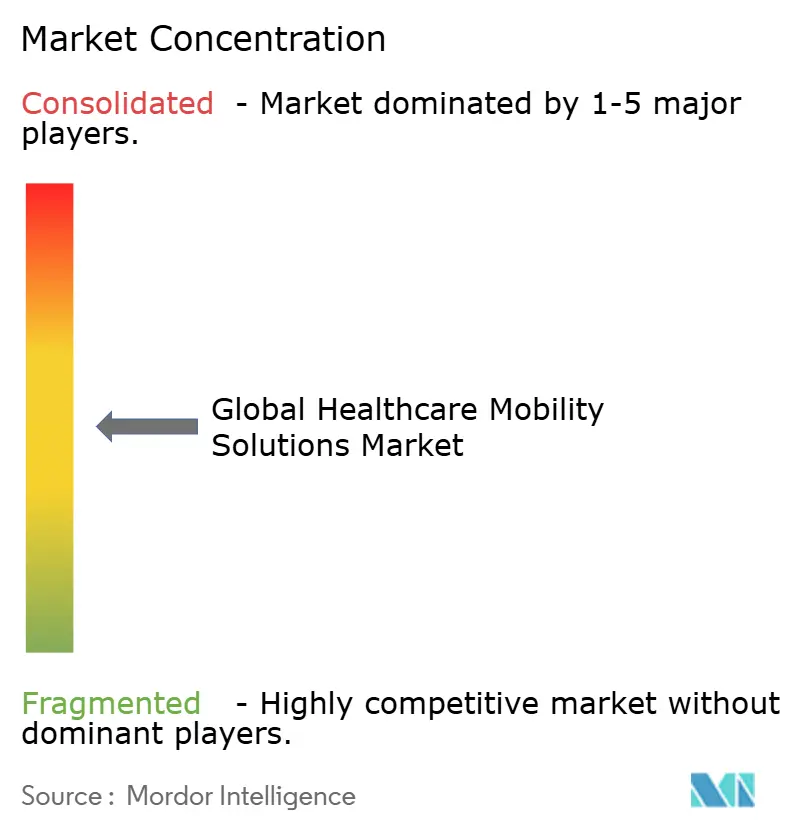
| Market Concentration | Medium |
Major Players *Disclaimer: Major Players sorted in no particular order Image © Mordor Intelligence. Reuse requires attribution under CC BY 4.0. | |
Global Healthcare Mobility Solutions Market Analysis by Mordor Intelligence
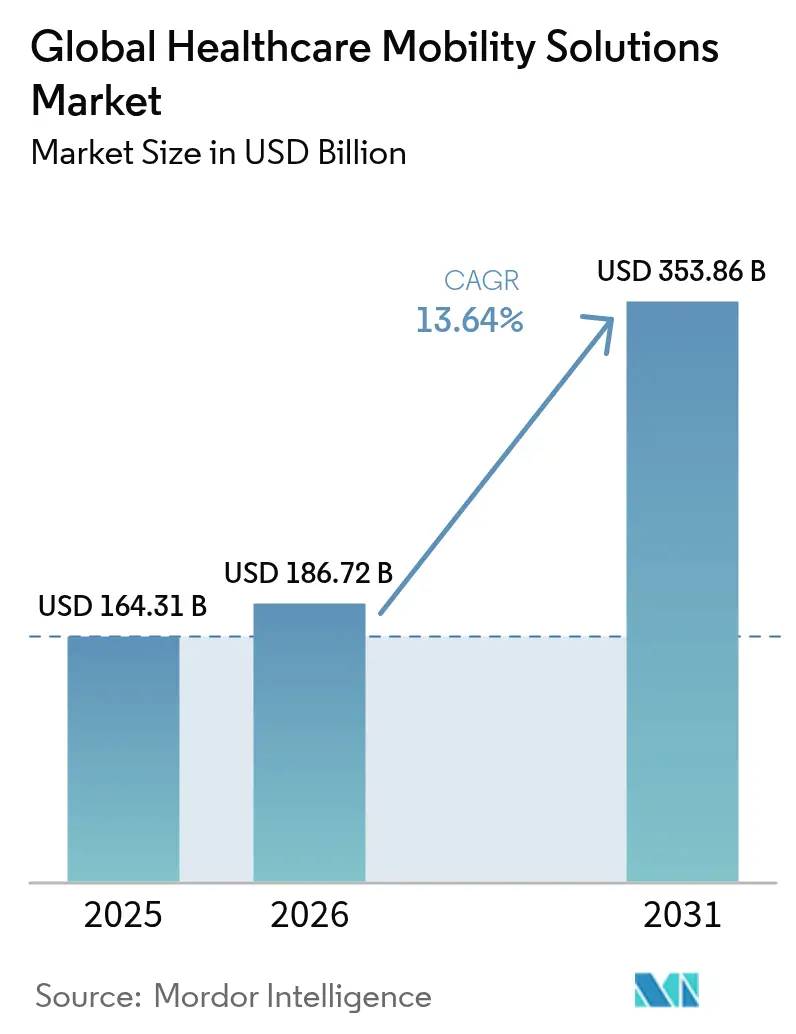
Healthcare mobility solutions market size in 2026 is estimated at USD 186.72 billion, growing from 2025 value of USD 164.31 billion with 2031 projections showing USD 353.86 billion, growing at 13.64% CAGR over 2026-2031. Across the forecast horizon, hospitals, clinics, payers, and technology firms invest in mobile platforms that improve care coordination, enable real-time monitoring, and shift services into homes and community settings. 5G private networks, edge AI, and cloud interoperability combine to support latency-sensitive applications such as remote surgery and continuous glucose monitoring, while new FDA guidance for AI-enabled devices provides a clearer commercialization pathway. Vendors that deliver secure, HIPAA-compliant architectures gain an immediate advantage as ransomware activity pushes cybersecurity to the top of procurement criteria[1]. Clinician shortages further accelerate adoption, because mobile tools automate documentation and workforce scheduling, lowering operating costs and reducing burnout.
Key Report Takeaways
- By product, Mobile Devices held 42.73% of healthcare mobility solutions market share in 2025; Mobile Applications expand fastest at a 14.22% CAGR through 2031.
- By application, Enterprise Solutions accounted for 61.88% revenue share in 2025, whereas mHealth Applications advance at 14.28% CAGR to 2031.
- By deployment model, cloud platforms captured 50.74% share in 2025 and are set to grow at 13.87% CAGR.
- By care setting, Hospitals & Clinics retained 55.76% share in 2025, while Emergency & Ambulatory Services expand most quickly at a 14.12% CAGR.
- By geography, North America led with 42.11% share in 2025; Asia-Pacific registers the strongest regional CAGR of 14.37%.
Note: Market size and forecast figures in this report are generated using Mordor Intelligence’s proprietary estimation framework, updated with the latest available data and insights as of 2026.
Market Trends and Insights
Drivers Impact Analysis of Global Healthcare Mobility Solutions Market*
| Driver | ~ % Impact on CAGR Forecast | Geographic Relevance | Impact Timeline |
|---|---|---|---|
| Tele-medicine and RPM expansion | +2.8% | Global, rural North America and emerging APAC markets | Short term (≤ 2 years) |
| Rising smartphone & wearable adoption | +2.1% | Global, strongest in Asia-Pacific and North America | Medium term (2-4 years) |
| Need to cut clinical workflow costs | +2.0% | North America and EU, growing in APAC | Medium term (2-4 years) |
| Hospital-at-home roll-outs | +1.9% | North America leading, early EU and Australia uptake | Medium term (2-4 years) |
| 5G private networks for low-latency mobility | +1.7% | Urban centers in North America, EU, China, Japan | Long term (≥ 4 years) |
| Spatial-computing AR surgical apps | +1.4% | Advanced markets in North America, EU, select APAC | Long term (≥ 4 years) |
| Source: Mordor Intelligence | |||
Expansion of Tele-medicine & RPM Programs
US patient participation in remote patient monitoring (RPM) is projected to reach 70.6 million in 2025, up from 29 million in 2020. Mayo Clinic’s Advanced Care at Home model has treated more than 2,000 patients with infection rates below inpatient norms and lower readmissions. CMS waivers now let 320-plus hospitals deliver acute care at home, moving hospital-level services into living rooms . Cleveland Clinic’s AI-based virtual triage system has reached 94% diagnostic accuracy and eased emergency department congestion. Hybrid, “click-and-brick” models that blend video, messaging, and in-person follow-ups stretch fixed resources and raise patient satisfaction.
Rising Adoption of Smartphones & Wearables
More than 80% of adults in Asia-Pacific now own a smartphone, enabling hospitals to deliver coaching, medication reminders, and biometrics directly to patients. Researchers at the University of Hong Kong have demonstrated organic electrochemical transistors that turn soft microelectronics into standalone AI wearables capable of on-skin analytics. The FDA’s 2025 clearance of the Stelo continuous glucose monitor for retail purchase illustrates the shift from prescription-only devices to consumer channels. As consumer devices gain clinical accuracy, data flows seamlessly into electronic records, allowing clinicians to spot trends before adverse events occur. Predictive insights generated on-device reduce emergency visits and make chronic-care economics more sustainable.
Need to Cut Clinical Workflow Costs
Administrative overhead consumes 25% of total US health spending, so executives target mobile tools that trim documentation time. Epic’s Rover app lets nurses complete bedside tasks in 8.7 minutes versus 94.5 minutes at desktop stations, while medication errors fall by one-third. Mercy saved USD 30.7 million in 2023 using AI scheduling that reduced agency staff needs. Microsoft and Epic are developing voice-driven charting that captures clinician-patient conversations automatically. Real-time location systems combined with mobile alerts shorten average patient wait time and raise bed turnover by double-digit percentages.
Hospital-at-home Roll-outs
Mass General Brigham plans to move 10% of medical admissions to in-home settings, aiming for lower costs and higher patient comfort. Mayo Clinic reports 30-day readmissions of 11.2% and mortality of 1.8%, matching inpatient safety while cutting total episode cost by up to 30%. The FDA’s Home as a Health Care Hub initiative promotes at-home diabetes programs that rely on continuous mobile monitoring. Kaiser Permanente’s service has scaled to cover 9% of its daily census, trimming average length of stay by almost two days. Mobile dashboards that coordinate supplies, labs, and nurse visits are indispensable to these distributed clinical networks.
Restraints Impact Analysis of Global Healthcare Mobility Solutions Market*
| Restraint | ~ % Impact on CAGR Forecast | Geographic Relevance | Impact Timeline |
|---|---|---|---|
| Cyber-security and HIPAA/GDPR risks | -1.8% | Global, stricter in EU and North America | Short term (≤ 2 years) |
| Shortage of digital-health talent | -1.6% | Global, acute in North America and mature APAC markets | Medium term (2-4 years) |
| Legacy EMR vendor lock-in to mobile APIs | -1.1% | Global | Medium term (2-4 years) |
| Battery & ruggedisation costs for medical devices | -0.7% | Emerging cost sensitive regions | Medium term (2-4 years) |
| Source: Mordor Intelligence | |||
Cyber-security & HIPAA/GDPR Risks
Cybercriminals increasingly target mobile endpoints, forcing providers to harden authentication, encryption, and patch management. Many hospital networks run legacy operating systems that cannot support modern zero-trust strategies, making full compliance difficult. EU regulators have begun levying sizeable fines for GDPR violations involving unencrypted mobile data transfers. Rural facilities flagged mobile security as a prerequisite for new telehealth grants awarded in 2025. Balancing tight security with clinician usability remains a central adoption barrier during the next two years.
Shortage of Digital-health Talent
Demand for engineers, data scientists, and clinical informaticists outstrips supply, delaying go-lives at many health systems. Budget limits reduce the ability to compete with Big Tech salaries, leading CIOs to rely on external integrators and managed services. Continuous platform updates require frequent retraining that frontline staff struggle to absorb amid heavy patient loads. Resistance grows when benefits are unclear, so change-management programs that show time savings are critical. Workforce development partnerships with universities and community colleges begin to expand the pipeline, but impact will take several years to materialize.
*Our forecasts treat driver/restraint impacts as directional, not additive. The impact forecasts reflect baseline growth, mix effects, and variable interactions.
Global Healthcare Mobility Solutions Market Segment Analysis
By Products & Services:
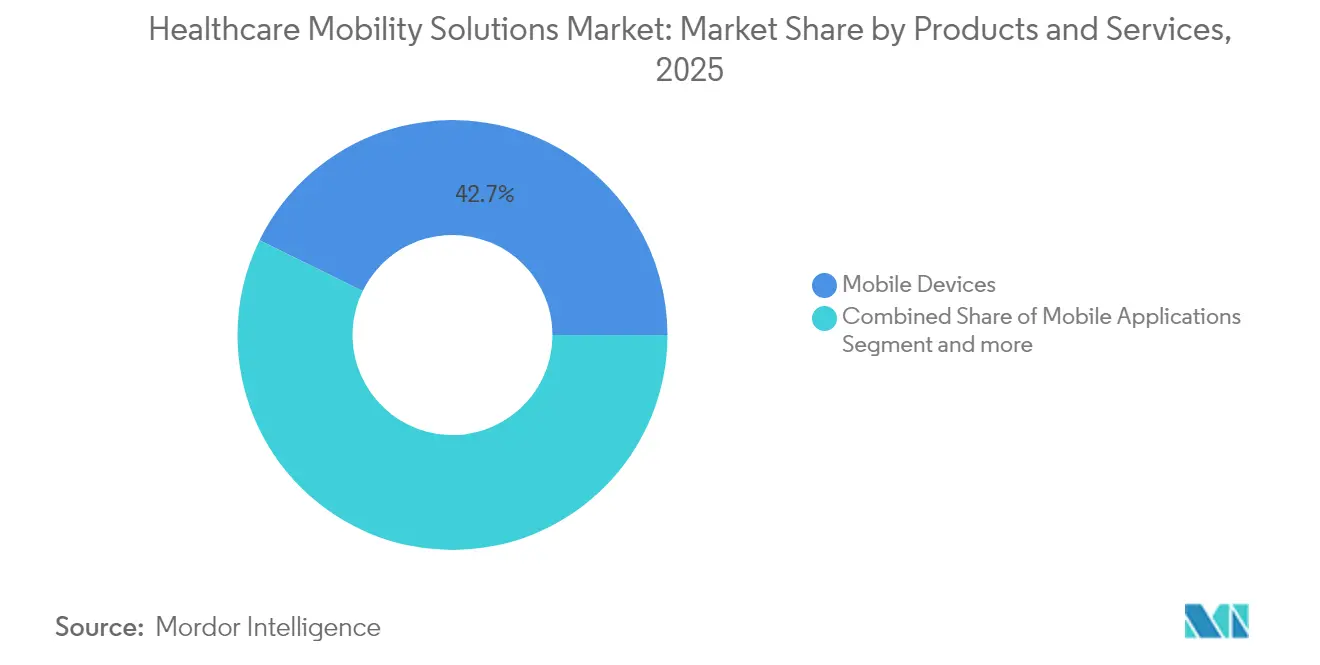
Mobile Applications Drive InnovationMobile Applications post the fastest 14.22% CAGR through 2031, even though Mobile Devices commanded 42.73% of 2025 revenue. The FDA’s 2024 decision to classify digital therapeutics for ADHD as Class II devices widened reimbursement pathways, making software-only products commercially viable. Enterprise platforms from Epic and Oracle Cerner now bundle secure messaging, single-sign-on, and device tracking, simplifying rollouts. The healthcare mobility solutions market repeatedly rewards vendors that leverage existing consumer smartphones instead of specialized hardware, reducing capital expenditure for providers.
Mobile Devices stay relevant for infection-resistant casings, battery hot-swap, and barcode medication administration. Yet the declining price of rugged consumer tablets narrows the gap, slowing hardware growth. Platform vendors that combine device agnosticism with tight EHR integration gain share by limiting IT complexity. AI-infused applications extend beyond vital-sign dashboards into medication titration, opioid stewardship, and rehabilitation coaching, pushing software front and center in purchasing decisions.

By Application:
Enterprise Solutions Dominate While mHealth SurgesEnterprise Solutions represented 61.88% of 2025 spending thanks to long-standing procurement cycles and bundled EHR contracts. Guthrie Clinic’s virtual care hub saved USD 7 million in wages and cut nurse turnover by half, proving the financial upside of mobility at scale. Automated note capture, ambient dictation, and real-time analytics are now staples of enterprise roadmaps across North America and Europe.
mHealth Applications, advancing 14.28% annually, tap a younger, tech-savvy audience that tracks steps, sleep, and blood glucose daily. Direct-to-consumer channels bypass insurance codes, giving start-ups quicker feedback loops and iterative product pathways. The healthcare mobility solutions market size for mHealth is expected to widen further as employers integrate wellness apps into benefit plans and payers roll out digital-first coverage.
By End User:
Providers Lead While Patient Segment AcceleratesProvider organizations owned 58.66% of revenue in 2025, reflecting capital budgets for EMR extensions and device fleets. Philips and smartQare are piloting wearable biosensors that stream vitals directly into command centers, giving nurses an up-to-the-minute clinical picture. Hospitals favor single-vendor suites that merge admissions, pharmacy, and imaging modules under one dashboard.
The Patient end-user bracket grows at 13.78% CAGR, buoyed by rising health-literacy and digital-payment adoption. FDA programs that designate the home as a healthcare node legitimize at-home chronic-care kits. As a result, the healthcare mobility solutions market continues to blur traditional lines between facility-based and consumer-led care.
By Care Setting:
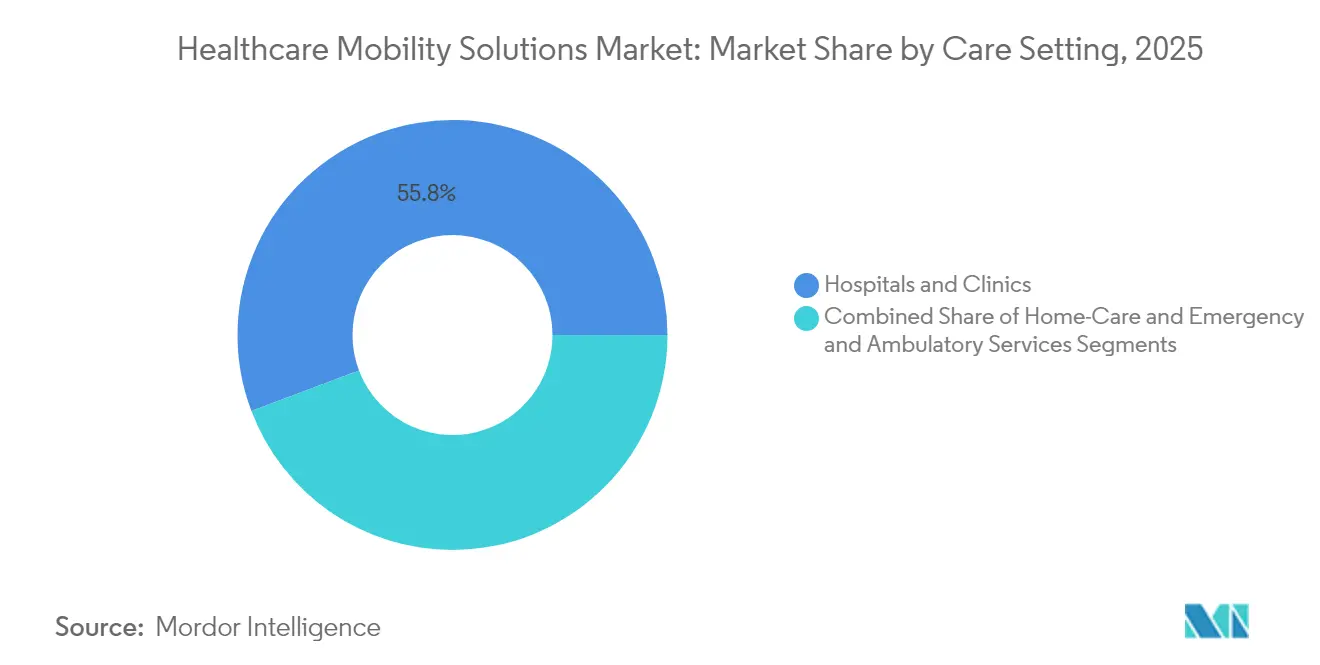
Hospitals Lead While Emergency Services SurgeHospitals & Clinics generated 55.76% of 2025 spending, underscoring their dominance in high-acuity care. Real-time location systems tied to mobile alerts improved bed turnover by 11% in multicenter trials. However, Emergency & Ambulatory Services expand at 14.12% CAGR because point-of-care teams demand rugged apps that expedite triage and imaging orders in transit.
Hospital-at-home environments rely on virtual wound checks, Bluetooth spirometers, and on-call physicians connected via secure tablets. The healthcare mobility solutions market share derived from these distributed settings is set to climb as payers reimburse more episodes managed outside facilities. Ambulance crews equipped with cloud-linked ultrasound now transmit images directly to stroke centers, shaving precious minutes off door-to-needle times.
By Deployment Mode:
Cloud Dominance AcceleratesCloud platforms accounted for 50.74% of total spend in 2025 and are expanding at a 13.87% CAGR. Philips and Amazon Web Services have added generative AI that drafts radiology reports and flags critical findings, boosting throughput by up to 20%. Subscription pricing aligns costs with usage, enabling regional hospitals to access advanced analytics without capital outlay.
On-premise systems still appeal to defense hospitals and academic centers that handle sensitive genomics data. Hybrid architectures that keep image archives on-site while pushing encounter data to the cloud are becoming common. The healthcare mobility solutions market size for cloud deployment is projected to widen as zero-trust architectures convince security teams that regulated workloads can reside off-premise.
Geography Analysis
North America Healthcare Mobility Solutions Market
North America commanded 42.11% of 2025 revenue because of mature reimbursement models, regulatory clarity, and an installed base of EHRs ready for mobile extensions. More than 320 US hospitals now hold CMS waivers for acute care at home, anchoring broad investment in logistics apps, dashboards, and 5G routers. Canadian provinces subsidize virtual consults to reach remote communities, while Mexico’s private hospitals adopt mobile triage to offset clinician shortages.
Europe Healthcare Mobility Solutions Market
Europe delivers steady adoption as cross-border standards mature. The European Health Data Space initiative promotes interoperable APIs that integrate wearables, imaging, and lab feeds. Germany funds 6G medicine research, and the UK co-authors transparency frameworks for machine-learning diagnostics with US partners. These programs help the healthcare mobility solutions market build trust in AI prognostics across the region.
APAC Healthcare Mobility Solutions Market
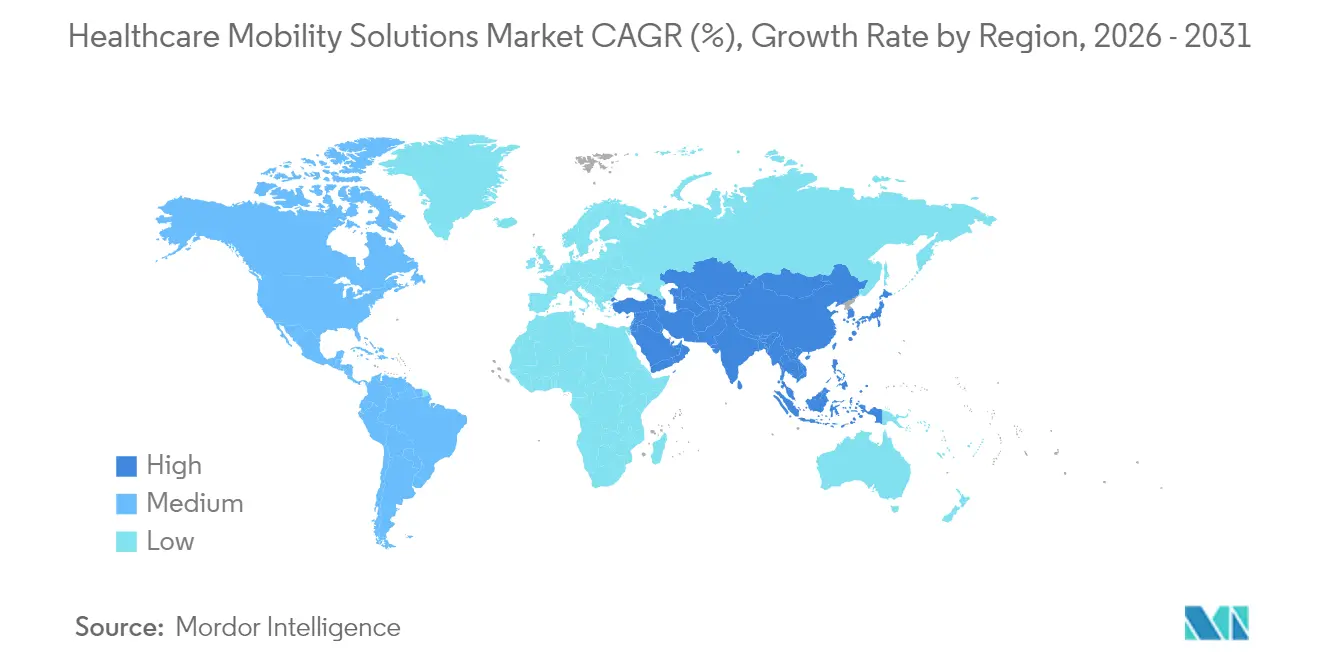
Asia-Pacific records the highest 14.37% CAGR. With 1.8 billion mobile subscribers, the region trails only North America in 5G penetration. Chinese surgeons have performed remote gastrectomies over standalone 5G, creating global headlines and regulatory momentum. India’s new reimbursement codes for digital-first care, plus Japan’s AI diabetic retinopathy screening, add scale. In Southeast Asia, start-ups raised USD 1.5 billion for telehealth in 2024, illustrating venture confidence in the healthcare mobility solutions market.
Regulatory Landscape
Healthcare mobility solutions sit at the intersection of medical device software requirements, data privacy obligations, and interoperability rules that vary by region. In the United States, the FDA has continued to clarify how software functions such as clinical decision support are regulated, alongside programs run through the Digital Health Center of Excellence that shape evidence expectations for mobile and AI-enabled health functions. Interoperability compliance is also progressing through defined pathways, with the Office of the National Coordinator for Health IT (ONC) advancing updated standards via the Standards Version Advancement Process (SVAP) in 2026 for FHIR-based implementation guides, tightening expectations for standardized APIs used by certified developers.
Outside the United States, compliance requirements increasingly blend device safety expectations with governance for AI and health data exchange. In the European Union, the Medical Device Regulation (MDR) and related guidance from the Medical Device Coordination Group (MDCG) continue to steer conformity assessment and post-market obligations for software-driven functions embedded in mobility solutions, while AI governance requirements apply in parallel for high-risk medical applications. In Asia, national legislation is also raising the bar for secure information sharing, including Singapore's Health Information Act 2026, which governs the national electronic health record system and emphasizes data security and integrity for cross-organization exchange. Across markets, updated security frameworks such as ISO 27799:2025 are being used to formalize controls for healthcare information security in mobile and remote-care environments.
Value Chain Analysis
The value chain covers device and connectivity inputs (smartphones, rugged handhelds, wearables, Wi-Fi/5G and private-network services), software layers (mobile apps, identity and access management, endpoint management, and analytics/AI), and clinical integration (EHR connectivity, interoperability APIs, and workflow configuration). Large platform vendors and cloud providers support data ingestion and compute, while specialized developers add capabilities such as ambient documentation, care coordination, and clinical decision support modules on top of EHR and data platforms. System integrators and managed service providers also bridge gaps tied to legacy EMR lock-in, security hardening requirements, and shortages of digital-health talent.
Procurement and distribution increasingly align with enterprise rollouts in hospitals and health systems, with additional pull from home-care and payer-sponsored programs where logistics, device provisioning, and patient onboarding become operational priorities. Partnerships show tighter coupling between hardware and workflow software, including Zebra Technologies working with Aiva Health to deploy hands-free AI-powered nurse assistants on Zebra healthcare mobile devices and wearable badges, and Philips collaborating with Bajaj Integrated Health System to deploy IntelliBridge Enterprise 3.0 Enterprise Cloud for device-to-system integration across home, clinic, and hospital settings in India. Cloud and data-platform alliances further shape delivery by making interoperability and AI operationalization part of the solution design, exemplified by CVS Health partnering with Google Cloud to build health technology services that connect stakeholders through data and AI services.
Competitive Landscape
The healthcare mobility solutions market features moderate fragmentation. Epic Systems and Oracle Cerner defend large footprints by embedding secure chat, bar-code meds, and clinician tools inside their core EHR apps. Microsoft deepens its presence through Azure Health Data Services, an Epic co-development deal for generative documentation, and partnerships with Providence for AI oncology. Apple leverages the HealthKit framework plus device-level security to entice hospitals building BYOD programs, while Samsung offers rugged tablets and Knox security built to HIPAA specifications.
Regulation favors agile software companies. The FDA’s new predetermined change-control plans allow AI algorithms to learn continuously once guardrails are in place[2]. Philips collaborates with NVIDIA to embed foundation models into MRI consoles, shrinking scan times and radiologist clicks[3].
Start-ups focusing on staff-facing chatbots and workflow analytics raise funding by targeting pain points like nurse overtime. As interoperability APIs open, best-of-breed apps gain traction, yet hospital CIOs still prefer integrated suites for enterprise risk management. Consequently, mergers such as Commure-Athelas-Augmedix illustrate a drive to build full-stack offerings that cover virtual scribing, revenue cycle, and care coordination in one license.
Global Healthcare Mobility Solutions Industry Leaders
-
Mckesson Corporation
-
Cisco Systems Inc.
-
Zebra Technologies Corp
-
Oracle Cerner
-
Omron Corporation
- *Disclaimer: Major Players sorted in no particular order
Global Healthcare Mobility Solutions Market Companies Covered in this Report
- AirStrip Technologies Inc.
- AT&T
- Cisco Systems
- Oracle
- Mckesson
- OMRON
- Koninklijke Philips
- SAP
- Zebra Technologies
- Epic Systems Corp.
- IBM Corp.
- Apple
- Samsung Group
- GE Healthcare
- Teladoc Health
- Stryker
- Honeywell International
- Medtronic
- Microsoft Corp.
- Qualcomm
Read Analysis of Global Healthcare Mobility Solutions Companies
Market Opportunities and Future Outlook
Health systems are shifting from pilot mobility deployments to broader enterprise modernization that makes mobile workflows, interoperability, and AI operationalization easier to scale across facilities and into the home. The most visible whitespace remains end-to-end data readiness for mobility-enabled care coordination, where cloud migration and standardized APIs reduce friction for deploying mobile documentation, secure messaging, and remote monitoring at scale. WellSpan Health's January 2026 announcement of a comprehensive migration of its technology portfolio to AWS, including large-scale data and application footprints, illustrates how provider IT roadmaps are aligning infrastructure with mobility, analytics, and security requirements.
A second opportunity area is connecting mobility with last-mile clinical logistics and continuous care infrastructure, particularly for hospital-at-home and outpatient pathways where turnaround time and coverage affect performance. Drone and autonomous delivery pilots expand integration needs for chain-of-custody, tracking, and results reporting inside clinical systems, such as the Abu Dhabi drone-based medical sample transport pilot launched under the SAVI Cluster initiative in January 2026. In parallel, health systems are operationalizing AI across production environments, which increases demand for mobile front-ends that can consume insights securely and in context, as reflected in Inova's completed data modernization effort supporting more than 70 deployed AI applications. These shifts point to solution packages that combine device management, interoperable data pipelines, and workflow automation for nurses and distributed care teams.
Recent Industry Developments in Global Healthcare Mobility Solutions Market
- July 2026: IKS Health completed its acquisition of TruBridge, Inc., expanding capabilities for rural and community hospitals across EHR-adjacent services and revenue cycle workflows. This acquisition strengthens bundled offerings that include mobile documentation and care coordination.
- June 2026: Oracle Health announced a collaboration with Theator to integrate AI-powered operating room analytics into the Oracle Health platform. The move adds a specialized AI layer to an enterprise clinical system, supporting mobility-enabled surgical documentation and workflow insights across perioperative teams.
- September 2024: Oracle introduced RFID-enabled automation for inventory replenishment within Oracle Fusion Cloud Supply Chain and Manufacturing. Strengthening item tracking and replenishment supports point-of-care availability and integrates with mobile workflows used by clinical and supply chain staff inside hospitals.
Global Healthcare Mobility Solutions Market Report Scope and Research Methodology
Market Definition and Coverage
This market covers revenues earned from healthcare mobility solutions that help clinicians, staff, and patients access and act on health information through mobile devices, mobility platforms, and healthcare apps. Counted solutions are tied to provider, payer, or home care workflows, and they typically connect with EHR or back office systems.
Scope exclusions: standalone consumer wellness apps that do not connect into a regulated healthcare workflow are excluded.
Segments Covered in This Report
- By Products & Services
- Mobile Devices
- Mobile Applications
- Enterprise Mobility Platforms
- By Application
- Enterprise Solutions
- mHealth Applications
- By End User
- Providers
- Payers
- Patients
- By Care Setting
- Hospitals & Clinics
- Home-Care / Hospital-at-Home
- Emergency & Ambulatory Services
- By Deployment Mode
- Cloud-based
- On-premise
- Geography
- North America
- United States
- Canada
- Mexico
- Europe
- Germany
- United Kingdom
- France
- Italy
- Spain
- Rest of Europe
- Asia-Pacific
- China
- Japan
- India
- South Korea
- Australia
- Rest of Asia-Pacific
- Middle East and Africa
- GCC
- South Africa
- Rest of Middle East and Africa
- South America
- Brazil
- Argentina
- Rest of South America
- North America
Data Sources, Market Sizing, and Validation
Desk Research
Desk work starts by mapping the demand environment and the supply environment, then aligning definitions so general mobility spending is not mixed with healthcare specific use. Public sources are used to anchor adoption and utilization, including health IT and digital health releases from agencies such as the US FDA and the US Office of the National Coordinator for Health IT, healthcare statistics from the World Health Organization, and IT security and privacy guidance from bodies such as NIST.
To keep the model grounded, we also review sources such as peer reviewed journals on clinical mobility outcomes, trade association publications on hospital IT priorities, and company filings and investor presentations for revenue and product scope clues. Where needed, paid subscriptions are used for company financials and intelligence, news and financials, patent databases, and an import and export shipment level database to sanity check device shipment trends. These sources are not exhaustive, and many other public references are used during data collection, validation, and clarification.
Primary Interviews and Surveys
Primary inputs come from interviews and short surveys with hospital and clinic IT and operations leaders, payers, digital health program owners, and solution delivery partners, so assumptions can be checked against how budgets and deployments happen in practice. Since this is a global market, coverage is balanced across APAC, EMEA, and the Americas, and we revisit a few experts when pricing, integration scope, or adoption signals do not align with the desk view.
Distribution of primary research fieldwork respondents
| Company type | Respondent position | Region |
|---|---|---|
| Top tier: 34% | CXOs: 16% | APAC: 44% |
| Mid tier: 47% | Functional/Unit leaders: 36% | EMEA: 32% |
| Smaller Players: 19% | Managers: 48% | Americas: 24% |
Market-Sizing & Forecasting
Sizing starts with a top down build where healthcare IT spend signals and digital workflow adoption indicators are used to reconstruct the addressable pool for mobility solutions, and then it is split into solutions that qualify under the market definition. To keep totals realistic, we corroborate results using selective bottom-up approximations, such as sampled vendor revenue disclosures, channel checks on typical deal sizes, and volume times ASP logic for mobile devices used in clinical settings.
Key inputs are kept practical, including hospital and clinic digitization levels, mobile device refresh cycles, use of secure clinical communication and workflow apps, integration intensity with EHR systems, and compliance driven security spend that often rides along with mobility deployments. For forecasting, scenario analysis is applied and then guided by how experts see budget cycles, cloud migration pace, and care shifting to home care impacting rollouts. When bottom-up inputs are missing, gaps are handled by using proxy ranges from comparable healthcare IT deployments and then narrowing them through follow-up validation.
Data Validation & Update Cycle
Validation is done by checking whether the modeled market aligns with independent signals, such as healthcare IT spending direction, device shipment trends, and adoption rates for clinical mobility and patient engagement tools. Outliers are reviewed, assumptions are challenged, and step-by-step logic is rechecked by a second analyst before sign-off so the totals do not rely on one person00s judgment.
Reports are refreshed annually, and interim adjustments are made when material events shift budgets or deployment pace. Before delivery, a final pass is completed to capture the latest public updates and to re-confirm any assumptions that were sensitive in the model.
Mordor Intelligence's Healthcare Mobility Solutions Market Size Compared Against Other Published Estimates
Published numbers for healthcare mobility solutions often vary because the category sits between healthcare IT, mobile hardware, and digital health services, so scope choices can change what gets counted. Differences also come from the year used as the starting point, how pricing is treated, and whether the estimate is validated with real buyer and implementer feedback.
The biggest gaps usually show up when one study includes broad consumer wellness spending, or when mobile devices are counted without separating general purpose units from healthcare workflow use. Some estimates also project faster growth by assuming uniform global adoption and straight-line ASP increases, while others apply currency conversion at different time points and do not revisit assumptions after major regulatory or reimbursement shifts. A key spread driver is whether only solutions that integrate into provider or payer workflows are counted (with consumer-only apps left out), which is the filter applied by Mordor Intelligence.
Benchmark comparison
| Source | Market Size | Gaps in Research Methodology |
|---|---|---|
| Mordor Intelligence | USD 186.72 B (2026) | |
| Industry Publisher A | USD 206.30 B (2024) | Uses a 2024 base and a broader revenue pool, and it does not clearly state exclusions for consumer wellness style apps or how integration into care workflows is tested. |
| Industry Publisher B | USD 201.22 B (2025) | Starts from a 2025 base and applies a higher growth path, and the pricing and rollout assumptions appear to lean on stated forecasts with limited detail on device versus software versus platform revenue boundaries. |
The table shows that the spread is mostly explained by base-year selection and how tightly the solution definition is enforced, rather than by a single math step. By keeping the inputs traceable to adoption signals, budget cycles, and practical pricing ranges, our estimate stays repeatable and easier to reconcile when new information is added.
Key Questions Answered in the Report
What is the current value of the healthcare mobility solutions market?
The market reaches USD 186.72 billion in 2026 and is projected to hit USD 353.86 billion by 2031 as investments accelerate.
Which product segment grows fastest?
Mobile Applications expand at 14.22% CAGR through 2031, reflecting a shift toward software-driven care delivery.
Why are hospitals investing in 5G private networks?
Private 5G offers ultra-low latency needed for remote surgery, continuous monitoring, and high-resolution imaging inside complex facilities.
How do hospital-at-home programs impact costs?
Studies from Mayo Clinic show cost reductions of 19%-30% compared with traditional inpatient care while maintaining comparable safety.
What cyber-security challenges do mobility projects face?
Expanding mobile endpoints enlarge attack surfaces; providers must meet HIPAA and GDPR mandates through encryption, device management, and zero-trust architectures.
Which region records the highest growth rate?
Asia-Pacific leads with a 14.37% CAGR thanks to widespread mobile adoption, 5G rollouts, and supportive government initiatives.