
Gynecological Examination Chairs Market Size and Share
Market Overview
| Study Period | 2020 - 2031 |
|---|---|
| Market Size (2026) | USD 579.75 Million |
| Market Size (2031) | USD 798.41 Million |
| Growth Rate (2026 - 2031) | 6.61 % |
| Fastest Growing Market | Asia-Pacific |
| Largest Market | North America |
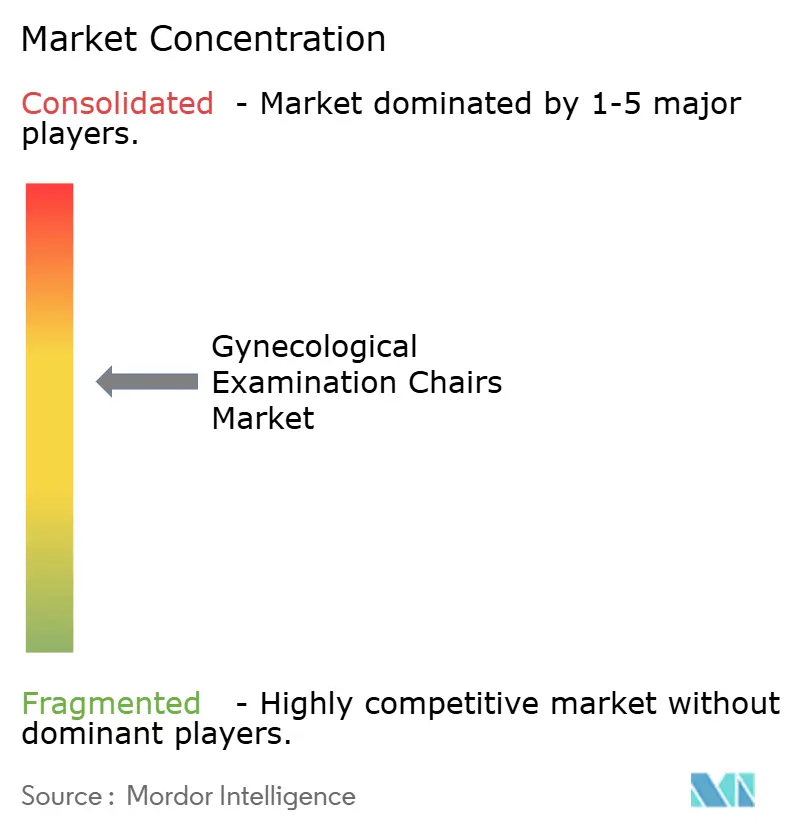
| Market Concentration | Medium |
Major Players *Disclaimer: Major Players sorted in no particular order Image © Mordor Intelligence. Reuse requires attribution under CC BY 4.0. | |
Gynecological Examination Chairs Market Analysis by Mordor Intelligence
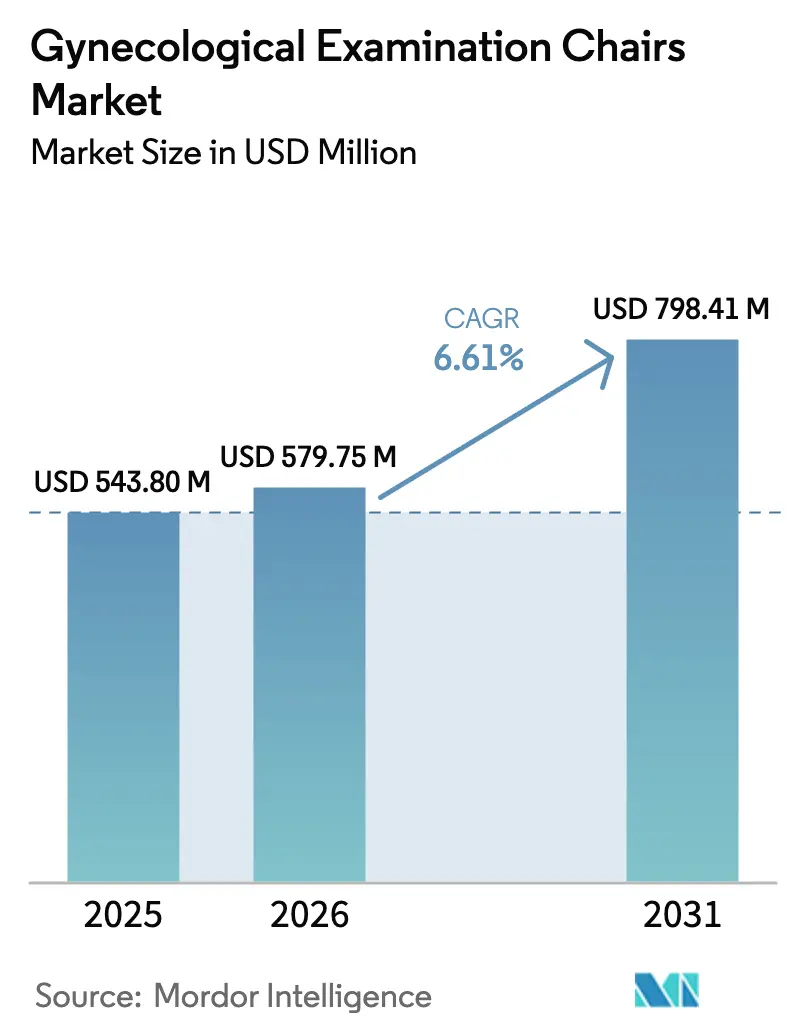
The Gynecological Examination Chairs Market size was valued at USD 543.80 million in 2025 and is estimated to grow from USD 579.75 million in 2026 to reach USD 798.41 million by 2031, at a CAGR of 6.61% during the forecast period (2026-2031).
The increasing prevalence of 1.21 billion gynecological disorders, coupled with aggressive hospital-bed expansions in the Asia-Pacific region and a payer-driven shift toward ambulatory care, is driving demand for advanced, high-throughput equipment. Electric motorized models now account for nearly 50% of global unit sales, with their rapid adoption supported by digital health initiatives that incentivize connected devices capable of transmitting utilization, positioning, and preventive maintenance data directly to Electronic Health Records (EHRs). Additionally, the expansion of retail clinics and mobile women’s health vans is broadening the customer base, with a focus on compact designs, antimicrobial upholstery, and subscription-based pricing models that transition costs from capital expenditure (capex) to operational expenditure (opex). However, these growth drivers are tempered by significant upfront price premiums compared to manual tables and the potential for increased redesign and validation costs due to anticipated EPA restrictions on ethylene oxide sterilization.
Key Report Takeaways
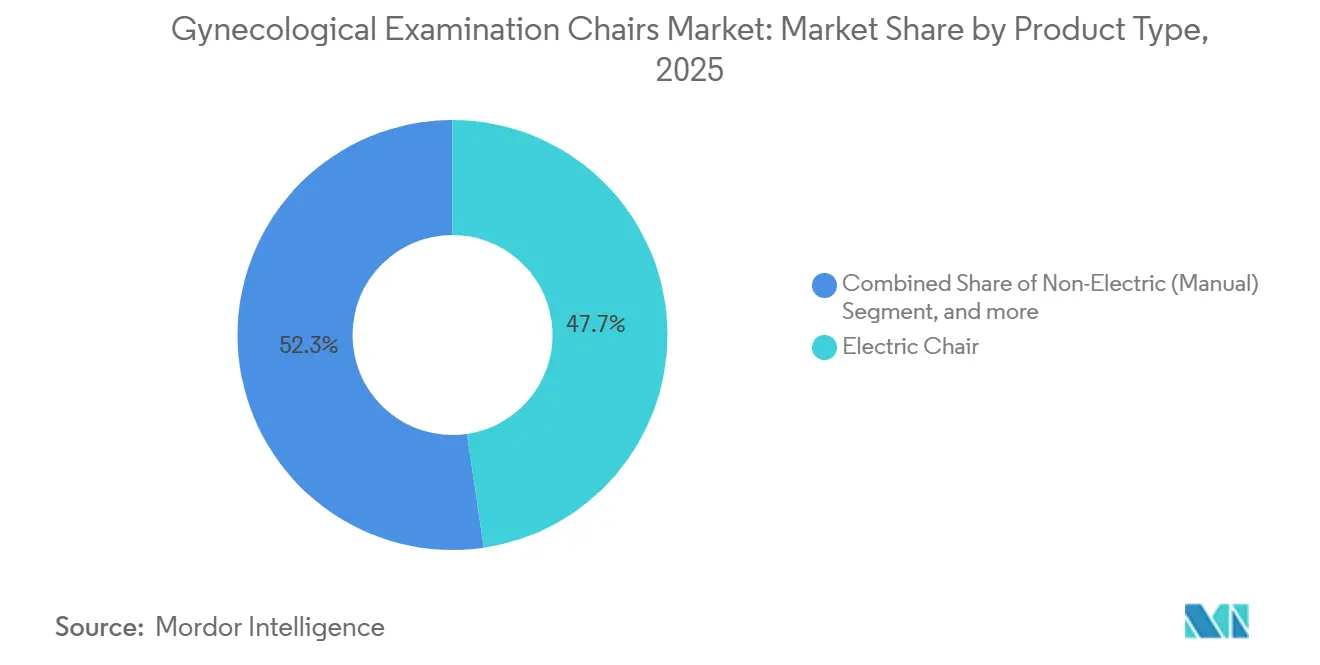
- By product type, electric motorized chairs held 47.67% of the gynecological examination chairs market share in 2025 and are advancing at an 8.54% CAGR through 2031.
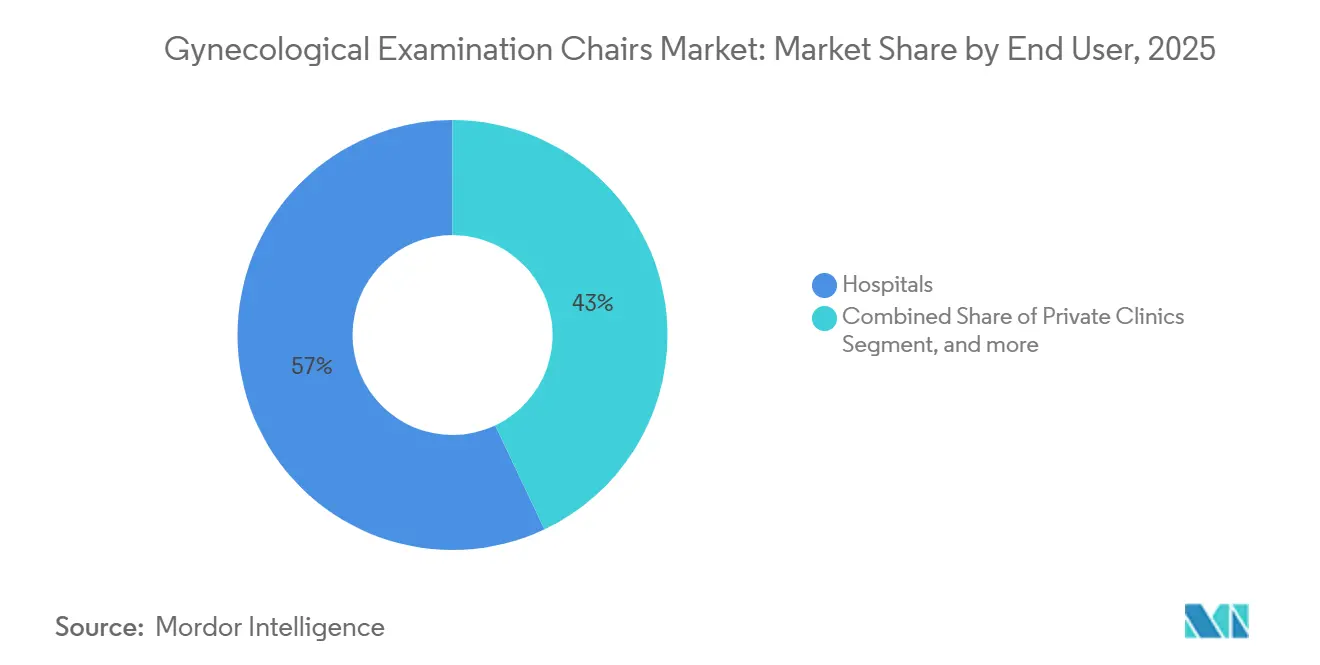
- By end user, ambulatory surgical centers are forecast to expand at an 8.87% CAGR to 2031, outpacing hospitals despite the latter’s 57.03% revenue lead in 2025.
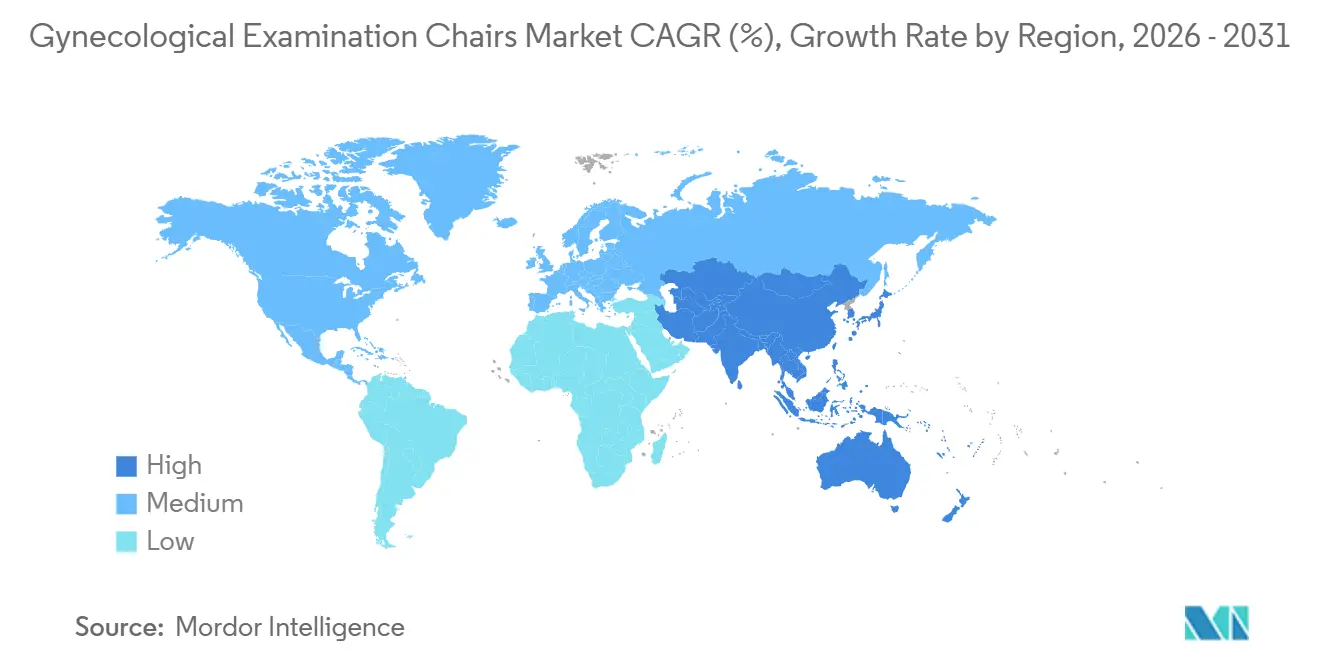
- By geography, Asia-Pacific is projected to register a 7.54% CAGR over 2026-2031, rising faster than North America’s otherwise dominant 41.56% revenue contribution in 2025.
Note: Market size and forecast figures in this report are generated using Mordor Intelligence’s proprietary estimation framework, updated with the latest available data and insights as of January 2026.
Market Trends and Insights
Drivers Impact Analysis of Gynecological Examination Chairs Market*
| Driver | (~) % Impact on CAGR Forecast | Geographic Relevance | Impact Timeline |
|---|---|---|---|
| Growing burden of women's health disorders | +1.8% | Global, with acute pressure in South Asia, Sub-Saharan Africa, and Latin America | Medium term (2-4 years) |
| Expansion of global healthcare infrastructure | +1.5% | Asia-Pacific core (India, China, Indonesia), spill-over to Middle East & Africa | Long term (≥ 4 years) |
| Technological advancements in examination chairs | +1.3% | North America, Europe, urban Asia-Pacific | Medium term (2-4 years) |
| Increasing focus on patient comfort and safety | +0.9% | Global, led by North America and Western Europe | Short term (≤ 2 years) |
| Integration of digital health and IoT solutions | +0.7% | North America, Europe, early adopters in Asia-Pacific metros | Medium term (2-4 years) |
| Shift toward decentralized and outpatient care delivery | +0.4% | United States, Canada, Western Europe | Short term (≤ 2 years) |
| Source: Mordor Intelligence | |||
Growing Burden of Women's Health Disorders
The 2021 Global Burden of Disease update reported 1.21 billion prevalent reproductive-system conditions, a figure that continues to rise as screening programs expand in key markets such as India, China, and Indonesia. This increasing diagnostic coverage is driving higher patient revisit rates and prompting clinics to replace outdated fixed-height tables with advanced multi-position electric chairs. These chairs, designed to optimize space, support multiple functions, including pelvic exams, colposcopy, and prenatal monitoring. Furthermore, national mandates for universal cervical-cancer screening are fueling demand for chairs equipped with imaging mounts and ADA-compliant transfer surfaces, aligning with evolving regulatory and operational requirements[1].
Expansion of Global Healthcare Infrastructure
Health-care expenditure in the Asia-Pacific region is projected to reach USD 5 trillion by 2030, fueled by key initiatives such as India's Ayushman Bharat insurance program, China's 14th Five-Year Plan commitment to establish 1,000 county-level hospitals for women and children, and multilateral funding aimed at expanding clinic networks in Indonesia. With new facilities adhering to modern WHO ergonomic and infection-control standards, there is a growing preference for advanced electric or electro-hydraulic chairs over traditional low-cost manual tables, driving a significant shift in medical equipment adoption.
Technological Advancements in Examination Chairs
Modern electric chairs use IP66-sealed linear actuators capable of 12,000 N push force, delivering smooth height changes from 17 to 36 inches plus Trendelenburg tilt via hand or foot controls. Self-locking mechanisms comply with IEC 60601-1 safety standards and maintain position during power loss. Peer-reviewed trials show that motorized systems can cut clinician muscle loading by up to 47%, a finding now referenced in many procurement scorecards. Hybrid electro-hydraulic designs bridge affordability and performance for cash-strapped public hospitals, while modular accessories extend a single chair across gynecology, urology, and minor surgery workflows.
Increasing Focus on Patient Comfort and Safety
Antimicrobial vinyl embedded with silver or copper reduces surface bioburden by 99.9% within 2 hours and trims terminal-cleaning time by nearly one-fifth. Transfer supports, low-height ranges, and 28-inch supine surfaces align with U.S. Medical Diagnostic Equipment standards, yet only 8.4% of surveyed primary-care sites met these specs in 2025. Chairs that meet these requirements sharply decrease staff lift-assist injuries, a top driver of workers' comp costs and malpractice claims.
Restraints Impact Analysis of Gynecological Examination Chairs Market*
| Restraint | (~) % Impact on CAGR Forecast | Geographic Relevance | Impact Timeline |
|---|---|---|---|
| High capital expenditure requirements | -1.2% | Global, acute in price-sensitive emerging markets (India, Indonesia, Sub-Saharan Africa) and independent clinics | Short term (≤ 2 years) |
| Stringent regulatory and compliance standards | -0.8% | North America, Europe, with spillover to Asia-Pacific as harmonization advances (China, Japan, South Korea) | Medium term (2-4 years) |
| Limited space and workflow constraints in clinics | -0.5% | Urban Asia-Pacific (Tokyo, Mumbai, Shanghai), dense European cities, and legacy U.S. community clinics | Short term (≤ 2 years) |
| Environmental sustainability and lifecycle considerations | -0.3% | Europe (carbon-footprint mandates), North America (EPA EtO restrictions), early pressure in Australia and Japan | Long term (≥ 4 years) |
| Source: Mordor Intelligence | |||
High Capital Expenditure Requirements
Electric gynecological chairs list at USD 2,950-7,500, compared with USD 1,050-2,400 for manual models, a 2-3× differential that strains ASC and rural-clinic budgets[2]. Add 10-15% for installation and USD 500-1,100 for accessories and the outlay becomes formidable; a 10-room women’s center can spend USD 50-75 thousand on chairs alone. Refurbished or subscription-priced offerings lower entry barriers, but uptake remains modest amid concerns about warranties and residual value.
Stringent Regulatory and Compliance Standards
Manufacturers must clear FDA 510(k), earn CE marks under EU MDR, and document ISO 13485 QMS plus IEC 60601 electrical safety, extending launches by up to two years and adding USD 0.5-2 million in pre-market costs[3]. Impending U.S. enforcement of accessibility rules and EPA toxics curbs may force redesigns or alternate sterilization validation, challenges that favor larger OEMs with dedicated regulatory teams.
*Our forecasts treat driver/restraint impacts as directional, not additive. The impact forecasts reflect baseline growth, mix effects, and variable interactions.
Gynecological Examination Chairs Market Segment Analysis
By Product Type:
Electric Chairs Dominate on Workflow and Ergonomic GainsIn 2025, electric motorized units accounted for 47.67% of the gynecological examination chairs market share and are projected to grow at a CAGR of 8.54%. This growth is driven by programmable memory presets, which reduce patient setup time by nearly 40%. Hospitals increasingly favor these units due to their IoT telemetry capabilities, which integrate directly with asset-management software. As a result, electric motorized units are becoming the standard choice in high-income regions. While hydraulic and electro-hydraulic hybrids remain prevalent in cost-sensitive markets, demand for powered height adjustments is rising to meet forthcoming accessibility regulations. Although smart, fully connected chairs currently represent less than 5% of shipments, they have demonstrated a nearly one-third reduction in downtime during North American pilot programs. This positions the segment for significant growth as cybersecurity frameworks mature.
Regulatory and sustainability pressures are further driving the adoption of powered models. Compliance with EPA sterilant regulations is simplified when detachable components are reprocessed with hydrogen peroxide or radiation rather than ethylene oxide. In 2024, OEM reprocessing programs recovered 5 million pounds of equipment, resulting in USD 239 million in customer savings. These lifecycle-cost advantages align with the priorities of value-based procurement committees. Meanwhile, manual tables are increasingly non-compliant with ADA height-adjustment standards and are expected to be relegated to ultra-low-budget or humanitarian applications.

By End User:
Hospitals Lead, ASCs Surge on Cost and ConvenienceIn 2025, hospitals accounted for a 57.03% revenue share, driven by enterprise-wide contracts bundling gynecological chairs with imaging carts and EHR integration at 15-20% below retail prices. These contracts align with replacement cycles that emphasize antimicrobial upholstery and actuator designs aimed at reducing caregiver injury claims. In contrast, ambulatory surgical centers (ASCs) are experiencing the fastest growth, with an 8.87% CAGR, as payers increasingly shift procedures away from hospitals to control costs. Each new ASC, supported by 6,300 Medicare-certified sites, typically establishes three to eight multipurpose procedure rooms, creating substantial demand for high-throughput chairs and contributing to significant cumulative volume.
Retail clinics represent another growth avenue, with major operators like CVS and Walgreens investing billions to expand locations offering well-woman exams. These clinics require compact, electrically adjustable chairs designed for 120-square-foot bays. Private OB/GYN offices and diagnostic centers continue to prefer electro-hydraulic hybrids that balance cost efficiency with functionality. Meanwhile, mobile care startups are adopting foldable, battery-powered chairs, optimized for deployment in curbside settings or community centers.
Geography Analysis
North America Gynecological Examination Chairs Market
In 2025, North America contributed 41.56% of the total revenue, driven by over 6,300 Ambulatory Surgical Centers (ASCs), ongoing hospital refresh cycles, and the enforcement of accessibility regulations disqualifying many fixed-height tables. The expansion of retail clinics in the U.S. is attracting new non-hospital buyers, while Canadian provincial mandates are fueling demand for ISO-certified equipment with bilingual support.
APAC Gynecological Examination Chairs Market
Asia-Pacific is positioned as the fastest-growing region, with a projected 7.54% CAGR through 2031. Key drivers include India's Ayushman Bharat initiative, China's plan to establish 1,000 county-level hospitals for women and children, and AIIB-funded clinic modernizations in Indonesia. These developments are generating significant demand for electric and hybrid chairs that comply with WHO ergonomic standards. Local manufacturers are maintaining competitive pricing below USD 2,000, enabling widespread adoption even in tier-two cities.
EMEA and LATAM Gynecological Examination Chairs Market
In Europe, single-payer procurement systems ensure stable volumes but exert pressure on margins. Sustainability clauses in procurement contracts are increasingly favoring vendors offering circular-economy solutions. The Middle East market is bifurcated, with high-end Gulf hospital chains contrasting with donor-funded initiatives in Sub-Saharan regions, which primarily procure manual or cost-effective hybrid solutions. In Latin America, currency fluctuations moderate growth; however, Brazil and Argentina continue to drive steady public tender activity aligned with national women's health programs.
Regulatory Landscape
Regulatory requirements vary by powertrain and region. Electrically operated gynecological examination chairs generally need to meet medical electrical equipment safety and EMC expectations (IEC 60601-1) and quality-system controls such as ISO 13485. In the United States, FDA device regulation under 21 CFR 880.6140 applies, while many non-electrically powered variants fall under Class I status and are 510(k) exempt, though manufacturers still need to comply with core FDA controls including establishment registration and device listing under CDRH.
In Europe, market access is governed by the EU Medical Device Regulation, Regulation (EU) 2017/745 (MDR). The MDR requires documented conformity to the applicable General Safety and Performance Requirements via a technical file, risk management, and an EU Declaration of Conformity before CE marking. This pathway shapes design controls for motorized chairs, including actuators, controls, and accessories, and pushes suppliers toward standardized testing and traceable components to support multi-country procurement and post-market expectations.
Value Chain Analysis
The value chain starts with upstream inputs such as steel and aluminum structures, polyurethane foam and antimicrobial upholstery, and electrical and electronic subassemblies, including linear actuators, hydraulics, power supplies, hand/foot controls, and control modules. OEMs and contract manufacturers then handle fabrication, machining, powder coating, and final assembly, followed by verification work tied to ISO 13485-aligned quality systems and electrical safety testing referenced to IEC 60601-1 for powered models. Packaging and labeling are completed to support batch traceability and serviceability.
Downstream, distribution splits between direct sales to hospitals and health systems, often bundled with accessories and service agreements, and regional medical equipment distributors serving private clinics, diagnostic centers, ambulatory surgical centers, and retail/minute clinics. Installation, preventive maintenance, parts logistics including actuators, upholstery kits, casters, and controls, and refurbishment or reprocessing programs form a material after-sales layer. In this segment, documentation and controlled handling support clinical-environment requirements and help suppliers compete on total cost of ownership rather than chair list price.
Competitive Landscape
In 2024, Stryker, Hill-Rom-Baxter, Midmark, and ArjoHuntleigh, all holding ISO 13485 certifications and multi-jurisdictional approvals, collectively accounted for 40-50% of global revenue. Stryker reinforced its market leadership with USD 22.6 billion in sales and completed seven strategic acquisitions to expand its installed base, capitalizing on scale advantages. The mid-tier market is driven by players such as LINET and Malvestio, along with several Chinese and Indian firms focusing on localized electro-hydraulic hybrids for national tenders. New entrants are addressing IoT gaps, as less than 5% of chairs are currently network-ready despite evidence of 30% downtime savings. Component suppliers like TiMOTION are lowering entry barriers for niche assemblers by offering turnkey EN 60601-certified actuator kits.
Retail-clinic giants are reshaping the competitive landscape: CVS controls 63% of U.S. retail outlets, while Walgreens is investing USD 5.2 billion to add 600 new sites. This consolidation allows both chains to influence market dynamics by driving demand for proprietary chair formats and subscription-based pricing models. Meanwhile, EPA sterilant restrictions and U.S. accessibility mandates are expected to pressure smaller competitors, creating opportunities for capital-rich multinationals to gain a competitive edge through rapid redesigns and compliance financing.
Gynecological Examination Chairs Industry Leaders
-
Stryker Corporation
-
Hill-Rom Holdings Inc. (Baxter)
-
Schmitz u. Söhne GmbH & Co. KG
-
Medifa-Hesse GmbH & Co. KG
-
Midmark Corporation
- *Disclaimer: Major Players sorted in no particular order
Gynecological Examination Chairs Market Companies Covered in this Report
- A-dec
- ABCO Health Care
- AGA Sanitätsartikel GmbH
- ArjoHuntleigh
- Avante Health Solutions
- Desco Medical
- GIMA S.p.A.
- Hill Laboratories Company
- Hill-Rom Holdings Inc. (Baxter)
- Inmoclinc S.A.
- Innomed Közép-Európai Zrt.
- LINET Group
- Malvestio S.p.A.
- Medifa-Hesse GmbH & Co. KG
- Midmark
- Oakworks Medical Inc.
- PMT Healthcare Pvt. Ltd.
- Promotal
- Schmitz u. Söhne GmbH & Co. KG
- Sonesta AB
- Stryker
- Taicang Kang Hui (Medik)
Market Opportunities and Future Outlook
Accessibility-compliant procedure surfaces and outpatient throughput create scope for new orders, with electric motorized chairs remaining the dominant product type by unit momentum and ambulatory surgical centers as an important end-user group. Midmark's May 2025 launch of the Midmark 631 procedure chair, positioned around U.S. Access Board accessibility requirements, is a concrete example of how accessibility criteria convert into purchasable specifications and replacement activity for fixed-height legacy tables.
Patient-experience driven differentiation also offers room to win share through comfort, anxiety reduction, and workflow simplification that support screening uptake and site-of-care expansion. In May 2026, Ceek Women's Health expanded distribution of its Nella Comfort Kit nationwide through Walmart, which signals stronger retail-channel emphasis on comfort-focused gynecologic-visit solutions that can align with clinic equipment upgrades. In parallel, UCL-recognized Soft Serve in July 2026 supports a product roadmap toward less invasive, patient-centric examinations.
Recent Industry Developments in Gynecological Examination Chairs Market
- May 2026: Ceek Women's Health expanded distribution of its Nella Comfort Kit nationwide through Walmart. The move broadened access to comfort-focused gynecologic-visit products via a major retail channel and reinforced patient-experience as a purchasing and adoption lever around exams. It also points to growing overlap between retail health footprints and women’s health visit workflows that can influence clinic equipment preferences.
- May 2025: Midmark expanded availability of the Midmark 631 procedure chair to several large outpatient networks, aligning procurement with U.S. Access Board accessibility requirements. The expansion supports rapid replacement of legacy fixed-height tables in ambulatory settings and strengthens competitive positioning around low-height ranges and configurable positioning.
- March 2024: SCHMITZ introduced the medi-matic gynecological examination chair, emphasizing ergonomic positioning and hygienic design features. The launch reinforced demand for adjustable, workflow-oriented chairs that support multi-position exams while tightening infection-control practices.
Gynecological Examination Chairs Market Report Scope and Research Methodology
Market Definition and Coverage
This market covers the revenue earned from gynecological examination chairs that are used to position patients for routine exams and OB-GYN procedures across care settings, including related chair configurations sold for clinical use. The values reflect manufacturer and channel sales within the geography set for the study.
Scope exclusions: We exclude general-purpose exam tables and non-clinical seating that is not designed or marketed for gynecological examination use.
Segments Covered in This Report
- By Product Type
- Non-Electric (Manual)
- Electric (Motorised)
- Hydraulic
- Electro-Hydraulic Hybrid
- Smart / IoT-Integrated Models
- By End User
- Hospitals
- Private Clinics
- Diagnostic Centres
- Ambulatory Surgical Centres
- Retail / Minute Clinics
- Geography
- North America
- United States
- Canada
- Mexico
- Europe
- Germany
- United Kingdom
- France
- Italy
- Spain
- Rest of Europe
- Asia-Pacific
- China
- Japan
- India
- Australia
- South Korea
- Rest of Asia-Pacific
- Middle East & Africa
- GCC
- South Africa
- Rest of Middle East & Africa
- South America
- Brazil
- Argentina
- Rest of South America
- North America
Data Sources, Market Sizing, and Validation
Desk Research
Desk research was used to set the market boundary, build the country list, and pull the most consistent demand and supply signals for women's health exam infrastructure. We referred to public sources such as the World Health Organization, the OECD health statistics portal, the World Bank, and national health ministries for indicators like outpatient volumes, facility counts, and health spending direction. For device context and clinical usage patterns, we also reviewed sources such as FDA public databases, peer-reviewed clinical journals, and selected trade association publications.
On the supply side, we used company annual reports, investor presentations, product catalogs, and reputable press to map product types, typical configurations (electric, non-electric, hydraulic), and replacement drivers. To ground-check financial direction and ownership changes, we used paid subscriptions for company financials and news intelligence selectively, and we used a patent database to scan feature trends that often affect pricing. The sources listed here are illustrative only, and many other documents were also reviewed for data collection, cross-checks, and clarification during the work.
Primary Interviews and Surveys
Primary discussions helped us validate how purchasing decisions are made for exam chairs, what buyers treat as like-for-like substitutes, and how replacement cycles differ by setting (hospital departments versus outpatient clinics). We spoke with a mix of manufacturers, distributors, procurement staff, and clinical users across APAC, EMEA, and the Americas, so pricing steps, tender behavior, and installation volumes could be confirmed and then reflected back into the model.
Distribution of primary research fieldwork respondents
| Company type | Respondent position | Region |
|---|---|---|
| Top tier: 39% | CXOs: 14% | APAC: 42% |
| Mid tier: 41% | Functional/Unit leaders: 30% | EMEA: 31% |
| Smaller Players: 20% | Managers: 56% | Americas: 27% |
Market-Sizing & Forecasting
Market sizing starts with a top-down build where healthcare infrastructure signals are translated into an addressable demand pool for gynecological exam rooms and procedure settings, then converted into chair demand using penetration and replacement logic. In practice, this meant country-level estimates were shaped by indicators such as outpatient OB-GYN visit volumes, counts of hospitals and specialty clinics, procedure mix shifts that need positioning support, and typical chair replacement cycles. After those totals were formed, we checked them against selective bottom-up approximations using sampled average selling prices by chair type, channel markups observed in procurement quotes, and supplier and distributor channel checks to keep the totals realistic.
For forecasting, we used scenario analysis supported by expert inputs, because chair demand is influenced by a few clear but shifting factors, including healthcare capex cycles, clinic expansion pace, and preference changes toward powered configurations. Where direct volume indicators were thin in smaller countries, we filled gaps using proxy variables such as health facility density and women's health service utilization, then re-validated the outputs with interview feedback before finalizing the series.
Data Validation & Update Cycle
Validation is done in layers so that obvious misses are caught early and small inconsistencies do not accumulate in the final totals. We compare model outputs against independent signals such as regional healthcare spending direction, facility expansion announcements, and observed pricing bands by chair type, then review for outliers at the country and regional levels. If a variance looks structural rather than noise, we revisit assumptions and trigger targeted re-contacts to confirm what changed (for example, tender timing, currency effects, or a shift in chair configuration preference).
Before sign-off, the numbers go through multiple analyst reviews focused on logic checks, year-on-year movement, and internal consistency between value, volume proxies, and pricing steps. Reports are refreshed annually, and interim updates are made when material events can change demand or pricing quickly. Right before delivery, a final data pass is completed so clients receive the latest view available.
Mordor Intelligence's Gynecological Examination Chairs Market Size Measured Against Other Published Estimates
Published market sizes for gynecological examination chairs can look different even when they sound like they cover the same topic, because the underlying boundaries and pricing rules are not always aligned. Differences usually come from what gets counted as an examination chair versus a broader exam table category, which end users are included, and how currency and pricing changes are carried through the forecast.
Procedure setting checks, observed chair price bands by configuration, and country-level facility and outpatient care signals are the evidence points that keep Mordor Intelligence's estimate tied to chairs used for OB-GYN exams within a defined clinical scope, rather than a wider medical seating bucket. When other publishers blend adjacent furniture items, apply aggressive replacement assumptions, or use a different base year currency timing, the final market value can move noticeably even if growth rates look similar.
Benchmark comparison
| Source | Market Size | Gaps in Research Methodology |
|---|---|---|
| Mordor Intelligence | USD 579.75 M (2026) | |
| Global Consultancy A | USD 429.51 M (2026) | Uses a narrower price build and tends to undercount higher-spec electric and hybrid configurations sold into hospitals, and it appears to apply a shorter replacement cycle primarily from outpatient clinic samples. |
| Industry Bulletin B | USD 687.06 M (2034) | Reports a later-year value with a longer horizon, and it likely includes adjacent procedure seating and broader installation scopes, which can inflate totals when combined with optimistic ASP progression assumptions. |
The comparison shows that the spread is mostly explained by scope boundaries, the way chair configurations are priced, and whether the time window is aligned to the same base year and currency timing. By keeping inputs traceable to facility and procedure signals and then cross-checking them with real-world price and channel feedback, the final market size stays practical to interpret and repeatable to update.
Key Questions Answered in the Report
What is the projected value of the gynecological examination chairs market by 2031?
The market is forecast to reach USD 798.41 million by 2031.
Which product type is growing fastest?
Electric motorized chairs are rising at an 8.54% CAGR thanks to ergonomic and digital-health advantages.
Why are ambulatory surgical centers important buyers?
ASCs seek cost-efficient, same-day care settings and are growing chair purchases at an 8.87% CAGR.
Which region will post the highest growth through 2031?
Asia-Pacific leads with a projected 7.54% CAGR as governments expand hospital and clinic capacity.
How are EPA sterilant rules affecting suppliers?
OEMs must validate hydrogen-peroxide or radiation methods or redesign components, adding compliance costs and favoring larger players.