
Guava Puree Market Size and Share
Market Overview
| Study Period | 2021 - 2031 |
|---|---|
| Market Size (2026) | USD 523.76 Million |
| Market Size (2031) | USD 712.81 Million |
| Growth Rate (2026 - 2031) | 6.36 % |
| Fastest Growing Market | Asia-Pacific |
| Largest Market | North America |
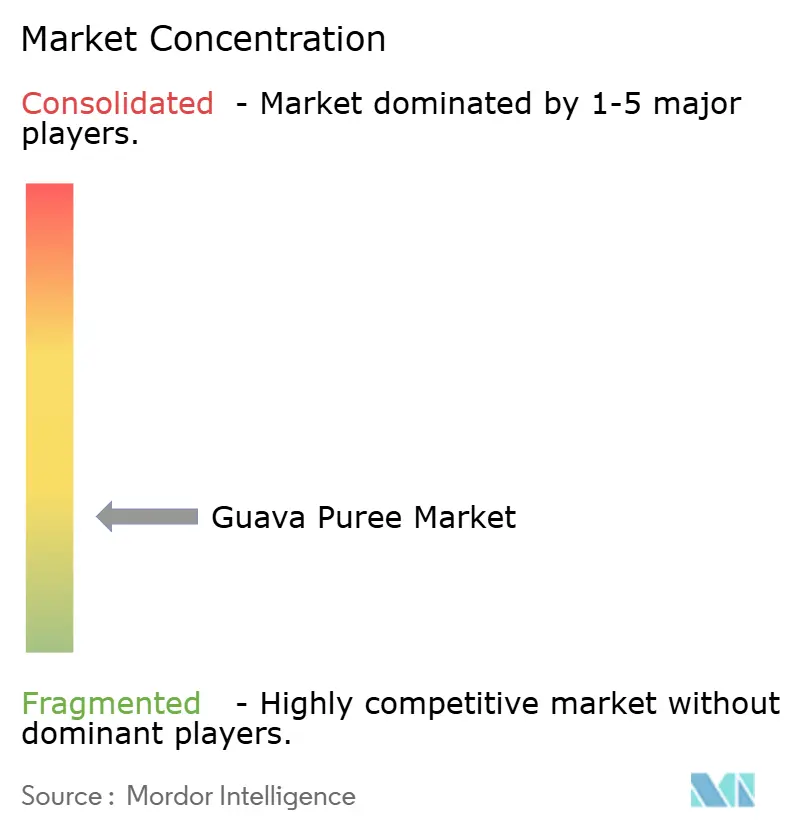
| Market Concentration | Low |
Major Players *Disclaimer: Major Players sorted in no particular order Image © Mordor Intelligence. Reuse requires attribution under CC BY 4.0. | |
Guava Puree Market Analysis by Mordor Intelligence
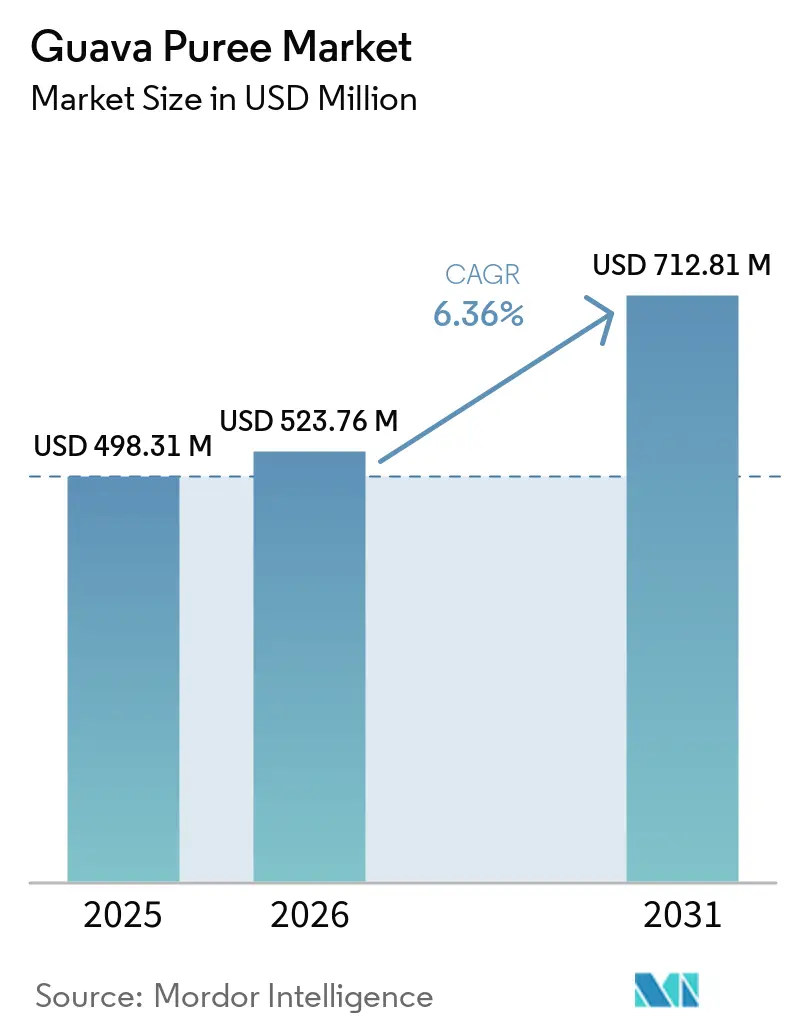
The Guava Puree Market size was valued at USD 498.31 million in 2025 and is estimated to grow from USD 523.76 million in 2026 to reach USD 712.81 million by 2031, at a CAGR of 6.36% during the forecast period (2026-2031). Clean-label formulation is broadening demand because guava can contribute sweetness, flavor, color, and texture in one fruit-based ingredient. Beverage producers remain important buyers, while infant nutrition is adding demand for products with traceable and minimally processed ingredients. Tropical flavors are moving into regular beverage ranges rather than being limited to seasonal launches, which supports recurring procurement of guava ingredients. Processors with aseptic capacity can supply customers throughout the year and can serve export routes without relying on refrigerated distribution. The Guava Puree Market, therefore, favors suppliers that combine reliable fruit sourcing, stable quality, and the certifications required by large food and beverage buyers.
Key Report Takeaways
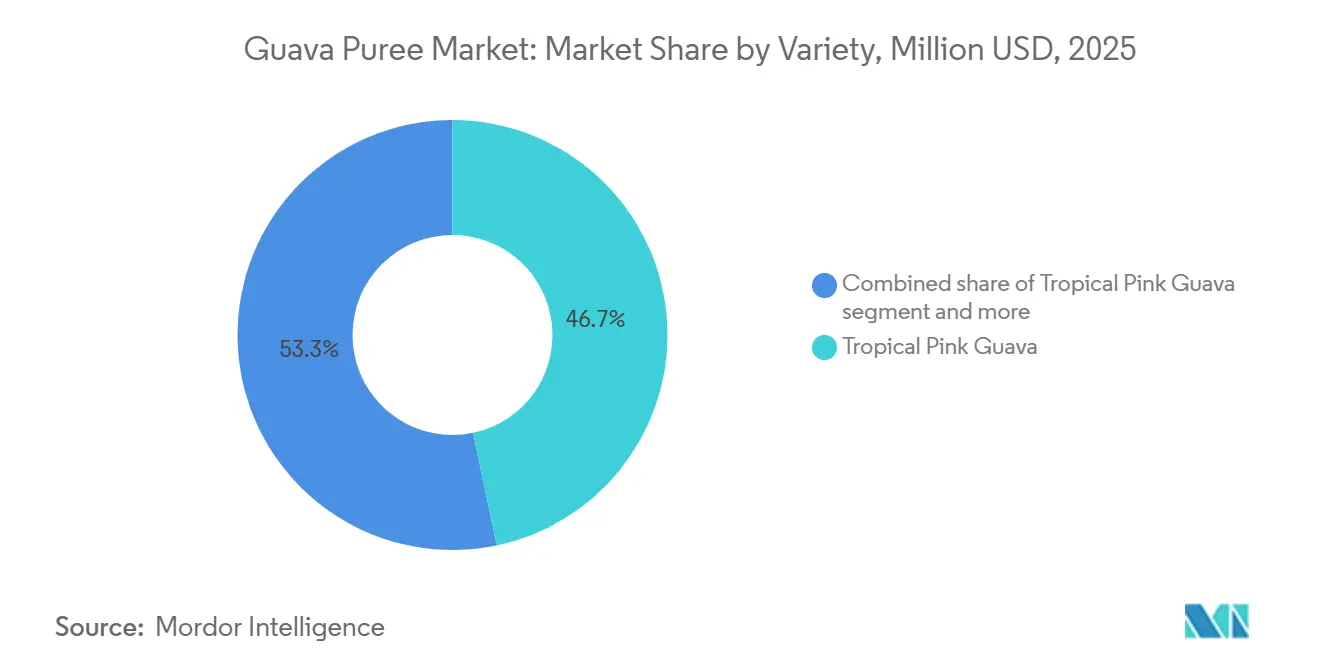
- By variety, Tropical Pink Guava held 46.71% of the Guava Puree Market share in 2025 and is forecast to grow at a 7.46% CAGR through 2031.
- By nature, conventional puree held 65.62% of the market value in 2025, while organic puree is forecast to grow at an 8.21% CAGR through 2031.
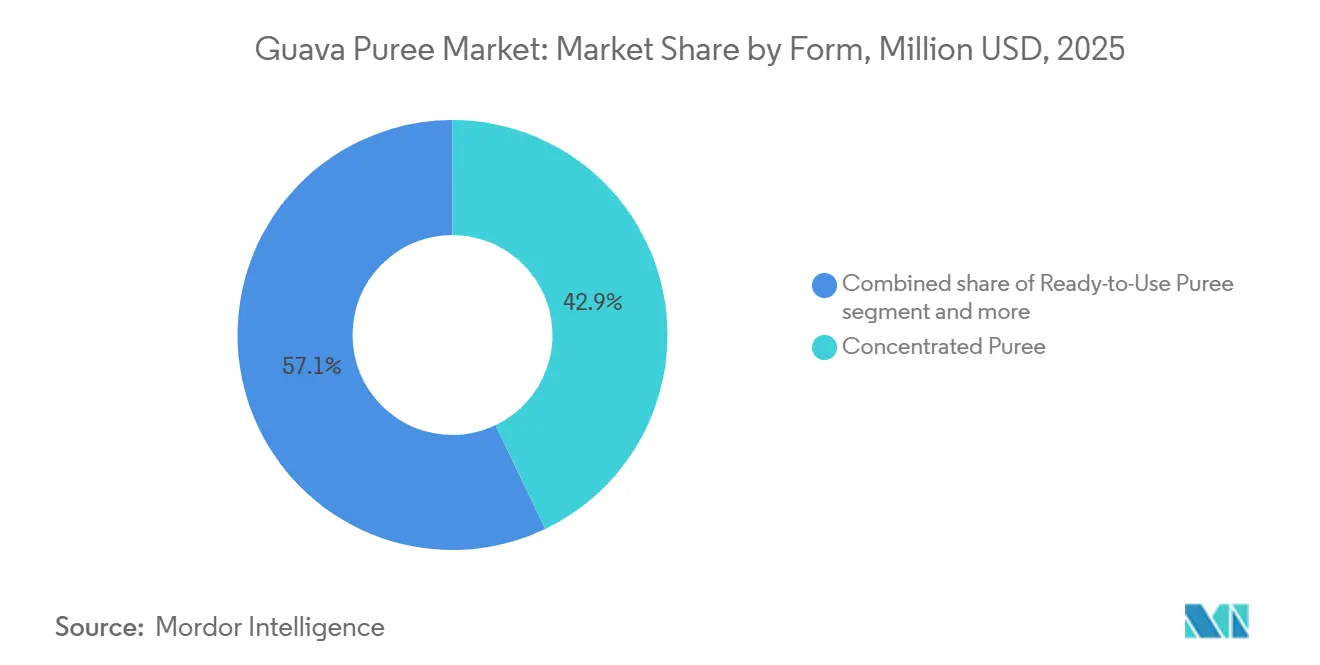
- By form, concentrated puree accounted for 42.91% of the Guava Puree Market size in 2025, while ready-to-use puree is projected to expand at an 8.28% CAGR through 2031.
- By application, beverages accounted for 55.47% of market value in 2025, while infant and baby food is forecast to grow at a 7.73% CAGR through 2031.
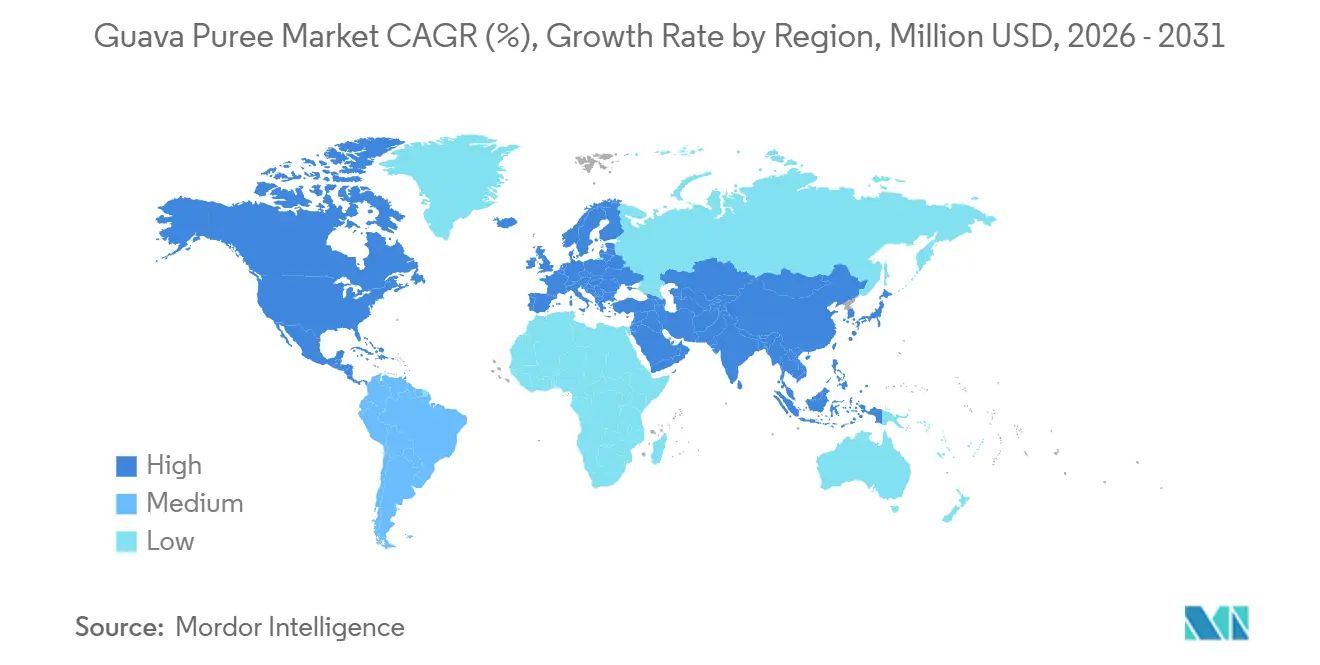
- By geography, North America held 33.90% of the market value in 2025, while Asia-Pacific is forecast to expand at a 7.82% CAGR through 2031.
Note: Market size and forecast figures in this report are generated using Mordor Intelligence’s proprietary estimation framework, updated with the latest available data and insights as of January 2026.
Market Trends and Insights
Drivers Impact Analysis of Guava Puree Market*
| Driver | (~) % Impact on CAGR Forecast | Geographic Relevance | Impact Timeline |
|---|---|---|---|
| Clean-label beverage reformulation | +1.8% | Global, with core demand in North America and Europe | Medium term (2-4 years) |
| Expansion of tropical flavor portfolios | +1.4% | North America, Europe, and the Asia-Pacific | Medium term (2-4 years) |
| Infant nutrition demand for natural fruit ingredients | +1.2% | North America, Europe, and the growing Asia-Pacific influence | Long term (≥ 4 years) |
| Organized food processing and year-round ingredient supply | +0.9% | India, Brazil (primary origins), South, and Southeast Asia | Long term (≥ 4 years) |
| Aseptic processing reducing seasonal availability risk | +0.7% | India, Mexico, and Brazil, with export relevance to Europe and North America | Short term (≤ 2 years) |
| Natural color and mouthfeel functionality in formulation | +0.5% | Europe and North America | Medium term (2-4 years) |
| Source: Mordor Intelligence | |||
Clean-label beverage reformulation
Beverage manufacturers are reformulating product lines with shorter ingredient declarations and fruit-based natural sweeteners, responding to consumer demand for recognizable, traceable ingredient systems. Guava puree occupies a dual role in this shift: it delivers natural sweetness and authentic tropical flavor while simultaneously providing color and mouthfeel, allowing it to displace artificial concentrates, synthetic colors, and flavor systems in a single ingredient substitution. Manufacturers increasingly see guava as a functional simplifier rather than merely a flavoring agent. Beverage Industry trade media documented that formulators are "turning to natural high-intensity sweeteners and single-strength fruit and vegetable juices as clean, consumer-recognized alternatives" to synthetic flavor systems. The EU Breakfast Directive's push toward higher-fruit formulations is creating additional pull in European markets, as manufacturers adjust recipes to meet rising minimum fruit content requirements and position reformulated products on clean-label credentials. The beverage application's 55.47% share of the guava puree market makes it the single most consequential demand anchor.
Expansion of tropical flavor portfolios
Premium beverage and food brands in North America and Europe are systematically moving guava from limited-edition to core SKU status, driven by the rapid diversification of consumer palates and the influence of Latin American and Southeast Asian cuisine across mainstream channels. T. Hasegawa's Flavor Trends 2026 report and Kerry Taste Charts 2026 explicitly identify guava/calamansi and guava/ginger as among the top emerging tropical flavor blends for functional beverages. In the United Kingdom, a market intelligence report from Uren identified pink guava and lychee as leading 2026 drink trends among Gen Z consumers, with pink guava noted for its compatibility with both spirit-based cocktails and alcohol-free RTD formats. This cross-channel relevance, from premium cocktails to smoothie pouches, broadens the guava puree demand base beyond traditional beverage concentrate buyers. The guava concentrate format benefits particularly, as beverage developers working at an industrial scale prefer high-brix concentrates for transportation efficiency and reconstitution flexibility across multiple product lines.
Infant nutrition demand for natural fruit ingredients
Infant and toddler nutrition brands apply the strictest ingredient purity standards of any application, and guava's nutritional density positions it as a functionally credible ingredient at modest inclusion rates. The Infant/Baby Food segment is projected to grow at 7.73% CAGR during 2026-2031, outpacing the overall market by more than 1 percentage point. This premium segment also generates a certification halo effect: processors approved to supply infant-grade guava puree (FSSC 22000, BRC AA+, USDA Organic) command higher average selling prices and unlock access to natural grocery and baby specialty retail channels that conventional-grade processors cannot serve. FSSAI's ePAAS single-window risk assessment system, which became mandatory for all product approvals in India from June 2026, tightens documentation standards for export-grade shipments and further differentiates compliant producers from uncertified suppliers[1]. The USDA National Organic Program's three-year synthetic-substance-free transition requirement constrains new organic guava supply entry and sustains price premiums, structurally advantaging processors with established certified supply chains. Regulatory influence on this segment is thus a market-shaping force, not merely a compliance cost.
Aseptic processing reducing seasonal availability risk
Fresh guava is among the most perishable tropical fruits, with a post-harvest shelf life of under 5 days. Aseptic processing, encompassing PLC-controlled sterilizers, sterile bag-in-drum filling, and ambient-temperature distribution, decouples guava puree supply from harvest seasonality, enabling year-round, export-grade product availability without cold chain dependency. This technical capability is commercially decisive: processors with certified aseptic lines can serve European and North American buyers on 30-60 day shipping cycles that are impossible with chilled formats. FSSC 22000-certified facilities demonstrate how aseptic puree produced from mature guavas can meet food-grade quality standards without preservatives or added sugars[2]. JBT Marel's multi-stage thermal processing approach, which allows processors to select pasteurization or sterilization conditions based on product acidity and target market specifications, further illustrates how technology investment differentiates export-ready processors from commodity-grade operators. Aseptic adoption is the primary mechanism through which India's cultivation dominance converts into exportable shelf-stable tropical fruit puree value.
Restraints Impact Analysis of Guava Puree Market*
| Restraint | (~) % Impact on CAGR Forecast | Geographic Relevance | Impact Timeline |
|---|---|---|---|
| Seasonal yield and raw-material price volatility | -1.1% | India, Mexico, Brazil, primary production origins | Short term (≤ 2 years) |
| Fresh-guava perishability and collection radius constraints | -0.8% | All origins; most acute in smallholder-intensive regions of India and South America | Medium term (2-4 years) |
| High aseptic, cold-storage, and compliance capital requirements | -0.9% | Emerging market processors in India, the Asia-Pacific, and South America | Long term (≥ 4 years) |
| Quality variation from smallholder and small-processor supply bases | -0.6% | India, Colombia, Mexico | Medium term (2-4 years) |
| Source: Mordor Intelligence | |||
Seasonal yield and raw-material price volatility
Guava cultivation is highly sensitive to monsoon variability in India, which supplies a majority of global fresh guava output. A Mongabay analysis published in October 2025 documented that rising temperature variability and erratic rainfall are reducing guava yields across key producing states in South Asia, with Uttar Pradesh farmers, operators of India's most commercially significant growing region, reporting direct livelihood impact from changing hydrological patterns. ABC Fruits' 2025 crop report flagged higher-than-expected market prices driven by supply shortages and uneven rainfall across Tamil Nadu and Karnataka. In Mexico, the transition between the Calvillo and Michoacán harvest cycles creates predictable seasonal supply gaps that lift spot prices; Spanish-language market updates from Commodity Board News confirmed that while Michoacán supply volumes in 2025 were "significantly better than during the last two years," the seasonal window still creates pricing firmness that larger processors absorb more easily than smaller operators. For processors on fixed-price supply contracts, raw material spikes directly compress margins.
High aseptic, cold-storage and compliance capital requirements
A compliant, export-ready aseptic guava puree line, covering aseptic sterilizers, bag-in-drum fillers, cold-storage inventory, and multi-standard certification (BRC, FSSC 22000, FSSAI, HACCP), represents a capital threshold of USD 2 million or more, depending on throughput capacity, a barrier that excludes the majority of small and mid-sized processors from premium export channels. This concentration dynamic is self-reinforcing: processors that have already cleared certification, such as Capricorn Food Products with its dual aseptic lines at its Satyavedu facility, continue capturing premium industrial contracts, while uncertified processors serve lower-margin domestic markets or commodity bulk trades. FSSAI's consolidated ePAAS compliance portal, effective June 2026, increases the documentation complexity for export approvals and widens the administrative cost gap between large certified exporters and smaller applicants seeking to enter regulated markets. This structural barrier limits competitive intensity at the premium tier, effectively concentrating high-value export contract capture among a small number of established processors.
*Our forecasts treat driver/restraint impacts as directional, not additive. The impact forecasts reflect baseline growth, mix effects, and variable interactions.
Guava Puree Market Segment Analysis
By Variety:
Pink Guava Anchors Volume and Value GrowthTropical Pink Guava held 46.71% of market value in 2025 and is forecast to grow at a 7.46% CAGR through 2031. It is the largest and fastest-growing variety in the supplied segmentation. Its salmon-pink color comes from lycopene and can reduce the need for added colorants in beverages, yogurt, and confectionery. Its antioxidant profile also supports its use in products positioned around fruit-based ingredients. The Guava Puree Market has seen pink guava gain relevance in premium beverage formats. Uren identified pink guava as a 2026 beverage flavor trend and noted its fit with both spirit-based and alcohol-free drinks. This relevance supports demand across both retail drinks and foodservice menus.
Tropical White Guava has a meaningful secondary position because its milder flavor suits bakery fillings, sauces, and white-label beverage concentrates. Buyers may prefer white guava when color neutrality is important in a finished product. Other varieties, including heritage cultivars and pear guava, remain relevant in local and artisan product lines. Tamil Nadu and Karnataka supply much of the pink guava puree available to export buyers, with their harvest patterns helping balance quality and volume across seasons. Organic certification can strengthen the value position of pink guava because verified supply chains are needed for USDA and EU organic claims. ABC Fruits lists NPOP, EU Organic, and NOP certifications for its pink and white guava puree exports. The Guava Puree Market rewards vertically integrated suppliers that can maintain both color consistency and certification records.

By Nature:
Organic Premiumization Reshapes a Conventional-Led CategoryConventional guava puree held 65.62% of the market value in 2025. Bulk buyers in beverages, bakery, and ice cream favor conventional supply because they require dependable volumes and competitive costs. Aseptic concentrated puree sourced from India and Mexico is mainly conventional and commonly supported by FSSAI, HACCP, and ISO 22000 processes. Organic puree is forecast to expand at an 8.21% CAGR through 2031, making it the faster-growing nature segment. The Guava Puree Market is seeing organic procurement become more relevant in premium private-label and baby-food channels. Tradin Organic Agriculture supplies frozen organic guava puree sourced from Colombia and India.
Organic demand is not only a consumer preference in European baby food and premium private-label categories. Buyers in Germany, the United Kingdom, and the Netherlands can specify certified tropical fruit purees as a basic sourcing condition. This creates a price premium for processors with established certified supply chains. The USDA National Organic Program requires a 3-year transition without prohibited synthetic substances, which limits how quickly new organic supplies can enter. Existing certified suppliers, therefore, have a timing advantage when demand rises. The Guava Puree Market continues to rely on conventional volume, while organic formats create a smaller but higher-value route for qualifying suppliers. This balance requires processors to manage separate sourcing, documentation, and customer requirements without compromising baseline quality.
By Form:
Concentrates Lead While Ready-to-Use Purees AccelerateConcentrated guava puree accounted for 42.91% of the market value in 2025. Higher Brix levels reduce the volume of water transported on long routes from India and Brazil to Europe and North America. This can lower freight costs for industrial customers buying at scale. Large beverage and bakery manufacturers can reconstitute concentrate at destination facilities, making it their usual bulk specification. Ready-to-use puree is forecast to grow at an 8.28% CAGR through 2031. The Guava Puree Market benefits from this format because foodservice operators and mid-sized manufacturers value faster preparation and batch consistency.
Aseptic ready-to-use purees can provide up to 18 months of ambient shelf life, which suits central kitchens and quick-service restaurant systems. Frozen puree remains important in premium foodservice, especially for pastry chefs, bartenders, and smoothie operators with commercial cold storage. The Perfect Purée of Napa Valley uses frozen formats to preserve fruit flavor and color within its premium fruit lineup. Dehydrated and dry puree serves a smaller but distinct role in confectionery, functional snacks, and nutraceutical products. These applications need powder incorporation and controlled water activity for shelf stability. The Guava Puree Market thus serves customers with different logistics, handling, and formulation needs through concentrated, frozen, dry, and ready-to-use formats.
By Application:
Beverages Lead While Infant Food Changes the Value MixBeverages accounted for 55.47% of the market value in 2025, making them the largest application. Guava is used in juice blends, nectars, functional ready-to-drink products, and craft mixers. Its natural Brix range and vitamin C content allow it to function as a primary flavor or a component within mixed tropical fruit blends. The Guava Puree Market benefits from the importance of guava in Mexican and Caribbean food traditions. This gives guava beverages a cultural link that synthetically flavored alternatives may not have. Concentrated formats remain particularly useful for beverage makers that prioritize ingredient cost efficiency in larger ready-to-drink lines.
Infant and baby food is forecast to grow at a 7.73% CAGR through 2031. Parents are seeking single-ingredient and minimally processed fruit purees that can introduce different flavors in early-stage nutrition. Ready-to-use guava puree can serve as a primary filling or a blended ingredient in pouches. Bakery and confectionery makers use guava acidity to balance fillings and jams. Snack and dessert makers use freeze-dried guava powder in nutrition bars and gummies, while ice cream and yogurt makers can use pink guava for its color. Sauces and dressings remain a smaller application but can grow in Latin American cuisine-inspired offerings. The Guava Puree Market has a broad application base, which reduces its reliance on one end-use channel even though beverages remain central.
Geography Analysis
The Americas and APAC Guava Puree Market
North America held 33.90% of the market value in 2025, making it the largest regional segment. The United States imports puree from India, Brazil, Mexico, Colombia, and the Dominican Republic. These imports support Hispanic-oriented specialty foods and mainstream beverage products using clean-label formulations. A 1.3% U.S. tariff on guava and mango puree under HS Code 2007.99.50 supports India’s sourcing position in the supplied analysis. Mexico is both a production origin and a consumption market for guava beverages, nectars, and confectionery. The Guava Puree Market in Canada offers a premium opportunity for organic concentrated products sold through natural-grocery and private-label channels.
Europe and APAC Guava Puree Market
Europe has a smaller regional share but remains a concentrated source of high-value demand. Germany, the United Kingdom, France, and the Netherlands support purchases for organic baby food, premium juice, dairy desserts, and artisan foods. Organic rules and Codex guidance create documentation demands that favor export-certified suppliers. Asia-Pacific is forecast to grow at a 7.82% CAGR through 2031, the fastest among the regional segments. India combines a large cultivation base with growing processing operations in Tamil Nadu, Karnataka, Andhra Pradesh, and Uttar Pradesh. The Guava Puree Market can gain as these processors convert fruit supplies into shelf-stable aseptic products for domestic and export customers. ITC reported strong growth in its Fruits and Vegetables business during the quarter ended June 30, 2026.
APAC, South America and MEA Guava Puree Market
China adds regional demand through growing packaged beverage capacity and dairy-adjacent ready-to-drink formats. India’s domestic demand also reflects the clean-label and functional-food preferences affecting other large consumer markets. South America combines processing supply with culturally established guava consumption. Brazil is expanding its processing of guava-based products, while Colombia’s origin-protected bocadillo veleño illustrates the specialty value of guava-based products. The Middle East and Africa have emerging demand in Gulf Cooperation Council countries for imported baby food and wellness-focused retail products. Egypt and Morocco also contribute cultivation potential in North Africa. The Guava Puree Market has opportunities across these regions, although certification, product format, and route-to-market needs differ widely.
Competitive Landscape
The Guava Puree Market is moderately fragmented. Indian processors hold strong positions because India has significant guava cultivation and an established export certification infrastructure. ITC Limited, Capricorn Food Products India Limited, Shimla Hills Offerings, and ABC Fruits compete through Brix consistency, reliable volumes, certification coverage, and price. Their certifications can include BRC, FSSC 22000, FSSAI, APEDA, Kosher, and Halal, depending on the supplier and product. These processors supply bulk concentrated and aseptic puree to European and North American ingredient buyers. The Guava Puree Market also includes international ingredient platforms that offer broader formulation and sourcing capabilities.
Döhler GmbH and Symrise AG compete through multi-format sourcing, formulation support, and supply reliability for food and beverage brands. Döhler acquired Premier Juices in North America in March 2025, adding guava, passion fruit, mango, pineapple, and related tropical fruit offerings to its regional portfolio. The acquisition also added blending, packaging, and quality-control capabilities at a Delaware logistics hub. Symrise completed a tropical dry-ingredients capacity upgrade at its Pasaje facility in Ecuador in July 2025, strengthening its supply capability for baby food, confectionery, and beverage customers[3]. In April 2026, Symrise opened an upgraded food and beverage site in Parets del Vallès near Barcelona with a larger mixing plant for powdered food and beverage solutions. These moves show how larger platforms extend their regional service and processing capabilities.
The Perfect Purée of Napa Valley, Les Vergers Boiron, and Mainfrucht GmbH address premium foodservice and artisan food applications. These suppliers emphasize provenance, flavor quality, and frozen formats rather than bulk industrial scale. The Perfect Purée partnered with Döhler in December 2024 to launch the Tastecraft freeze-dried fruit line, including Pink Guava, for North American foodservice. A gap remains for vertically integrated suppliers that can provide organic and conventional puree from India, Colombia, and Brazil in both aseptic and frozen formats. PLC-based sterilization, enzymatic deseeding, and cold-chain planning can help mid-sized processors meet demanding buyer specifications. The Guava Puree Market remains competitive across several tiers, with scale, certifications, format flexibility, and application support determining supplier positioning.
Guava Puree Industry Leaders
-
Döhler GmbH
-
ITC Limited
-
Citrofrut S.A. de C.V.
-
ABC Fruits
-
Symrise AG
- *Disclaimer: Major Players sorted in no particular order
Guava Puree Market Companies Covered in this Report
- ITC Limited
- Döhler GmbH
- Capricorn Food Products India Limited
- Citrofrut S.A. de C.V.
- Superior Foods, Inc.
- Aditi Foods India Pvt. Ltd.
- Kiril Mischeff Limited
- Shimla Hills Offerings Pvt. Ltd.
- SunOpta, Inc.
- ABC Fruits
- Symrise AG
- Mainfrucht GmbH & Co. KG
- Grünewald Fruchtsaft GmbH
- Ariza B.V.
- Taj Pharmaceuticals Ltd.
- Sime Darby Plantation Berhad
- The Perfect Purée of Napa Valley
- Tradin Organic Agriculture B.V.
- Les vergers Boiron
- Dream Foods Caribe
Recent Industry Developments in Guava Puree Market
- June 2026: SunOpta Inc. completed its USD 25 million+ production facility expansion at its Omak, Washington, plant, adding a new fruit ingredient processing line and increasing manufacturing capacity by 25% to meet demand for natural and organic fruit ingredient products that had seen double-digit growth for 21 consecutive quarters.
- April 2026: Symrise opened its upgraded Food and Beverage site in Parets del Vallès near Barcelona and installed a new large-scale mixing plant. The expansion increased capacity for powdered food and beverage solutions, including tropical fruit applications, and strengthened its EMEA ingredient supply chain.
- April 2025: Döhler North America acquired Premier Juices, which added guava, mango, passion fruit, pineapple, and other tropical fruit products to its North American natural ingredient portfolio, alongside Premier Juices' blending, packaging, and quality-control capabilities at its Delaware logistics hub.
Global Guava Puree Market Report Scope
Guava puree is a smooth, thick, and viscous fruit product made by crushing, blending, and sieving ripe, sound guava fruit (Psidium guajava) to completely remove the hard seeds and fibrous skin. The guava puree market is segmented by variety, nature, form, application, and geography. By variety, the market is segmented into tropical pink, tropical white, and others. By nature, the market is segmented into conventional and organic. By form, the market is segmented into concentrated, frozen, dehydrated/dry, and ready-to-use. By application, the market is segmented into beverages, infant/baby food, bakery and confectionery, snacks and desserts, ice cream and yogurt, sauces and dressings, and others. By geography, the market is segmented into North America, Europe, Asia-Pacific, South America, and the Middle East and Africa. The market forecasts are provided in terms of value (USD).
| Tropical Pink Guava |
| Tropical White Guava |
| Other Guava Varieties |
| Conventional |
| Organic |
| Concentrated Puree |
| Frozen Puree |
| Dehydrated/Dry Puree |
| Ready-to-Use Puree |
| Beverages |
| Infant/Baby Food |
| Bakery and Confectionery |
| Snacks and Desserts |
| Ice Cream and Yogurt |
| Sauces and Dressings |
| Other Applications |
| North America | United States |
| Canada | |
| Mexico | |
| Rest of North America | |
| Europe | United Kingdom |
| Germany | |
| France | |
| Italy | |
| Spain | |
| Sweden | |
| Belgium | |
| Poland | |
| Netherlands | |
| Rest of Europe | |
| Asia-Pacific | China |
| Japan | |
| India | |
| Thailand | |
| Singapore | |
| Indonesia | |
| South Korea | |
| Australia | |
| Rest of Asia-Pacific | |
| South America | Brazil |
| Argentina | |
| Colombia | |
| Peru | |
| Chile | |
| Rest of South America | |
| Middle East and Africa | United Arab Emirates |
| South Africa | |
| Saudi Arabia | |
| Nigeria | |
| Egypt | |
| Morocco | |
| Turkey | |
| Rest of Middle East and Africa |
| Variety | Tropical Pink Guava | |
| Tropical White Guava | ||
| Other Guava Varieties | ||
| Nature | Conventional | |
| Organic | ||
| Form | Concentrated Puree | |
| Frozen Puree | ||
| Dehydrated/Dry Puree | ||
| Ready-to-Use Puree | ||
| Application | Beverages | |
| Infant/Baby Food | ||
| Bakery and Confectionery | ||
| Snacks and Desserts | ||
| Ice Cream and Yogurt | ||
| Sauces and Dressings | ||
| Other Applications | ||
| Geography | North America | United States |
| Canada | ||
| Mexico | ||
| Rest of North America | ||
| Europe | United Kingdom | |
| Germany | ||
| France | ||
| Italy | ||
| Spain | ||
| Sweden | ||
| Belgium | ||
| Poland | ||
| Netherlands | ||
| Rest of Europe | ||
| Asia-Pacific | China | |
| Japan | ||
| India | ||
| Thailand | ||
| Singapore | ||
| Indonesia | ||
| South Korea | ||
| Australia | ||
| Rest of Asia-Pacific | ||
| South America | Brazil | |
| Argentina | ||
| Colombia | ||
| Peru | ||
| Chile | ||
| Rest of South America | ||
| Middle East and Africa | United Arab Emirates | |
| South Africa | ||
| Saudi Arabia | ||
| Nigeria | ||
| Egypt | ||
| Morocco | ||
| Turkey | ||
| Rest of Middle East and Africa | ||
Key Questions Answered in the Report
What is driving demand for guava puree?
Demand is supported by clean-label reformulation, broader tropical flavor use, infant nutrition needs, and the availability of shelf-stable aseptic products.
Which guava puree form is most widely used?
Concentrated puree led with 42.91% of the 2025 value because it reduces freight volume and suits industrial buyers who can reconstitute ingredients.
Why is pink guava important to food and beverage formulators?
Pink guava held 46.71% of the 2025 value and provides natural color, tropical flavor, and lycopene-based visual appeal in drinks, dairy, and confectionery.
Which application is growing fastest for guava puree?
Infant and baby food is forecast to grow at a 7.73% CAGR through 2031 as brands seek traceable and minimally processed fruit ingredients.