
Groundwater Treatment Chemicals Market Size and Share
Market Overview
| Study Period | 2021 - 2031 |
|---|---|
| Market Size (2026) | USD 1.36 Billion |
| Market Size (2031) | USD 1.88 Billion |
| Growth Rate (2026 - 2031) | 6.73 % |
| Fastest Growing Market | Asia-Pacific |
| Largest Market | North America |
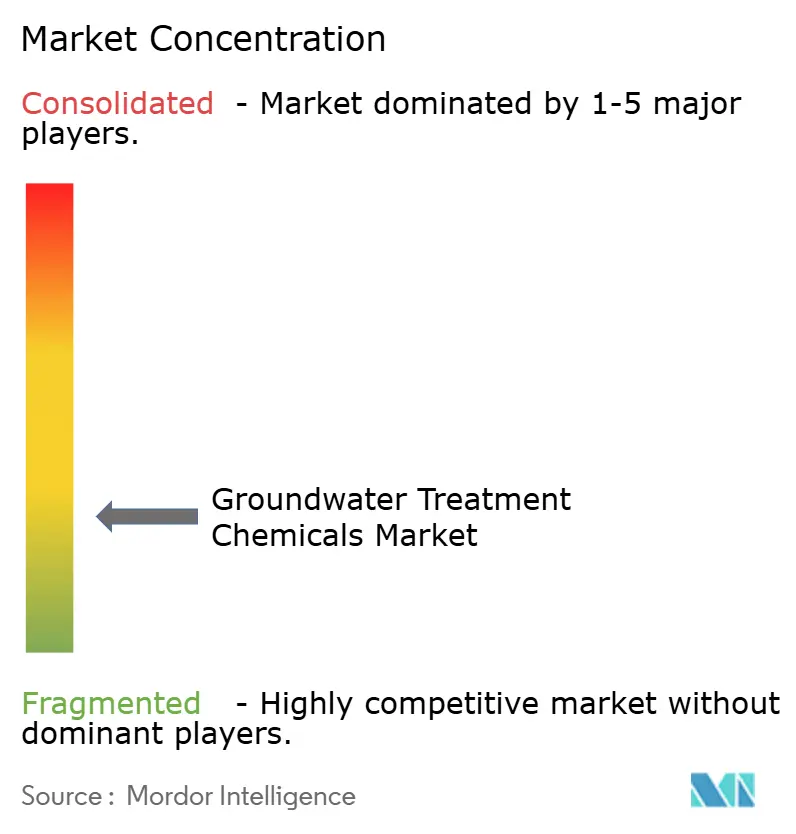
| Market Concentration | Low |
Major Players *Disclaimer: Major Players sorted in no particular order Image © Mordor Intelligence. Reuse requires attribution under CC BY 4.0. | |
Groundwater Treatment Chemicals Market Analysis by Mordor Intelligence
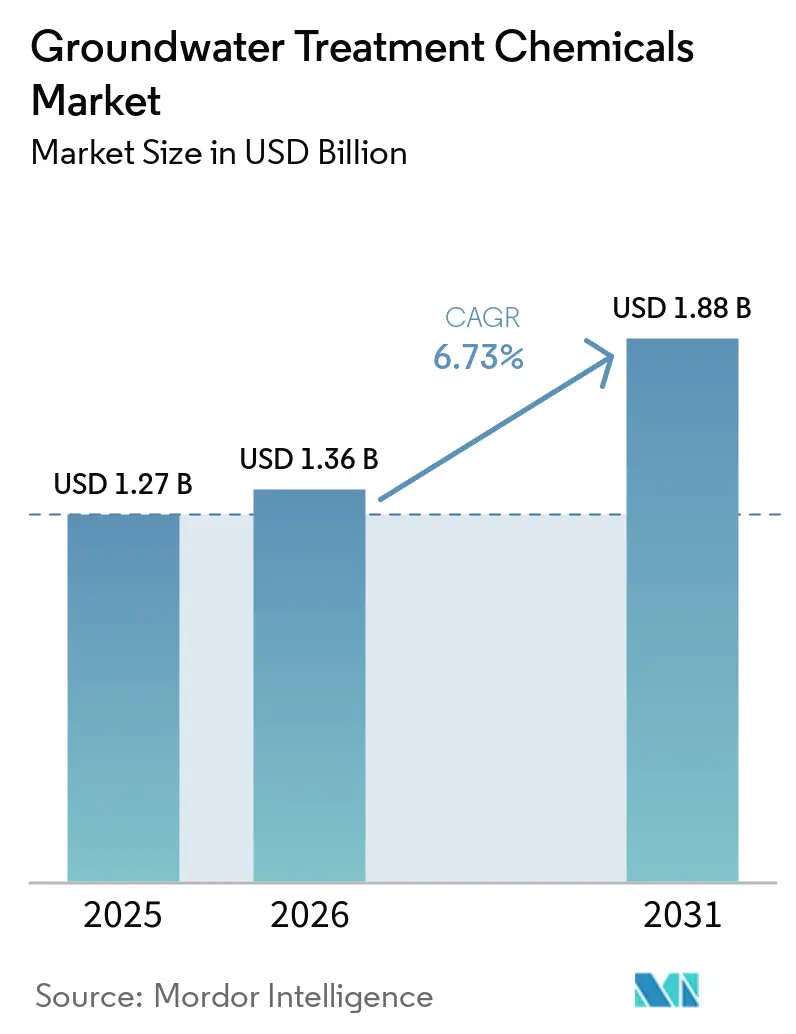
The Groundwater Treatment Chemicals market size was valued at USD 1.27 billion in 2025 and is estimated to grow from USD 1.36 billion in 2026 to reach USD 1.88 billion by 2031, at a CAGR of 6.73% during the forecast period (2026-2031). Regulatory requirements are converting contamination liabilities into funded treatment and remediation programs, which support demand across municipal and industrial sites. The U.S. Environmental Protection Agency (EPA) set enforceable limits for 6 per- and polyfluoroalkyl substances (PFAS) in 2024, including 4 parts per trillion for perfluorooctanoic acid (PFOA) and perfluorooctane sulfonic acid (PFOS), and public water systems must meet the maximum contaminant levels (MCLs) by 2029. The groundwater treatment chemicals market is also supported by industrial cleanup programs that require long-term chemical procurement. In March 2026, the EPA and the U.S. Department of Justice reached a USD 668 million settlement for the Lower Duwamish Waterway cleanup in Seattle, where groundwater interception and sediment remediation will continue for at least 10 years. Suppliers are responding by expanding adsorbent, ion-exchange, and site-specific treatment capabilities, while costs for acrylamide monomer and changing PFAS compliance timelines remain important risks for the groundwater treatment chemicals market.
Key Report Takeaways
- By chemical type, coagulants and flocculants held 35.34% of the groundwater treatment chemicals market share in 2025, while scale and corrosion inhibitors are projected to advance at a 7.34% CAGR through 2031.
- By application, groundwater remediation held 53.23% of the groundwater treatment chemicals market share in 2025 and is projected to advance at a 7.86% CAGR through 2031.
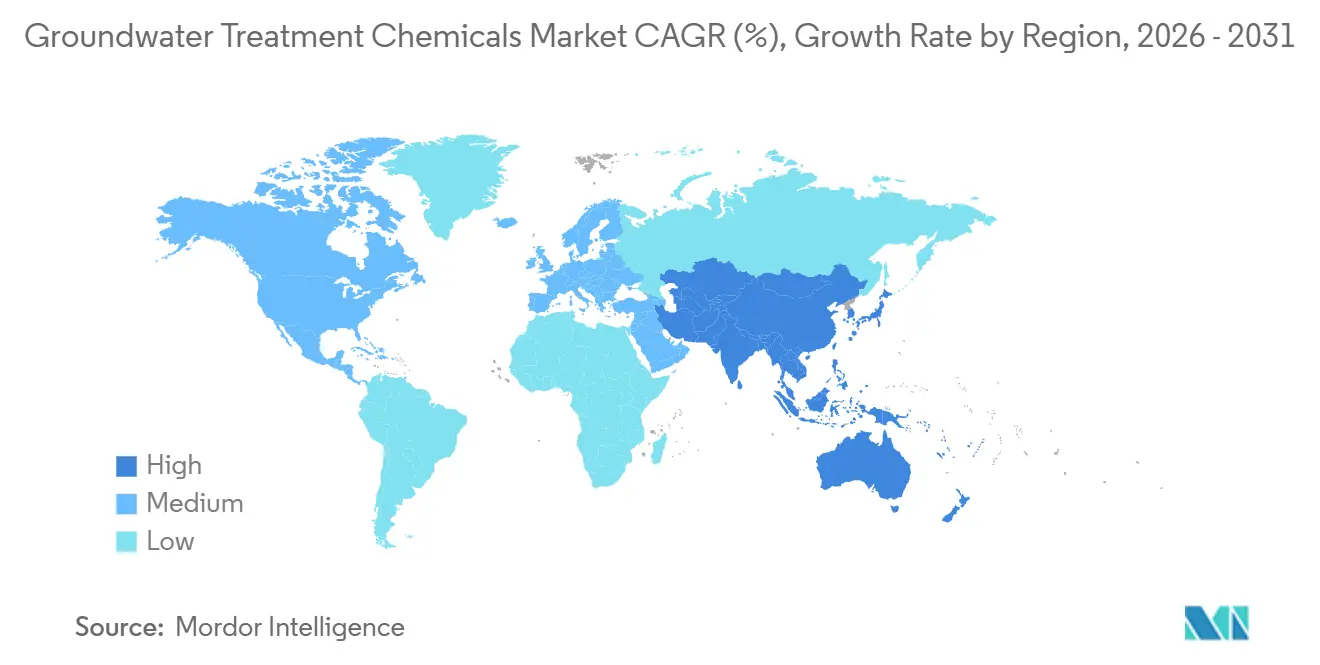
- By geography, North America held 33.67% of the groundwater treatment chemicals market share in 2025, and Asia-Pacific is projected to advance at a 7.58% CAGR through 2031.
Note: Market size and forecast figures in this report are generated using Mordor Intelligence’s proprietary estimation framework, updated with the latest available data and insights as of January 2026.
Market Trends and Insights
Drivers Impact Analysis of Groundwater Treatment Chemicals Market*
| Driver | (~) % Impact on CAGR Forecast | Geographic Relevance | Impact Timeline |
|---|---|---|---|
| PFAS Compliance and Groundwater Monitoring Expansion | +2.4% | Global, concentrated in North America and Western Europe | Short-term (≤ 2 years) |
| Brownfield Redevelopment and Site-Closure Pressure | +1.8% | North America & Europe, spillover to APAC urban corridors | Medium-term (2–4 years) |
| Industrial Legacy Contamination and Liability Allocation | +1.4% | Global, highest density in North America, Germany, and Japan | Long-term (≥ 4 years) |
| In-Situ Treatment Preference Over Excavation and Long-Term Pump-and-Treat | +1.2% | North America, Europe, early adoption in Australia and South Korea | Medium-term (2–4 years) |
| Site-Specific Chemistry for Mixed Contaminant Plumes | +0.8% | North America, EU, and APAC industrial corridors | Medium-term (2–4 years) |
| Lower-Waste Passive Sorption and Reactive-Barrier Adoption | +0.5% | APAC and North America, with early gains in the Nordic countries and Japan | Long-term (≥ 4 years) |
| Source: Mordor Intelligence | |||
PFAS Compliance and Groundwater Monitoring Expansion
The EPA's 2024 National Primary Drinking Water Regulation established a defined procurement timetable for U.S. water utilities. Public water systems serving more than 10,000 people must complete initial quarterly monitoring by April 2027 and meet full MCL requirements by April 2029[1]. Each noncompliant entry point may require granular activated carbon (GAC), anion-exchange resins, or reverse osmosis, together with pretreatment chemicals that protect treatment-media performance. Veolia operated 34 PFAS treatment systems in the United States in mid-2025 and opened a USD 35 million GAC facility in Delaware that can treat 30 million gallons per day for more than 100,000 residents. The company has also committed to expanding treatment coverage to more than 100 U.S. water production sites in future years. New GAC systems create recurring spent-carbon replacement needs, which broadens the demand base for adsorbent suppliers in the groundwater treatment chemicals market.
Brownfield Redevelopment and Site-Closure Pressure
Brownfield contamination can delay property transfers, increase environmental insurance costs, and create liability concerns during due diligence. Site owners facing no-further-remediation closure schedules are using in-situ approaches that can provide measurable contaminant reduction within planned project periods. In March 2026, REGENESIS and AECOM installed a PlumeStop colloidal activated carbon in-ground PFAS barrier at a U.S. Army National Guard facility using the IBIS inline blending and injection system. The installation was designed to contain the PFAS plume without ongoing maintenance obligations or a secondary PFAS waste stream. Passive systems can avoid surface treatment infrastructure and ongoing energy costs, which supports more predictable remediation budgets. This is shifting some demand in the groundwater treatment chemicals market from continuous bulk volumes toward limited specialty chemical injections.
Industrial Legacy Contamination and Liability Allocation
Industrial legacy contamination continues to create new funded remediation requirements rather than a shrinking project base. Comprehensive Environmental Response, Compensation, and Liability Act (CERCLA) assigns cleanup costs to potentially responsible parties, including current and past owners, operators, and transporters. In March 2026, Ford Motor Company and the Borough of Ringwood, New Jersey, entered a consent decree for final groundwater cleanup at the Ringwood Mines/Landfill Superfund site. The site included benzene, 1,4-dioxane, and lead from historic paint sludge disposal, and the treated groundwater may become a future drinking-water source for nearby communities. The USD 668 million Lower Duwamish settlement further shows how liability allocation supports long-duration chemical procurement. More sophisticated buyer groups are placing greater value on contracts that link chemical performance to verified contaminant reductions in the groundwater treatment chemicals market.
In-Situ Treatment Preference Over Excavation and Long-Term Pump-and-Treat
In-situ chemical treatment can offer cost advantages over excavation and long-term pump-and-treat, where contaminant depth prevents practical excavation. Permeable reactive barriers (PRBs) use the natural hydraulic gradient and can reduce the need for above-ground equipment, energy, and routine maintenance. A 2024 field assessment found that a zero-valent iron PRB reduced zinc, lead, and nickel mass flux by 82%, 72%, and 79%, respectively, within 7 months at a metal-contaminated site with high groundwater mineralization. A 2025 review found that PRBs can have lower life-cycle costs than pump-and-treat systems when reactive-media longevity matches site geochemistry. This approach favors periodic purchases of zero-valent iron, activated carbon, and biochar over continuous oxidant dosing. Suppliers with media production and injection-engineering capabilities are therefore better placed to serve this part of the groundwater treatment chemicals market.
Restraints Impact Analysis of Groundwater Treatment Chemicals Market*
| Restraint | (~) % Impact on CAGR Forecast | Geographic Relevance | Impact Timeline |
|---|---|---|---|
| Subsurface Heterogeneity and Oxidant Demand | -0.8% | Global | Long-term (≥ 4 years) |
| PFAS Destruction and Concentrate Disposal Cost | -0.6% | North America & EU | Short-term (≤ 2 years) |
| Reagent Safety, Handling, and Injection Complexity | -0.4% | Global, particularly in emerging markets | Medium-term (2–4 years) |
| Variable Regulatory Acceptance of Emerging Chemistries | -0.3% | APAC, South America, and Middle East and Africa | Long-term (≥ 4 years) |
| Source: Mordor Intelligence | |||
Subsurface Heterogeneity and Oxidant Demand
Aquifer heterogeneity remains a persistent constraint on oxidant performance because geology varies across a contaminated plume. Hydraulic conductivity, organic matter, and mineral content can alter both dose requirements and the area reached by an injected reagent. Required oxidant doses can be 3 to 10 times higher than laboratory estimates. A 2024 study found that per- and polyfluoroalkyl substances mass-flux reduction differed significantly between homogeneous and heterogeneous aquifers under the same chemical loading. The uncertainty requires detailed sampling and monitoring before procurement, which can extend sales cycles. Suppliers that include site characterization and pilot testing can reduce purchasing friction but may absorb added service costs in the groundwater treatment chemicals market.
PFAS Destruction and Concentrate Disposal Cost
The lack of cost-effective in-situ PFAS destruction chemistry remains a major technical limitation. Common oxidants and reductants can degrade chlorinated solvents or petroleum hydrocarbons, but terminal PFAS compounds resist commercially scaled chemical destruction. A 2025 review found that permanganate and persulfate-based oxidants mainly convert PFAS precursors into more persistent terminal forms rather than fully mineralizing them. The review also reported that commercially scaled in-situ destruction technology for terminal PFAS at CERCLA sites was not available. Activated carbon captures PFAS on spent media that then needs thermal reactivation or hazardous-waste disposal. Until destruction methods become commercially viable, monitored containment will limit addressable chemical volumes in the groundwater treatment chemicals market.
*Our forecasts treat driver/restraint impacts as directional, not additive. The impact forecasts reflect baseline growth, mix effects, and variable interactions.
Groundwater Treatment Chemicals Market Segment Analysis
By Chemical Type:
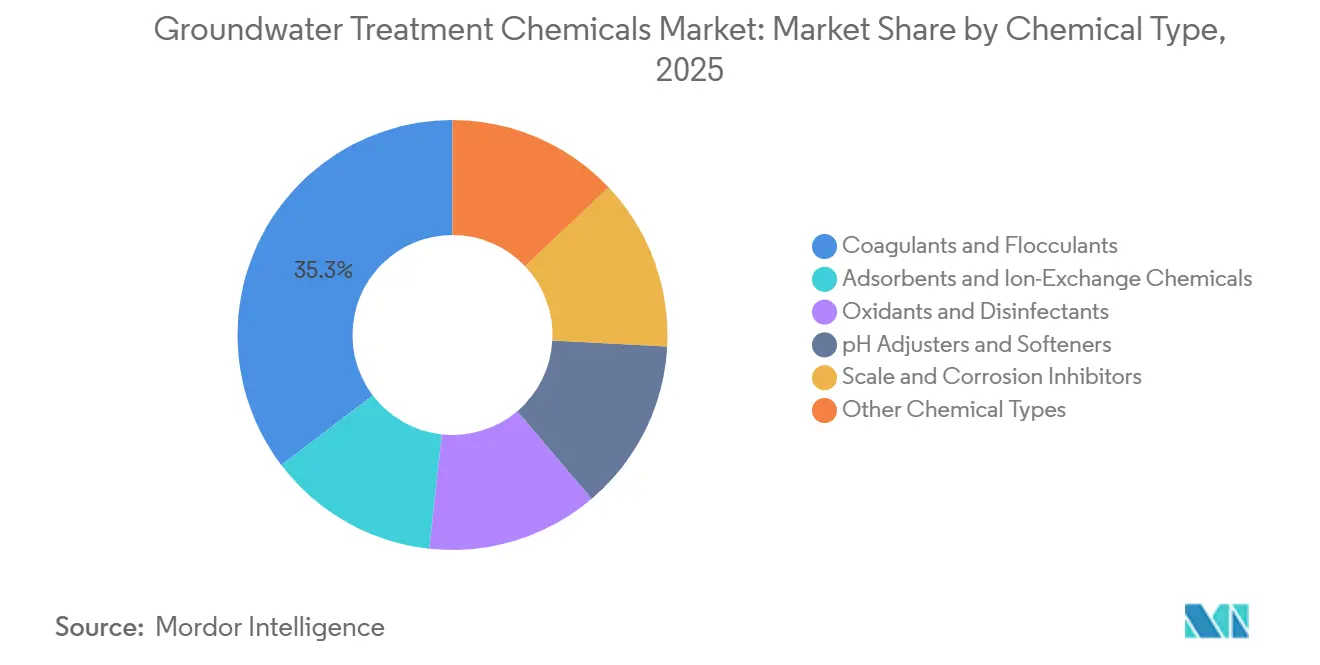
Scale and Corrosion Inhibitors Gaining Ground in a Coagulants and Flocculants-Led MarketCoagulants and flocculants commanded 35.34% of the groundwater treatment chemicals market size in 2025 because they remove suspended solids, turbidity, and particulate-bound contaminants from groundwater used for municipal supply and industrial reuse. SNF Group is one of the world's leading producers of water-soluble polymers. Kemira Oyj's April 2026 investor presentation placed its share of the polymers-for-water-treatment market at 15%. These companies compete with regional producers through formulation performance, supply security, and certified product lines. Scale and corrosion inhibitors are projected to advance at a 7.34% CAGR through 2031 as zero-liquid-discharge systems increase mineral concentration in closed-loop groundwater recycling operations.
Oxidants and disinfectants accounted for a substantial portion, with persulfate and hydrogen peroxide systems used where chemical destruction is required. Adsorbents and ion-exchange chemicals are attracting investment that is larger than their current revenue contribution. In June 2026, the EPA evaluated colloidal activated carbon (CAC) as an in-situ PFAS sequestration technology under the CERCLA framework. Kemira Oyj entered activated-carbon reactivation through a United Kingdom acquisition in 2024 and is building a plant in Helsingborg, Sweden, that is expected to begin operating in the second half of 2027. Kemira Oyj also announced a USD 23.4 million investment for a Tarragona, Spain, facility in February 2026. Potential of hydrogen (pH) adjusters and softeners support treatment conditions, while biostimulants and electron donors are gaining use in enhanced bioremediation at chlorinated-solvent sites. These product developments strengthen the groundwater treatment chemicals industry across both compliance treatment and site remediation.

By Application:
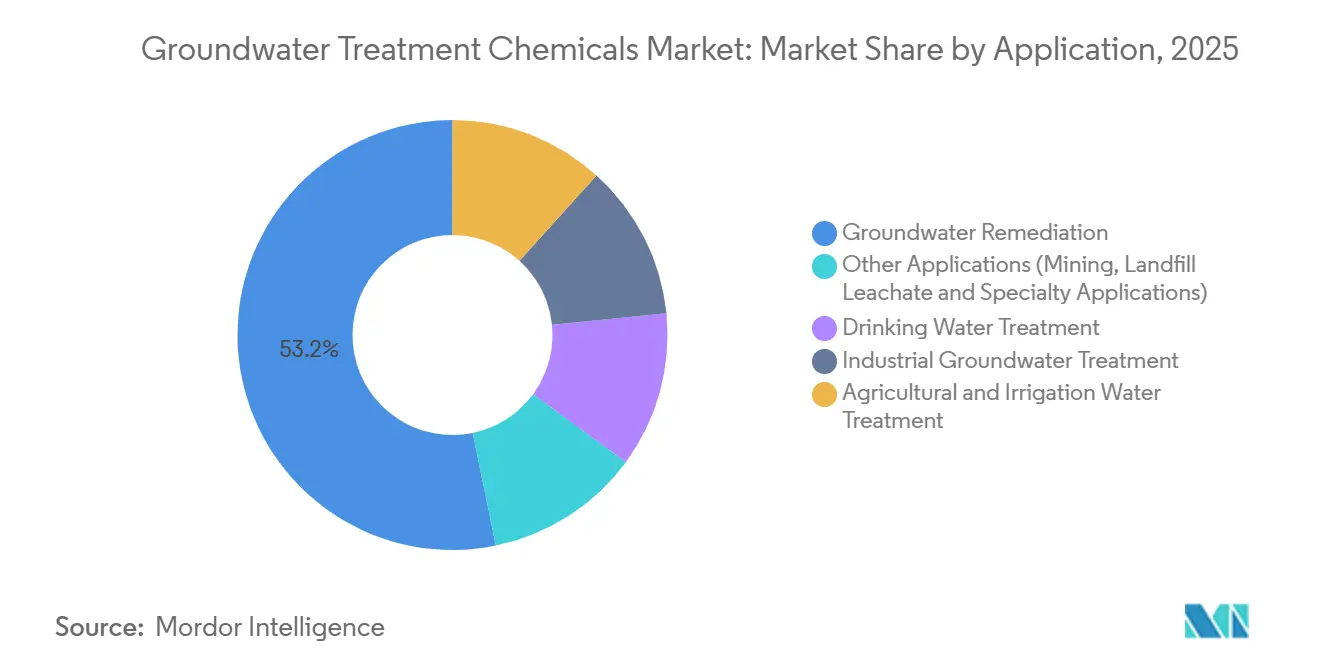
Groundwater Remediation Dominance Reflects Chemistry IntensityGroundwater remediation held 53.23% of revenue in 2025, reflecting the chemical intensity of CERCLA-mandated programs. A single remedy set out in a Record of Decision can require continuous chemical injection for 5 to 20 years. This can create cumulative chemical spending that exceeds the spending at a municipal treatment site with a similar footprint. Drinking water treatment represented a major application, using coagulants, disinfectants, and pH adjusters to meet Safe Drinking Water Act standards and PFAS MCLs. Industrial groundwater treatment uses scale inhibitors, corrosion inhibitors, and biocides for closed-loop cooling, process water, and produced water systems.
Agricultural and irrigation water treatment addresses nitrate, fluoride, and arsenic contamination that can limit groundwater use for crops. India's Central Ground Water Board classified 10.8% of assessed groundwater blocks as over-exploited in 2025. In May 2025, Bangalore Water Supply and Sewerage Board launched an INR 1,323.46 crore (approximately USD 159 million) wastewater-management and reuse initiative. Other applications include mining pit dewatering, landfill leachate control, and specialty industrial discharges. These uses are smaller in scale but can support premium formulations because site conditions differ. Suppliers that serve all five applications can compete for integrated treatment contracts within the groundwater treatment chemicals industry.
Geography Analysis
North America and Europe Groundwater Treatment Chemicals Market
North America held 33.67% of the groundwater treatment chemicals market size in 2025, supported by established Superfund enforcement and a large inventory of legacy industrial sites. The United States remained the main subregional contributor, with demand tied to CERCLA consent decrees, U.S. Army Corps of Engineers (USACE) remediation contracts, and PFAS MCL requirements. Tetra Tech, Inc. was selected in 2026 to design a dedicated PFAS treatment facility in Dayton, Ohio, with a projected construction cost of USD 350 million[2]. Canada contributed demand from mining and oil-sands water management, while Europe had demand centered in Germany, France, and the United Kingdom, where brownfield density and evolving groundwater standards support active remediation.
APAC Groundwater Treatment Chemicals Market
Asia-Pacific is projected to advance at a 7.58% CAGR through 2031. China's demand is supported by stricter regulation of chlorinated organics and phosphorus discharges, zero-liquid-discharge mandates for lithium battery facilities, and data-center cooling-water requirements. India's Jal Jeevan Mission and water-quality programs are expanding institutional procurement for coagulants, adsorbents, and pH adjustment chemicals. Kurita Water Industries Ltd. reported net sales of JPY 208,970 million (approximately USD 1.39 billion) for the fiscal year ended March 2026. Japan and South Korea support demand from semiconductor and electronics manufacturing, where groundwater treatment requires precise chemical control.
South America and MEA Groundwater Treatment Chemicals Market
South America is developing from an earlier base, with Brazil and Argentina representing the principal subregional demand centers. Brazil's pulp and paper, mining, and petrochemical activities create groundwater treatment needs, while environmental enforcement is formalizing remediation obligations. In 2025, Solvay and Veolia completed a 10-year industrial water-reuse partnership at Solvay's Santo André plant in Brazil, achieving 94% water recycling and saving the equivalent of 133 Olympic swimming pools of freshwater annually. The groundwater treatment chemicals market in the Middle East and Africa has a split demand profile between Gulf-state requirements for scale and corrosion inhibitors and South African mining requirements for heavy-metal removal and tailings-water treatment. Lower regulatory enforcement in both areas continues to limit the urgency-led demand seen in North America and Europe.
Competitive Landscape
The groundwater treatment chemicals market is highly fragmented. Within the global groundwater treatment chemicals market, suppliers are broadening their offers from chemical supply into analytics, dosing optimization, and full-site services. Kemira Oyj acquired Water Engineering, Inc. for USD 150 million in 2025 and acquired AquaBlue, Inc., SIDRA Wasserchemie, and Thatcher Group's iron sulfate coagulant business in its 2025-2026 acquisition program. The company described this activity as part of its strategy to double water-related revenue.
Ecolab Inc. completed its acquisition of Ovivo's Electronics business in December 2025 for CAD 2.4 billion (approximately USD 1.73 billion). In April 2026, Ecolab Inc. introduced Water Navigator IQ, an artificial intelligence-enabled enterprise platform for water-use, treatment-efficiency, and operational-risk management. Evonik Industries AG launched an International Organization for Standardization mass-balance-certified low-carbon peracetic acid in June 2026. The product was independently verified by TÜV Rheinland and supports lower Scope 3 emissions from oxidant procurement. These moves show that service integration and lower-carbon formulations are becoming relevant competitive factors in the groundwater treatment chemicals market.
A major opportunity remains commercially scalable PFAS destruction chemistry because no in-situ chemical option is currently available at commercial scale for terminal PFAS at CERCLA sites. Mixed-contaminant sites also require combined or sequential treatment formulations, rather than single-contaminant programs. REGENESIS uses site-specific amendment programs that combine colloidal carbon, in-situ bioremediation, and monitoring technologies. In July 2026, DuPont launched WAVE PRO, a platform that connects ultrafiltration, ion exchange, reverse osmosis, and nanofiltration in one water-treatment design environment. Such tools can improve treatment design and expand the role of monitoring data in chemical selection. The groundwater treatment chemicals market remains competitive because regional and niche formulators continue to limit pricing power for commodity products.
Groundwater Treatment Chemicals Industry Leaders
-
Veolia
-
Ecolab Inc.
-
Kemira Oyj
-
Kurita Water Industries Ltd.
-
Solenis
- *Disclaimer: Major Players sorted in no particular order
Groundwater Treatment Chemicals Market Companies Covered in this Report
- Carus Group Inc.
- DuPont
- Ecolab Inc.
- Evonik Industries AG
- Kemira Oyj
- Kurita Water Industries Ltd.
- Regenesis
- SNF Group
- Solenis
- Solvay
- Veolia
- Xylem
Recent Industry Developments in Groundwater Treatment Chemicals Market
- July 2026: DuPont launched the enhanced WAVE PRO platform, integrating ultrafiltration, ion exchange, reverse osmosis, and nanofiltration to streamline water-treatment system design. The platform supports the development of treatment systems for dissolved metals and other contaminants, strengthening the application of treatment chemicals and media in contaminated groundwater remediation.
- September 2025: Kemira Oyj agreed to acquire Water Engineering, Inc. for approximately USD 150 million, expanding its industrial water-treatment capabilities across North America. The acquisition broadens Kemira’s treatment portfolio and service network, supporting wider deployment of chemical treatment solutions for contaminant removal in groundwater and industrial water applications.
Global Groundwater Treatment Chemicals Market Report Scope
Groundwater treatment chemicals are specialized substances used to remove contaminants, control unwanted reactions, and improve the quality of groundwater for safe use or discharge. They support the treatment of contaminated aquifers and groundwater streams affected by industrial activity, agriculture, natural mineral content, and other pollution sources.
The Groundwater Treatment Chemicals Market is segmented by chemical type, application, and geography. By chemical type, the market is segmented into coagulants and flocculants, oxidants and disinfectants, pH adjusters and softeners, scale and corrosion inhibitors, adsorbents and ion-exchange chemicals, and other chemical types. By application, the market is segmented into groundwater remediation, drinking water treatment, industrial groundwater treatment, agricultural and irrigation water treatment, and other applications (mining, landfill leachate and specialty applications). The report also covers the market size and forecasts for groundwater treatment chemicals in 15 countries across major regions. For each segment, the market sizing and forecasts have been done on the basis of value (USD).
Segmentation Overview
| Coagulants and Flocculants |
| Oxidants and Disinfectants |
| pH Adjusters and Softeners |
| Scale and Corrosion Inhibitors |
| Adsorbents and Ion-Exchange Chemicals |
| Other Chemical Types |
| Groundwater Remediation |
| Drinking Water Treatment |
| Industrial Groundwater Treatment |
| Agricultural and Irrigation Water Treatment |
| Other Applications (Mining, Landfill Leachate and Specialty Applications) |
| Asia-Pacific | China |
| India | |
| Japan | |
| South Korea | |
| Rest of Asia-Pacific | |
| North America | United States |
| Canada | |
| Mexico | |
| Europe | Germany |
| United Kingdom | |
| France | |
| Italy | |
| Rest of Europe | |
| South America | Brazil |
| Argentina | |
| Rest of South America | |
| Middle East and Africa | Saudi Arabia |
| South Africa | |
| Rest of Middle East and Africa |
| By Chemical Type | Coagulants and Flocculants | |
| Oxidants and Disinfectants | ||
| pH Adjusters and Softeners | ||
| Scale and Corrosion Inhibitors | ||
| Adsorbents and Ion-Exchange Chemicals | ||
| Other Chemical Types | ||
| By Application | Groundwater Remediation | |
| Drinking Water Treatment | ||
| Industrial Groundwater Treatment | ||
| Agricultural and Irrigation Water Treatment | ||
| Other Applications (Mining, Landfill Leachate and Specialty Applications) | ||
| By Geography | Asia-Pacific | China |
| India | ||
| Japan | ||
| South Korea | ||
| Rest of Asia-Pacific | ||
| North America | United States | |
| Canada | ||
| Mexico | ||
| Europe | Germany | |
| United Kingdom | ||
| France | ||
| Italy | ||
| Rest of Europe | ||
| South America | Brazil | |
| Argentina | ||
| Rest of South America | ||
| Middle East and Africa | Saudi Arabia | |
| South Africa | ||
| Rest of Middle East and Africa | ||
Key Questions Answered in the Report
What is the size of the groundwater treatment chemicals market?
The groundwater treatment chemicals market stands at USD 1.36 billion in 2026 and is projected to reach USD 1.88 billion by 2031.
What is driving demand for groundwater treatment chemicals?
PFAS compliance requirements, brownfield remediation, industrial contamination cleanup, and in-situ treatment adoption are supporting demand.
Which chemical type led the market demand in 2025?
Coagulants and flocculants held 35.34% of revenue in 2025, supported by their role in turbidity and suspended-solids removal.
Which application led the market demand in 2025?
Groundwater remediation held 53.23% of revenue in 2025 because CERCLA-mandated programs can require multiyear chemical injection.