
Greenhouse Film Market Size and Share
Market Overview
| Study Period | 2020 - 2031 |
|---|---|
| Market Size (2026) | USD 7.84 Billion |
| Market Size (2031) | USD 11.38 Billion |
| Growth Rate (2026 - 2031) | 7.72 % |
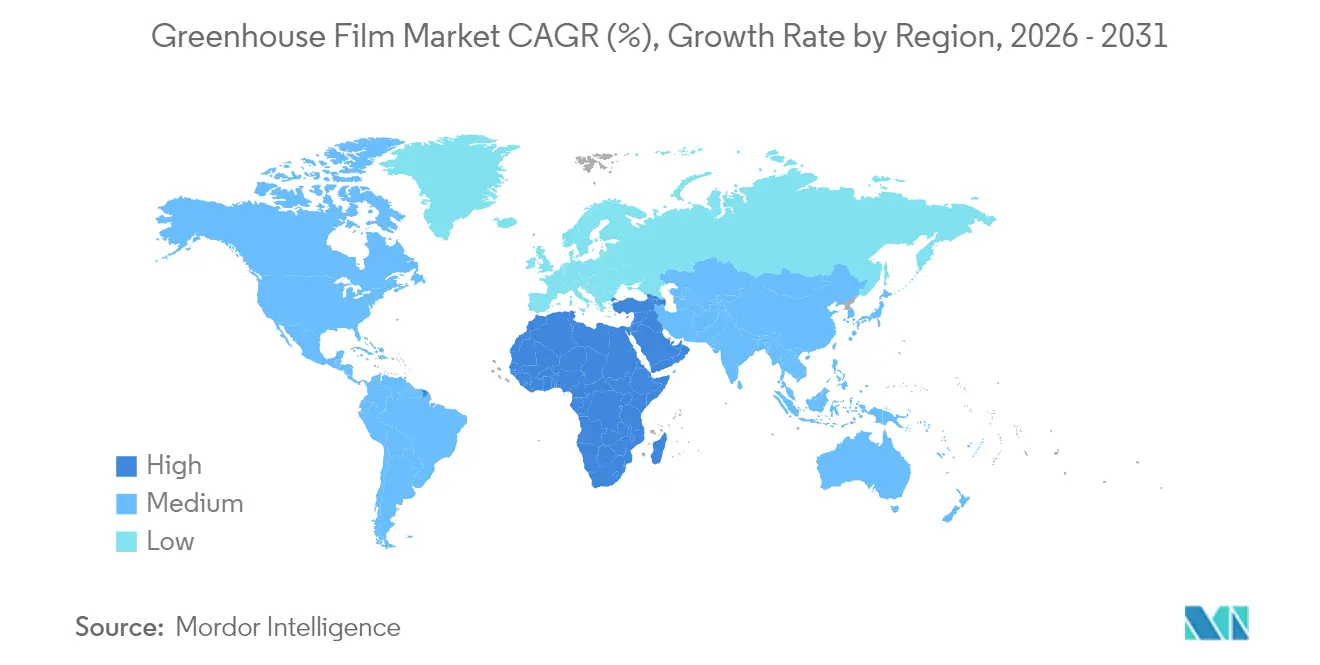
| Fastest Growing Market | Middle East and Africa |
| Largest Market | Asia Pacific |
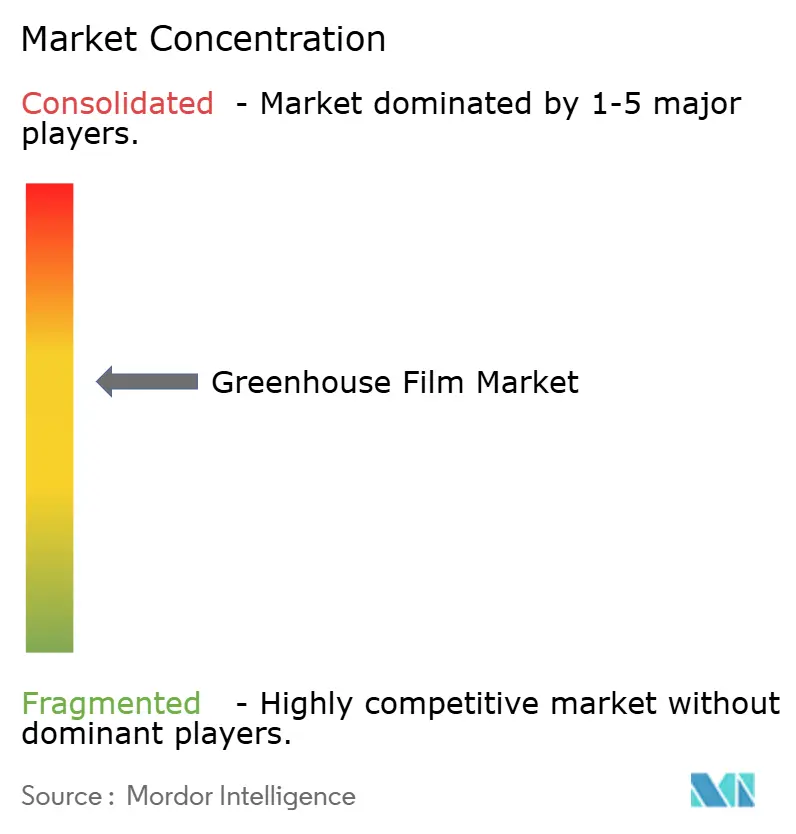
| Market Concentration | Medium |
Major Players *Disclaimer: Major Players sorted in no particular order Image © Mordor Intelligence. Reuse requires attribution under CC BY 4.0. | |
Greenhouse Film Market Analysis by Mordor Intelligence
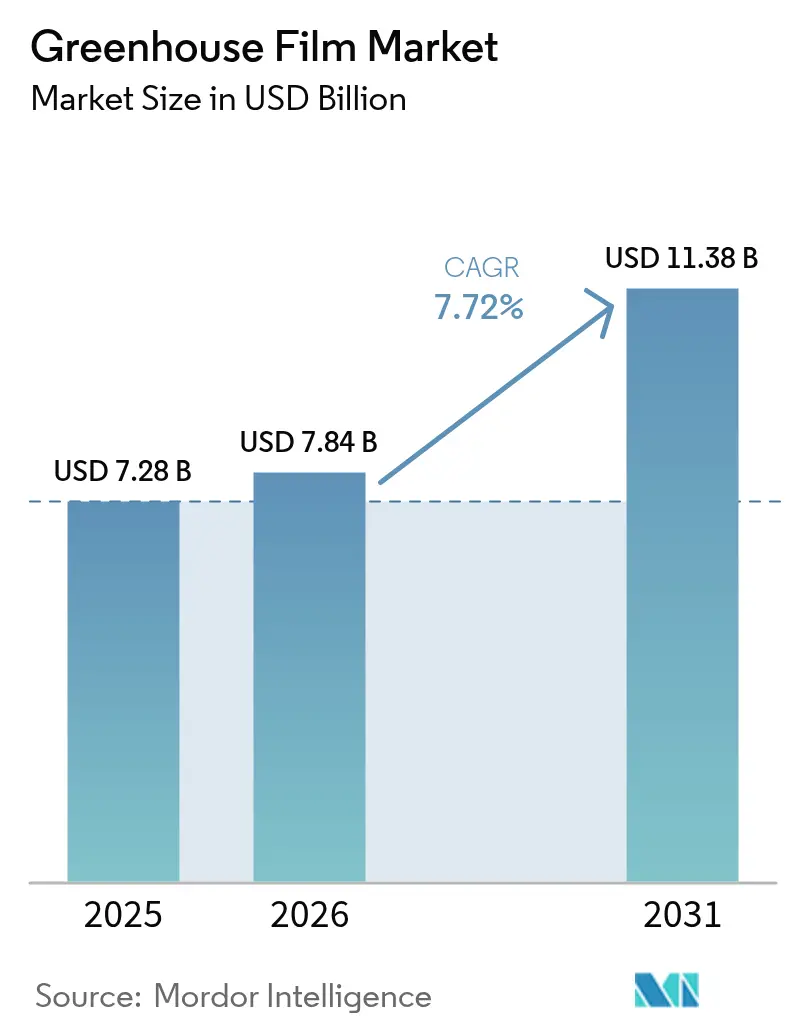
The Greenhouse Film market size is expected to grow from USD 7.28 billion in 2025 to USD 7.84 billion in 2026 and is forecast to reach USD 11.38 billion by 2031 at 7.72% CAGR over 2026-2031. Growth rests on the rising need for controlled-environment agriculture that shields crops from erratic weather, secures local supply chains, and supports year-round production. Demand accelerates as multilayer polyethylene films with UV stabilizers and spectral-shifting additives raise yields while lowering energy costs. Asia-Pacific keeps its lead on the strength of large-scale installations in China, India’s expanding protected-cultivation programs, and competitive regional resin supply. North America and Europe maintain technology leadership through investments in durable films that integrate sensors, antimicrobial compounds, and recycling-ready resins.
Key Report Takeaways
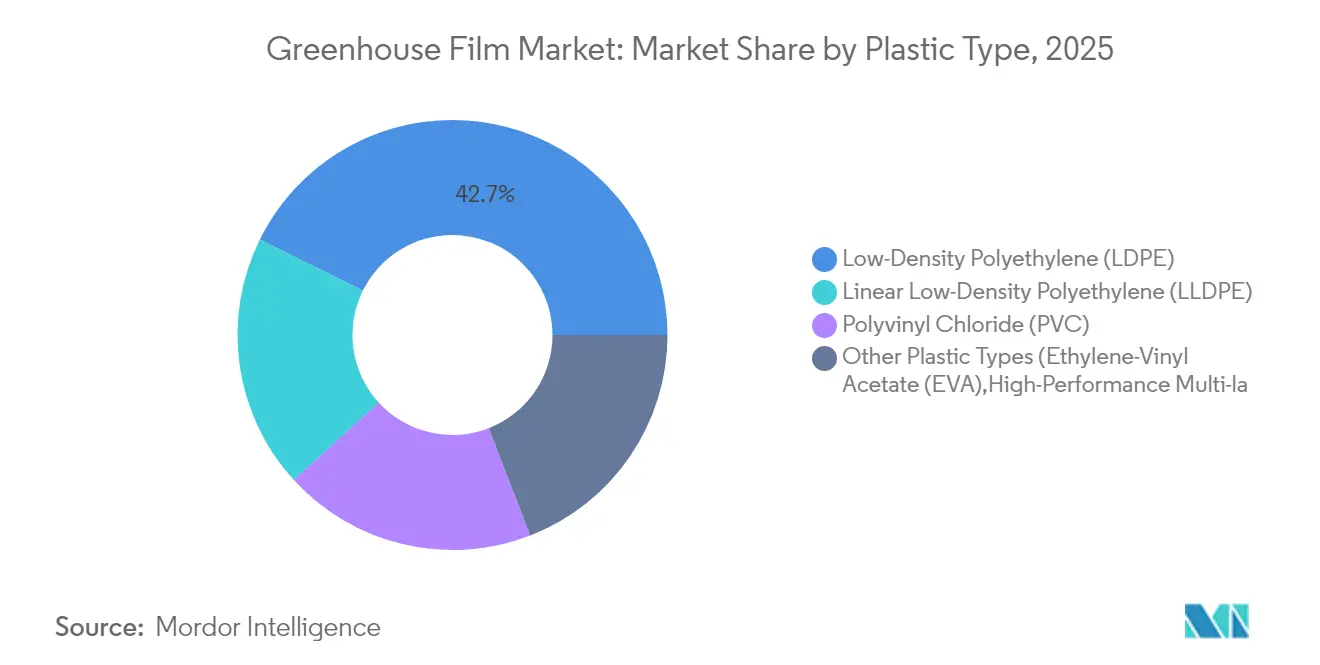
- By plastic type, Low-Density Polyethylene held a 42.68% greenhouse film market share in 2025, while high-performance “Other” plastics are set to grow at 8.61% CAGR to 2031.
- By thickness, films below 200 microns captured 46.88% of the greenhouse film market size in 2025; thicker films above 200 microns are forecast to expand at 8.33% CAGR through 2031.
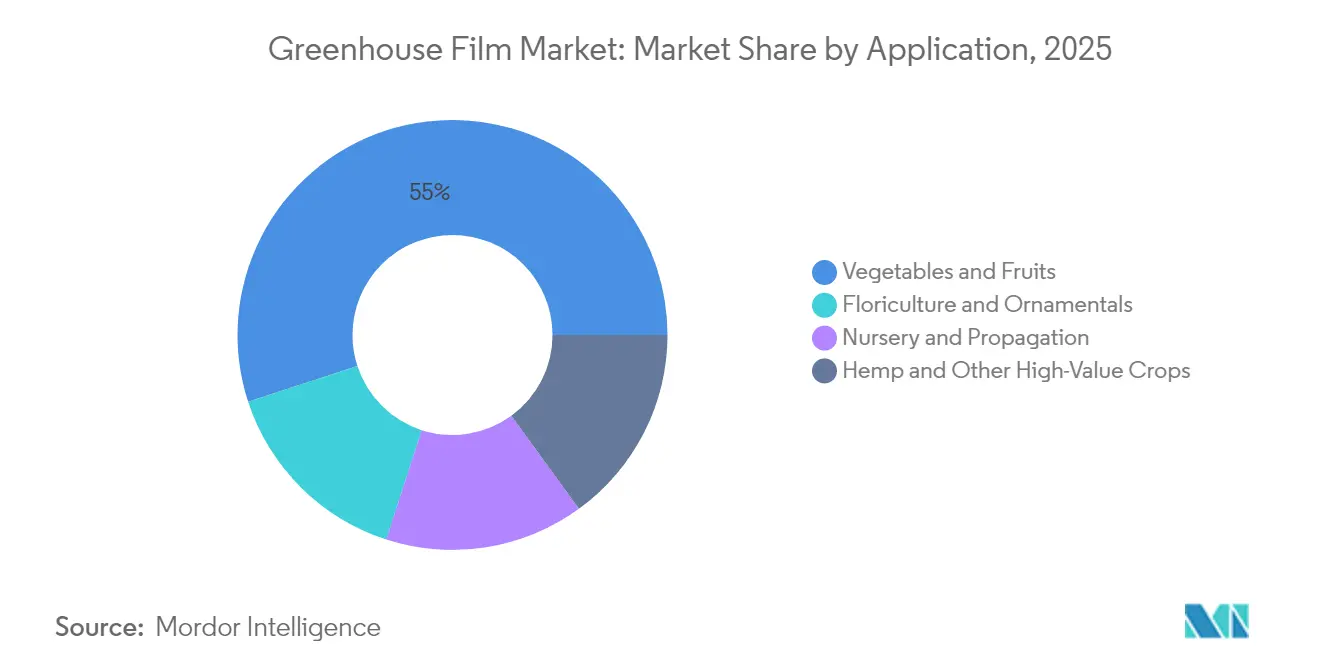
- By application, fruits and vegetables commanded 55.02% revenue share of the greenhouse film market in 2025; hemp and other high-value crops post the fastest CAGR at 8.74% to 2031.
- By geography, Asia-Pacific accounted for 48.40% of global revenue in 2025, while the Middle East & Africa segment is projected to register an 8.42% CAGR to 2031.
Note: Market size and forecast figures in this report are generated using Mordor Intelligence’s proprietary estimation framework, updated with the latest available data and insights as of 2026.
Market Trends and Insights
Drivers Impact Analysis of Greenhouse Film Market*
| Driver | (~) % Impact on CAGR Forecast | Geographic Relevance | Impact Timeline |
|---|---|---|---|
| Rising demand from fresh-produce supply chains | +2.1% | Global, with concentration in North America & EU | Medium term (2-4 years) |
| Expansion of greenhouse-protected cultivation acreage | +1.8% | APAC core, spill-over to MEA | Long term (≥ 4 years) |
| Surge in controlled-environment agriculture investments | +1.5% | North America & EU, emerging in APAC | Short term (≤ 2 years) |
| Integration of luminescent spectral-shifting films | +0.9% | Global, early adoption in advanced markets | Medium term (2-4 years) |
| Adoption of antiviral and antimicrobial PE film additives | +0.7% | Global, accelerated in post-pandemic markets | Short term (≤ 2 years) |
| Source: Mordor Intelligence | |||
Rising demand from fresh-produce supply chains
Retailers and food-service operators prioritize supply continuity by locating greenhouses closer to urban centers. Proximity curbs freight costs, trims spoilage, and supports consumer expectations for traceable produce. Rabobank notes that Canadian and U.S. growers expanded vegetable greenhouse floor space by double digits in 2024. Crop yields are 15–30% higher than comparable field production, and shelf-life gains cut retailer waste—benefits that reinforce long-term contracts between growers and major grocers.
Expansion of greenhouse-protected cultivation acreage
Global protected-cultivation surface now exceeds 1.3 million ha, with China alone holding 60.4% of total area. Government subsidies for plastic-house construction in India, Vietnam, and Morocco lower adoption barriers for small farmers and spur local food security programs. Greenhouses show up to 90% water-use savings over open-field cultivation, a critical feature in arid Asia and MEA regions where water scarcity threatens staple food supplies.
Surge in controlled-environment agriculture investments
Venture capital and corporate investors injected more than USD 800 million into greenhouse hardware and automation startups during 2024. Hippo Harvest raised USD 21 million to scale robotic micro-greenhouses, while Ridder Drive Systems earmarked USD 70 million for climate-control and automation platforms. Funding accelerates R&D in advanced resins, thin-film coatings, and IoT-ready greenhouse envelopes that lower labor inputs and energy bills.
Integration of luminescent spectral-shifting films
Spectral-shifting layers convert UV/blue photons into red wavelengths that plants use more efficiently. Nature Food reports yield boosts above 20% in lettuce when luminescent films replace standard polyethylene covers[1]. Quantum-dot films demonstrate comparable tomato yields with lower daily light integral, allowing operators to downsize supplemental lighting loads. Fiber-coupled concentrators tested in commercial trials funneled 10% extra photosynthetically active radiation into lower canopies, delivering a 7% production lift in vine crops.
Restraints Impact Analysis of Greenhouse Film Market*
| Restraint | (~) % Impact on CAGR Forecast | Geographic Relevance | Impact Timeline |
|---|---|---|---|
| Short functional life versus rigid glazing sheets | -1.2% | Global, particularly in harsh climate regions | Medium term (2-4 years) |
| Escalating plastic-waste regulations and ESG pressures | -0.8% | North America & EU, expanding globally | Long term (≥ 4 years) |
| Volatile ethylene and EVA feedstock pricing | -0.6% | Global, concentrated in Asia-Pacific production | Short term (≤ 2 years) |
| Source: Mordor Intelligence | |||
Short functional life versus rigid glazing sheets
Single-layer LDPE films typically demand replacement every 3–5 years, adding downtime labor and waste-management costs. Multilayer co-extrusion and UV-block additives now stretch service life to 7–10 years under temperate conditions, yet rigid polycarbonate or glass panels still last 15–20 years. Operators weigh lower up-front costs against higher lifetime replacement cycles, especially in hail-prone or high-UV regions. The market responds with thicker (>200 micron) films that combine tensile strength with improved light diffusion, narrowing the durability gap.
Escalating plastic-waste regulations and ESG pressures
California’s extended producer responsibility law and the EU’s Packaging & Packaging Waste Regulation assign end-of-life costs to manufacturers. Berry Global boosted post-consumer recycled polyethylene usage by 36% in 2024 and targets 30% circular content across film lines by 2030[2]. Dow-Mitsui Polychemicals rolled out biomass-derived EVA and LDPE grades with ISCC PLUS certification to help greenhouse operators meet Scope 3 emission goals without sacrificing film performance. Research into fully degradable urea-formaldehyde/PVA composites shows promise for low-residue mulch and tunnel covers.
*Our forecasts treat driver/restraint impacts as directional, not additive. The impact forecasts reflect baseline growth, mix effects, and variable interactions.
Greenhouse Film Market Segment Analysis
By Plastic Type:
Premium Materials Gain on LDPE’s Scale AdvantageLow-Density Polyethylene remains the cornerstone of the greenhouse film market, accounting for a 42.68% 2025 share. Global resin capacity, ease of extrusion, and proven toughness keep LDPE price-competitive for multi-hectare greenhouses. The greenhouse film market size for LDPE based covers is projected to advance in lockstep with refurbishment cycles, yet cost instability tied to ethylene feedstock leaves margins thin for processors. Other plastic types—chiefly multilayer EVA copolymers, polyolefin blends, and nanocomposite laminates—are on an 8.61% CAGR trajectory through 2031. EVA’s higher clarity, adhesive compatibility, and elasticity enable thicker coatings that cut replacement frequency while accommodating smart-film sensor grids. Graphene-reinforced EVA laminates improved electrical conductivity by an order of magnitude in lab tests, opening routes to in-film heating or data transmission functions. This performance premium underpins broader adoption in high-value specialty crop houses willing to pay for longer life and greater yield gains.

By Thickness:
Thin Films Dominate, Thick Films AccelerateFilms under 200 microns secured 46.88% of 2025 demand because they stretch over large spans, admit maximum light, and minimize resin usage. Their prevalence is higher in climates with mild wind loads and subsidy programs that offset frequent re-covers. The greenhouse film market size for this thickness bracket remains large; however, shorter lifespans raise total ownership costs where extreme heat or hail is common. Films above 200 microns are projected to post an 8.33% CAGR as growers in North America, MEA, and Northern China shift to thicker, UV-stabilized membranes to reduce downtime. Co-extruded five-layer products combine diffuse inner layers with IR-barrier outer layers that cut nighttime heat loss by 15%, trimming fuel bills. Higher puncture resistance also supports automated venting systems that flex covers repeatedly without tearing.
By Application:
Traditional Produce Dominates, Hemp Leads UpsideFruits and vegetables held 55.02% of revenue in 2025, reflecting entrenched supply chains for tomatoes, peppers, cucumbers, and leafy greens. Multi-span hydroponic complexes in Spain’s Almería basin and China’s Shandong province rely on cost-effective LDPE films to feed European and Asian supermarkets. The greenhouse film market size linked to this crop cluster scales with urban demand for pesticide-free, locally-sourced salads. Hemp and other high-value crops represent the breakout segment, forecast at 8.74% CAGR to 2031. U.S. industrial and cannabinoid hemp output benefits from controlled-environment yields that exceed open-field harvests by 2-3 cycles per year, with research showing cannabinoid concentration gains under precise photoperiod regimes. Specialty growers invest in EVA or multilayer PO films with superior light diffusion and odor control to maximize floral biomass and active compound production.
Geography Analysis
APAC Greenhouse Film Market
Asia-Pacific’s 48.40% greenhouse film market share in 2025 stems from China’s 2 million ha greenhouse footprint and competitive resin production clusters. Government grants and low-interest loans under India’s Pradhan Mantri Krishi Sinchayee Yojana support a gradual shift from open-field vegetables toward protected cultivation. Japan and South Korea emphasize high-end film imports with anti-fog and IR-blocking layers to meet premium produce standards.
North America and Europe Greenhouse Film Market
North America and Europe form a mature, regulation-intensive bloc that champions recyclable and recycled-content films. U.S. growers added 19% more greenhouse farms between 2012 and 2017 as retailers embraced “grown-near-me” sourcing models, and the trend is expected to continue through compact modular greenhouse projects. European operators deploy diffused-light covers combined with cogeneration heating systems to offset high energy tariffs, positioning thick multilayer films as part of their carbon-reduction strategies.
MEA Greenhouse Film Market
The Middle East & Africa segment is set for an 8.42% CAGR. Solar-rich Gulf states subsidize climate-controlled houses that pair IR-reflective roofs with photovoltaic canopies, conserving water while leveraging abundant sunlight. In East Africa, over 250 vegetable houses erected in Somalia demonstrate how modular designs can displace imports, create jobs, and stabilize local prices. South Africa and Morocco pursue export-oriented berry production, relying on UV-curable EVA films that tolerate high ultraviolet indices without yellowing.
Regulatory Landscape
Regulation is tightening around agricultural plastics through packaging rules, extended producer responsibility (EPR), and performance standards that affect film design and end-of-life obligations. In Europe, the Packaging and Packaging Waste Regulation (EU) 2025/40 entered into force in February 2025, with primary obligations applying from August 12, 2026. This timetable is pushing suppliers to document recyclability and align product labeling with the European Commission's delegated and implementing acts under development during 2026. Separately, CEN published EN 13206:2025 (August 2025) to standardize dimensional, mechanical, optical, and thermal requirements for thermoplastic covering films used in agriculture and horticulture. That standardization supports harmonized claims and procurement specifications across the region.
Outside Europe, stewardship programs are shifting from voluntary collection to mandatory schemes. New Zealand's Ministry for the Environment confirmed in December 2025 that it is moving to draft regulations for a mandatory Rural Recycling Scheme covering farm plastics, including bale wrap and silage sheets, indicating rising expectations for agricultural film recovery systems. Across the value chain, correct product classification is becoming more important under evolving rules. European Commission guidance and FAQs issued in March 2026 clarified exclusions from PPWR packaging definitions for certain industrial process films when they function as enablers in manufacturing cycles, increasing the need for clear documentation on intended use and lifecycle responsibilities.
Value Chain Analysis
The greenhouse film value chain starts with petrochemical and polymer producers supplying LDPE, LLDPE, EVA and specialty polyolefin resins, followed by additive and masterbatch suppliers offering UV stabilizers, anti-fog/anti-drip, IR barrier, antimicrobial, and spectral-shifting packages. Film converters then co-extrude or laminate mono- to multilayer structures, often five-layer designs, to improve durability and thermal performance. Distribution typically runs through greenhouse constructors, agricultural input dealers, and direct-to-grower programs linked to protected-cultivation projects, while downstream buyers specify thickness, optical properties, and service life based on local climate loads, heating costs, and crop value.
Logistics and input-cost volatility remain a key constraint, particularly where resins or finished films are imported. In April 2026, reports from Morocco's Souss Massa region described supply strain linked to Red Sea and broader Middle East disruptions, with greenhouse film price increases cited for both imported and locally produced material. These effects highlight exposure to shipping lanes such as the Suez corridor and the knock-on impact on project economics. At the same time, the innovation layer of the chain is expanding through branded technology films and IP-backed formulations, including spectrum-shifting diffuse covers (commercial launches reported in 2026) and patent activity around thermicity and anti-drip designs, which raises the importance of qualified additive supply, process control, and technical service support for growers.
Competitive Landscape
The greenhouse film market features a moderately concentrated field where the top five suppliers control roughly 50% of global volume. Vertically integrated resin-to-film majors such as Berry Global and RKW Group secure feedstock, extrusion capacity, and distribution in one chain, safeguarding margins during ethylene price swings. Specialty players carve niches through antimicrobial or luminescent technology licensing.
Strategic moves skew toward horizontal expansion: RKW’s buyout of Danafilms broadened its North-American footprint and added blown-film expertise for thick covers. Berry Global and Amcor entered an all-stock merger in January 2025 aiming for USD 650 million in synergies and a global R&D pool of USD 180 million. The deal pools circular-economy assets, including Berry’s Tulsa Circular Innovation Center and Amcor’s film recycling trials, to accelerate PCR-rich greenhouse cladding lines.
Greenhouse Film Industry Leaders
-
RKW Group
-
Polifilm
-
Ginegar
-
Berry Global Inc.
-
Armando Alvarez Group
- *Disclaimer: Major Players sorted in no particular order
Greenhouse Film Market Companies Covered in this Report
- Agripolyane
- Armando Alvarez Group
- Beijing Kingpeng International Hi-Tech Corporation
- Berry Global Inc.
- Charu Agroplast Pvt Ltd
- Essen Multipack Limited
- Exxon Mobil Corporation
- Ginegar
- SHOUMAN COMPANY
- Lumite, Inc.
- Plastika Kritis SA
- Polifilm
- RKW Group
- TCT (Thai Charoen Thong Karntor Co. Ltd)
- Trioworld
Market Opportunities and Future Outlook
Compliance-driven redesign and traceable end-of-life pathways create whitespace for film suppliers that can provide standard-aligned, recycling-compatible structures while maintaining optical and thermal performance. In Europe, EN 13206:2025 offers a technical anchor for procurement and performance claims, and PPWR 2025/40 timelines, with major obligations applying from August 12, 2026, increase urgency around documentation, labeling readiness, and portfolio rationalization toward simpler, mechanically recyclable constructions. This regulatory momentum also aligns with industry initiatives that promote National Collection and Recycling Schemes (NCRS) as a practical model for agricultural plastics circularity, giving resin-to-film players and converters a basis to differentiate through take-back partnerships, certified recycled-content offerings, and design-for-recycling architectures.
Technology-led differentiation is also creating premium openings where growers pay for higher yields, lower energy use, and longer service life. Evidence from 2026 includes commercial activity around advanced light and heat management, such as Ondex launching a diffuse covering that shifts light spectrum, and iyris with Grupo Armando Alvarez scaling OASIS SecondSky coverings for temperature reduction. Material positioning is also expanding in high-performance categories, including ETFE-based greenhouse films marketed for long service life. On the supply side, localized manufacturing investment supports faster lead times and tailored product mixes, illustrated by SPR (Armando Alvarez Group) initiating operations at a Texas facility producing specialized agricultural films using ExxonMobil Signature Polymers resins, which supports availability for high-spec greenhouse covers and reduces reliance on import lanes exposed to disruption.
Recent Industry Developments in Greenhouse Film Market
- April 2026: SPR (Armando Alvarez Group) initiated operations at a new Texas manufacturing facility to produce specialized agricultural films, including greenhouse covers, using ExxonMobil Signature Polymers resins. The added local capacity supports shorter lead times and product customization for North American growers and greenhouse builders. It also signals continued investment in higher-spec agricultural film portfolios rather than commodity-only output.
- July 2025: Uzbekistan, working with China, announced plans to begin producing smart greenhouse films designed to regulate internal temperatures, based on nano-composite particles developed by the Uzbekistan Academy of Sciences Institute of Materials Science. The concept converts ultraviolet radiation into near-infrared to generate thermal energy and stabilize greenhouse conditions. This adds competitive pressure on conventional polyethylene covers by pushing heat-management functionality into the film layer.
- January 2024: Plastika Kritis developed the Sunmaster EVO AC greenhouse polyethylene film using nanotechnology to enhance anti-drip and anti-mist performance. The company positioned the film as retaining anti-condensate properties across its stated four-year lifespan, addressing a common degradation issue in conventional covers. The development highlights ongoing differentiation through additive and surface-engineering approaches that reduce crop losses and improve light transmission consistency.
Greenhouse Film Market Report Scope and Research Methodology
Market Definition and Coverage
This market covers the value of plastic films used as greenhouse coverings that help manage light, heat, and humidity for protected cultivation, and it is sized as revenues generated from film sales across major producing and consuming regions.
Scope exclusions: Glass greenhouse panels, rigid polycarbonate sheets, shade nets, irrigation parts, greenhouse structures, and installation labor are excluded from this sizing.
Segments Covered in This Report
- By Plastic Type
- Low-Density Polyethylene (LDPE)
- Linear Low-Density Polyethylene (LLDPE)
- Polyvinyl Chloride (PVC)
- Other Plastic Types (Ethylene-Vinyl Acetate (EVA),High-Performance Multi-layer, etc.)
- By Thickness (Micron)
- Less than 200
- Equal to 200
- Greater than 200
- By Application
- Vegetables and Fruits
- Floriculture and Ornamentals
- Nursery and Propagation
- Hemp and Other High-Value Crops
- By Geography
- Asia-Pacific
- China
- India
- Japan
- South Korea
- ASEAN Countries
- Rest of Asia-Pacific
- North America
- United States
- Canada
- Mexico
- Europe
- Germany
- United Kingdom
- France
- Italy
- Spain
- Russia
- NORDIC Countries
- Rest of Europe
- South America
- Brazil
- Argentina
- Rest of South America
- Middle East and Africa
- Saudi Arabia
- South Africa
- Rest of Middle East and Africa
- Asia-Pacific
Data Sources, Market Sizing, and Validation
Desk Research
Desk work started with a clear map of where greenhouse films sit inside agricultural plastics, followed by a check on how much protected cultivation is expanding by country. Public sources such as FAOSTAT, World Bank indicators, UN Comtrade trade statistics, and national agriculture ministries were used to understand greenhouse area trends, crop intensity, and import patterns for polymer films and resins.
We also reviewed sources such as USDA and Eurostat releases for horticulture and greenhouse activity signals, along with peer reviewed papers on film life, UV stabilization, and replacement cycles. Company annual reports, investor presentations, association websites, and reputed trade press were used to cross-check product mix shifts like multilayer structures and light-diffusion grades. Where needed, we referenced paid subscriptions for company financials and intelligence, and shipment-level import-export data to validate directional movement. These examples are not exhaustive, and many other sources were also reviewed for data collection, validation, and clarification.
Primary Interviews and Surveys
Primary discussions were run with film manufacturers, resin and additive participants, converters, distributors, and large greenhouse operators to confirm demand drivers and real purchasing behavior. Since the market is global, interviews were balanced across APAC, EMEA, and the Americas to test assumptions around replacement cycles, thickness preferences, and pricing moves that do not move the same way across regions.
children are empty by design per schema, and the respondent split is shown in the table below.
Distribution of primary research fieldwork respondents
| Company type | Respondent position | Region |
|---|---|---|
| Top tier: 29% | CXOs: 17% | APAC: 44% |
| Mid tier: 51% | Functional/Unit leaders: 36% | EMEA: 37% |
| Smaller Players: 20% | Managers: 47% | Americas: 19% |
Market-Sizing & Forecasting
Sizing begins with a top-down build that reconstructs the demand pool from protected cultivation footprint and the practical film consumption per unit area, then converts that into value using region-specific pricing. To keep the model grounded, results are corroborated with selective bottom-up approximations, such as roll-ups from sampled supplier volumes by region, distributor channel checks, and an ASP multiplied by estimated replacement volume. Those comparisons are then used to adjust totals where gaps show up.
Key inputs included greenhouse area expansion by country, film replacement cycle by climate and crop intensity, typical thickness bands used for different greenhouse types, resin and additive cost movement that influences pricing, and the shift toward longer-life and multilayer films that changes average selling price. In markets where area data was not clean, we used trade flows of film-related categories and expert-provided penetration assumptions to fill the missing link, and we kept those assumptions visible for review.
For forecasting, scenario analysis was applied around two practical levers, greenhouse area growth and replacement rate, and then checked against expected resin cost direction and adoption of premium functional films. Where primary experts showed disagreement, we kept conservative ranges and used follow-up calls before locking the final curve.
Data Validation & Update Cycle
Validation is handled through step-by-step triangulation across the model outputs, trade and production signals, and what primary respondents described as realistic purchasing volumes. Outliers are investigated at country and regional level, and assumptions are re-checked when price and volume trends move in opposite directions without a clear reason.
Before sign-off, the work goes through multiple analyst reviews, and we re-contact sources when a key input like replacement life or pricing changes materially from the first pass. Reports are refreshed annually, and interim updates are made when material events occur, such as major resin price swings, policy changes related to plastics, or a demand shock in protected cultivation. Right before delivery, a fresh review pass is completed so clients receive the latest updated view.
Mordor Intelligence's Greenhouse Film Market Size Versus Other Published Estimates
Published market sizes for greenhouse film do not always match because the boundary of what is counted can shift, and because pricing and replacement assumptions are not handled the same way across studies. Differences also show up when the base year is not aligned, or when currency timing is applied at different points in the forecast.
The biggest drivers tend to be whether adjacent agricultural films are mixed into the total, how long films are assumed to last in hot climates versus mild climates, and how fast average selling prices are escalated as multilayer and functional grades grow. Some estimates also lean on aggressive adoption curves for protected cultivation expansion, while others use slower scenarios that are not always reconciled back to area and trade signals.
Benchmark comparison
| Source | Market Size | Gaps in Research Methodology |
|---|---|---|
| Mordor Intelligence | USD 7.84 B (2026) | |
| Global Consultancy A | USD 8.77 B (2026) | Often applies faster price uplift into the forecast and may assume shorter replacement life uniformly across regions, which lifts annual demand volume and the implied ASP line. |
| Industry Research House B | USD 7.59 B (2024) | Uses an earlier base year and can understate later-year value if resin-driven price inflation and premium film mix shift are not fully carried forward into the current-year sizing. |
The table shows a tight spread, and in Mordor Intelligence's model the total is built around greenhouse covering films only, with thickness and application-level replacement cycles used to avoid pulling in broader agricultural film categories. When scope, replacement life, and the timing of price changes are kept explicit, the resulting number stays traceable to area, usage, and price inputs that a reader can follow and re-check.
Key Questions Answered in the Report
What is the current Greenhouse Film Market size?
The greenhouse film market is valued at USD 7.84 billion in 2026 and is projected to reach USD 11.38 billion by 2031.
Which plastic type dominates greenhouse film demand?
Low-Density Polyethylene leads with a 42.68% share in 2025 thanks to its cost-effectiveness and proven durability in large installations.
Which application segment is expanding fastest?
Hemp and other high-value crops are forecast to grow at 8.74% CAGR through 2031 due to legalization trends and premium cannabinoid yields in controlled environments.
How are sustainability pressures influencing product innovation?
Manufacturers are increasing recycled content, launching biomass-based resins, and designing recyclable multilayer structures to comply with emerging regulations and brand ESG commitments.