
Market Overview
| Study Period | 2020 - 2031 |
|---|---|
| Forecast Data Period | 2026 - 2031 |
| Base Year Market Size (2025) | USD 34.63 Billion |
| Market Size (2026) | USD 37.88 Billion |
| Market Size (2031) | USD 59.23 Billion |
| Growth Rate (2026 - 2031) | 9.38 % |
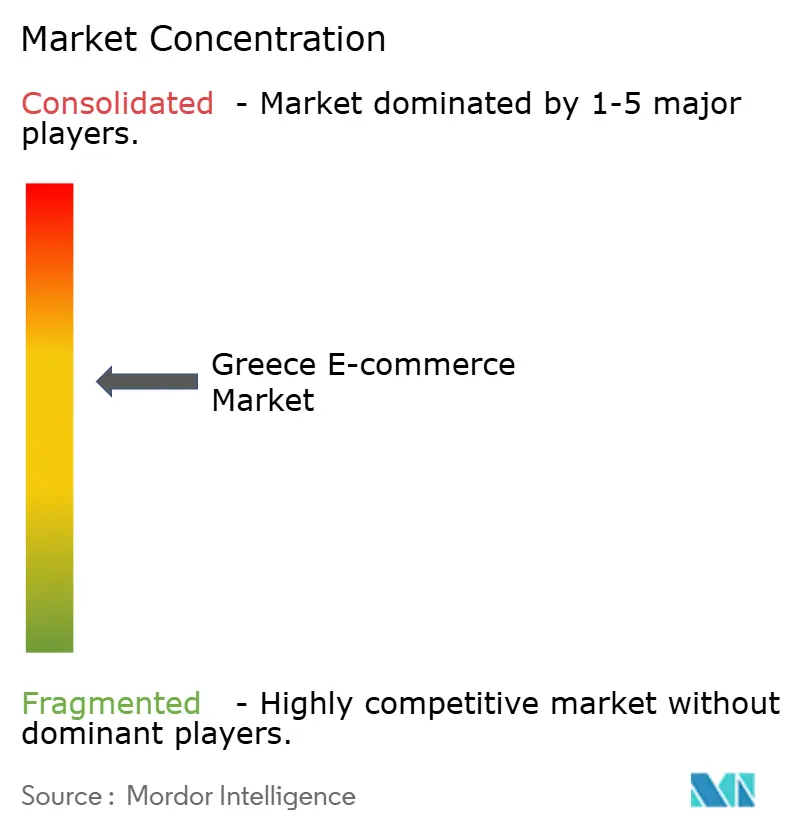
| Market Concentration | Medium |
Major Players *Disclaimer: Major Players sorted in no particular order Image © Mordor Intelligence. Reuse requires attribution under CC BY 4.0. | |
Greece E-commerce Market Analysis by Mordor Intelligence
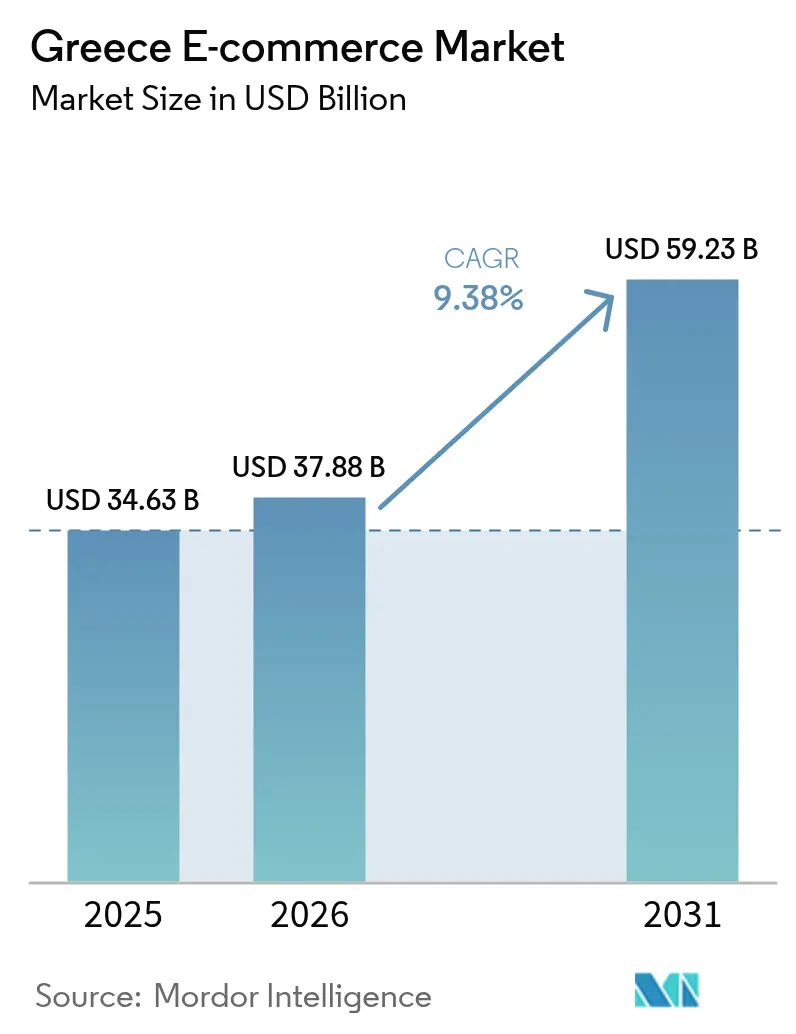
The Greece e-commerce market size was valued at USD 34.63 billion in 2025 and estimated to grow from USD 37.88 billion in 2026 to reach USD 59.23 billion by 2031, at a CAGR of 9.38% during the forecast period (2026-2031). Rising 5G coverage, decisive government digitalization policies, and a marked shift in consumer habits toward online shopping are accelerating this growth. Mobile transactions now dominate order volumes, and omnichannel models with click-and-collect options are reshaping service expectations. Cross-border demand from tourists is opening premium revenue streams, while last-mile locker networks are shortening delivery times and lifting customer satisfaction. Merchants that invest in mobile-first design, frictionless payments, and data-driven personalization are best placed to capture share in the Greece e-commerce market as traditional retail stagnates.
Key Report Takeaways
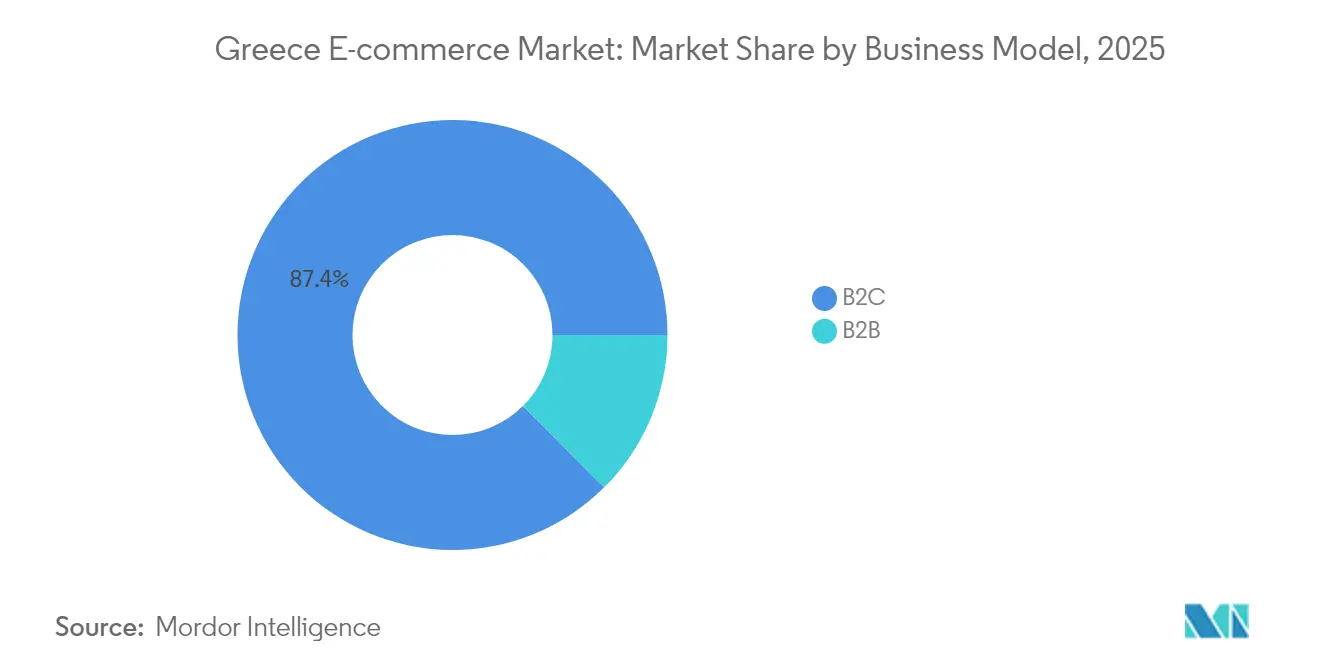
- By business model, the B2C segment led with 87.44% of the Greece e-commerce market share in 2025, while B2B is forecast to post a 12.35% CAGR through 2031.
- By device, smartphones captured 64.71% of transactions in 2025; other connected devices are projected to expand at a 12.74% CAGR to 2031.
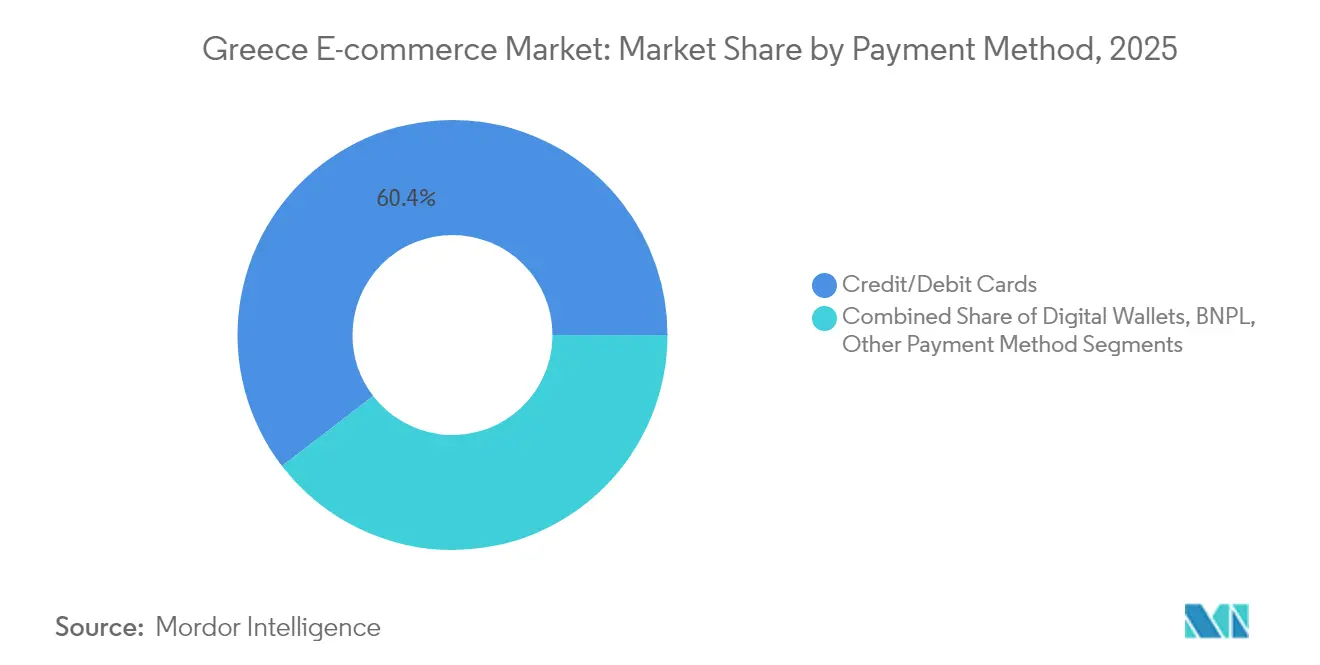
- By payment method, cards accounted for 60.42% of transaction value in 2025, whereas digital wallets are projected to grow at a 13.65% CAGR through 2031.
- By product category, food & beverages commanded 26.88% of the Greece e-commerce market size in 2025, and beauty & personal care is advancing at a 11.92% CAGR over the forecast period.
Note: Market size and forecast figures in this report are generated using Mordor Intelligence’s proprietary estimation framework, updated with the latest available data and insights as of 2026.
Greece E-commerce Market Trends and Insights
Drivers Impact Analysis*
| Driver | (~) % Impact on CAGR Forecast | Geographic Relevance | Impact Timeline |
|---|---|---|---|
| Surge in Mobile Shopping Driven by Widespread 5G Roll-out in Urban Greece | +2.5% | Urban centers (Athens, Thessaloniki), with gradual expansion to secondary cities | Medium term (2-4 years) |
| Government's "Digital Bible" Tax Incentives Accelerating SME On-boarding | +1.8% | National, with higher adoption in commercial hubs | Medium term (2-4 years) |
| Rapid Growth of Omnichannel Click-and-Collect Services | +1.5% | Urban centers and tourist destinations | Short term (≤ 2 years) |
| Tourism-Led Luxury Spend Propelling Cross-Border Orders | +1.2% | Tourist destinations (Athens, islands), luxury retail corridors | Short term (≤ 2 years) |
| Expansion of Last-Mile Locker Networks Cutting Delivery Times Less Than 24 h | +0.9% | Urban centers, with planned expansion to secondary markets | Medium term (2-4 years) |
| Rising Adoption of BNPL Among Greek Gen-Z Shoppers | +0.7% | National, with concentration among younger demographics | Medium term (2-4 years) |
| Source: Mordor Intelligence | |||
Surge in Mobile Shopping Driven by Widespread 5G Roll-out
Fifth-generation networks now cover 86% of Greek urban areas, enabling high-resolution images, livestream demos, and instant in-app payments that keep shoppers on handheld devices for longer sessions.[1] Retailers prioritise thumb-friendly page layouts, biometric login, and accelerated checkouts because mobile constitutes the majority of visits and revenue in the Greece e-commerce market. Delivery fleets integrate GPS tracking into apps, letting customers follow couriers in real time, which raises satisfaction and repeat purchase rates. Advertisers run location-aware push campaigns that convert footfall into digital traffic within minutes of store exposure. As network coverage extends to secondary cities by 2027, incremental users will deepen penetration across the Greece e-commerce market.
Government’s “Digital Bible” Tax Incentives Accelerating SME On-boarding
The 200% super-deduction for qualified digital expenses lowers entry costs for small merchants and creates a predictable payback period for web-store investments.[2] Uptake has been strongest in electronics and fashion micro-retailers that previously relied on neighbourhood foot traffic. Cloud providers and payment gateways are bundling discounted packages to align with the subsidy rules, further easing adoption. Regional chambers of commerce report improved digital skills after the government funded targeted training courses. As more SMEs list products online, inventory variety on domestic marketplaces rises, encouraging consumers to consolidate spending within local platforms and boosting the Greece e-commerce market.
Rapid Growth of Omnichannel Click-and-Collect Services
Seven leading retailers now synchronise store and online stock in real time, letting buyers reserve items online and collect within hours. This model addresses concerns about delivery reliability in dense urban areas and mitigates last-mile costs.[3] Early adopters are recording lower return rates because customers can inspect goods before leaving the store. Retailers use in-store pickup to cross-sell complementary products, lifting average transaction values. Real-estate owners benefit from higher footfall, creating a virtuous loop that entrenches omnichannel fulfilment within the Greece e-commerce market.
Tourism-Led Luxury Spend Propelling Cross-Border Orders
Foreign arrivals outstrip 2019 levels, and affluent visitors often continue purchasing Greek luxury items after returning home. Brands have introduced duty-paid shipping options and multilingual after-sales support to capture these repeat orders. Dedicated microsites highlight Greek provenance, leveraging cultural narratives to differentiate from global competitors. Partnerships with hotel concierges and cruise operators steer travellers to curated digital storefronts. This cross-border activity injects premium margins and diversifies demand beyond the domestic base.
Restraints Impact Analysis*
| Restraint | (~) % Impact on CAGR Forecast | Geographic Relevance | Impact Timeline |
|---|---|---|---|
| High Return Rates in Fashion Category Eroding Profitability | -1.2% | National, with higher impact in urban centers | Medium term (2-4 years) |
| Persistent Preference for Cash-on-Delivery Elevating Costs | -0.9% | National, with stronger effect in rural areas and islands | Medium term (2-4 years) |
| Fragmented Logistics Across Islands Raising Fulfilment Complexity | -0.7% | Island regions, particularly smaller Aegean islands | Long term (≥ 4 years) |
| Inflation-Induced Down-trading Limiting Average Order Values | -0.5% | National, with pronounced effect on lower-income segments | Short term (≤ 2 years) |
| Source: Mordor Intelligence | |||
High Return Rates in Fashion Category Eroding Profitability
Return levels near 30% strain working capital, warehouse throughput, and sustainability targets. Size uncertainty and colour mismatch remain the top triggers, prompting retailers to pilot augmented-reality fitting rooms that overlay garments on user images. Some platforms reward shoppers who keep items with loyalty points, nudging behaviour while protecting margins. Courier firms are offering discounted reverse-logistics bundles to large merchants, yet smaller sellers bear higher per-unit costs. The issue underscores the importance of accurate product data and predictive sizing algorithms in protecting profitability across the Greece e-commerce market.
Persistent Preference for Cash-on-Delivery Elevating Costs
COD still dominates low-value orders outside metropolitan areas, imposing cash-handling costs and higher failed-delivery rates. Card-on-delivery terminals are a transitional fix, but merchants incur fee premiums for portable POS devices. Government digital-literacy campaigns and real-time bank transfer schemes are slowly shifting behaviour, yet trust barriers remain. Platforms emphasise buyer-protection guarantees and instant refunds to encourage prepaid methods. Until COD declines below critical mass, fulfilment budgets will carry a structural cost penalty.
*Our forecasts treat driver/restraint impacts as directional, not additive. The impact forecasts reflect baseline growth, mix effects, and variable interactions.
Segment Analysis
By Business Model: B2C Dominates While B2B Gains Momentum
The B2C segment generates 87.44% of the Greece e-commerce market. Widespread mobile literacy, secure payment rails, and rich product content make online retail the default for electronics, groceries, and fashion. Consumer expectations for free returns and next-day delivery continue to climb, pressuring margins yet widening addressable demand. In contrast, B2B online procurement is valued lower today but is forecast to expand at a 12.35% CAGR as enterprises digitise sourcing and seek volume discounts through electronic catalogues. Government subsidies for SME digital platforms reduce the payback period for suppliers, and corporate buyers increasingly integrate e-invoicing, which streamlines reconciliation. Consequently, B2B will represent a rising share of the Greece e-commerce market size across the forecast window.
Large wholesalers adopt punch-out catalogues to interface with enterprise resource planning systems, cutting manual order entry. Freight forwarders negotiate dynamic pricing by pooling B2B volumes, improving delivery reliability to regional warehouses. Marketplaces are onboarding industrial supplies, safety equipment, and raw materials, moving beyond office stationery. Digital credit assessment tools shorten supplier onboarding cycles, while embedded financing options support bulk purchases. The interplay of automation and financing innovation positions B2B as a structural growth lever inside the Greece e-commerce market.

By Device Type: Mobile Sets the Standard for User Experience
Smartphones account for 64.71% of transaction value in 2025. Retailers optimise imagery compression and biometric authentication to keep checkout within two taps. Push notifications with personalised promotions drive repeat traffic during off-peak hours, smoothing server loads. Larger screen real estate on foldable devices encourages higher average order values for furniture and electronics. Other connected devices, including wearables and voice-enabled home assistants, grow from a low base at a 12.74% CAGR as consumers embrace ambient commerce. Laptops remain relevant for complex B2B orders requiring detailed specification comparison, supporting a balanced device mix within the Greece e-commerce market.
5G edge computing supports augmented reality overlays that preview furniture in real scale through mobile cameras, improving conversion. Retailers integrate low-code app builders to iterate features rapidly and align with evolving OS guidelines. In-app wallets autofill loyalty points, while context-aware chatbots resolve queries without redirecting to desktops. These user-experience advancements reinforce mobile’s primacy and anchor the Greece e-commerce market size gains attributed to handheld devices.
By Payment Method: Digital Wallets Challenge Card Leadership
Cards hold a 60.42% share in 2025 online spend. Strong dispute-resolution frameworks and widespread merchant acceptance underpin this position. Digital wallets, however, post a 13.65% CAGR, propelled by single-click authentication, integrated rewards, and biometric security. Younger cohorts prefer wallet apps linked to debit instruments, trusting device fingerprint sensors over card data entry. BNPL modules embedded within wallets raise conversion on discretionary categories, while instant bank transfers close settlement cycles for merchants. Cash-on-delivery, though declining, serves risk-averse first-time shoppers, particularly beyond large urban areas, prolonging payment method diversity across the Greece e-commerce market.
Payment processors invest in tokenisation to minimise fraud, lowering chargeback ratios. Loyalty coalitions integrate airline miles and grocery points into wallet ecosystems, encouraging repeat usage. Regulatory frameworks such as PSD2 mandate strong customer authentication, which wallets satisfy via facial recognition, giving them a compliance edge. Merchants weigh interchange fees against wallet incentives as they design checkout flows. These factors collectively reshape spending patterns and influence the Greece e-commerce market share of each payment method.
By B2C Product Category: Food & Beverages Retain the Lead
Food & beverages produced 26.88% of the Greece e-commerce market size in 2025. Quick-commerce operators promise delivery within 15 minutes in major cities, motivating basket consolidation and subscription upgrades. Grocers leverage dark stores near high-density zones to optimise picking efficiency. Meanwhile, beauty & personal care registers a 11.92% CAGR, buoyed by AI-based skin-analysis quizzes that generate tailored product bundles. Ethical ingredient sourcing seals customer loyalty among millennials who value transparency.
Consumer electronics sustain volume through flash-sale promotions that leverage real-time inventory feeds. Fashion faces margin headwinds from returns, prompting investment in 3D sizing guides. Home furnishings benefit from augmented reality staging and deferred-payment options. Toy and hobby segments peak during holiday seasons, supported by influencer-driven unboxing content. These dynamics illustrate the varied growth arcs that coexist under the Greece e-commerce market umbrella.
Geography Analysis
Athens and Thessaloniki contribute the majority of order volumes, supported by 86% 5G penetration and dense courier networks. Automated parcel machine availability remains below European norms, at 712,170 inhabitants per unit, yet expansion plans target a 50% improvement by 2027. Coastal and island regions lag due to fragmented logistics; nevertheless, tourism inflows drive premium sales in Mykonos, Santorini, and Crete, especially for luxury goods that tourists continue purchasing online post-departure. Rural mainland areas show rising adoption as digital literacy programs extend broadband and smartphone subsidies.
Cross-border commerce now accounts for 30% of Greek online shoppers, with Germany, Italy, and China ranking as top source markets. Harmonised EU VAT rules and the Digital Services Act are lowering administrative barriers, encouraging merchants to localise listings in multiple languages. Forwarders route parcels through regional hubs near Patras and Alexandroupoli ports, shortening inbound lead times. These improvements integrate Greece more tightly into the continental fulfilment grid, boosting overall resilience of the Greece e-commerce market.
Regional governments invest in road upgrades and cold-chain facilities to stimulate agricultural exports via e-commerce channels, diversifying rural income. The National Broadband Plan targets full fibre coverage for 90% of households by 2030, promising further uplift. Combined, these infrastructure and policy efforts position geography as both a challenge and an opportunity for scaling the Greece e-commerce market.
Regulatory Landscape
Greece e-commerce operators sit under a layered EU and national compliance stack that covers consumer protection, taxation, platform governance, and telecom oversight. Under the EU Digital Services Act (Regulation EU 2022/2065) as implemented nationally via Law 5099/2024, the Hellenic Telecommunications and Post Commission (EETT) serves as the Digital Services Coordinator, including oversight mechanisms for intermediary service providers operating in Greece. In parallel, businesses selling online must handle VAT and registration obligations (including via TAXISnet/myAADE), and EU mechanisms such as the VAT One Stop Shop matter for cross-border transactions.
Enforcement and compliance structures tightened with Law 5255/2025 (passed November 28, 2025), which established the Independent Authority for Market Control and Consumer Protection and consolidated market surveillance and consumer-protection functions. The change affects complaint handling, dispute resolution, and retailer obligations around fair commercial practices. On the transactional and public-sector side, mandatory B2G e-invoicing requirements for foreign economic operators require alignment with EN 16931 through the PEPPOL framework, reinforcing interoperability and auditability expectations that are increasingly relevant to B2B workflows.
Value Chain Analysis
The Greece e-commerce value chain starts with merchants and brands (from SMEs to large omnichannel retailers) and runs through marketplaces, storefront technology, payments, and compliance layers before reaching fulfilment and last-mile delivery. Local platforms such as Skroutz anchor product discovery and traffic aggregation, while international marketplaces (including AliExpress and Temu) intensify cross-border assortment and price competition. On the enabling side, payment acceptance (cards, wallets, and BNPL) and customer-service tooling link the front-end experience to conversion, while tax and reporting systems add required back-office integration.
Order execution relies on warehousing, picking, parcel linehaul, and last-mile networks that also have to serve island geographies, which increases cost pressure and service-variability risk versus mainland urban corridors. Compliance increasingly drives operational handoffs: Greece completed the final phase of mandatory B2G e-invoicing implementation in January 2025, and the e-transport document framework requires supply-chain data submission into myDATA, creating additional integration requirements across shippers, carriers, and sellers. Data-center and cloud capacity investment in Attica supports resilience for peak traffic and personalization, and it also underpins AI-enabled service operations tied to mobile-led commerce journeys.
Competitive Landscape
The market exhibits moderate concentration, with local platform Skroutz and international giants Amazon and Alibaba occupying the top tier. Local knowledge allows Greek marketplaces to curate region-specific assortments and offer cash-on-delivery, while global players deploy scale advantages in cross-border logistics and cloud infrastructure. Price competition in electronics and fashion is intense, pushing firms to differentiate through value-added services such as real-time order tracking, same-day delivery, and AI-driven product recommendations.
Strategic partnerships are proliferating. ACS collaborates with property managers to install parcel lockers in residential complexes, shrinking final-mile distances. Payment provider Viva Wallet integrates BNPL functionality directly into merchant checkouts, raising conversion among budget-conscious consumers. Retailers invest in augmented reality to lower fashion returns and protect gross profit. The emphasis on service quality reflects a shift from pure price wars to holistic customer-experience leadership within the Greece e-commerce market.
White-space opportunities remain in niche verticals such as gourmet foods and medical supplies, where incumbents lack specialised fulfilment capabilities. International entrants Temu and ABOUT YOU pursue aggressive discounting and sustainability labelling respectively, forcing incumbents to refine positioning. Continuous innovation and adaptive logistics models will determine long-term winners as the Greece e-commerce market evolves.
Greece E-commerce Industry Leaders
-
Skroutz S.A.
-
Kotsovolos (Dixons South-East Europe S.A.)
-
Plaisio Computers S.A.
-
RetailWorld S.A.
-
e-shop.gr
- *Disclaimer: Major Players sorted in no particular order
Market Opportunities and Future Outlook
Policy-backed digitalization creates whitespace for merchants and platforms that can scale compliance and onboarding. The national digital roadmap for 2026-2030 sets out 125 measures backed by EUR 6.1 billion in public funding alongside an estimated EUR 7 billion in private investment, supporting spend on merchant digitization, cloud services, cybersecurity, and interoperable invoicing and reporting. In April 2026, Joint Ministerial Decision 315/2026 created a Registry of Enterprises for the Provision of Digital Goods (eMarketplace) to manage digital voucher transactions and supplier accreditation, establishing a structured pathway for accredited e-commerce suppliers and platforms to participate in voucher-driven demand.
The tightening EU rulebook also opens room for specialized compliance-led offerings within the e-commerce stack. The Digital Services Act regime (with EETT as coordinator under Law 5099/2024) increases demand for marketplace governance tooling, trader traceability processes, and transparency reporting capabilities, while Law 5160/2024 implementing NIS2 raises cybersecurity requirements for covered entities and their digital supply chains. From August 2026, obligations under the EU Artificial Intelligence Act for organizations using AI systems (such as chatbots and dynamic pricing) increase demand for compliant AI deployment, documentation, and monitoring, favoring vendors and platforms that package risk controls into customer-facing automation rather than treating compliance as a separate back-office function.
Recent Industry Developments
- July 2026: Kotsovolos inaugurated its 7th store in the Thessaloniki region at the Mediterranean Cosmos retail center, extending its physical footprint alongside its e-commerce operations. The expansion supports omnichannel journeys such as click-and-collect and returns handling, which can reduce last-mile and reverse-logistics friction for online orders. It strengthens the retailer’s omnichannel integration and competitive presence in northern Greece.
- May 2026: Blackstone signed a definitive agreement to acquire a majority stake in Skroutz from CVC Capital Partners, with closing targeted for H2 2026. The transaction indicates major capital backing for Greece's leading local marketplace, with potential acceleration in logistics capabilities, merchant services, and cross-border competitiveness. It could reshape marketplace scale and service offerings in the Greek e-commerce landscape.
- November 2025: Law 5255/2025 established the Independent Authority for Market Control and Consumer Protection, consolidating market surveillance and consumer-protection functions and shaping retailer obligations and complaint-handling standards. The reform anchors a new enforcement posture that retailers must align with across online and offline channels.
Research Methodology Framework and Report Scope
Market Definition and Coverage
For this report, the Greece e-commerce market is defined as the value of goods and services purchased through online channels by buyers in Greece. It covers transactions routed through websites and mobile apps, and it includes both B2C and B2B activity.
Scope exclusions: this sizing excludes purely offline retail sales, even if orders are later supported by digital marketing or loyalty programs.
Segmentation Overview
- By Business Model
- B2C
- B2B
- By Device Type
- Smartphone / Mobile
- Desktop and Laptop
- Other Device Types
- By Payment Method
- Credit / Debit Cards
- Digital Wallets
- BNPL
- Other Payment Method
- By B2C Product Category
- Beauty and Personal Care
- Consumer Electronics
- Fashion and Apparel
- Food and Beverages
- Furniture and Home
- Toys, DIY and Media
- Other Product Categories
Data Sources, Market Sizing, and Validation
Desk Research
Desk research was used to set the outer boundaries of the market and anchor the model to Greece specific, measurable signals. We relied on public statistics and adoption indicators such as ELSTAT retail trade outputs, Eurostat household internet access and online shopping participation, and Bank of Greece payments statistics (card usage and online payment trends).
To pressure test directionally, we also reviewed sources including the Hellenic Telecommunications and Post Commission for telecom and broadband context, EU digital economy scoreboards for readiness indicators, and customs and trade releases when relevant for cross-border buying patterns. Company filings, investor presentations, and reputable business press were used to interpret category momentum and channel strategies. For hard-to-find financial line items and corporate activity timelines, we referenced paid databases for company financials and intelligence plus news and financials, and these inputs were used to validate assumptions rather than set the market total directly. These sources are illustrative rather than exhaustive, since other public documents and datasets were also used for data collection, validation, and clarification.
Primary Interviews and Surveys
Greece-based expert interviews and surveys cover merchants, marketplaces, logistics providers, payment specialists, and digital commerce managers. Their input helps test secondary turnover data, identify unreported cross-border orders, check mobile and wallet adoption, and refine category and average-order-value assumptions within the Greece market. Respondents are re-contacted when an answer conflicts with public indicators or the market model.
Distribution of primary research fieldwork respondents
| Company type | Respondent position |
|---|---|
| Top tier: 28% | CXOs: 15% |
| Mid tier: 47% | Functional/Unit leaders: 34% |
| Smaller Players: 25% | Managers: 51% |
Market-Sizing & Forecasting
The core model uses a top-down and bottom-up approach. First, macro retail and services spending is translated into an online demand pool for Greece using measurable penetration and usage indicators. Next, that demand pool is split into B2C and B2B, then shaped further using buying behavior observed in interviews (for example, how much of Electronics and Fashion is being bought online versus in-store).
In practice, a few market fingerprints drive the totals and the trend line, including internet and smartphone access, the share of consumers buying online, payment mix shifts (cards and digital wallets), delivery speed expectations that change conversion rates, and category level seasonality around promotions and holiday periods. We then corroborate the overall number with selective bottom-up checks, such as sampled order value by category multiplied by estimated order volumes from channel checks, and supplier and retailer revenue ranges where public reporting exists. Where bottom-up evidence is incomplete for smaller sellers, we use penetration based scaling and cross checks against retail turnover shares so the estimate is not overbuilt from a narrow sample.
For forecasting, scenario analysis was used because Greece e-commerce growth is sensitive to a small set of practical variables that can shift quickly, including consumer confidence, shipping costs, payment acceptance, and delivery capacity. The final forecast path was adjusted using consensus ranges obtained from industry experts on expected adoption speed, price inflation effects on average order value, and the pace of logistics improvement.
Data Validation & Update Cycle
Outputs were checked against independent signals before sign-off, including whether implied online spend per buyer aligns with adoption rates and whether category splits remain realistic versus what participants in Greece report. When a variance looked too large, we reviewed the underlying drivers again, and we re-contacted respondents selectively to confirm whether the change was real or a data artifact.
A multi-step analyst review is followed so assumptions, formulas, and currency handling are consistent across the historic period and the forecast. Reports are refreshed annually, and interim updates are triggered when material events occur, such as major regulation changes, step changes in payment adoption, or a visible shift in last mile capacity. Before delivery, we do a fresh pass on the latest public releases so clients receive the most current view possible.
Mordor Intelligence's Greece Ecommerce Market Size Versus Other Published Estimates
Published estimates for Greece e-commerce often differ because the underlying signals being measured are not always the same, and because some sources focus on consumer online purchases while others track broader transaction value flows. The year used, currency conversion timing, and whether the figure is revenue or GMV can also move the final number.
ELSTAT referenced online retail turnover, payment adoption trends, and category purchase behavior gathered in interviews, and these checks keep Mordor Intelligence's estimate tied to an actual Greece transaction pool, rather than a narrow retail-only view or a platform GMV-only view. Differences also show up when an estimate includes services heavily (travel, tickets, and on-demand) or excludes them, and when B2B online ordering is either counted as part of e-commerce or kept outside the headline number.
Benchmark comparison
| Source | Market Size | Gaps in Research Methodology |
|---|---|---|
| Mordor Intelligence | USD 34.63 B (2025) | |
| Trade Journal A | USD 19.82 B (2024) | This figure is based on consumer online purchases reported in EUR for 2024, and it can understate the market if B2B online ordering and some cross-border flows are not captured in the same way as a full e-commerce definition. |
| Industry Data Provider B | USD 9.83 B (2025) | This estimate is presented as e-commerce revenue or GMV in a narrower online retail lens, and it can run lower if services and non-retail categories are excluded or if the metric emphasizes platform GMV rather than total online transaction value. |
The table shows that the spread is mostly explained by what is being counted (retail turnover versus total online transaction value, and revenue versus GMV) and by which buyer group is included (consumer only versus consumer plus business). Our approach stays repeatable by linking the total to public adoption signals and then validating key assumptions through market interviews, which helps keep the final number consistent from year to year.
Key Questions Answered in the Report
What is the current value of the Greece e-commerce market?
The Greece e-commerce market is valued at USD 37.88 billion in 2026 and is on track to reach USD 59.23 billion by 2031.
Which segment of the Greece e-commerce market is growing the fastest?
The B2B segment records the highest forecast growth, expanding at a 12.35% CAGR as enterprises embrace digital procurement.
How important are mobile devices to online retail in Greece?
Smartphones account for 64.71% of 2025 transaction value, making mobile optimisation a strategic imperative for merchants.
What payment methods dominate Greek online shopping?
Cards lead with a 60.42% share, though digital wallets are gaining rapidly with a 13.65% CAGR expected through 2031.
Why are click-and-collect services expanding so quickly?
They address delivery reliability concerns, reduce last-mile costs, and create store traffic for cross-selling, contributing a +1.5% impact on market CAGR.
What logistical challenge is unique to the Greece e-commerce market?
Serving the many Aegean islands raises fulfilment complexity, contributing a –0.7% drag on forecast CAGR until infrastructure upgrades mature.