
Market Overview
| Study Period | 2020 - 2031 |
|---|---|
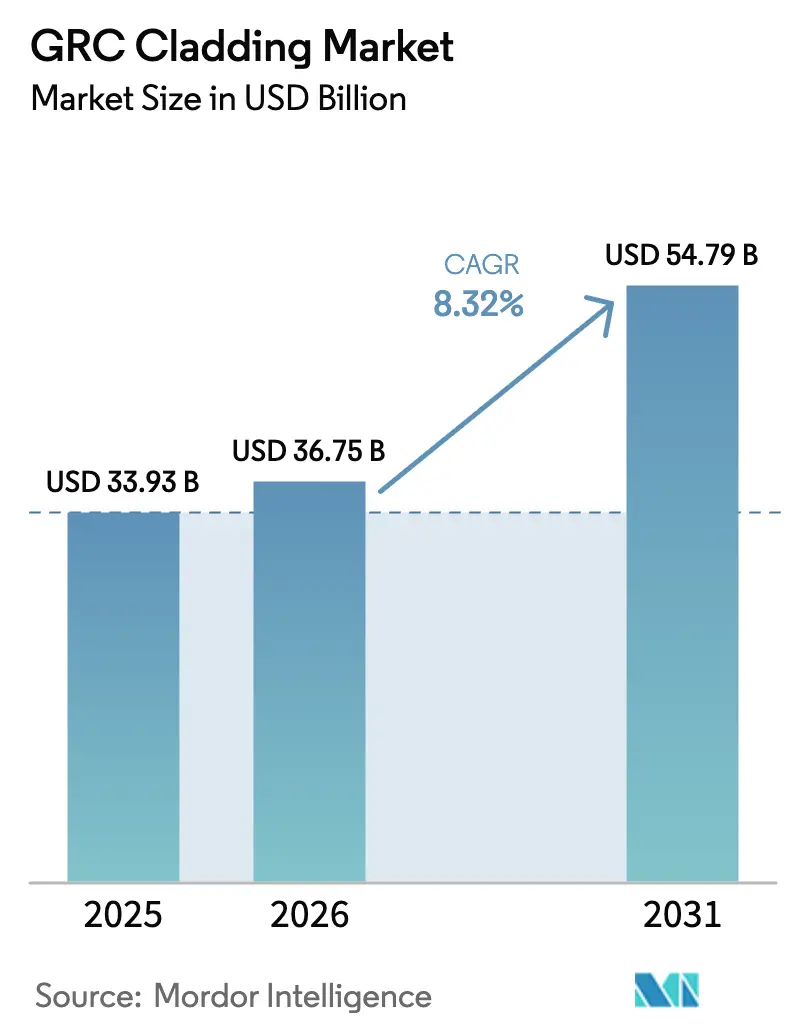
| Market Size (2026) | USD 36.75 Billion |
| Market Size (2031) | USD 54.79 Billion |
| Growth Rate (2026 - 2031) | 8.32 % |
| Fastest Growing Market | Middle East and Africa |
| Largest Market | Asia Pacific |
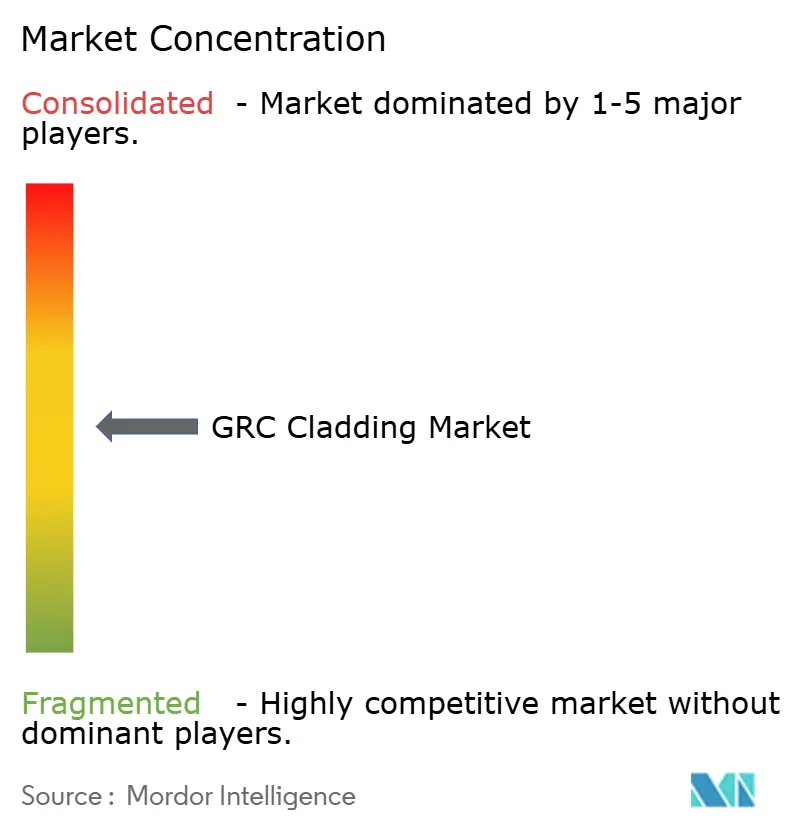
| Market Concentration | Medium |
Major Players *Disclaimer: Major Players sorted in no particular order Image © Mordor Intelligence. Reuse requires attribution under CC BY 4.0. | |
GRC Cladding Market Analysis by Mordor Intelligence
The GRC cladding market size is expected to grow from USD 33.93 billion in 2025 to USD 36.75 billion in 2026 and is forecast to reach USD 54.79 billion by 2031 at 8.32% CAGR over 2026-2031. Growing preference for lightweight, non-combustible façades, combined with tighter fire-safety rules, positions glass-reinforced concrete (GRC) as the go-to alternative where traditional precast panels prove too heavy or inflexible. Developers value the material’s one quarter weight advantage over concrete, which trims structural loads and shortens construction cycles. Investment flows into smart city projects across Asia-Pacific, rapid adoption of modular construction in the Middle East, and the pursuit of lower life-cycle costs in North America reinforce demand. Meanwhile, industry players accelerate low-carbon formulations to match emerging embodied carbon regulations, keeping the GRC cladding market on an innovation path.[1]https://www.wbdg.org/resources/seismic-safety-building-envelope.
Key Report Takeaways
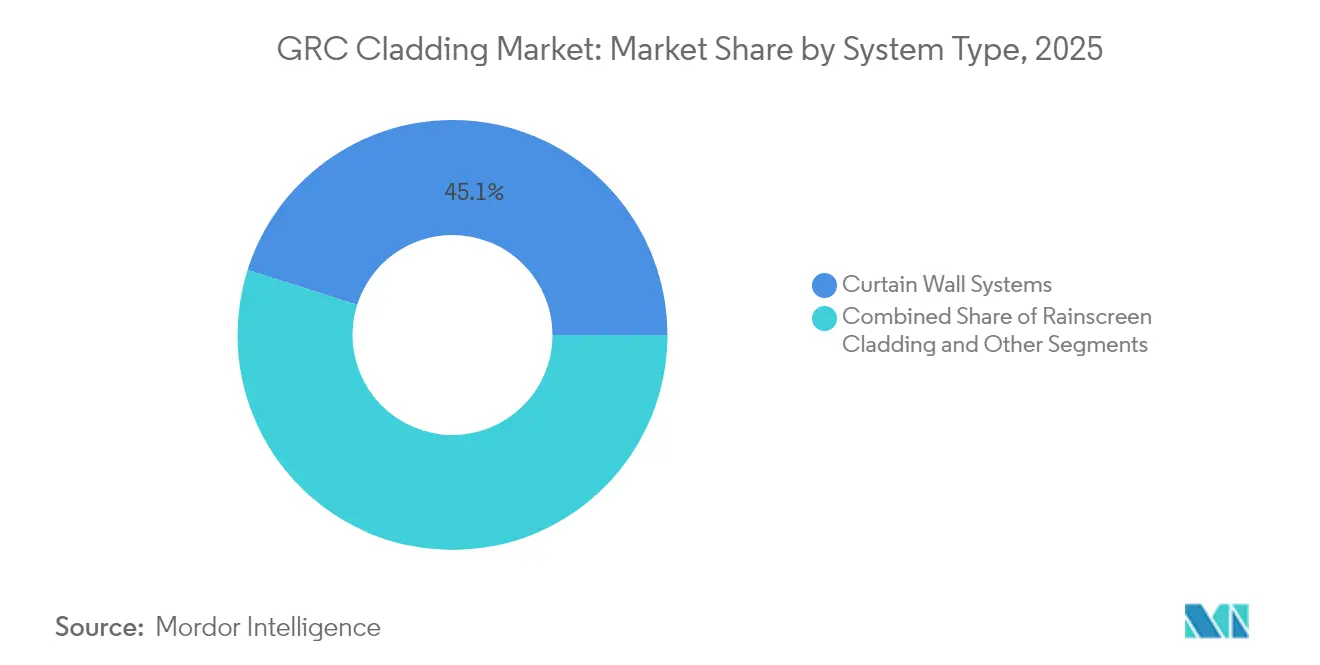
- By system type, curtain wall systems led with 45.12% revenue share in 2025 while the “Others” category primarily heritage skins and modular assemblies recorded the swiftest 9.12% CAGR through 2031.
- By application, commercial buildings controlled 51.88% of the GRC cladding market share in 2025; residential construction is poised to expand at a 9.74% CAGR to 2031.
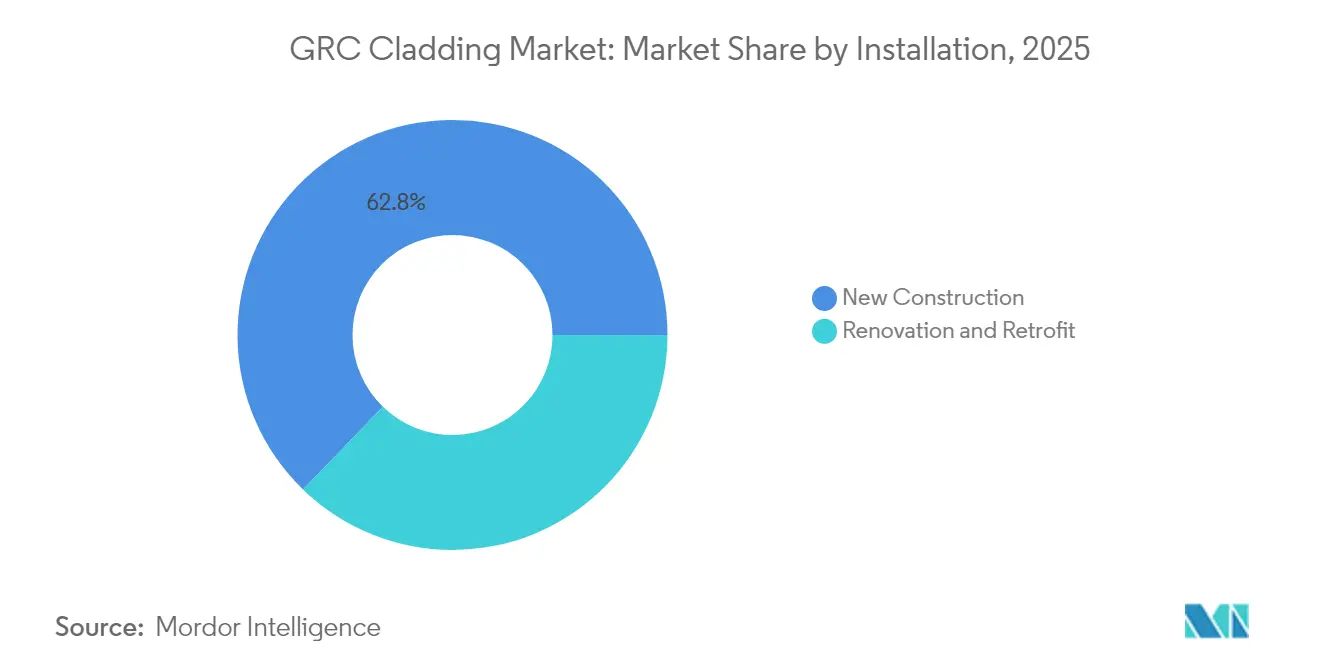
- By installation, new-build projects captured 62.76% of demand in 2025, whereas renovation and retrofit activity is advancing at the highest 9.76% CAGR as fire-safety remediation accelerates.
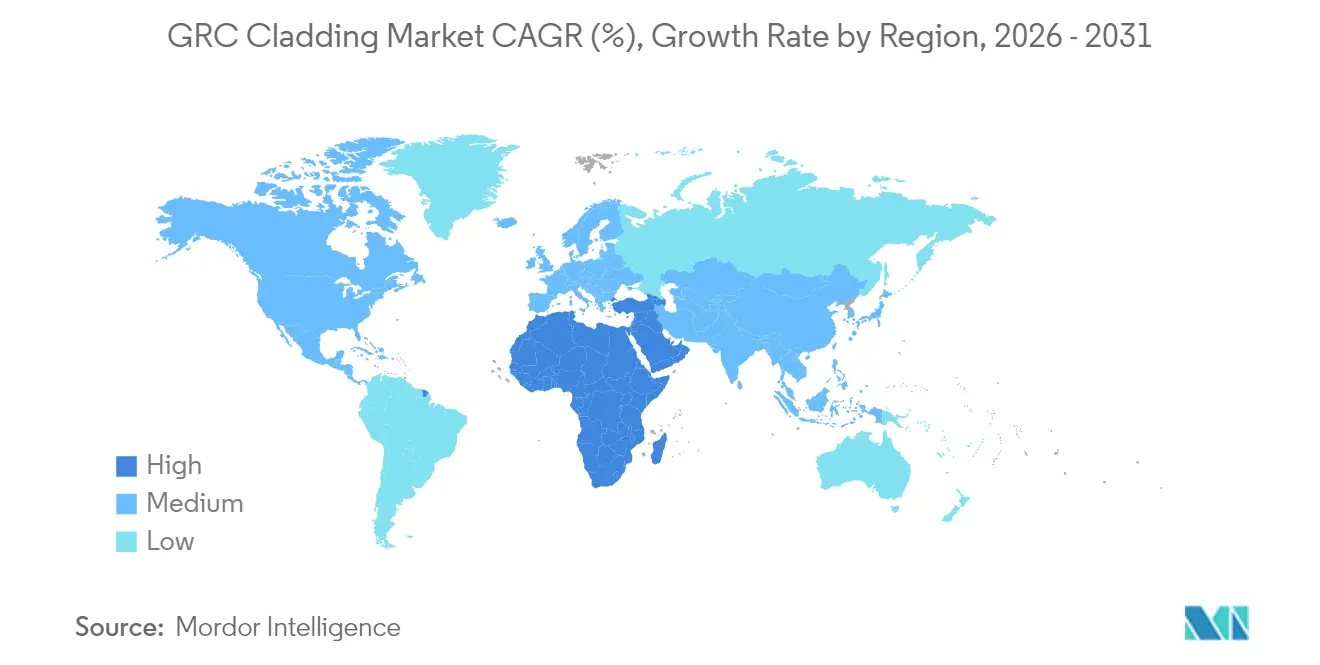
- By geography, Asia-Pacific dominated with 42.98% of 2025 revenues; the Middle East & Africa is growing the fastest at 9.71% CAGR to 2031.
Note: Market size and forecast figures in this report are generated using Mordor Intelligence’s proprietary estimation framework, updated with the latest available data and insights as of 2026.
Market Trends and Insights
Drivers Impact Analysis of GRC Cladding Market*
| Driver | (~) % Impact on CAGR Forecast | Geographic Relevance | Impact Timeline |
|---|---|---|---|
| Rapid urbanization & smart-city construction boom | 2.1% | APAC core, spill-over to MEA | Medium term (2-4 years) |
| High-rise demand for lightweight, high-strength facades | 1.8% | Global, concentrated in APAC & North America | Long term (≥ 4 years) |
| Stricter fire-safety & seismic codes for cladding | 1.5% | Australia, UK, North America with global adoption | Short term (≤ 2 years) |
| Superior durability & low life-cycle cost | 1.2% | Global | Long term (≥ 4 years) |
| Off-site modular construction uptake | 0.9% | North America & EU, expanding to APAC | Medium term (2-4 years) |
| Heritage façade retrofits using ultra-thin GRC skins | 0.3% | Europe, North America historic districts | Medium term (2-4 years) |
| Source: Mordor Intelligence | |||
Rapid Urbanization & Smart-City Construction Boom
Surging city populations across China, India, and Southeast Asia stretch local infrastructure and energize demand for high-performance façades. India’s construction GDP jumped 13.3% year-on-year in Q3 2024 as Smart Cities and Make in India initiatives funneled public spending into mixed-use towers and transit hubs. Municipal design codes increasingly reward energy-efficient envelopes, steering architects toward GRC assemblies that blend thermal mass, intricate form, and compatibility with building-integrated photovoltaics. China National Building Materials’ 15.14% 2024 revenue rise signals a durable appetite for innovative cladding across the region’s megaproject pipeline[2]https://www.tipranks.com/news/company-announcements/china-national-building-material-reports-strong-financial-growth-for-bnbm-in-2024. Beyond tier-one cities, developers in India’s secondary metros and Vietnam’s emerging industrial zones specify GRC cladding market solutions to speed project delivery without sacrificing aesthetics.
Stricter Fire-Safety & Seismic Codes for Cladding
Post-Grenfell regulation reshaped façade procurement. Victoria’s audit flagged more than 800 buildings for immediate remediation, fueling demand for non-combustible, test-certified panels. GRC passes NFPA 285 without extensive fire-stopping details, simplifying compliance for North American projects. Accredited UAE producers, guided by International Fire Consultants, now export to multiple jurisdictions, signaling global standardization. Governments from Australia to Canada plan staged bans on combustible façades, locking in a multi-year tailwind for the GRC cladding market.
Superior Durability & Low Life-Cycle Cost
Fifty-year service-life expectations, UV stability, and low water absorption minimize maintenance. Proven products such as Rieder’s concrete skin series require only periodic washing, sidestepping the repaint cycles that burden metal panels. Life-cycle studies show that after 15-20 years, total ownership cost undercuts alternatives once repainting, sealant renewal, or corrosion mitigation enter the equation. When supplementary cementitious materials like fly ash cut embodied carbon by up to 40%, owners satisfy durability and sustainability targets in one specification. These attributes solidify the GRC cladding market as a premium yet economical choice for long-term assets.
Heritage Façade Retrofits Using Ultra-Thin GRC Skins
Conservation architects deploy 12-15 mm panels to replicate historical stonework on Victorian, Beaux-Arts, and Art Deco landmarks without overloading aging substrates. European grant programs fund energy upgrades that pair ventilated GRC rainscreens with insulation, merging preservation with performance. Specialized fabricators command premium pricing by mastering custom molds and color-matched surface treatments. As municipalities expand retrofit incentives, the GRC cladding market gains a resilient niche in culturally sensitive districts.
Restraints Impact Analysis of GRC Cladding Market*
| Restraint | (~) % Impact on CAGR Forecast | Geographic Relevance | Impact Timeline |
|---|---|---|---|
| Higher upfront cost versus conventional concrete panels | -1.8% | Global, particularly price-sensitive markets | Short term (≤ 2 years) |
| Competition from low-cost metal composite cladding | -1.2% | Emerging markets, value-engineering projects | Medium term (2-4 years) |
| Cement and glass fiber prices are volatile | -0.9% | Global, supply-chain dependent regions | Short term (≤ 2 years) |
| Embodied carbon scrutiny of cementitious facades | -0.6% | Europe, North America with green building mandates | Long term (≥ 4 years) |
| Source: Mordor Intelligence | |||
Higher Upfront Cost Versus Conventional Concrete Panel
Sprayed GRC requires alkali-resistant glass fibers and skilled applicators, elevating material and labor premiums. Yet structural savings from lighter envelopes shrink the delta when the entire project economics are tallied. On geometrically complex facades curved or perforated GRC’s moldability often undercuts stone or custom metal, pushing owners back to the GRC cladding market after value-engineering exercises.
Competition from Low-Cost Metal Composite Cladding
Aluminum composite systems remain 40-60% cheaper in initial bids, especially where enforcement of fire codes lags. Insurance carriers, however, now surcharge combustible façades, eroding long-term savings. As governments roll out blanket bans, price-driven choice narrows, steering projects toward the GRC cladding market despite capital-cost sensitivity.
*Our forecasts treat driver/restraint impacts as directional, not additive. The impact forecasts reflect baseline growth, mix effects, and variable interactions.
GRC Cladding Market Segment Analysis
By System Type:
Curtain Wall Integration Drives ComplexityCurtain walls captured 45.12% of the GRC cladding market size in 2025, reflecting their prevalence on high-rise commercial facades where architects pair lightweight panes with generous glazing for a daylight strategy. The segment’s demanding tolerances and engineered anchors elevate barriers to entry, rewarding full-service manufacturers that offer design-assist and on-site technical crews. Rainscreen installations follow, leveraging GRC’s vapor permeability to manage condensation in humid zones, while ultra-thin heritage skins and modular units form the fastest-growing “Others” category at a 9.12% CAGR. Design offices increasingly explore perforated panels that double as solar-shading devices, and early prototype projects embed thin-film PV directly onto GRC substrates to create energy-positive façades.
In the longer-term outlook, the GRC cladding market sees system convergence, where hybrid curtain wall–rainscreen assemblies meet seismic, thermal, and acoustic goals in a single package. Manufacturers invest in digital twins and CNC mold production to serve bespoke geometry at scale. Engineering consultancies favor GRC over heavier concrete in hoist-restricted urban sites, and GRCA technical bulletins standardize testing to accelerate approvals. Sustainability mandates push for demountable curtain wall frames, enabling future material separation and recycling, a design ethos well matched to GRC’s cementitious recyclability.


By Application:
Commercial Dominance Faces Residential DisruptionCommercial buildings held 51.88% of the GRC cladding market share in 2025, propelled by corporate headquarters, life-science labs, and civic buildings where expressive facades reinforce brand identity. Reconfigurable molds and color-matched surface treatments deliver signature looks without artisan stone costs, keeping GRC on architects’ shortlists for statement atria and lobby extensions. Health-care and education facilities add institutional volume, seeking non-combustible skins that withstand heavy foot traffic and stringent hygiene standards.
Residential construction grows at a brisk 9.74% CAGR as mid-rise developers embrace factory-installed wall panels that abbreviate site schedules and limit neighborhood disruption. Modular apartment blocks in London’s regeneration districts and Tokyo’s infill sites already specify GRC as a standard module finish. Data-center operators, classified under “Others,” adopt GRC for fire-rated walls that also shield electromagnetic interference. With global hyperscale capacity projected to double by 2026, demand from this niche could outpace legacy institutional segments, enlarging the total GRC cladding market addressable base.
By Installation:
Retrofit Market Gains MomentumNew-build activity claimed 62.76% of the 2025 GRC cladding market size, supported by early integration of panelized envelopes into BIM workflows. Engineers optimize connection plates and story-height panels before groundbreaking, slashing rework and contingencies. Yet retrofit programs underpin the fastest 9.76% CAGR, propelled by mandatory replacement of combustible aluminum composites. In Australia, public funding offsets replacement costs, and specialty contractors offer turn-key swap-outs that keep occupants in place.
Heritage retrofits rely on ultra-thin GRC skins affixed over original masonry with stainless split-pins that preserve ventilation gaps. This approach raises thermal performance by 20-30% while honoring preservation charters. Retrofits also unlock embodied-carbon credits through life extension, appealing to investors tracking ESG metrics. As more insurance carriers refuse coverage for high-risk cladding, retrofit volumes could reach parity with new-build demand by the early 2030s, reshaping revenue allocation across the GRC cladding market.
Geography Analysis
APAC GRC Cladding Market
Asia-Pacific commanded 42.98% of 2025 revenue, underpinned by China’s megacity pipeline and India’s USD 1.4 trillion construction roadmap to 2025. Local producers such as CNBM scale output via automated spray lines and robotic trimming, shortening lead times for cross-border projects in ASEAN. Smart-city blueprints stipulate low-carbon façades and integrated renewables, dovetailing with evolving GRC panels that host PV laminates. Rising labor costs in coastal China push some fabrication toward Vietnam and Indonesia, broadening regional supply and intensifying price competition within the GRC cladding market.
MEA GRC Cladding Market
The Middle East & Africa records the highest 9.71% CAGR as Saudi Arabia’s NEOM, UAE’s cultural museums, and Egypt’s New Administrative Capital specify non-combustible façades resilient to 50 °C summers. Domestic champions in Oman and Qatar leverage GRCA membership to win public tenders, while European players partner locally to navigate import duties and heat-of-hydration challenges. New civil-defense codes promulgated in 2025 synchronize with NFPA 285, tightening envelope fire tests and elevating GRC’s risk-mitigation appeal.
North America and Europe GRC Cladding Market
North America and Europe exhibit lower but steady growth, driven by regulation over volume. U.S. jurisdictions adopt NFPA 285-based exceptions for non-combustible systems, simplifying approval of GRC rainscreens over traditional cavity-barrier layouts. Europe’s 2027 embodied-carbon ceiling accelerates low-clinker formulations as players seek Environmental Product Declarations to secure public-sector projects. Retrofit demand spikes in the UK, Ireland, and France, where combustible panels face legal removal deadlines, keeping order books robust across the mature yet lucrative GRC cladding market.

Regulatory Landscape
Regulation for GRC/GFRC cladding is shaped by fire-performance requirements and increasingly prescriptive material and production standards. In the United States, NFPA 285 testing is a common pathway for exterior wall assemblies, while California tightened technical referencing for GFRC under public-school and essential-facility oversight: the Division of the State Architect (DSA) IR 19-2 for the 2025 California Building Code (CBC) points GFRC panels to ANSI/PCI 128 (including the 2024 edition) for specification and acceptance. Standards such as ASTM C1666 for alkali-resistant glass fiber also anchor core material inputs and performance verification, along with test methods used in GRCA documentation (for example, ASTM C948 for absorption/density, ASTM C1230 for tensile behavior, and ASTM C1560 for accelerated aging).
Outside North America, European and international frameworks place more weight on factory production control and consistent conformity for glass-fiber reinforced cement products. BS EN 1169 is used as a reference point for factory production control for glass-fibre reinforced cement products, while EN 15422 is cited for alkali-resistant glass fibers in GRCA-aligned specifications. Across regions, GRCA guidance and Full Member quality systems (commonly aligned with ISO 9001) continue to influence project specifications and prequalification, particularly where owners and consultants require traceable testing, documented mix control, and repeatable panel performance for high-rise and retrofit work.
Value Chain Analysis
The GRC cladding value chain starts with upstream inputs such as white cement and supplementary cementitious materials, alkali-resistant glass fibers (commonly specified to ASTM C1666/EN 15422), admixtures and pigments, anchors and stainless-steel fixings, and mold-making materials. These move into specialized fabrication, typically via spray-up or premix manufacturing, followed by curing, trimming and finishing, and quality control against project and association specifications (for example, GRCA and ANSI/PCI 128 for GFRC panels). Midstream value is increasingly created through digital design-to-manufacture workflows, including BIM-driven detailing, CNC-routed molds, and factory production control that reduces variability on architecturally complex facades.
Downstream, the chain runs through logistics, site installation, and envelope commissioning, where tolerances, attachment engineering, and interface management with glazing, insulation, and air-water barriers drive delivered performance. Offsite integration is a key differentiator. Clark Pacific highlights factory-built facade delivery models that coordinate panel production with insulation application and window installation to reduce site labor and compress schedules. On the materials side, vertically integrated cement and distribution platforms also shape availability and responsiveness; UltraTech Cement, for example, couples cement capacity with more than 4,400 UltraTech Building Solutions outlets as of early 2025, supporting faster specification-to-supply cycles for cementitious facade and precast ecosystems in its served markets.
Competitive Landscape
The GRC cladding market remains moderately fragmented. The top five players account for roughly 35-40% of global revenue, while dozens of regional specialists fill domestic pipelines. European incumbents differentiate through color-consistent, through-pigmented skins and carbon-neutral formulations. Middle-East fabricators excel in supersized panel logistics, shipping 6 m-long units to desert megaprojects with integrated lifting lugs[4]https://www.grca.online/grca-memberships/full-members/zanette-srl. Asian producers emphasize cost efficiency, betting on high-volume residential towers to absorb capacity.
Technology shifts dictate competitive order. Firms deploying digitally driven mold routing can cut lead times by 25-30%, winning design-bid-build schedules that penalize delays. Adoption of three-dimensional glass-fiber weaves improves out-of-plane stiffness, permitting thinner panels with equal span capability and unlocking shipping savings. GRCA Full-Member certifications, renewed by several plants in January 2025, remain a hallmark of quality and influence specifier shortlists. Strategic exits underscore specialization pressures: Ibstock’s March 2025 withdrawal freed continental market share for Rieder and SigmaRoc’s cladding divisions. In April 2025, SigmaRoc sealed a partnership with Adaptavate to commercialize low-carbon wallboard chemistry that could migrate into GRC mixes, indicating cross-fertilization between façade and interior board technologies. Overall rivalry gravitates toward sustainability credentials, factory automation, and turnkey installation packages that lower total project risk for developers.
GRC Cladding Industry Leaders
Clark Pacific
Ultratech Cement Pvt Ltd
BB Fiberbeton
Sto Group
Rieder Group
- *Disclaimer: Major Players sorted in no particular order
GRC Cladding Market Companies Covered in this Report
- UltraTech Cement Ltd
- Clark Pacific
- BB Fiberbeton
- ASAHI BUILDING-WALL CO. LTD
- Willis Construction Co. Inc.
- Loveld
- Fibrobeton
- GB Architectural Cladding Products Ltd
- Ibstock Telling
- BCM GRC Limited
- Sto Group
- Rieder Group
- GRC UK Ltd
- Panel Systems Ltd
- Permastone
- Pennine Stone Ltd
- Delta Panels
- GRC Arabia
- EuroGRC
- FCP Pre-fabricados

Market Opportunities and Future Outlook
A near-term whitespace sits in assembly-level compliance and specifier confidence for non-combustible facades, where standardized GFRC specifications can shorten approvals and reduce rework. The 2025 California Building Code interpretation under DSA that points GFRC panels to ANSI/PCI 128 formalizes a clearer acceptance route for regulated projects, creating opportunities for manufacturers that can provide documented testing, traceable factory production control, and design-assist packages aligned to these references. Producers that pair GRCA-aligned QA with project-specific engineering (anchors, movement joints, and moisture management) have stronger traction in renovation and retrofit programs, where owners want predictable performance and faster permitting.
Execution-driven opportunities also appear in high-value building types that prioritize speed, fire performance, and envelope repeatability, notably healthcare, life sciences, and data centers. Clark Pacifics portfolio points to this shift: California medical and research facilities have used prefabricated facade approaches with integrated punched windows and custom GFRC framing, and a Nevada data center used offsite-manufactured insulated wall panels in late 2025, reflecting procurement pull for factory-delivered envelope scope. On the design side, landmark mixed-use developments such as Mission Rock in San Francisco show demand for complex textures and geometry that are more difficult to replicate with heavier precast, supporting premium applications where GRC is specified for both aesthetics and constructability.
Recent Industry Developments in GRC Cladding Market
- June 2026: Clark Pacific reported a major installation milestone for the UC Santa Barbara Infinite Facade project, noting final-panel progress for the prefabricated facade scope. The update reinforces the role of offsite-manufactured panel systems in accelerating envelope closure and lowering schedule risk on large institutional projects.
- April 2026: Clark Pacific highlighted the Mission Rock Building G facade system in the Spring edition of Ascent magazine, showcasing the architectural precast/GFRC approach used on a high-profile San Francisco development. Public visibility around executed complex geometry supports specifier confidence in GRC for signature commercial projects where form, fire performance, and constructability are evaluated together.
- March 2025: Ibstock announced a strategic withdrawal from GRC cladding to refocus on core masonry products. The move altered supplier options in parts of Europe and opened near-term share-capture room for remaining GRC fabricators and cladding divisions serving regulated facade replacement and new-build demand.


GRC Cladding Market Report Scope and Research Methodology
Market Definition and Coverage
This market covers the value of glass reinforced concrete (GRC) cladding used on building exteriors, including panels and facade elements supplied for new construction and for renovation and retrofit work.
Scope exclusions: It does not count full building construction value, general concrete work, or non-GRC facade materials such as metal, wood, vinyl, or glass-only curtain wall glazing.
Segments Covered in This Report
- By System Type
- Rainscreen Cladding
- Curtain Wall Systems
- Others
- By Application
- Residential
- Commercial
- Others
- By Installation
- New Construction
- Renovation & Retrofit
- By Geography
- North America
- United States
- Canada
- Mexico
- South America
- Brazil
- Argentina
- Chile
- Rest of South America
- Europe
- Germany
- United Kingdom
- France
- Italy
- Spain
- Rest of Europe
- Asia-Pacific
- China
- India
- Japan
- South Korea
- Australia
- Rest of Asia-Pacific
- Middle East & Africa
- United Arab Emirates
- Saudi Arabia
- South Africa
- Nigeria
- Rest of Middle East and Africa
- North America
Data Sources, Market Sizing, and Validation
Desk Research
Desk work starts by mapping where GRC cladding demand comes from and how it is typically specified in projects, and then tying that to construction activity and facade renovation cycles. We referenced public sources such as the US Census Bureau construction spending releases, Eurostat construction output, UN Comtrade trade statistics for relevant cement and fiber inputs, IEA buildings and energy efficiency trackers, and fire and building code publications that influence non-combustible facade choices.
To turn those signals into usable model inputs, we also reviewed company annual reports and investor presentations, project award news from reputed construction press, and association and standards-body pages that describe GRC use cases and performance expectations. A paid subscription source for company financials and a patent database were used selectively to cross-check supplier scale and product direction. The sources listed here are illustrative only, and many other public documents were used for data collection, validation, and clarification.
Primary Interviews and Surveys
Primary work was used to validate what desk research cannot show clearly, especially the typical project mix, replacement cycles, and how pricing moves with input costs and fabrication complexity. We spoke with a mix of manufacturers, fabricators, installers, facade consultants, and procurement roles across major construction regions so demand drivers and assumptions could be confirmed and adjusted before final totals were set.
Distribution of primary research fieldwork respondents
| Company type | Respondent position | Region |
|---|---|---|
| Top tier: 28% | CXOs: 16% | APAC: 52% |
| Mid tier: 56% | Functional/Unit leaders: 40% | EMEA: 29% |
| Smaller Players: 16% | Managers: 44% | Americas: 19% |
Market-Sizing & Forecasting
Sizing begins with a top-down build that reconstructs the addressable demand pool from construction output, facade spend share, and the penetration of GRC in cladding specifications, which is then split by new build versus renovation and by major regions. The totals are corroborated with selective bottom-up checks, such as sampled project bill of quantity patterns, supplier capacity and utilization discussions, and an ASP x volume sense check for common panel categories.
Key inputs used in the model include new commercial floor space additions, renovation and retrofit intensity (especially for energy and facade refresh), fire safety led material substitution, labor and installation cost pressure, and the movement of key input costs like cement, sand, and alkali-resistant glass fiber. Forecasting uses scenario analysis supported by a light multivariate regression layer, where construction starts and non-residential permitting trends help explain the baseline growth path and then expert feedback is used to tune adoption and pricing assumptions by region. Where bottom-up signals are patchy, gaps are handled through conservative adoption ranges and then aligned back to the verified top-down demand pool so the estimate stays repeatable and explainable.
Data Validation & Update Cycle
Validation is done through step-by-step checks so the output stays consistent with real-world signals. We compare implied GRC cladding spend against independent indicators like construction output growth, renovation cycles, and the observed share of non-combustible facade specifications, and then investigate any sharp variances by geography or application.
Before sign-off, the model is reviewed across multiple analyst passes, and outliers trigger re-checks of assumptions and, when needed, follow-up calls with interviewees. Reports are refreshed annually, with interim updates when material events shift construction activity, input costs, or code-related demand. Before delivery, an analyst runs a fresh update pass so the final numbers reflect the latest available information.
Mordor Intelligence's Grc Cladding Market Size Versus Other Published Estimates
Published market sizes for GRC cladding often vary because each study sets its own inclusion rules, timing, and pricing logic, and those choices can move the total by a wide margin. The biggest differences usually come from whether adjacent facade materials are blended in, how retrofit work is treated, and how quickly pricing is updated when cement, fiber, and labor costs change.
The main gap comes from scope creep into broader facade systems and mixed-material cladding, where Mordor Intelligence counts only GRC-specific cladding value and keeps pricing tied to project-driven panel demand rather than assigning an average facade spend share across all envelopes.
Benchmark comparison
| Source | Market Size | Gaps in Research Methodology |
|---|---|---|
| Mordor Intelligence | USD 36.75 B (2026) | |
| Industry Report A | USD 38.59 B (2026) | This figure appears to sit closer to a broader facade and cladding spend pool, with a higher assumed near-term adoption rate of GRC in large commercial projects and less explicit separation of GRC-only panels from adjacent systems. |
| Industry Report B | USD 3.38 B (2025) | This estimate likely uses a narrower counted scope, which can happen when only selected regions, only panel sales (excluding installation value), or only a subset of applications are included, and when currency timing and pricing updates are not aligned to the same base year. |
Overall, the spread is explained by what gets counted as GRC cladding and how demand and pricing are rebuilt from construction activity. By keeping the steps traceable to construction output, adoption signals, and realistic pricing updates, the model stays easier to replicate and to audit across regions and end uses.


Key Questions Answered in the Report
What is the projected value of the GRC cladding market by 2031?
The GRC cladding market is expected to reach USD 54.79 billion by 2031, reflecting an 8.32% CAGR over 2026-2031.
Which region accounts for the largest share of GRC cladding demand?
Asia-Pacific held 42.98% of global 2025 revenues, driven by rapid urbanization and infrastructure spending.
Why are developers switching from aluminum composite to GRC façades?
Stricter fire-safety codes and rising insurance premiums on combustible panels push owners toward non-combustible GRC systems that simplify compliance and lower long-term risk.
How does GRC support modular construction?
Lightweight panels integrate into factory-built volumetric modules, trimming project schedules by up to 50% and ensuring consistent quality under controlled conditions.
Page last updated on:


 Your data is secure and never sold or shared.


