
Graphics Processing Unit (GPU) Market Size and Share
Graphics Processing Unit (GPU) Market Analysis by Mordor Intelligence
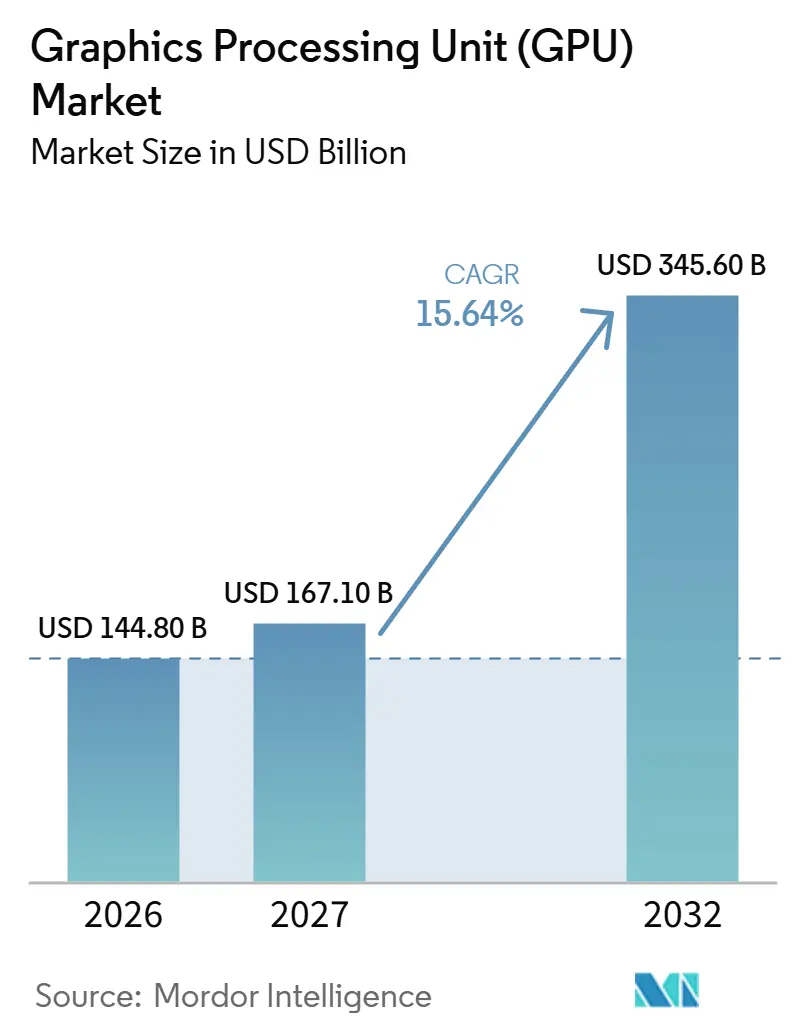
The graphics processing unit (GPU) market size is expected to increase from USD 144.8 billion in 2026 to USD 167.1 billion in 2027 and reach USD 345.6 billion by 2032, growing at a CAGR of 15.64% over 2027-2032.
Production AI clusters and India's shared compute programs are widening access routes to GPU capacity. Service contracts connect accelerator capacity with broader cloud infrastructure, making usable server configurations part of the commercial offer. Suppliers can address these needs through discrete accelerators or processor packages with integrated graphics, depending on the application. Expected memory cost increases and destination-specific sales restrictions can nevertheless prevent technical capability from becoming an affordable, accessible offer. Commercial opportunity consequently turns on the combination of GPU capability, usable configurations and permitted delivery routes, with memory economics constraining customer reach.
Key Report Takeaways
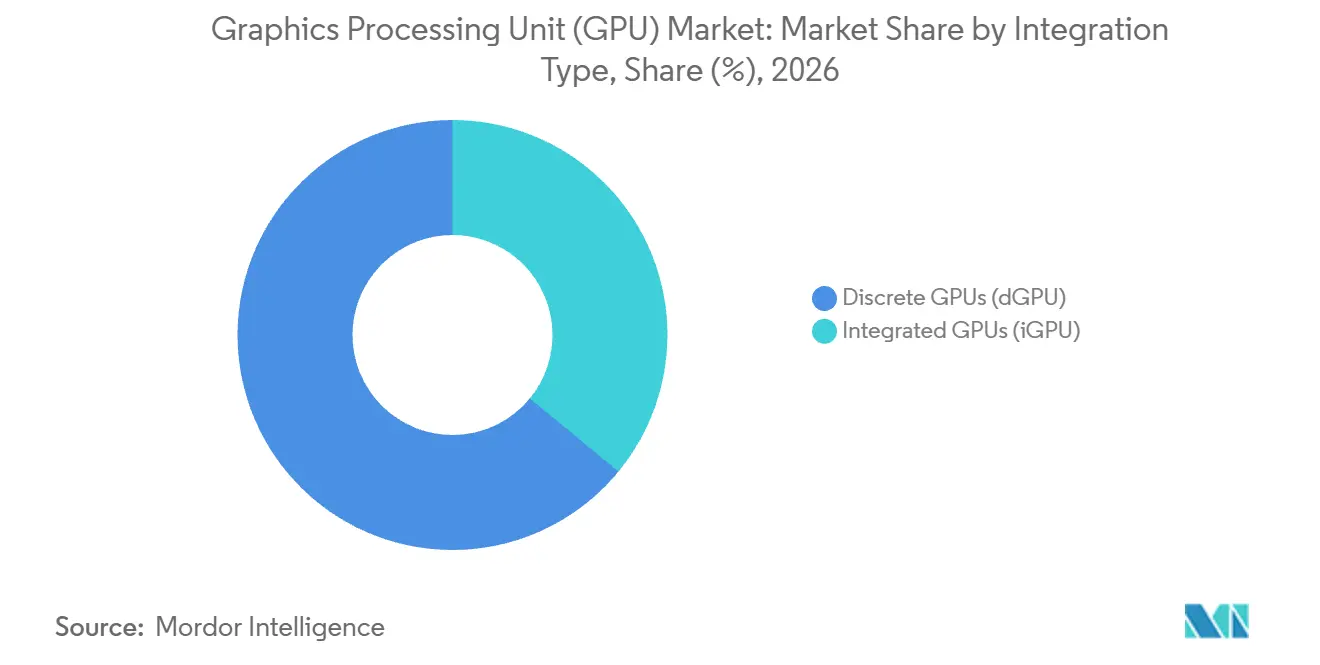
- By integration type, discrete GPUs held a 64.05% graphics processing unit (GPU) market share in 2026 and are forecast to be the fastest-growing segment with a 15.96% CAGR over 2027-2032.
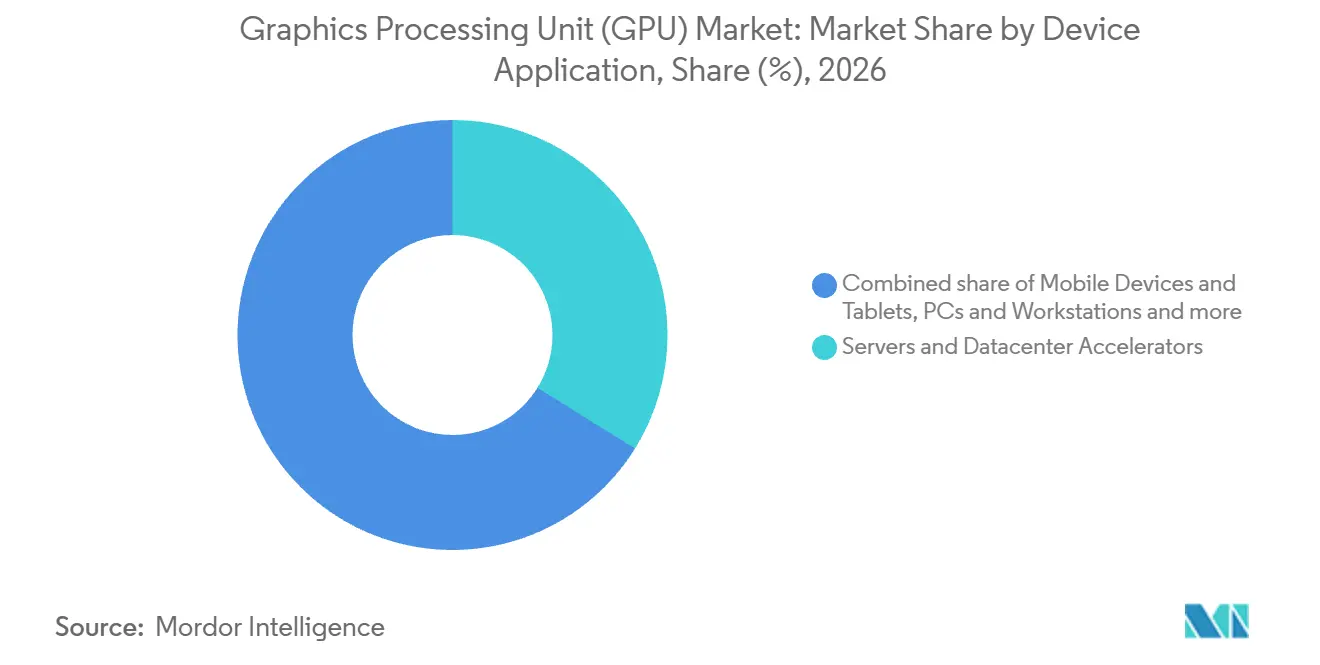
- Across device applications, servers and data center accelerators accounted for a 33.86% share of the graphics processing unit (GPU) market size in 2026 and are projected to grow fastest at a CAGR of 16.9% over 2027-2032.
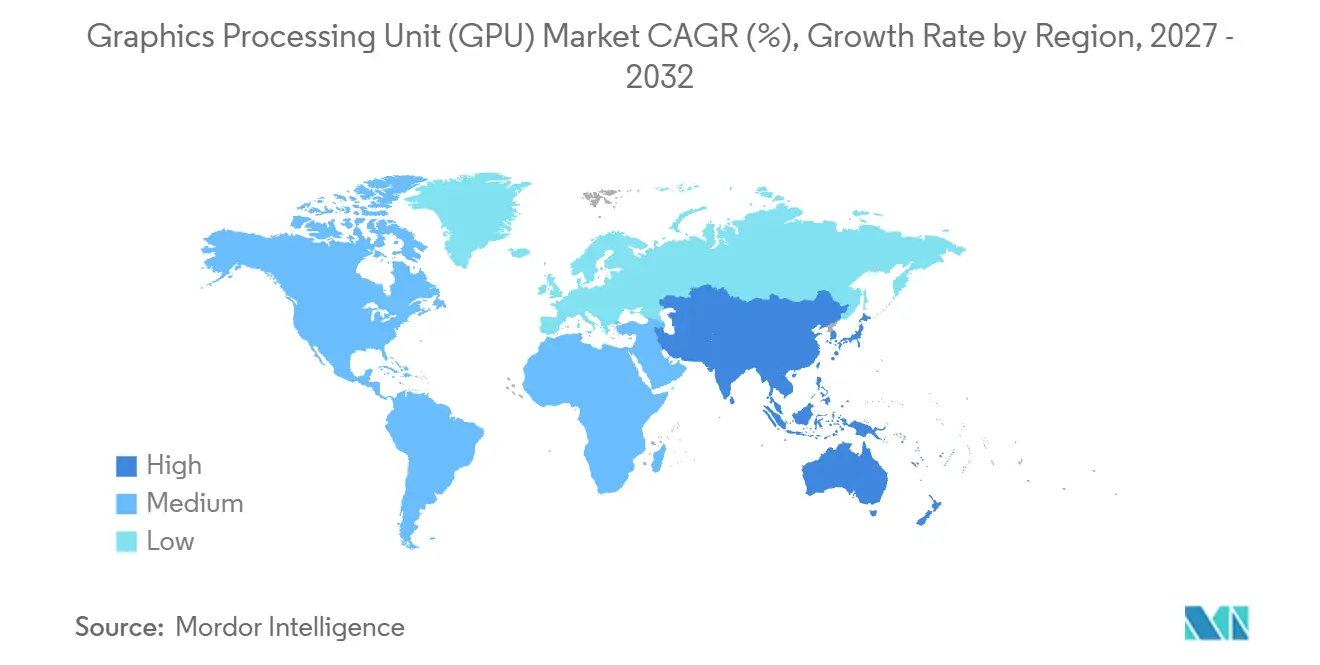
- Geographically, Asia-Pacific led with 43.18% of the market in 2026 and is forecast to be the fastest-growing geography at a CAGR of 15.9% over 2027-2032.
Note: Market numbers in this report are based on Mordor Intelligence's proprietary estimation framework, which combines nine months of actuals with Q4 projections for base year 2026.
Market Trends and Insights
Drivers Impact Analysis of Graphics Processing Unit (GPU) Market*
| Driver | (~) % Impact on CAGR Forecast | Geographic Relevance | Impact Timeline |
|---|---|---|---|
| Hyperscale AI Training and Inference Cluster Expansion | +12% | United States of America | Medium term (2-4 years) |
| Enterprise AI Factory and Sovereign Compute Procurement | +4% | India and Saudi Arabia | Medium term (2-4 years) |
| Edge AI Upgrade Cycle in PCs and Mobile Devices | +2% | United States of America | Short term (≤ 2 years) |
| Rising ADAS and In-Cabin Compute Content per Vehicle | +1.6% | Europe, including Germany | Medium term (2-4 years) |
| Chiplet-Based GPU Road Maps Improving Yield and Product Scaling | +0.9% | United States and Taiwan | Long term (≥ 4 years) |
| GPU-as-a-Service Broadening Access Beyond Hyperscalers | +0.7% | India and Saudi Arabia | Short term (≤ 2 years) |
| Source: Mordor Intelligence | |||
Hyperscale AI Training and Inference Cluster Expansion
Large production AI clusters concentrate substantial GPU demand in individual hyperscale operators' expansion programs. Microsoft Azure delivered its first at-scale production cluster with more than 4,600 NVIDIA GB300 NVL72 systems, built on NVIDIA Blackwell Ultra GPUs, for OpenAI workloads in October 2025. In October 2026, Meta reported that its Prometheus supercluster in New Albany, Ohio, comprised hundreds of thousands of GPUs.[1] Its completed first phase had trained Meta's Muse foundational models, so part of that capacity was already running a training workload. Expanding such clusters increases the accelerator capacity required by a single operator rather than depending on upgrades by many individual device buyers. GPU suppliers consequently face large increments of potential demand tied to individual hyperscalers' build schedules.
Enterprise AI Factory and Sovereign Compute Procurement
Publicly backed compute pools concentrate demand from organizations that need GPU access without building dedicated facilities. IndiaAI Mission shared compute capacity in India exceeded 45,000 GPUs as of June 2026.[2] That structure connects public infrastructure policy with commercial GPU deployment while distributing access across multiple users. For suppliers, the relevant opportunity is capacity provision to the shared service rather than a separate equipment sale to every participant. With more than 38,000 GPUs onboarded by March 2026 and capacity exceeding 45,000 by June, the program expanded shared supply within months, enlarging the pool available to startups and academia.
Edge AI Upgrade Cycle in PCs and Mobile Devices
PC OEMs translate local AI requirements into processor and graphics configurations for new devices. AI PCs represented 33% of Lenovo's PC shipments in Q2 FY2025/26, establishing a substantial commercial base within that company's PC business. In October 2025, Lenovo made its ThinkCentre neo 55a Gen 6 all-in-one available in select markets with integrated graphics and up to an AMD Ryzen AI 300 Series processor. For an integrated GPU supplier, the design opportunity sits inside the processor package selected by the OEM rather than a separate add-in-card sale. A similar distinction applies to graphics functionality within mobile processor packages. Each device shipped with the selected processor's integrated graphics contributes GPU volume to that supplier, linking the upgrade opportunity to the OEM's processor design win.
Rising ADAS and In-Cabin Compute Content per Vehicle
Automakers and Tier 1 suppliers select GPU-containing platforms to support driver-assistance functions within vehicle designs. Qualcomm reported in 2025 that its Snapdragon Ride ADAS platform combined CPU, GPU and NPU hardware and had been deployed in more than 60 countries. That combination makes GPU content part of a broader compute selection rather than a separate graphics-card purchase. Suppliers addressing additional driver-assistance and cabin functions must secure the relevant role within the vehicle platform before those requirements can generate component demand. Each awarded platform sets the GPU content of every vehicle built on it, and vehicle output then multiplies that content.
Restraints Impact Analysis of Graphics Processing Unit (GPU) Market*
| Restraint | (~) % Impact on CAGR Forecast | Geographic Relevance | Impact Timeline |
|---|---|---|---|
| Export Controls and Tariff Volatility | -2.5% | United States and China | Short term (≤ 2 years) |
| Elevated GPU and Memory ASPs Slowing Mainstream Adoption | -1.7% | North America, Europe and Asia-Pacific | Short term (≤ 2 years) |
| HBM and CoWoS Allocation Bias Toward AI Racks | -0.8% | South Korea and China | Medium term (2-4 years) |
| Grid Interconnection Delays for High-Density GPU Campuses | -0.6% | United States of America | Long term (≥ 4 years) |
| Source: Mordor Intelligence | |||
Export Controls and Tariff Volatility
Chinese government restrictions blocked some H200 sales covered by U.S. licenses to specific China-based customers, NVIDIA reported. NVIDIA incurred a USD 0.4 billion charge for excess H200 inventory and purchase obligations in the first half of fiscal 2027 as demand for H200 products diminished. AMD incurred approximately USD 440 million in net inventory and related charges in 2025 because of restrictions affecting Instinct MI308 exports.[3] Because the licenses require U.S. inspection, H200s shipped under the program are subject to a 25% tariff on import into the United States, which NVIDIA reported it could not pass on to customers. AMD obtained some U.S. licenses and began MI308 shipments to certain China-based customers at the end of fiscal 2025. Partial licensing relief leaves suppliers exposed to destination restrictions and the cost of product-specific inventory commitments.
Elevated GPU and Memory ASPs Slowing Mainstream Adoption
Higher GPU prices can prevent a performance upgrade from becoming a completed purchase. PC Partner Group Limited reported that VGA Card shipments declined substantially in the first half of FY2026 compared with the second half of FY2025. The company expected rising graphics-memory costs to substantially increase VGA Card costs in the second half of FY2026. It also expected entry-level cards to face more severe shortages, potentially raising average selling prices further during that period. Passing higher costs through to buyers would intensify the affordability constraint, while absorbing them would pressure board-maker economics. For buyers relying on lower-priced boards, the expected entry-level shortages would narrow availability while exposing them to further price increases.
*Our forecasts treat driver/restraint impacts as directional, not additive. The impact forecasts reflect baseline growth, mix effects, and variable interactions.
Graphics Processing Unit (GPU) Market Segment Analysis
By Integration Type:
Workstation Demand Supports Discrete GPU ValueDiscrete GPUs (dGPU) accounted for a 64.05% share of the graphics processing unit (GPU) market size in 2026 and are forecast to be the fastest-growing segment, with a 15.96% CAGR over 2027-2032. NVIDIA reported USD 7.2 billion in Edge Computing segment revenue for Q2 FY2027, ended July 26, 2026, up 27% year over year. Blackwell workstation sales drove the increase, partly offset by slower consumer PC sales tempered by elevated memory and system prices. This contrast makes professional workstations an important commercial route to discrete GPU demand when consumer configurations face affordability pressure.
Integrated GPUs (iGPU) shift the commercial decision toward the processor package that carries the graphics functionality. Intel held a 61% share of total PC GPU shipments in Q3 2025, including integrated and discrete graphics, which PCWorld described as basically representative of Intel CPUs shipped with integrated graphics. The supplier competes for a place in the device design through that combined offer, making processor selection and graphics capability part of the same configuration decision. If the integrated package meets the intended workload, a separate GPU product has less additional capability to sell to that buyer. Dedicated GPU suppliers must justify the extra product through application requirements the integrated package cannot meet.

By Device Application:
Platform Coverage and Contracted Compute Broaden DemandServers and data center accelerators represented a 33.86% graphics processing unit (GPU) market share in 2026 and are forecast to be the fastest-growing segment at a CAGR of 16.9% over 2027-2032. AMD reported USD 6.7 billion in Data Center segment revenue in Q2 2026, up 107% from Q2 2025, driven by EPYC processors and Instinct GPUs. On July 12, 2025, TensorWave reported its North American training cluster was fully operational with 8,192 AMD Instinct MI325X GPUs. Zyphra launched an MI355X-powered inference service with TensorWave as its infrastructure partner on May 4, 2026. These deployments give GPU suppliers distinct training and inference channels through specialized cloud operators, extending server demand beyond general processor expansion.
Signed compute-service commitments turn GPU capacity into a multi-year commercial relationship, adding another demand route alongside hardware procurement. In March 2026, Akamai signed a 4-year, USD 200 million cloud-services agreement with a major U.S. technology company covering future use of a multi-thousand NVIDIA Blackwell GPU cluster and other cloud services. The commercial offer combines accelerator access with other cloud infrastructure, allowing the provider to address more of the computing requirement. For GPU vendors, this creates an indirect demand route through an infrastructure provider with a committed service customer. The timing of GPU hardware purchases rests with Akamai's deployment of the cluster rather than with the customer's signed commitment.
Geography Analysis
Asia-Pacific Graphics Processing Unit (GPU) Market
Asia-Pacific, the largest geography, accounted for a 43.18% share of the graphics processing unit (GPU) market size in 2026 and is forecast to grow fastest at a CAGR of 15.9% over 2027-2032. By May 2026, NHN Cloud had completed an AI data center in Seoul with 7,656 NVIDIA B200 GPUs through a government-led program. NHN Cloud began supplying some GPU resources to industry, academia and research institutions on April 1, 2026, with the national-asset infrastructure allocated under government policy. In Australia, National Computational Infrastructure expanded Gadi in 2025 with 30 GPU nodes, each containing 4 NVIDIA H200 GPUs.
North America's commercial routes include Canadian cloud capacity backed by customer agreements. In May 2026, HIVE Digital Technologies subsidiary BUZZ HPC began operating 504 liquid-cooled NVIDIA B200 GPUs at Bell Canada AI Fabric's Manitoba data center under 2-year customer agreements worth approximately USD 30 million. Europe provides a public-procurement channel through the European High-Performance Computing Joint Undertaking's August 2026 contract with Bull for an AMD Instinct MI430X supercomputer in Finland. Hosted by the LUMI AI Factory consortium, the system is expected to be installed and available to startups, small and medium-sized enterprises, and research users in 2027. These routes place contract conversion at different points, with Canada demonstrating service activation and Finland committing future shared capacity.
In South America, Google Cloud made G4 virtual machines with NVIDIA RTX PRO 6000 Blackwell Server Edition GPUs available in São Paulo on September 24, 2026, for local inference and real-time workloads. On March 11, 2026, AXIA Energia's Rio de Janeiro neocloud, developed with Cepel, had 32 NVIDIA H200 GPUs in operation and planned to reach 96 by the end of that month. Capacity was offered to universities, research institutions and startups, providing a local route to specialist compute. In the Middle East and Africa, AMD, Cisco and HUMAIN reported live Instinct MI355X infrastructure in Saudi Arabia on August 31, 2026, serving HUMAIN customers in the Kingdom and beyond. With AMD supplying GPUs, Cisco networking and HUMAIN the service, the Saudi model separates hardware participation from the operator's wider customer reach.
Regulatory Framework and Outlook
The comparison assesses selected jurisdictions from the perspective of GPU suppliers conducting cross-border business. Product classification, destination and end use determine which export-control requirements apply. Under the U.S. pathway covering H200, MI325X and similar exports to China, applicants must demonstrate no reduction in global semiconductor production capacity available to U.S. customers. They must also demonstrate that purchasers adopted export-compliance procedures including customer screening, and that products underwent independent third-party performance and security testing in the United States.
Regulatory Table of Graphics Processing Unit (GPU) Market
| Decision factor | United States | Germany | China |
|---|---|---|---|
| Primary authority | Bureau of Industry and Security | Federal Office for Economic Affairs and Export Control, BAFA | Ministry of Commerce, MOFCOM |
| Key instruments or direction | EAR advanced-computing export controls and conditional China/Macau review | Regulation (EU) 2021/821; advanced-computing control-list addition adopted September 14, 2026 | Dual-use restrictions on specified Japanese military users, military uses and other military-capability-enhancing end uses; designated older notices suspended through November 10, 2026 |
| Commercial effect | China/Macau export review requires EAR 3A090 TPP below 21,000, total DRAM bandwidth below 6,500 GB/s and additional application information; other covered applications to Country Group D:5 destinations or Macau face presumed denial | Authorization for Annex I items; conditional end-use controls can cover unlisted items | Prohibits covered Japan-bound dual-use transactions and third-country transfers of Chinese-origin items for the specified end users or uses |
| Current policy attractiveness | Low | Medium | Medium |
| Future direction of policy attractiveness | No change | Hardening | Hardening |
| Source: Mordor Intelligence | |||
The U.S. rating reflects selective approval, additional demonstrations and presumed denial outside the qualifying pathway, with the retained licensing framework supporting continuity. Germany's rating reflects a defined authorization framework, while the September 2026 adoption of added advanced-computing controls supports wider future compliance coverage. China's Announcement 2026 No. 1 prohibits dual-use exports to Japanese military users, military uses and other end uses enhancing Japan's military capability, including third-country transfers of Chinese-origin items, subject to item classification and end-use screening. NVIDIA reported PRC restrictions blocked some U.S.-licensed H200 sales to specific China-based customers, with program shipments accounting for less than 1% of its Data Center revenue for the quarter ended July 26, 2026.
Value Chain Stages
The value chain compares GPU design, wafer fabrication, packaging and testing, and partner graphics-card commercialization. AMD's fiscal 2025 production relied on TSMC for GPU and microprocessor wafers at 7 nm or smaller nodes and primarily on GlobalFoundries above 7 nm. This division separates product design from manufacturing execution, giving capacity providers a distinct commercial role. AMD also identified possible customer allocation if third-party manufacturing constraints reduced available products, linking upstream capacity risk to customer fulfillment.
Value Chain Analysis Table of Graphics Processing Unit (GPU) Market
| Primary activity | Key participants | Value capture | Bottleneck | Resilience response |
|---|---|---|---|---|
| GPU architecture and product design | GPU developers such as Advanced Micro Devices, Inc. | GPU product sales | Matching product designs to qualified manufacturing processes | Align design choices with qualified process capabilities |
| Wafer fabrication | Semiconductor foundries such as TSMC and Samsung Electronics Co., Ltd., used by NVIDIA | Wafer-fabrication sales | Exposure to third-party production capacity | Broaden qualified manufacturing relationships |
| Semiconductor assembly, packaging and testing | Assembly, test, mark and packaging providers for AMD products such as its Tongfu Microelectronics joint ventures, Siliconware Precision Industries and King Yuan Electronics | Assembly, packaging and test service fees | Coordinating qualified backend capacity with wafer releases | Match backend reservations to fabrication schedules |
| Graphics-card design and commercialization | Radeon card-design partners such as ASRock, ASUS and GIGABYTE | Partner graphics-card sales | Dependence on packaged GPU delivery before card fulfillment | Coordinate card introductions with upstream delivery commitments |
| Source: Mordor Intelligence | ||||
NVIDIA reported expanding supplier relationships to build redundancy and long-term manufacturing capacity in fiscal 2026. Additional fabrication options are most useful when packaging and final-product partners can support the same delivery schedule. Spare capacity at one stage cannot deliver a finished GPU on its own, so resilience rests on a complete qualified production route.
Competitive Landscape
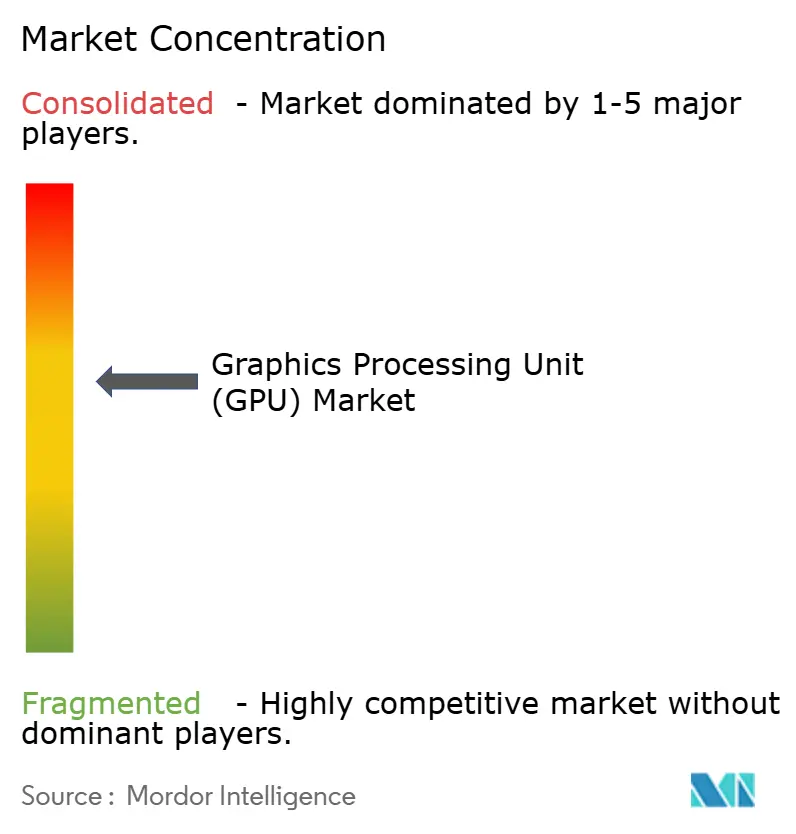
Competition is concentrated around established GPU platform suppliers, with different positions in merchant accelerators and graphics embedded in device platforms. NVIDIA Corporation reported USD 89 billion in Data Center segment revenue for Q2 FY2027, ended July 26, 2026, up 117% year over year. Advanced Micro Devices, Inc. supplies Instinct GPUs and EPYC processors, while Intel Corporation develops Arc Pro GPUs for workstation and AI inference applications. These supplier roles span different computing requirements, so the competitive boundary is the platform a customer selects rather than a single comparable chip sale.
Apple Inc. designs integrated GPUs for its MacBook Pro system-on-chip platforms. Apple reported USD 33.7 billion in Mac net sales for fiscal 2025, ended September 27, 2025, demonstrating the scale of the Mac line that carries its MacBook Pro system-on-chip platforms. Qualcomm Incorporated's subsidiary Qualcomm Technologies, Inc. supplies Snapdragon PC platforms with Adreno GPUs. Both approaches place graphics inside a broader computing offer, allowing differentiation to rest on the combined configuration. Apple can monetize graphics through its own device category, whereas Qualcomm's operating subsidiary competes for PC platform selection by device makers, giving the companies different routes to commercial value.
Qualcomm said its Snapdragon X2 PC platforms were in production on April 29, 2026. That reported milestone makes manufacturing readiness a concrete part of the challenge to established PC graphics platforms. In September 2026, Acer announced the Predator Atlas 7 handheld with up to Intel Arc G3 Extreme processors and up to Arc B390 graphics, planning Q4 2026 North American and November 2026 EMEA availability. NVIDIA's licensed H200 shipments to China contributed less than 1% of its Data Center revenue in the quarter ended July 26, 2026, illustrating the limited scale of that restricted sales channel. The competitive opening therefore differs by supplier, combining OEM platform access for challengers with destination-specific regulatory constraints for accelerator leaders.
Graphics Processing Unit (GPU) Industry Leaders
-
NVIDIA Corporation
-
Advanced Micro Devices, Inc.
-
Intel Corporation
-
Apple Inc.
-
Qualcomm Incorporated
- *Disclaimer: Major Players sorted in no particular order
Graphics Processing Unit (GPU) Market Companies Covered in this Report
- NVIDIA Corporation
- Advanced Micro Devices, Inc.
- Intel Corporation
- Qualcomm Incorporated
- Arm Holdings plc
- Apple Inc.
- Samsung Electronics Co., Ltd.
- MediaTek Inc.
- Imagination Technologies Group Limited
- Huawei Technologies Co., Ltd.
- Moore Threads Technology Co., Ltd.
- Shanghai Biren Technology Co., Ltd.
- VeriSilicon Microelectronics (Shanghai) Co., Ltd.
- Shanghai Zhaoxin Semiconductor Co., Ltd.
- VIA Technologies, Inc.
- UNISOC (Shanghai) Technologies Co., Ltd.
- Renesas Electronics Corporation
- Rockchip Electronics Co., Ltd.
- Loongson Technology Corporation Limited
- Bolt Graphics, Inc.
Key Opportunities for Market Participants
The comparison distinguishes institutional GPU supply through complete servers, research clusters and specified professional cards. In fiscal 2025 in the United States, Harvard's Office of the Vice Provost for Research partnered with University Research Computing to build a central GPU cluster for its research enterprise. The initiative aimed to meet increasing GPU demand and mitigate costly individual investments by labs and centers. For Harvard, pooling research requirements can concentrate the supplier opportunity in a shared system rather than separate lab purchases.
Market Opportunities Table of Graphics Processing Unit (GPU) Market
| Opportunity | Why now | Buyer / lead segment | Recommended play | Main barrier | Likely beneficiaries |
|---|---|---|---|---|---|
| GPU components for research servers | IISc opened a GPU-server tender on October 16, 2026, with bids due November 5, 2026 | Indian Institute of Science, Bengaluru research computing | Partner on the server bid with a GPU component offer | Dependence on integration into the complete server offer | GPU suppliers and server integrators |
| GPUs for research cluster deployment | IIT Kanpur opened a GPU-cluster tender on October 6, 2026, with bids due October 27, 2026 | Indian Institute of Technology Kanpur, research clusters | Align GPU delivery with the cluster integrator's deployment offer | Coordinating component supply with a complete cluster bid | GPU suppliers and cluster integrators |
| Specified professional graphics cards | NISER opened an RTX PRO 4000 Blackwell graphics-card tender on October 6, 2026, with bids due October 27, 2026 | National Institute of Science Education and Research, Odisha | Address the named professional-card requirement | Product fit with the specified card model | NVIDIA Corporation and suppliers of the named card |
| Source: Mordor Intelligence | |||||
The Indian server and cluster listings have bid deadlines between October 27 and November 5, 2026. NISER's specified RTX PRO 4000 Blackwell requirement limits the card opportunity to NVIDIA and suppliers of that named product. Harvard's U.S. partnership to build a central cluster illustrates the cost problem of separate lab investments. IIT Kanpur's separate institutional tender provides the Indian cluster opportunity, making participation in a complete-system bid by October 27, 2026 the relevant supplier route.
Recent Industry Developments in Graphics Processing Unit (GPU) Market
- Oct 2026: Meta reported that its Prometheus supercluster in New Albany, Ohio, comprised hundreds of thousands of GPUs and that its completed first phase had trained Muse foundational models.
- Sep 2026: Google Cloud made G4 virtual machines powered by NVIDIA RTX PRO 6000 Blackwell Server Edition GPUs available in São Paulo for local inference and real-time workloads.
- Sep 2026: The European Commission adopted a delegated regulation adding advanced-computing integrated circuits and other dual-use items to the EU control list.
Graphics Processing Unit (GPU) Market Report Scope and Research Methodology
Market Definition and Coverage
Graphics processing unit (GPU) market measures annual revenue from new, factory-shipped GPU circuits and GPU cards sold globally for use in computing devices, data center infrastructure, vehicles, and embedded systems. Revenue is counted at the sale of the GPU product, including GPUs integrated into a processor package or another device.
Scope exclusions: Refurbished GPU products, pure AI application-specific integrated circuits, FPGA accelerators, and complete servers, PCs, mobile devices, gaming systems, vehicles, and other systems sold without separately recognized GPU product revenue are excluded.
Segments Covered in This Report
- By Integration Type
- Integrated GPUs (iGPU)
- Discrete GPUs (dGPU)
- By Device Application
- Mobile Devices and Tablets
- PCs and Workstations
- Servers and Datacenter Accelerators
- Gaming Consoles and Handhelds
- Automotive and ADAS
- Other Embedded and Edge Devices
- By Geography
- North America
- United States
- Canada
- Mexico
- Europe
- Germany
- United Kingdom
- France
- Italy
- Rest of Europe
- Asia-Pacific
- China
- Japan
- South Korea
- India
- Southeast Asia
- Rest of Asia-Pacific
- South America
- Middle East and Africa
- North America
Data Sources, Market Sizing, and Validation
Desk Research
Public evidence such as AMD's investor financial results report Data Center segment revenue and name Instinct GPU demand as a contributor, giving a cross-check on accelerator demand, while Meta Engineering's description of its Prometheus cluster provides a demand-side signal for data center deployments. The Semiconductor Industry Association's semiconductor sales reported by Tom's Hardware and the World Semiconductor Trade Statistics forecast provide context on chip demand and prices, and the U.S. Bureau of Industry and Security's export-control guidance helps identify policy conditions that may affect eligible GPU shipments.
Company filings, investor presentations, product announcements, and reputable trade and financial press can add product mix, capacity, shipment, pricing, and customer timing evidence. Analysts use these alongside public trade and regulatory information to cross-check the market picture. These sources are not exhaustive, and further sources inform collection, validation, and clarification.
Primary Interviews and Surveys
Interviews and structured surveys would cover GPU suppliers, board and processor-package partners, cloud and data center operators, device manufacturers, and vehicle-platform participants, with executives, functional leaders, and managers contributing views on revenue recognition, shipment timing, pricing, and application demand. Analysts would use these perspectives to test secondary-source assumptions and variable forecasts, clarify gaps where company disclosures combine GPU and non-GPU revenue, and triangulate conflicting indicators before revising estimates. Respondent coverage would span APAC, EMEA, and the Americas to reflect the global market.
Distribution of primary research fieldwork respondents
| Company type | Respondent position | Region |
|---|---|---|
| Top tier: 30% | CXOs: 20% | APAC: 45% |
| Mid tier: 45% | Functional/Unit leaders: 35% | EMEA: 30% |
| Smaller Players: 25% | Managers: 45% | Americas: 25% |
Market-Sizing & Forecasting
Analysts first estimate the global value of supplier GPU product sales from company and industry revenue evidence, then check the total selectively through supplier roll-ups and sampled GPU average selling prices multiplied by shipment volumes. The model tracks GPU-specific supplier revenue, accelerator deployments and cloud capacity additions, PC and mobile device shipments and refresh cycles, vehicle platform design activity, and GPU and memory pricing. Together these indicators show changes in volume, product mix, and recognized GPU value. Application and geographic shares are built from supplier disclosures, customer and shipment evidence, and the location and end use of GPU product sales, with integrated, discrete, and hybrid products classified once.
Where GPU revenue is combined with CPU or system sales, analysts use disclosed product details and independent shipment or pricing signals to estimate the GPU portion, and retain a range when separation is not possible. Scenario analysis carries forward demand and supply indicators under different assumptions for AI infrastructure investment, device refreshes, memory availability, power constraints, and export controls. Because supplier disclosures can combine GPU and other product revenue, analyst interviews would test each major input and the forecast drivers before a change is accepted.
Data Validation & Update Cycle
Analysts triangulate supplier revenue disclosures with shipment, pricing, deployment, and regulatory signals, then investigate anomalies such as abrupt changes in GPU mix, average selling prices, or application and regional shares. A reviewer checks source definitions, units, period alignment, calculations, and the treatment of combined GPU and non-GPU revenue. Unresolved differences prompt analyst re-contact with relevant respondents and renewed source checks before sign-off. The model is refreshed annually, updated between cycles when material events change demand, supply, or sales eligibility, and reviewed again against the latest evidence before delivery.
Mordor Intelligence's Graphics Processing Unit Market Size Measured Against Other Published Estimates
Published estimates can differ in the transactions and products they count and the inputs used to model demand. Graphics processing unit (GPU) market measures annual revenue from new, factory-shipped GPU circuits and GPU cards sold globally for use in computing devices, data center infrastructure, vehicles, and embedded systems.
Key Gap Drivers include the study's defined coverage and market-specific modeling choices. The model tracks GPU-specific supplier revenue, accelerator deployments and cloud capacity additions, PC and mobile device shipments and refresh cycles, vehicle platform design activity, and GPU and memory pricing.
Benchmark comparison
| Source | Market Size | Gaps in Research Methodology |
|---|---|---|
| Mordor Intelligence | USD 167.1 B (2027) | |
| Global Consultancy A | USD 126.8 B (2026) | At its 2026 base, this estimate is 24.1% below this report's 2027 value of USD 167.1 B, 1 year later. The estimate is for 2026, one year before the comparison year, and its published forecast continues beyond that estimate. |
| Global Consultancy B | USD 72.03 B (2025) | At its 2025 base, this estimate is 56.9% below this report's 2027 value of USD 167.1 B, 2 years later. The estimate is for 2025, two years before the comparison year, and its published forecast continues through 2030. |
Mordor Intelligence's analysts triangulate supplier revenue disclosures with shipment, pricing, deployment, and regulatory signals, then investigate anomalies such as abrupt changes in GPU mix, average selling prices, or application and regional shares.
Key Questions Answered in the Report
What is the graphics processing unit (GPU) market size and growth outlook?
The size is projected to reach USD 167.1 billion in 2027 and USD 345.6 billion by 2032, with a CAGR of 15.64% over 2027-2032.
Which forces are expanding demand for GPUs?
Production AI clusters and shared compute are important drivers. India's IndiaAI Mission shared capacity exceeded 45,000 GPUs as of June 2026.
Which GPU integration type holds the largest share?
Discrete GPUs were the largest segment with 64.05% of the market in 2026 and are forecast to grow at a CAGR of 15.96% over 2027-2032.
Which companies are major GPU participants?
Major participants include NVIDIA Corporation, Advanced Micro Devices, Inc., Intel Corporation, Apple Inc. and Qualcomm Incorporated.
What constrains mainstream GPU adoption?
High prices and memory cost pressure can limit access. PC Partner Group Limited expected rising graphics-memory costs to substantially increase VGA card costs in the second half of FY2026.
Which region leads GPU sales value and forecast growth?
Asia-Pacific held 43.18% of the market in 2026 and is forecast to be the fastest-growing geography at a CAGR of 15.9% over 2027-2032.