
Global Grapeseed Extract Market Size and Share
Market Overview
| Study Period | 2021 - 2031 |
|---|---|
| Market Size (2026) | USD 371.39 Million |
| Market Size (2031) | USD 497.68 Million |
| Growth Rate (2026 - 2031) | 6.04 % |
| Fastest Growing Market | Asia Pacific |
| Largest Market | North America |
| Market Concentration | Low |
Major Players *Disclaimer: Major Players sorted in no particular order Image © Mordor Intelligence. Reuse requires attribution under CC BY 4.0. | |
Global Grapeseed Extract Market Analysis by Mordor Intelligence
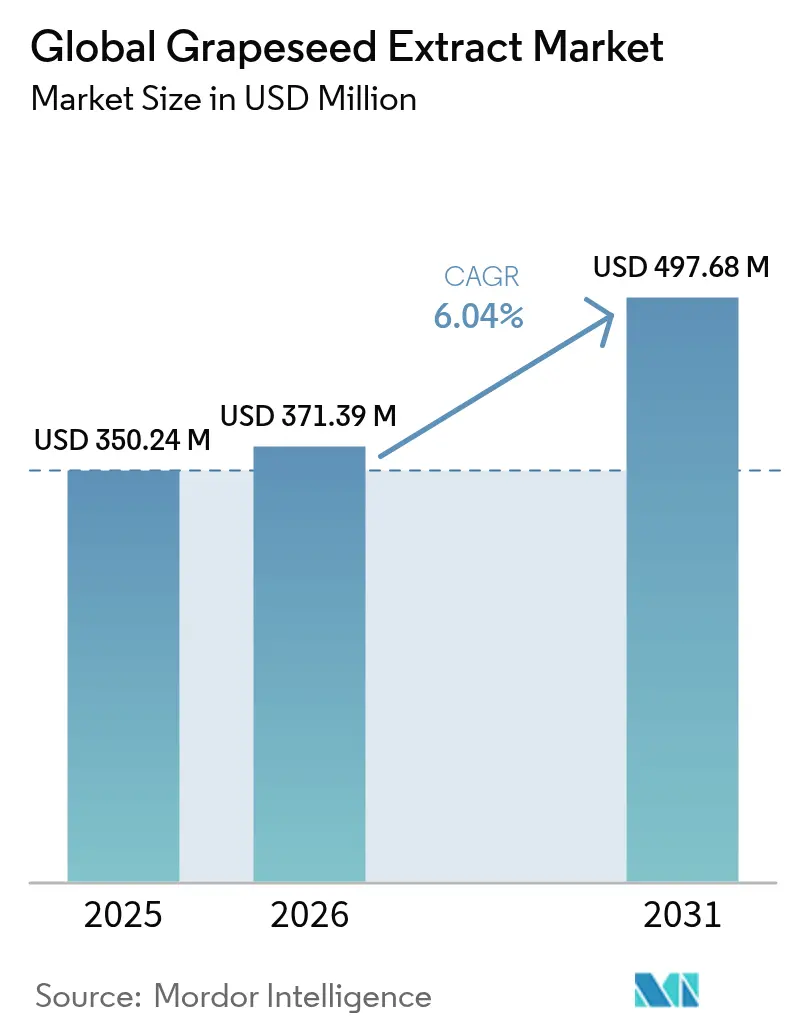
Grape seed extract market size in 2026 is estimated at USD 371.39 million, growing from 2025 value of USD 350.24 million with 2031 projections showing USD 497.68 million, growing at 6.04% CAGR over 2026-2031. The market growth is primarily attributed to increased consumer demand for natural health products, heightened awareness of preventive healthcare measures, and extensive applications across multiple industries. The expanding recognition of grape seed extract's cardiovascular health benefits has significantly influenced market expansion. Furthermore, the rising consumer preference for clean-label and plant-based products has strengthened market growth, particularly as consumers increasingly prioritize natural ingredients. The market is also experiencing substantial growth due to the extract's applications in the pharmaceutical industry, where it is utilized in various therapeutic formulations. Additionally, the cosmetics and personal care industry's incorporation of grape seed extract in anti-aging products and skin care formulations has contributed to market expansion.
Key Report Takeaways
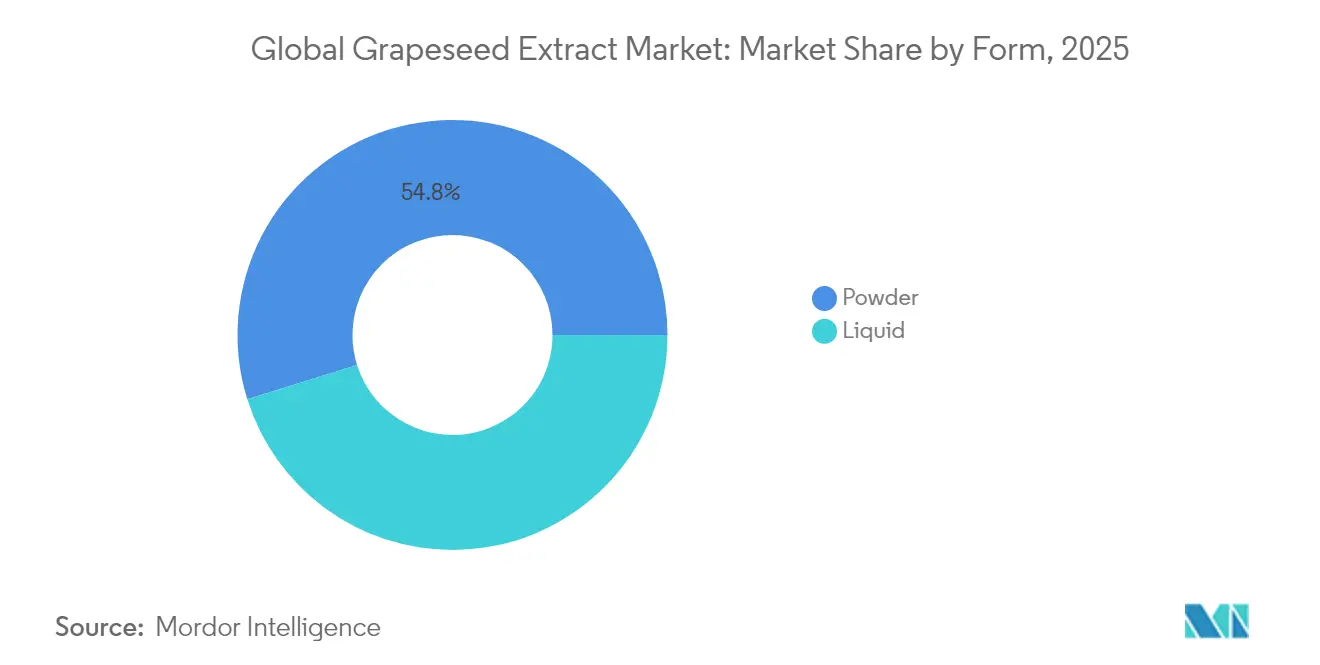
- By form, powder held 54.83% of the grape seed extract market share in 2025; liquid is projected to expand at an 8.45% CAGR through 2031.
- By nature, conventional products led with 84.92% share in 2025; organic variants are forecast to advance at an 10.92% CAGR.
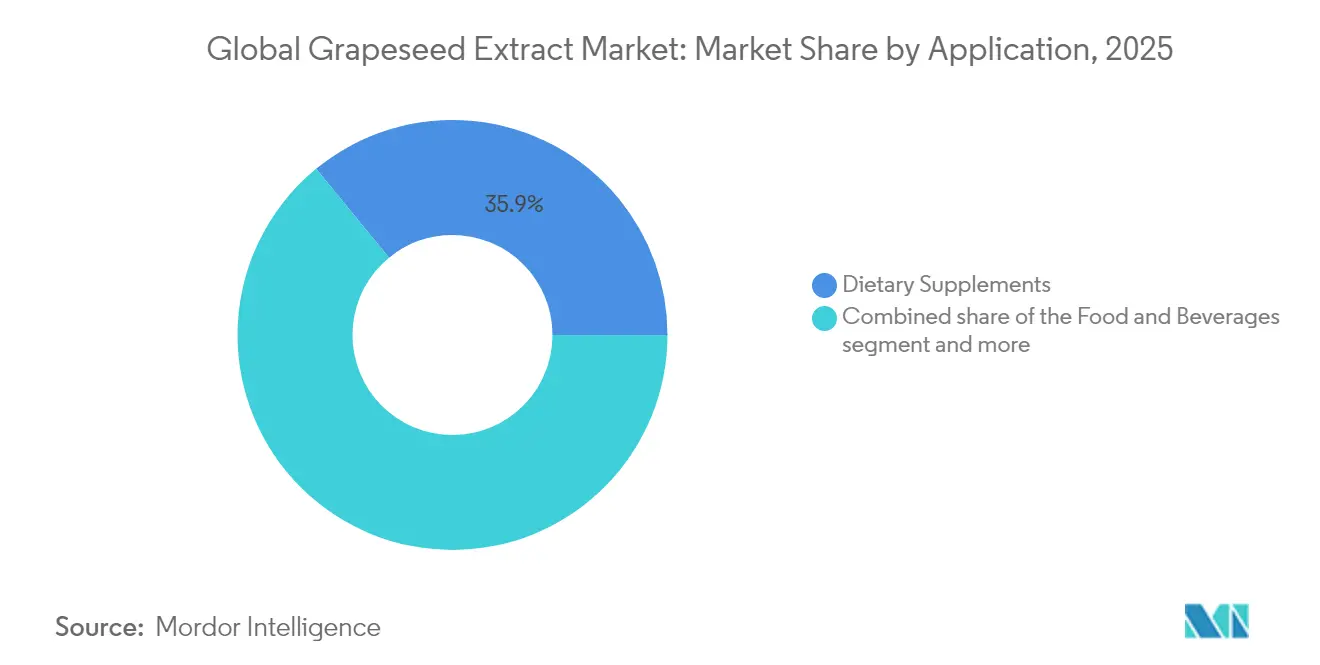
- By application, dietary supplements commanded 35.94% share of the grape seed extract market size in 2025, whereas pharmaceuticals are expected to grow at 9.35% CAGR to 2031.
- By geography, North America contributed 35.02% revenue in 2025, while Asia-Pacific is poised for a 9.28% CAGR over the forecast window.
Note: Market size and forecast figures in this report are generated using Mordor Intelligence’s proprietary estimation framework, updated with the latest available data and insights as of 2026.
Market Trends and Insights
Drivers Impact Analysis of Global Grapeseed Extract Market*
| Driver | (~) % Impact on CAGR Forecast | Geographic Relevance | Impact Timeline |
|---|---|---|---|
| Rising demand for natural antioxidants in dietary supplements | +1.2% | Global, with strongest growth in North America and Asia-Pacific | Medium term (2-4 years) |
| Expanding adoption in cosmetics and personal-care anti-ageing lines | +0.8% | Europe and North America core, expanding to Asia-Pacific premium segments | Medium term (2-4 years) |
| Premiumization trend in functional foods and beverages driving grape seed extract fortification | +0.6% | North America and Europe, emerging in urban Asia-Pacific markets | Long term (≥ 4 years) |
| Growing clinical evidence for cardiovascular benefits of grape seed extract | +0.9% | Global, with regulatory momentum in developed markets | Long term (≥ 4 years) |
| Regulatory approval of grape seed extract-based bio-fungicides in viticulture | +0.4% | Europe initially, potential expansion to global wine regions | Short term (≤ 2 years) |
| Adoption of cost-effective, eco-friendly sub-critical water extraction to meet clean-label demand | +0.5% | Global manufacturing hubs, led by Europe and North America | Medium term (2-4 years) |
| Source: Mordor Intelligence | |||
Rising demand for natural antioxidants in dietary supplements
The global grape seed extract market is experiencing growth driven by increasing demand for natural antioxidants in dietary supplements. Grape seed extract contains high levels of polyphenols, particularly proanthocyanidins, which provide antioxidant properties that combat oxidative stress, reduce inflammation, and support cardiovascular health. Consumer preference for preventive healthcare and clean-label nutrition has increased the demand for plant-derived ingredients like grape seed extract. The rising prevalence of lifestyle-related diseases, including heart disease, diabetes, and obesity, has enhanced the appeal of antioxidant-rich supplements. Grape seed extract has gained prominence due to its documented health benefits. The Council for Responsible Nutrition (CRN) reported that 74% of adults in the United States consumed dietary supplements in 2023, reflecting the widespread adoption of daily supplementation for proactive health maintenance [1]. This trend supports the incorporation of grape seed extract in supplement formulations targeting heart health, immune function, and aging support.
Expanding adoption in cosmetics and personal-care anti-ageing lines
Grape seed extract demonstrates effectiveness in collagen synthesis and UV protection for cosmetic applications. Advanced encapsulation technologies, particularly hyalurosome formulations, improve dermal penetration and bioavailability, overcoming traditional limitations of topical polyphenol delivery. The incorporation of grape seed extract in premium anti-aging formulations aligns with industry trends toward natural, scientifically validated ingredients, as consumers seek products without synthetic additives. This trend drives the demand for anti-aging creams, evidenced by approximately 0.85 million men in Germany utilizing anti-aging cream within seven days in 2024, according to IfD Allensbach [2]. Recent patent developments, including formulations that combine grape seed extract with muscadine pomace and beta-glucan, show continued innovation in cosmeceutical applications for skin firmness, radiance, and tone improvement. The market growth continues as clinical studies validate grape seed extract's photoprotective properties and its effectiveness in enhancing keratinocyte viability under oxidative stress conditions.
Premiumization Trend in Functional Foods and Beverages
Food manufacturers systematically incorporate grape seed extract into functional beverages to address the requirements of health-conscious consumers seeking cardiovascular and cognitive benefits. The European Food Safety Authority's comprehensive assessment of grape pomace extracts, in conjunction with established safety protocols, facilitates regulatory compliance for functional food applications across principal markets. Advanced extraction methodologies, specifically supercritical CO2 and subcritical water techniques, enable the production of standardized extracts with optimal polyphenol concentrations while adhering to clean-label specifications. Market expansion continues as manufacturers develop precise formulations that maintain bioactive compound integrity and organoleptic characteristics across diverse food applications.
Growing clinical evidence for cardiovascular benefits of Grape Seed Extract
Clinical evidence supporting cardiovascular benefits drives the growth of the global grape seed extract market. Grape seed extract contains high concentrations of polyphenolic compounds, particularly oligomeric proanthocyanidins (OPCs), which have antioxidant and anti-inflammatory properties. Clinical studies show grape seed extract reduces blood pressure, improves endothelial function, decreases LDL cholesterol oxidation, and supports vascular health. These benefits address cardiovascular disease (CVD), the leading cause of death worldwide. As a result, grape seed extract has become an important ingredient in cardiovascular health supplements, particularly for aging populations and individuals with cardiovascular risk factors. The cardiovascular benefits are significant, considering the prevalence of heart disease. In 2023, the Centers for Disease Control and Prevention (CDC) reported that approximately 4.8% of adults in the United States had coronary heart disease (CHD). This clinical evidence establishes grape seed extract as a complement to conventional cardiovascular care, increasing its demand in nutraceutical and pharmaceutical applications.
Restraints Impact Analysis of Global Grapeseed Extract Market*
| Restraint | (~) % Impact on CAGR Forecast | Geographic Relevance | Impact Timeline |
|---|---|---|---|
| Price volatility of raw materials due to grape harvest fluctuations and climate variability | -0.7% | Global, with acute impacts in California, Europe, Australia | Short term (≤ 2 years) |
| Divergent regional limits on proanthocyanidin daily intake | -0.4% | Primarily Europe vs North America regulatory differences | Medium term (2-4 years) |
| Quality-recall risk from residual solvents and heavy-metal loads | -0.6% | Global manufacturing centers, particularly emerging markets | Short term (≤ 2 years) |
| Intensifying competition from alternative polyphenol sources | -0.5% | Global, with strongest pressure in cost-sensitive segments | Long term (≥ 4 years) |
| Source: Mordor Intelligence | |||
Price volatility of raw materials due to grape harvest fluctuations and climate variability
Climate change affects grape production and supply chain stability. Grape cultivation areas are declining due to changing climate conditions. In Canada, the cultivation area decreased from 32,950 acres in 2022 to 31,000 acres in 2023, according to Canada Statistics [3]. Rising temperatures and altered precipitation patterns affect grape seed quality and proanthocyanidin concentrations, impacting extract yields and potency. This makes product standardization more challenging. Premium wineries often retain high-quality grape seeds for specialized applications rather than selling them to extract manufacturers, affecting the availability of wine industry by-products. Supply chain disruptions from extreme weather events demonstrate the industry's vulnerability to climate-related impacts. The increased demand for grape seed extract, especially organic and premium-grade materials, has created raw material price volatility, with these specialized products commanding higher prices than conventional alternatives.
Divergent regional limits on proanthocyanidin daily intake
The global regulatory landscape for grape seed extract remains fragmented. Health Canada mandates 100 mg daily limits and adult-only cautionary labeling, while European authorities apply different assessment criteria under novel food regulations. The European Food Safety Authority's restrictions on green tea extract containing EGCG, due to liver injury risks at 800 mg or higher daily doses, indicate heightened regulatory oversight that may affect grape seed extract products. Japan implements distinct health food regulations, requiring dedicated safety assessments and Food Sanitation Act compliance. These varying regulatory requirements across regions compel manufacturers to develop market-specific formulations and compliance protocols, resulting in increased development costs and market entry challenges.
*Our forecasts treat driver/restraint impacts as directional, not additive. The impact forecasts reflect baseline growth, mix effects, and variable interactions.
Global Grapeseed Extract Market Segment Analysis
By Form:
Powder Dominance Drives Manufacturing EfficiencyPowder formulations lead the market with a 54.83% share in 2025. Manufacturers prefer powder formats due to their stability, standardization capabilities, and cost-effective processing for dietary supplement production. Powders offer better shelf stability and integrate easily into capsules and tablets, helping moisture-sensitive proanthocyanidins retain their potency during storage. Liquid formulations grow at 8.45% CAGR through 2031, as consumers prefer their better absorption rates and convenience in functional beverages and cosmetics. New encapsulation methods like liposomal and hyalurosome technologies improve how the body absorbs grape seed extract, supporting premium cosmeceutical products.
Manufacturers use sub-critical water extraction and supercritical CO2 processes to produce liquid extracts with high polyphenol content that meet clean-label standards at competitive costs. Pharmaceutical companies choose liquid forms for clinical use because they offer precise dosing and quick absorption for treatments. Private label manufacturers drive powder segment growth by seeking cost-effective standardized ingredients, though they face quality control and adulteration challenges that require better testing methods. While powders dominate sales volume, liquid forms generate higher profits through premium products and enhanced benefits.

By Nature:
Organic Premium Positioning Accelerates Market DifferentiationConventional grape seed extract holds 84.92% market share in 2025, supported by established supply chains and cost advantages across dietary supplements and functional foods. This segment leverages mature extraction technologies and standardized processing methods to deliver consistent proanthocyanidin concentrations while maintaining competitive pricing. The organic segment is growing at 10.92% CAGR through 2031, driven by premium positioning and consumer acceptance of higher prices for certified organic ingredients. Organic certification requirements increase supply chain complexity but enable higher price premiums, especially in cosmetic and pharmaceutical applications where clean-label attributes enhance product differentiation.
The organic grape seed extract segment faces constraints from limited certified organic grape processing capacity and higher raw material costs. However, increasing consumer concerns about pesticide residues in conventional products support its growth. The expansion of organic variants aligns with clean-label trends in functional foods and dietary supplements, as manufacturers focus on sustainable sourcing and environmental responsibility. While conventional grape seed extract continues to dominate by volume, organic variants generate higher value through premium applications and positioning strategies that highlight sustainability and purity.
By Application:
Pharmaceuticals Accelerate Beyond Traditional SupplementsDietary supplements maintain the largest application share at 35.94% in 2025, driven by established consumer acceptance and regulatory pathways across multiple distribution channels. The supplements segment benefits from clinical validation of cardiovascular benefits, with trials showing significant reductions in carotid atherosclerotic plaque progression. Pharmaceuticals represent the fastest-growing segment at 9.35% CAGR through 2031, supported by increasing clinical evidence for therapeutic applications in cardiac remodeling and vascular health management. Food and beverage applications expand through functional product development, where grape seed extract enables premium positioning and health claims.
Cosmetics and personal care applications utilize grape seed extract's proven benefits in collagen synthesis and photoprotection, demonstrating improvements in skin hydration and wrinkle reduction through standardized treatment protocols. Animal nutrition applications show benefits in livestock health, including enhanced antioxidant capacity and gut microbial diversity in poultry production. Other applications, including industrial uses such as natural antimicrobial agents for water disinfection, present opportunities to expand beyond traditional health and nutrition markets.
Geography Analysis
North America Grapeseed Extract Market
North America holds 35.02% market share in 2025, driven by mature dietary supplement markets, established regulatory frameworks, and consumer awareness of grape seed extract's health benefits. The region's leadership position results from widespread adoption of proanthocyanidin supplements and the Food and Drug Administration's GRAS status, enabling product development across multiple applications. California's grape production provides supply chain advantages, though climate change factors like extreme heat and wildfire risks affect raw material availability.
Europe Grapeseed Extract Market
Europe shows substantial market potential following the European Commission's approval of grape seed extract as a basic substance for plant protection, expanding beyond dietary supplements. The region's focus on sustainable agriculture and reducing copper use in viticulture supports grape seed extract as a bio-fungicide. European Food Safety Authority assessments of grape pomace extracts and polyphenol health claims enable functional food applications, despite varying national regulations. The region's cosmetic sector demonstrates growth, with consumers accepting higher prices for natural, scientifically validated anti-aging ingredients.
APAC Grapeseed Extract Market
Asia-Pacific exhibits the highest growth rate at 9.28% CAGR through 2031, attributed to increased health awareness, higher disposable incomes, and growing interest in preventive healthcare using natural antioxidants. Japan's regulatory structure for health foods and food additives provides clear market entry pathways, requiring thorough safety assessments and documentation. Chinese e-commerce giants elevate visibility through cross-border platforms, and functional drink startups blend grape seed extract with botanicals to appeal to young demographics. The region's growth continues as manufacturers develop products aligned with local regulations and preferences, incorporating traditional medicine and appropriate delivery formats.

Regulatory Landscape
Regulation of grape seed extract varies by intended use and category, including food ingredient, dietary supplement, supplemented food, or plant-protection input. In the United States, grape seed extract appears in the FDA Substances Added to Food inventory for use as a flavoring agent or adjuvant, and FDA has issued a no-questions response to a GRAS notice (GRN 125, closed August 2003) for its use as an antioxidant in beverages, supporting product formulation pathways in foods and drinks.
In Canada, Health Canada permits standardized grape seed extract (oligomeric proanthocyanidins) as a supplemental ingredient in supplemented foods following a safety assessment, with specific composition and labeling requirements that influence product positioning and allowable claims. In the European Union, Commission Implementing Regulation (EU) 2025/96 (January 2025) approved Vitis vinifera L. seed extract as a basic substance under plant-protection rules, enabling use contexts such as viticulture inputs while keeping it distinct from authorization as a food additive under the Union list. This separation reinforces the need for market-specific compliance strategies.
Value Chain Analysis
The value chain starts with grape processing by-products, especially pomace from wineries and juice producers. Rapid separation of seeds from skins and stalks, along with controlled handling, helps preserve polyphenols before downstream processing. Seed preprocessing typically includes cleaning and drying to low moisture to stabilize the raw material, followed by extraction (water or aqueous systems and, in some facilities, supercritical fluid extraction). Purification steps such as membrane filtration (ultrafiltration or reverse osmosis) concentrate proanthocyanidins, and the material is finalized either as standardized powder or as liquid concentrates.
Midstream players place emphasis on standardization, analytical verification, and contaminant control to meet specifications for food, nutraceutical, cosmetic, and pharmaceutical use. Indena S.p.A., Nexira, and Botanic Innovations participate in botanical ingredient processing and commercialization. Downstream channels include B2B supply to dietary supplement and functional food manufacturers, cosmetic formulators, and pharma users, supported by distributor networks for regional reach. Regulatory specifications increasingly shape process controls and documentation, including Canada’s supplemental-ingredient framework for defined oligomeric proanthocyanidin content and labeling requirements. That setup raises the value of validated testing, traceability, and consistent extract profiles across batches.
Competitive Landscape
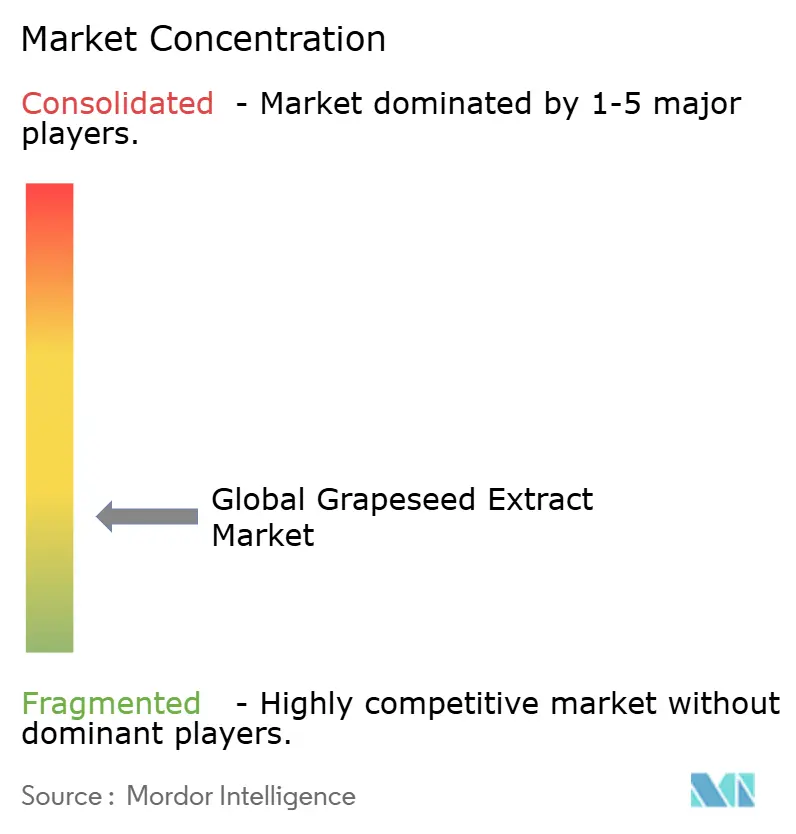
The grape seed extract market is fragmented, where key players use vertical integration and advanced extraction technologies to maintain their market position. Companies like Givaudan S.A., Indena S.p.A., Botanic Innovations, LLC, and Nexira target pharmaceutical-grade applications to maximize their returns on technology investments. These companies focus on quality assurance and regulatory compliance to address the widespread adulteration issues in commercial supplements. Companies actively develop patents for new extraction methods, including nanoparticle preparation technology that improves the absorption of water-insoluble compounds.
New companies enter the market with sustainable extraction technologies and specialty products, such as bio-fungicides and advanced cosmetic formulations. The pharmaceutical sector offers growth potential, especially in heart health management and recovery after heart attacks. Companies that invest in advanced extraction methods like supercritical and subcritical water processing gain advantages in meeting clean-label demands.
Extract manufacturers form partnerships with end-use industries to expand their market presence in functional foods and cosmetics. The market's lower-value segments remain fragmented, creating opportunities for business consolidation as quality and regulatory requirements become stricter across major markets. Companies with strong testing and authentication capabilities continue to gain market share as quality standards increase.
Global Grapeseed Extract Industry Leaders
-
Givaudan S.A.
-
Indena S.p.A.
-
Botanic Innovations, LLC
-
Phyto Life Sciences Private Limited
-
Nexira
- *Disclaimer: Major Players sorted in no particular order
Global Grapeseed Extract Market Companies Covered in this Report
- Givaudan S.A.
- Indena S.p.A.
- Botanic Innovations, LLC
- Phyto Life Sciences Private Limited
- Nexira
- Shaanxi JF Natural Products
- Netqem LLC
- Polyphenolics
- Ambe NS Agro Products Pvt. Ltd.
- Hunan NutraMax Inc.
- Bio-Botanica Inc.
- NP Nutra
- Jeeva Organic Private Limited
- Mitushi Bio Pharma
- Suhani Agro Industries
- Midas Pharma GmbH
- Mrida Greens & Development Private Limited
- Xi'an Healthful Biotechnology Co.,Ltd
- Hebei Xinqidian Biotechnology
- Forward Farma BV
Market Opportunities and Future Outlook
A near-term opportunity is concentrated in formulations that need clearer regulatory pathways and standardized quality, particularly in foods and beverages. FDA has issued no-questions GRAS responses for grape seed extract uses and also recognizes it for flavoring and adjuvant functions, which supports broader form-factor innovation beyond capsules. In Canada, the formal permission framework for grape seed extract as a supplemental ingredient in supplemented foods, together with the transition to compliant market access through December 31, 2025, supports reformulation and relabeling cycles that favor suppliers with specification-aligned, documentation-ready inputs.
Opportunity is also tied to channel and geographic expansion visible in company actions for botanical extracts used in health products. Grape King Bio reported obtaining a Malaysian Direct Selling License in February 2026 and initiating operations in Kuala Lumpur as a regional hub, while also noting that new manufacturing capacities at its Pingzhen (Phase I) and Longtan (Phase II) facilities are scheduled to commence operations in 2026. Separately, the EU approval of Vitis vinifera L. seed extract as a basic substance under plant-protection regulation (Implementing Regulation (EU) 2025/96, January 2025) creates an adjacent, agriculture-linked demand pocket for standardized extracts positioned for viticulture uses, complementing existing demand for dietary supplements, cosmetics, and functional foods.
Recent Industry Developments in Global Grapeseed Extract Market
- February 2026: Grape King Bio obtained a Malaysian Direct Selling License and initiated operations in Kuala Lumpur, positioning the company to commercialize health-product ingredients and finished offerings through a regulated channel. The move broadens market access in Southeast Asia and supports localized go-to-market execution and distribution scale.
- January 2025: The European Commission published Implementing Regulation (EU) 2025/96 approving Vitis vinifera L. seed extract as a basic substance under Regulation (EC) No 1107/2009 for plant protection use. This action expands the addressable application set beyond traditional nutraceutical and cosmetic uses by enabling an agriculture-linked pathway tied to viticulture inputs.
- October 2024: Indena S.p.A. highlighted in vitro research (published in Nutrients) indicating its standardized grape seed extract Enovita could inhibit GABA-T, an enzyme associated with mood and cognitive function. The update supports differentiated positioning for standardized extracts and can influence product development toward cognitive and mood-related benefit platforms within supplements.
Global Grapeseed Extract Market Report Scope and Research Methodology
Market Definition and Coverage
This market covers the value of grape seed extract sold as an ingredient (typically standardized polyphenol-rich extracts) in powder or liquid form, and used across supplements, food, cosmetics, pharmaceuticals, and animal nutrition, across major regions.
Scope exclusions: We exclude cold-pressed grape seed oil and broader polyphenol blends that are not marketed and sold specifically as grape seed extract.
Segments Covered in This Report
- By Form
- Liquid
- Powder
- By Nature
- Conventional
- Organic
- By Application
- Food and Beverages
- Cosmetics and Personal Care
- Pharmaceutical
- Dietary Supplements
- Animal Nutrition
- Others
- By Geography
- North America
- United States
- Canada
- Mexico
- Rest of North America
- Europe
- Germany
- United Kingdom
- Italy
- France
- Spain
- Rest of Europe
- Asia-Pacific
- China
- India
- Japan
- Australia
- Rest of Asia-Pacific
- South America
- Middle East and Africa
- North America
Data Sources, Market Sizing, and Validation
Desk Research
Desk work started with mapping the grape processing by-product chain, from extraction and standardization through ingredient distribution, so the demand pools could be tied back to actual usage. To keep assumptions grounded, we leaned on public sources such as USDA and Eurostat agricultural data, FAOSTAT production series, UN Comtrade trade statistics, and peer-reviewed nutrition and food science journals that discuss typical extract composition and use rates.
We also reviewed company filings, investor presentations, technical brochures, association websites, and reputable business press to understand capacity additions, application mix, and pricing direction. Where needed, we used paid subscriptions for company financials and intelligence, news and financials screening, patent databases, and an import/export shipment-level dataset to support checks on activity and trade flows. The sources listed here are illustrative, and many other public references were also used for data collection, clarification, and cross-checking.
Primary Interviews and Surveys
Primary work focused on interviews and short surveys with extract manufacturers, ingredient distributors, and downstream formulators in supplements, food, and personal care, since these groups see both pricing and volume movement. We covered major consuming regions and asked about typical standardization grades, formulation inclusion rates, channel mix, and how demand shifts with consumer health trends. This input helped validate desk assumptions and close data gaps.
Distribution of primary research fieldwork respondents
| Company type | Respondent position | Region |
|---|---|---|
| Top tier: 38% | CXOs: 12% | APAC: 45% |
| Mid tier: 40% | Functional/Unit leaders: 42% | EMEA: 35% |
| Smaller Players: 22% | Managers: 46% | Americas: 20% |
Market-Sizing & Forecasting
The sizing starts with a top-down build where regional demand is reconstructed using a practical demand pool, namely usage by major end applications that regularly specify botanical extracts. We then translate this demand into value using observed pricing by grade and form. Once that first cut is built, it is corroborated with selective bottom-up approximations, including rolling up a sample of supplier revenues where disclosure exists, channel checks with distributors, and volume and ASP spot checks for common standardized grades.
Key inputs used in the model include extraction yield and standardization norms (which affect the sellable output), the split between powder and liquid formats, application mix across supplements, food, and cosmetics, trade intensity for extract ingredients by region, and observed price bands by polyphenol concentration and order size. When company-level volume is not directly visible, gaps are handled by applying utilization and mix assumptions validated in interviews, and then checking whether the implied totals align with import/export direction and end-market formulation activity.
For forecasting, we used scenario analysis supported by a simple multivariate regression lens, where growth is tied to variables that industry participants could explain clearly, such as supplement category expansion, clean-label product launches, and region-level income and health spending direction. Assumptions on pricing and mix were adjusted only after confirming likely changes in standardization preferences and supply availability with primary respondents.
Data Validation & Update Cycle
Outputs are checked through multiple passes, starting with arithmetic and unit consistency, followed by region and application reasonableness checks, and then variance review against independent demand signals. If a region shows a spike that cannot be explained by known drivers, for example a trade jump without matching downstream use signals, the model is reworked and the related assumptions are revisited.
Before sign-off, an analyst review step compares results against alternative cuts of the model and flags where sensitivity is highest. Follow-up calls are then triggered for any material gaps. Reports are refreshed annually, and interim updates are made when major events occur, such as supply disruptions, regulatory changes affecting botanical claims, or notable capacity shifts. Right before delivery, we do a fresh pass so clients receive the latest updated view.
Mordor Intelligence's Grapeseed Extract Market Size Compared Against Other Published Estimates
Published numbers for grapeseed extract can vary because the market boundary is not always treated the same, and because pricing and application coverage are handled differently across studies. Differences typically come from what is counted as extract versus adjacent grape-derived ingredients, how standardized grades are priced over time, and whether the estimate is checked against real trade and downstream formulation signals.
Import and export movement for botanical extracts, along with consistent shifts in supplement and personal care formulation activity, are the checks that keep Mordor Intelligence tied to grape seed extract sold as a distinct ingredient in powder and liquid forms, instead of drifting into grape seed oil or broader polyphenol blends. Variance can also appear when some publishers lock in a single price assumption or do not test it with distributors, which can understate higher-standardization grades and overstate low-grade volumes.
Benchmark comparison
| Source | Market Size | Gaps in Research Methodology |
|---|---|---|
| Mordor Intelligence | USD 371.39 M (2026) | |
| Trade Journal A | USD 177.80 M (2022) | Uses an older reference year and appears to reflect a narrower ingredient definition, with limited visibility on standardized grade pricing and downstream application coverage. |
| Regional Consultancy B | USD 129.41 M (2025) | Focuses on Vitis vinifera seed extract as a tighter sub-scope and likely excludes parts of the broader commercial grapeseed extract ingredient market, which reduces the total value estimate. |
The spread in the table is mainly explained by scope boundaries and the year used for sizing, followed by how pricing by standardization grade is treated. By keeping inclusions clear and cross-checking with trade direction and application pull-through, the final number stays traceable to a repeatable set of inputs that can be revisited as the market shifts.
Key Questions Answered in the Report
What is the current value of the grape seed extract market?
The market is valued at USD 371.39 million in 2026 and is projected to reach USD 497.68 million by 2031.
Which region leads global demand?
North America holds 35.02% of revenue, driven by a mature nutraceutical sector and ready raw-material access.
Why are liquid grape seed extract formats growing faster than powders?
Liquids absorb more rapidly, blend easily into functional beverages and cosmetics, and benefit from clean-label extraction technologies, supporting an 8.45% CAGR.
How significant is organic grape seed extract?
Although conventional dominates in volume, organic variants are expanding at an 10.92% CAGR as consumers favor certified sustainable ingredients.