
Virology Testing Market Size and Share
Market Overview
| Study Period | 2020 - 2031 |
|---|---|
| Market Size (2026) | USD 13.25 Billion |
| Market Size (2031) | USD 17.56 Billion |
| Growth Rate (2026 - 2031) | 5.79 % |
| Fastest Growing Market | Asia-Pacific |
| Largest Market | North America |
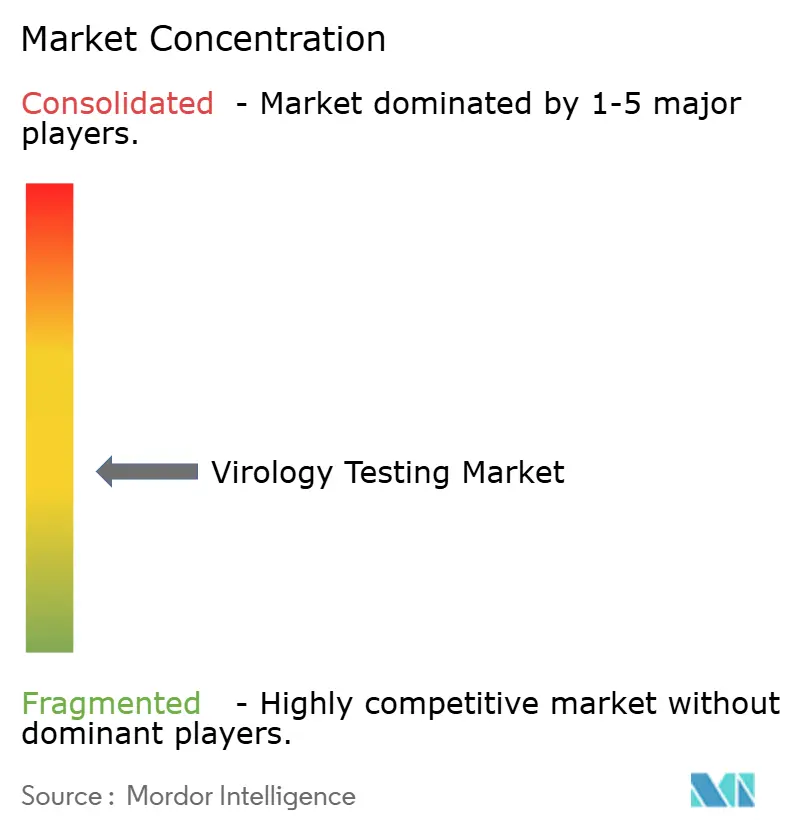
| Market Concentration | Medium |
Major Players *Disclaimer: Major Players sorted in no particular order Image © Mordor Intelligence. Reuse requires attribution under CC BY 4.0. | |
Virology Testing Market Analysis by Mordor Intelligence
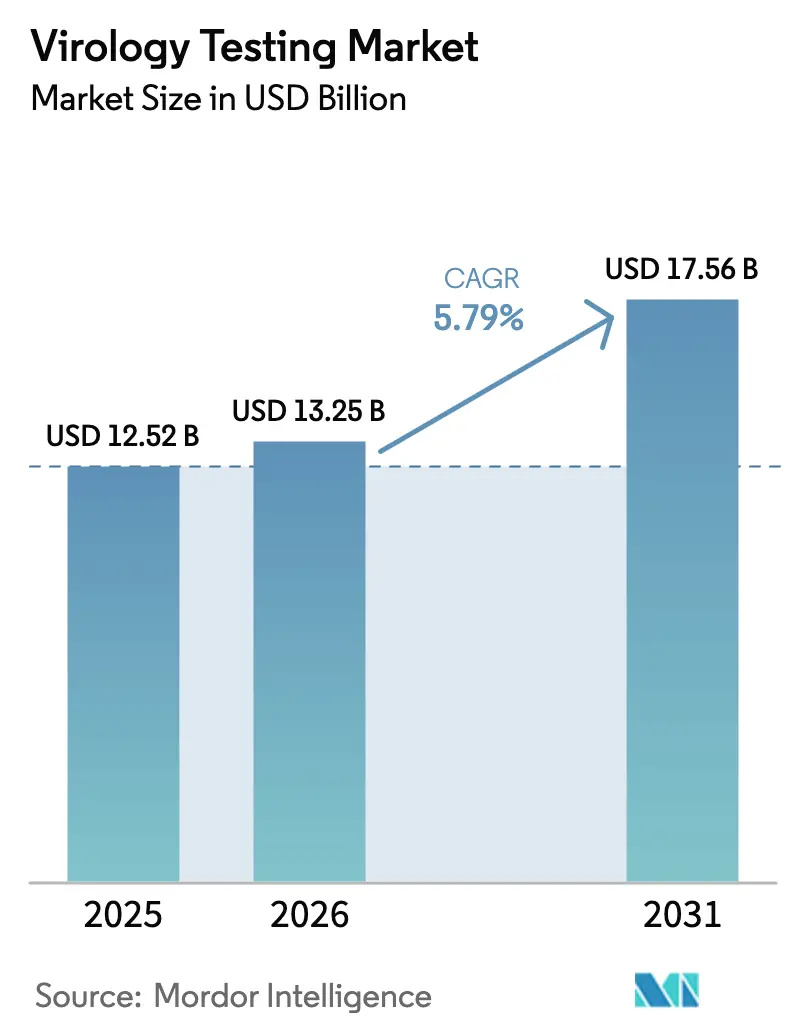
The virology testing market size is expected to increase from USD 12.52 billion in 2025 to USD 13.25 billion in 2026 and reach USD 17.56 billion by 2031, growing at a CAGR of 5.79% over 2026-2031. Laboratories are moving from batch immunoassays to continuous-access molecular systems that trim result times from days to hours, a shift propelled by wastewater-surveillance mandates and strategic stockpiles of multi-pathogen respiratory panels. Consumables commanded 62.46% of 2025 revenue, yet automated instruments will record a 6.76% annual rise through 2031 as hospitals install PCR workcells to handle seasonal testing spikes without adding staff. Molecular diagnostics methods held 49.26% share in 2025 and will grow at 6.67% on the back of FDA-cleared point-of-care platforms such as Cepheid’s CLIA-waived Xpert Bordetella pertussis assay. Centralized laboratories captured 47.89% of 2025 demand, but at-home and self-testing will deliver the quickest 6.81% CAGR as regulatory frameworks mature beyond COVID-19 emergency authorizations.[1]
Key Report Takeaways
- By type, consumables captured 62.46% of 2025 revenue, while instruments will post a 6.76% CAGR through 2031.
- By diagnostic technique, molecular methods accounted for a 49.26% virology testing market share in 2025 and are forecast to grow at a 6.67% CAGR through 2031.
- By testing setting, at-home and self-testing are slated to expand at a 6.81% CAGR between 2026 and 2031.
- By end user, hospitals and clinics will grow at a 6.78% pace, overtaking reference-lab growth.
- By geography, Asia-Pacific is positioned for a 6.89% CAGR to 2031, while North America retained 40.23% of 2025 revenue.
Note: Market size and forecast figures in this report are generated using Mordor Intelligence’s proprietary estimation framework, updated with the latest available data and insights as of January 2026.
Global Virology Testing Market Trends and Insights
Drivers Impact Analysis*
| Driver | (~) % Impact on CAGR Forecast | Geographic Relevance | Impact Timeline |
|---|---|---|---|
| Rising prevalence of viral diseases | +1.2% | Global, with acute pressure in Asia-Pacific and sub-Saharan Africa | Medium term (2-4 years) |
| Growing regulatory clearances for novel assays | +0.9% | North America & EU, spillover to APAC through harmonized submissions | Short term (≤ 2 years) |
| Rapid adoption of molecular POC PCR platforms | +1.4% | North America, Western Europe, urban APAC hubs | Short term (≤ 2 years) |
| Expansion of wastewater-based viral surveillance | +0.7% | North America, Australia, pilot programs in EU and Latin America | Medium term (2-4 years) |
| AI-driven automated laboratory workflows | +0.8% | North America, Western Europe, Japan | Medium term (2-4 years) |
| Government stockpiling of multi-pathogen panels | +0.6% | North America, EU, strategic reserves in Middle East | Long term (≥ 4 years) |
| Source: Mordor Intelligence | |||
Rising Prevalence of Viral Diseases
Outbreaks such as 61 U.S. human H5N1 cases in 2024-2025 pressed state labs to expand PCR capacity. Mpox clade Ib detections in Central Africa triggered WHO emergency declarations that accelerated real-time PCR rollouts.[2] Chronic programs, for example Egypt’s hepatitis C elimination effort, maintain repeat viral-load testing. These parallel clinical and public-health needs sustain demand for flexible multiplex systems that accept new targets without hardware replacement. Dense populations and expanding access in Asia-Pacific and sub-Saharan Africa amplify volume growth, underpinning the 1.2 percentage-point lift in the global CAGR.
Growing Regulatory Clearances for Novel Assays
The FDA’s breakthrough-device pathway shortened review cycles, exemplified by QIAGEN’s QIAstat-Dx Rise, cleared in September 2025 after an expedited process.[3] Europe’s IVDR, despite deadline extensions, is consolidating suppliers as smaller firms exit rather than absorb high conformity costs. Harmonized guidelines from the International Medical Device Regulators Forum encourage simultaneous submissions, accelerating global launches and adding 0.9 percentage points to the CAGR in developed markets.
Rapid Adoption of Molecular POC PCR Platforms
Cepheid’s GeneXpert network now exceeds 30,000 placements, giving emergency departments rapid triage capability. Abbott’s ID NOW surpasses 100,000 units and returns influenza A/B or SARS-CoV-2 results in 13 minutes. A 2024 Journal of Clinical Microbiology study found point-of-care molecular testing cut hospital stay by 1.2 days, saving USD 2,400 per admission. QIAGEN’s QIAstat-Dx Rise fills the mid-volume gap at 160 continuous samples daily. CLIA waiver extensions broaden the addressable market to roughly 200,000 U.S. physician-office labs, giving the driver a 1.4 percentage-point push.
Expansion of Wastewater-Based Viral Surveillance
The CDC’s National Wastewater Surveillance System spans 1,500 U.S. plants, tracking SARS-CoV-2, influenza A, RSV and mpox. Australia will roll out a nationwide pathogen network in early 2026. The UK evaluated automated liquid-handling and PCR workcells that allow seven-day operation without weekend staff, demonstrating labor savings. Standardized reagent kits tailored to inhibitor-rich wastewater matrices form a new, season-independent consumable stream that lifts CAGR by 0.7 percentage points.
Restraints Impact Analysis*
| Restraint | (~) % Impact on CAGR Forecast | Geographic Relevance | Impact Timeline |
|---|---|---|---|
| Stringent product-approval regulations | -0.5% | EU (IVDR transition), emerging markets with evolving frameworks | Medium term (2-4 years) |
| Reimbursement & pricing reforms in key markets | -0.7% | North America (CMS CLFS cuts), Europe (national payer negotiations) | Short term (≤ 2 years) |
| Donor-funding cuts disrupting LMIC HIV testing | -0.4% | Sub-Saharan Africa, Southeast Asia | Short term (≤ 2 years) |
| Global shortage of skilled molecular technologists | -0.6% | Global, acute in North America and Western Europe | Medium term (2-4 years) |
| Source: Mordor Intelligence | |||
Stringent Product-Approval Regulations
IVDR compliance costs can top EUR 500,000 per device family, and notified-body capacity is limited to 30 organizations, creating year-long approval queues. India adopted local-validation rules in 2024, adding further complexity. Smaller assay makers are leaving the EU, narrowing menu variety and shaving 0.5 percentage points off CAGR during the transition.
Reimbursement & Pricing Reforms in Key Markets
CMS cut the Clinical Laboratory Fee Schedule 1.3% in 2025 and Medicare Advantage plans imposed prior authorization for costly molecular tests. Germany’s payer networks negotiated 15%-20% discounts on respiratory panels in 2024. These pricing pressures subtract 0.7 percentage points from CAGR in the short term.
*Our forecasts treat driver/restraint impacts as directional, not additive. The impact forecasts reflect baseline growth, mix effects, and variable interactions.
Segment Analysis
By Type: Instruments Drive Capital Refresh Cycles
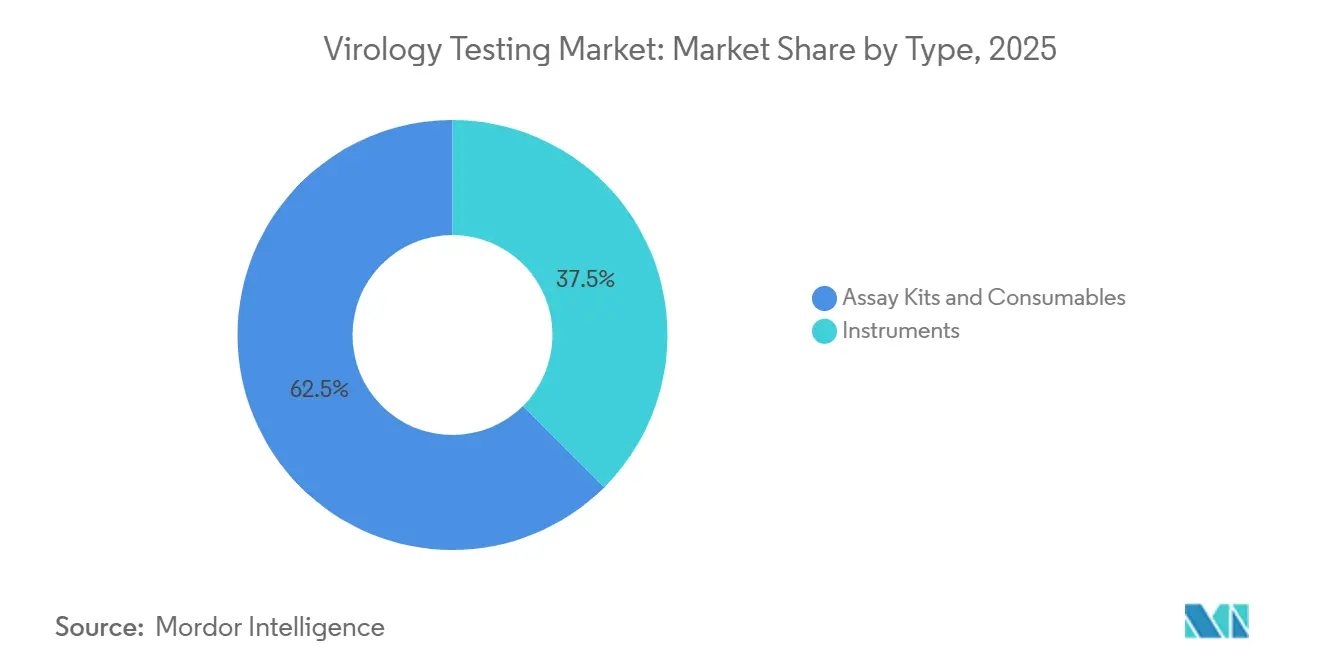
Instruments will climb at a 6.76% pace to 2031, outstripping the overall virology testing market. Hospitals are buying integrated PCR workcells such as Roche’s cobas 5800 to overcome staffing gaps and compress turnaround. Consumables still generated 62.46% of 2025 revenue, anchoring the virology testing market size with recurring sales. Instruments, however, carry 50%-60% gross margins and deliver service-contract annuities, fostering vendor lock-in. Public-sector budget caps in Europe temper adoption, but automation imperatives keep the sub-segment on a faster trajectory.
Consumables will continue to dominate revenue through 2031 as wastewater programs and chronic-disease monitoring lift test volumes. Even so, capital budgets are prioritizing multi-panel PCR systems that accept respiratory, STI and bloodborne targets on a single chassis, keeping instrument growth lively. Validation costs and staff-training hurdles create switching friction that benefits established vendors.
By Diagnostic Technique: Molecular Methods Sustain Dominance
Molecular methods captured 49.26% of 2025 dollars and will advance at a 6.67% clip, steering the virology testing market share toward higher-complexity assays. PCR remains the backbone, bolstered by CLIA-waived cartridges like Xpert Bordetella pertussis.
Falling sequencing costs—USD 200-300 per sample on Illumina’s NextSeq 1000/2000—are making NGS surveillance feasible for routine outbreak response. Immunoassays lose ground as molecular platforms match turnaround speed at declining prices. Mass-spectrometry stays niche for viral work, and culture techniques remain isolated to reference labs.
By Testing Setting: At-Home Testing Rebounds Post-Pandemic
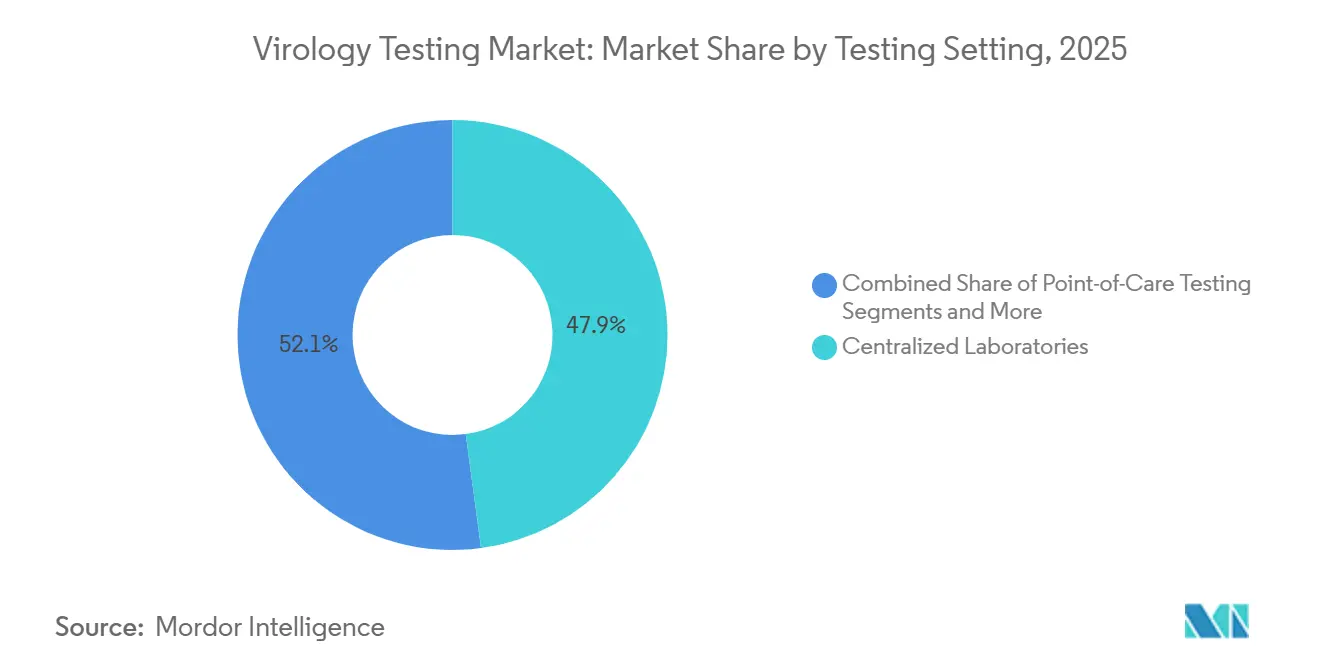
At-home testing will rebound at a 6.81% CAGR, led by FDA-cleared OTC combo tests for flu and SARS-CoV-2. Centralized labs still held 47.89% of 2025 revenue owing to viral-load and genotyping services.
Point-of-care systems like GeneXpert and ID NOW bridge the gap, enabling sub-hour results within clinical workflows. Quality-control warnings from FDA in 2024 spotlight the need for rigorous validation as home tests extend into STI and hepatitis categories.

By End User: Hospitals Gain Share Through Vertical Integration
Hospitals and clinics will edge up at 6.78% through 2031 as health systems internalize testing to curb send-out fees and capture technical revenue. Mid-throughput solutions such as QIAstat-Dx Rise fit hospital daily volumes without batch delays.
Public-health agencies, meanwhile, represent strategic demand anchored in wastewater surveillance, while reference labs grapple with margin compression under CLFS cuts.
Geography Analysis
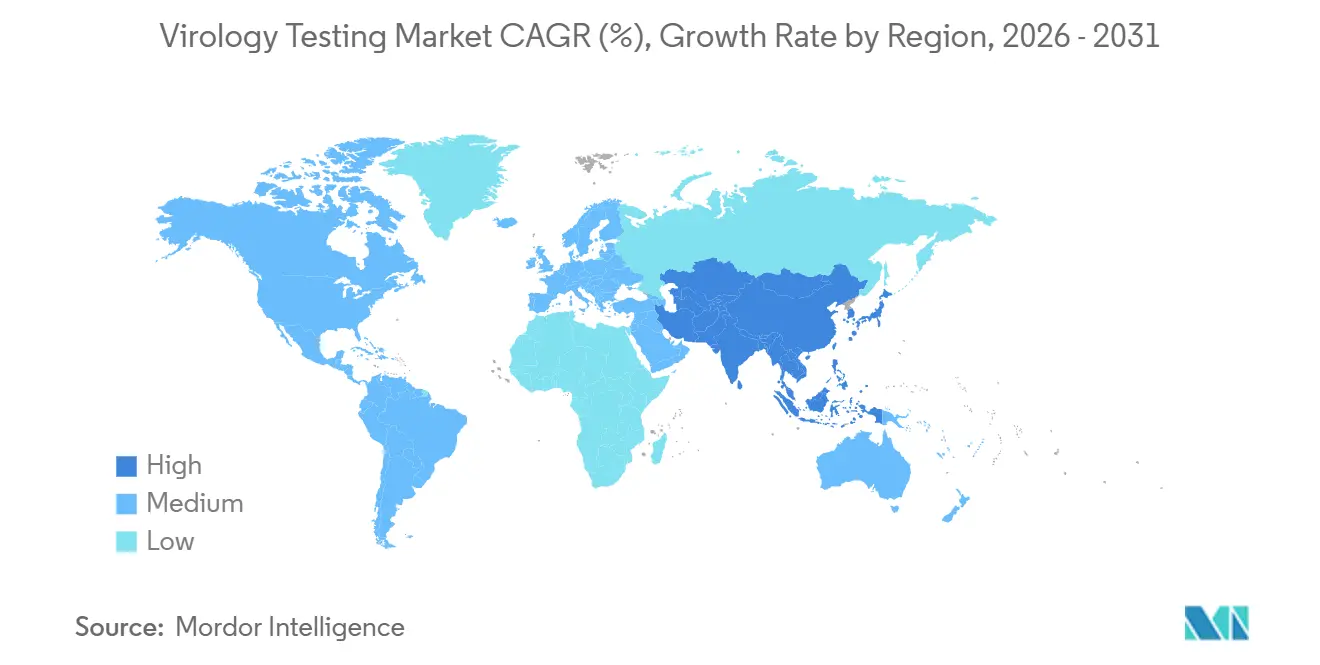
Asia-Pacific’s rapid infrastructure spend and infectious-disease burden position the region for the fastest ascent, even as North America continues to supply 40.23% of 2025 sales. China’s domestic firms leverage lower pricing to win tenders, while India deploys 1,000 district-level PCR labs by 2027. Australia’s nationwide wastewater network exemplifies policy-driven demand outside clinical cycles.
Europe, holding roughly one-quarter of 2025 revenue, is constrained by IVDR compliance costs that push smaller vendors out, narrowing instrument menus but solidifying demand for big-platform replacements. Bulk-purchase price deals in Germany and France hold down ASPs.
Middle East and Africa expand regional hubs to meet fast-response regulations, yet donor-funding cuts threaten sub-Saharan HIV testing continuity. South America adds capacity via public-private deals, but foreign-exchange swings hamper reagent imports, moderating growth.
Regulatory Landscape
Virology testing products operate under tightening in vitro diagnostic (IVD) controls that increasingly distinguish emergency, point-of-care, and laboratory-developed pathways. In the United States, FDA actions in 2025 and 2026 reinforced this direction, including a September 2025 final guidance describing enforcement policies for IVD tests during Section 564 declared emergencies and a June 2026 Federal Register final order that classifies certain SARS-CoV-2 point-of-care devices into class II with special controls, which strengthens post-emergency commercialization requirements.
In Europe, the IVDR transition continues to shape assay availability and supplier participation, with notified-body capacity constraints influencing certification timelines for higher-risk IVDs. Globally, WHO updated its IVD prequalification approach in 2026 by separating performance evaluation from the broader assessment process and revising fee structures, which shifts compliance workload for suppliers targeting tender-driven and donor-funded programs in low- and middle-income countries.
Value Chain Analysis
The virology testing value chain runs from raw-material suppliers (antibodies, enzymes, plastics, oligos) to assay and instrument OEMs, contract development and manufacturing partners, logistics providers (including cold chain), and multi-tier distribution into hospitals, reference labs, and public-health agencies. Large OEMs such as Roche, Abbott, Thermo Fisher, and Danaher (Cepheid) anchor demand through installed bases and closed consumables, while specialist upstream providers such as Fujirebio supply critical IVD components and offer OEM/CDMO services that support menu expansion and private-label production.
Bottlenecks remain around high-purity enzymes and polymerases, specialized plastics and injection-molding capacity for high-throughput consumables, and temperature-sensitive reagent distribution, which can affect lead times during seasonal surges or outbreak response. Evidence of resilience-building includes protocol-level flexibility efforts (for example, validated alternative reagents published for molecular workflows in 2025) and improving availability perceptions in the laboratory channel, where a 2025 industry survey reported higher supply adequacy than in 2024, reflecting normalization after pandemic-era constraints.
Competitive Landscape
The top five suppliers—Roche, Abbott, Danaher, Thermo Fisher and Hologic—collectively command a large share of global revenue. Roche’s cobas 5800 installation in Liverpool cut sexual-health turnaround to one day, underscoring automation value. Danaher’s Cepheid secured CLIA waiver for pertussis cartridges, extending reach to 200,000 U.S. physician-office labs.
Second-tier players, including Seegene and QuidelOrtho, differentiate through broad multiplex menus but face margin pressure from pricing reforms. Oxford Nanopore’s portable sequencers open field-based surveillance opportunities, while QIAGEN’s Rise platform serves mid-volume hospital labs. Agilent embeds AI quality-control in automated workcells to cut manual review by 40%. Regulatory uncertainty over adaptive algorithms may slow high-stakes deployments, but installed-base lock-in keeps competition moderate.
Virology Testing Industry Leaders
-
F. Hoffmann-La Roche AG
-
Bio-Rad Laboratories Inc
-
Hologic Inc.
-
Thermo Fisher Scientific Inc.
-
Abbott Laboratories
- *Disclaimer: Major Players sorted in no particular order
Market Opportunities and Future Outlook
Decentralized and surge-ready molecular capacity is a key whitespace area, backed by wastewater surveillance expansion and regional laboratory infrastructure programs. The CDCs National Wastewater Surveillance System operates across about 1,500 US plants, and Australias planned nationwide pathogen network rollout in early 2026 is translating surveillance into repeat, matrix-specific consumable demand and standardized workflows that are less dependent on seasonal clinical volumes.
Product and technology whitespace is also forming around high-throughput sample-to-answer systems, ultra-precision digital PCR standardization, and field-validated CRISPR assays that reduce sample prep and instrument burden. In June 2026, Bruker launched the MyGenius PRO high-throughput PCR-based sample-to-answer molecular diagnostics system, and in South Korea, BioTNS was selected in June 2026 to host a government program (KRW 30 billion) focused on establishing technical standards for ultra-precision dPCR diagnostics, signaling institutional backing for performance and comparability in next-generation quantitative virology testing. Regional capability build-out further supports demand formation, including the July 2026 designation of the Uganda Virus Research Institute as an East African Community regional centre of excellence in virology, which expands the addressable base for instruments, assays, and training-linked services in emerging markets.
Recent Industry Developments
- July 2026: Roche introduced the cobas Hepatitis D Virus (HDV) test for detection and quantification of HDV RNA for use on cobas 5800, 6800, and 8800 systems in CE-marked countries. The launch broadens standardized viral-load style testing on an established high-throughput installed base, supporting recurring reagent pull-through across multiple lab sizes.
- September 2025: QIAGEN secured FDA clearance for QIAstat-Dx Rise, a continuous-access molecular platform positioned for mid-volume laboratories. The clearance supports faster menu expansion cycles in hospital and health-system labs that are shifting away from batch workflows to reduce turnaround time and staffing pressure.
- October 2024: Healgen obtained FDA authorization for the first over-the-counter combo flu and COVID-19 molecular test. The authorization advances regulated at-home molecular virology testing beyond pandemic-era emergency use pathways and reinforces demand for consumer-friendly, multi-pathogen panels.
Research Methodology Framework and Report Scope
Market Definition and Coverage
For this study, the virology testing market covers revenues generated from testing solutions used to detect, identify, or monitor viral infections across routine clinical diagnosis, outbreak surveillance, and treatment monitoring. The scope includes instrument systems and assay kits, plus consumables used in laboratory and near-patient settings across major regions.
Scope exclusions: We exclude vaccines, antivirals, general microbiology tests that are not virus-focused, and purely academic research workflows that are not used for diagnostic or clinical decision-making.
Segmentation Overview
- By Type
- Instruments
- Assay Kits & Consumables
- By Diagnostic Technique
- Molecular Diagnostics Method
- PCR-based Methods
- NGS-based Methods
- Immunoassay-based Method
- Mass-Spectrometry-based Method
- Others
- Molecular Diagnostics Method
- By Testing Setting
- Centralized Laboratories
- Point-of-Care Testing
- At-Home and Self-Testing
- By End User
- Hospitals and Clinics
- Diagnostic Laboratories
- Public Health and Surveillance Agencies
- Others
- By Geography
- North America
- United States
- Canada
- Mexico
- Europe
- Germany
- United Kingdom
- France
- Italy
- Spain
- Rest of Europe
- Asia-Pacific
- China
- Japan
- India
- Australia
- South Korea
- Rest of Asia-Pacific
- Middle East and Africa
- GCC
- South Africa
- Rest of Middle East and Africa
- South America
- Brazil
- Argentina
- Rest of South America
- North America
Data Sources, Market Sizing, and Validation
Desk Research
Desk research helped us set the market perimeter and build the first draft of demand signals by region, technique, and testing setting. We relied on public and official sources such as the World Health Organization, the US CDC, the European Centre for Disease Prevention and Control, the US FDA public databases for IVD clearances, and the OECD health statistics for contextual health system indicators. Performance references were cross-checked using peer-reviewed journals indexed on platforms such as PubMed.
To convert these signals into sizing inputs, we reviewed company annual reports, investor presentations, and reputable press releases to understand product mix and geography exposure, then checked key assumptions using patent databases and a news and financials subscription for timely event tracking. Where public reporting was thin, we used an import-export shipment-level database and a global contracts and tenders source selectively to sanity-check instrument placements and tender-led procurement. These desk sources are illustrative only, and additional public documents were used to collect, validate, and clarify the final dataset.
Primary Interviews and Surveys
Primary work was used to pressure-test the desk model and to close gaps around real-world test utilization, price movement, and how quickly demand shifts between centralized labs and at-home and self-testing. We spoke with diagnostic lab leaders, hospital procurement and lab managers, distributors, and technical specialists across APAC, EMEA, and the Americas so assumptions could be adjusted for local reimbursement, regulation, and purchasing patterns.
Distribution of primary research fieldwork respondents
| Company type | Respondent position | Region |
|---|---|---|
| Top tier: 34% | CXOs: 16% | APAC: 39% |
| Mid tier: 49% | Functional/Unit leaders: 33% | EMEA: 36% |
| Smaller Players: 17% | Managers: 51% | Americas: 25% |
Market-Sizing & Forecasting
We sized the market using a top-down demand pool build that starts from virology testing volumes and installed capacity indicators, then translates these into revenue using technique-level and setting-level price points. We subsequently checked the results with selective bottom-up approximations, such as sampled ASP times volume for high-usage assays, channel checks on instrument placements, and supplier-side revenue splits by region, to keep totals realistic.
Key inputs included the share shift toward molecular methods, the consumables-to-instrument mix, utilization rates in centralized laboratories, the adoption pace of at-home and self-testing, and the cadence of respiratory and emerging virus seasonality. For forecasting, we used scenario analysis so demand could be flexed based on outbreak intensity, regulatory tightening or easing for self-testing, and lab staffing constraints, then smoothed the final trajectory through year-by-year expert consensus from interviews. Where data gaps showed up in smaller countries, we applied proxy ratios using comparable healthcare spend and testing intensity, then corrected them through regional validations.
Data Validation & Update Cycle
Outputs were validated through multiple cross-checks, including comparing implied test volumes against publicly visible surveillance signals and checking whether price and mix assumptions aligned with procurement and reimbursement realities discussed by respondents. Outliers were flagged when growth rates or regional splits drifted away from known capacity and utilization constraints, and then the assumptions were reviewed by another analyst before sign-off.
The report is refreshed on an annual cycle, and interim updates are triggered when major regulatory changes, outbreak waves, or notable pricing moves materially change the demand curve. Before delivery, we run a final update pass to ensure the latest public releases and key interview feedback are reflected in the model.
Mordor Intelligence's Global Virology Testing Market Size Compared With Other Published Estimates
Published market values for virology testing do not always match because the scope and counting rules are not consistent across sources. The differences usually come from what each source includes as virology testing, for example whether broader infectious disease IVD is folded in, how it treats at-home self-testing, and which year and currency timing are used.
In practice, the biggest gaps are driven by whether revenues are counted only for virus-focused assay kits and consumables plus instruments, or whether adjacent lab categories and related services are also added, which can inflate totals. Another recurring driver is pricing logic, where some estimates hold ASPs flat after COVID-era volatility, while others assume faster price normalization without validating it through lab procurement checks and technique-share updates. In this study, those updates are kept current through re-contacts and setting-level splits before sign-off in Mordor Intelligence.
Benchmark comparison
| Source | Market Size | Gaps in Research Methodology |
|---|---|---|
| Mordor Intelligence | USD 12.52 B (2025) | |
| Trade Journal A | USD 5.86 B (2025) | This figure appears to undercount by emphasizing routine clinical viral test revenue and excluding a wider mix of assay consumables and instrument-linked spend in centralized labs, and it can also treat self-testing as a separate retail category. |
| Regional Consultancy B | USD 7.80 B (2026) | This estimate uses a later base year and can apply conservative utilization assumptions for molecular platforms, which reduces implied consumables pull-through, and it may exclude parts of decentralized testing that are captured when settings are mapped consistently. |
Across the three values, most of the spread can be explained by scope boundaries and by how volumes and prices are connected to technique mix and testing setting. By keeping inputs tied to observable utilization, setting shifts, and price movement, the final number stays traceable to repeatable steps as new data becomes available.
Key Questions Answered in the Report
What is the projected value of the virology testing market in 2031?
It is forecast to reach USD 17.56 billion by 2031, growing at a 5.79% CAGR.
Which segment will grow fastest by testing setting?
At-home and self-testing are set to expand at a 6.81% CAGR through 2031 as regulatory pathways mature.
Why are instruments outpacing consumables in growth?
Hospitals are refreshing capital with automated PCR workcells that handle rising volumes while offsetting technologist shortages, giving instruments a 6.76% CAGR.
Which region shows the strongest growth outlook?
Asia-Pacific is poised for a 6.89% CAGR, driven by expansive laboratory-network investments and streamlined IVD approvals.
How are reimbursement changes affecting U.S. laboratories?
A 1.3% CLFS cut in 2025 is squeezing reference-lab margins and accelerating hospital in-sourcing of molecular testing.
What role does wastewater surveillance play in market expansion?
National programs in the U.S. and Australia create a steady consumable stream independent of seasonal clinical volume, lifting overall demand.