
Suture Anchor Devices Market Size and Share
Market Overview
| Study Period | 2020 - 2031 |
|---|---|
| Market Size (2026) | USD 0.91 Billion |
| Market Size (2031) | USD 1.18 Billion |
| Growth Rate (2026 - 2031) | 5.36 % |
| Fastest Growing Market | Asia-Pacific |
| Largest Market | North America |
| Market Concentration | Medium |
Major Players *Disclaimer: Major Players sorted in no particular order Image © Mordor Intelligence. Reuse requires attribution under CC BY 4.0. | |
Suture Anchor Devices Market Analysis by Mordor Intelligence
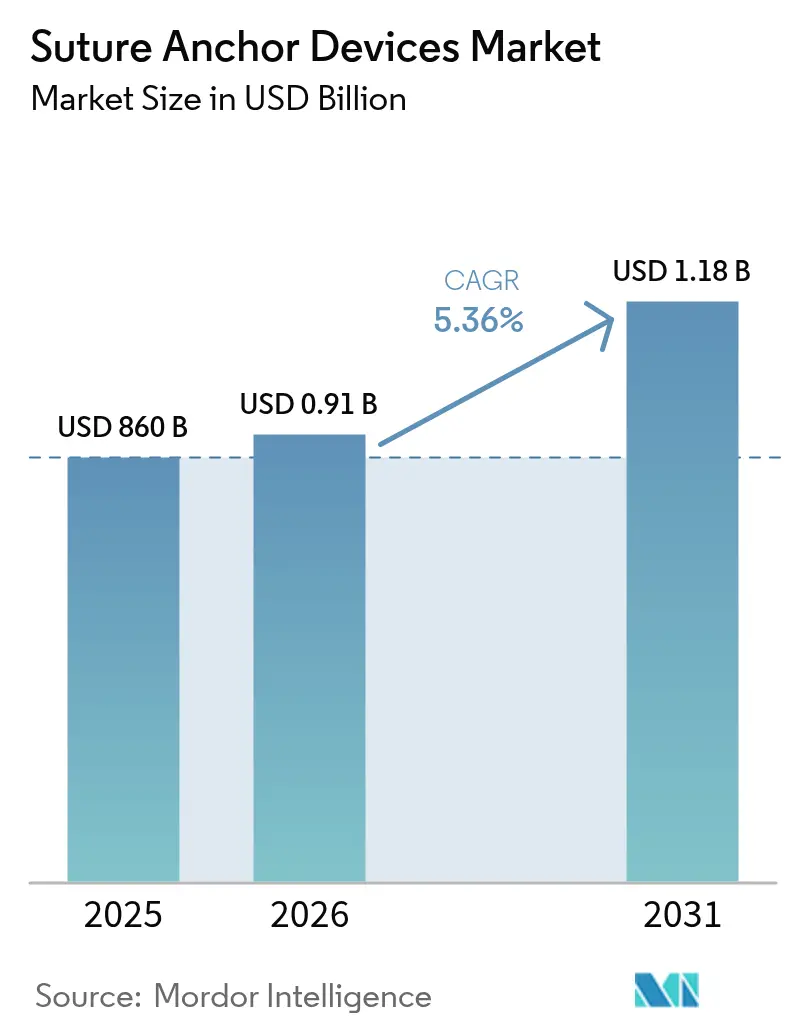
The global suture anchor devices market size was valued at USD 860 million in 2025 and estimated to grow from USD 906.1 million in 2026 to reach USD 1,176.74 million by 2031, at a CAGR of 5.36% during the forecast period (2026-2031). Growth reflects broader adoption of ambulatory surgical centers, advances in minimally invasive arthroscopy, and an aging population actively seeking elective orthopedic care. Knotless fixation, bio-absorbable materials, and tape-based constructs are shaping product differentiation as surgeons favor solutions that simplify technique while preserving post-operative imaging quality. Regulatory clarity around ASTM-recognized absorbable polymers is speeding product approvals, and reimbursement policies that lift outpatient payments by 2.9% in 2025 further stimulate procedure volumes[1]Centers for Medicare & Medicaid Services, “CY 2025 Medicare Hospital Outpatient Prospective Payment System and Ambulatory Surgical Center Payment System Final Rule (CMS 1809-FC),” cms.gov. Competitive intensity is moderate: incumbent multinationals are lengthening portfolios rather than introducing disruptive breakthroughs, while raw-material risk in PEEK supply and looming microplastics restrictions create supply-chain and compliance challenges. Demand in Asia-Pacific is accelerating on the back of expanding middle-class healthcare spending, positioning the region as the fastest-growing contributor to the suture anchor devices market through 2030.
Key Report Takeaways
- By product type, non-absorbable anchors led with 53.02% of the suture anchor devices market share in 2025, while absorbable variants are projected to grow at 8.13% CAGR to 2031.
- By material, PEEK and carbon-reinforced PEEK captured 35.12% of the suture anchor devices market size in 2025; bio-absorbable polymers are advancing at an 8.03% CAGR through 2031.
- By fixation mechanism, knotless systems accounted for 44.18% revenue in 2025, whereas tape-based platforms are forecast to expand at an 8.01% CAGR.
- By application, shoulder repairs held 37.25% of the suture anchor devices market size in 2025; hip procedures are the fastest-growing segment at 9.08% CAGR.
- By end-user, hospitals owned 67.05% revenue share in 2025, while ambulatory surgical centers are climbing at 10.06% CAGR to 2031.
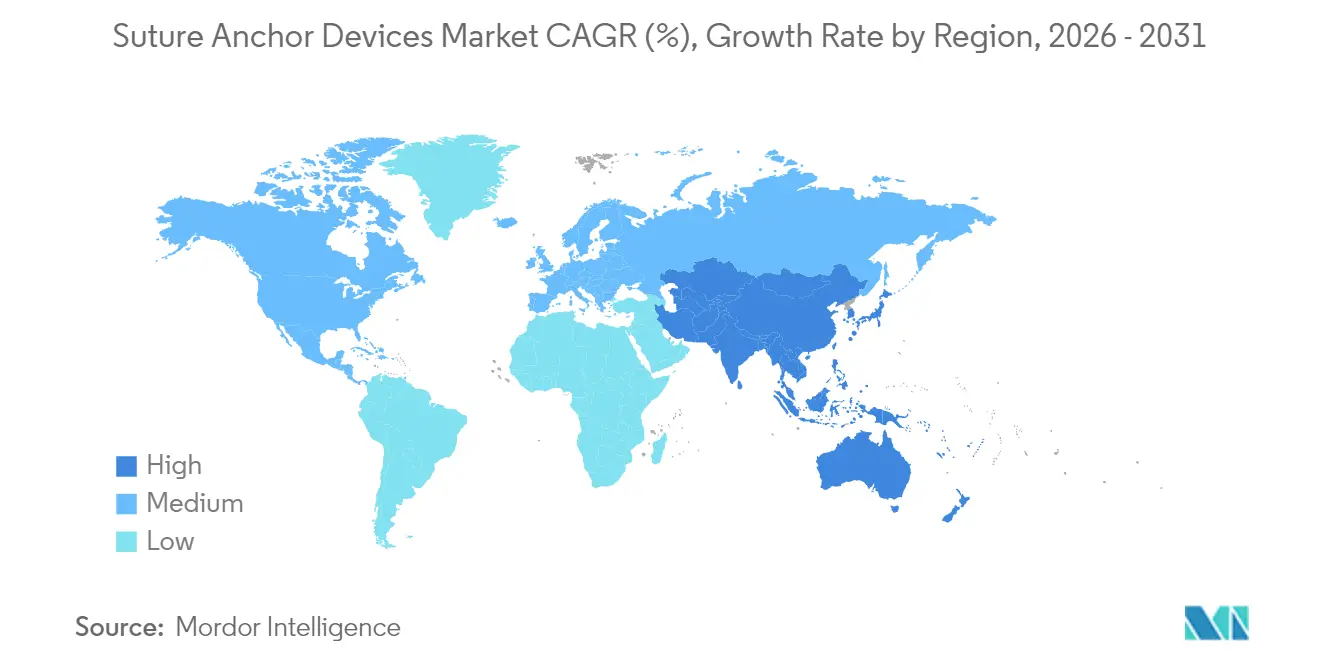
- By geography, North America held 40.33% of 2025 revenue, while Asia-Pacific is advancing at a 9.14% CAGR to 2031.
Note: Market size and forecast figures in this report are generated using Mordor Intelligence’s proprietary estimation framework, updated with the latest available data and insights as of 2026.
Market Trends and Insights
Drivers Impact Analysis of Suture Anchor Devices Market*
| Driver | (~) % Impact on CAGR Forecast | Geographic Relevance | Impact Timeline |
|---|---|---|---|
| Aging-related orthopedic injuries surge | +1.2% | North America & Europe | Long term (≥ 4 years) |
| Growing demand for minimally-invasive arthroscopy | +0.9% | North America & Asia-Pacific | Medium term (2-4 years) |
| Increasing incidence of sports & recreation accidents | +0.7% | North America & Europe | Medium term (2-4 years) |
| Shift toward bio-absorbable anchors to reduce MRI artifacts | +0.6% | Global | Medium term (2-4 years) |
| Advancements in knotless, tape-based anchor platforms | +0.5% | Global | Short term (≤ 2 years) |
| US ASC reimbursement changes favoring anchor-based repairs | +0.4% | United States | Short term (≤ 2 years) |
| Source: Mordor Intelligence | |||
Aging-Related Orthopedic Injuries Surge
An expanding cohort of adults over 65 now drives roughly half of the 18.5 million orthopedic procedures performed annually in the United States. Higher life expectancy and active lifestyles mean more patients present with rotator-cuff tears, osteoarthritis, and hip fractures, all of which routinely require anchor fixation. Germany anticipates knee arthroplasty incidence to climb 55% by 2040, illustrating demographic pull across Europe. In parallel, U.S. outpatient reimbursement uplifts make anchor-based repairs viable in non-acute settings, reinforcing volume growth. These intersecting trends underpin durable demand for the suture anchor devices market.
Growing Demand For Minimally-Invasive Arthroscopy
Nano-arthroscopy has reduced portal size to 2 mm, enabling procedures under local anesthesia that bypass full-scale operating rooms. Arthrex’s NanoScope platform exemplifies this shift with single-use 1 mm imaging sensors that also serve as MRI alternatives. Clinical data show needle arthroscopy produces lower post-op pain scores compared with standard techniques, while ASCs can perform such cases at 26% lower cost than hospital outpatient departments. As minimally invasive preferences deepen, procedure counts—and by extension the suture anchor devices market—are set to rise.
Increasing Incidence Of Sports & Recreation Accidents
Structured surveillance records 128,761 lower-extremity injuries in U.S. track and field during the past decade, with sprains and strains forming nearly half of incidents. Soccer adds 843,063 cases, emphasizing constant ligament and tendon trauma across youth and adult athletes. ACL reconstructions exceed 400,000 annually; advanced anchors and emerging magnesium-based fixation solutions are vital for early mobilization. Such injury statistics create recurrent, procedure-driven pull for the suture anchor devices market.
Shift Toward Bio-Absorbable Anchors To Reduce MRI Artifacts
Permanent metal implants distort follow-up imaging, driving surgeons toward absorbable poly(lactide-co-glycolide) anchors now covered under ASTM F2579-18 standards[2]U.S. Food and Drug Administration, “Recognized Consensus Standards: Medical Devices,” fda.gov. Eliminating artifacts facilitates accurate re-evaluation and secondary interventions. Clinical studies confirm controlled degradation profiles and bone-substitution within 24 months, though polyglycolic acid anchors still trigger inflammatory events in 4.3% of patients. The trade-off between imaging clarity and biocompatibility keeps material innovation front and center across the suture anchor devices market.
Restraints Impact Analysis of Suture Anchor Devices Market*
| Restraint | (~) % Impact on CAGR Forecast | Geographic Relevance | Impact Timeline |
|---|---|---|---|
| Adverse tissue reactions to certain absorbable polymers | -0.8% | Global | Medium term (2-4 years) |
| Premium pricing versus conventional fixation methods | -0.6% | Price-sensitive markets | Long term (≥ 4 years) |
| Emerging micro-plastics regulations targeting degrading polymers | -0.4% | Europe | Long term (≥ 4 years) |
| PEEK supply-chain concentration elevating raw-material risk | -0.3% | Manufacturing regions | Medium term (2-4 years) |
| Source: Mordor Intelligence | |||
Adverse Tissue Reactions To Certain Absorbable Polymers
Polyglycolic acid anchors evoke granulomatous inflammation requiring surgical drainage in 6.3% of cases, with hospital stays averaging 18 days[3]Bone & Joint Journal, “Foreign-body reactions to fracture fixation implants of biodegradable synthetic polymers,” boneandjoint.org.uk. Osteolytic tunnels can appear 12 weeks post-op, compromising fixation integrity. Carbon-fiber PEEK plates also shed particles that elevate local cytokine response. These biocompatibility hurdles temper near-term uptake of newer materials in the suture anchor devices market.
Premium Pricing Versus Conventional Fixation Methods
Advanced anchors can cost more than double stainless-steel screws, challenging adoption where centralized procurement emphasizes lowest-bid awards, as recently observed in China’s volume-based purchasing rounds. Cost-effectiveness studies still favor long-term benefits, but ASC facility managers often hesitate without clear reimbursement offsets, creating friction in expanding the suture anchor devices market.
*Our forecasts treat driver/restraint impacts as directional, not additive. The impact forecasts reflect baseline growth, mix effects, and variable interactions.
Suture Anchor Devices Market Segment Analysis
By Product Type:
Absorbable Momentum BuildsAbsorbable anchors represent the innovation vanguard. In 2025 non-absorbables retained the largest block at 53.02% revenue, yet absorbables are projected to outpace with an 8.13% CAGR. This divergence directly increases the suture anchor devices market size captured by degradable formats as hospitals shift to MRI-friendly post-op protocols. Smith & Nephew’s REGENESORB platform, which converts to bone within two years, embodies the clinical argument for resorption. Surgeons remain cautious because 4.3% of bio-polymer cases show adverse reactions, but ongoing polymer science is trimming complication rates. Government standards like ASTM F2579-18 certify performance criteria, easing tender participation and reinforcing confidence in the suture anchor devices market.
The non-absorbable category still commands surgeon loyalty where high-load bearing and long-term certainty are paramount. Metallic anchors excel in revision scenarios, while expanded PEEK lines deliver bone-like modulus to mitigate stress shielding. As competitive suppliers blend absorbable tips with non-absorbable cores, hybrid designs will blur categorical lines, sustaining wide choice within the suture anchor devices market.


By Material:
PEEK Dominance Meets Bio-Polymer ChallengePEEK and carbon-reinforced PEEK formed 35.12% of overall revenue in 2025, giving this high-performance polymer the single-largest material footprint in the suture anchor devices market share. Machinability and CT-compatibility make PEEK a default in complex shoulder and hip work. Evonik’s VESTAKEEP i4 3DF now enables ASTM F2026-compliant 3-D printed implants, unlocking surgeon-specific geometries. Yet bio-polymers such as PLLA and PLGA are accelerating at 8.03% CAGR, underpinned by degradability and osteoconductive fillers.
Titanium and stainless steel retain niches in trauma and hard-bone fixation where permanent strength overrides imaging concerns. Coralline graft composites and biphasic calcium phosphate-doped PEEK offer middle-ground solutions that encourage bone in-growth. Over the forecast period, material diversity is likely to intensify as suppliers hedge against PEEK supply concentration, cushioning the suture anchor devices market against raw-material shocks.
By Fixation Mechanism:
Knotless Leads, Tape Gains GroundKnotless anchors collected 44.18% revenue in 2025, exemplifying the shift toward streamlined workflows within the suture anchor devices market. Designs like Stryker’s CinchLock eliminate knot stacks, lowering subacromial irritation and speeding closures. Tape-based variants escalate at 8.01% CAGR, widening contact area that diffuses stress and supports biology; retrospective studies report 11% re-tear rates comparable to knotted repairs yet with thicker tendon healing.
Knotted anchors persist for surgeons who value tactile control or need to tailor tension intra-operatively. Second-generation all-suture platforms demonstrate 96.4% success at six months, validating soft anchors in bony avulsion repairs. Across mechanisms, intellectual-property jockeying around self-locking sleeves and expandable braids is expected to sharpen competition inside the suture anchor devices market.
By Application:
Shoulder Volume, Hip VelocityRotator-cuff repair kept 37.25% revenue in 2025, confirming the shoulder as the volume engine of the suture anchor devices market size. Complex double-row “suture-bridge” configurations demand multiple anchors, multiplying unit consumption per case. Nonetheless, hip labral reconstructions and femoroacetabular impingement corrections show 9.08% CAGR, the fastest across joints. Surgeons attribute momentum to earlier MRI recognition and growing athlete populations seeking corrective hip work.
Meniscal, MCL, and ankle stabilization procedures increasingly rely on miniaturized anchors compatible with tight joint spaces. Robotic arthroscopic systems under development integrate automated anchor delivery, promising heightened accuracy and lower variability. These advances will continue to broaden procedure mix within the suture anchor devices market.

By End-user:
Hospital Scale Versus ASC AgilityHospitals still accounted for 67.05% global revenue in 2025, benefiting from integrated care pathways and trauma case inflow. Yet ambulatory surgical centers are projected to climb 10.06% CAGR, reflecting payer incentives and patient preference for same-day discharge. CMS added 21 codes—including rotator-cuff repairs—to the ASC-covered list for 2025, locking anchors into higher outpatient utilization. Specialty orthopedic clinics further fragment demand, targeting sports medicine and geriatric niches.
As hospitals adopt robotic suites and bundled payments, they will emphasize anchor systems compatible with efficiency metrics and digital tracking. In turn, ASCs will negotiate volume-based contracts anchored around knotless, absorbable lines that streamline turnover, collectively expanding the suture anchor devices market.
Geography Analysis
North America Suture Anchor Devices Market
North America generated 40.33% of 2025 revenue and remains the technology bellwether for the suture anchor devices market. Medicare’s 36.2% rise in outpatient shoulder arthroplasty reimbursement, together with a 2.9% facility-wide uplift, reinforces hospital and ASC economics. Canadian universal coverage ensures consistent baseline volumes, while Mexican medical-tourism corridors broaden the regional patient pool.
Europe Suture Anchor Devices Market
Europe contributes stable but slower growth as national health systems impose strict cost containment. Medical Device Regulation (EU) 2017/745 compels recertification of legacy anchors, adding compliance costs yet heightening product quality. Germany’s knee and hip replacement projections underpin procedure demand, whereas microplastics rules effective October 2029 will steer material choices toward eco-compliant polymers.
APAC Suture Anchor Devices Market
Asia-Pacific is on a 9.14% CAGR trajectory, outpacing all regions. Japan showcases early adoption of robotic arthroplasty and absorbable anchors to manage an aging demographic. India and ASEAN nations prioritize capacity investments; reference-market inclusion changes in Australia simplify device approvals, speeding cross-border introduction. Manufacturers with regional assembly or price-band portfolios will capture outsized upside in this high-growth theater of the suture anchor devices market.

Regulatory Landscape
In the United States, suture anchors are typically regulated as Class II devices under 21 CFR 888.3030/888.3040 and generally proceed through the FDA 510(k) pathway with product codes such as MAI and MBI. Approval timelines are closely linked to predicate selection and the bench-testing package, including performance testing for absorbable materials. A key quality-system milestone is the FDA Quality Management System Regulation (QMSR) update that incorporates ISO 13485:2016 by reference into 21 CFR Part 820, effective February 2, 2026, which increases the emphasis on ISO-aligned documentation, risk management, and supplier controls across global manufacturing networks.
In Europe, Regulation (EU) 2017/745 (MDR) governs classification and conformity assessment for implantable and invasive devices based on intended purpose. For suture anchor manufacturers, this raises the compliance burden for legacy portfolios and keeps notified bodies and clinical evaluation central to submissions. Across major markets, ISO 13485:2016 continues to function as the core quality-management reference, while U.S. FDA-recognized consensus standards for absorbable polymers, including ASTM standards referenced within FDA programs, support more standardized evidence packages for resorbable and bio-composite anchor reviews.
Competitive Landscape
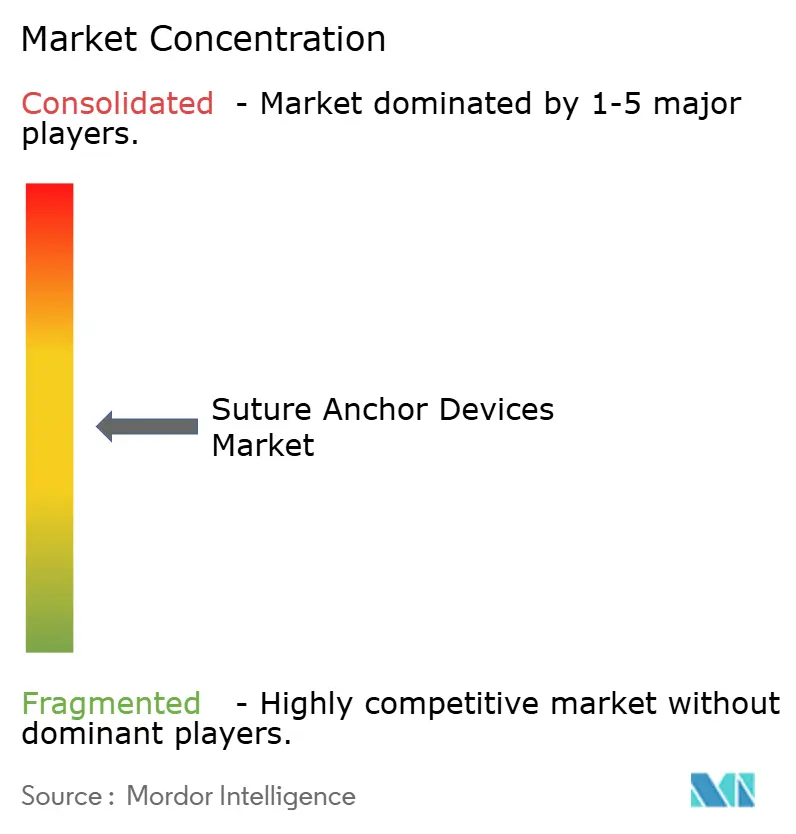
Market concentration is moderate, with Smith & Nephew, Johnson & Johnson, Arthrex, and Zimmer Biomet controlling a majority share through broad catalogs rather than singular blockbuster devices. Platform ecosystems tether anchors to proprietary inserters and sutures, deepening switching costs. Recent examples include Smith & Nephew’s foot-and-ankle tension-adjustment suite and Stryker’s USD 4.9 billion acquisition of Inari Medical to diversify into venous care, both moves enhancing cross-selling leverage.
Emerging entrants exploit material niches—such as fully bio-composite anchors—or leverage additive manufacturing for patient-specific geometries. Tetrous’ EnFix patents extend preload retention mechanisms, highlighting IP skirmishes around fixation biomechanics. FDA technical amendments enabling predetermined change-control plans reduce regulatory friction for iterative upgrades, a boon for agile competitors.
Risk factors include PEEK resin concentration among a handful of suppliers and intermittent shortages affecting lead times. Additionally, bio-polymer biocompatibility events can trigger recalls, impacting brand reputation across the suture anchor devices industry. Strategic hedging through multi-source agreements and diversified material science pipelines is therefore central to sustaining leadership.
Suture Anchor Devices Industry Leaders
Smith & Nephew plc
Zimmer Biomet Holdings
ConMed Corporation
Arthrex, Inc.
Johnson and Johnson (DePuy Synthes, Inc.)
- *Disclaimer: Major Players sorted in no particular order
Suture Anchor Devices Market Companies Covered in this Report
- Smiths Group
- Johnson & Johnson
- Arthrex
- Stryker
- Zimmer Biomet
- Conmed
- Medtronic
- Parcus Medical LLC
- Wright Medical Group
- Teknimed
- Enovis (DJO)
- Integra LifeSciences
- Double Medical
- Anika Therapeutics
- Medartis
- Orthomed SAS
- B. Braun
- OrthAlign Inc.
- Ceterix Orthopaedics
- Teleflex Medical

Market Opportunities and Future Outlook
Product expansion around knotless, all-suture, and bio-integrative constructs is creating near-term whitespace in soft tissue-to-bone repair workflows where surgeons favor simplified technique and imaging-friendly materials. Recent product and regulatory signals include Arthrex releasing the TightRope SB all-suture implant for ACL fixation (February 2026) and receiving FDA 510(k) clearance for Bioabsorbable PushLock Suture Anchors (May 2026). In parallel, OSSIO received FDA 510(k) clearance for the OSSIOfiber Suture Anchor (February 2026). Together, these actions intensify competition around metal-free and absorbable designs that aim to maintain fixation strength while reducing artifact and implant permanence concerns.
Cross-selling opportunities are also widening through M&A and platform bundling that tie anchors to broader repair ecosystems, especially in high-volume shoulder procedures and expanding outpatient settings. Smith+Nephew completed the acquisition of Integrity Orthopaedics (January 2026), adding the Tendon Seam rotator cuff repair system to its shoulder repair portfolio, while continuing product-line updates such as the Q-FIX KNOTLESS All-Suture Anchor release (July 2025). With CMS adding codes including rotator-cuff repairs to the ASC-covered list for 2025, suppliers that bundle anchors with compatible instrumentation and standardized workflows have a clearer route to deepen utilization in ambulatory surgical centers without relying on disruptive, single-device breakthroughs.
Recent Industry Developments in Suture Anchor Devices Market
- May 2026: Smith+Nephew highlighted double-digit growth in its shoulder repair portfolio in its Q1 2026 trading update, citing performance that includes the Q-FIX KNOTLESS All-Suture Anchor. The update positioned knotless, all-suture platforms as core portfolio growth drivers, sharpening competitive focus on simplified arthroscopic workflows.
- December 2025: CONMED announced the Hercules XE Kit with BioBrace Implant for foot and ankle lateral ligament augmentation. The release reflects continued convergence of mechanical fixation with adjunct soft-tissue support solutions, expanding system selling opportunities for ankle stabilization procedures that use anchors and related fixation components.
- June 2025: CONMED received FDA 510(k) clearance for the Argo Knotless Anchor (K251530) under 21 CFR 888.3040. The clearance adds another knotless option in the Class II pathway, reinforcing a crowded innovation lane where incremental design and delivery-tool advantages influence conversion and contracting.


Suture Anchor Devices Market Report Scope and Research Methodology
Market Definition and Coverage
This market covers revenue from suture anchor devices used to fix soft tissue to bone in orthopedic and sports medicine procedures, including arthroscopic and open repairs, counted at the point of device sale across major regions.
Scope exclusions: Interference screws, trauma plates, and other ligament fixation implants are excluded, even when used in the same shoulder or knee procedure.
Segments Covered in This Report
- By Product Type
- Absorbable
- Non-Absorbable
- By Material
- Metal (Titanium / Stainless)
- Bio-absorbable Polymer (PLLA, PLGA)
- PEEK & Carbon-reinforced PEEK
- Hybrid / Bio-composite
- By Fixation Mechanism
- Knotted
- Knotless
- Tape-based
- By Application
- Shoulder-Rotator Cuff
- Hip-Labral & FAIS
- Knee-Meniscal & MCL
- Foot & Ankle
- Elbow & Wrist
- By End-user
- Hospitals
- Ambulatory Surgical Centers (ASCs)
- Specialty Orthopedic Clinics
- Geography
- North America
- United States
- Canada
- Mexico
- Europe
- Germany
- United Kingdom
- France
- Italy
- Spain
- Rest of Europe
- Asia-Pacific
- China
- Japan
- India
- South Korea
- Australia
- Rest of Asia-Pacific
- Middle East and Africa
- GCC
- South Africa
- Rest of Middle East and Africa
- South America
- Brazil
- Argentina
- Rest of South America
- North America
Data Sources, Market Sizing, and Validation
Desk Research
Desk work starts with building a clear procedure and device map so we size only what is actually a suture anchor device. Public sources are used to anchor the demand pool, such as procedure guidance and safety communications from the US FDA, utilization and setting-of-care signals from the US CDC, and reimbursement and coding references published by CMS.
To keep the model realistic by region, we also review clinical and adoption signals in peer reviewed orthopedic journals, along with society or association materials such as AAOS publications and meeting abstracts, plus government health statistics in large markets. These are complemented with company filings, investor decks, and reputable press to interpret product mix shifts (for example, knotless uptake and bio-composite adoption). When needed, we use paid subscriptions for company financials and patent databases to clarify portfolios and price direction. The sources listed here are illustrative only, and many other public references were also reviewed for data collection, cross checks, and clarification.
Primary Interviews and Surveys
Primary work is used to validate the real world split between anchor types and to confirm how hospitals and ambulatory surgical centers purchase and standardize these devices. We speak with a mix of clinicians, procurement leads, distributors, and product specialists across APAC, EMEA, and the Americas, so pricing, utilization by procedure, and near-term changes in technique feed into the final model.
Distribution of primary research fieldwork respondents
| Company type | Respondent position | Region |
|---|---|---|
| Top tier: 35% | CXOs: 17% | APAC: 43% |
| Mid tier: 48% | Functional/Unit leaders: 24% | EMEA: 33% |
| Smaller Players: 17% | Managers: 59% | Americas: 24% |
Market-Sizing & Forecasting
Sizing begins from a top-down demand pool build where procedure volumes and care settings are reconstructed by major country, and then linked to typical suture anchor usage per procedure. Once that structure is stable, we corroborate totals with selective bottom-up checks, such as rolling up a sampled set of supplier revenues by region and sanity checking implied average selling prices against channel feedback.
Key inputs include arthroscopy and sports medicine procedure trends (rotator cuff and labral repair are especially important), anchor-per-case norms for shoulder and knee repairs, mix shifts between knotted and knotless systems, material preferences (metallic, polymer, PEEK, and bio-composite), and price movement tied to contracting and tender behavior. Where company reporting is incomplete, gaps are handled by using peer set ratios, distributor splits, and region-level procedure intensity to avoid overstating smaller countries.
Forecasts are built using scenario analysis, since procedure recovery, outpatient shift, and product mix can change at different speeds by region. The final outlook is set after expert feedback aligns on the likely direction of procedure volumes, implant usage per case, and price erosion or premiumization over the forecast window.
Data Validation & Update Cycle
Before sign-off, results are triangulated across three lenses, which are procedure-based demand, supplier-side revenue reasonableness, and implied pricing by anchor type. Outliers are flagged at country and region level, and then reworked when a mismatch shows up against known surgery trends, reimbursement shifts, or channel structure.
A second analyst reviews assumptions, calculations, and unit logic, followed by a final consistency check across all tables and narrative claims. The report is refreshed annually, and interim updates are made when material events occur, such as major regulatory actions or step changes in procedure volumes. Before delivery, we do a fresh pass on key indicators so clients receive the most up to date view available.
Mordor Intelligence's Global Suture Anchor Devices Market Size Compared Against Other Published Estimates
Published market values for suture anchor devices can look different because the scope line is not drawn the same way, and because procedure and pricing assumptions are refreshed on different schedules. Differences also come from how firms handle outpatient migration, knotless adoption, and how they translate clinical volume signals into device demand.
Interference screws are a frequent add-on in some estimates, yet this item sits outside Mordor Intelligence's scope for the suture anchor devices market, which narrows the count to anchors used for soft tissue reattachment. Another common gap is the year used for currency conversion and whether values are held constant or allowed to float with FX, and then there is the question of how aggressively anchor-per-case and ASP are pushed upward as new systems launch.
Benchmark comparison
| Source | Market Size | Gaps in Research Methodology |
|---|---|---|
| Mordor Intelligence | USD 0.91 B (2026) | |
| Trade Journal A | USD 0.87 B (2025) | Uses a different base year and tends to rely on manufacturer-reported market totals, with limited clarity on whether outpatient procedure mix and constant-currency conversion are applied consistently. |
| Global Consultancy B | USD 0.87 B (2025) | Starts from a broad orthopedic repair spend pool and applies penetration assumptions, which can understate device-per-case variation and may blend adjacent fixation implants into the same bucket. |
The spread in the table is mostly explained by what gets included alongside anchors, how procedure volume is translated into anchor demand, and the currency year used for conversion. By tying the count to procedure-driven usage and then checking the implied pricing and revenue totals, the final number stays traceable to practical inputs that can be revisited as clinical practice changes.


Key Questions Answered in the Report
What is the current size of the suture anchor devices market and how fast is it growing?
The market is valued at USD 906.1 million in 2026 and is forecast to reach USD 1,176.74 million by 2031, growing at a 5.36% CAGR.
Which product types are expanding the quickest?
Absorbable anchors show the fastest momentum, advancing at an 8.13% CAGR as surgeons favor MRI-friendly, resorbable solutions.
Why are knotless and tape-based fixation systems gaining popularity?
They shorten operating time, reduce soft-tissue irritation, and provide load distribution that supports better healing, driving an 8.01% CAGR for tape-based designs.
Which region offers the highest growth potential through 2031?
Asia-Pacific leads with a projected 9.14% CAGR, buoyed by expanding healthcare infrastructure and rising middle-class demand for advanced orthopedic care.
What key factors may restrain market growth?
Adverse tissue reactions to certain bio-polymers, premium pricing pressures in cost-sensitive markets, and upcoming microplastics regulations could temper adoption.
Page last updated on:


 Your data is secure and never sold or shared.


