
Specialty Paper Market Size and Share
Market Overview
| Study Period | 2020 - 2031 |
|---|---|
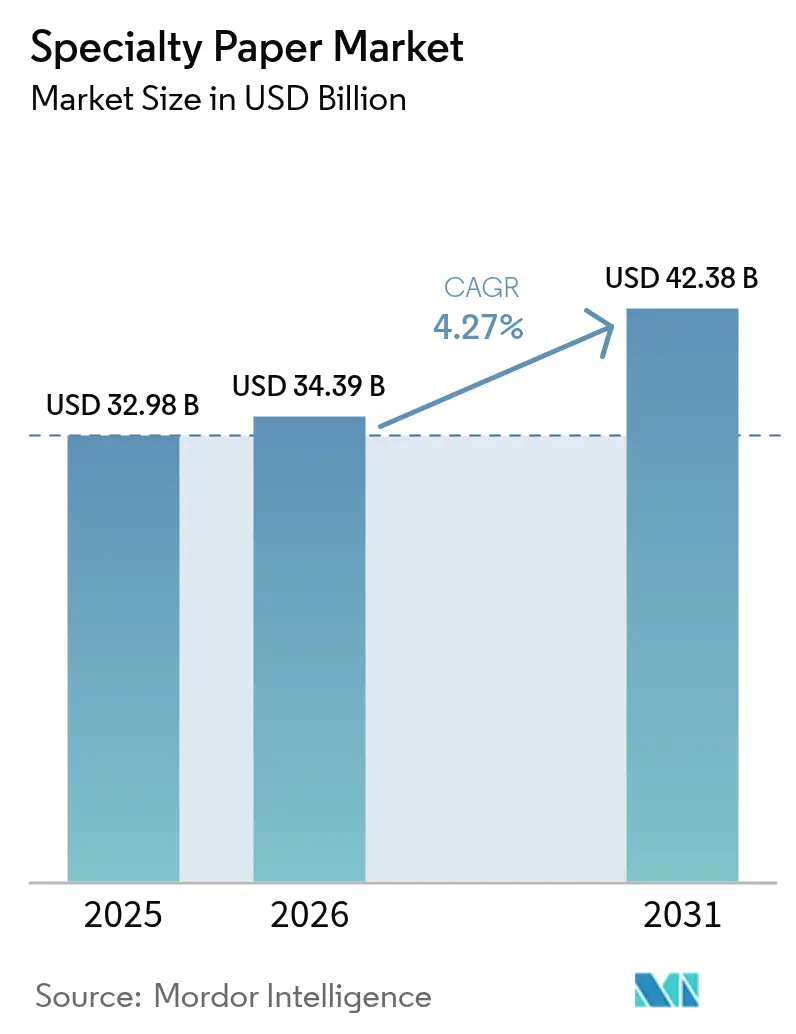
| Market Size (2026) | USD 34.39 Billion |
| Market Size (2031) | USD 42.38 Billion |
| Growth Rate (2026 - 2031) | 4.27 % |
| Fastest Growing Market | Asia-Pacific |
| Largest Market | Europe |
| Market Concentration | Medium |
Major Players *Disclaimer: Major Players sorted in no particular order Image © Mordor Intelligence. Reuse requires attribution under CC BY 4.0. | |
Specialty Paper Market Analysis by Mordor Intelligence
The specialty paper market size was valued at USD 32.98 billion in 2025 and estimated to grow from USD 34.39 billion in 2026 to reach USD 42.38 billion by 2031, at a CAGR of 4.27% during the forecast period (2026-2031). This trajectory mirrors the global shift toward fiber-based packaging, heightened regulatory scrutiny of single-use plastics, and the rise of smart functionality requirements in labels and electronics. Consolidation among leading producers, exemplified by multibillion-dollar packaging mergers, is generating scale efficiencies while unlocking wider geographic reach. Europe presently leads demand, yet Asia-Pacific is expanding faster on the back of e-commerce penetration, capacity additions, and electronics manufacturing growth. Raw-material volatility and chemical-additive rules remain key risks, putting a premium on integrated pulp ownership and agile coating technologies.
Key Report Takeaways
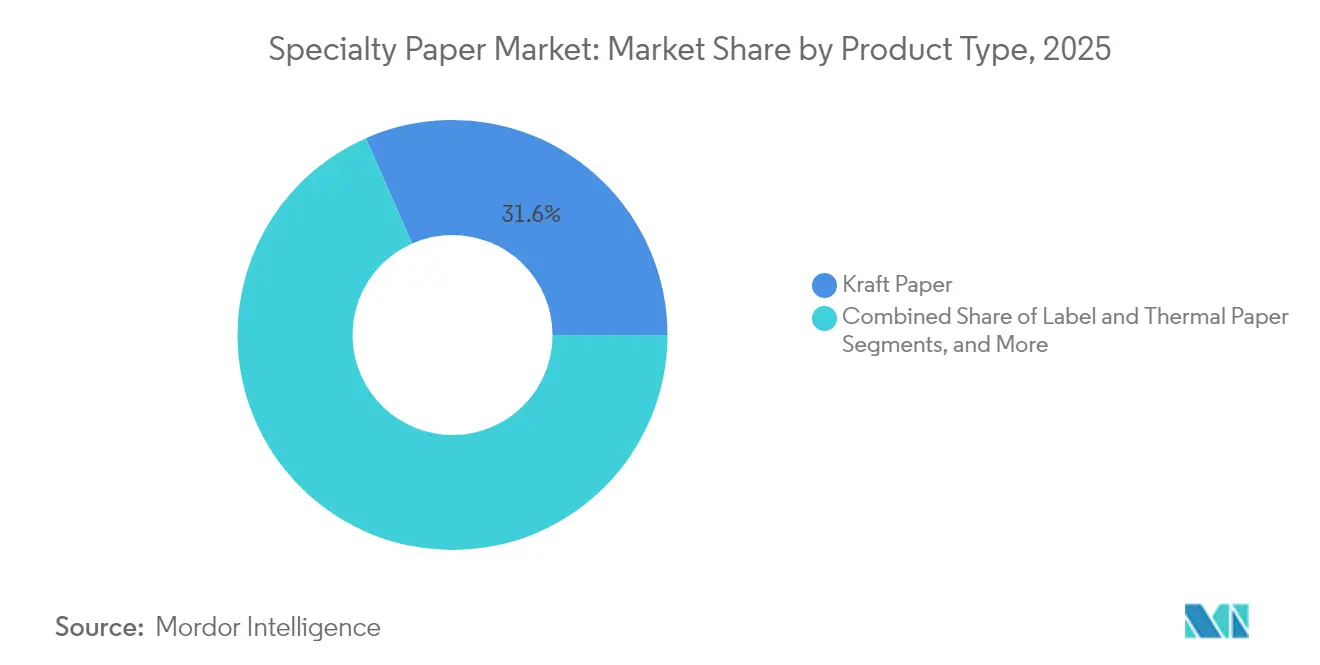
- By product type, kraft paper accounted for 31.60% of the Specialty Paper market share in 2025, while release-liner paper is set to grow at a 6.18% CAGR to 2031.
- By raw material, virgin fiber commanded 48.40% share of the Specialty Paper market size in 2025; recycled fiber is forecast to advance at 5.15% CAGR through 2031.
- By functionality, barrier and grease-proof grades held 58.10% revenue share in 2025, whereas anti-microbial papers are projected to expand at a 5.10% CAGR to 2031.
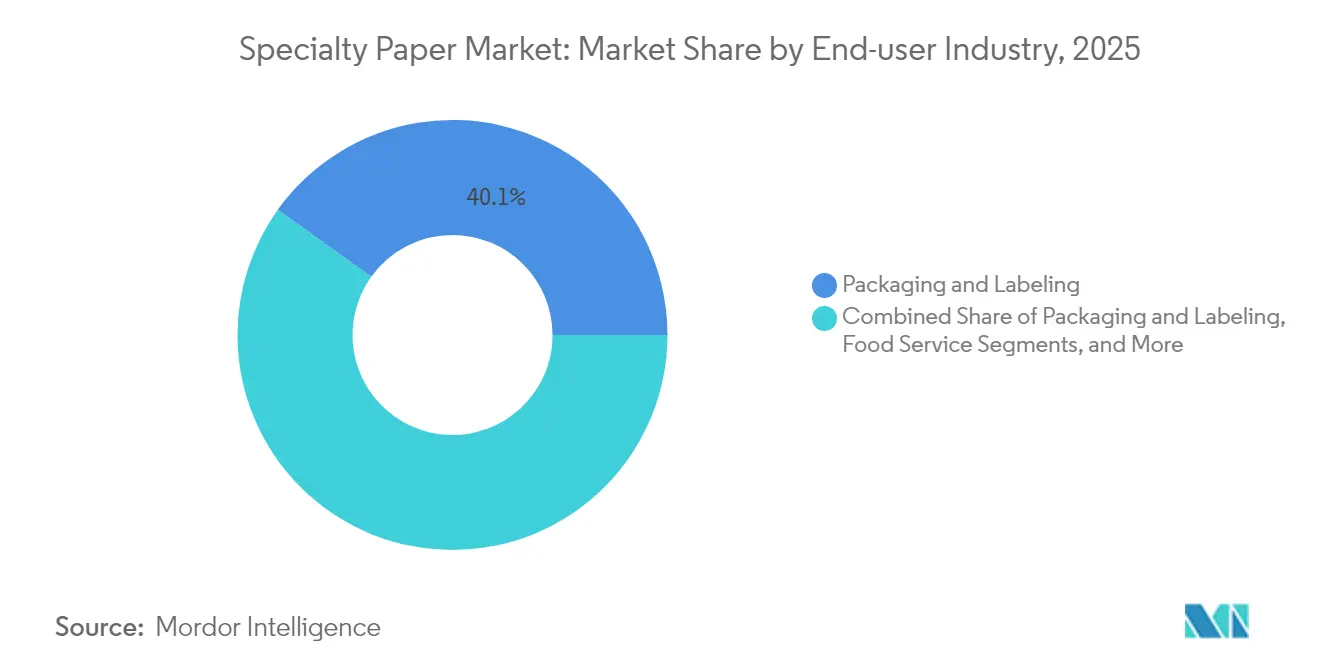
- By end-user industry, packaging and labeling led with a 40.10% share in 2025, while medical and healthcare is the fastest-growing segment at 5.45% CAGR.
- By form, sheets dominated with 52.70% share of the Specialty Paper market size in 2025; rolls are projected to post a 5.55% CAGR over the forecast period.
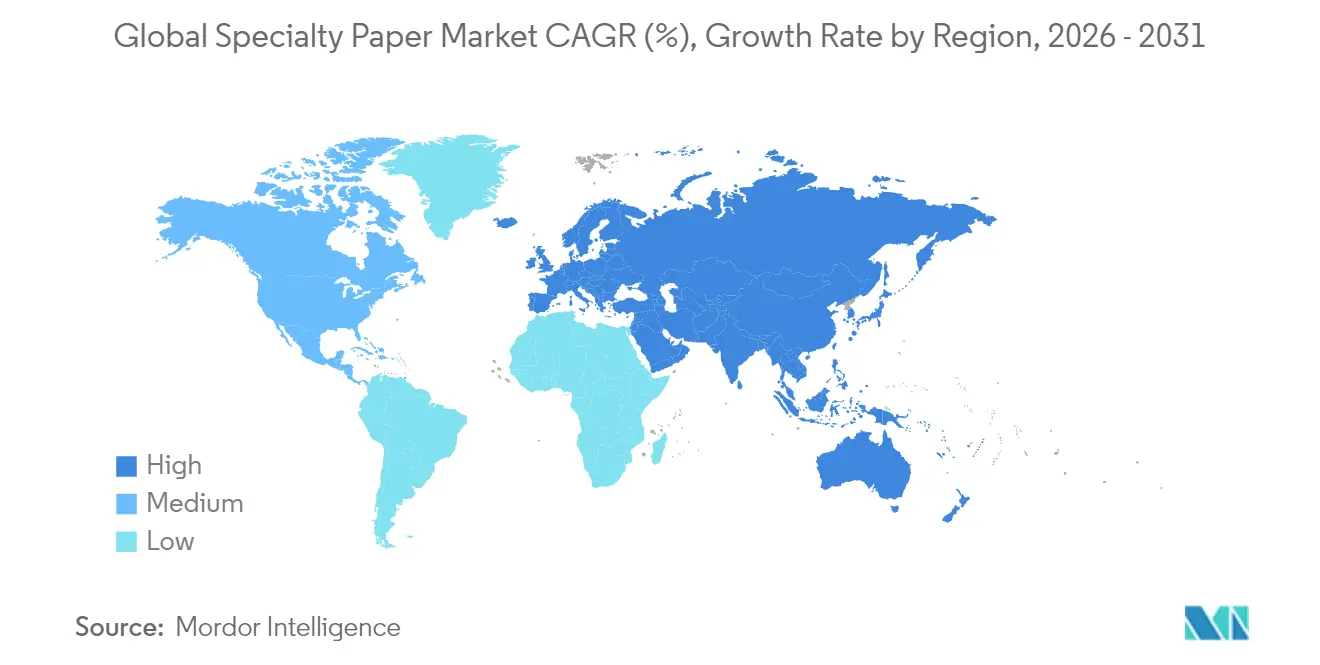
- By geography, Europe captured 32.70% of the Specialty Paper market share in 2025; Asia-Pacific is advancing at a 6.05% CAGR through 2031.
Note: Market size and forecast figures in this report are generated using Mordor Intelligence’s proprietary estimation framework, updated with the latest available data and insights as of 2026.
Market Trends and Insights
Drivers Impact Analysis of Specialty Paper Market*
| Driver | (~) % Impact on CAGR Forecast | Geographic Relevance | Impact Timeline |
|---|---|---|---|
| E-commerce push for sustainable packaging | +0.8% | North America and Europe | Medium term (2-4 years) |
| Food-service shift to fiber disposables | +0.6% | Developed market worldwide | Short term (≤ 2 years) |
| Smart-label release-liner demand | +0.4% | North America and Europe | Medium term (2-4 years) |
| Flexible printed-electronics substrates | +0.3% | Asia-Pacific primary | Long term (≥ 4 years) |
| Security papers for pharma | +0.2% | Global hubs | Medium term (2-4 years) |
| PFAS-free grease-proof coatings | +0.5% | North America and EU | Short term (≤ 2 years) |
| Source: Mordor Intelligence | |||
E-commerce Push for Sustainable Packaging
Rapid online retail growth is accelerating the “paperization” of secondary and tertiary packaging as brands phase out plastics to meet Extended Producer Responsibility mandates[1] International Paper, “2025 Sustainability Report,” internationalpaper.com. Retailers now specify certified fiber, recyclable formats, and lower basis-weight kraft grades that reduce freight costs without compromising load integrity. Continuous order fulfillment drives demand for printable kraft mailers and molded-fiber cushioning, anchoring stable volume gains across shipping categories. Producers with integrated kraft assets capture margin upside because they can flex pulp streams toward high-growth e-commerce variants while mitigating raw-material shocks.
Food-Service Shift to Fiber-Based Disposables
Legislated single-use plastic bans in Europe, North America, and key Asian cities have triggered a swift migration to fiber utensils, cups, and clamshells. Advances in grease-proof barrier chemistries now enable paper containers to tolerate hot oils and sauces, allowing quick-service restaurants to meet compostability targets. Chain-level contracts prioritize post-consumer recycled content, supporting wider collection and re-pulping infrastructure. Volume visibility in food-service channels encourages multi-machine retrofits at mills specializing in cupstock and lightweight MG papers, boosting asset utilization.
Smart-Label Release-Liner Demand Surge
Connected-packaging programs in retail and logistics integrate RFID and NFC labels to automate inventory tracking and enhance shopper engagement. New plastic-free inlays, such as Trimco’s PaperMark platform, rely on FSC-certified release-liner paper that offers dimensional stability for precise die-cutting. Digital press penetration toward 10% of label volume by 2029 raises quality requirements for release substrates, driving specification upgrades that favor specialty grades over commodity glassine. As omnichannel fulfillment scales, liner recycling initiatives gain traction, extending circular-economy credentials for converters and brand owners alike.
Flexible Printed-Electronics Substrates
Printing advances now deposit conductive polymers and graphene onto coated paper, enabling cost-effective sensors, batteries, and antennas for wearables and packaging. Pilot trials in South Korea and Japan demonstrate roll-to-roll throughput compatibility with legacy flexographic lines, lowering adoption barriers. Performance parity with polymer films on bend radius and moisture resistance is within reach through multilayer coatings, opening a new addressable frontier for high-margin grades tailored to electronics supply chains.
Restraints Impact Analysis of Specialty Paper Market*
| Restraint | (~) % Impact on CAGR Forecast | Geographic Relevance | Impact Timeline |
|---|---|---|---|
| Pulp-price volatility and supply shocks | -0.7% | Global, with acute impact in Europe and North America | Short term (≤ 2 years) |
| Chemical-additive regulatory tightening | -0.4% | Europe and North America primarily | Medium term (2-4 years) |
| High-clarity mono-material plastic films | -0.3% | Global, strongest in Asia-Pacific and North America | Medium term (2-4 years) |
| Slow ink-jet press adoption in EMs | -0.2% | Emerging markets, particularly Latin America & Africa | Long term (≥ 4 years) |
| Source: Mordor Intelligence | |||
Pulp-Price Volatility and Supply Shocks
Benchmark Northern Bleached Softwood Kraft touched EUR 1,380 per metric ton in April 2024 after labor actions in Finland and mill incidents curtailed supply, squeezing specialty margins. Spot price spikes force non-integrated converters to adjust pricing quarterly, risking customer churn. Climate-related fiber disruptions and limited greenfield capacity suggest enduring volatility, reinforcing the strategic value of captive pulp or long-term chip contracts.
Chemical-Additive Regulatory Tightening
EU and US agencies are phasing out PFAS, mineral-oil inks, and select biocides, compelling mills to accelerate R&D pipelines for compliant barrier systems. Compliance validation and line-scale trials add cost and slow commercial rollouts, burdening smaller players that lack formulation capacity. The resulting squeeze may accelerate consolidation yet also elevate switching costs, fortifying incumbent relationships with brand owners that demand assured regulatory continuity.
*Our forecasts treat driver/restraint impacts as directional, not additive. The impact forecasts reflect baseline growth, mix effects, and variable interactions.
Specialty Paper Market Segment Analysis
By Product Type:
Kraft Paper Holds Scale While Release-Liner Gains PaceKraft grades generated the largest revenue contribution at 31.60% Specialty Paper market share in 2025, buoyed by industrial sacks, carrier bags, and burgeoning e-commerce mailers. The Karlsborg mill in Sweden alone produces 335,000 tons of sack kraft per year, underscoring the scale economics backing this position. Growth now tilts toward release-liner paper, which is forecast at a 6.18% CAGR through 2031 on the strength of RFID-enabled labels and rising digital press adoption. Smart labels require ultra-smooth calipers and calibrated density, steering converters toward engineered liner substrates and away from commodity options. Décor and laminating papers remain sizeable yet see share pressure from digital décor films, while filter and security papers preserve niche relevance through exacting performance criteria and embedded anti-counterfeit features.
Structural demand for high-purity fiber and tighter moisture control anchors long-term kraft capacity commitments even as liner innovations capture incremental value. Producers diversify grade slates to hedge against cyclical swings, but capital allocations now prioritize coating flexibility to address the liner opportunity. This bifurcation within the Specialty Paper Market fosters a portfolio mix where heritage kraft volumes finance next-wave liner technology upgrades.


By Raw Material:
Recycled Fiber Momentum Builds Despite Virgin DominanceVirgin fiber held 48.40% of the Specialty Paper market size in 2025 owing to tensile and porosity thresholds demanded by premium labels, security stock, and medical wraps. Yet recycled fiber is charting a 5.15% CAGR to 2031 as circular-economy mandates normalize recovered-content ratios and as brown recycled pulp grades reach specifications suitable for barrier-coated packaging. The Specialty Paper market size attached to synthetic and hybrid compositions remains modest, but these materials enable unique properties such as solvent resistance for automotive gaskets.
Non-wood pulps drawn from bamboo and agricultural residue are advancing through new enzymatic processes that mitigate silica contamination. Cost parity with hardwood chips remains elusive, constraining scale, yet brand-owner carbon disclosures are incentivizing trial volumes. Mills armed with dual-fiber systems can toggle furnish recipes to offset pulp pricing spikes, enhancing resilience during volatile cycles.
By Functionality/Coating:
Barrier Grades Lead; Anti-Microbial Rises FastBarrier and grease-proof papers captured 58.10% Specialty Paper market share in 2025, reflecting pervasive uptake across quick-service packaging and frozen foods. PFAS withdrawal deadlines have catalyzed investment in algae-based and mineral-oil-free barriers certified for fatty and acidic contact. Anti-microbial papers, though smaller in volume, are expanding at a 5.10% CAGR as hospitals adopt germ-inhibiting wraps amid heightened infection-control protocols.
Conductive and antistatic coatings are garnering pilot orders from electronics assemblers, signaling a fusion of paper with functional chemistries once exclusive to polymers. Water-resistant and fire-retardant segments sustain moderate growth linked to outdoor signage and industrial gasketing. Suppliers differentiate through modular coating stations that accommodate quick chemistry swaps, enabling agile compliance with divergent regional safety codes.
By End-User Industry:
Packaging Dominates; Medical AcceleratesPackaging and labeling applications retained 40.10% market share in 2025 as e-commerce, shelf-ready formats, and personalization lifted volumes in corrugated liner, folding carton, and label laminate. The medical and healthcare segment is projected to outpace at 5.45% CAGR, fueled by rising biologic drug launches that require high-barrier, tamper-evident paper-foil structures. Food-service outlets boost specialty demand through compostable cupstock and grease-proof wraps, while printing and publication volumes continue to migrate to digital media.
Building and construction demand persists in décor laminates and overlay papers for engineered wood, though economic slowdowns may temper near-term uptake. Industrial filtration media for transportation and energy maintain defensible niches, with emerging traction in hydrogen fuel-cell separator prototypes. This end-user diversification anchors the Specialty Paper Market against sector-specific shocks.
By Form:
Sheets Prevail; Rolls Outpace GrowthSheets constituted 52.70% revenue in 2025, integral to offset printing and specialty converter workflows that favor cut-size efficiency. Rolls, however, are on course for a 5.55% CAGR as high-speed label, masking-tape, and RFID inlay lines optimize continuous web throughput. Converters cite lower trim waste and faster job changeovers when sourcing master rolls, spurring mills to upgrade winding and reel diameters.
Converted products such as retail bags, tapes, and cups continue to capture downstream value, with machine manufacturers reporting steady order pipelines for nested-forming and pleating equipment. The shift to rolls mirrors the automation imperative within the Specialty Paper Market, pushing upstream producers to guarantee tight CD moisture profiles that safeguard web stability under elevated line speeds.
Geography Analysis
Europe Specialty Paper Market
Europe remained the largest regional contributor at 32.70% Specialty Paper market share in 2025, underpinned by strict environmental statutes that accelerate conversion from plastics to fiber. Monthly paper and board output rebounded from the 2023 energy shock as mills optimized CHP configurations and locked in renewable electricity contracts. Germany and France lead eco-ink adoption and mineral-oil phase-outs, directing order flow toward low-migration label stock. Yet energy cost inflation has precipitated selective capacity closures, including UPM’s Ettringen site slated to cease operations in July 2025. Consolidation, such as Heinzel Group’s acquisition of Steyrermühl, signals a tightening asset base geared toward higher-margin grades.
APAC Specialty Paper Market
Asia-Pacific is the fastest-growing territory at a 6.05% CAGR to 2031. China’s rebound in containerboard demand and Nine Dragons Paper’s Malaysian expansion illustrate a southward capacity realignment that taps proximate ASEAN markets, predicting 4% cardboard growth per year. Electronics supply chains in Japan and South Korea spur demand for conductive and antistatic papers, while India’s rising disposable-income levels lift specialty food-service grades. Regional governments channel stimulus into waste-paper collection infrastructure, broadening recycled-fiber availability that fuels local specialty conversions.
North America Specialty Paper Market
North America records steady mid-single-digit growth as nearshoring and packaging automation offset mature publishing segments. Investment programs such as Kimberly-Clark’s USD 2 billion expansion underscore confidence in long-run tissue and specialty capacity economics. Simultaneously, mega-mergers like Smurfit WestRock consolidate corrugated integration, enabling cost synergies and wider customer reach. The US South attracts greenfield pulp projects due to forest proximity and competitive energy tariffs, supporting integrated models better positioned to weather pulp price gyrations.

Regulatory Landscape
Regulation is accelerating substitution from plastics to fiber while tightening chemistry compliance for specialty grades used in foodservice and packaging. In the European Union, the Packaging and Packaging Waste Regulation (EU) 2025/40 entered into force on 11 February 2025 and applies from 12 August 2026, setting a harmonized framework that supports recyclability requirements and includes restrictions relevant to food-contact packaging (including PFAS-related provisions). For mills, coaters, and exporters serving Europe, this translates into higher specification and documentation requirements.
In the United States, FDA food-contact rules for paper and paperboard remain a core compliance anchor for grease-proof and barrier-coated applications, with 21 CFR 176.170 governing components used in contact with aqueous and fatty foods. The regulation requires appropriate pre-market clearance routes for substances used in paper manufacture and coatings. With EU packaging rules and FDA oversight both in play, companies face greater need for validated migration testing, tighter raw material traceability, and faster reformulation as barrier chemistries move toward PFAS-free and low-migration systems.
Value Chain Analysis
The specialty paper value chain begins with fiber sourcing (virgin and recycled), then moves into pulp production and papermaking, followed by functional upgrades through coating, sizing, and converting steps that tailor grades for barrier and grease-proof packaging, release liners, and healthcare wraps. Vertical integration and multi-party development programs increasingly connect upstream fiber security with downstream performance requirements, helping mitigate pulp-price volatility and reduce qualification time for high-spec grades.
Coating and additive suppliers sit close to the compliance gate, since barrier performance and regulatory fit (food-contact migration, PFAS-free systems, low-odor and low-migration inks) often drive converter and brand-owner acceptance. Collaboration and integration are visible in partnerships that link paper production with packaging or converting innovation, including Stora Enso and Matrix Pack (strategic partnership to scale formed fiber packaging technologies) and UPM with Royal Vaassen (fibre-based barrier paper concept development), as well as regional capability-building such as Naini Papers partnering with PrimeFiber Global Paper Solutions to develop indigenous packaging-grade specialty papers in India. Bottlenecks center on energy and input cost exposure at mills, limited availability of high-performance barrier solutions that remain repulpable, and shifting sustainability definitions that complicate procurement and label claims across regions.
Competitive Landscape
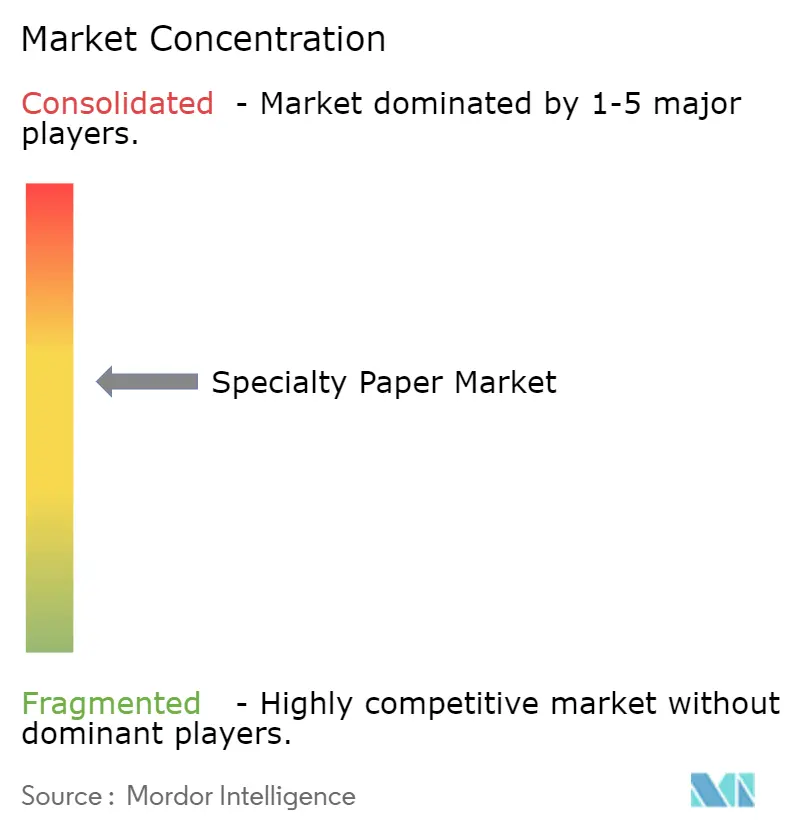
Moderate concentration defines the Specialty Paper Market as top producers continue to merge, seeking scale and fiber security. International Paper’s USD 7.2 billion purchase of DS Smith and the Smurfit Kappa-WestRock tie-up worth USD 11.2 billion exemplify this wave of consolidation that pivots portfolios toward packaging growth and away from declining graphic papers. Vertical integration-from timberland to converting-protects margins via captive pulp and secures supply continuity for global brand owners.
Technology capability is emerging as a sharper differentiator than sheer tonnage. Avery Dennison’s Materials Group reports outperformance by focusing on premium pressure-sensitive and intelligent labels, showcasing how adhesive science and liner innovation create resiliency despite broader market pressures. Mills retrofit coaters for multi-chemistry flexibility, enabling quick shifts among grease-proof, anti-microbial, and conductive runs without extended downtime.
Smaller specialists defend share by targeting high-barrier niches such as security banknote stock or flame-retardant laminates where entry hurdles deter commoditization. However, escalating compliance costs and volatile inputs may prompt further consolidation or strategic alliances aimed at joint RandD and mill-level debottlenecking.
Specialty Paper Industry Leaders
Stora Enso Oyj
Mondi plc
Nippon Paper Industries Co., Ltd.
SAPPI Limited
International Paper Company
- *Disclaimer: Major Players sorted in no particular order
Specialty Paper Market Companies Covered in this Report
- Ahlstrom Corporation
- Asia Pulp and Paper (APP) Sinarmas
- BillerudKorsnäs AB
- Domtar Corporation
- Fedrigoni S.p.A.
- Georgia-Pacific LLC
- International Paper Company
- ITC Limited (Paperboards and Specialty Papers Division)
- JK Paper Ltd.
- Koehler Paper SE
- LINTEC Corporation
- Mondi plc
- Nippon Paper Industries Co., Ltd.
- Nordic Paper Holding AB
- Oji Holdings Corporation
- SAPPI Limited
- Smurfit WestRock Corporation
- Stora Enso Oyj
- Twin Rivers Paper Company LLC
- UPM-Kymmene Corporation

Market Opportunities and Future Outlook
A major opportunity is the expansion of barrier-coated, recyclable paper solutions that replace complex plastic and aluminum structures in food and consumer packaging. The regulatory pull from the EU PPWR applicability from 12 August 2026 is reinforced by vendor innovation across coatings, sealants, and substrates. In 2026 announcements from materials and chemistry suppliers, multiple product introductions point to active whitespace in paper-compatible seal and barrier systems, including Henkel launching a cold seal solution for barrier-coated paper packaging (Loctite Liofol CS 7106 RE) and expanding water-based barrier and heat-seal coatings for paper applications. Michelman also introduced bio-based barrier coatings for paper packaging, and Stahl launched a dedicated barrier coatings portfolio for paper-based packaging.
Capacity and capability additions are also opening up investable lanes in localized converting and specialty-grade production, particularly tied to e-commerce and industrial sacks and bags where automation and supply assurance sit high on procurement checklists. Mondi opened a new automated paper bag production facility in Pittsburgh, Pennsylvania in April 2026 with a target annual capacity of 300 million units, reflecting continued downstream investment in paper-based formats. On the production side, Lecta commissioned an additional metallizing line at its Leitza mill in Spain to lift barrier paper output, and Pudumjee Paper Products announced plans for a 68,000 MT specialty paper facility in Mahad, Maharashtra focused on food-contact and industrial grades. Across these moves, demand is tightening around mills that can support multi-chemistry coating flexibility, certified fiber sourcing, and converter-ready roll supply for higher-speed packaging lines and evolving recyclability requirements.
Recent Industry Developments in Specialty Paper Market
- April 2026: Stora Enso launched Performa Natura Aqua, a dispersion-coated folding boxboard (GC2) designed for foodservice and bakery packaging. The product targets barrier performance needs while keeping the structure fiber-based, aligning with brand-owner moves away from plastic-heavy formats and tightening chemical scrutiny in food-contact applications.
- September 2025: UPM Specialty Papers partnered with Royal Vaassen to develop the Barryrwrap concept, a fibre-based, recyclable barrier paper solution positioned to replace plastic and aluminum in food packaging. The collaboration links substrate design with downstream converting know-how, shortening qualification timelines for high-barrier paper packaging.
- July 2024: Northern Bleached Softwood Kraft pulp supply tightness carried into 2024, contributing to sharp price volatility that peaked with benchmark NBSK touching EUR 1,380 per metric ton in April 2024 after supply disruptions. This elevated the value of integrated pulp positions and longer-term fiber contracting for specialty paper producers and converters managing margin stability.


Specialty Paper Market Report Scope and Research Methodology
Market Definition and Coverage
In this report, we define specialty paper as paper grades engineered for specific performance needs, such as barrier, release, labeling, filtration, decor, or food-contact use, and valued as factory-gate and channel revenue in USD across the global market.
Scope exclusions: We exclude commodity printing and writing paper grades and general packaging paper that is not sold or specified as a specialty grade.
Segments Covered in This Report
- By Product Type
- Kraft Paper
- Release-Liner Paper
- Label and Thermal Paper
- Décor and Laminating Paper
- Filter and Security Paper
- Others
- By Raw Material
- Virgin Fiber
- Recycled Fiber
- Synthetic Fiber
- Hybrid Composites
- By Functionality/Coating
- Barrier and Grease-Proof
- Water-Resistant
- Anti-microbial
- Conductive and Antistatic
- Fire-Retardant
- Other functionality/Coating
- By End-user Industry
- Packaging and Labeling
- Food Service
- Printing and Publication
- Building and Construction
- Industrial and Automotive
- Medical and Healthcare
- Other End-user Industries
- By Form
- Rolls
- Sheets
- Converted Products (Bags, Tapes, Cups, and More)
- By Geography
- North America
- United States
- Canada
- Mexico
- Europe
- United Kingdom
- Germany
- France
- Italy
- Spain
- Nordics
- Rest of Europe
- Asia-Pacific
- China
- India
- Japan
- South Korea
- ASEAN
- Australia
- New Zealand
- Rest of Asia-Pacific
- South America
- Brazil
- Argentina
- Rest of South America
- Middle East and Africa
- Middle East
- Saudi Arabia
- United Arab Emirates
- Rest of Middle East
- Africa
- South Africa
- Egypt
- Nigeria
- Rest of Africa
- Middle East
- North America
Data Sources, Market Sizing, and Validation
Desk Research
Desk research starts with building an industry map, so we can connect paper demand to end markets that actually pull specialty grades. For this, we refer to public sources such as FAO forestry and paper statistics, UN Comtrade trade flows for pulp and paper items, and government statistical releases on manufacturing output and packaging consumption where available.
To sharpen the inputs, we also use sources such as national customs portals, central bank FX and inflation series, patent databases for coating and barrier technologies, and peer reviewed papers on fiber, coatings, and food-contact compliance. Annual reports, investor presentations, and press releases help us understand capacity moves, mill conversions, and pricing actions. These are then tested against news and financials subscriptions and shipment-level import/export databases where relevant. These examples are not exhaustive, and many other public sources are also checked for data collection, validation, and clarification.
Primary Interviews and Surveys
Primary interviews are used to check what is hard to see in public data, including the specialty share within broader paper grades, typical ASP ranges by application, and how fast substitution from plastics is happening in packaging and food service. We speak with producers, converters, distributors, and large end users, and we make sure coverage includes major consuming regions so assumptions are not driven by one geography.
Distribution of primary research fieldwork respondents
| Company type | Respondent position | Region |
|---|---|---|
| Top tier: 30% | CXOs: 13% | APAC: 47% |
| Mid tier: 55% | Functional/Unit leaders: 31% | EMEA: 30% |
| Smaller Players: 15% | Managers: 56% | Americas: 23% |
Market-Sizing & Forecasting
Sizing begins with a top-down build where production, trade, and apparent consumption signals are used to reconstruct the addressable demand pool for specialty grades by region, which is then converted into value using application-level ASP bands. Inputs we track include specialty grade penetration within packaging and labeling, coated and barrier paper adoption in food-contact formats, release liner and labelstock demand tied to logistics and retail volumes, filtration and industrial activity indicators, and pulp and energy cost trends that affect realized pricing.
Once the total is formed, we corroborate it with selective bottom-up approximations, such as a roll-up of sampled supplier revenue exposure to specialty papers, distributor channel checks on volumes, and sanity checks using ASP times volume for a few high-visibility applications. Where company disclosures mix specialty and non-specialty paper, gaps are handled by applying interview-validated allocation keys linked to product mix and regional capacity.
For forecasting, we mainly use scenario analysis supported by a light multivariate check, since demand is influenced by substitution pace, packaging regulations, and pricing cycles. Assumptions for penetration, capacity additions, and ASP progression are refreshed with expert feedback, and then applied consistently across regions to keep the forecast explainable and repeatable.
Data Validation & Update Cycle
Validation is done through triangulation across independent signals, so we compare the model output against trade intensity, capacity announcements, and the implied per-capita specialty paper consumption trend by region. When a number looks off, it is reviewed for unit issues, FX timing, double counting across applications, or pricing assumptions, and then reworked before internal sign-off.
Reports are refreshed annually, and we also do interim updates when material events occur, such as large mill conversions, major regulatory changes affecting food-contact and barrier chemistries, or sharp pulp price moves. Before delivery, a final analyst pass is completed so clients receive the latest updated view.
Mordor Intelligence's Global Specialty Paper Market Estimate Compared With Other Published Estimates
Published market sizes for specialty paper can differ even when the topic name looks similar, because the scope boundary is not standardized and the pricing logic is not always shown. Differences also come from whether the study values are closer to mill-level revenue, broader channel revenue, or blended numbers that mix specialty and commodity grades.
By tracking application-level penetration and refreshing ASP ranges with interview checks, Mordor Intelligence keeps the count tied to specialty-grade demand in packaging, labeling, food service, and technical uses, instead of widening the pool to include general paper grades when definitions get loose.
Benchmark comparison
| Source | Market Size | Gaps in Research Methodology |
|---|---|---|
| Mordor Intelligence | USD 34.39 B (2026) | |
| Global Consultancy A | USD 31.40 B (2025) | Uses a different base year and a longer horizon, and the definition appears to lean more on broad specialty paper themes without clearly separating specialty-grade revenue from adjacent paper categories across all applications. |
| Industry Publisher B | USD 38.50 B (2024) | The scope shown includes a wide set of segments and is presented alongside ranking logic, which can inflate totals if revenues are aggregated at a higher channel level or if mixed product portfolios are not cleanly filtered to specialty-only sales. |
The spread in values mainly follows three practical choices: the base year used, how tightly specialty grades are separated from broader paper demand, and whether pricing is anchored to consistent ASP bands by application. With the scope filters and cross-checks laid out, the market total stays easier to trace back to repeatable inputs and simple calculations.


Key Questions Answered in the Report
What is the current value of the Specialty Paper Market?
The market stands at USD 34.39 billion in 2026 and is forecast to reach USD 42.38 billion by 2031.
Which region is growing the fastest?
Asia-Pacific records the highest growth, advancing at a 6.05% CAGR through 2031.
Which product type leads revenue?
Kraft paper remains the largest product segment, holding 31.60% of 2025 market share.
Why are PFAS-free coatings important?
Regulatory bans effective in 2025 compel food-service and packaging companies to adopt alternative grease-proof chemistries, boosting demand for new barrier papers.
Page last updated on:


 Your data is secure and never sold or shared.


