
Market Overview
| Study Period | 2020 - 2031 |
|---|---|
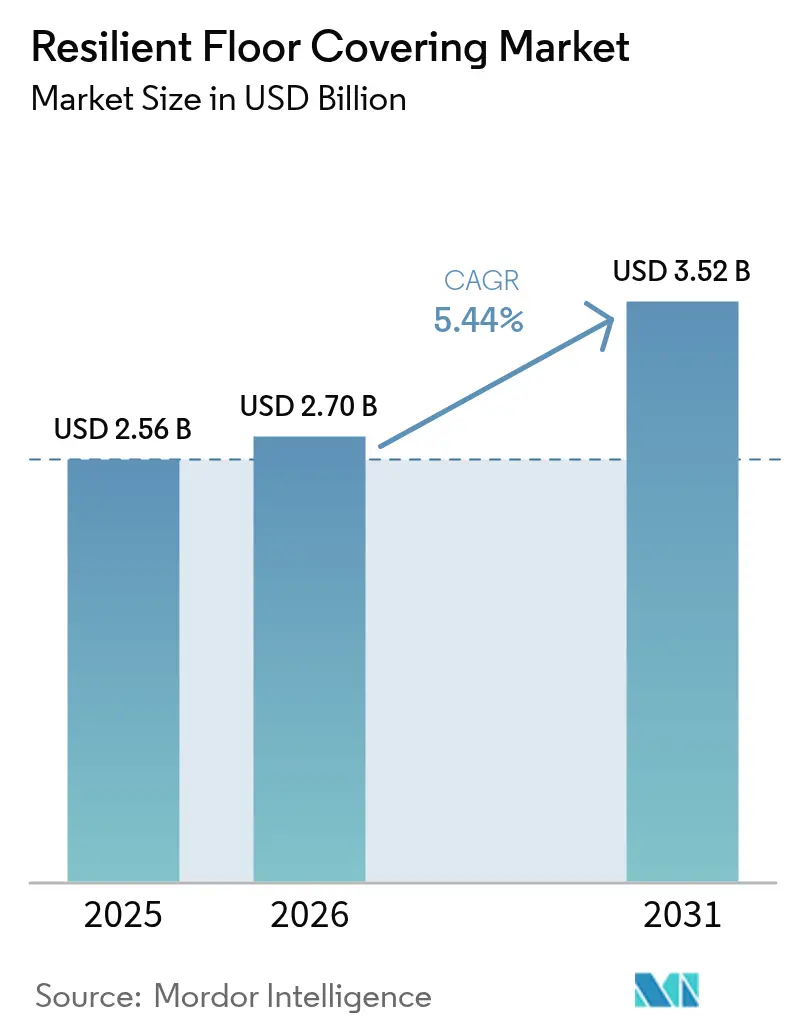
| Market Size (2026) | USD 2.7 Billion |
| Market Size (2031) | USD 3.52 Billion |
| Growth Rate (2026 - 2031) | 5.44 % |
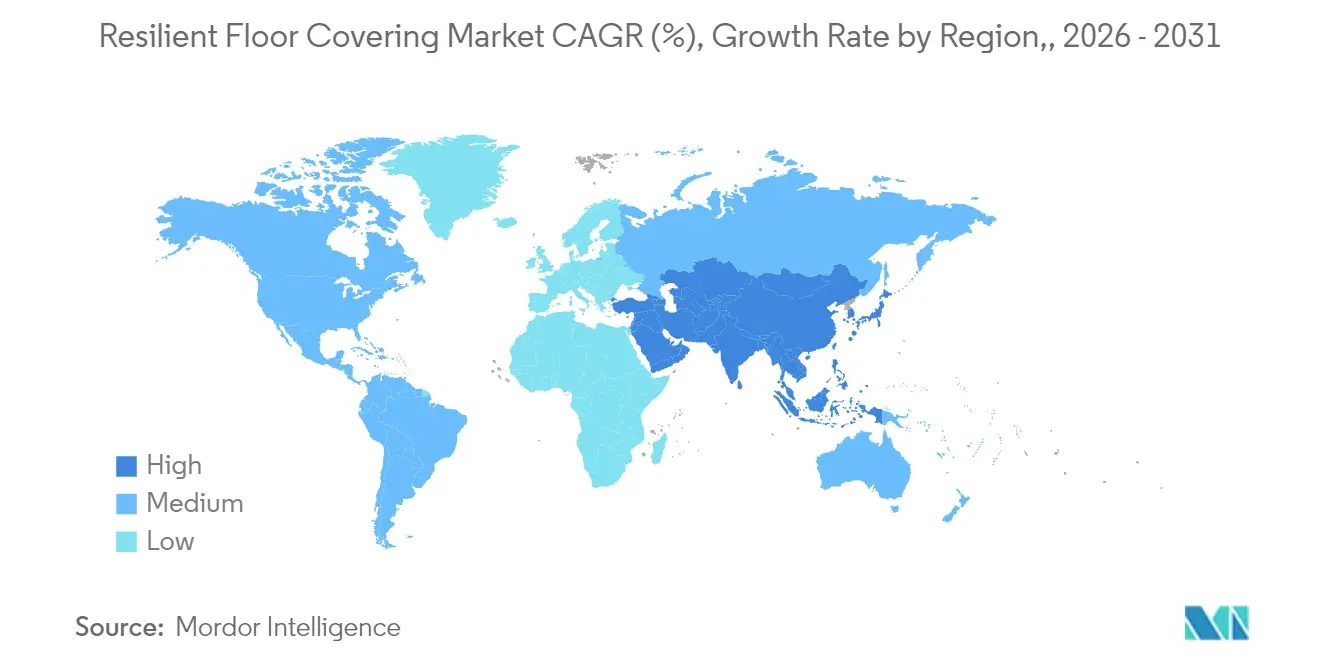
| Fastest Growing Market | Asia Pacific |
| Largest Market | North America |
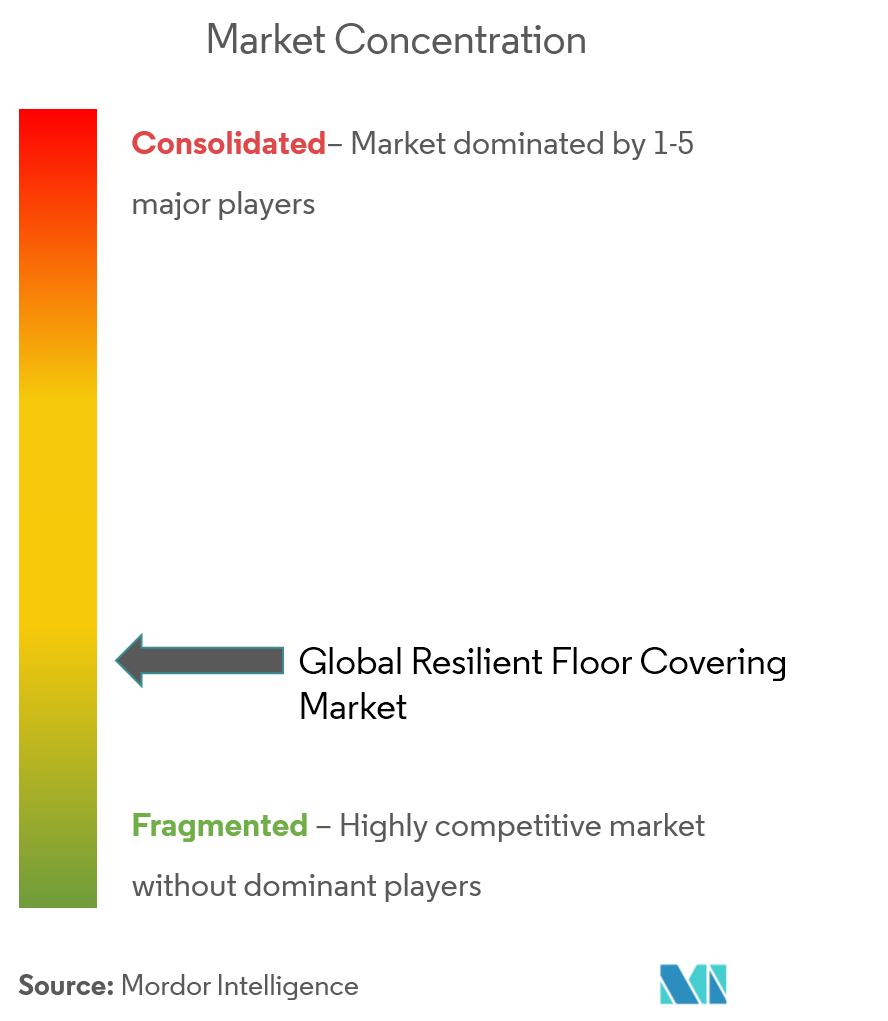
| Market Concentration | Low |
Major Players *Disclaimer: Major Players sorted in no particular order Image © Mordor Intelligence. Reuse requires attribution under CC BY 4.0. | |
Resilient Floor Covering Market Analysis by Mordor Intelligence
The resilient floor covering market size was valued at USD 2.56 billion in 2025 and estimated to grow from USD 2.7 billion in 2026 to reach USD 3.52 billion by 2031, at a CAGR of 5.44% during the forecast period (2026-2031). Consistent demand stems from luxury vinyl tile (LVT) upgrades in homes, an expanding healthcare construction pipeline in Asia-Pacific, and steady product innovation that keeps resilient flooring competitive against ceramics, laminate, and hardwood. Digital printing, embossed-in-register texturing, and rigid-core engineering have expanded design choices and improved impact resistance, while PVC-free options strengthen environmental credentials without eroding performance. The U.S. Environmental Protection Agency issued a draft risk evaluation for DINP plasticizer, citing potential human-health risks under certain use conditions[1]Source: Environmental Protection Agency, “Draft Risk Evaluation for Diisononyl Phthalate (DINP),” epa.gov. Supply-chain shifts toward near-shore production in North America and Europe are reducing tariff exposure and lead times, making localized inventory easier to manage. Climate-driven building codes that emphasize water resistance and easy sanitation further reinforce adoption, positioning the resilient floor covering market as a reliable growth segment within the wider finishes sector.
Key Report Takeaways
- By product type, luxury vinyl tile accounted for 29.94% of revenue in 2025; stone plastic composite is projected to expand at an 8.22% CAGR to 2031 in the resilient floor covering market.
- By installation type, glue-down solutions held 46.12% of the resilient floor covering market share in 2025, while click-lock systems recorded the highest projected CAGR at 7.63% through 2031.
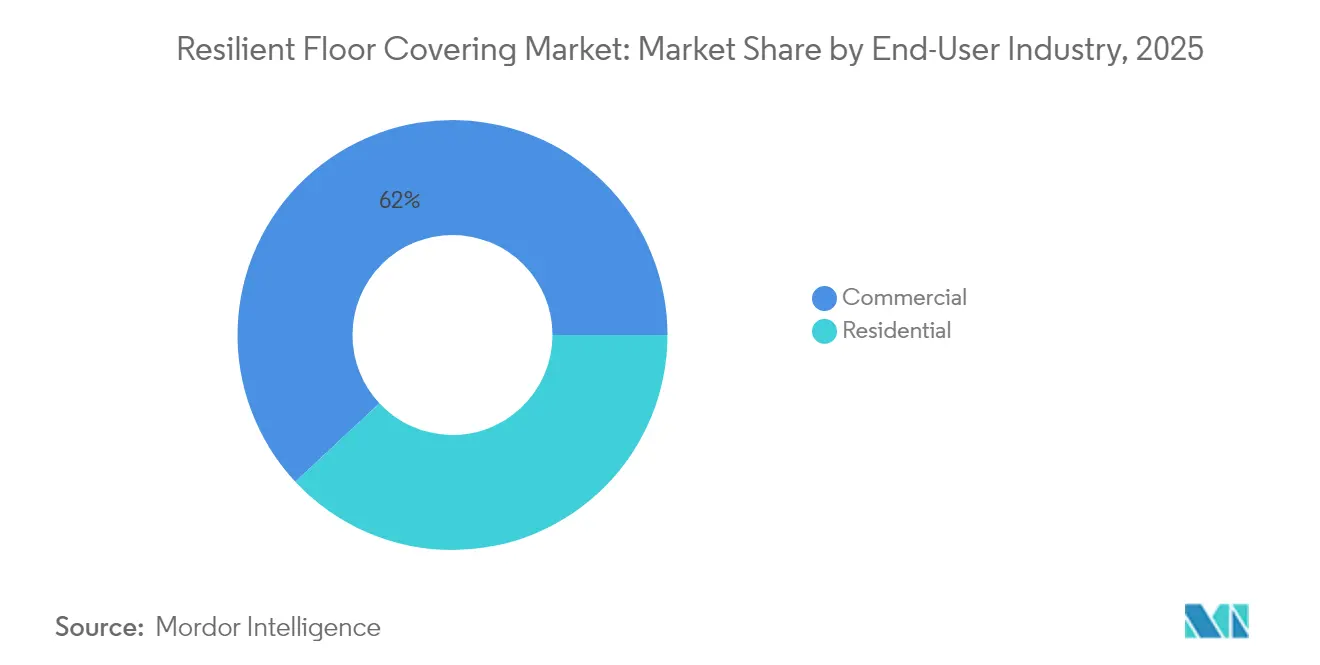
- By end-user, the residential segment accounted for 38.05% of the resilient floor covering market size in 2025 and is advancing at an 8.09% CAGR through 2031.
- By geography, Europe commanded 31.70% of global revenue in 2025; Asia-Pacific is set to grow the fastest at a 9.03% CAGR to 2031.
- Mohawk Industries, Tarkett, Shaw Industries, Armstrong Flooring, and Mannington Mills hold significant market share in 2024, leaving space for mid-tier specialists.
Note: Market size and forecast figures in this report are generated using Mordor Intelligence’s proprietary estimation framework, updated with the latest available data and insights as of 2026.
Market Trends and Insights
Drivers Impact Analysis of Resilient Floor Covering Market*
| Driver | (~) % Impact on CAGR Forecast | Geographic Relevance | Impact Timeline |
|---|---|---|---|
| Rapid Adoption of LVT in Residential Remodels | + 0.7% | North America, Europe, Australia | Short term (≤ 2 years) |
| Healthcare Build-out in Asia-Pacific Requiring Hygienic, Slip-Resistant Floors | + 0.6% | Asia-Pacific, particularly China, India, Asia-Pacific | Medium term (2-4 years) |
| Waterproof SPC/WPC Demand for Climate-Resilient Housing | + 0.5% | Global, with concentration in coastal and flood-prone regions | Medium term (2-4 years) |
| Digital Printing and EIR Finishes Elevating Aesthetics | + 0.4% | Global, with early adoption in North America and Europe | Short term (≤ 2 years) |
| Low-VOC Regulations Fueling Eco-Labelled Resilient Materials | + 0.3% | Europe, North America, developed Asia-Pacific | Medium term (2-4 years) |
| Circular Linoleum and PVC Take-Back Boosting Green Certifications | + 0.2% | Europe, North America | Long term (≥ 4 years) |
| Source: Mordor Intelligence | |||
Rapid Adoption of LVT in Residential Remodels
Home renovation remains the primary demand engine for LVT. Homeowners choose the product for realistic visuals, affordability, and resistance to moisture that simplifies open-plan layouts connecting kitchens, dining areas, and family rooms. Digital printing creates sharp wood and stone graphics that rival natural materials at lower price points, while click-lock profiles shorten installation time by eliminating adhesives. Even when housing starts stalled in 2024, LVT grew in share by displacing carpet and laminate, demonstrating resilience in downturns. The driver sustains significant lift for the resilient floor covering market through at least 2027, particularly in replacement projects across the United States, Germany, France, and Australia.
Healthcare Build-out in Asia-Pacific Requiring Hygienic, Slip-Resistant Floors
Hospitals and clinics under construction across China, India, Indonesia, and Vietnam demand seamless, non-porous sheets that resist microbial growth and enable strict infection control. Suppliers now combine integrated cove-rise detailing, heat-welded seams, and embedded antimicrobial layers to comply with evolving health standards. Asian governments subsidize specialty flooring for critical-care wards, creating steady tender volumes. With more than 2,000 public-sector bed additions scheduled through 2028 in India alone, healthcare construction contributes consistent momentum to the resilient floor covering market.
Waterproof SPC/WPC Demand for Climate-Resilient Housing
Stone Plastic Composite and Wood Plastic Composite boards maintain dimensional stability in flood-exposed basements, coastal vacation rentals, and hurricane-prone multifamily properties. Insurance guidelines issued in 2024 for Florida and Philippine coastal provinces now endorse rigid-core products as a mitigation strategy, influencing builder choice. Homeowners appreciate that SPC floors can be mopped dry and reoccupied quickly after water intrusion, minimizing claim costs. These factors lift SPC adoption rates and widen the user base beyond residential to include hospitality lobbies and small-format grocery chains.
Digital Printing and EIR Finishes Elevating Aesthetics
Advances in ink-jet heads and synchronized embossing let manufacturers align wood grain visuals with tactile ridges, producing floors that pass casual inspection as real timber or slate. Small-batch customization permits boutique hotels to specify exclusive colorways without large minimum orders, opening new premium niches for the resilient floor covering market. Decorative possibilities spur architectural interest, leading to more frequent specifications for retail flagships and corporate amenity zones where branded design is essential.
Restraints Impact Analysis of Resilient Floor Covering Market*
| Restraint | (~) % Impact on CAGR Forecast | Geographic Relevance | Impact Timeline |
|---|---|---|---|
| PVC Feed-stock Price Volatility Compressing Margins | -0.6% | Global, with heightened impact in import-dependent regions | Medium term (2-4 years) |
| Anti-Dumping Tariffs on Asian LVT | -0.5% | North America, Europe | Short term (≤ 2 years) |
| Environmental Scrutiny of Chlorinated Plastics | -0.3% | Europe, North America | Long term (≥ 4 years) |
| Skilled-Installer Shortage Elevating Failure Rates | -0.2% | Global, particularly acute in North America and Europe | Medium term (2-4 years) |
| Source: Mordor Intelligence | |||
PVC Feed-stock Price Volatility Compressing Margins
Polyvinyl chloride costs fluctuate with oil and energy markets, disturbing price lists and squeezing margins, especially for producers lacking backward integration. Spikes in 2024 forced rapid re-quotations on large commercial bids, straining distributor relationships. Europe’s push toward bio-attributed vinyl and North America’s recycling programs create partial buffers, yet unpredictable input costs continue to drag on profitability across the resilient floor covering market.
Anti-Dumping Tariffs on Asian LVT
Trade remedies enacted by the United States and the European Union raised import duties on certain Chinese LVT ranges, prompting rapid sourcing shifts. While domestic plants in Georgia, Tennessee, and Poland ramp up capacity, near-term supply gaps lead to higher landed prices. Project timelines stretch as distributors adjust to new lead times, tempering short-term growth potential for the resilient floor covering market until regional output stabilizes.
*Our forecasts treat driver/restraint impacts as directional, not additive. The impact forecasts reflect baseline growth, mix effects, and variable interactions.
Resilient Floor Covering Market Segment Analysis
By Product Type:
SPC Disrupts Traditional Vinyl DominanceLuxury vinyl tile holds 29.94% of overall demand and remains the most versatile offering in the resilient floor covering market. High-definition graphics, low maintenance, and competitive pricing underpin its continued leadership. Stone Plastic Composite is expanding more quickly, advancing at an 8.22% CAGR on the strength of rigid cores that minimize telegraphing over uneven substrates and withstand heavier impacts. Wood Plastic Composite stays relevant at the upper end of residential due to its softer underfoot feel and superior acoustics, though price premiums suppress volume. Conventional vinyl sheet persists in operating theaters and education corridors, where welded seams improve hygiene. Vinyl composition tile continues to decline as institutional buyers shift to no-wax surfaces. Niche alternatives—linoleum, rubber, and cork—collectively equal about 15% of turnover, driven by sustainability ratings and specialized acoustic needs.
SPC’s limestone-reinforced spine gives installers a dimensionally stable plank that tolerates heat swings, supporting projects in sun-belt markets and glass-walled high-rises. Manufacturers run hybrid production lines capable of alternating LVT and SPC on a single shift, maintaining balanced inventories and responsive order cycles. Mass-market retailers advertise easy cleanup, dent resistance, and low lifetime cost, expanding rigid-core visibility and accelerating its share gains inside the resilient floor covering market size hierarchy.


By Installation Type:
Click Systems Challenge Traditional AdhesivesGlue-down methods control 46.12% of the 2025 volume because permanent adhesion remains critical in hospitals, supermarkets, and schools, where rolling equipment and high foot traffic impose shear loads that floating floors struggle to support. They also facilitate welded seams that form monolithic coverings, easing sanitation protocols. However, Click-lock planks grow at 7.63% CAGR as contractors seek shorter build programs and reduced labor expense. Locking edges engage with light tapping, letting installers cover up to 100 m² in a day, cutting downtime for busy households and fast-tracking commercial renovations. Loose-lay formats, comprising heavier tiles secured by friction and perimeter tape, cater to data centers and offices where under-floor cable access is imperative. The variety of installation choices sustains parallel growth tracks and enhances the overall adaptability of the resilient floor covering market.
By End-User Industry:
Residential Sector Leads Growth TrajectoryResidential projects produced 38.05% of revenue in 2025 and are set to grow at 8.09% CAGR. Waterproof performance, simplified cleaning, and an expanding style library resonate with homeowners upgrading kitchens, mudrooms, and lower-level leisure spaces. Repair and remodel activity in mature U.S. suburbs, German multifamily blocks, and Japan’s aging condominiums continues to prioritize quick-fit planks that minimize occupant disruption. The commercial category remains broad. Healthcare facilities adopt homogeneous resilient sheets that tolerate aggressive cleaning agents. Education installs cushioned LVT to reduce ambient noise and lower maintenance budgets. Retail brands specify digitally printed planks to unify store prototypes across regions, while corporate offices incorporate bio-based designs that strengthen sustainability reporting. Industrial segments stay niche yet steady; anti-static vinyl serves electronics assembly, and chemical-resistant sheets secure pharmaceutical laboratories. Hospitality flags combine wood-look SPC in guest rooms with stone-appearance tiles in lobbies to create cohesive yet durable settings within the resilient floor covering market.
By Distribution Channel:
Specialty Retailers Defend Against Digital DisruptionIndependent flooring showrooms continue to dominate because in-person consultations help clients navigate wear-layer ratings, sound-absorbing underlays, and color coordination. Installers often partner with these stores, closing the loop on labor shortages. Home-center chains use big-box reach and palletized inventory to address entry-price shoppers seeking weekend DIY upgrades. E-commerce platforms display augmented-reality room visualizers and ship small-parcel sample packs within 48 hours, enabling hassle-free selection online. Hybrid retailers such as Floor and Decor blend digital browsing with in-store design kiosks for an omnichannel experience. A handful of manufacturers now operate flagship galleries where architects can evaluate new technologies before specifying. This mix of channels stabilizes demand across economic cycles and diversified buyer types, making the resilient floor covering market less volatile than many other building-product categories.
Geography Analysis
Europe Resilient Floor Covering Market
Europe contributes 31.70% of worldwide revenue, sustained by stringent indoor-air regulations, retrofit subsidies, and circular-economy directives that incentivize closed-loop recycling. Germany and France anchor demand with social-housing upgrades, while Scandinavian municipalities choose bio-based linoleum for schools. Tarkett’s ReStart® program captures site offcuts and end-of-life material, demonstrating a regional blueprint for material recovery. Refurbishment spending remains brisk as energy-efficiency grants reward occupants who seal building envelopes and add low-VOC surfaces, favoring resilient flooring’s quick installation over existing substrates.
APAC Resilient Floor Covering Market
Asia-Pacific represents the fastest growth at 9.03% CAGR, underpinned by megacity residential towers, hospital expansions, and expanding disposable income. China alone absorbs millions of square meters of resilient sheets for public hospitals and large-format retail malls. India’s urban housing missions require cost-effective, waterproof solutions that stand up to monsoon humidity. Japan and South Korea request premium acoustic layers to complement lightweight steel construction. Across ASEAN, infrastructure pipelines in Indonesia, Thailand, and Vietnam lift consumption as builders pivot from ceramic tiles to easier-to-handle click-lock planks, reinforcing the scale-out trajectory of the resilient floor covering market.
North America Resilient Floor Covering Market
North America generates roughly a quarter of global sales, and tariff actions have triggered rapid on-shoring. New lines in Georgia and Ontario support local distributors, trimming shipping times and safeguarding supply. Canadian provinces specify low-VOC products for provincial facilities, while Mexico builds capacity to serve domestic housing and export opportunities under free-trade frameworks. The region sees consistent renovation fueled by aging housing stock, with SPC planks often chosen to resolve historic moisture issues in basements and ground-floor extensions. Demand diversification across single-family, multifamily, and light commercial enhances the structural stability of the resilient floor covering market size in North America.

Regulatory Landscape
Resilient floor coverings face tighter chemical-disclosure, indoor-air, and circular-economy compliance expectations, alongside trade actions that can shift sourcing decisions. In the United States, scrutiny of plasticizers used in vinyl formulations increased following the U.S. Environmental Protection Agency draft risk evaluation for DINP, while indoor-air and emissions oversight for construction products continues to be influenced by state-level requirements such as California Air Resources Board programs and federal references used for building materials.
In Europe, standardization and circularity requirements advanced in 2025-2026 through updated product standards and EU-wide sustainability instruments. CEN approved EN 650:2025 for PVC resilient floor coverings (replacing EN 650:2012), and CEN also published floor-covering standards in 2026, including SIST EN 18135:2026 supporting a product-passport structure aligned with the EU digital product transparency direction, and EN 688:2026 for corklinoleum. The European Commission extended EU Ecolabel criteria for wood-, cork-, and bamboo-based floor coverings until December 31, 2029 (Commission Decision (EU) 2026/66), reinforcing demand for low-emission, documented material choices in projects pursuing ecolabels and public procurement specifications. In China, the State Administration for Market Regulation published GB 18586-2026 for limits on hazardous substances in PVC flooring, with implementation set from October 1, 2027, raising compliance stakes for exporters serving China’s large institutional and healthcare build pipeline.
Value Chain Analysis
The value chain starts with petrochemical and bio-based inputs, including PVC resin, plasticizers, stabilizers, and fillers such as limestone for SPC, plus pigments and inks for digital print and backing and underlayment materials. Manufacturers then compound and process inputs through calendaring or extrusion, apply surface-layer printing and embossed-in-register finishing, and convert materials into sheets, tiles, and rigid-core planks. Products move through regional distribution centers, specialty retailers and home centers, and professional installers, with healthcare and education work often guided by specification channels. Industry programs such as RFCI’s ASSURE Certified provide a compliance and testing framework in North America that shapes product formulation and documentation across the chain, particularly for rigid-core WPC/SPC categories.
Supply-chain risk management has become more central to resilient flooring economics as tariffs and freight volatility reshape sourcing decisions. Industry reporting in 2026 highlighted elevated tariffs on certain China-origin resilient products and a shift of supply toward Southeast Asia, Mexico, and domestic U.S. facilities, reinforcing near-shore production strategies already noted in North America and Europe. Logistics costs have also surfaced as a pressure point in early 2026, with diesel-driven surcharges and fuel volatility prompting distributor pricing actions and supporting inventory buffering and fuller-container consolidation. Within manufacturing, capacity additions and restarts in the United States for rigid-core and LVT assortments support shorter lead times, but the chain remains exposed to PVC feedstock swings and transportation disruptions given the petrochemical linkage in many resilient formulations.
Competitive Landscape
The five largest manufacturers combine for 1/3rd of worldwide sales, indicating a moderately concentrated but innovation-driven field. Mohawk Industries leverages vertical integration, transforming post-consumer vinyl and recycled polymers into PureTech, a PVC-free line that meets low-carbon construction targets[2]Source: Mohawk Industries, “PureTech Launch Overview,” mohawkindustries.com. . Tarkett’s global take-back network underscores its circular-economy leadership, enabling quicker raw-material inventory cycles and lower Scope 3 emissions[3]Source: Tarkett Group, “ReStart® Take-Back & Recycling Program,” tarkett.com.. Shaw Industries, expanding Georgia rigid-core capacity, seeks to replace import volumes with domestic output, while Armstrong Flooring focuses on technical performance sheets for intensive-care units. Mannington Mills positions high-graphic SPC planks through boutique distributors, reinforcing its design-led identity.
Below the top tier, Responsive Industries scales production in India to service Asia-Pacific growth corridors, and Gerflor refines healthcare-centric wall-to-floor integration for infection-critical zones. Emerging niche entrants concentrate on climate-specific or PVC-free formulations, staking claims in white-space categories. Competitive intensity skews toward product differentiation and sustainability metrics, not price wars, which preserves margins and facilitates steady reinvestment in the resilient floor covering market.
White-space opportunities revolve around renewable polymer chemistries, installer-friendly click profiles, and sensor-ready flooring that feeds building-performance dashboards. Regulatory drift toward PVC alternatives accelerates R&D pipelines, meaning companies that commercialize compliant formulas early can seize future tender lists. Continuous digital-print upgrades push the boundary between authentic and replicated visuals, raising consumer valuations and protecting price points. These dynamics, coupled with a mid-level concentration index, foster active competition yet leave room for agile challengers to capture specialized demand segments.
Resilient Floor Covering Industry Leaders
Mohawk Industries Inc.
Tarkett S.A.
Shaw Industries Group Inc.
Armstrong Flooring LLC
Mannington Mills Inc.
- *Disclaimer: Major Players sorted in no particular order
Resilient Floor Covering Market Companies Covered in this Report
- Mohawk Industries Inc.
- Tarkett S.A.
- Shaw Industries Group Inc.
- Armstrong Flooring LLC (AHF Products)
- Mannington Mills Inc.
- Gerflor Group
- Forbo Flooring Systems
- Interface Inc.
- LG Hausys (LX Hausys)
- Nora Systems GmbH
- Polyflor Ltd (James Halstead)
- Engineered Floors LLC
- Karndean Designflooring
- Responsive Industries Ltd.
- CFL Flooring
- Beaulieu International Group
- Parterre Flooring Systems
- Novalis Innovative Flooring
- Milliken & Company
- Fatra a.s.
- IVC Group (BerryAlloc)
- Upofloor (Kahrs Group)*

Market Opportunities and Future Outlook
Documented whitespace is concentrated in decarbonized and PVC-free resilient formats, and in localized manufacturing that reduces tariff and freight exposure while improving availability for large replacement cycles. Product launches in 2026 reflect a continued shift toward alternative chemistries and recycled inputs, including Interface’s introduction of noravant, a PVC-free rubber resilient flooring solution, and Kahrs’ launch of the Zero Mod LVT line using post-production waste from its Zero Sheet line. At the same time, European circularity pressure and product-transparency direction, including product-passport related standardization activity (for example, CEN work reflected in SIST EN 18135:2026), support opportunities for suppliers that can provide verified composition, recycled content, and take-back pathways at scale, building on programs such as Tarkett’s ReStart.
Capacity and footprint actions indicate how suppliers are positioning for rigid-core demand and reducing lead-time volatility. Shaw Industries committed USD 90 million to expand Plant RP in Ringgold, Georgia, aiming to more than double resilient production capacity by 2026, and AHF Products brought a 328,000-square-foot facility in Cartersville, Georgia back online with capacity exceeding 200 million square feet to support rigid core expansion. Forbo Flooring Systems opened its first U.S. production facility for Flotex in Hazle Township, Pennsylvania, showing continued localization of resilient manufacturing beyond vinyl planks into other resilient categories. These moves align with the market’s stated shift toward near-shore production and provide a practical basis for suppliers and distributors to build more stable assortments in core LVT/SPC, while also expanding PVC-free and circular product lines for healthcare, education, and sustainability-led specifications.
Recent Industry Developments in Resilient Floor Covering Market
- May 2026: Forbo Flooring Systems opened its first U.S. production facility for Flotex in Hazle Township, Pennsylvania. The added domestic manufacturing base supports shorter lead times and reduces import and freight exposure for a resilient category used across commercial interiors.
- April 2025: Mohawk Industries launched PureTech, a PVC-free resilient plank made with 80% recycled content and positioned for ESG-driven specifications. The launch expanded PVC-free options in mainstream resilient planks and increased competitive pressure around recycled-content claims and documentation.
- November 2024: Shaw Industries invested USD 90 million in Ringgold, Georgia, to more than double SPC and LVT output by 2026. The expansion strengthened North American supply resilience amid tariff-related sourcing shifts and supported higher local availability for rigid-core assortments.


Resilient Floor Covering Market Report Scope and Research Methodology
Market Definition and Coverage
This market covers resilient floor covering products sold for building floors, where the surface is a flexible material offered as sheet, tile, or plank formats. We include sales used in new builds, replacements, and major renovations across residential and non-residential buildings.
The sizing excludes carpets, artificial turf, adhesives, and maintenance chemicals.
Segments Covered in This Report
- By Product Type
- Luxury Vinyl Tile (LVT)
- Dry-Back (Glue-Down)
- Click-Lock Floating
- Loose-Lay
- Vinyl Sheet
- Vinyl Composition Tile (VCT)
- Stone Plastic Composite (SPC) / Rigid Core
- Wood Plastic Composite (WPC)
- Linoleum
- Rubber
- Cork
- Luxury Vinyl Tile (LVT)
- By Installation Type
- Glue-Down
- Floating / Click-Lock
- Loose-Lay
- By End-User Industry
- Residential
- Commercial
- Healthcare Facilities
- Education Buildings
- Retail & Supermarkets
- Hospitality & Leisure
- Corporate Offices
- Industrial & Manufacturing
- By Distribution Channel
- Offline
- Specialty Stores
- Home Centers & DIY Chains
- Online
- Offline
- Geography
- North America
- Canada
- United States
- Mexico
- South America
- Brazil
- Peru
- Chile
- Argentina
- Rest of South America
- Asia-Pacific
- India
- China
- Japan
- Australia
- South Korea
- South-East Asia (Singapore, Malaysia, Thailand, Indonesia, Vietnam, Philippines)
- Rest of Asia-Pacific
- Europe
- United Kingdom
- Germany
- France
- Spain
- Italy
- BENELUX (Belgium, Netherlands, Luxembourg)
- NORDICS (Denmark, Finland, Iceland, Norway, Sweden)
- Rest of Europe
- Middle East & Africa
- United Arab Emirates
- Saudi Arabia
- South Africa
- Nigeria
- Rest of Middle East & Africa
- North America
Data Sources, Market Sizing, and Validation
Desk Research
Desk research is used to set the starting facts for the model and ensure our assumptions match what is visible in public data. We typically reference sources such as U.S. Census Bureau construction spending, Eurostat construction output, UN Comtrade trade flows for flooring materials, and World Bank macro indicators to track demand direction by region.
We also use national building permit series, customs and tariff schedules, peer-reviewed construction materials journals, and relevant building or flooring association publications to confirm product definitions and common use cases. Company annual reports, investor presentations, and reputable press coverage are then used to cross-check capacity announcements, regional exposure, and pricing commentary. Where needed, analysts also reference paid subscriptions for company financials and intelligence, import and export shipment-level visibility, and patent databases to clarify product innovation and value chain positioning. The sources listed here are illustrative, and additional public and paid references are used for collection, validation, and clarification.
Primary Interviews and Surveys
Primary work is used to pressure-test demand drivers and translate broad signals into usable model inputs, especially around mix shifts between sheet, tile, and rigid core formats. We speak with manufacturers, distributors, installers, and large buyers, and then validate regional patterns across APAC, EMEA, and the Americas so the final totals reflect real purchasing behavior.
Distribution of primary research fieldwork respondents
| Company type | Respondent position | Region |
|---|---|---|
| Top tier: 28% | CXOs: 16% | APAC: 48% |
| Mid tier: 55% | Functional/Unit leaders: 24% | EMEA: 33% |
| Smaller Players: 17% | Managers: 60% | Americas: 19% |
Market-Sizing & Forecasting
Sizing starts with a top-down build where construction activity, renovation intensity, and trade and production signals are used to reconstruct the addressable demand pool for resilient floor coverings in each region. We then check the result with selective bottom-up approximations, such as supplier revenue roll-ups for a sample set, channel checks on typical price bands, and volume-to-value conversions using sampled ASPs and format mix.
Key inputs that anchor the model include residential and commercial construction output, flooring renovation frequency, housing completions, import dependence for key resilient categories, and observed mix shifts toward rigid core formats like SPC and WPC. Pricing is handled through regional ASP ranges adjusted for inflation and for material and energy cost cycles, then reviewed with interview feedback so unrealistic jumps are avoided. Where direct volume proxies are weak, gaps are handled by using nearby country benchmarks and scaling by construction intensity and income level to keep the estimates explainable.
Forecasting uses a scenario-led approach supported by multivariate regression. Drivers include construction spending, urbanization and housing starts, renovation and replacement cycles, and relative price movements feeding the outlook. The final forecast path is reviewed with experts so short-term cyclicality and medium-term adoption trends are captured in a simple and repeatable way.
Data Validation & Update Cycle
Outputs are validated through cross-checks against independent signals, including construction activity trends, trade flows, and region-level pricing movements, before numbers are finalized. Large variances trigger a re-check of assumptions such as format mix, ASP ranges, or import reliance, and we may re-contact respondents when a gap cannot be explained with public indicators.
Before sign-off, the model and the written logic go through a multi-step analyst review to align unit consistency, currency treatment, and growth rates across all regions. Reports are refreshed annually, and interim updates are made when material events occur, such as policy shifts impacting construction, major capacity moves, or sudden raw material price changes. Right before delivery, a fresh pass is completed so clients receive the latest updated view rather than an older snapshot.
Mordor Intelligence's Global Resilient Floor Covering Market Size Compared Against Other Published Estimates
Published market values for resilient floor covering rarely match because the product boundary and the value point in the chain are not treated the same way. Differences also show up when firms use different base years, apply different currency conversions, or assume different construction cycles.
Adhesives and maintenance chemicals are a common add-on in some estimates, and that item sits outside Mordor Intelligence's scope, which keeps the total tied to finished floor covering product sales only. Another driver is category overlap, where some sources emphasize only LVT or only vinyl-based formats, but others blend in the full resilient set including linoleum, rubber, and cork, which changes mix and the average selling price profile. Timing also affects comparisons, because pricing assumptions can shift with freight, resin, and energy costs, so older refresh cycles can drift away from current market reality.
Benchmark comparison
| Source | Market Size | Gaps in Research Methodology |
|---|---|---|
| Mordor Intelligence | USD 2.70 B (2026) | |
| Industry Statistics Publisher A | USD 36.20 B (2024) | Uses a broader resilient flooring scope that can capture more of the overall flooring value chain and may include wider installation-related activity, which pushes totals far above a finished resilient floor covering-only view. |
| Research Portal B | USD 17.10 B (2024) | Represents an LVT-focused number that concentrates on a single resilient sub-category and applies its own base-year pricing and mix assumptions, which will not align with an all-resilient product basket. |
The spread across figures is mainly explained by what is being counted, whether it is a single category like LVT, a broader resilient flooring umbrella, or only the finished resilient floor covering product itself. By keeping the inputs tied to construction and renovation demand signals and then cross-checking pricing and mix with interview feedback, we end up with a number that is easier to trace and to update as conditions change.


Key Questions Answered in the Report
What is the current resilient floor covering market size?
The resilient floor covering market is worth USD 2.7 billion in 2026 and is projected to reach USD 3.52 billion by 2031.
Which segment leads the resilient floor covering market?
Luxury vinyl tile remains the top product, holding 29.94% of 2025 revenue.
Which product category is growing the fastest?
Stone Plastic Composite is forecast to grow at an 8.22% CAGR through 2031 because of its rigid, waterproof core.
Why is Asia-Pacific the fastest-growing region?
Rapid urbanization, healthcare construction, and rising consumer income push Asia-Pacific demand to a 9.03% CAGR.
How large is the residential opportunity?
Residential applications already account for 38.05% of global revenue and are expanding at 8.09% CAGR on sustained remodeling activity.
What installation method is taking share from glue-down?
Click-lock floating planks are gaining momentum with a 7.63% CAGR due to faster, adhesive-free assembly that suits both DIY and professional crews.
Page last updated on:


 Your data is secure and never sold or shared.


