
Packaging Pumps and Dispensers Market Size and Share
Market Overview
| Study Period | 2020 - 2031 |
|---|---|
| Market Size (2026) | USD 10.52 Billion |
| Market Size (2031) | USD 13.43 Billion |
| Growth Rate (2026 - 2031) | 5.01 % |
| Fastest Growing Market | Asia Pacific |
| Largest Market | North America |
| Market Concentration | Medium |
Major Players *Disclaimer: Major Players sorted in no particular order Image © Mordor Intelligence. Reuse requires attribution under CC BY 4.0. | |
Packaging Pumps and Dispensers Market Analysis by Mordor Intelligence
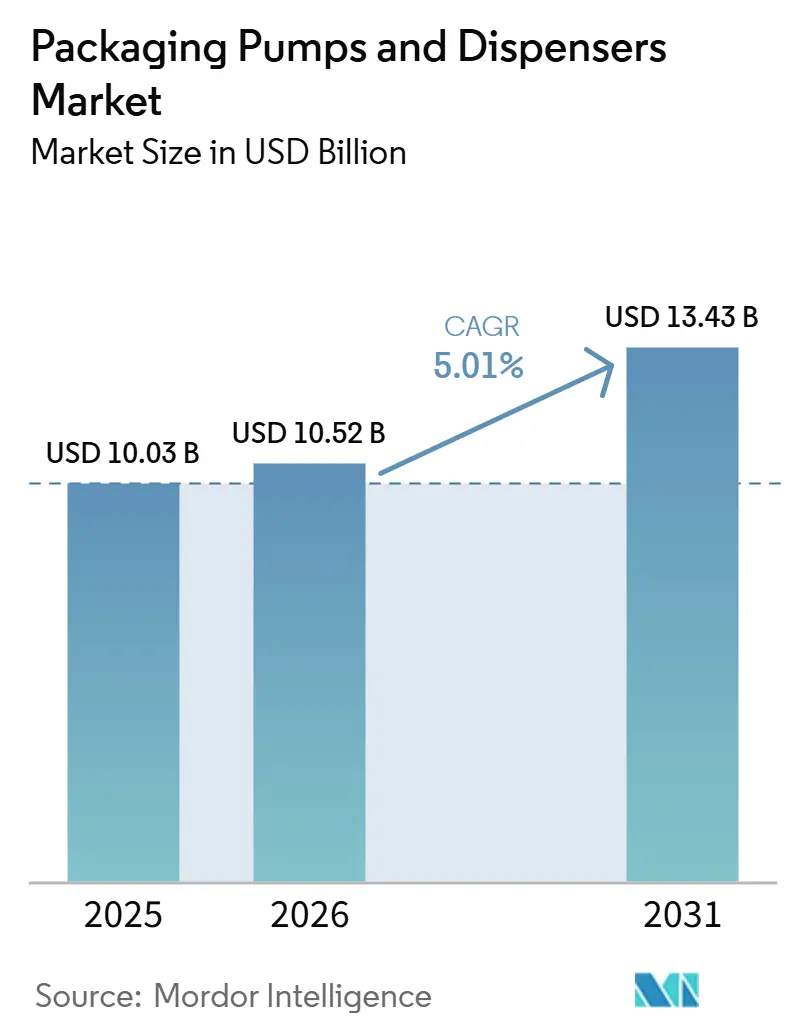
The packaging pumps and dispensers market size was USD 10.03 billion in 2025 and is estimated to grow from USD 10.52 billion in 2026 to reach USD 13.43 billion by 2031, at a CAGR of 5.01% during the forecast period (2026-2031). Demand is supported by formats that provide controlled doses, reduce waste, and maintain product stability between uses. Beauty brands are raising requirements for appearance, ingredient protection, and recyclability simultaneously. Pharmaceutical and consumer health products increasingly require reliable dose delivery that consumers can use without clinical support. European packaging rules are shifting pump design toward recyclable, mono-material formats. Across the packaging pumps and dispensers market, these requirements are changing component selection and the supplier capabilities that brands evaluate before a product launch, favoring companies with technical depth, testing capability, and broad manufacturing networks.
Key Report Takeaways
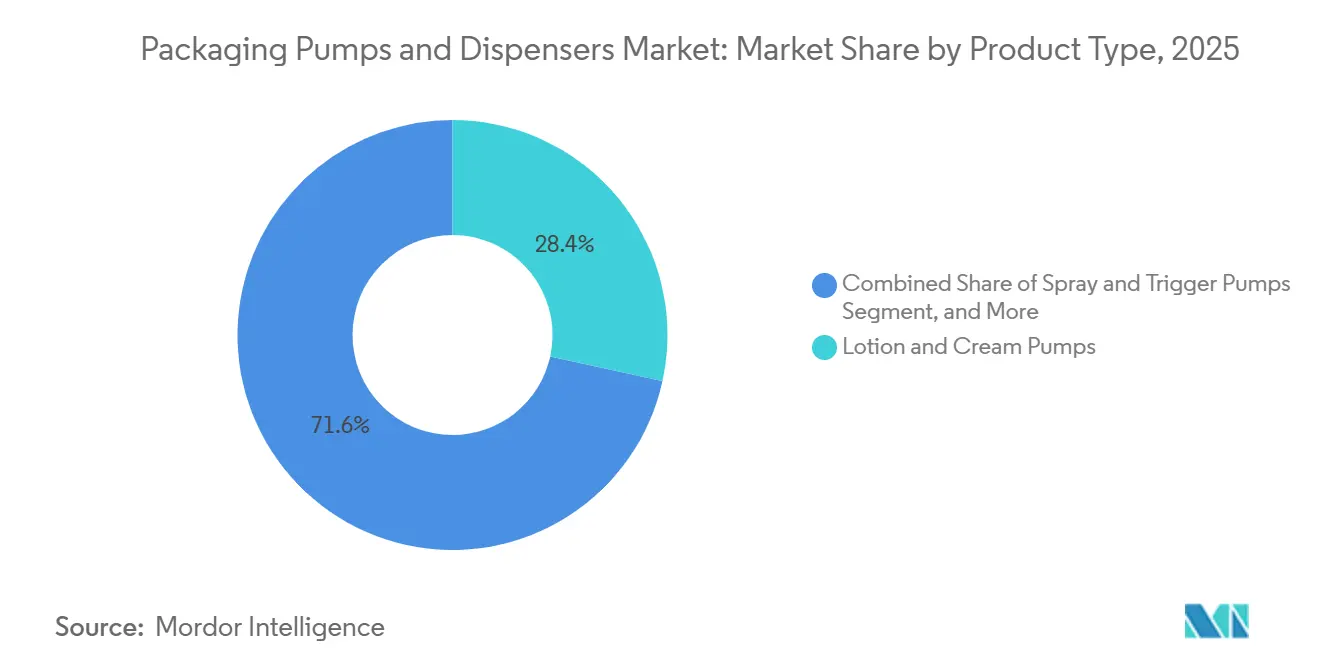
- By product type, lotion and cream pumps captured 28.43% of the packaging pumps and dispensers market share in 2025.
- By material type, the packaging pumps and dispensers market size for metal is projected to grow at a 5.63% CAGR through 2031.
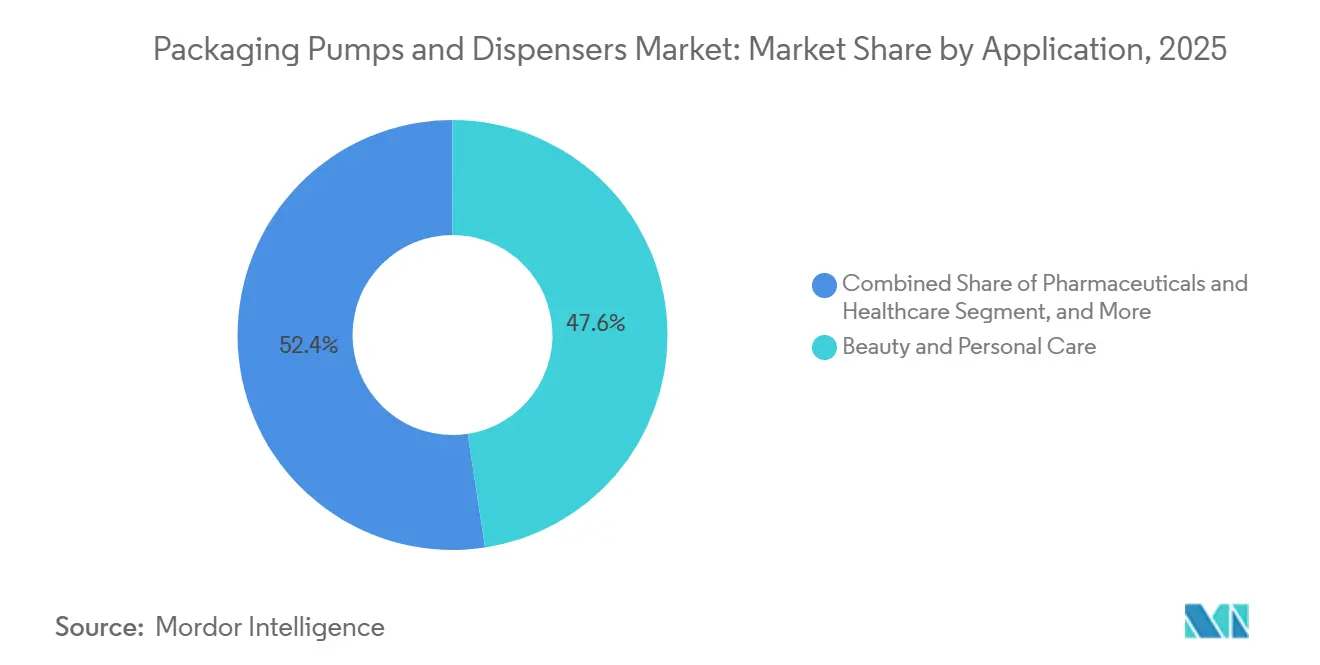
- By application, beauty and personal care accounted for 47.58% of the packaging pumps and dispensers market in 2025.
- By distribution channel, the packaging pumps and dispensers market size for online stores and marketplaces is projected to grow at a 6.17% CAGR through 2031.
- By geography, North America held 29.56% of the packaging pumps and dispensers market share in 2025.
Note: Market size and forecast figures in this report are generated using Mordor Intelligence’s proprietary estimation framework, updated with the latest available data and insights as of January 2026.
Market Trends and Insights
Drivers Impact Analysis of Packaging Pumps and Dispensers Market*
| Driver | (~) % Impact on CAGR Forecast | Geographic Relevance | Impact Timeline |
|---|---|---|---|
| Rising Demand for Controlled-Dose and Convenient Packaging | +1.4% | Global, concentrated in North America, Europe, and core Asia-Pacific markets | Short term (≤ 2 years) |
| Premiumization of Beauty and Personal Care Products | +1.1% | North America, Europe, Japan, South Korea, and China | Medium term (2-4 years) |
| Adoption of Recyclable and Mono-Material Pump Systems | +0.9% | Europe, North America, Asia-Pacific, and Middle East and Africa | Medium term (2-4 years) |
| E-Commerce Demand for Leak-Resistant and Lockable Dispensers | +0.7% | North America and Europe, with rapid growth in Asia-Pacific | Short term (≤ 2 years) |
| Liquid and Semi-Liquid Product Format Expansion | +0.5% | Global, with stronger growth in South America and emerging Asia-Pacific markets | Long term (≥ 4 years) |
| Hygiene, Sanitizer, and Homecare Application Growth | +0.4% | Global, with strong growth in Middle East and Africa | Short term (≤ 2 years) |
| Source: Mordor Intelligence | |||
Rising Demand for Controlled-Dose and Convenient Packaging
Controlled-dose dispensing has become a core requirement in skincare, pharmaceutical, and household applications. It reduces product waste and can provide more consistent use. The need is especially visible in topical medicines and over-the-counter nasal products used outside clinical settings. Aptar reported USD 1.74 billion in 2025 pharma sales, up 6%, supported by emergency medicine, injectable systems, and consumer healthcare solutions.[1]Aptar Beauty, “Future Fully Recyclable Dispensing Pump,” Aptar, aptar.com Its beauty segment also reported 13% core sales growth in personal care, including hair, body, and sun care products. These conditions favor suppliers that can combine consumer-friendly operation with pharmaceutical-grade dispensing experience.
Premiumization of Beauty and Personal Care Products
Premium beauty products require dispensers with a consistent feel, appearance, and performance. Airless pumps, custom fragrance actuators, and refillable systems carry higher value than conventional pumps. These designs also help brands protect sensitive ingredients and support a differentiated user experience. Silgan reported USD 2.7 billion in 2025 dispensing and specialty closures sales, a 17% increase, following the integration of Weener Packaging and growth in the fragrance and beauty segments. Aptar increased its ownership of BTY to 80% in 2025 and supplied INUNE prestige fragrance pumps for the launches of Christian Dior and Valentino. Smaller dermocosmetics brands are also seeking customized actuators, which increases the value of rapid tooling and decoration capabilities.
Adoption of Recyclable and Mono-Material Pump Systems
The EU Packaging and Packaging Waste Regulation entered into force on February 11, 2025, and applies from August 12, 2026. For the airless packaging market, mono-material pumps that deliver comparable barrier performance yield a first-mover edge as EPR fees escalate for multi-layer formats. The regulation requires packaging placed on the EU market to be recyclable and sets design-for-recycling requirements from 2030. Conventional pump assemblies often combine polypropylene, polyethylene, metal springs, and glass balls, which complicates sorting and recycling. Amcor introduced Magic One in March 2026 as a 100% polyolefin airless dispenser with a 96% restitution rate and PPWR-aligned recyclability. Silgan's ERA engine uses 95% polyethylene and 5% polypropylene, and its airless extension is designed to integrate into standard plastic recycling streams. Certification is becoming an important qualification factor for suppliers serving European brands.
E-Commerce Demand for Leak-Resistant and Lockable Dispensers
Parcel shipping exposes dispensers to pressure changes, vibration, and temperature shifts. Pump systems, therefore, need stronger leak-prevention and secure-locking features. Transit failures can lead to chargebacks and product losses for brands and retailers. Aptar's Future mono-material pump is qualified under Amazon's ISTA-6 protocol and uses a free-spinning actuator with a locking ring. The design can also be fully recyclable with a polyethylene or PET bottle. Silgan introduced Aspire Chroma in February 2026, featuring Pirouette Technology for refill-ready bottle separation. E-commerce is thus increasing both volume demand and the technical requirements placed on the packaging, pumps, and dispensers market.
Restraints Impact Analysis of Packaging Pumps and Dispensers Market*
| Restraint | (~) % Impact on CAGR Forecast | Geographic Relevance | Impact Timeline |
|---|---|---|---|
| Volatile Resin, Metal, and Component Costs | -1.2% | Global, most acute in Southeast Asia and South America | Short term (≤ 2 years) |
| Limited Recycling Infrastructure for Multi-Material Pump Assemblies | -0.9% | Global, with the largest gap in Middle East, Africa, and parts of Asia-Pacific | Long term (≥ 4 years) |
| High Tooling and Manufacturing Costs for Customized Pumps | -0.6% | Global, particularly affecting mid-tier brands and emerging-market suppliers | Medium term (2-4 years) |
| Formulation Compatibility and Dose-Consistency Failures | -0.4% | Global, concentrated in pharmaceutical and cosmeceutical applications | Medium term (2-4 years) |
| Source: Mordor Intelligence | |||
Volatile Resin, Metal, and Component Costs
Polypropylene and polyethylene represent much of the material content in standard pump assemblies. Their prices follow crude oil and naphtha movements, which can be difficult for smaller manufacturers to manage. Aptar's beauty segment adjusted EBITDA margin declined to 12.1% in 2025 from 13.0% in 2024, due to tariffs, supplier disruptions, manufacturing inefficiencies, and product mix. Silgan used its larger European manufacturing base after the Weener acquisition to support cost pass-through arrangements. Larger suppliers can spread sourcing risk through broader supply networks, while smaller producers may have less capital for redesign and compliance work. Steel spring costs also matter in fragrance and pharmaceutical products, where precision cannot be reduced.
Limited Recycling Infrastructure for Multi-Material Pump Assemblies
Mono-material designs do not by themselves ensure that a pump will be recycled after use. Most markets outside northern Europe still lack the infrastructure to process pump components at scale. Traditional assemblies require separating plastic parts, metal springs, and glass balls before they can enter standard recycling systems. The PPWR requires recyclability, but the regulation also recognizes that recycling performance depends on collection, sorting, and recycling systems. The Association of Plastic Recyclers offers a pathway for specific components in North America, although collection coverage remains uneven. Brands must therefore assess end-of-life outcomes by country to support recyclability claims, a requirement that can place more pressure on mid-sized companies.
*Our forecasts treat driver/restraint impacts as directional, not additive. The impact forecasts reflect baseline growth, mix effects, and variable interactions.
Packaging Pumps and Dispensers Market Segment Analysis
By Product Type:
Lotion Pumps Lead, Airless Formats AccelerateLotion and cream pumps held 28.43% of the packaging pumps and dispensers market share in 2025. They are widely used for shampoos, body lotions, conditioners, and mass skin care products. Their operating profile suits products that need high-volume dispensing with low actuation force. Private-label and value brands continue to use these pumps as a standard format. This installed base supports stable demand even as premium brands add specialized systems.
Airless pumps are projected to grow at a CAGR of 5.78% through 2031. They are used in preservative-free skin care, clinical dermocosmetics, and pharmaceutical topicals. Oxidation protection and dose accuracy support product stability claims in these applications. Magic One provides outputs from 0.3 ml to 1 ml through a single-engine concept and uses a PPWR-aligned polyolefin design. Spray and trigger pumps remain important in home care, while foam pumps are used in hand hygiene and gentle cleansing products. Specialty closures for industrial and food-service uses follow industrial output rather than consumer-product trends.


By Material Type:
Plastic Commands Volume, Metal Gains in Specialty SegmentsPlastic held 76.91% of the packaging pumps and dispensers market share by material type in 2025. Polypropylene and polyethylene are used across a range of applications because they offer chemical resistance, processability, and cost-effectiveness. Polypropylene remains common in standard lotion and trigger pumps. Polyethylene is gaining use in mono-material systems where brands seek recyclability certification. These materials can help a pump meet design-for-recycling requirements when the overall system is compatible.
Metal is projected to grow at a CAGR of 5.63% through 2031. Premium fragrances, pharmaceutical dispensing, and luxury skin care use metal components to ensure precision and enhance product presentation. Metal components are also used where a premium tactile effect and structural rigidity are important. Glass retains a small position in ultra-premium skin care and pharmaceutical packaging. PVC faces regulatory pressure under EU PPWR rules, while PET has modest use in food and beverage closures. The packaging pumps and dispensers industry is moving plastic designs toward mono-material polyethylene and polypropylene, while metalized and multi-layer formats face tighter requirements from 2030.
By Application:
Beauty Anchors Volume, Pharmaceuticals Add Margin DepthBeauty and personal care accounted for 47.58% of the packaging pumps and dispensers market size in 2025. The application ranges from 50 ml premium serums to 1-liter salon foam dispensers. Aptar's personal care core sales grew 13% in 2025 across hair care, body care, and skin care lines. This demand extends beyond prestige facial care into broader pump-dispensed personal care products. Brand requirements increasingly combine shelf appeal, reliable function, and material choices that support compliance.
Pharmaceuticals and healthcare are projected to grow at a CAGR of 6.23% through 2031. Topical dosage products and over-the-counter nasal medicines require accurate, contamination-controlled delivery. Aptar's bidose nasal spray system was used for CARDAMYST, an FDA-approved self-administered nasal spray for paroxysmal supraventricular tachycardia. Home care products use pumps in surface disinfection, laundry, and dish care. Food and beverages remain a smaller use case for portion-control condiments and food service. Aptar acquired Brazil-based Sommaplast in 2025 to expand its portfolio of oral dosing dispensers and dosing cups for pharmaceutical applications.
By Distribution Channel:
Supermarkets Provide the Base, Online Stores Reshape RequirementsSupermarkets and hypermarkets accounted for 40.32% of the packaging pumps and dispensers market in 2025. They remain important for personal care and home cleaning products that consumers buy as essentials. In-store testing allows consumers to assess ergonomics, spray quality, and ease of actuation. This physical interaction remains important for products with premium or sensory attributes. Retail stores, therefore, retain a durable role in introducing and selling pump-dispensed products.
Online stores and marketplaces are projected to expand at a CAGR of 6.17% through 2031. Channel growth requires designs that prevent leaks and tolerate transit conditions. Aptar's Future pump combines a locking feature with Amazon ISTA-6 qualification for e-commerce distribution. Silgan expects USD 310 million in 2026 capital expenditure, including investment supporting dispensing product innovation.[2]AptarGroup, Inc., “AptarGroup 2025 Annual Report,” U.S. Securities and Exchange Commission, sec.gov Specialty stores remain relevant for prestige beauty, dermocosmetics, and professional hair care. These channels provide product knowledge and sampling that broad retail and online formats cannot always match.
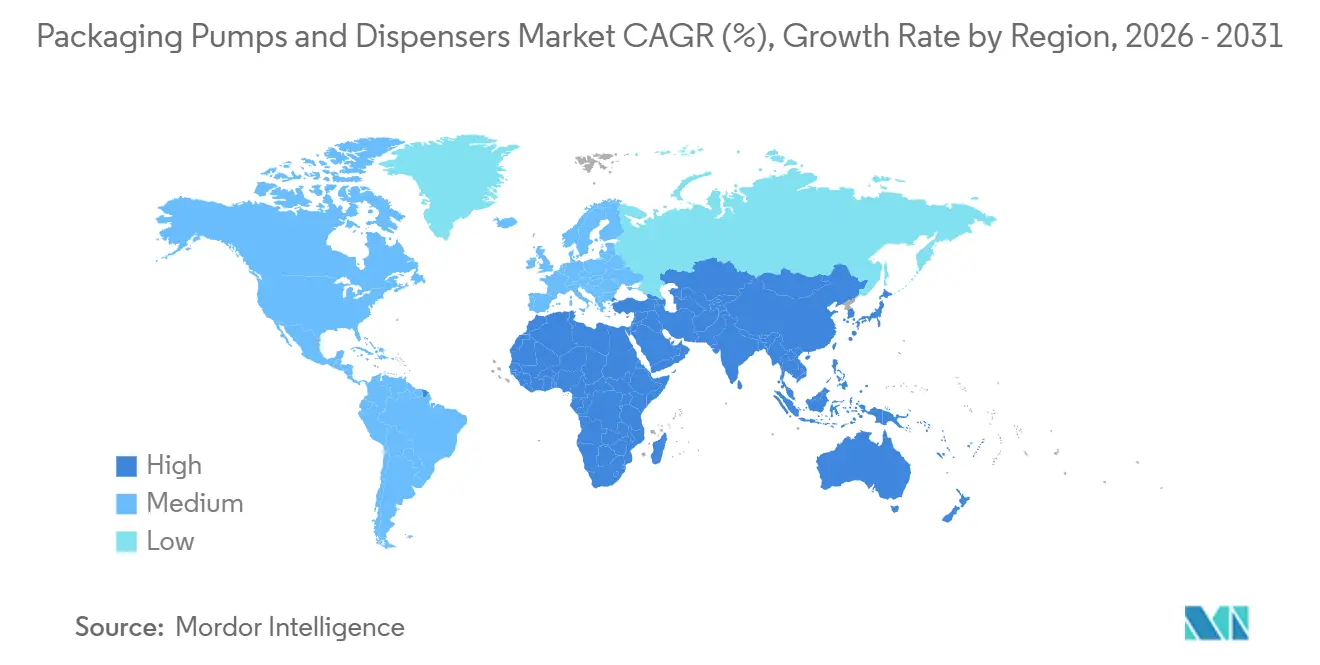
Geography Analysis
The Americas Packaging Pumps and Dispensers Market
North America held 29.56% of the packaging pumps and dispensers market share in 2025. Premium beauty adoption, established retail networks, and early uptake of recyclable pumps support demand across the packaging pumps and dispensers market in the region. The United States accounts for much of the regional base, while Canada and Mexico add demand through organized retail and pharmaceutical packaging. Silgan expects 2026 dispensing volumes and adjusted EBIT to exceed 2025 levels, with USD 310 million in capital expenditure directed toward dispensing and pet food growth.[3]Silgan Dispensing Systems, “Aspire Chroma: Standing Out with Endless Color at PPW 2026,” Silgan Dispensing, silgandispensing.com South America is centered on Brazil, where Aptar's acquisition of Sommaplast supports oral pharmaceutical dispensing capabilities.
Europe and Middle East Packaging Pumps and Dispensers Market
Europe has a large base of premium beauty and pharmaceutical packaging in the packaging pumps and dispensers market. The PPWR applies from August 2026 and requires suppliers to demonstrate recyclability. Germany, France, the United Kingdom, Italy, and Spain are the primary demand markets for packaging pumps and dispensers. Amcor is commissioning a Magic One line in Lohne, Germany, with first deliveries expected in early 2027. Turkey, Saudi Arabia, and the UAE support demand in the Middle East for customized premium fragrance pumps.
APAC and Africa Packaging Pumps and Dispensers Market
Asia-Pacific is projected to grow at a CAGR of 6.09% through 2031, the fastest regional rate in the packaging pumps and dispensers market. China, India, South Korea, Japan, and Australia combine population scale with expanding beauty and personal care consumption. China's ingredient-focused beauty products support airless formats, while India’s retail expansion supports first-time pump use in lower-tier cities. South Korean brands use dual-chamber and airless systems that can later appear in global product lines, while Africa has early-stage demand in South Africa, Egypt, Nigeria, and Kenya as consumers move from sachets toward pump-dispensed personal care products.

Competitive Landscape
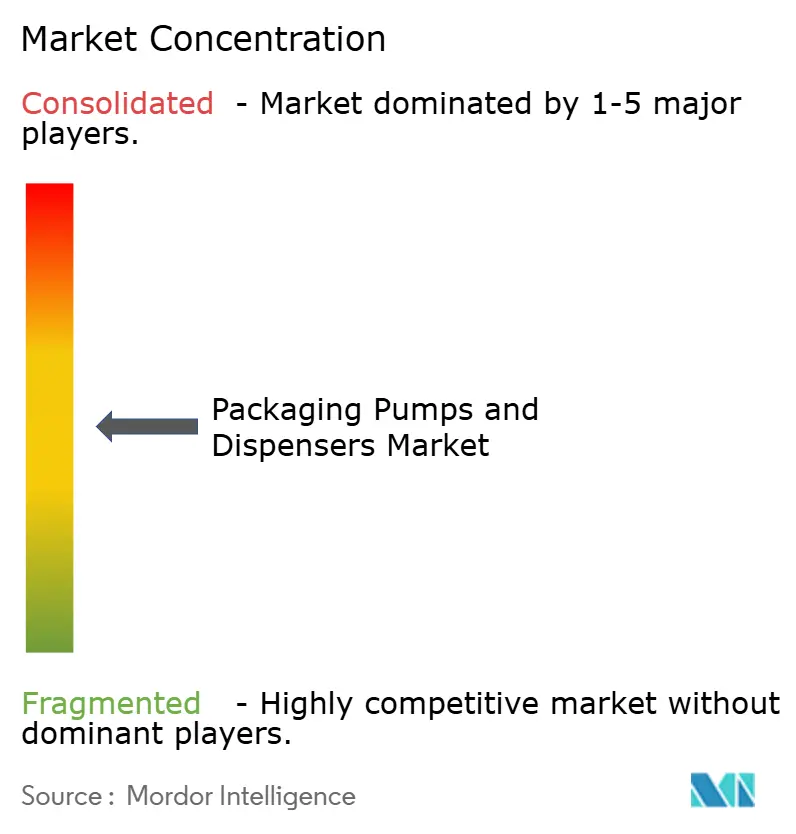
The packaging pumps and dispensers market is moderately concentrated in high-value applications. AptarGroup, Silgan Holdings, and TriMas, through Rieke Packaging, hold important positions in pharmaceutical dispensing, premium beauty, and e-commerce-ready formats. Volume demand for mass personal care and home care remains more fragmented across Asian contract manufacturers and regional European suppliers. The packaging pumps and dispensers market is therefore shaped by capability in recyclable designs, e-commerce transit performance, and precision dosing. Silgan's dispensing products grew more than 30% in 2025 following the Weener Packaging integration.
TriMas and Aptar are developing alternatives to conventional metal-spring configurations for the packaging pumps and dispensers market. Rieke's Singolo foamer uses a polymeric spring alternative approved by the Association of Plastic Recyclers.[4]Rieke Packaging Systems, “Singolo Fully Recyclable Foaming Dispenser,” Rieke Packaging, riekepackaging.com Aptar has also introduced a high-dose pump with a metal-free spring outside the dosage chamber. Coster, Guala Dispensing, and Quadpack use European precision manufacturing and proximity to PPWR requirements to compete with lower-cost suppliers. Recycling certification is becoming a procurement consideration for European brand owners in the packaging, pumps, and dispensers market.
This development shifts supplier selection toward verifiable end-of-life performance as well as price and lead time. Gerresheimer agreed in July 2026 to sell its Centor prescription drug dispensing unit and global Primary Packaging Plastics business to Apax Funds for EUR 1.5 billion (USD 1.71 billion). The 2 businesses generated EUR 570 million (USD 648 million) in 2025 revenue and employed 2,400 people. This portfolio change may create opportunities for remaining suppliers in topical and oral pharmaceutical dispensing.
Packaging Pumps and Dispensers Industry Leaders
AptarGroup, Inc.
Silgan Holdings Inc.
Amcor plc
TriMas Corporation
Guala Dispensing S.p.A.
- *Disclaimer: Major Players sorted in no particular order
Packaging Pumps and Dispensers Market Companies Covered in this Report
- AptarGroup, Inc.
- Silgan Holdings Inc.
- Amcor plc
- TriMas Corporation
- Coster Tecnologie Speciali S.p.A.
- Guala Dispensing S.p.A.
- Frapak Packaging B.V.
- Mitani Valve Co., Ltd.
- Quadpack Industries
- Taplast S.p.A.
- Raepak Ltd.
- Afa Dispensing Group B.V.
- Zhejiang Sun-Rain Industrial Co., Ltd.
- Gerresheimer AG
- Precision Valve Corporation

Recent Industry Developments in Packaging Pumps and Dispensers Market
- July 2026: Gerresheimer AG entered into definitive agreements to sell its Centor prescription drug dispensing unit and global Primary Packaging Plastics business to Apax Funds at a combined enterprise value of EUR 1.5 billion (USD 1.71 billion). The 2 business units generated combined revenue of EUR 570 million (USD 648 million) in fiscal year 2025 and employed 2,400 people. The Centor sale is expected to close by the end of fiscal year 2026.
- March 2026: Amcor announced the Magic One airless dispensing system, a 100% polyolefin design compliant with EU PPWR recyclability standards, delivering 0.3 ml to 1 ml output volumes and a 96% restitution rate. A new production line is being commissioned at Amcor's Lohne, Germany facility, with first deliveries expected in early 2027.
- February 2026: Silgan Dispensing extended its ERA all-plastic cosmetic engine into airless packaging formats for facial serums and creams in 30 ml, 40 ml, and 50 ml versions. It also launched the Aspire Chroma customizable fragrance pump with Pirouette refill-ready technology at Paris Packaging Week 2026.
- February 2026: AptarGroup reported 2025 net sales of USD 3.78 billion, up 5%, pharma sales of USD 1.74 billion, up 6%, and beauty sales of USD 1.31 billion, up 7%. The board approved a USD 600 million share repurchase authorization and guided capital investments of USD 260 million to USD 280 million for 2026.


Global Packaging Pumps and Dispensers Market Report Scope
Packaging pumps and dispensers are crucial elements in dispensing solutions. A packaging dispenser is a container, closure, package, device, or vending machine designed to hold and dispense small quantities of various products, including facial tissues, paper cups, candy, and liquids. Brands often incorporate dispensing mechanisms to enhance the functionality of their packaging. Dispensing pumps typically comprise pistons, pump chambers, pump heads, and collars. These components can be customized to deliver specific outputs for individual applications.
The Packaging Pumps and Dispensers Market Report is Segmented by Product Type (Lotion and Cream Pumps, Spray and Trigger Pumps, Foam Pumps, Airless Pumps, and Other Product Types), Material Type (Plastic [Polypropylene, Polyethylene, Polyethylene Terephthalate, Polyvinyl Chloride, and Other Plastics], Metal, Glass, and Other Material Types), Application (Beauty and Personal Care, Homecare, Pharmaceuticals and Healthcare, Food and Beverages, Industrial and Automotive, and Other Applications), Distribution Channel (Supermarkets and Hypermarkets, Specialty Stores, and Online Stores and Marketplaces), and Geography (North America, South America, Europe, Asia-Pacific, Middle East, and Africa). The Market Forecasts are Provided in Terms of Value (USD).
| Lotion and Cream Pumps |
| Spray and Trigger Pumps |
| Foam Pumps |
| Airless Pumps |
| Other Product Types |
| Plastic | Polypropylene (PP) |
| Polyethylene (PE) | |
| Polyethylene Terephthalate (PET) | |
| Polyvinyl Chloride (PVC) | |
| Other Plastics | |
| Metal | |
| Glass | |
| Other Material Types |
| Beauty and Personal Care |
| Homecare |
| Pharmaceuticals and Healthcare |
| Food and Beverages |
| Industrial and Automotive |
| Other Applications |
| Supermarkets and Hypermarkets |
| Specialty Stores |
| Online Stores and Marketplaces |
| North America | United States |
| Canada | |
| Mexico | |
| South America | Brazil |
| Argentina | |
| Colombia | |
| Rest of South America | |
| Europe | Germany |
| United Kingdom | |
| France | |
| Italy | |
| Spain | |
| Russia | |
| Rest of Europe | |
| Asia-Pacific | China |
| India | |
| Japan | |
| South Korea | |
| Australia | |
| Rest of Asia-Pacific | |
| Middle East | Saudi Arabia |
| United Arab Emirates | |
| Turkey | |
| Rest of Middle East | |
| Africa | South Africa |
| Egypt | |
| Nigeria | |
| Kenya | |
| Rest of Africa |
| By Product Type | Lotion and Cream Pumps | |
| Spray and Trigger Pumps | ||
| Foam Pumps | ||
| Airless Pumps | ||
| Other Product Types | ||
| By Material Type | Plastic | Polypropylene (PP) |
| Polyethylene (PE) | ||
| Polyethylene Terephthalate (PET) | ||
| Polyvinyl Chloride (PVC) | ||
| Other Plastics | ||
| Metal | ||
| Glass | ||
| Other Material Types | ||
| By Application | Beauty and Personal Care | |
| Homecare | ||
| Pharmaceuticals and Healthcare | ||
| Food and Beverages | ||
| Industrial and Automotive | ||
| Other Applications | ||
| By Distribution Channel | Supermarkets and Hypermarkets | |
| Specialty Stores | ||
| Online Stores and Marketplaces | ||
| By Geography | North America | United States |
| Canada | ||
| Mexico | ||
| South America | Brazil | |
| Argentina | ||
| Colombia | ||
| Rest of South America | ||
| Europe | Germany | |
| United Kingdom | ||
| France | ||
| Italy | ||
| Spain | ||
| Russia | ||
| Rest of Europe | ||
| Asia-Pacific | China | |
| India | ||
| Japan | ||
| South Korea | ||
| Australia | ||
| Rest of Asia-Pacific | ||
| Middle East | Saudi Arabia | |
| United Arab Emirates | ||
| Turkey | ||
| Rest of Middle East | ||
| Africa | South Africa | |
| Egypt | ||
| Nigeria | ||
| Kenya | ||
| Rest of Africa | ||


Key Questions Answered in the Report
What is the packaging pumps and dispensers market size?
The packaging pumps and dispensers market size is estimated at USD 10.52 billion in 2026 and is forecast to reach USD 13.43 billion by 2031 at a CAGR of 5.01%.
Which product type leads packaging pumps and dispensers demand?
Lotion and cream pumps led with a 28.43% share in 2025, supported by broad use in shampoos, lotions, conditioners, and mass skin care. Airless pumps are the faster-growing product type through 2031, because they are suited to products that need greater protection from oxidation and consistent dispensing.
Which application is expected to grow fastest through 2031?
Pharmaceuticals and healthcare are projected to grow at a CAGR of 6.23%, supported by topical and nasal dose-delivery requirements. These uses place greater emphasis on reliable doses and protection against contamination.
Why are mono-material pump systems gaining adoption?
EU PPWR requirements and brand demand for recyclable packaging are increasing the use of polyethylene and polypropylene designs that are easier to recycle. These designs can reduce the sorting difficulties created by mixed-material pump assemblies.
Which region is expected to grow fastest for pumps and dispensers?
Asia-Pacific is projected to grow at a CAGR of 6.09% through 2031, supported by urbanization and expanding beauty and personal care consumption. China, India, South Korea, Japan, and Australia are the main regional demand centers.
Page last updated on:


 Your data is secure and never sold or shared.


