Market Overview
| Study Period | 2020 - 2031 |
|---|---|
| Market Size (2026) | USD 4.75 Billion |
| Market Size (2031) | USD 10.03 Billion |
| Growth Rate (2026 - 2031) | 16.12% CAGR |
| Fastest Growing Market | Asia Pacific |
| Largest Market | Asia Pacific |
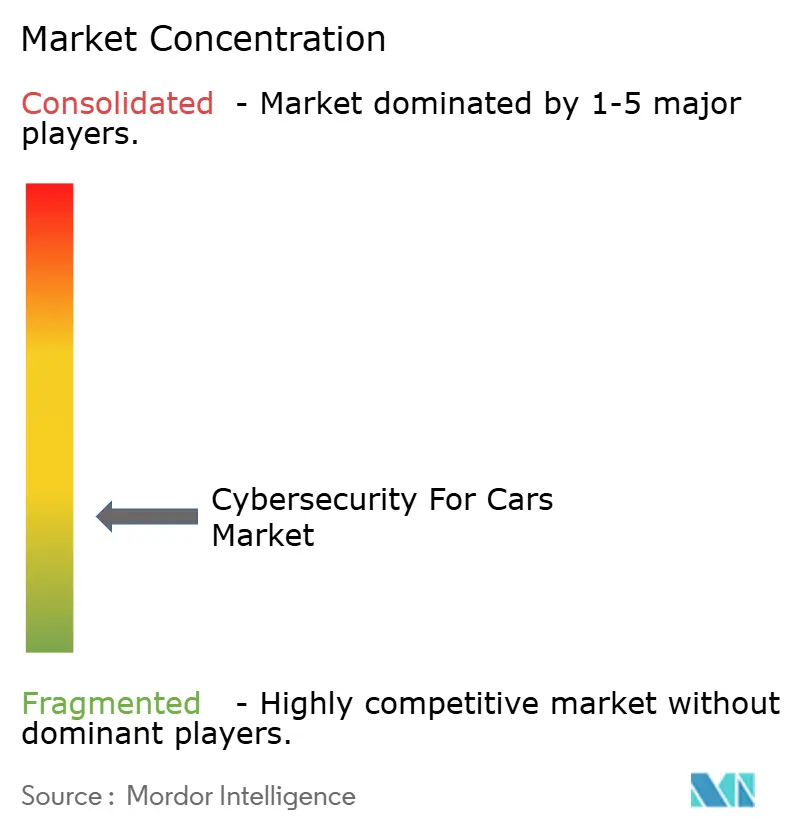
| Market Concentration | Low |
Major Players *Disclaimer: Major Players sorted in no particular order Image © Mordor Intelligence. Reuse requires attribution under CC BY 4.0. | |
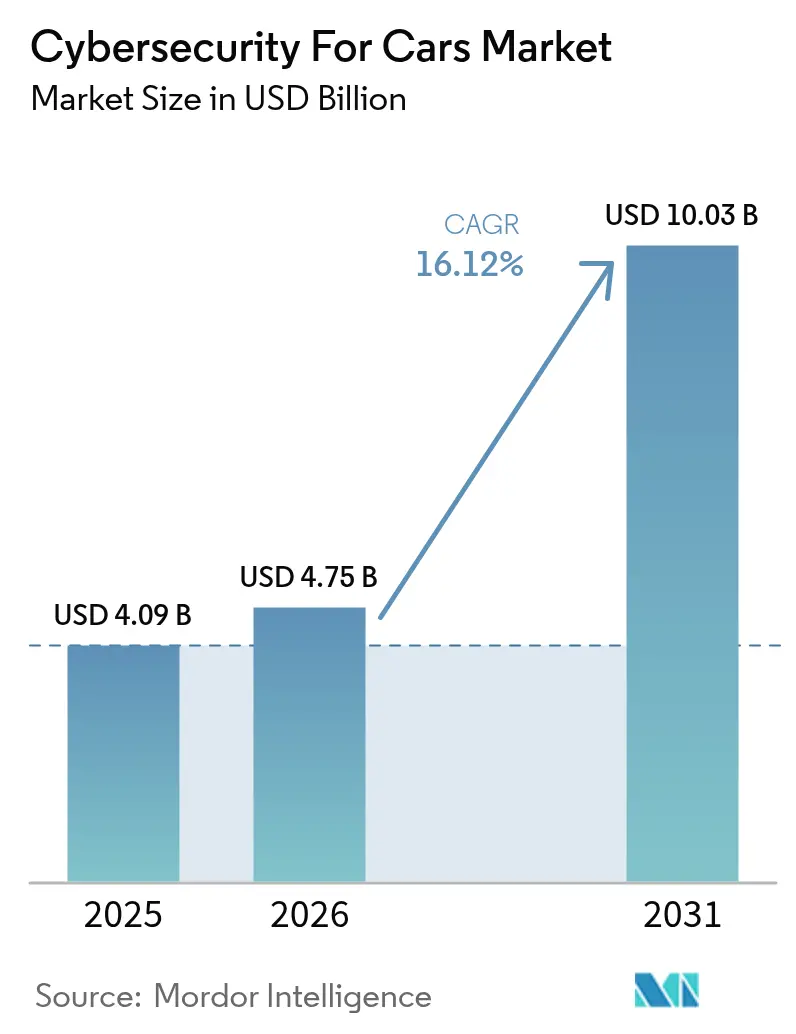
Cybersecurity For Cars Market Analysis by Mordor Intelligence
Cybersecurity For Cars Market size in 2026 is estimated at USD 4.75 billion, growing from 2025 value of USD 4.09 billion with 2031 projections showing USD 10.03 billion, growing at 16.12% CAGR over 2026-2031. Rapid vehicle digitalization, growing regulatory scrutiny, and wider 5G/V2X roll-outs are reshaping competitive strategies and opening new service-led revenue pools. Manufacturers race to certify Cybersecurity Management Systems before UNECE R155/R156 audits, while cloud-native security platforms gain traction as software-defined vehicles demand continuous protection. Simultaneously, electric-vehicle adoption, bidirectional charging, and sensor-rich ADAS features multiply the attack surface, attracting specialized solution vendors that promise real-time threat intelligence and automated response. OEMs also eye monetization of over-the-air security updates and usage-based insurance programs that reward certified cyber-hardening, partially offsetting high integration costs.
Key Report Takeaways
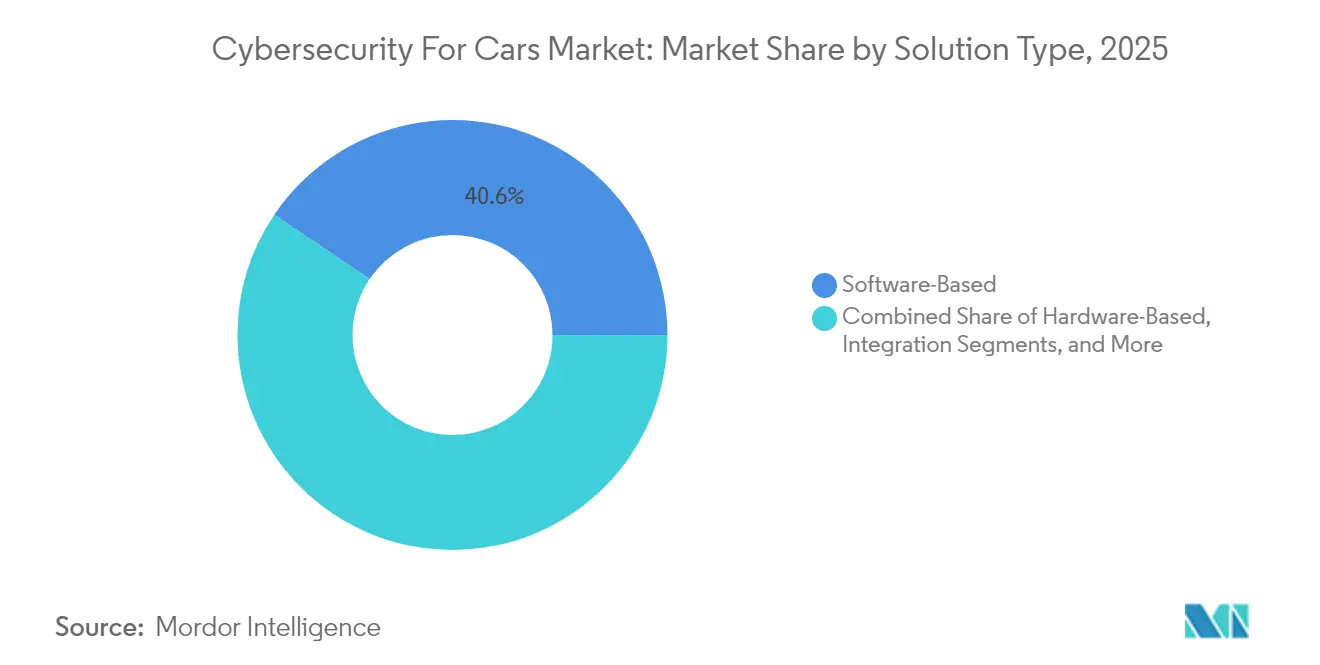
- By solution type, software-based offerings led with 40.55% revenue share in 2025, while professional services are forecast to register the fastest 19.1% CAGR to 2031.
- By security type, endpoint security accounted for 29.62% of the cybersecurity for cars market share in 2025, whereas cloud security is projected to climb at 20.6% CAGR through 2031.
- By vehicle type, passenger cars represented 56.48% of demand in 2025; the cybersecurity for cars market size for electric vehicles is set to expand at 21% CAGR between 2026-2031.
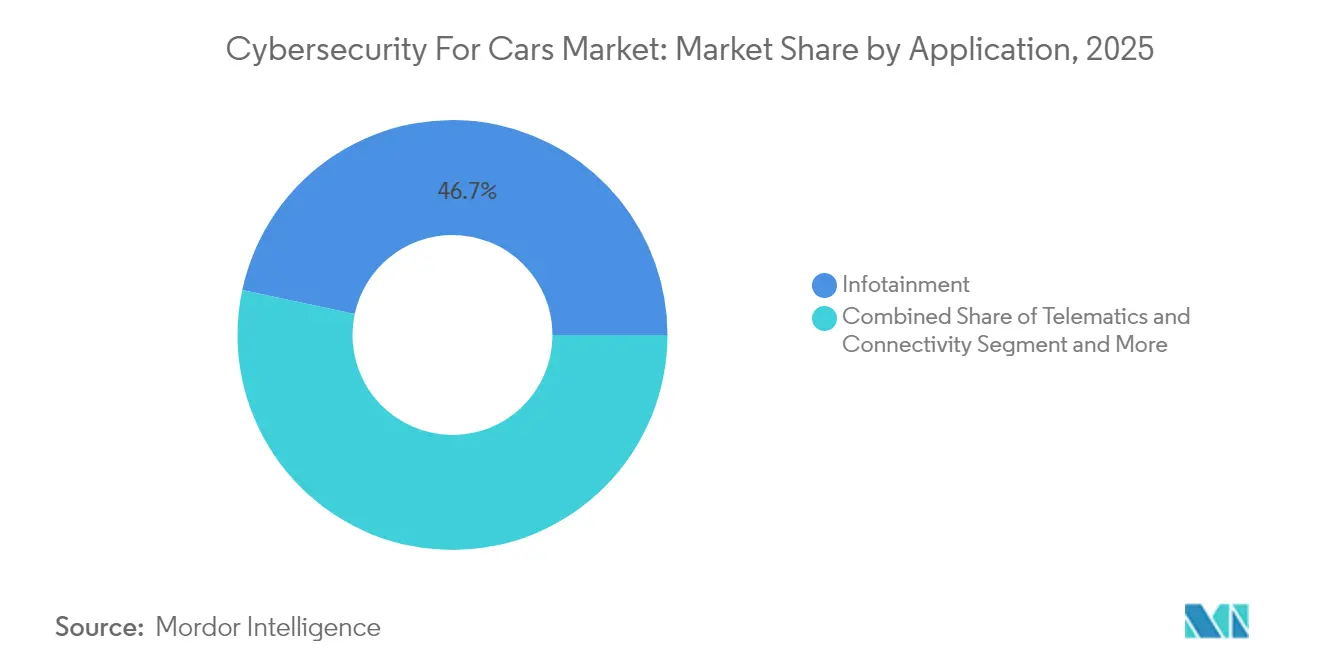
- By application, infotainment systems captured 46.65% of the cybersecurity for cars market size in 2025, while ADAS and safety applications are expected to grow at a 20.9% CAGR through 2031.
- By form type, in-vehicle embedded solutions dominated with 57.41% revenue share in 2025, and external cloud services are projected to post the highest 22.9% CAGR to 2031.
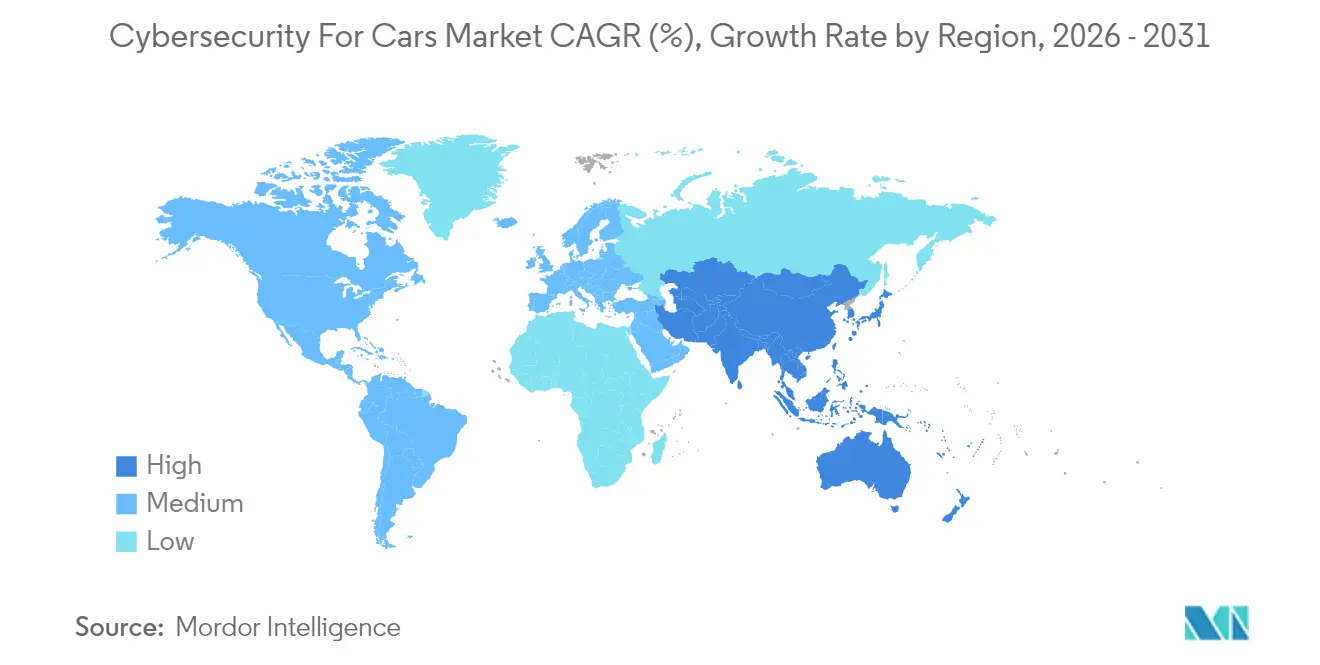
- By geography, Asia-Pacific led with 35.12% revenue share in 2025 and is anticipated to register the fastest 19.5% CAGR over the forecast period.
Note: Market size and forecast figures in this report are generated using Mordor Intelligence’s proprietary estimation framework, updated with the latest available data and insights as of 2026.
Market Trends and Insights
Drivers Impact Analysis of Cybersecurity For Cars Market*
| Driver | (~) % Impact on CAGR Forecast | Geographic Relevance | Impact Timeline |
|---|---|---|---|
| Regulatory mandates (UNECE R155/R156, ISO 21434) compliance wave | +4.2% | Global; early adoption in EU and Japan | Medium term (2-4 years) |
| Rapid growth in connected-vehicle fleet and 5G/V2X roll-outs | +3.8% | APAC core; spill-over to North America and EU | Short term (≤ 2 years) |
| ADAS/autonomous feature proliferation elevating cyber-risk | +3.1% | North America and EU leading; APAC following | Medium term (2-4 years) |
| Vehicle-to-Grid (V2G) bidirectional charging | +2.4% | EU and California early markets; expanding globally | Long term (≥ 4 years) |
| Usage-based-insurance discounts for certified cyber-hardening | +1.8% | North America and EU mature insurance markets | Medium term (2-4 years) |
| OEM monetization of OTA security updates | +1.3% | Global; premium segments first | Long term (≥ 4 years) |
| Source: Mordor Intelligence | |||
Regulatory mandates drive fundamental change
Global homologation now hinges on demonstrating end-to-end security. UNECE R155 alone creates a USD 2.1 billion compliance opportunity by 2030 as OEMs must track 69 attack vectors and prove continuous monitoring throughout vehicle lifecycles. [1]VicOne, “UN R155,” vicone.com ISO/SAE 21434 hardcodes cybersecurity engineering into concept and decommission phases, prompting carmakers to expand specialist teams. Similar rules emerge in Japan and the United States, eliminating first-mover disadvantages and standardizing baselines worldwide.
Connected-vehicle fleet expansion multiplies attack surfaces
Modern cars host up to 150 ECUs and 100 million lines of code—volumes that could triple by 2030, stressing legacy defenses. Backend servers already account for 43% of incidents, and 95% of attacks originate remotely. [2]Automotive IQ, “UNECE R155/R156 Compliance,” automotive-iq.com 5G-based V2X exchanges add high-bandwidth vectors exposing telematics gateways, while ransomware targeting dealership IT highlights supply-chain vulnerabilities beyond the vehicle perimeter.
ADAS proliferation elevates safety-critical risks
AI-driven perception stacks introduce adversarial-learning weaknesses that may misread traffic signs, with researchers cataloging 115 threats in driver monitoring alone. Sensor spoofing against radar and ultrasonic modules underscores the need for multi-layered protection spanning silicon, middleware, and cloud analytics, spurring demand for specialized runtime intrusion detection.
Vehicle-to-Grid integration creates bidirectional pathways
Only 12% of CCS chargers currently support TLS, leaving most deployments open to man-in-the-middle exploits. Vulnerabilities such as CVE-2024-37310 inside open-source charging firmware expose entire EV fleets and potentially the grid. Regulators and utilities now view automotive security as a critical infrastructure risk.
Restraints Impact Analysis of Cybersecurity For Cars Market*
| Restraint | (~) % Impact on CAGR Forecast | Geographic Relevance | Impact Timeline |
|---|---|---|---|
| High integration cost and legacy E/E architectures | -2.8% | Global; established OEMs most affected | Short term (≤ 2 years) |
| Fragmented standards and certification overload | -1.9% | Global; regional variations | Medium term (2-4 years) |
| Acute shortage of automotive-grade cyber-talent | -2.1% | North America and EU | Medium term (2-4 years) |
| Post-warranty liability for long-life vehicles | -1.4% | Global; regulatory uncertainty | Long term (≥ 4 years) |
| Source: Mordor Intelligence | |||
Legacy architecture integration costs constrain adoption
Retrofitting 150-plus ECUs in legacy platforms can add 15-20% to vehicle development budgets. Continental’s 2022 breach illustrated supplier-network exposure and forced expensive architecture reviews. Such financial drag delays roll-outs among volume brands, even as compliance deadlines loom.
Automotive cybersecurity talent shortage limits execution
Roles demand deep knowledge of CAN, FlexRay, ISO 26262, and real-time constraints that few traditional IT security professionals possess. Smaller suppliers struggle to match salary offers from tech firms, widening the skills gap just as demand spikes. Investments like BMW i Ventures’ USD 12 million in RunSafe Security reflect efforts to backfill capabilities across the supply chain.
*Our forecasts treat driver/restraint impacts as directional, not additive. The impact forecasts reflect baseline growth, mix effects, and variable interactions.
Cybersecurity For Cars Market Segment Analysis
By Solution Type:
Professional services outpace as compliance complexities surgeSoftware-based platforms held 40.55% of 2025 revenue, underscoring their centrality in a software-defined vehicle era where embedded firewalls, secure firmware, and runtime intrusion detection converge. Consulting-led offerings, however, are on a 19.1% CAGR ascent as OEMs outsource gap analyses, threat modeling, and audit preparation to specialist advisors. The cybersecurity for cars market increasingly rewards vendors capable of bundling continuous monitoring with UNECE R155 documentation support, a capability visible in HARMAN’s end-to-end WP.29 packages.
Professional services also orchestrate multi-vendor integration when hardware security modules, PKI suites, and cloud SOC platforms must interoperate inside tight development timelines. Such cross-domain coordination positions service providers as primary gatekeepers of compliance roadmaps, shifting revenue toward recurring assessment and managed-detection contracts. Consequently, the cybersecurity for cars market is witnessing alliances where software licensors embed service retainer clauses to secure lifetime margins.


By Security Type:
Cloud security accelerates while endpoint remains essentialEndpoint controls retained a 29.62% share in 2025 because cryptographic keys, secure boot, and ECU-level firewalls remain foundational. Yet cloud defenses are racing ahead at 20.6% CAGR as automakers shift data lakes, OTA orchestration, and fleet analytics off-board. The cybersecurity for cars market size for cloud protection is swelling each quarter, buoyed by collaborations such as Upstream’s tie-up with Google Cloud. Incident lessons from the 2024 Volkswagen data breach showed that insufficient encryption of telemetry can cascade into reputational damage.
Network-layer segmentation and TLS v1.3 upgrades ride parallel with cloud growth, while application-centric hardening becomes imperative as vehicles download microservices weekly. Wireless security remains the final mile, guarding 5G links that now underpin platooning and V2I signalling. As virtual ECUs offload tasks to the edge, hybrid architectures combining in-vehicle enforcement with remote AI-assisted analytics form the emerging blueprint across the cybersecurity for cars market.
By Vehicle Type:
Electric-vehicle focus intensifies protective spendPassenger cars still anchor revenue, accounting for 56.48% of demand in 2025, yet electric vehicles represent the fastest-growing slice at 21% CAGR. Their dependence on battery management systems, high-voltage controllers, and V2G interfaces expands both threat vectors and regulatory scrutiny, enlarging the cybersecurity for cars market size earmarked for EV protection. Studies revealing low TLS adoption among public chargers and disclosures such as CVE-2024-37310 have sharpened OEM and utility focus on end-to-end encryption, firmware signing, and anomaly scoring.
Commercial fleets increasingly procure telematics with built-in intrusion-prevention to avoid cargo disruptions, while heavy trucks integrate secure gateways that isolate safety-critical brake controllers from infotainment head-units. These differing risk profiles sustain multi-tier demand, ensuring the cybersecurity for cars market continues to fragment by propulsion type and duty cycle.
By Application:
ADAS and safety spend gains momentumInfotainment held the largest slice at 46.65% in 2025 because audio-video domains remain an easy phishing and ransomware target. However, security outlays around ADAS and safety systems are rising at 20.9% CAGR as lidar fusion, automated lane-keep, and driver monitoring migrate into higher SAE automation levels. This pivot moves the cybersecurity for cars market share toward functions that can physically endanger occupants if compromised. The STRIDE-mapped catalogue of 115 threats against driver monitoring systems underscores the urgency.
Telematics remains the connective tissue between vehicle and cloud, making secure MQTT brokering and certificate rotation key purchase criteria. Powertrain controllers, once isolated, now expose APIs for regenerative-braking updates, demanding signed firmware and runtime integrity checks. Charging infrastructure security rounds out the stack, especially in regions deploying bidirectional energy services.
By Form Type:
External cloud services reshape architecturesIn-vehicle embedded solutions stayed dominant with a 57.41% share in 2025, driven by real-time needs such as secure boot and cryptographic seed-key routines. Yet, external cloud services exhibit a 22.9% CAGR as automakers centralize threat intelligence, vulnerability scanning, and fleetwide policy management. Upstream’s Ocean AI illustrates how aggregated telemetry enables machine-learning models that predict and neutralize complex, multi-vehicle attacks. The cybersecurity for cars market thus evolves toward a dual-plane model: embedded enforcement for milliseconds-level reactions, and cloud orchestration for situational awareness and over-the-air patching.
Microsoft’s integration of VicOne threat feeds into GitHub workflows shows dev-sec-ops convergence, tightening feedback loops between software releases and field monitoring. As continuous delivery culture takes hold, cloud-native SOCs become indispensable to maintain compliance and performance metrics.
Geography Analysis
APAC Cybersecurity For Cars Market
Asia-Pacific commanded 35.12% revenue in 2025 and is projected to grow at 19.5% CAGR, making it the fastest-advancing geography within the cybersecurity for cars market. China’s scaling of connected-EV production fuels large-scale procurement of V2G-ready PKI and ECU hardening suites, while Japan’s early alignment with UNECE rules accelerates supplier certification programs. South Korea’s 5G highways amplify demand for real-time over-the-air patching technologies, and India’s emergent export ambitions trigger investments in ISO 21434 compliance tooling. Collectively, these dynamics push regional vendors to deliver low-latency cloud SOC services hosted within data-residency-compliant zones.
North America and Europe Cybersecurity For Cars Market
North America represents a mature yet evolving arena where premium vehicle trims and robust insurance ecosystems encourage cybersecurity monetization. The United States Connected Vehicles Rule, effective March 2025, forces OEMs to audit supply chains for sanctioned components, redirecting procurement toward domestic chipsets and security modules. Canada’s tier-one suppliers leverage proximity and regulatory alignment to integrate secure Ethernet backbones, while Mexico’s assembly plants adopt managed-security services to counter rising ransomware aimed at just-in-time logistics. Europe remains a regulatory trendsetter and R&D hub. Germany hosts flagship suppliers such as Bosch ETAS and Continental, although the latter’s prior breach highlighted vulnerabilities in centralized architecture. France and the United Kingdom channel public grants into quantum-safe automotive cryptography, while the ENX VCS audit framework overlays ISO 21434 to standardize supplier assessments. Eastern European engineering hubs contribute competitive talent, though war-related cyber sanctions reshape sourcing strategies.

Regulatory Landscape
Vehicle cybersecurity requirements are increasingly tied to type approval through UNECE WP.29, particularly UN Regulation No. 155 (CSMS) and UN Regulation No. 156 (SUMS). For vehicle types in categories M, N, and O, the mandatory type approval requirements under UN R155 became effective on 1 July 2024 in contracting-party markets, pushing OEMs and suppliers to demonstrate organizational processes for continuous cyber risk management across the vehicle lifecycle.
In Europe, the EU Cyber Resilience Act (Regulation (EU) 2024/2847) sets horizontal cybersecurity obligations for products with digital elements, while generally avoiding duplicate assessment for vehicles already covered by the EU vehicle safety framework and UN R155-aligned requirements. In March 2026, Commission Delegated Regulation (EU) 2026/699 further tightened the interface between cybersecurity and access to vehicle on-board diagnostics (OBD) information, reinforcing the need to secure diagnostic access and third-party interactions alongside in-vehicle controls.
Value Chain Analysis
The value chain spans cybersecurity requirements definition (OEM product security organizations), architecture and component integration (Tier-1 suppliers and semiconductor vendors), software development and validation (toolchain vendors, pentest labs, and managed security providers), and independent assessment (audit schemes and certification bodies). UNECE R155/R156 compliance has amplified the role of evidence generation and supplier assurance, with schemes such as ENX VCS (based on ISO/SAE 21434) used to verify organizational cybersecurity maturity and extend accountability beyond the OEM into Tier-1 to Tier-3 software and electronics supply chains.
Upstream and similar intelligence-driven platforms point to an expanding off-board layer of the chain, where fleet telemetry and vulnerability intelligence support continuous monitoring and incident response. OEM and supplier actions also show SBOM and software supply-chain governance moving upstream: BYD selected Karamba Security (June 2024) to automate SBOM generation for ECUs aligned with UN R155 needs. Ecosystem efforts, including Auto-ISAC partnerships (Manifest and FESCARO, August 2025) and Stellantis joining GlobalPlatform (September 2025), also highlight ongoing work to standardize security components, APIs, and assurance methods across software-defined vehicle programs.
Competitive Landscape
The cybersecurity for cars market features moderate fragmentation where established tier-one suppliers intersect with security pure-plays. Continental, Bosch ETAS, DENSO, and NXP leverage deep vehicle integration to embed hardware-root-of-trust and secure gateway offerings. Upstream, VicOne, and Argus supply AI-driven SOC platforms and threat intelligence that complement in-vehicle defenses, enabling OEMs to monitor fleets in real time. Semiconductor leaders Infineon and Renesas bundle secure microcontrollers with automotive Ethernet switch silicon, targeting domain controller architectures.
Strategic partnerships define go-to-market execution. Infineon’s USD 2.5 billion acquisition of Marvell’s Automotive Ethernet business broadens its portfolio into high-bandwidth networking essential for ADAS domain controls. [5]Infineon Technologies, “Infineon Further Strengthens Its Number One Position in Automotive Microcontrollers,” infineon.com VicOne’s integration with Microsoft’s developer tools accelerates secure-coding adoption, tightening the loop between design and field feedback. Upstream’s Ocean AI brings automated root-cause investigation, lowering SOC response times. Meanwhile, automakers invest directly: BMW i Ventures’ stake in RunSafe Security secures software immunization IP across its supply base. Competitive intensity is expected to rise as quantum-resistant cryptography and AI-generated code defense emerge as next battlegrounds.
Cybersecurity For Cars Industry Leaders
Continental AG
Harman International
Bosch ETAS GmbH
Infineon Technologies AG
NXP Semiconductors NV
- *Disclaimer: Major Players sorted in no particular order
Cybersecurity For Cars Market Companies Covered in this Report
- Continental AG
- Harman International (Samsung)
- Bosch ETAS GmbH
- Infineon Technologies AG
- NXP Semiconductors NV
- Cisco Systems Inc.
- DENSO Corporation
- Visteon Corporation
- Delphi Technologies plc
- Honeywell International Inc.
- Argus Cyber Security Ltd.
- Karamba Security Ltd.
- Arilou Technologies Ltd.
- Escrypt GmbH
- Secunet Security Networks AG
- Upstream Security Ltd.
- VicOne Inc. (Trend Micro)
- GuardKnox Cyber-Technologies Ltd.
- BlackBerry QNX
- SafeRide Technologies Ltd.
- Cybellum Technologies Ltd.
- Trillium Secure Inc.
- Vector Informatik GmbH
- Comsec Automotive Ltd.
- GuardSquare NV
- AutoCrypt Co. Ltd.

Market Opportunities and Future Outlook
UNECE R155/R156 and ISO/SAE 21434 create a practical whitespace around workflow, evidence, and audit-readiness automation across OEMs and multi-tier suppliers, especially as software release cadence shifts toward continuous delivery. Toolchain integration opportunities focus on embedding threat analysis and risk assessment (TARA), SBOM governance, secure update processes (SUMS), and field monitoring into a single operational loop that can be presented during homologation and supplier audits without duplicative documentation across regions.
Software-defined vehicle programs and centralized compute, including zonal E/E architectures, are also pulling security deeper into platforms rather than treating it as an add-on point solution. That shift expands demand for controller-level hardening and cryptographic agility. Consolidation and capability build-outs support this direction, with KPIT Technologies announcing in May 2026 an agreement to acquire a majority stake in Cymotive (total consideration expected to range between USD 60 million and USD 120 million). The transaction signals investment behind AI-led automotive cybersecurity engineering and integration services that connect in-vehicle protections with DevSecOps practices and lifecycle compliance delivery.
Recent Industry Developments in Cybersecurity For Cars Market
- May 2026: KPIT Technologies entered into an agreement to acquire a majority stake in automotive cybersecurity specialist Cymotive for a total consideration expected to range between USD 60 million and USD 120 million. The acquisition strengthens KPIT's ability to deliver AI-led automotive cybersecurity capabilities alongside its SDV engineering services. It also reflects buyer demand for integrated offerings that connect product engineering, compliance evidence, and continuous protection.
- June 2025: Continental began supplying its CoSmA digital key system for the Audi Q6 e-tron, using ultra-wideband (UWB) to mitigate relay attacks. This expands series-production deployment of secure access technologies beyond pilots and premium options into core vehicle programs. The award reinforces cybersecurity as a differentiator in user-facing vehicle access and identity functions.
- April 2024: Continental introduced Zone Control Units (ZCUs) for server-based vehicle architectures, incorporating dedicated cybersecurity elements to support secure over-the-air (OTA) updates. The introduction aligns cybersecurity with the shift toward centralized compute and zonal architectures that consolidate functions and data paths. It also increases the importance of securing gateways and update mechanisms that span multiple domains in software-defined vehicles.


Cybersecurity For Cars Market Report Scope and Research Methodology
Market Definition and Coverage
This market covers solutions and services that protect a car and its connected systems from cyber attacks, including preventing unauthorized access, detecting threats, and supporting secure software updates over the air (OTA).
Scope exclusions: We exclude general enterprise cybersecurity tools and consumer device security apps that do not connect to, monitor, or protect in-vehicle networks and vehicle cloud links.
Segments Covered in This Report
- By Solution Type
- Software-Based
- Hardware-Based
- Professional Services
- Integration
- Other Solutions
- By Security Type
- Network Security
- Application Security
- Cloud Security
- Endpoint Security
- Wireless Security
- By Vehicle Type
- Passenger Cars
- Light Commercial Vehicles
- Heavy Commercial Vehicles
- Electric Vehicles (BEV/HEV/PHEV)
- By Application
- Infotainment
- Telematics and Connectivity
- Powertrain/Propulsion Control
- ADAS and Safety
- Charging Infrastructure and V2G
- By Form Type
- In-Vehicle (Embedded)
- External Cloud Services
- By Geography
- North America
- United States
- Canada
- Mexico
- South America
- Brazil
- Argentina
- Chile
- Rest of South America
- Europe
- Germany
- United Kingdom
- France
- Italy
- Spain
- Russia
- Rest of Europe
- Asia-Pacific
- China
- India
- Japan
- South Korea
- Malaysia
- Singapore
- Australia
- Rest of Asia-Pacific
- Middle East and Africa
- Middle East
- United Arab Emirates
- Saudi Arabia
- Turkey
- Rest of Middle East
- Africa
- South Africa
- Nigeria
- Rest of Africa
- Middle East
- North America
Data Sources, Market Sizing, and Validation
Desk Research
Desk research was used to frame demand drivers and anchor the model with consistent public signals that can be checked year to year. We leaned on sources such as UNECE cybersecurity regulations and related technical notes, NHTSA and other transport safety agency releases, and standards guidance from bodies such as ISO and SAE.
To quantify and sanity check the market, we reviewed automotive production and parc indicators from sources such as OICA and national statistics, plus customs and trade data where relevant for hardware flows. Company annual reports, earnings decks, reputable press coverage, peer reviewed papers, and patents were used to track product direction, typical security functions, and the timing of major platform shifts. In a few cases, paid subscriptions for company financials, news, and patent intelligence were used to speed up cross-checking, and then the inputs were validated again through interviews. The desk sources listed here are illustrative only, and many other public references were also used for data collection, validation, and clarification.
Primary Interviews and Surveys
Primary work focused on validating what is actually deployed in vehicles today, and how it is priced, bought, and renewed. Cybersecurity spend can sit across OEM, supplier, and service budgets, so we also wanted to confirm which budgets respondents treat as vehicle cybersecurity versus broader IT security. We spoke with a mix of solution providers, integrators, and automotive stakeholders across APAC, EMEA, and the Americas to confirm adoption levels for embedded security, OTA protection, and cloud-side monitoring, and then to pressure-test assumptions used in the final model.
Distribution of primary research fieldwork respondents
| Company type | Respondent position | Region |
|---|---|---|
| Top tier: 28% | CXOs: 13% | APAC: 41% |
| Mid tier: 54% | Functional/Unit leaders: 33% | EMEA: 34% |
| Smaller Players: 18% | Managers: 54% | Americas: 25% |
Market-Sizing & Forecasting
Sizing starts from a top-down demand pool build that ties vehicle production, connected car penetration, and the share of vehicles subject to cybersecurity and software update expectations into an addressable base. We then convert that base into spending using typical security content and price ranges observed across programs.
The total is corroborated with selective bottom-up approximations by rolling up sampled supplier revenues where disclosures exist, and by using ASP times volume checks for high-frequency items like embedded security modules and recurring security services.
Inputs tracked include connected and software-defined vehicle rollout timing, OTA update adoption, V2X and telematics fitment trends, compliance timing for UNECE R155 and R156, and the mix shift toward EVs, which typically carry higher software content. Where bottom-up signals had gaps, ranges were built using comparable program pricing and normalized per-vehicle security content, then adjusted after interview feedback.
Forecasting uses scenario analysis supported by a simple multivariate regression layer, where vehicle production, connectivity penetration, and compliance-driven adoption act as the key explanatory variables. The final forecast is kept practical, so each driver can be traced back to a public indicator and a clearly stated assumption that can be re-checked during updates.
Data Validation & Update Cycle
Validation is done by triangulating model totals against independent signals, such as vehicle production trends, connected car shipment momentum, and the observed pace of cybersecurity regulation implementation in major regions. Outliers are reviewed at the component and application level, and when a variance cannot be explained by mix or pricing, we re-check the assumption chain and may re-contact relevant experts.
Before sign-off, the work goes through multi-step internal review where logic, inputs, and arithmetic are inspected, followed by a final reasonableness pass on growth rates and regional shares. Reports are refreshed annually, and interim updates are made when material events occur, for example, major regulatory enforcement changes or step changes in OTA security deployment. Right before delivery, we perform a fresh check so clients receive the latest updated view.
Mordor Intelligence's Global Market for Cybersecurity of Cars Market Size Compared With Other Published Estimates
Published market sizes for car cybersecurity can look far apart, because the same topic gets counted with different boundaries, different years, and different pricing logic. The spread usually comes from how studies treat in-vehicle security versus cloud security, whether professional services are included, and how fast adoption is assumed to rise under new vehicle cybersecurity and software update requirements.
Aftermarket mobile antivirus and generic enterprise security software sit outside Mordor Intelligence's scope, which is one practical reason the 2026 total can differ from estimates that count any security spend that is only loosely related to the vehicle. Differences also show up when one estimate anchors to production volumes and compliance timing, while another leans mainly on long-range growth assumptions, mixes years without consistent currency timing, or does not validate ASP progression with interviews across regions.
Benchmark comparison
| Source | Market Size | Gaps in Research Methodology |
|---|---|---|
| Mordor Intelligence | USD 4.75 B (2026) | |
| Global Consultancy A | USD 2.99 B (2024) | Uses an earlier base year and a broader form-based framing that can shift what gets counted as vehicle security spend, and the time step can understate near-term growth from compliance-led rollouts. |
| Industry Newswire B | USD 0.75 B (2024) | Often reflects a narrower slice of the stack and may emphasize select solution types and short-horizon reported deals, which can leave out embedded plus cloud security programs that are priced through multi-year vehicle platforms. |
The table shows that year alignment and what is counted as vehicle-linked security are the two biggest drivers of the difference. By keeping the scope tied to in-vehicle and vehicle-cloud security functions, and then checking pricing and adoption with primary feedback, we arrive at a market value that is easier to reconcile back to real vehicle programs and repeatable input drivers.


Key Questions Answered in the Report
What is driving the rapid growth of the cybersecurity for cars market?
Mandatory UNECE R155/R156 regulations, 5G-enabled connectivity, and the migration to software-defined vehicles have increased attack surfaces and forced OEMs to invest in continuous protection, supporting a 16.12% CAGR through 2031.
How large is the cybersecurity for cars market size today?
The cybersecurity for cars market size reached USD 4.75 billion in 2026 and is forecast to grow to USD 10.03 billion by 2031.
Which region leads the cybersecurity for cars market?
Asia-Pacific leads with 35.12% revenue share in 2025, propelled by China’s connected-EV production and Japan’s early regulatory adoption.
Why is cloud security gaining prominence in automotive cybersecurity?
OTA updates, remote diagnostics, and fleet analytics increasingly rely on cloud services, making cloud security the fastest-growing segment at 20.6% CAGR.
What is the biggest challenge for OEMs implementing cybersecurity measures?
High integration costs for legacy E/E architectures and a shortage of automotive-grade cyber-talent jointly restrict rollout speed, together depressing projected CAGR by roughly 5 percentage points.
How are OEMs monetizing cybersecurity investments?
Automakers now charge subscription fees for over-the-air security updates and partner with insurers to offer usage-based premiums tied to certified cyber-hardening, creating new recurring revenue streams.
Page last updated on: