
Maleic Anhydride Market Size and Share
Market Overview
| Study Period | 2021 - 2031 |
|---|---|
| Market Volume (2026) | 3.23 Million tons |
| Market Volume (2031) | 3.98 Million tons |
| Growth Rate (2026 - 2031) | 4.28 % |
| Fastest Growing Market | Asia Pacific |
| Largest Market | Asia Pacific |
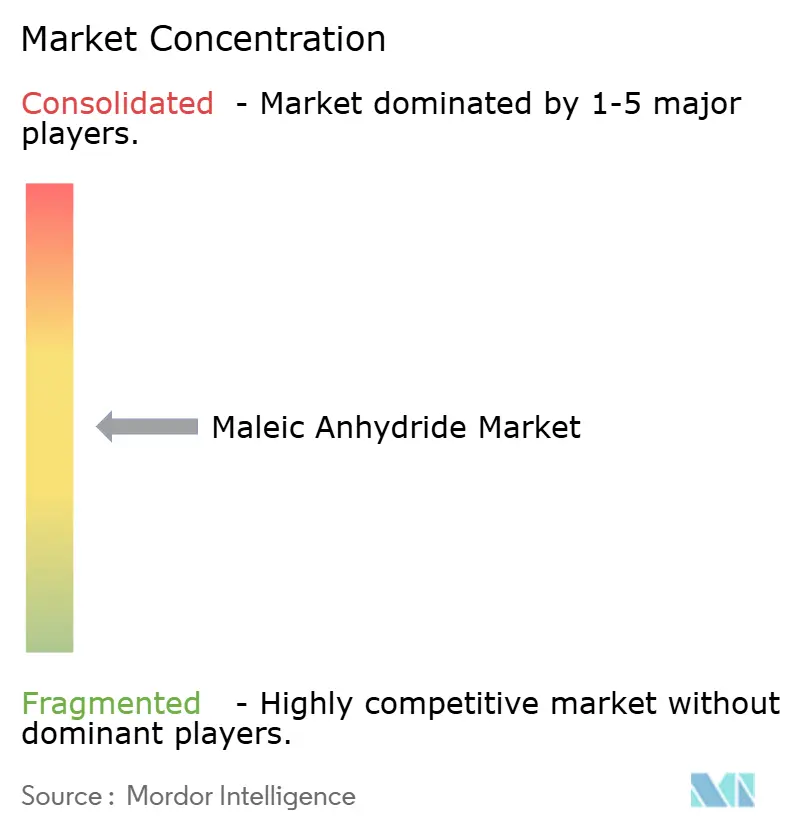
| Market Concentration | Medium |
Major Players *Disclaimer: Major Players sorted in no particular order Image © Mordor Intelligence. Reuse requires attribution under CC BY 4.0. | |
Maleic Anhydride Market Analysis by Mordor Intelligence
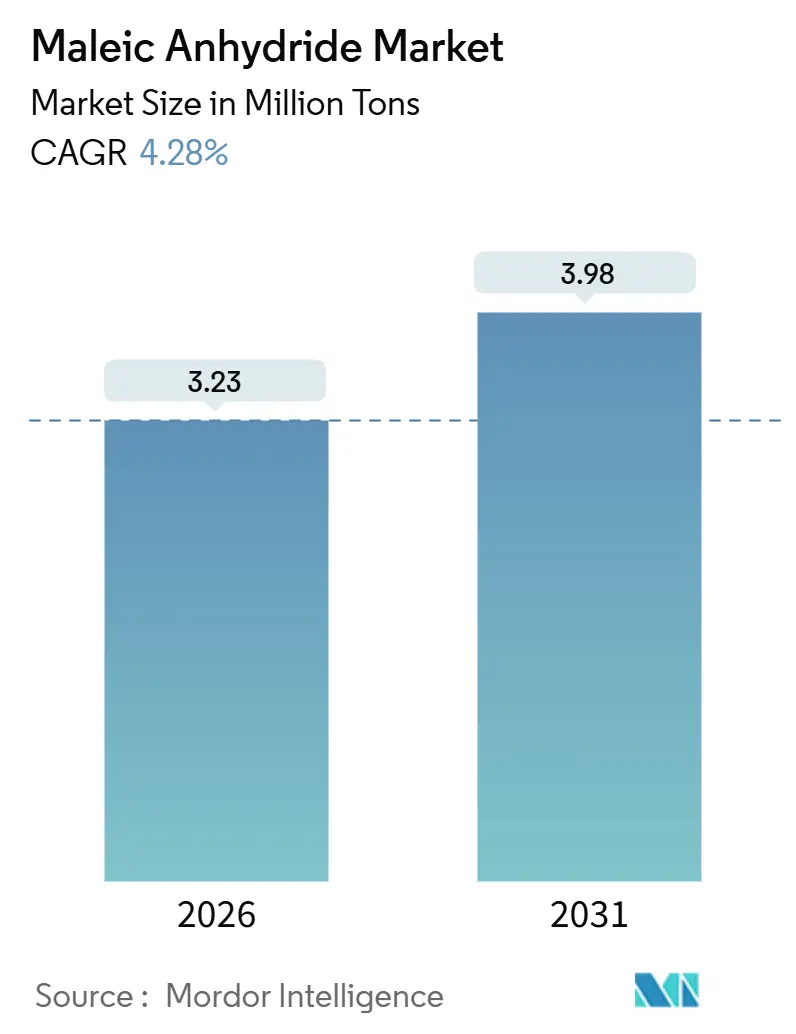
The Maleic Anhydride Market size is estimated at 3.23 million tons in 2026, and is expected to reach 3.98 million tons by 2031, at a CAGR of 4.28% during the forecast period (2026-2031). This growth rests on Asia-Pacific capacity additions, accelerating recycled-PET composite adoption, and the steady pivot from benzene to n-butane feedstock. New Chinese plants boosted global nameplate by 1.46 million tons in 2024, creating oversupply that squeezed margins, especially in Europe and South America. Western producers responded by shutting or mothballing older benzene units, while integrated resin manufacturers in North America and Southeast Asia are embracing molten supply to lower logistics costs. Regulatory drivers—EU circular-economy rules and stricter OECD benzene-emission caps—continue to push production toward low-emission processes and higher-value derivative grades. Competitive intensity is therefore highest in the commodity flake trade, whereas specialty copolymers and high-purity molten grades offer margin resilience.
Key Report Takeaways
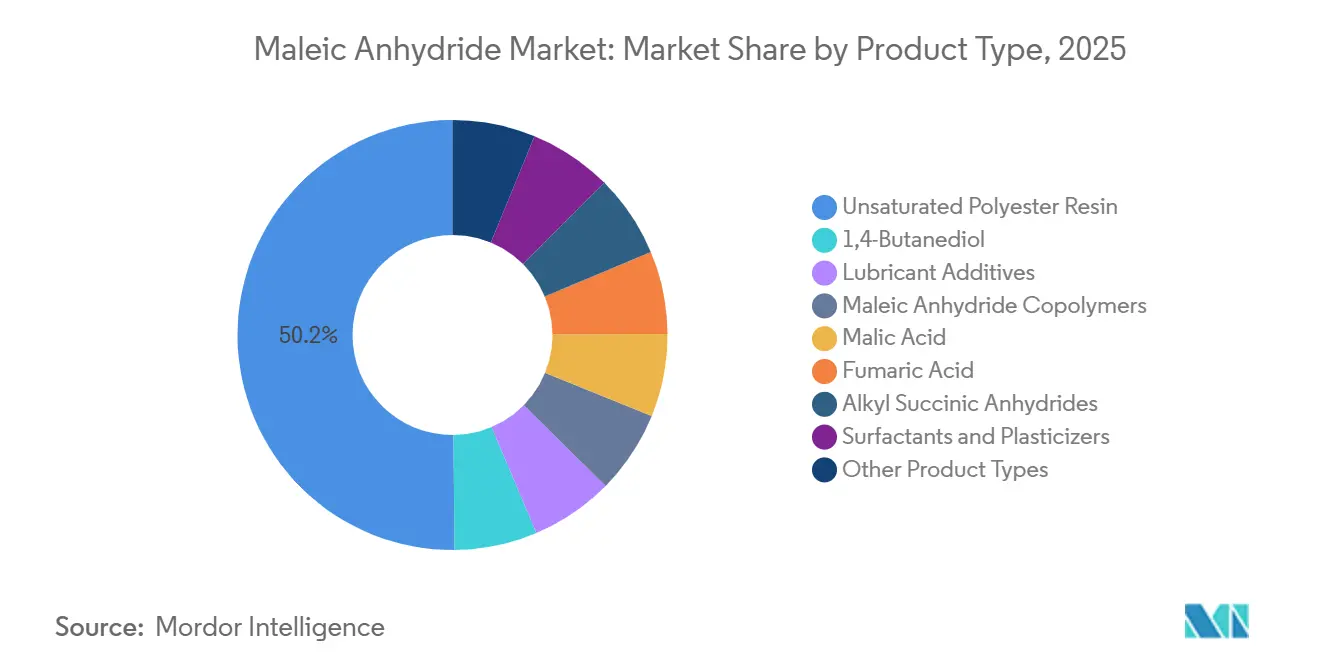
- By product type, unsaturated polyester resin captured 50.15% of the maleic anhydride market share in 2025 and is forecast to expand at a 4.98% CAGR between 2026-2031.
- By raw material, the n-butane route commanded 70.45% share of the maleic anhydride market size in 2025, and the benzene-based route is projected to expand at a 4.72% CAGR through 2031.
- By physical form, the solid form commanded 60.78% share of the maleic anhydride market size in 2025, and molten grade volume is advancing at a 4.93% CAGR, outpacing solid flake/prill growth.
- By end-user industry, construction accounted for 62.23% of the maleic anhydride market size in 2025 and is forecast to expand at a 4.78% CAGR to 2031.
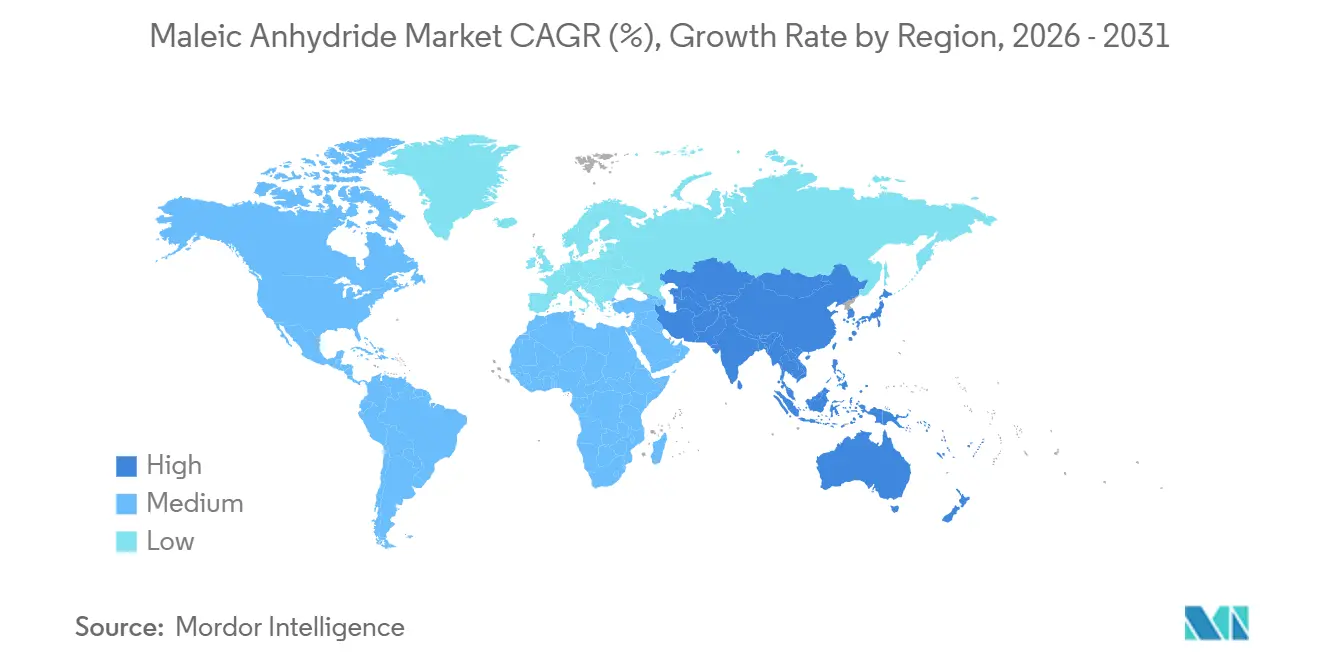
- By geography, Asia-Pacific captured 69.45% of the maleic anhydride market share in 2025 and is advancing at a 4.66% CAGR to 2031.
Note: Market size and forecast figures in this report are generated using Mordor Intelligence’s proprietary estimation framework, updated with the latest available data and insights as of January 2026.
Market Trends and Insights
Drivers Impact Analysis of Maleic Anhydride Market*
| Drivers | (~) % Impact on CAGR Forecast | Geographic Relevance | Impact Timeline |
|---|---|---|---|
| Surging adoption of recycled-PET UPR in European construction | +0.8% | Europe (EU-27), with early adoption in Germany, France, Netherlands | Medium term (2–4 years) |
| Capacity additions of n-butane plants lowering feedstock cost | +1.2% | Global, with strongest effect in North America (Gulf Coast), Middle East (Saudi Arabia, Oman), Asia-Pacific (China coastal provinces) | Short term (≤ 2 years) |
| Lightweight SMC panels for EVs boosting UPR demand in North America | +0.6% | North America (United States, Mexico), spill-over to Europe | Medium term (2–4 years) |
| Rising 1,4-BDO demand for spandex and PBT in Asia | +0.9% | Asia-Pacific core (China, India, Vietnam, Indonesia), spill-over to Middle East textile hubs | Medium term (2–4 years) |
| Bio-based succinic-acid copolymers unlocking premium margins | +0.4% | Global, with early commercialization in Japan, Europe (Germany, Netherlands), North America | Long term (≥ 4 years) |
| Source: Mordor Intelligence | |||
Surging Adoption of Recycled-PET UPR in European Construction
In response to EU Regulation 2022/1616, which mandates recycled content in plastics, and the 2024 Ecodesign Regulation, requiring digital product passports to certify circular attributes, European composite producers are taking proactive steps[1]. They are blending post-consumer PET with maleic-anhydride-modified unsaturated polyester resin. This strategy not only helps them secure green-building credits but also enables a reduction in embodied carbon. Countries like Germany, France, and the Netherlands are leading the charge, channeling their UPR demand into these eco-friendly blends. With passport obligations set to take effect in July 2026, the adoption of these practices is poised to accelerate, solidifying maleic anhydride’s pivotal role as a compatibilizer in the realm of low-carbon construction composites.
Capacity Additions of N-Butane Plants Lowering Feedstock Cost
In 2024, n-butane oxidation dominated with a commanding share of global capacity. Notably, new facilities in China and Oman, leveraging cutting-edge vanadium-phosphate and tri-leaf catalysts, are achieving high yields[2]. These advancements not only enhance productivity but also mitigate benzene emissions, allowing these facilities to dodge EPA NESHAP compliance costs. Furthermore, feedstock dynamics tilt in favor of butane, while producers in the Asia-Pacific region paid less for butane than for benzene. This pronounced cost disparity is fueling a surge in conversions and greenfield projects across three continents, solidifying the n-butane route's competitive advantage.
Lightweight SMC Panels for EVs Boosting UPR Demand in North America
In 2025, North American electric vehicle (EV) production surged, marking a robust year-on-year growth. OEMs are now turning to sheet-molding-compound battery enclosures, utilizing unsaturated polyester resin (UPR) and maleic anhydride for each vehicle. The USMCA's local-content regulations are pushing for domestic resin production. This is underscored by the launch of new facilities in Illinois and West Virginia, both of which became operational in 2024. With the rising popularity of gigacasting, the appetite for flame-retardant SMC grades, known for their superior wet-out properties, is set to eclipse the growth of traditional automotive composites, leading to an uptick in regional maleic anhydride consumption.
Rising 1,4-BDO Demand for Spandex and PBT in Asia
Asian textile and electronics clusters are utilizing 1,4-BDO to produce spandex and PBT. By continuously hydrogenating maleic anhydride to BDO at 190 °C, a high yield is achieved. This success has spurred integrated investments, such as BASF’s Zhanjiang Verbund, which is set to commence downstream oxo-C4 units in 2025. China, India, and Vietnam have collectively boosted their PBT capacity, and spandex fiber production has also increased. With a captive BDO supply, producers are insulated from the volatile commodity prices of maleic anhydride, allowing them to command a premium on high-purity grades.
Restraints Impact Analysis of Maleic Anhydride Market*
| Restraints | (~) % Impact on CAGR Forecast | Geographic Relevance | Impact Timeline |
|---|---|---|---|
| Global oversupply driven by new Chinese capacities | -1.1% | Global, with most acute margin pressure in Asia-Pacific, Europe, and Latin America | Short term (≤ 2 years) |
| Stricter OECD benzene-emission caps raising compliance cost | -0.5% | OECD countries (North America, Europe, Japan, South Korea), with benzene-route plants most affected | Medium term (2–4 years) |
| ICE phase-out curbing lube-oil-additive derivatives | -0.3% | Europe (EU-27), North America (United States, Canada), with gradual impact in Asia-Pacific | Long term (≥ 4 years) |
| Source: Mordor Intelligence | |||
Global Oversupply Driven by New Chinese Capacities
In 2024, China unveiled new capacity, spearheaded by Hengli's complex, pushing China's global output share past the 70% mark. Ex-works prices plummeted, a stark contrast to North America's spot prices, igniting a surge in exports. Meanwhile, utilization rates dipped. Western players, grappling with elevated fixed costs, began shuttering plants: Huntsman ceased operations at its Moers facility in mid-2025, and Nan Ya put its Taiwan site on hold in late 2024. In a bid to navigate these challenges, industry incumbents are now focusing on high-purity molten supplies and specialty copolymers, areas where competition from China remains limited.
Stricter OECD Benzene-Emission Caps Raising Compliance Cost
In response to EPA NESHAP and similar EU regulations, which impose benzene limits, units utilizing the benzene route have been compelled to adopt oxidizers and implement continuous monitoring. These measures have escalated operating costs and incurred significant capital expenditure. Consequently, this financial burden has led Huntsman and Nan Ya to shutter their plants and has dissuaded the establishment of new benzene-based facilities. Reflecting this trend, every capacity announced post-2024—including Hengli in China, ABP in Oman, and Indian Oil’s proposed unit in Panipat—has pivoted to n-butane oxidation, signaling a pronounced shift away from benzene technology.
*Our forecasts treat driver/restraint impacts as directional, not additive. The impact forecasts reflect baseline growth, mix effects, and variable interactions.
Maleic Anhydride Market Segment Analysis
By Product Type:
Unsaturated Polyester Resin Dominance Reflects Construction and EV Composites MomentumUnsaturated polyester resin secured 50.15% of the maleic anhydride market share in 2025 and is tracking a 4.98% CAGR to 2031, ahead of the overall market. European regulations are pushing for the use of recycled-PET blends. In North America, electric vehicle (EV) battery enclosures are utilizing maleic anhydride for each vehicle. These applications act as a buffer, shielding volumes from the cyclical downturns often seen in commodity resins. Demand for 1,4-BDO is on an annual growth trajectory, driven by investments in spandex and PBT across Asia. While the usage of lubricant additives has seen a decline as combustion engines wane, maleic anhydride copolymers are thriving. These copolymers, utilized in water treatment and bio-based packaging, are helping to mitigate the downturn in lubricants. Additionally, fumaric and malic acid derivatives are witnessing steady annual growth, primarily fueled by their use as beverage acidulants.
Specialty products, despite their lower volumes, command significant margins. For instance, bio-based succinic-acid copolymers are achieving impressive premiums in the premium packaging sector. Producers are strategically tapping into these niche markets to navigate the challenges of oversupply. Notably, Japanese research and development is making strides, focusing on the furfural-route maleic anhydride and its downstream green copolymers. This dual landscape not only solidifies unsaturated polyester's central role in the maleic anhydride market's revenue but also highlights the diversification of profit pools through its derivatives.

By Raw Material:
N-Butane Route Ascendancy Driven by Yield, Cost, and Regulatory AdvantagesThe n-butane route dominated 70.45% of production in 2025 and is projected to grow faster than the overall maleic anhydride market. Butane oxidation eliminates benzene emissions and captures co-product hydrogen, delivering lower cash costs and simpler permitting. BASF's tri-leaf catalyst boosts yield and reduces reactor pressure drop, translating to significant savings, especially with energy being the second-largest variable cost.
Benzene-based production, though declining in share, is forecast to grow at a 4.72% CAGR through 2031, faster than the overall market, because surviving benzene-route plants are concentrated in integrated petrochemical complexes where benzene is a low-cost byproduct of naphtha cracking and where producers have already amortized compliance investments. Surviving benzene units remain competitive only where benzene is an internal cracker by-product, for example, Huntsman’s U.S. Gulf Coast sites co-located with UPR reactors. Even there, continued operation hinges on already-amortized scrubbers.
By Physical Form:
Molten Grade Gains Traction as Integrated Producers Co-LocateSolid forms (flake and prill) accounted for 60.78% of the 2025 volume because they store and ship easily across oceans. Molten supply, though smaller, is climbing at 4.93% CAGR thanks to integrated resin complexes in Illinois,
In Kuantan and Yantai, heated pipelines and railcars have managed to reduce energy consumption in packaging and re-melting. This reduction is particularly significant given that carbon pricing in Europe is projected to increase. Molten distribution has an economic radius, leading to a concentration of uptake in areas where UPR plants are adjacent to maleic anhydride reactors. Europe, however, is falling behind. The continent's fragmented resin plants find it uneconomical to invest in dedicated hot-tank logistics, resulting in a dominance of flakes in EU trade.
By End-User Industry:
Construction Leads, but Automotive and Electronics Diversify DemandConstruction consumed 62.23% of the maleic anhydride market size in 2025 and is growing at a 4.78% CAGR to 2031. India's infrastructure initiatives and the EU's push for a circular economy are fueling this growth. The automotive sector is reaping the rewards of a surge in demand for EV-driven composites and parts, thanks to the USMCA regulations. In the electronics realm, there's notable growth largely driven by the demand for connectors and sensor housings, specifically those made from PBT sourced from BDO. While the food and beverage and specialty chemicals sectors collectively represent a smaller portion of the market, they are witnessing stable growth, bolstered by regulations. This stability helps insulate overall demand from the declining trend of oil additives in ICE lubricants.

Geography Analysis
APAC Maleic Anhydride Market
Asia-Pacific held 69.45% of global volume in 2025 and advances at a 4.66% CAGR to 2031. Hengli alone boosts China's output, but with utilization rates lingering around 70%, export pressures remain pronounced. Indian Oil's project in Panipat signals India's pivot from a 70% reliance on imports to a stride towards self-sufficiency. Meanwhile, Japan and South Korea are channeling efforts into high-purity and bio-based research and development, setting the stage for a commercial leap into furfural routes after 2028.
North America Maleic Anhydride Market
North America is on a growth trajectory, buoyed by EV production and USMCA content stipulations. New butane facilities in Illinois and West Virginia are dedicated to in-house resin production, and Gulf Coast benzene units operate solely where scrubbers have seen their depreciation. Selling prices in the region often surpass Chinese exports, underscoring the logistics and purity premiums commanded.
EMEA and South America Maleic Anhydride Market
Europe, holding a share of demand, is expanding at a more tempered pace, grappling with energy-price challenges and stringent benzene-emission regulations. However, Europe's surge in recycled-PET composites and the impending rollout of digital passports provide a cushion for the maleic anhydride market against the influx of Asian imports. South America and the MEA region see strategic investments like ABP's plant in Oman, which capitalizes on affordable butane to cater to the resin markets in Africa and the Middle East that have long been underserved.
Regulatory Landscape
Maleic anhydride is treated as a hazardous industrial chemical in major markets, with requirements covering worker protection and product stewardship that influence handling, labeling, and emissions controls. In the United States, it is listed on the TSCA Inventory and covered under OSHA Hazard Communication requirements (29 CFR 1910.1200), which means producers and distributors need compliant SDSs and workplace labeling and training for both solid and molten grades.
In Europe, REACH registration is administered through ECHA, where substance dossiers and compliance workflows are managed via the ECHA CHEM platform, which underwent technical upgrades in late 2025 and early 2026. Cross-border rules also shape flows for both commodity and specialty grades, with maleic anhydride commonly classified under HS code 2917.14 and national tariff schedules requiring more granular digit structures for declarations. The GCC move to 12-digit HS code structures effective January 1, 2025 increases reporting complexity for exporters serving Middle East and Africa demand centers, making accurate classification and documentation more relevant for eligibility under country-specific tariff and preference rules.
Value Chain Analysis
The value chain is built on hydrocarbon feedstocks, primarily n-butane and, to a lesser extent, benzene and ortho-xylene-derived streams from integrated complexes. Producers oxidize n-butane in fixed-bed multitubular reactors using vanadium phosphorus oxide (VPO) catalysts, supported by utilities such as air, steam, cooling water, and scrubbing systems used to recover and purify maleic anhydride. Catalyst and process-licensing inputs (including technology packages provided by established chemical licensors) affect yields, energy intensity, and emissions performance, so technology choice is a key upstream decision for new builds and revamps.
Midstream, maleic anhydride is supplied as solid flakes and prills for long-distance trade, and as molten material where buyers can use heated storage and insulated trucks, railcars, or pipelines within an economic distribution radius tied to adjacent UPR and derivative units. Downstream demand concentrates in unsaturated polyester resins, 1,4-BDO intermediates, and copolymers, and procurement strategies increasingly link maleic anhydride volumes to integrated resin and C4 derivative platforms to reduce logistics friction and improve supply reliability. The post-2024 shift toward n-butane-based projects, alongside closures of older, higher-cost assets in some OECD locations, has reinforced Asia-Pacific and the Middle East as incremental export supply hubs built around large, integrated sites.
Competitive Landscape
The maleic anhydride market is moderately fragmented. Chinese oversupply has forced Western exits. Survivors pivot to value-added niches. BASF’s Zhanjiang Verbund integrates a steam cracker, a maleic anhydride unit, and downstream oxo-C4 units to capture integrated margins. Regionally, PETRONAS Chemicals bought BASF’s 113 kt Kuantan plant to supply ASEAN molten demand, and ABP’s Oman unit serves Middle East composites. Indian Oil’s Panipat plant will mitigate India’s import reliance and supply its growing construction segment. Technology leadership - tri-leaf catalysts, AI controls, and molten logistics - defines cost positions, and the pivot to specialty copolymers and bio-based derivatives differentiates margin performance in an otherwise oversupplied maleic anhydride market.
Maleic Anhydride Industry Leaders
-
Polynt S.p.A.
-
Huntsman International LLC
-
Mitsubishi Chemical Group Corporation
-
INEOS AG
-
Wanhua
- *Disclaimer: Major Players sorted in no particular order
Maleic Anhydride Market Companies Covered in this Report
- AOC
- Arkema
- Ashland
- Bartek Ingredients Inc.
- BASF
- Borealis AG
- Clariant
- Evonik Industries AG
- Huntsman International LLC
- I G Petrochemicals Ltd. (IGPL)
- INEOS AG
- LANXESS
- Mitsubishi Chemical Group Corporation
- NAN YA PLASTICS CORPORATION
- NIPPON SHOKUBAI CO., LTD.
- PETRONAS Chemicals Group Berhad
- Polynt S.p.A.
- Sinopec Qilu Petrochemical
- SK Functional Polymer
- Thirumalai Chemicals
- Wanhua
Market Opportunities and Future Outlook
Near-term opportunities center more on supply-chain reconfiguration and documented pull-through into higher-value applications than on incremental growth in commodity flake trade. In Europe, circular-economy compliance is moving buyers toward maleic-anhydride-modified UPR formulations for recycled-PET composite blends, with policy support coming from the EU Ecodesign framework and the rollout of digital product passports effective July 2026. That shift creates whitespace for binders and compatibilizers designed to meet traceability requirements, particularly for construction-oriented composites.
On the supply side, capacity and technology activity continues to favor n-butane oxidation and integrated chemical-park economics. PETRONAS Chemicals outlined plans to produce maleic anhydride in Kuantan, Malaysia by the first half of 2025 after acquiring and repurposing a 113 ktpa plant, aligning production with ASEAN resin demand and molten logistics. In Oman, Al Baleed Petrochemical Company awarded CONSER (MAIRE) a technology licensing contract in September 2024 for a 50,000 tpy maleic anhydride plant in the Salalah Free Zone, pointing to investment toward exportable, cost-advantaged production aimed at downstream composites and regional derivative chains.
Recent Industry Developments in Maleic Anhydride Market
- April 2026: Huntsman reported in its Q1 2026 update that Performance Products volumes were lower, reflecting the prior closure of its Moers, Germany maleic anhydride operations and softer demand conditions. The disclosure highlighted the shift from European manufacturing toward serving the region through North American supply points, which changes lead times and trade flows for European buyers.
- May 2025: Huntsman announced the closure of its maleic anhydride facility in Moers, Germany following a strategic review, and stated it would supply Europe from its North American sites in Pensacola, Florida and Geismar, Louisiana. The consolidation reduced exposure to structurally higher European operating costs amid global oversupply pressure.
- March 2024: Polynt signed a non-binding memorandum of understanding to acquire Polyprocess, a French supplier of specialty gelcoats and related composites derivatives, including the transfer of its production plant in Saint-Jean-d’Illac, France. The step strengthened downstream positioning in composites, where value-added formulations can help buffer maleic anhydride chain participants from commodity margin volatility.
Maleic Anhydride Market Report Scope and Research Methodology
Market Definition and Coverage
For this study, the market covers maleic anhydride that is produced and sold as a chemical intermediate, in solid or molten form, and supplied into downstream manufacturing chains that consume it as an input.
Scope exclusions: It does not count volumes that stay fully captive and never enter merchant trade, and it also excludes downstream derivative product revenues.
Segments Covered in This Report
- By Product Type
- Unsaturated Polyester Resin
- 1,4-Butanediol
- Lubricant Additives
- Maleic Anhydride Copolymers
- Malic Acid
- Fumaric Acid
- Alkyl Succinic Anhydrides
- Surfactants and Plasticizers
- Other Product Types
- By Raw Material
- N-Butane
- Benzene
- By Physical Form
- Solid (Flake / Prill)
- Molten
- By End-user Industry
- Construction
- Automobile
- Electronics
- Food and Beverage
- Oil Products
- Personal Care
- Pharmaceuticals
- Agriculture
- By Geography
- Asia-Pacific
- China
- India
- Japan
- South Korea
- Rest of Asia-Pacific
- North America
- United States
- Canada
- Mexico
- Europe
- Germany
- United Kingdom
- France
- Italy
- Rest of Europe
- South America
- Brazil
- Argentina
- Rest of South America
- Middle-East and Africa
- Saudi Arabia
- South Africa
- Rest of Middle-East and Africa
- Asia-Pacific
Data Sources, Market Sizing, and Validation
Desk Research
Desk research was used to map the supply chain and to anchor the demand pool to observable signals. We relied on public references such as national customs portals for import and export trends, UN Comtrade for cross-country reconciliation, and the World Bank and IMF for macro indicators that influence chemical demand.
To keep assumptions realistic, we also reviewed sources such as energy and petrochemical statistics published by agencies like the IEA and EIA, safety and classification documents from regulators such as ECHA, and peer-reviewed chemistry and polymer journals that describe process routes and yield-related constraints. Company annual reports, investor presentations, and reputable trade press were used to understand capacity changes, turnaround cycles, and key end-use exposure. Where needed, paid subscriptions covering company financials and intelligence, shipment-level trade, and patent databases were used to cross-check facts and avoid missing smaller but active routes. The sources listed here are illustrative, and many other public references were also reviewed for data collection, clarification, and cross-verification.
Primary Interviews and Surveys
Primary discussions were completed with participants across the value chain, including producers, distributors, and downstream buyers that convert maleic anhydride into key intermediates. We used these inputs to sanity-check utilization levels, regional trade reliance, and how costs were passed through into contract pricing. The same set of respondent views was then used to confirm that the final model reflects what buyers and sellers were seeing in the most recent quarters across APAC, EMEA, and the Americas.
Distribution of primary research fieldwork respondents
| Company type | Respondent position | Region |
|---|---|---|
| Top tier: 38% | CXOs: 14% | APAC: 42% |
| Mid tier: 43% | Functional/Unit leaders: 34% | EMEA: 34% |
| Smaller Players: 19% | Managers: 52% | Americas: 24% |
Market-Sizing & Forecasting
Sizing is constructed mainly through a top-down build that reconstructs addressable merchant demand from downstream production activity and trade flows, and then converts that demand into market value using region-specific price assumptions. To make sure the totals are not drifting, we corroborate the outcome with selective bottom-up approximations, such as sampled capacity-by-utilization rollups and channel checks on typical realized prices, and then adjust where mismatches persist.
Key inputs that shape the model include announced and operating capacity by region, estimated utilization and outage patterns, import and export balances, downstream pull from unsaturated polyester resin and 1,4-butanediol chains, and feedstock-linked price movement (n-butane or benzene) that influences maleic anhydride ASPs. Where pricing is volatile, an average annual ASP is built from quarterly directionality and then stress-tested against trade unit values and interview feedback, which helps avoid overstating revenue in spike months. Forecasts are developed using scenario analysis, where demand drivers and operating rates are varied within ranges validated by experts, and then the central case is selected when it aligns with observed macro and chemical-cycle indicators. Gaps in country data are handled through regional proxies tied back to trade intensity and known production footprints, and these assumptions are revisited when new capacity or policy changes emerge.
Data Validation & Update Cycle
Validation is done through multiple checks so that one weak data series does not dominate the result. We compare modeled volumes and values against independent signals, including trade balances, capacity announcements, and downstream production markers, and then review outliers that do not match the expected chemical-cycle direction.
Before sign-off, assumptions are reviewed in steps, including internal peer review and targeted re-contacts when pricing, utilization, or trade direction changes materially. The report is refreshed annually, and interim updates are made when major events occur, such as large capacity additions, sustained outages, or sharp feedstock moves. Right before delivery, the model is re-run with the latest available inputs so clients receive an updated view rather than a stale snapshot.
Mordor Intelligence's Global Maleic Anhydride Market Market Size Compared With Other Published Estimates
It is normal to see different market sizes for maleic anhydride across public sources, even when they appear to cover the same product. The gaps usually come from how each publisher treats captive versus merchant volumes, how they convert tons into revenue, and which year of pricing and FX timing they lock into the model.
When the refresh cycle is faster, quarterly price shifts and currency movements get captured sooner, which can lift or compress the stated USD value without any real change in physical demand. Some estimates also blend maleic anhydride with adjacent derivative revenues, or they use a single global ASP that misses regional spreads tied to feedstock and trade dependence. In our build, the latest annualized ASP and FX timing are rechecked before finalization, a step that keeps Mordor Intelligence focused on the merchant market boundary rather than temporary spot distortions.
Benchmark comparison
| Source | Market Size | Gaps in Research Methodology |
|---|---|---|
| Mordor Intelligence | USD 3.23 M (2026) | |
| Global Consultancy A | USD 3.22 B (2024) | Value-first reporting can diverge when a single blended global ASP is applied and when the implicit FX year differs from the demand year, which can understate regions with higher realized pricing. |
| Industry Publisher B | USD 3.36 B (2025) | Some published numbers appear to include broader chemistry value capture or looser merchant boundaries, and they can lean on earlier-year pricing assumptions that do not fully reflect later feedstock-driven ASP resets. |
Across the table, the spread is mainly explained by value conversion choices, especially which ASP window is used and how currency is timed, along with whether captive material is treated as part of the tradable market. By tying the model to observable trade, capacity, and downstream pull, and then forcing pricing assumptions to be consistent with the same period, our estimate stays easier to trace and repeat for decision-making.
Key Questions Answered in the Report
What is the forecast size of the maleic anhydride market in 2031?
Global volume is projected to reach 3.98 million tons by 2031, expanding at a 4.28% CAGR from 3.23 million tons in 2026.
Why is the n-butane route gaining share over the benzene route?
N-butane oxidation offers higher yields, lower feedstock cost, and avoids benzene-emission compliance expenses, leading to a 70.45% share in 2025.
How does EV production influence maleic anhydride demand?
In North America, as EV output rises, so does the regional consumption of sheet-molding-compound panels, which each EV utilizes with maleic anhydride.
Which region adds the most new capacity?
In 2024, China emerged as the leading contributor to global capacity expansion, primarily driven by Hengli's unit.
What strategic shift are incumbents making to protect margins?
Producers focus on specialty copolymers, molten supply, and bio-based derivatives that command price premiums over commodity grades.