
Market Overview
| Study Period | 2020 - 2031 |
|---|---|
| Forecast Data Period | 2026 - 2031 |
| Historical Data Period | 2020 - 2024 |
| Growth Rate | 9.95 % |
| Fastest Growing Market | Asia Pacific |
| Largest Market | North America |
Major Players *Disclaimer: Major Players sorted in no particular order Image © Mordor Intelligence. Reuse requires attribution under CC BY 4.0. | |
Incontinence Devices and Ostomy Market Analysis by Mordor Intelligence
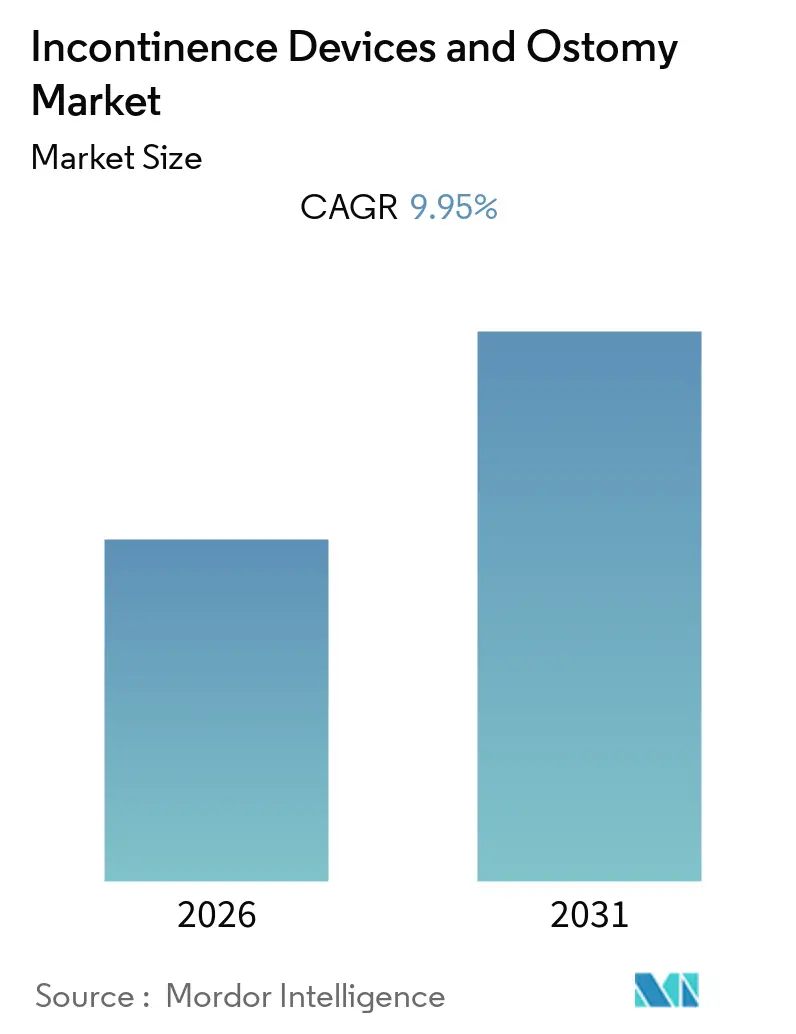
The Incontinence Devices and Ostomy Market size is expected to register a CAGR of 9.95% during the forecast period.
The outbreak of the COVID-19 pandemic significantly impacted the incontinence devices and ostomy business, as only the most acute ostomy surgeries were performed following the outbreak. Stoma care is a potentially overlooked aspect of the outbreak, and no specific stoma care recommendations were published during the pandemic. According to the study published by the National Library of Medicine in March 2022, ostomies decreased by 19.5% during the time between March 2020 and February 2021. Thus, the decline in surgeries related to ostomies hampered the growth of the market during the pandemic. However, the demand for ostomy care products for home care considerably increased during the same period as most patients opted for home treatments. Hence, COVID-19 had a significant impact on market growth. However, as COVID-19 cases have subsided, the market has been recovering very well and is likely to maintain the same trend over the forecast period.
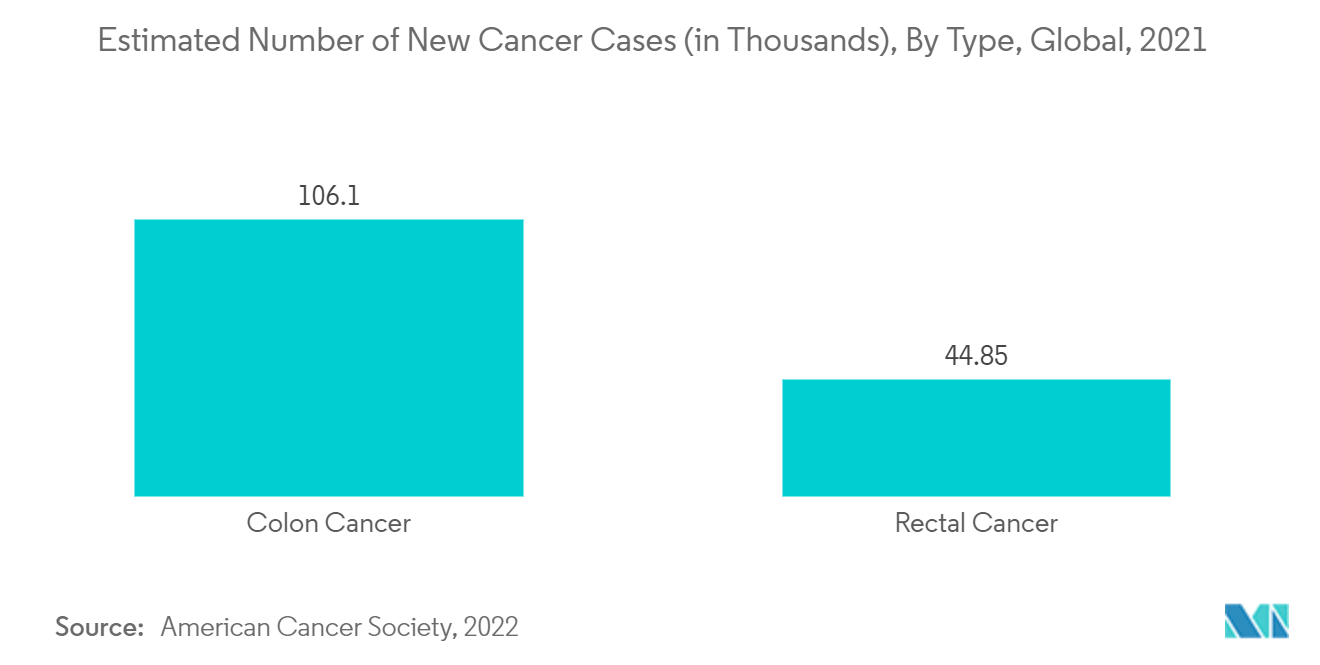
The major factor contributing to the growth of the market studied is the high prevalence of inflammatory bowel diseases (IBD), rising prevalence of urinary incontinence (UI), including ulcerative colitis or Crohn's disease, and colorectal cancer, resulting in increased ostomy surgery cases. According to the WHO updates from July 2021, an increase of around 70% is expected in colorectal cancer cases across the world by 2030. Furthermore, according to statistics published by GLOBOCAN, colorectal cancer (CRC) is the fourth most common type of cancer among the German population, and approximately 57,528 new cases of CRC were reported in Germany in 2021. Additionally, according to statistics provided by GLOBOCAN in 2020, approximately 33,815 new cases of colon cancer and 11,951 new deaths were reported in the United Kingdom in 2020 increasing the demand for ostomy surgeries and devices, thereby boosting the market growth over the forecast period. Moreover, as per a study published in April 2022 by Female Pelvic Medicine & Reconstructive Surgery, 61.8% of women had urinary incontinence (UI), corresponding to 78,297,094 adult United States women, with 32.4% of all women reporting symptoms at least monthly in 2021. Of those with UI, 37.5% had stress urinary incontinence, 22.0% had urgency urinary incontinence, 31.3% had mixed symptoms, and 9.2% had unspecified incontinence. Thus, a high burden of UI in women is expected to increase the demand for incontinence products which is expected to boost the growth of the market over the forecast period.
The development of efficient and suitable pouching systems and associated accessories which help to improve the quality of life of ostomy patients, is expected to open up the growth horizons for the studied market over the forecast period. For instance, the company Trio Healthcare launched a silicone-based ostomy seal, Trio Siltac. This product aids in preventing leakage and protecting the skin around the stoma. Such technological advancements are anticipated to propel the market growth over the forecast period.
Furthermore, an increase in initiatives to raise awareness about ostomy in individuals further propels the growth of the market. For instance, the United Ostomy Association of America Inc. (UOAA) works to improve the quality of ostomy healthcare and promote higher standards of care in all healthcare settings. The organization commemorates World Ostomy Day on the first Saturday of October every year to raise awareness about ostomy care. Such initiatives is likely to create awareness among the general population about stoma care, thereby aiding market growth.
However, lack of proper reimbursement and complications associated with ostomy and usage of incontinence products are likely to restrain the market growth.
Note: Market size and forecast figures in this report are generated using Mordor Intelligence’s proprietary estimation framework, updated with the latest available data and insights as of 2026.
Global Incontinence Devices and Ostomy Market Trends and Insights
Colostomy Bags are Expected to Observe Lucrative Growth in the Application Segment
A colostomy bag also called a stoma bag, or ostomy bag, is a small, waterproof pouch used to collect waste from the body. During a surgical procedure known as a colostomy, an opening, called a stoma or ostomy, is formed between the large intestine (colon) and the abdominal wall. This allows waste products to be excreted through the opening in the abdominal wall rather than via the colon through the rectum and anus. Stools and other waste products are drainable into the pouch-like colostomy bag, which can then be emptied at regular intervals.
The demand for these bags has increased over the years due to the increasing incidence of inflammatory bowel diseases (IBD). For instance, according to the research study published in BMC Journal in August 2021, in the United Kingdom, the incidence of inflammatory bowel disease (IBD), Crohn's disease (CD), and ulcerative colitis (UC) were found to be 28.6, 10.2, and 15.7 per 100,000 population, respectively in 2021. Such a high incidence of these diseases is expected to drive market growth.
Furthermore, the rising number of product launches is also expected to further drive segmental growth in the coming years. The introduction of efficient and suitable ostomy bags which help to improve the quality of life of ostomy patients is expected to provide ample growth opportunities for the segment's growth. For instance, in June 2021, Pelican Healthcare Ltd., located in Cardiff, strengthened its position as one of the leading manufacturers of disposable stoma devices in the United Kingdom and Ireland healthcare sectors with the introduction of the ModaViostomy bag range.
North America Dominates the Market and is Expected to do the Same in the Forecast Period
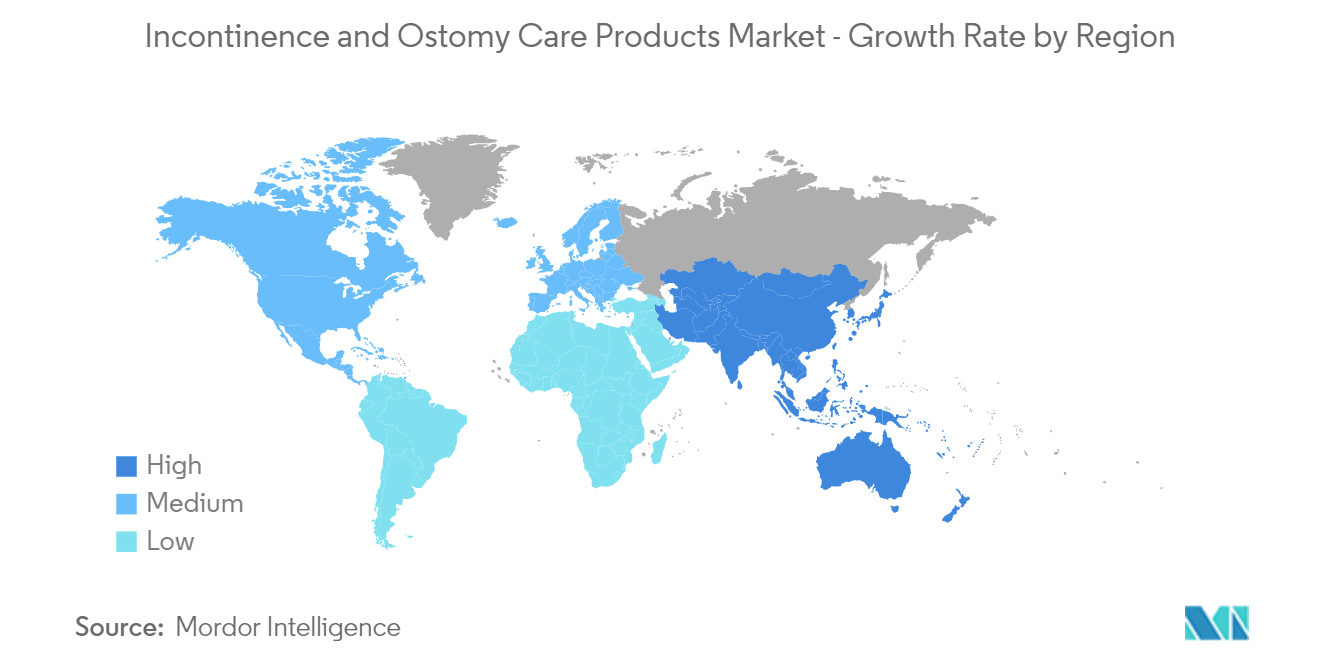
North America dominated the incontinence devices and ostomy market and accounted for the largest revenue share owing to factors such as an increase in the number of patients due to Crohn's disease, ulcerative colitis, and rising awareness initiatives related to ostomy care or stoma surgical procedures.
As per a Johns Hopkins University article of 2023, more than 25 million adult Americans experience temporary or chronic urinary incontinence. Electrical stimulation is used in continence care to manage urinary and fecal incontinence. Additionally, the cost of treatment of UI in the United States alone is USD 16.3 billion, 75% of which is spent on the treatment of women. This increasing prevalence of UI in the United States is expected to propel the market's growth.
Moreover, several market players are implementing various strategic initiatives that support the market's growth. For instance, in April 2021, Welland Medical expanded its business in Canada through its distributor, Premier Ostomy Centre. It is directly available to people living in Canada. Such developments are likely to boost the market growth in the nation over the forecast period. Additionally, in January 2022, Owens & Minor Inc. and Apria Inc. entered into a definitive agreement under which Owens & Minor will acquire Apria. The acquisition is anticipated to broaden the company's ostomy portfolio.
Competitive Landscape
The incontinence devices and ostomy care products market is highly competitive and consists of a number of major players. Companies like Abena AS, B. Braun Melsungen AG, Coloplast Corporation, ConvaTec, Hollister Inc., and Kimberly-Clark Corporation, among others, hold substantial shares in the market.
Incontinence Devices and Ostomy Industry Leaders
-
Kimberly-Clark Corporation
-
Unicharm Corporation
-
Coloplast Corporation
-
Hollister Inc.
-
B. Braun Melsungen AG
- *Disclaimer: Major Players sorted in no particular order

Market Opportunities and Future Outlook
Procurement-led access and portfolio bundling across ostomy and continence care are opening gaps for suppliers that can win system-level placements and provide broader accessory sets. In 2026, Coloplast renewed national group purchasing agreements for Ostomy Care with Premier (three-year) and Vizient (two-year), which reinforces the role of GPO coverage and consistent supply for acute and post-acute channels. ConvaTec also expanded its ESENTA accessories in North America in March 2026 with a co-branded eakin freeseal ostomy seal, pointing to continued demand for skin protection and leakage-control add-ons that aim to improve patient comfort and reduce complications.
Competitive positioning is increasingly tied to distribution scale and expansion across care settings, especially where home care and professional care overlap. In June 2026, HR HealthCare acquired SteriGear LLC, including the Fig Leaf urinary drainage device brand, which broadens urinary drainage capabilities and supports a wider urology solutions offering across settings. These moves track product and service emphasis on integrated drainage systems, soft-convex barrier concepts, and accessory upgrades designed for long-term chronic care management and caregiver workflows, rather than standalone product sales.
Recent Industry Developments
- June 2026: Unicharm launched Lifree Comfort Night pads designed for long-term use in hospitals and nursing facilities. The product positioning targets overnight leakage management and caregiver workload reduction in professional care settings, supporting deeper penetration in institutional channels.
- April 2026: Kimberly-Clark introduced Goodnites Language of Bedwetting, an augmentative and alternative communication system for children with autism. By extending the brand into a communication and support tool, the company broadened engagement with caregivers and clinicians beyond the core absorbent product proposition.
- May 2024: Coloplast announced three significant product launches to strengthen its ostomy care portfolio and highlighted reimbursement progress in the United Kingdom for its Heylo digital leakage system. The combination of new product introductions and reimbursement support highlights momentum toward improved fit, leakage control, and digitally enabled stoma care pathways.
Research Methodology Framework and Report Scope
Market Definition and Coverage
For this study, the market covers revenues generated from incontinence care products and ostomy care products sold for routine management and post-surgical care across major regions, with values measured in USD and aligned to end-user demand.
Scope exclusions: This sizing excludes surgical procedures, hospital services, and prescription drugs, and it also excludes non-medical consumer substitutes that are not sold as incontinence or ostomy care products.
Segmentation Overview
- By Product Type
- Incontinence Care Products
- Absorbents
- Incontinence Bags
- Other Product Types (Clamps, Deodorizers, Cleaners, Urinals, etc.)
- Ostomy Care Products
- Ostomy Bags
- Colostomy Bags
- Ileostomy Bags
- Urostomy Bags
- Skin Barriers
- Irrigation Products
- Other Ostomy Products
- Ostomy Bags
- Incontinence Care Products
- By Application
- Bladder Cancer
- Colorectal Cancer
- Crohn's Disease
- Kidney Stone
- Chronic Kidney Failure
- Other Applications
- Geography
- North America
- United States
- Canada
- Mexico
- Europe
- Germany
- United Kingdom
- France
- Italy
- Spain
- Rest of Europe
- Asia-Pacific
- China
- Japan
- India
- Australia
- South Korea
- Rest of Asia-Pacific
- Middle East and Africa
- GCC
- South Africa
- Rest of Middle East and Africa
- South America
- Brazil
- Argentina
- Rest of South America
- North America
Data Sources, Market Sizing, and Validation
Desk Research
Desk research starts by mapping the demand pool and care pathways that drive product consumption, then checking where reliable public series exist. We relied on sources such as the World Health Organization for aging and disease burden context, the US Centers for Disease Control and Prevention for prevalence and risk factors, and OECD health statistics for long-term care and care-setting indicators. For procedure and condition context, sources such as the US National Library of Medicine and other peer-reviewed clinical journals helped validate typical ostomy use cases and replacement patterns.
On the supply and trade side, we cross-checked import-export signals, pricing references, and category descriptions using sources such as UN Comtrade, national customs portals where available, and medical device regulator websites that publish product classification and guidance (for example, the US FDA database pages). Company filings, annual reports, investor presentations, and trusted press were used to confirm portfolio mix and regional exposure. We also used paid subscriptions for company financials and for patent database lookups to validate innovation direction and product pipelines. The desk sources listed here are illustrative, and many other public sources were also used for data collection, cross-checks, and clarification.
Primary Interviews and Surveys
Primary interviews were used to convert broad prevalence and procedure signals into realistic product volumes, pricing bands, and channel splits, then stress test the key model assumptions. We spoke with a mix of manufacturers, distributors, clinicians involved in continence and ostomy care, and procurement and home-care stakeholders across APAC, EMEA, and the Americas to confirm replacement frequency, product mix, and the effect of reimbursement and care-setting shifts on ordering patterns.
Distribution of primary research fieldwork respondents
| Company type | Respondent position | Region |
|---|---|---|
| Top tier: 31% | CXOs: 15% | APAC: 48% |
| Mid tier: 50% | Functional/Unit leaders: 28% | EMEA: 32% |
| Smaller Players: 19% | Managers: 57% | Americas: 20% |
Market-Sizing & Forecasting
Sizing is built by reconstructing demand from the treated cohort and care setting, where prevalence, procedure volumes (for ostomy creation), and long-term care penetration are translated into product users and annual usage. We apply a top-down approach first, linking the prevalence-to-treated-cohort build-up to typical consumption rates for key incontinence and ostomy categories, then converting to value using average selling price bands by channel.
To keep the totals grounded, selective bottom-up approximations are used to validate and adjust the aggregated estimates. This includes supplier revenue checks, sampled price points across channels, and distributor feedback on category shares. Variables that typically matter in the model include the older adult population share, the long-term care and home-care mix, ostomy creation and reversal patterns, replacement frequency (pouching and skin barrier cycles), reimbursement breadth, and material cost movements that affect pricing. Forecasting is run using scenario analysis supported by short lists of drivers from experts, so the outlook reflects changes in demographics, care-setting shifts, and pricing progression rather than a single straight-line growth curve. When a country-level datapoint is missing, the gap is handled through proxy indicators, such as similar reimbursement structure and care-setting mix, and then rechecked with primary feedback before inclusion.
Data Validation & Update Cycle
Validation is done by comparing independent checks across the model so the totals make sense from more than one angle, then following up where a mismatch appears. We review year-over-year movements against signals such as demographic changes, care-setting shifts, and trade and pricing markers, and then investigate outliers before final sign-off.
A second analyst review is applied to the assumptions, conversion steps, and currency treatment to reduce calculation errors and scope leakage. Reports are refreshed annually, with interim updates when material events change category demand or pricing. Before delivery, a final pass is completed so the published view reflects the latest available public data and the most recent expert feedback.
Mordor Intelligence's Global Incontinence Devices and Ostomy Market Market Size Compared With Other Published Estimates
Published totals for this market can differ substantially even when they discuss similar products, largely because the inclusion rules and pricing averaging are not always the same. Variations usually come from whether adjacent wound and skin care items are counted, whether retail and reimbursement pricing are blended using the same method, and whether the latest care-setting mix has been captured.
The benchmark table shows a noticeable spread across 2024 values, and in Mordor Intelligence's model the total is built from incontinence and ostomy care product revenues only, with procedure and service spending kept outside the market and with usage frequency and channel-level pricing checked through primary inputs.
Benchmark comparison
| Source | Market Size | Gaps in Research Methodology |
|---|---|---|
| Mordor Intelligence | USD 17.89 B (2024) | |
| Global Consultancy A | USD 16.99 B (2024) | Uses a narrower pricing construct that can overweight retail discounting, and it appears to apply a slower price progression with less adjustment for reimbursement driven mix changes. |
| Industry Publisher B | USD 18.83 B (2024) | Likely includes adjacent consumables and broader post-surgical supplies, which can lift totals, and the category boundaries are not clearly tied to replacement frequency and channel specific ASP checks. |
Overall, the gap pattern mainly reflects scope edges and how volumes and prices are converted into revenue across channels. By keeping assumptions tied to repeatable variables such as treated users, replacement cycles, and channel level pricing bands, the estimate stays traceable and easier to replicate when new data points arrive.
Key Questions Answered in the Report
What is the current Incontinence Devices and Ostomy Market size?
The Incontinence Devices and Ostomy Market is projected to register a CAGR of 9.95% during the forecast period (2026-2031)
Who are the key players in Incontinence Devices and Ostomy Market?
Kimberly-Clark Corporation, Unicharm Corporation, Coloplast Corporation, Hollister Inc. and B. Braun Melsungen AG are the major companies operating in the Incontinence Devices and Ostomy Market.
Which is the fastest growing region in Incontinence Devices and Ostomy Market?
Asia Pacific is estimated to grow at the highest CAGR over the forecast period (2026-2031).
Which region has the biggest share in Incontinence Devices and Ostomy Market?
In 2025, the North America accounts for the largest market share in Incontinence Devices and Ostomy Market.
What years does this Incontinence Devices and Ostomy Market cover?
The report covers the Incontinence Devices and Ostomy Market historical market size for years: 2019, 2020, 2021, 2022, 2023 and 2024. The report also forecasts the Incontinence Devices and Ostomy Market size for years: 2026, 2027, 2028, 2029, 2030 and 2031.