
High Tibial Osteotomy Plates Market Size and Share
Market Overview
| Study Period | 2020 - 2031 |
|---|---|
| Market Size (2026) | USD 270.36 Million |
| Market Size (2031) | USD 330.78 Million |
| Growth Rate (2026 - 2031) | 4.12 % |
| Fastest Growing Market | Asia-Pacific |
| Largest Market | North America |
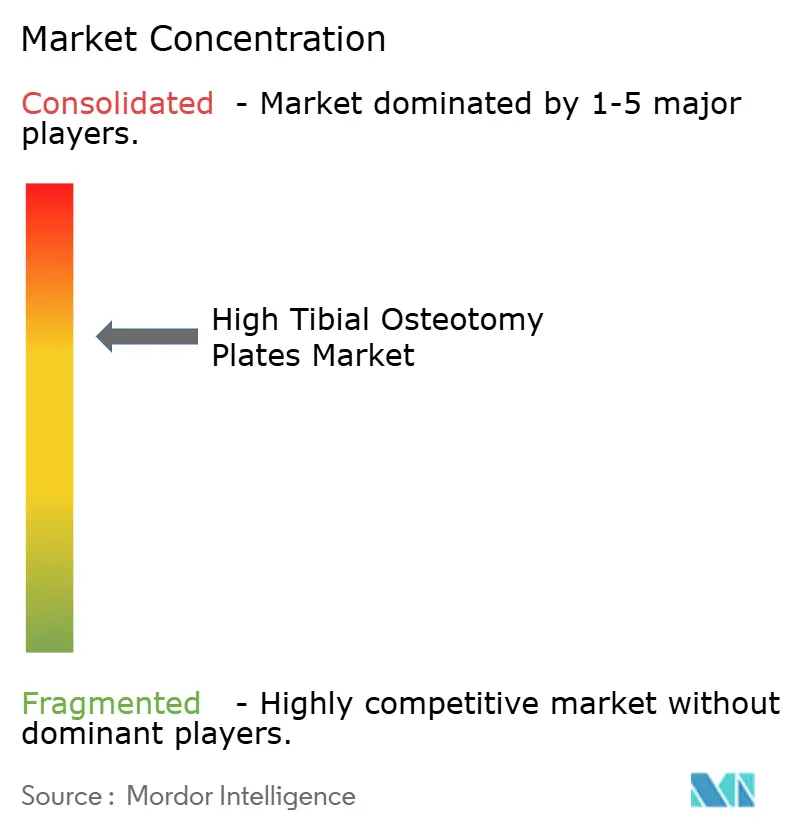
| Market Concentration | Medium |
Major Players *Disclaimer: Major Players sorted in no particular order Image © Mordor Intelligence. Reuse requires attribution under CC BY 4.0. | |
High Tibial Osteotomy Plates Market Analysis by Mordor Intelligence
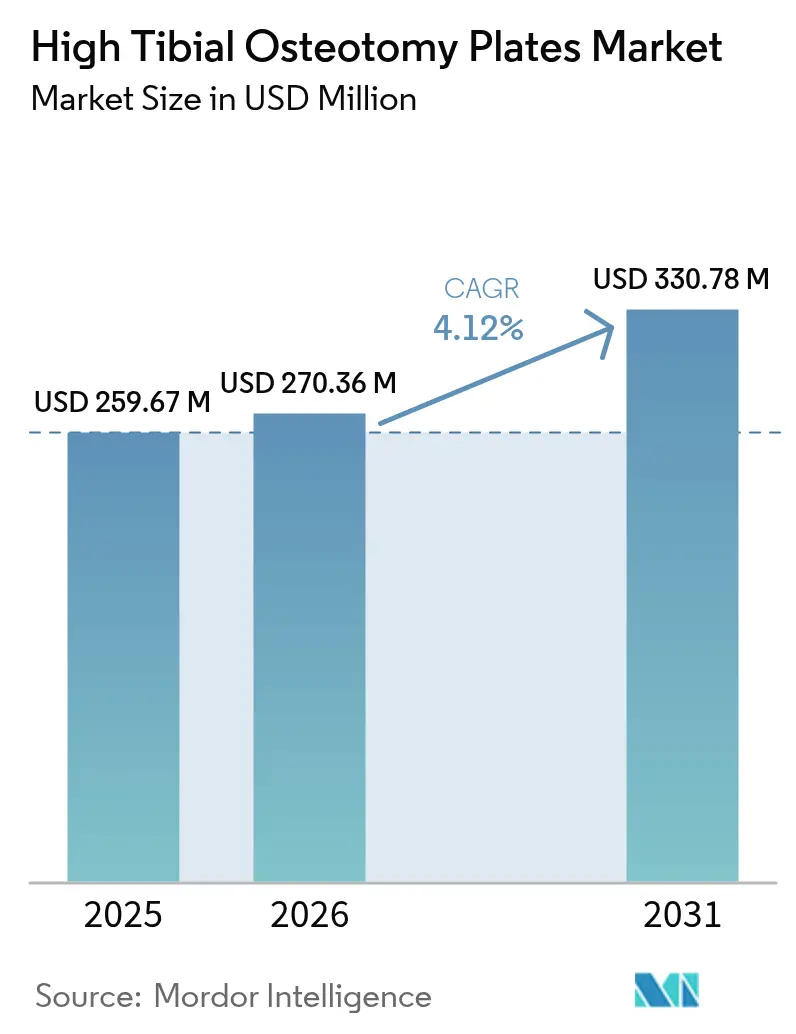
The High Tibial Osteotomy Plates Market size is expected to grow from USD 259.67 million in 2025 to USD 270.36 million in 2026 and is forecast to reach USD 330.78 million by 2031 at 4.12% CAGR over 2026-2031.
Growth is fueled by surgeons’ preference for joint-preserving surgery over total knee arthroplasty, steady innovation in hybrid metal-polymer plates, and rising procedure volumes at ambulatory surgery centres. Wider adoption of radiolucent PEEK designs and patient-specific implants supports premium pricing. Meanwhile, revision rates that remain higher than primary arthroplasty create demand for more durable fixation solutions. Regulatory changes that align the FDA Quality Management System Regulation with ISO 13485:2016 may initially raise compliance costs but should streamline future approvals, shortening the product development cycle.
Key Report Takeaways
- By material, metals led with 64.83% of the high tibial osteotomy plates market share in 2025; polymers are projected to expand at a 5.64% CAGR to 2031.
- By technique, opening-wedge procedures accounted for 52.58% revenue in 2025, while hybrid plate-frame constructs are forecast to grow at 6.62% CAGR through 2031.
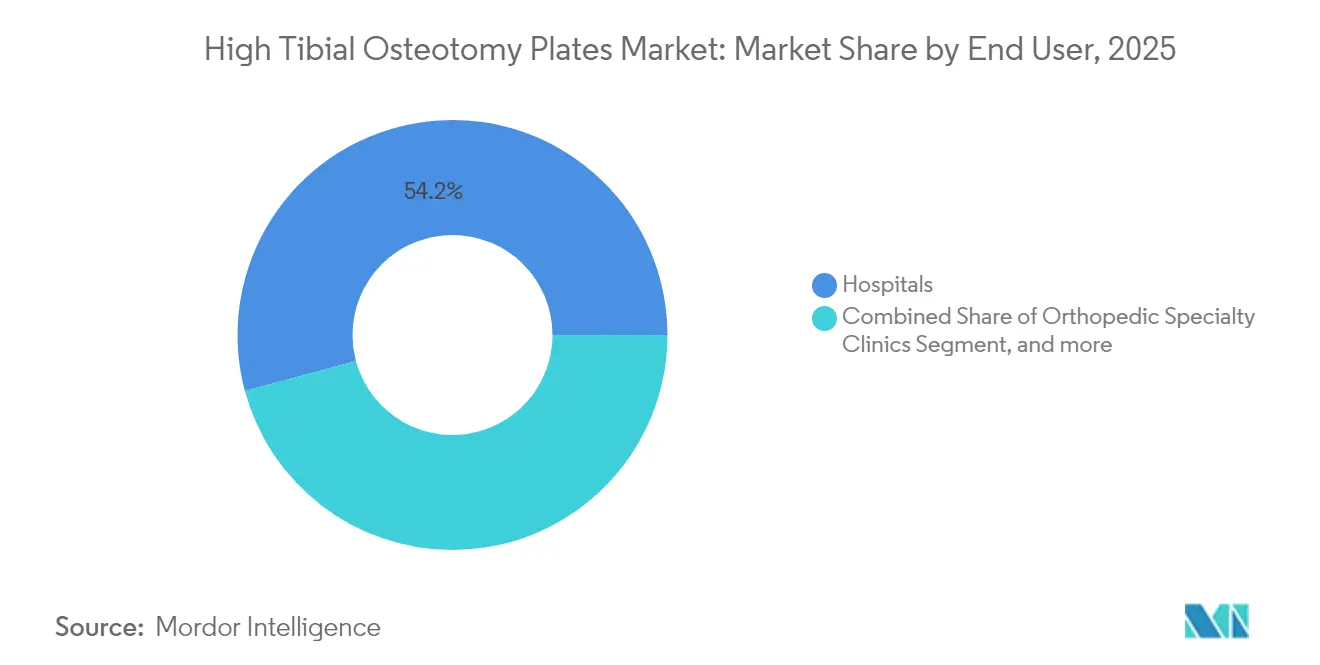
- By end user, hospitals held 54.19% of the high tibial osteotomy plates market size in 2025; ambulatory surgery centres record the fastest growth at 4.89% CAGR.
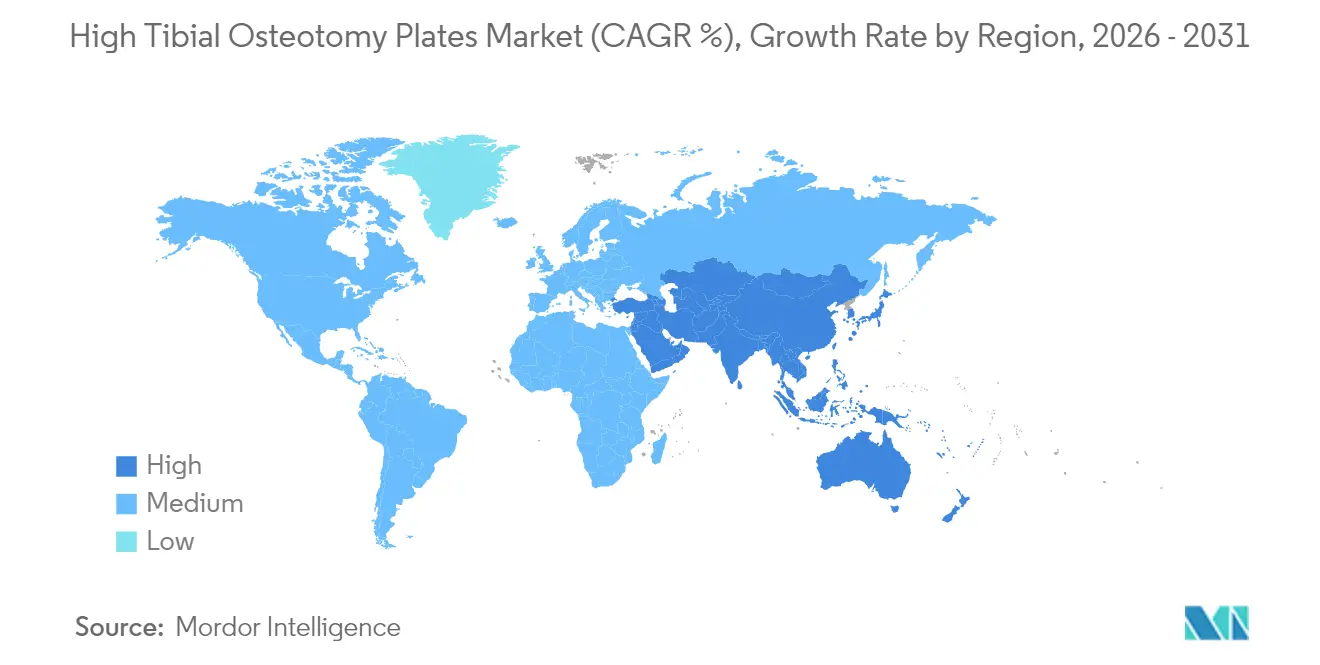
- By geography, North America captured 37.03% of 2025 revenue, yet Asia is advancing at a 5.49% CAGR toward 2031.
Note: Market size and forecast figures in this report are generated using Mordor Intelligence’s proprietary estimation framework, updated with the latest available data and insights as of 2026.
Market Trends and Insights
Drivers Impact Analysis of High Tibial Osteotomy Plates Market*
| Driver | (~) % Impact on CAGR Forecast | Geographic Relevance | Impact Timeline |
|---|---|---|---|
| Rising prevalence of osteoarthritis & varus knee deformities | +1.2% | Global, with highest impact in North America & Europe | Long term (≥ 4 years) |
| Aging-athlete population boosting joint-preserving surgeries | +0.8% | North America & Europe, emerging in APAC | Medium term (2-4 years) |
| Continuous plate innovations (low-profile, locking, hybrid metals-PEEK) | +0.6% | Global, led by North America & Europe | Short term (≤ 2 years) |
| Patient-specific 3D printed plates entering clinical practice | +0.4% | North America & Europe, expanding to APAC | Medium term (2-4 years) |
| Sports-medicine insurers covering HTO in APAC markets | +0.3% | APAC core, spill-over to MEA | Long term (≥ 4 years) |
| Shift toward day-care HTO boosting ASC volumes in North America | +0.5% | North America, early adoption in Europe | Short term (≤ 2 years) |
| Source: Mordor Intelligence | |||
Rising Prevalence of Osteoarthritis & Varus Knee Deformities
Adults aged 30-44 already represent 32.97 million osteoarthritis cases worldwide, and electronic health-record analyses that combine narrative notes with coded data double prevalence estimates to 11.8% compared with diagnosis codes alone. Elevated BMI remains the leading modifiable risk factor. The surge in disease burden among younger, active adults sustains demand for joint-preserving options, positioning the high tibial osteotomy plates market as a durable growth story through 2030.[1]
Aging-Athlete Population Boosting Joint-Preserving Surgeries
Retired professional footballers show 28% knee osteoarthritis prevalence versus 13% during their careers, underscoring the cumulative impact of repetitive stress. Long-term follow-up studies report 85% satisfaction after high tibial osteotomy and 95% survival at five years in optimally selected patients, encouraging surgeons to recommend osteotomy over arthroplasty for athletes under 50 with BMI < 25. The resulting willingness to pay supports rapid uptake of premium patient-specific plates.
Continuous Plate Innovations
Finite-element optimisation has delivered low-profile angular-stable systems such as TomoFix Anatomical plates that lower implant prominence and cut lateral-hinge stress. Carbon fibre-reinforced PEEK reduces stress shielding versus titanium yet maintains fixation strength, while protective screws decrease hinge-fracture risk by 62%. Johnson & Johnson’s VOLT Plating System illustrates how variable-angle locking and dynamic compression now converge in a single implant platform.[2]
Patient-Specific 3D-Printed Plates Entering Clinical Practice
Additive manufacturing enables plates that match a patient’s tibial contour, reducing operating-room adjustments. The FDA approval of restor3d’s talus implant and the rapid 510(k) for Curiteva’s porous PEEK lumbar cage show regulators’ growing comfort with bespoke devices. Streamlined patient-matched guide guidance suggests that bench testing alone will suffice for some future submissions, accelerating time to market.
Restraints Impact Analysis of High Tibial Osteotomy Plates Market*
| Restraint | (~) % Impact on CAGR Forecast | Geographic Relevance | Impact Timeline |
|---|---|---|---|
| High procedural & implant cost vs. TKA reimbursement gaps | -0.9% | Global, most pronounced in emerging markets | Medium term (2-4 years) |
| Revision risk from hinge-fracture & non-union events | -0.7% | Global, higher impact in less experienced centers | Long term (≥ 4 years) |
| Slow regulatory clearance cycles for novel biomaterials | -0.5% | North America & Europe regulatory jurisdictions | Short term (≤ 2 years) |
| Limited surgeon training outside tier-1 orthopedic centers | -0.6% | Global, most acute in emerging markets | Long term (≥ 4 years) |
| Source: Mordor Intelligence | |||
High Procedural & Implant Cost vs. TKA Reimbursement Gaps
Direct medical costs favour high tibial osteotomy at USD 20,436 versus USD 24,637 for unicompartmental or total knee arthroplasty, yet payer schedules still reimburse arthroplasty more generously. In Canada and Japan, reimbursement misalignment leaves hospitals under-compensated for HTO despite its clinical benefits, limiting access in publicly funded systems.[3]
Revision Risk from Hinge-Fracture & Non-Union Events
Lateral hinge fractures occur in 25% of medial opening-wedge procedures and push overall complication rates beyond 15%. Type II and III fractures heighten instability and can delay union, while TKA performed after failed HTO shows 7.66% revision compared with 3.79% for primary TKA. These risks raise surgeon caution, particularly in centres with low case volumes.
*Our forecasts treat driver/restraint impacts as directional, not additive. The impact forecasts reflect baseline growth, mix effects, and variable interactions.
High Tibial Osteotomy Plates Market Segment Analysis
By Material:
Metals Dominate Despite Polymer InnovationMetals held 64.83% of 2025 revenue, anchoring the high tibial osteotomy plates significant market size. Surgeons rely on titanium for strength, biocompatibility, and broad instrument compatibility. Stainless steel retains a foothold in budget-sensitive settings despite fatigue concerns. The numerical leadership of metals reflects decades of outcome data and established reimbursement coding.
Polymers, chiefly PEEK, are growing at a 5.64% CAGR through 2031, the fastest of any material class. Carbon-fibre-reinforced PEEK diffuses load and improves imaging, while magnesium-based bio-absorbables show lower revision (1/275) versus titanium (18/111). Surface modifications such as hydroxyapatite coatings improve osteointegration, auguring a wider role for polymers. If hybrid designs meet durability benchmarks, polymer composites may approach one quarter of the high tibial osteotomy plates market by 2031.


By Technique:
Opening-Wedge Leadership Challenged by Hybrid InnovationOpening-wedge operations generated 52.58% of 2025 revenue. Familiar workflow, abundant instrumentation, and favourable anatomic corrections underpin this preference. However, single-plate constructs suffer lateral hinge stress that fuels 25% fracture incidence.
Hybrid plate-frame configurations are advancing at 6.62% CAGR. Biplanar cuts paired with lateral hinge screws lower instability, and retrotubercle modifications increase fixation by 62%. Greater slope control and reduced graft need make hybrids attractive for complex varus deformities. As long as training gaps close, hybrid constructs could command one third of the high tibial osteotomy plates market by 2031.
By End User:
Hospital Dominance Erodes as ASCs Gain MomentumHospitals controlled 54.19% of global revenue in 2025, yielding major revenue in the high tibial osteotomy plates market. Integrated imaging, intensive-care support, and readiness for complex revisions keep hospitals at the centre of high-risk cases.
Ambulatory surgery centres are growing at 4.89% CAGR. Day-case opening-wedge procedures using intraosseous PEEK implants now discharge in 5.6 hours, with 77% of patients achieving clinically important improvements. The CMS removal of TKA from inpatient-only status signals payer comfort with outpatient orthopaedics, encouraging insurers to extend similar coverage to HTO. Partnerships between high-volume surgeons and ASC operators will accelerate share gains for this channel.
Geography Analysis
North America High Tibial Osteotomy Plates Market
North America contributes 37.03% of 2025 sales, driven by early adoption of hybrid plates, widespread sports medicine coverage, and robust ASC infrastructure. Commercial insurers reimburse HTO at rates that approach arthroplasty, and the prevalence of sports injuries sustains high procedure volumes. The region’s regulatory clarity around 3D-printed implants further attracts new product launches.
Europe High Tibial Osteotomy Plates Market
Europe follows with stable uptake supported by ageing populations and strong public health systems. Germany and the Nordic countries favour joint preservation, although reimbursement caps in the United Kingdom temper growth. Continental centres of excellence disseminate training programs that slowly reduce complication variability across the bloc.
APAC, MEA and South America High Tibial Osteotomy Plates Market
Asia-Pacific is the fastest-growing region at 5.49% CAGR. Korea’s high insurance approval rates for knee surgery and China’s expanding middle class are key demand drivers. Japan faces cost inflation that constrains hospital margins, yet rising osteoarthritis prevalence still expands the patient pool. Regulatory harmonisation under ASEAN Medical Device Directive will shape access timelines. Middle East & Africa and South America remain nascent, limited by surgeon density and capital budgets but poised to benefit from technology transfer.
Regulatory Landscape
In the United States, high tibial osteotomy (HTO) fixation plates are overseen as FDA Class II orthopedic fixation plate controls (21 CFR 888.3030, product code HRS). Most offerings require 510(k) clearance built around substantial equivalence, supported by bench and biocompatibility evidence. FDA's Quality Management System Regulation alignment with ISO 13485:2016 also increases the emphasis on design controls, risk management, and supplier oversight, which affects how iterative updates (for example, new locking options or polymer-metal hybrids) are documented and maintained across product families.
In Europe, HTO plates are regulated as implantable devices under EU MDR 2017/745, which has tightened clinical evaluation, post-market surveillance, and post-market clinical follow-up expectations compared with legacy frameworks. That shift can influence notified-body capacity and recertification timelines for established portfolios. In China, the National Medical Products Administration (NMPA) requires foreign manufacturers to work through a China authorized agent for registration and local communications, and higher-risk orthopedic implants commonly face more extensive clinical evaluation pathways, raising the bar for market entry and lifecycle changes relative to mature US 510(k) pathways.
Competitive Landscape
The high tibial osteotomy plates market remains moderately consolidated. DePuy Synthes anchors the field with TriLEAP and VOLT systems that combine low-profile contours and variable-angle locking. Zimmer Biomet followed with the Oxford Cementless Partial Knee, reinforcing its knee-preservation franchise. Stryker and Smith & Nephew focus on robotics integration, with the former leveraging the MAKO platform for precise osteotomy planning.
Specialist firms such as Arthrex and Integra LifeSciences concentrate on screw fixation enhancements and surgeon-specific kits. Meanwhile, Curiteva and restor3d pioneer 3D-printed patient-matched implants, creating a moat around custom instrumentation. FDA Predetermined Change Control Plans give established players a speed advantage in iterative improvements, potentially intensifying consolidation.
Future competition will hinge on digital workflow integration. Johnson & Johnson’s VELYS Robotic-Assisted Solution already covers unicompartmental knee arthroplasty; extending that guidance to osteotomy would differentiate its plate suite. Companies that bridge planning software, navigation, and advanced biomaterials are best positioned to grow share as surgeons prioritise reproducible outcomes and shorter theatre times.
High Tibial Osteotomy Plates Industry Leaders
-
Arthrex, Inc.
-
Smith & Nephew
-
Johnson & Johnson
-
Stryker Corporation
-
B. Braun SE
- *Disclaimer: Major Players sorted in no particular order
High Tibial Osteotomy Plates Market Companies Covered in this Report
- Johnson & Johnson
- Zimmer Biomet
- Stryker
- Smiths Group
- Arthrex
- Integra LifeSciences
- B. Braun SE (Aesculap)
- Acumed
- AMPLITUDE Surgical
- Intercus
- Novastep (Enovis)
- SBM France
- Auxein Medical
- MicroPort Orthopedics
- OrthoPediatrics
- LimaCorporate
- mediCAD
- Limmed
- Orthofix
- Mathys AG
- Tianjin Walkman Biomaterial
Market Opportunities and Future Outlook
The clearest white space is at the intersection of joint-preservation demand and precision-enabling workflows, especially systems that pair radiolucent materials, notably PEEK-based designs, with patient-specific instrumentation and preoperative 3D planning. Clinical literature that evaluates combined patient-specific instruments and patient-specific plates supports accurate correction of alignment parameters such as hip-knee-ankle angle and posterior tibial slope. That combination strengthens the case for premium, planning-led HTO platforms that target reproducibility and reduce intraoperative adjustment, including in ambulatory settings.
Another active opportunity centers on digital integration within established orthopedic navigation and robotics ecosystems, using software planning, guided cutting, and intraoperative feedback to standardize technique. Companies that can bundle plating, instruments, and digital planning into a single workflow have an edge, including platform approaches referenced in broader orthopedics such as Johnson & Johnson's VELYS, while keeping documentation aligned to quality-system expectations for iterative plate updates.
Recent Industry Developments in High Tibial Osteotomy Plates Market
- April 2026: Smith & Nephew refreshed published information and specifications for its NAVIO Sports Medicine platform, supporting image-free planning workflows used for procedures including high tibial osteotomy. The update reinforces the role of digital planning and intraoperative guidance in osteotomy execution, encouraging bundled solutions that connect planning tools with fixation implant selection.
- March 2026: Arthrex released updated technical documentation for the PEEKPower HTO plate system. Continued documentation updates support broader adoption of radiolucent, polymer-based plating approaches and help standardize surgeon technique across sites using the same implant platform.
- November 2024: Zimmer Biomet received FDA approval for the Oxford Cementless Partial Knee in the United States, with a commercial launch planned for 2025. While not an HTO plate, the milestone adds competitive pressure within knee joint-preservation pathways and can influence how surgeons and payers position osteotomy versus partial arthroplasty for eligible patients.
High Tibial Osteotomy Plates Market Report Scope and Research Methodology
Market Definition and Coverage
This market covers the sales value of fixation plates used in high tibial osteotomy (HTO) procedures, where the proximal tibia is realigned. The scope assumes sterile, single-use implants sold for orthopedic operating rooms.
Scope exclusions: We exclude generic trauma plates used for other long-bone repairs and implants primarily intended for total knee arthroplasty (TKA) or unicompartmental knee arthroplasty (UKA).
Segments Covered in This Report
- By Material
- Metals
- Titanium Plates
- Stainless-Steel Plates
- Polymers
- PEEK Plates
- Other High-Performance Polymers
- Bio-absorbable / Composite Plates
- Metals
- By Technique
- Opening-Wedge HTO
- Closing-Wedge HTO
- Biplanar / Distal-Tuberosity HTO
- Hybrid Plate-Frame Constructs
- By End User
- Hospitals
- Orthopedic Specialty Clinics
- Ambulatory Surgery Centers
- By Geography
- North America
- United States
- Canada
- Mexico
- Europe
- Germany
- United Kingdom
- France
- Italy
- Spain
- Rest of Europe
- Asia-Pacific
- China
- Japan
- India
- Australia
- South Korea
- Rest of Asia-Pacific
- Middle East & Africa
- GCC
- South Africa
- Rest of Middle East & Africa
- South America
- Brazil
- Argentina
- Rest of South America
- North America
Data Sources, Market Sizing, and Validation
Desk Research
Desk research was used to build the base context on procedure demand, the clinical pathway for HTO, and how osteotomy volumes can vary by region. We relied on public sources such as the World Health Organization, OECD health statistics, national health ministries, and large public hospital reporting where procedure mix is discussed. For clinical practice signals, we reviewed peer reviewed orthopedic journals and guidance from orthopedic associations such as AAOS or EFORT.
On the supply side, we used company annual reports, investor presentations, and reputable medical device news coverage to understand product launches and pricing direction. In a few places, we referenced paid company financials and intelligence subscription materials, plus a patent database, to confirm ownership changes and technology activity that can affect ASP assumptions. The desk sources listed are illustrative only, and we reviewed additional public documents to collect, cross check, and clarify data points.
Primary Interviews and Surveys
Primary work focused on orthopedic surgeons, procurement teams, and distributor-side stakeholders who observe ordering patterns and product substitutions over time. Because this is a global market, we spoke with participants across APAC, EMEA, and the Americas to check differences in regional procedure mix, hospital purchasing cycles, and sensitivity to reimbursement or tender pressure. These conversations were used to close gaps in procedure-to-implant conversion, typical plate usage per case (including how often plates are used in reoperations), and how pricing moves during tenders and renewals.
Distribution of primary research fieldwork respondents
| Company type | Respondent position | Region |
|---|---|---|
| Top tier: 37% | CXOs: 12% | APAC: 41% |
| Mid tier: 47% | Functional/Unit leaders: 42% | EMEA: 37% |
| Smaller Players: 16% | Managers: 46% | Americas: 22% |
Market-Sizing & Forecasting
We sized the market mainly through a top-down demand pool build, where country-level HTO procedure volumes are reconstructed and then converted into plate demand using usage rates validated through interviews. Those totals were valued using region-specific average selling price ranges that reflect hospital contract structures and channel dynamics, followed by currency conversion using consistent annual average rates. To keep the model grounded, we added selective bottom-up checks using sampled supplier revenue disclosures, distributor channel checks, and ASP multiplied by estimated unit placements in key countries.
Key inputs include osteotomy procedure incidence and growth, the share of eligible knee osteoarthritis patients routed to osteotomy versus arthroplasty, open wedge versus closed wedge procedure mix, average plates per case (including revision or reoperation impact), and pricing trends shaped by tenders and adoption of premium features. Where direct country procedure series were not available, we used regional analogs and adjusted using population age mix and orthopedic capacity indicators, then validated the direction through clinician feedback.
For forecasting, we ran scenario analysis around procedure growth and ASP movement, and the base case was aligned with the consensus view from primary respondents on adoption speed and procurement pressure. Short-term shifts were handled carefully since hospital budgets and elective surgery recovery can change quickly, so we kept sensitivity ranges visible and designed them so they could be rerun.
Data Validation & Update Cycle
Triangulation was done by checking whether implied plate volumes align with procedure totals, and whether ASP ranges remain realistic versus what hospitals and channel partners described. We also ran variance checks across regions, so outliers in procedure intensity, conversion rate, or pricing were flagged and reviewed before sign off. When a value moved beyond expected ranges, we re-contacted respondents to confirm whether the change came from reimbursement dynamics, tender outcomes, or mix shifts.
Reports are refreshed annually, and we also run interim updates when material events occur, such as major regulatory changes, supply disruptions, or meaningful pricing resets in large geographies. Before delivery, an analyst performs a fresh pass through the model and key assumptions so the updated view reflects the latest public signals.
Mordor Intelligence's Global High Tibial Osteotomy Plates Market Size Versus Other Published Estimates
Published market values for high tibial osteotomy plates can vary, even when other publishers appear to refer to the same product category. The differences typically come from how each publisher defines what counts as an osteotomy plate sale, which year is used as the base, and how procedure volumes and pricing are translated into revenue.
Generic trauma plates and knee arthroplasty implants sit outside Mordor Intelligence's defined scope, which can reduce our total versus estimates that bundle adjacent orthopedic plates or joint implants into a single figure. Variation also appears when a model assumes faster osteotomy adoption, uses a single global ASP, or relies on older currency conversion rather than refreshing pricing and mix checks using recent hospital purchasing inputs.
Benchmark comparison
| Source | Market Size | Gaps in Research Methodology |
|---|---|---|
| Mordor Intelligence | USD 270.36 M (2026) | |
| Industry Publisher A | USD 238.90 M (2024) | Uses an earlier base year and a shorter horizon, and the implied revenue can shift if regional procedure volumes and purchasing cycles are not revalidated for recent post-pandemic elective surgery normalization. |
| Market Tracker B | USD 289.00 M (2025) | Shows a higher near term value that can occur when pricing is applied as a single global average or when conversion from procedures to implants assumes higher plate usage per case without matching checks across countries. |
The table shows that the spread is mainly explained by scope boundaries, base year selection, and how procedure volumes and ASPs are converted into revenue. By tying the demand pool to osteotomy procedures and then pressure testing pricing and mix assumptions through interviews, we arrive at a number that is easier to trace and re-run as conditions change.
Key Questions Answered in the Report
What is the current size of the high tibial osteotomy plates market?
The high tibial osteotomy plates market size stands at USD 270.36 million in 2026 and is expected to reach USD 330.78 million by 2031.
Which material segment is growing fastest?
Polymer-based plates, mainly PEEK composites, expand at a 5.64% CAGR due to radiolucency and lower stress shielding.
Why are ambulatory surgery centres gaining share?
Same-day discharge protocols and insurer support allow opening-wedge procedures with PEEK implants to finish in 5.6 hours, driving 4.89% CAGR in ASC demand.
What geographic region is expanding most quickly?
Asia-Pacific posts the fastest growth at 5.49% CAGR, led by Korea’s high procedural volumes and China’s ageing population.
How do hybrid plate-frame constructs improve outcomes?
Hybrid systems distribute load more evenly and reduce lateral hinge fracture risk by up to 62%, supporting complex deformity correction and quicker rehabilitation.
What regulatory changes will affect manufacturers after 2026?
The FDA Quality Management System Regulation will align with ISO 13485:2016, raising compliance obligations yet promising smoother global approvals thereafter.