
Market Overview
| Study Period | 2020 - 2031 |
|---|---|
| Market Size (2026) | USD 2.46 Billion |
| Market Size (2031) | USD 4.25 Billion |
| Growth Rate (2026 - 2031) | 11.62 % |
| Fastest Growing Market | Asia Pacific |
| Largest Market | North America |
| Market Concentration | Medium |
Major Players *Disclaimer: Major Players sorted in no particular order Image © Mordor Intelligence. Reuse requires attribution under CC BY 4.0. | |
Healthcare Information Exchange Market Analysis by Mordor Intelligence
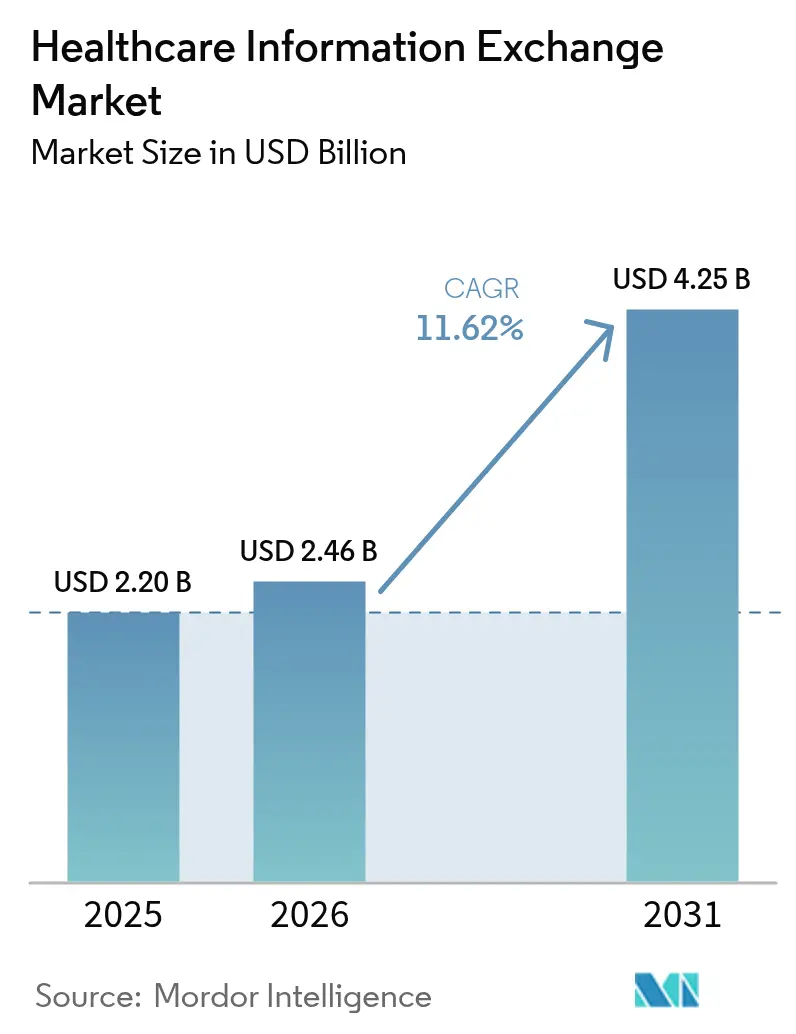
The health information exchange market size was valued at USD 2.20 billion in 2025 and estimated to grow from USD 2.46 billion in 2026 to reach USD 4.25 billion by 2031, at a CAGR of 11.62% during the forecast period (2026-2031). This rapid expansion mirrors global digital‐health priorities, including stricter interoperability rules, growing cybersecurity vigilance, and the shift to value-based care models. National frameworks such as the Trusted Exchange Framework and Common Agreement (TEFCA) are reinforcing interoperability expectations, while providers invest in hybrid cloud architectures to balance local control with scalability. Centralized deployments still dominate, yet the hybrid approach’s strong growth signals a gradual redesign of data governance strategies. Meanwhile, Epic Systems’ nationwide TEFCA roll-out is redefining competitive dynamics, prompting rivals to accelerate platform upgrades and security enhancements.
Key Report Takeaways
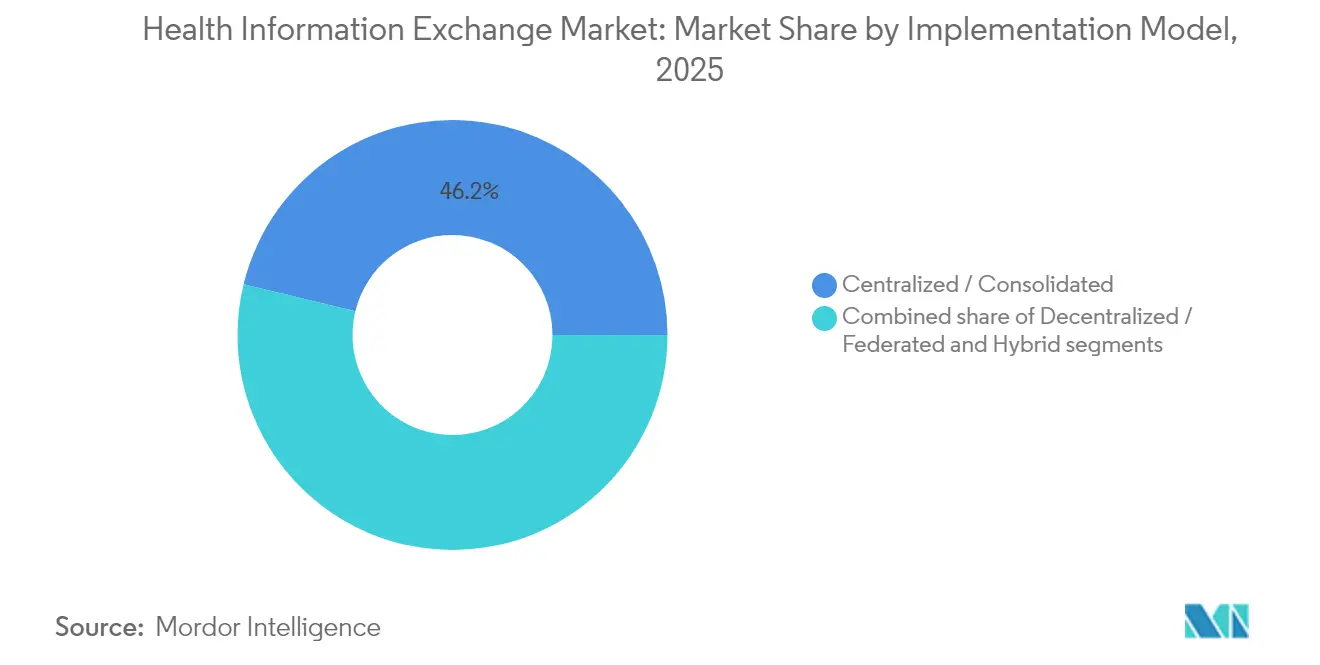
- By implementation model, centralized/consolidated deployments held 46.20% of health information exchange market share in 2025; hybrid approaches are expanding at 13.12% CAGR through 2031.
- By application, workflow management accounted for 34.20% of the health information exchange market size in 2025, whereas the “other applications” category is growing at 13.55% CAGR on the back of AI decision-support use cases.
- By component, Enterprise Master Person Index systems led with 29.40% health information exchange market share in 2025, while clinical data repository solutions are growing fastest at 14.39% CAGR.
- By end user, healthcare providers dominated with 56.85% share in 2025, but payers are forecast to grow at 14.30% CAGR through 2031.
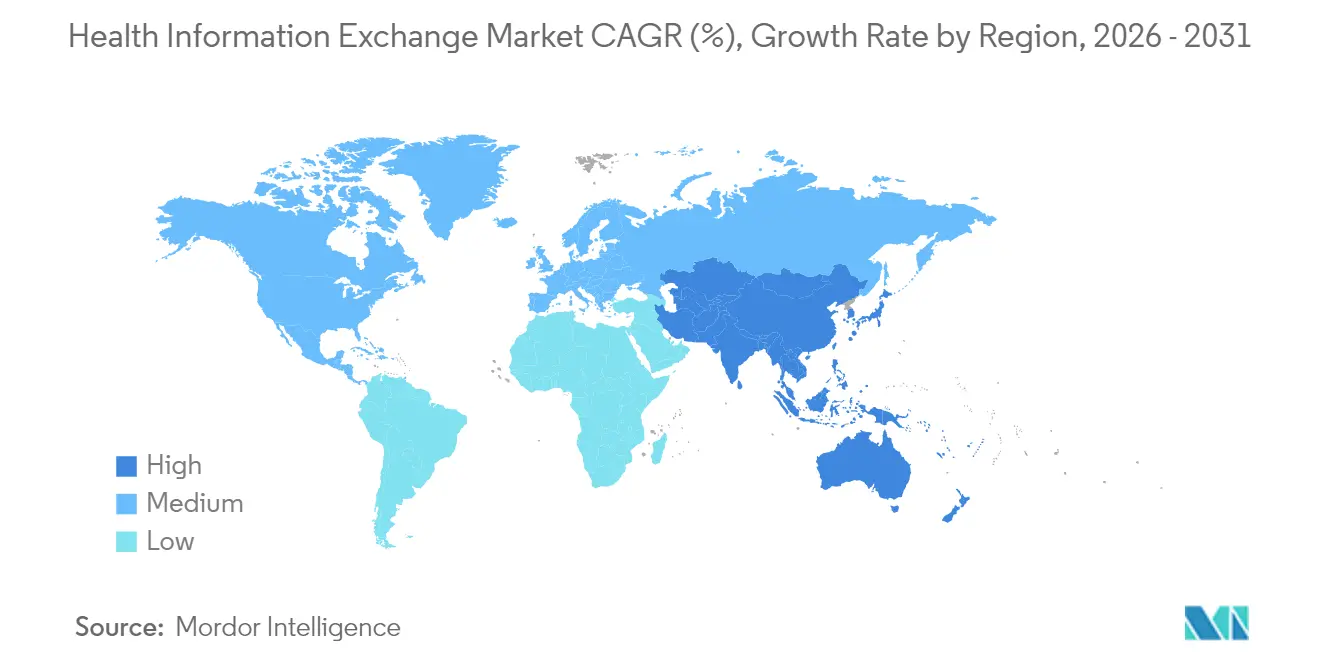
- By geographic region, North America captured 47.10% of health information exchange market share in 2025, while Asia-Pacific is advancing at a 12.21% CAGR toward 2031.
Note: Market size and forecast figures in this report are generated using Mordor Intelligence’s proprietary estimation framework, updated with the latest available data and insights as of 2026.
Market Trends and Insights
Drivers Impact Analysis of Healthcare Information Exchange Market*
| Driver | % Impact on CAGR Forecast | Geographic Relevance | Impact Timeline |
|---|---|---|---|
| Accelerating digital transformation of healthcare systems | +2.8% | Global, led by North America and EU | Medium term (2-4 years) |
| Expanding government funding for nationwide interoperability | +2.1% | North America core, spill-over to APAC | Long term (≥ 4 years) |
| Shift toward value-based care and population health management | +1.9% | North America & EU, emerging in APAC | Long term (≥ 4 years) |
| Rapid growth of cloud-based health IT deployments | +1.6% | Global, fastest in Asia-Pacific | Medium term (2-4 years) |
| Emergence of consumer-driven health-data ownership models | +1.2% | North America & EU | Medium term (2-4 years) |
| Integration of artificial intelligence for real-time clinical decision support | +1.8% | Tech-advanced markets worldwide | Short term (≤ 2 years) |
| Source: Mordor Intelligence | |||
Accelerating Digital Transformation of Healthcare Systems
Digital transformation has moved past basic EHR roll-outs into enterprise-wide interoperability platforms that enable real-time data exchange across care settings. Hospital groups are prioritizing patient-experience metrics alongside operational efficiency, prompting greater investment in standards-based data-sharing frameworks. In Asia-Pacific, government grants for digital-health infrastructure amplify adoption as providers respond to aging populations and rural access challenges. Interoperability tools now function as the central nervous system of connected care, linking clinicians, payers, and public-health agencies. The outcome is a measurable uptick in cross-facility data liquidity, which improves care coordination and reduces redundant testing.
Expanding Government Funding for Nationwide Interoperability
Public-sector investment is reaching unprecedented levels. The U.S. Centers for Disease Control and Prevention earmarked USD 255 million for public-health data exchange through 2026[1]. Across the Atlantic, the European Health Data Space regulation set aside EUR 810 million for cross-border exchange readiness by 2031[2]. Australia is financing vendor connections to My Health Record, while Japan and South Korea have placed interoperability at the heart of national digital-health agendas. Government funds are widening the user base beyond hospitals, enabling community clinics and research bodies to join secure exchange networks.
Shift Toward Value-Based Care and Population Health Management
The Centers for Medicare & Medicaid Services intends to move every beneficiary into an accountable-care relationship by 2030. Providers entering risk-sharing contracts require timely access to multi-source patient data to close care gaps, stratify risk, and track quality metrics. Integrated payer-provider organizations—so-called payviders—are now major adopters of exchange platforms as they align financial risk with clinical outcomes. Robust data-sharing capabilities are proving integral to hitting shared-savings targets and preventing avoidable readmissions.
Rapid Growth of Cloud-Based Health IT Deployments
Cloud adoption offers elastic scaling, automated updates, and resilient disaster recovery, making software-as-a-service HIE models attractive. In Asia-Pacific, many systems leapfrog legacy hardware by opting directly for cloud-native deployments, shaving months off implementation timelines. Vendors are consolidating around cloud-first architectures, standardizing on HL7 FHIR APIs that simplify third-party integrations. Hospitals report smoother upgrades, tighter security patch cycles, and improved uptime compared with on-premise predecessors.
Emergence of Consumer-Driven Health-Data Ownership Models
Patients increasingly expect seamless access to and control over their own records. U.S. rules now compel providers to furnish electronic data through API-enabled apps. As mobile health adoption rises, patient-led data exchange is transforming the traditional provider-centric model. Healthcare organizations respond with enhanced portal functionalities and digital front doors that allow individuals to authorize data sharing with specialists, researchers, or fitness apps.
Restraints Impact Analysis of Healthcare Information Exchange Market*
| Restraints Impact Analysis | (~) % Impact on CAGR Forecast | Geographic Relevance | Impact Timeline |
|---|---|---|---|
| High capital investment for interoperability infrastructure | -1.4% | Global, especially smaller providers | Medium term (2-4 years) |
| Persistent data privacy and cybersecurity threats | -2.2% | Worldwide, heightened in North America & EU | Short term (≤ 2 years) |
| Fragmented standards and vendor information-blocking practices | -1.5% | Global | Medium term (2-4 years) |
| Limited technical expertise in small and rural provider settings | -1.0% | Rural and underserved areas worldwide | Medium term (2-4 years) |
| Source: Mordor Intelligence | |||
High Capital Investment for Interoperability Infrastructure
Joining an exchange often demands substantial upfront fees, staff training, and multi-vendor interface development. Rural hospitals with thin margins struggle to justify large expenditures without clear reimbursement incentives. Even when funding is available, project complexity can delay tangible benefits, leading some organizations to stagger roll-outs or limit participation. Hybrid models reduce—but do not eliminate—capital pressure, as local hardware is still required for edge processing and business-continuity planning.
Persistent Data Privacy and Cybersecurity Threats
Healthcare remains a lucrative target for cybercriminals. The Change Healthcare ransomware incident exposed 190 million records and cost an estimated USD 3.1 billion to remediate. Such breaches intensify provider hesitation to share data widely, fearing reputational harm and regulatory fines. Regulators respond with tougher penalty regimes, pushing organizations to invest in zero-trust frameworks and continuous-monitoring services. These added security obligations slow onboarding and inflate total cost of ownership for exchange platforms.
*Our forecasts treat driver/restraint impacts as directional, not additive. The impact forecasts reflect baseline growth, mix effects, and variable interactions.
Healthcare Information Exchange Market Segment Analysis
By Implementation Model:
Hybrid Deployments Drive Future GrowthCentralized architectures retained 46.20% of health information exchange market share in 2025, favored for straightforward governance and simpler vendor management. Yet hybrid frameworks are pacing at a 13.12% CAGR, reflecting mounting concern over single points of failure. The health information exchange market size for hybrid deployments is projected to expand sharply as hospitals keep sensitive data on-site while using cloud nodes for national connectivity. Change Healthcare’s outage illustrated the risks of over-centralization, prompting board-level discussions on resiliency. Hybrid adopters also value the ability to migrate incrementally, avoiding major downtime. Vendors are releasing modular toolkits that allow local data residency alongside FHIR-based cloud services. This dual-layer model supports disaster recovery, reduces latency for bedside applications, and meets data-localization mandates in Europe and Asia.
Growth momentum indicates hospitals will favor flexible topologies that evolve with regulatory requirements. As TEFCA connectivity matures, hybrid participants can peer with nationwide networks without relinquishing local database control. Meanwhile, federated implementations persist among institutions operating in jurisdictions with stringent sovereignty rules, such as Germany and India. Collectively, these dynamics position the hybrid configuration as a bridge between traditional on-premise systems and fully hosted solutions, ensuring the health information exchange market retains deployment-model diversity through 2031.

By Setup Type:
Public Sector AccelerationPrivate exchanges accounted for 61.90% of the health information exchange market size in 2025, largely driven by hospital networks seeking bespoke workflows. Public HIE programs, however, are forecast for a 14.15% CAGR, buoyed by federal and state grants that lower barriers for safety-net clinics. CDC’s Data Modernization Initiative exemplifies this shift, underwriting cloud migration costs for public-health nodes. The European Health Data Space takes a similar stance, assigning national authorities to spearhead infrastructure build-out. Public platforms increasingly facilitate syndromic surveillance and chronic-disease registries, functions often overlooked in private systems.
As a result, governments are setting architectural baselines that private stakeholders must match, thereby lifting overall interoperability maturity. Smaller physician groups benefit from no-cost onboarding, gaining access to wider referral networks and decision-support assets. These factors collectively raise the profile of public exchanges, gradually rebalancing market composition while reinforcing the societal value of open data sharing.
By Application:
Workflow Management Leads, AI Applications SurgeWorkflow-management tools dominated with 34.20% of health information exchange market share in 2025 as providers fought staffing shortages and administrative overhead. Secure messaging, order reconciliation, and discharge summaries remain daily necessities, anchoring budget allocations. Nevertheless, AI-driven clinical-decision modules within the “other applications” bucket are registering a 13.55% CAGR. Epic’s addition of more than 100 AI features underscores the pivot toward intelligent automation. These capabilities mine longitudinal patient data to suggest medication adjustments, predict deterioration, and reduce manual chart review.
Investment in advanced analytics signals a broader intent to turn raw data into actionable insight. As predictive models prove clinical value, stakeholders expect reimbursement mechanisms to recognize decision-support outcomes, further stimulating adoption. Consequently, the health information exchange market is expanding from a transactional data-bus concept into a strategic intelligence layer, embedding analytics at the point of care.
By Exchange Type:
Consumer-Mediated Growth AcceleratesQuery-based exchange remained largest at 41.10% of health information exchange market share in 2025, critical for emergency departments needing instant patient histories. Direct-trust protocols still facilitate routine referrals, but consumer-mediated exchange is projected to climb 13.08% CAGR through 2031. Application-programming-interface access lets patients aggregate records from multiple portals into smartphone apps, reflecting rising consumer expectations. U.S. rulemaking now penalizes information blocking, forcing hospitals to deliver data to any app chosen by the patient.
Payers see an opportunity to embed member engagement solutions that integrate claims and clinical data, improving chronic-disease management. Device makers also plan to sync wearable data with exchange networks, creating a feedback loop between home monitoring and clinical decision-making. This patient-centric movement promises to widen the data mix flowing through platforms, elevating privacy and consent management to core competencies.
By Component:
Clinical Data Repositories Drive InnovationEnterprise Master Person Index modules led components with 29.40% market share in 2025, underscoring the non-negotiable need for accurate patient matching. Yet clinical data repositories show the fastest expansion at 14.39% CAGR, as organizations aggregate longitudinal histories to support population-health dashboards. Health plans leverage repositories to stratify risk, while research consortia mine de-identified cohorts for precision-medicine studies. Vendors now bundle high-speed analytics engines with repository licenses, enabling real-time quality-measure reporting.
Record locator services and provider directories continue to underpin care coordination, but they are now integrated into broader suites rather than sold as stand-alone modules. Emerging add-ons—blockchain security layers, homomorphic-encryption toolkits, and federated-learning hubs—signal how the health information exchange market will extend component architecture to meet specialized security and research demands.

By End User:
Payers Drive Fastest ExpansionProviders generated 56.85% of 2025 revenue, given their frontline role in data generation. Public-health agencies remain steady participants thanks to pandemic-era reporting mandates. Payers, however, are forecast to grow at 14.30% CAGR as they deepen involvement in risk-bearing arrangements. Integrated health systems use shared platforms to align care-coordination workflows with claims adjudication, reducing discord between clinical and financial processes. Payers also seek to harness real-time data to trigger member outreach, detect fraud, and support value-based contracts.
This acceleration alters vendor roadmaps, prompting feature sets tailored to actuarial analytics, prior-authorization automation, and secure bidirectional data feeds. The health information exchange industry thereby becomes a linchpin for payer-provider convergence strategies, positioning exchange vendors at the nexus of clinical and financial transformation.
Geography Analysis
North America Healthcare Information Exchange Market
North America retained 47.10% of 2025 revenue, driven by comprehensive regulatory mandates and robust federal funding. TEFCA adoption is expanding quickly as Epic Systems connects more than 1,000 hospitals through standardized APIs. Canada and Mexico add further growth, supported by national telehealth investments. The USD 3.1 billion fallout from the Change Healthcare breach spurred hospital boards to increase cybersecurity budgets, reinforcing exchange subscriptions viewed as essential infrastructure.
Europe Healthcare Information Exchange Market
Europe is reshaping its data-sharing landscape under the European Health Data Space regulation, which earmarked EUR 810 million for cross-border exchange readiness through 2031. Countries such as Finland already demonstrate mature nationwide services through the Kanta platform, acting as blueprints for other member states. The EHDS framework introduces standardized consent mechanisms that balance innovation with privacy, prompting vendors to enhance data-protection modules for the regional market.
APAC Healthcare Information Exchange Market
Asia-Pacific, the fastest-growing region at 12.21% CAGR, benefits from heavy public investment and demographic pressures. Japan’s national platform build-out, Australia’s My Health Record enhancements, and India’s flagship Ayushman Bharat Digital Mission illustrate government commitment. Cloud-native deployments allow emerging markets to skip legacy hardware phases, creating fertile ground for new entrants. Venture capital flows to telehealth and hospital-at-home models also stimulate demand for real-time data orchestration, bolstering the region’s contribution to overall health information exchange market growth.
Regulatory Landscape
In the United States, interoperability policy continues to be anchored by TEFCA governance and federal health IT certification, while standards pathways are being updated to accelerate API-based exchange. The Assistant Secretary for Technology Policy/ONC published the 2026 Interoperability Standards Advisory reference edition and the 2026 Standards Version Advancement Process (SVAP) cycle, enabling voluntary adoption of newer standards such as HL7 FHIR US Core Implementation Guide STU 6.0.0 beginning August 29, 2026. ONC also released the HTI-5 Proposed Rule (December 2025), which proposes removal of 34 and revision of seven certification criteria to reduce developer burden and further align certified health IT with FHIR-based interoperability.
In Europe, the European Health Data Space (EHDS) sets a harmonized compliance trajectory for primary and secondary use of health data, with the EHDS Regulation (EU) 2025/327 entering into force in March 2025 and key provisions scheduled to apply from March 26, 2029. The European Commission advanced implementation governance through Commission Implementing Regulation (EU) 2026/771 (adopted April 7, 2026), establishing the EHDS Board to coordinate cooperation among Member States. Stakeholder engagement also intensified through an EHDS implementation dialogue held on June 10, 2026, reflecting the need for consistent implementation guidance and alignment to existing standards across cross-border exchange scenarios.
Competitive Landscape
The market exhibits moderate consolidation, with Epic Systems expanding its lead through TEFCA connectivity and consistent customer-satisfaction scores. Epic added 176 U.S. hospitals in 2024 while Oracle Health lost 74 sites as upgrades stalled. InterSystems and Health Catalyst pursue a best-of-breed strategy, focusing on specialized analytics and data-repository performance. M&A activity is accelerating: HEALWELL AI’s April 2025 acquisition of Orion Health formed a global interoperability and AI powerhouse, and Centauri Health Solutions acquired MedAllies to strengthen direct-messaging capabilities.
Competitive differentiation now hinges on vendor partnership models, security credentials, and multi-cloud resiliency rather than mere interface counts. Emerging opportunities include consumer-mediated exchange apps, blockchain-secured networks, and AI-native decision-support platforms. Vendors that pair robust cybersecurity with rapid innovation are best positioned to capture the next wave of health information exchange market demand.
Healthcare Information Exchange Industry Leaders
-
Epic Systems Corporation
-
Oracle Cerner Corporation
-
Veradigm, Inc.
-
InterSystems Corporation
-
Orion Health
- *Disclaimer: Major Players sorted in no particular order

Healthcare Information Exchange Market Companies Covered in this Report
- Epic Systems
- Oracle Cerner Corporation
- Veradigm, Inc.
- Intersystems
- Orion Health
- Meditech
- eClinicalWorks
- Optum Insight
- Change Healthcare
- NextGen Healthcare
- OpenText
- Infor
- Koninklijke Philips
- Axway
- Health Catalyst
- 4medica
- Verato
- Konica Minolta Healthcare
- CliniComp
- Orchestrate Healthcare
Market Opportunities and Future Outlook
TEFCA is moving from a connectivity milestone to operational scale, creating near-term whitespace for vendors and networks that can package onboarding, consent, and exchange-purpose compliance into repeatable deployments. In June 2026, ONC announced that one billion health records have been exchanged through the TEFCA network, and government materials also cite TEFCA growth from about 10 million documents before 2025 to 464 million by the end of 2025. As exchange volumes rise, demand concentrates on reliability and governance tooling, including identity resolution, auditability, and incident response, particularly for multi-party data sharing that involves payers and public health agencies.
A second opportunity area is standards-led data enrichment that supports AI-enabled workflows and patient access without adding integration burden. ONC published draft USCDI v7 in February 2026, proposing 29 new data elements, and SVAP approvals support voluntary adoption of newer standard versions by certified developers starting August 29, 2026, which creates a clearer upgrade path for FHIR-based APIs. TEFCA operating guidance is also becoming more explicit through SOP updates, including Facilitated FHIR and exchange-purpose SOPs approved in January 2026 (effective February 15 and March 8, 2026), expanding the room for suppliers to operationalize Treatment, Payment, and Health Care Operations exchange at scale across hybrid and multi-cloud architectures.
Recent Industry Developments in Healthcare Information Exchange Market
- May 2026: Epic Systems and Labcorp expanded their collaboration to integrate Labcorp's full test menu into Epic Aura to streamline diagnostic ordering and results management for hospitals and health systems. The partnership strengthens end-to-end data exchange between clinical workflows and external labs, increasing the value of standardized interfaces and reducing friction in multi-organization interoperability.
- November 2025: Oracle Health received ONC Health IT certification for its next-generation AI-powered EHR (Certification Number 15.04.04.1221.Orac.25.00.1.251003). The certification supports broader deployment in regulated US environments and increases competitive pressure on incumbents to modernize interoperability and compliance capabilities alongside AI enablement.
- July 2024: Abridge, Mayo Clinic, and Epic announced a collaboration to develop an integrated AI documentation solution for nurses within Epic workflows. Embedding AI documentation into core clinical systems raises demand for high-quality longitudinal data flows and tighter governance around data sharing, reinforcing the role of HIE infrastructure as a base for AI-assisted care delivery.
Healthcare Information Exchange Market Report Scope and Research Methodology
Market Definition and Coverage
We define the healthcare information exchange (HIE) market as the revenue earned from platforms and services that enable electronic sharing of clinical and administrative data across separate healthcare organizations, payers, public health bodies, and patients, with workflows that support interoperability.
Scope exclusions: We exclude stand-alone EHR features used only inside a single enterprise, analytics tools that do not exchange data externally, and physical IT hardware.
Segments Covered in This Report
- By Implementation Model
- Centralized / Consolidated
- Decentralized / Federated
- Hybrid
- By Setup Type
- Private
- Public
- By Application
- Internal Interfacing
- Secure Messaging
- Workflow Management
- Web Portal Development
- Other Applications
- By Exchange Type
- Direct Exchange
- Query-Based Exchange
- Consumer-Mediated Exchange
- By Component
- Enterprise Master Person Index (EMPI)
- Healthcare Provider Directory (HPD)
- Record Locator Service (RLS)
- Clinical Data Repository
- Other Components
- By End User
- Public Health Agencies
- Healthcare Providers
- Payers & Health Plans
- Other End Users
- Geography
- North America
- United States
- Canada
- Mexico
- Europe
- Germany
- United Kingdom
- France
- Italy
- Spain
- Rest of Europe
- Asia-Pacific
- China
- Japan
- India
- Australia
- South Korea
- Rest of Asia-Pacific
- Middle East & Africa
- GCC
- South Africa
- Rest of Middle East & Africa
- South America
- Brazil
- Argentina
- Rest of South America
- North America
Data Sources, Market Sizing, and Validation
Desk Research
Desk research is used to set the outer boundaries of the model and to anchor assumptions to observable signals. We referenced public sources such as the Office of the National Coordinator for Health IT (ONC) interoperability and adoption statistics, Centers for Medicare and Medicaid Services (CMS) program rules, and standards documentation from HL7 (including FHIR) to understand what exchange activity typically counts as HIE.
To avoid building estimates from a single lens, we also reviewed sources such as World Health Organization (WHO) digital health publications, OECD health system indicators, and government or association portals for health IT policy updates. These were combined with annual reports, filings, investor decks, and credible press coverage to cross-check demand drivers and pricing direction. In addition, we used paid subscriptions for company financials and intelligence, patent databases, and selective contract and tender tracking where available for health IT deployments. This desk list is illustrative only, and many additional public sources were reviewed for data collection, validation, and clarification.
Primary Interviews and Surveys
Primary work was done through expert interviews and structured surveys with providers, payer networks, HIE operators, health IT implementers, and integration specialists. We used this step to confirm what is actually being purchased (for example, exchange platform subscriptions versus integration services), how contracts are structured, and what adoption looks like across large and mid-sized care settings, before assumptions were finalized for each region.
Distribution of primary research fieldwork respondents
| Company type | Respondent position | Region |
|---|---|---|
| Top tier: 31% | CXOs: 13% | APAC: 43% |
| Mid tier: 47% | Functional/Unit leaders: 28% | EMEA: 30% |
| Smaller Players: 22% | Managers: 59% | Americas: 27% |
Market-Sizing & Forecasting
Sizing starts with a top-down build where health IT spending pools and digital health adoption signals are translated into an addressable HIE demand pool by applying penetration and usage assumptions for exchange workflows. Once that demand pool is mapped, the totals are checked using selective bottom-up approximations, such as sampled average contract values for exchange platforms and services, implementation intensity by facility type, and channel checks with integrators, which are then used to adjust over or under counts.
In the model, a few practical inputs carry most of the weight, even though many more are reviewed. These include provider and payer adoption of interoperability requirements, growth in connected care networks, volumes of cross-organization data exchange events where available, cloud versus on-premise deployment mix, and typical pricing movement for subscriptions and managed services. When certain countries lack consistent indicators, gaps are handled using proxy variables like hospital count, digitization maturity, and documented policy timelines, and then normalized back to comparable markets.
Forecasting is run using scenario analysis with a light multivariate regression layer, where adoption drivers, policy enforcement timing, and healthcare digitization measures are treated as leading indicators. The final forward path is stress-tested with primary feedback so the trend lines do not jump unrealistically when regulation or budgets shift.
Data Validation & Update Cycle
Validation is done through triangulation across desk inputs, primary feedback, and independent market signals, and then each major assumption is variance-tested before it is locked. When an outlier shows up, such as an unusually high revenue per facility or a sudden region mix swing, it is traced back to a specific driver like scope mismatch, timing of currency conversion, or one-time rollout effects, and follow-up calls are triggered where needed.
Before sign-off, outputs go through multi-step analyst reviews so that definitions, math, and year-on-year movement stay consistent. Reports are refreshed annually, and interim updates are made when material events occur, such as policy changes, major contract cycles, or large pricing resets. Right before delivery, we do a final pass to ensure the market view reflects the latest confirmed inputs.
Mordor Intelligence's Global Healthcare Information Exchange Market Market Size Versus Other Published Estimates
Published market sizes for healthcare information exchange can look different even when the topic label is the same, since the counting rules often shift between platform revenue, services, and adjacent interoperability tools. The year used as the starting point also matters because exchange contracts renew on cycles, and some sources normalize values using different currency timing.
By tracking scope boundaries around exchange workflows, refreshing currency and inflation assumptions annually, and checking results against adoption indicators, Mordor Intelligence keeps the 2026 estimate centered on HIE platform and service revenue tied to cross-organization data exchange, rather than wider interoperability software totals. The biggest gaps usually come from whether a study bundles internal-only integration tools, counts broader digital health analytics, or applies aggressive uptake assumptions without re-checking contract mix and deployment pace across regions.
Benchmark comparison
| Source | Market Size | Gaps in Research Methodology |
|---|---|---|
| Mordor Intelligence | USD 2.46 B (2026) | |
| Global Consultancy A | USD 2.27 B (2025) | Uses a different base year and a longer horizon, and the scope discussion suggests broader segmentation that can include exchange models and components that are not consistently revenue-realized in the same year. |
| Industry Publisher B | USD 2.84 B (2025) | Reports a higher 2025 total that may reflect a wider bundle of setup types and end-use categories, and it is not always clear how implementation services and recurring platform fees are separated to prevent double counting. |
The spread across sources is mainly explained by timing and what gets counted as HIE versus adjacent interoperability spending. When the market is tied back to observable adoption and contract patterns, and when inclusions are kept consistent year to year, the resulting number is easier to reconcile and repeat for planning.
Key Questions Answered in the Report
What is driving the rapid growth of the health information exchange market?
Strong regulatory mandates, rising cybersecurity investments, and the shift to value-based care are expanding adoption, resulting in an 11.62% CAGR through 2031.
Which implementation model is growing fastest?
Hybrid deployments, which balance local data control with cloud scalability, are expanding at a 13.12% CAGR.
How big is the health information exchange market size today?
The market stands at USD 2.46 billion in 2026 and is forecast to reach USD 4.25 billion by 2031.
Which region leads the health information exchange market?
Asia Pacific is estimated to grow at the highest CAGR over the forecast period (2026-2031).
Which region has the biggest share in Healthcare Information Exchange Market?
North America holds 47.10% of 2025 revenue thanks to TEFCA roll-outs and federal funding.
What role do payers play in future growth?
Payers are the fastest-growing end-user group at 14.30% CAGR as they require comprehensive patient data for risk-sharing and care-management programs.
What is the biggest restraint to market expansion?
Persistent cybersecurity threats, exemplified by the Change Healthcare breach, remain the primary barrier, reducing forecast CAGR by an estimated 2.2%.