
Healthcare Descriptive Analytics Market Size and Share
Market Overview
| Study Period | 2022 - 2031 |
|---|---|
| Market Size (2026) | USD 27.86 Billion |
| Market Size (2031) | USD 78.06 Billion |
| Growth Rate (2026 - 2031) | 22.90 % |
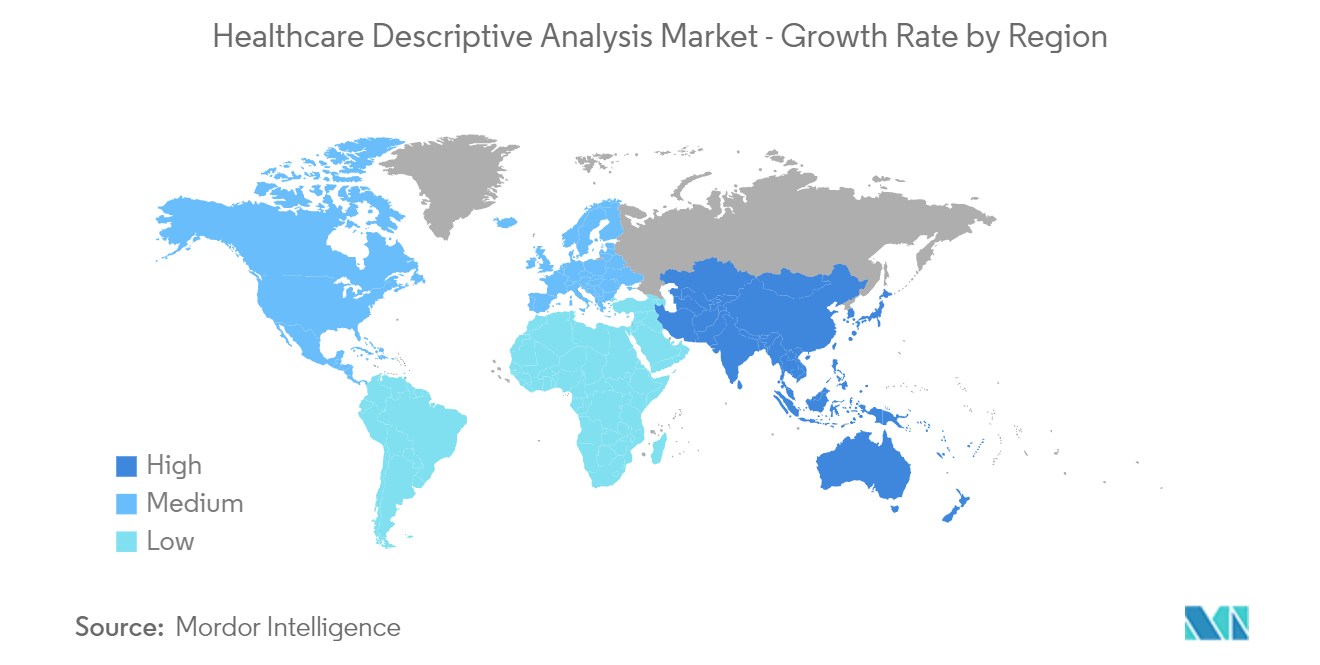
| Fastest Growing Market | Asia-Pacific |
| Largest Market | North America |
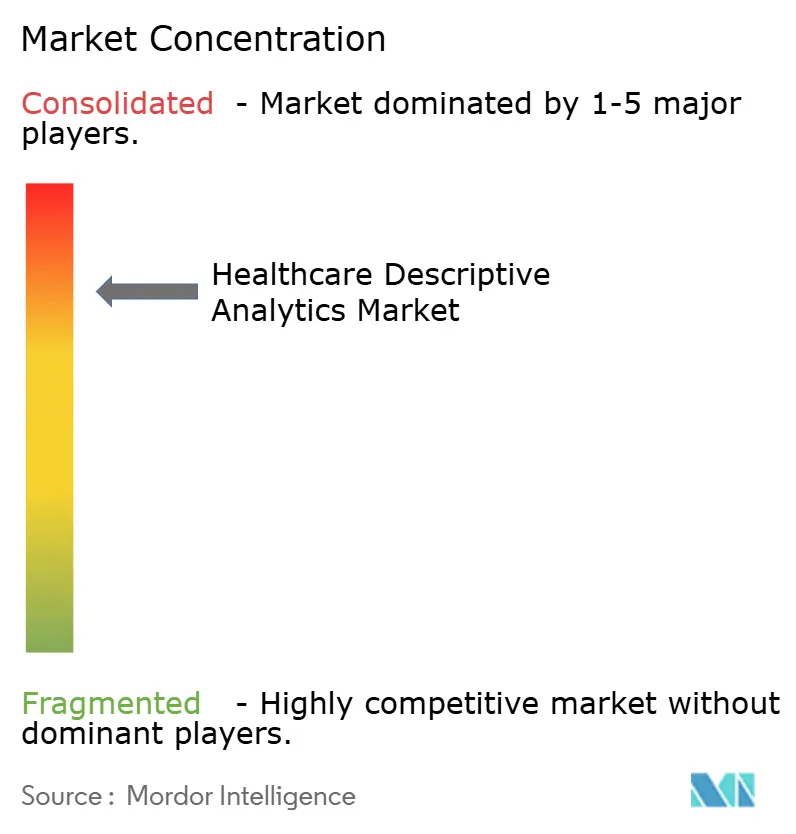
| Market Concentration | High |
Major Players *Disclaimer: Major Players sorted in no particular order Image © Mordor Intelligence. Reuse requires attribution under CC BY 4.0. | |
Healthcare Descriptive Analytics Market Analysis by Mordor Intelligence
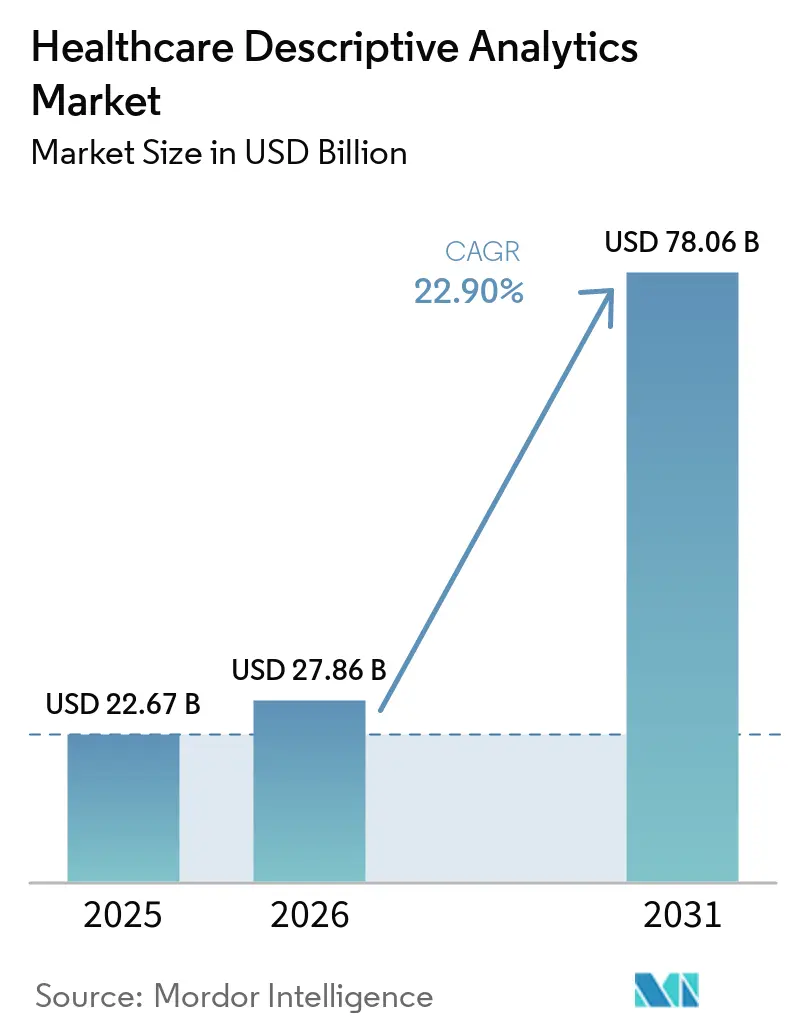
The Healthcare Descriptive Analytics Market size was valued at USD 22.67 billion in 2025 and estimated to grow from USD 27.86 billion in 2026 to reach USD 78.06 billion by 2031, at a CAGR of 22.90% during the forecast period (2026-2031).
The global battle against the COVID-19 pandemic benefited greatly from the use of advanced healthcare data analytics. The healthcare industry was able to track the pandemic's spread, monitor population health, predict disease severity and resulting demand, and offer the general public optimized medical solutions by utilizing data during the pandemic. According to the study published in NCBI in May 2021, calls and questionnaires were used to collect epidemiologic and disease-related data for the study, which were then descriptively analyzed. Thus, research activity increased during the pandemic, which had a big impact on market expansion. Post-pandemic, the market is seeing uniform growth due to the rising digitalization, increased adaptation of analytics, increased healthcare infrastructure, and technological advancements in healthcare descriptive analytics.
The increasing need to reduce healthcare expenditure, including the cost associated with medical product flaws and hospital workflow inefficiencies, is anticipated to increase the usage of big data in the healthcare sector. For instance, according to a study published in 'Health Informatics' in January 2021, healthcare descriptive analytics employs recent and old data to produce macro and micro insights that help in business and patient decision-making. According to the same source, the use of health data analytics allows for improvements in patient care, faster and more accurate diagnoses, preventive measures, and more personalized treatment. Such advantages of descriptive analysis in healthcare are expected to drive the market's growth.
The digitalization of healthcare data is a primary driver of the healthcare descriptive analytics market. Many developed countries are implementing electronic medical records to digitalize healthcare. For instance, the German healthcare system's largest digitalization project, the electronic patient health record (Elektronische Patientenakte - ePA), began on January 1, 2021. The ePA aims to provide extensive digital connectivity inside the German healthcare system, including between patients and clinicians, as well as between providers in hospital and primary care settings. The objective of the project is to create a central location for all patient information such as test results, diagnosis, medications, and personal health data from wearable devices. Such developments are expected to drive the market.
The rising demand for descriptive analysis in the assessment of clinical data is expected to drive the market's growth over the forecast period. For instance, in June 2021, IQVIA launched Clinical Data Analytics Suite (CDAS), a SaaS-based clinical data analytics platform that transforms clinical data analytics from descriptive reports, which improve trial safety for patients and quicken drug development. Such launches and the increased adoption of descriptive analytics in drug discovery are expected to drive the market.
However, data privacy and security concerns are expected to restrain the market's growth over the forecast period.
Note: Market size and forecast figures in this report are generated using Mordor Intelligence’s proprietary estimation framework, updated with the latest available data and insights as of 2026.
Global Healthcare Descriptive Analytics Market Trends and Insights
Cloud-based Segment Expected to Hold a Significant Share of the Market During the Forecast Period
Cloud computing has been defined as the practice of using remote servers in place of local servers or networks to store, manage, and process data. Therefore, the use of the cloud moves the data center infrastructure outside the organization.
There are many advantages of cloud-based descriptive analytics in healthcare that are expected to propel the segment's growth. For instance, according to a study published in the Journal of Medical Internet Research in January 2022, the use of cloud computing involving storage and processing of data in healthcare has great potential in facilitating data-driven innovations. The cloud platforms, along with data analytics and AI, can help organizations achieve the goal of storage and processing of healthcare data. They can also help focus on patient care and security.
Several major players are making plans and launching new healthcare descriptive analysis products in the market. For instance, in March 2022, Microsoft announced the general availability of Azure Health Data Services, a cloud platform for managing and analyzing various forms of patient data. In addition, in July 2021, Amazon Web Services Inc. (AWS) reported the availability of Amazon HealthLake, a cloud-based health IT solution that leverages machine learning to extract, organize, and store structured patient health data. Such initiatives are expected to drive the market's growth.
Hence, cloud-based technologies can give users access to advanced analytics capabilities, thereby driving the segment's growth.
North America is Expected to Hold a Major Share in the Healthcare Descriptive Analytics Market
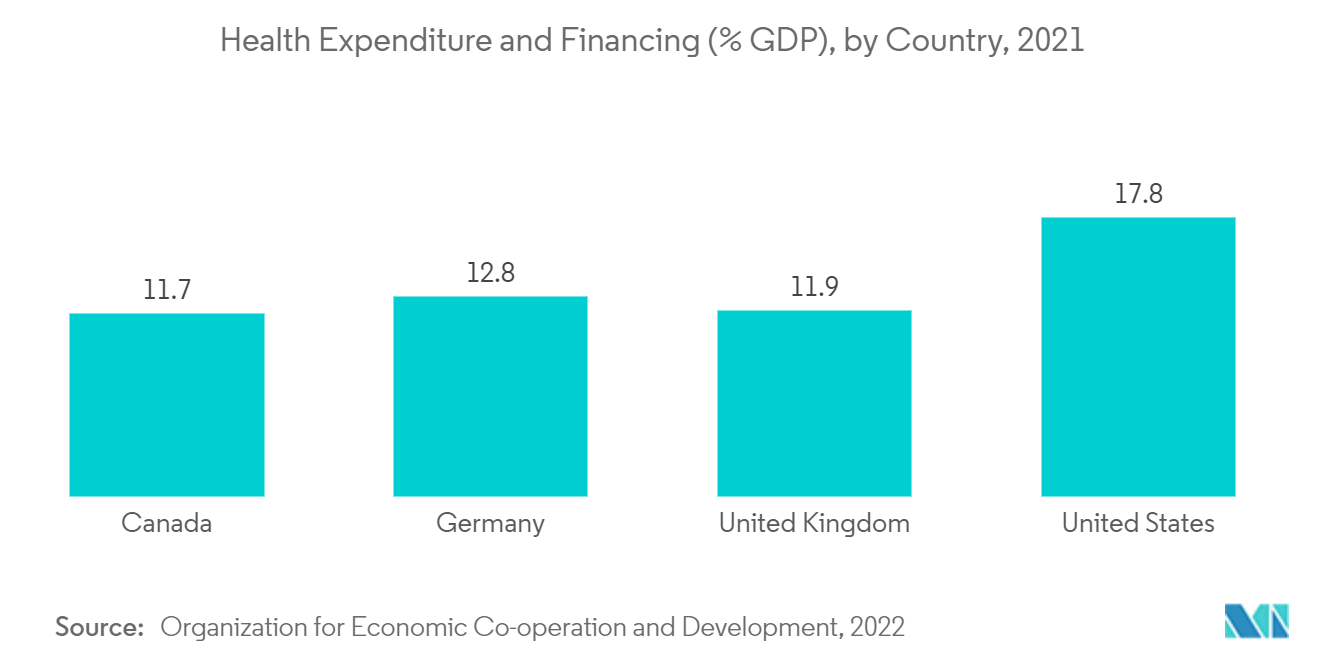
Growing federal healthcare mandates to curb rising healthcare costs and provide quality care, increasing regulatory requirements, growing EHR adoption, and rising government initiatives focusing on personalized medicine, population health management, and value-based reimbursements are driving the healthcare descriptive analytics market in North America.
The increasing funding from the US government for supporting healthcare is an attributing factor to the growth of the market in the United States. For instance, according to the Congressional Budget Office data published in 2021, in the past two decades, federal funding for the National Institute of Health (NIH) totaled over USD 700 billion. Thus, increasing healthcare spending in the United States is expected to boost the market due to the increased adoption of healthcare descriptive analysis in research settings.
Several companies are collaborating to support big data and improve healthcare analytics. For instance, in September 2022, Walmart entered a 10-year partnership with United Health on value-based care. To assist its physicians in providing value-based care, Walmart Health will receive analytics and decision support tools from UnitedHealth's Optum. Optum manages numerous outpatient clinics and medical practices, and it has analytics tools that collect data from payers and providers to better coordinate and deliver care. Such collaborations to provide healthcare analytics to physicians are expected to drive the market's growth in North America.
The strong foothold of key market players, increased research for the development of innovative software, and sophisticated healthcare infrastructure are also expected to drive the market in North America.
Competitive Landscape
The healthcare descriptive analytics market is moderately competitive due to the strategies adopted by key market players, such as product launches and partnerships. Some of the market players operating in the market include IBM, Inovalon, Oracle Corporation, McKesson Corporation, MedeAnalytics, Optum Inc., and Allscripts Healthcare Solutions Inc.
Healthcare Descriptive Analytics Industry Leaders
-
IBM
-
Oracle Corporation
-
McKesson Corporation
-
MedeAnalytics, Inc.
-
Inovalon
- *Disclaimer: Major Players sorted in no particular order
Market Opportunities and Future Outlook
Interoperability mandates and standards advancement are creating new opportunities for descriptive analytics to make more granular, computable healthcare data usable across clinical and administrative workflows. In the United States, the 2026 CMS Interoperability Standards and Prior Authorization for Drugs proposed rule pushes payers toward electronic prior authorization capabilities and interoperability API reporting, which raises demand for analytics that can track throughput, exceptions, and performance across payer-provider interactions. At the same time, ONC's 2026 Standards Version Advancement Process (SVAP) allows certified health IT developers to incorporate updated standards, including HL7 FHIR US Core implementation guides, beginning August 29, 2026. ONC has also targeted July 2026 for the final version 7 release of the United States Core Data for Interoperability (USCDI), reinforcing the need for data-quality, mapping, and audit-ready reporting layers.
Commercial investment is also pointing to opportunity in structuring and normalizing unstructured EHR data into analysis-ready datasets for quality reporting, value-based care, and research. For example, xCures completed a USD 46 million Series B round in June 2026 to scale its data-structuring platform that maps unstructured EHR data to standardized biomedical vocabularies, which signals continued spending on tooling that converts raw records into consistent descriptive insights. This environment supports demand for cloud-based descriptive analytics capabilities, including data ingestion, standardization, dashboards, and configurable reporting, to help hospitals, clinics, payers, and life-sciences teams reconcile clinical, claims, and operational data while retaining governance and security controls.
Recent Industry Developments
- June 2026: MedeAnalytics announced new enhancements to its enterprise analytics offerings for Medicare Advantage and Employer Group performance, including innovations to unify data across quality, risk, finance, utilization, SDOH, and member experience. The update strengthens payer-focused descriptive analytics by consolidating reporting and performance management across multiple program dimensions into a single analytics layer.
- October 2025: GE HealthCare launched CareIntellect for Perinatal, a cloud-first application aimed at optimizing care delivery in perinatal settings. The launch expands cloud-based analytics adoption at the point of care, reinforcing demand for descriptive dashboards that support workflow standardization and operational visibility across departments.
- October 2024: Oracle announced updates to Oracle Health Data Intelligence to help healthcare organizations improve care quality, operational efficiency, and financial performance. The enhancements underscore continued vendor investment in enterprise data platforms that blend clinical and operational data for descriptive reporting used by providers and health systems.
Research Methodology Framework and Report Scope
Market Definition and Coverage
This market covers software, services, and related tools used by healthcare organizations to summarize and report past data so teams can understand what happened and improve decisions.
Scope exclusions: We exclude non-healthcare analytics spend and pure data storage or IT infrastructure spend when it is not tied to descriptive analytics use cases.
Segmentation Overview
- By Application
- Clinical Data Analytics
- Financial Data Analytics
- Administrative Data Analytics
- Research Data Analytics
- By Component
- Software
- Hardware
- Services
- By Deployment
- On-premise
- Web-based
- Cloud-based
- By End User
- Private Organization
- Hospitals
- Clinics
- Other End Users
- Private Organization
- Geography
- North America
- United States
- Canada
- Mexico
- Europe
- Germany
- United kingdom
- France
- Italy
- Spain
- Rest of Europe
- Asia-Pacific
- China
- Japan
- India
- Australia
- South Korea
- Rest of Asia-Pacific
- Middle East and Africa
- GCC
- South Africa
- Rest of Middle East and Africa
- South America
- Brazil
- Argentina
- Rest of South America
- North America
Data Sources, Market Sizing, and Validation
Desk Research
Desk research was used to set the boundaries of what is counted, and to build a clean set of demand and supply signals before modeling. We used public sources such as the US Centers for Medicare and Medicaid Services (CMS) health expenditure tables, the World Health Organization (WHO) health statistics, the OECD health data series, and national health ministry publications to understand system scale and digitization direction.
To connect this to analytics adoption, we also reviewed sources such as peer reviewed health informatics journals, national EHR adoption programs, and public regulatory guidance that influences reporting and quality measurement. Company filings, investor presentations, press coverage, and procurement notices helped cross-check product positioning and where revenue is actually generated. In a few places, we used paid subscriptions for company financials and intelligence, patent databases, and a global contracts and tenders feed to verify deal flow patterns. These examples are not exhaustive, and many other public documents and checks were used to collect, validate, and clarify the data.
Primary Interviews and Surveys
Primary work focused on validating what portion of healthcare analytics budgets are truly descriptive, and how deployments are split across cloud, web-based, and on-premise models in real buying situations. We spoke with a mix of solution providers, implementation partners, hospital and clinic data teams, and payer and life sciences users across the Americas, EMEA, and APAC so assumptions could be challenged from more than one angle.
Distribution of primary research fieldwork respondents
| Company type | Respondent position | Region |
|---|---|---|
| Top tier: 33% | CXOs: 20% | APAC: 39% |
| Mid tier: 45% | Functional/Unit leaders: 29% | EMEA: 35% |
| Smaller Players: 22% | Managers: 51% | Americas: 26% |
Market-Sizing & Forecasting
Sizing started with a top-down build that reconstructs the addressable spend pool using healthcare IT and digital health spending signals, and then narrows it using adoption and usage splits specific to descriptive analytics. We then corroborated totals with selective bottom-up approximations, such as sampled vendor revenue disclosures, partner channel checks, and ASP times volume logic for common module bundles, and gaps were adjusted when coverage was uneven by region.
A few of the market fingerprints that fed the model were EHR and claims digitization levels, reporting and quality-measure requirements that increase dashboarding needs, hospital and clinic software spend patterns, cloud migration pace in healthcare, and the relative mix of clinical, financial, administrative, and research reporting workloads. Forecasts were built using scenario analysis, where we tested conservative and accelerated adoption cases, and then aligned the final path to what interviewees considered realistic for budgets, deployment constraints, and procurement cycles.
Data Validation & Update Cycle
Model outputs were checked against independent signals like healthcare IT spending direction, public digitization milestones, and observed shifts in cloud deployment, which helped spot values that did not fit real market behavior. When variances were large, we revisited assumptions, re-checked source consistency, and re-contacted experts to confirm whether the change was real or driven by definitional mismatch.
Before sign-off, the work goes through multi-step analyst review so the logic, inputs, and math align across regions and years. Reports are refreshed annually, and interim updates are made when material events change demand or pricing assumptions. Right before delivery, an analyst performs a fresh pass so clients receive the latest updated view.
Mordor Intelligence's Global Healthcare Descriptive Analytics Market Market Estimate Compared With Other Published Estimates
Published sizes for healthcare descriptive analytics can differ because the counted scope is not always the same and because some models lean on very different adoption and pricing paths. The table helps show how fast these differences can add up when hardware, services, and adjacent analytics types are treated inconsistently.
Key gap drivers usually come from what gets included beyond descriptive reporting, how cloud versus on-premise revenues are valued, the assumed shift from perpetual licenses to subscriptions, and the refresh timing for currency conversion and inflation. The benchmark table shows a higher 2026 value, and in Mordor Intelligence's model the scope counts descriptive analytics across software, hardware, and services only when it is tied to healthcare reporting use cases rather than broader advanced analytics bundles.
Benchmark comparison
| Source | Market Size | Gaps in Research Methodology |
|---|---|---|
| Mordor Intelligence | USD 27.86 B (2026) | |
| Industry Publisher A | USD 3.86 B (2024) | Uses a much smaller spend pool and appears to treat descriptive analytics closer to a limited software-only view, which can undercount services, implementation, and broader provider adoption outside a narrow cohort. |
| Research House B | USD 8.40 B (2025) | Anchors on a different base year and may apply a tighter definition of descriptive analytics workloads, and the model assumptions around pricing and deployment mix can shift totals when cloud subscriptions are treated differently from license revenue. |
Taken together, the spread is mainly explained by scope boundaries and the way deployment and pricing transitions are modeled across years. By keeping the inputs traceable to adoption signals, healthcare IT spending direction, and interview-validated workload splits, the final number stays repeatable and easier to reconcile with what buyers and suppliers see in the market.
Key Questions Answered in the Report
How big is the Healthcare Descriptive Analytics Market?
The Healthcare Descriptive Analytics Market size is expected to reach USD 27.86 billion in 2026 and grow at a CAGR of 22.90% to reach USD 78.06 billion by 2031.
What is the current Healthcare Descriptive Analytics Market size?
In 2026, the Healthcare Descriptive Analytics Market size is expected to reach USD 27.86 billion.
Who are the key players in Healthcare Descriptive Analytics Market?
IBM, Oracle Corporation, McKesson Corporation, MedeAnalytics, Inc. and Inovalon are the major companies operating in the Healthcare Descriptive Analytics Market.
Which is the fastest growing region in Healthcare Descriptive Analytics Market?
Asia-Pacific is estimated to grow at the highest CAGR over the forecast period (2026-2031).
Which region has the biggest share in Healthcare Descriptive Analytics Market?
In 2025, the North America accounts for the largest market share in Healthcare Descriptive Analytics Market.
What years does this Healthcare Descriptive Analytics Market cover, and what was the market size in 2025?
In 2025, the Healthcare Descriptive Analytics Market size was estimated at USD 27.86 billion. The report covers the Healthcare Descriptive Analytics Market historical market size for years: 2021, 2022, 2023 and 2024. The report also forecasts the Healthcare Descriptive Analytics Market size for years: 2025, 2026, 2027, 2028, 2029 and 2030.