
Enteral Feeding Tubes Market Size and Share
Market Overview
| Study Period | 2020 - 2031 |
|---|---|
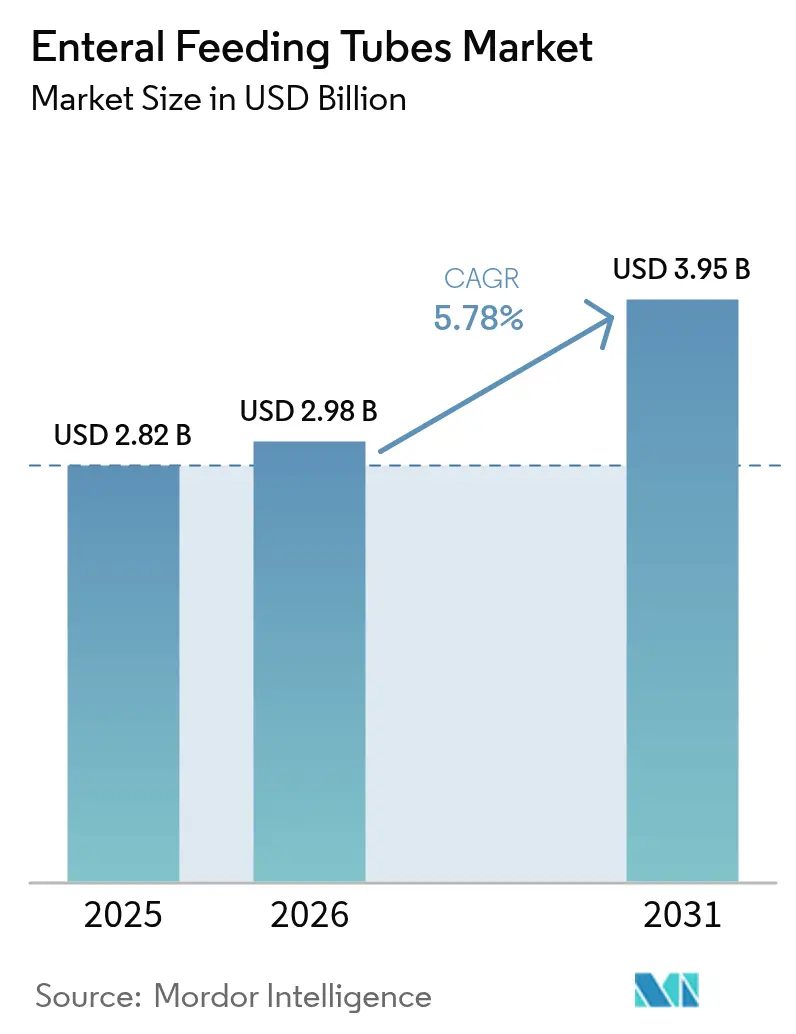
| Market Size (2026) | USD 2.98 Billion |
| Market Size (2031) | USD 3.95 Billion |
| Growth Rate (2026 - 2031) | 5.78 % |
| Fastest Growing Market | Asia-Pacific |
| Largest Market | North America |
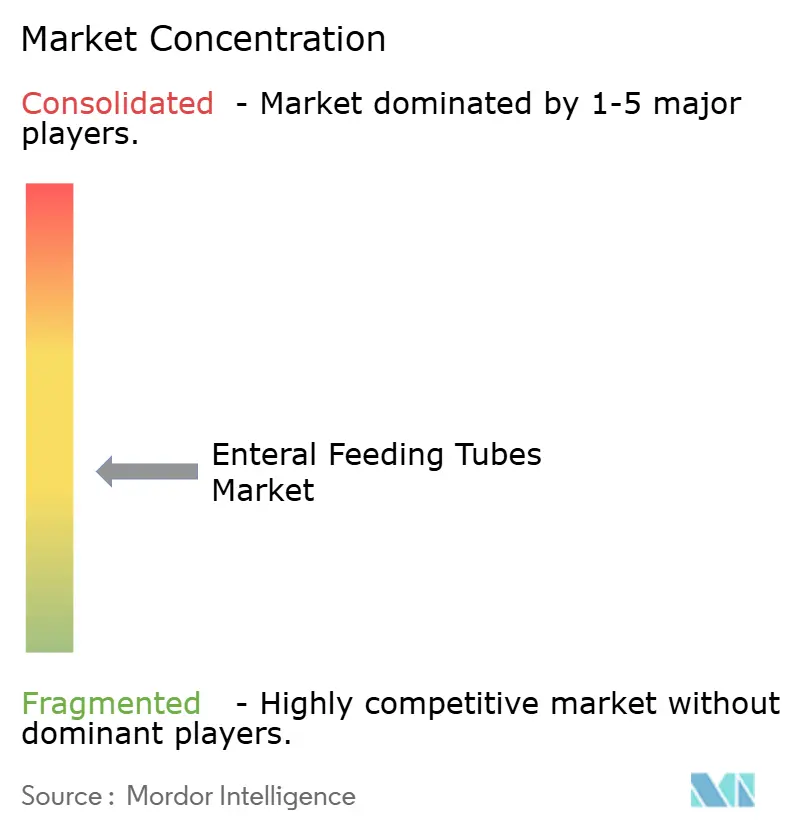
| Market Concentration | Medium |
Major Players *Disclaimer: Major Players sorted in no particular order Image © Mordor Intelligence. Reuse requires attribution under CC BY 4.0. | |
Enteral Feeding Tubes Market Analysis by Mordor Intelligence
Enteral feeding tubes market size in 2026 is estimated at USD 2.98 billion, growing from 2025 value of USD 2.82 billion with 2031 projections showing USD 3.95 billion, growing at 5.78% CAGR over 2026-2031. Momentum stems from rising gastrointestinal disease prevalence, the global malnutrition burden, and advances such as electromagnetic tracking systems that cut placement-error risk. Consolidation among suppliers, highlighted by BD’s USD 4.2 billion purchase of Edwards Lifesciences’ Critical Care unit, adds scale to smart-connected feeding platforms. New FDA Quality System Regulation amendments, effective February 2026, align international design-control standards, smoothing global product registration. In parallel, payers increasingly reimburse home-based enteral nutrition, accelerating demand from outpatient and telehealth channels.
Key Report Takeaways
- By product category, enterostomy tubes led with 45.86% revenue share in 2025, while self-advancing spiral tubes are projected to expand at 10.63% CAGR to 2031.
- By patient type, adults accounted for 69.98% of the enteral feeding tubes market size in 2025; the neonatal cohort is advancing at an 8.32% CAGR through 2031.
- By application, oncology held 32.44% of the enteral feeding tubes market share in 2025; critical care and trauma is forecast to grow 8.89% CAGR to 2031.
- By end user, hospitals commanded 61.94% share of the enteral feeding tubes market size in 2025, while home care is expanding at a 9.74% CAGR through 2031.
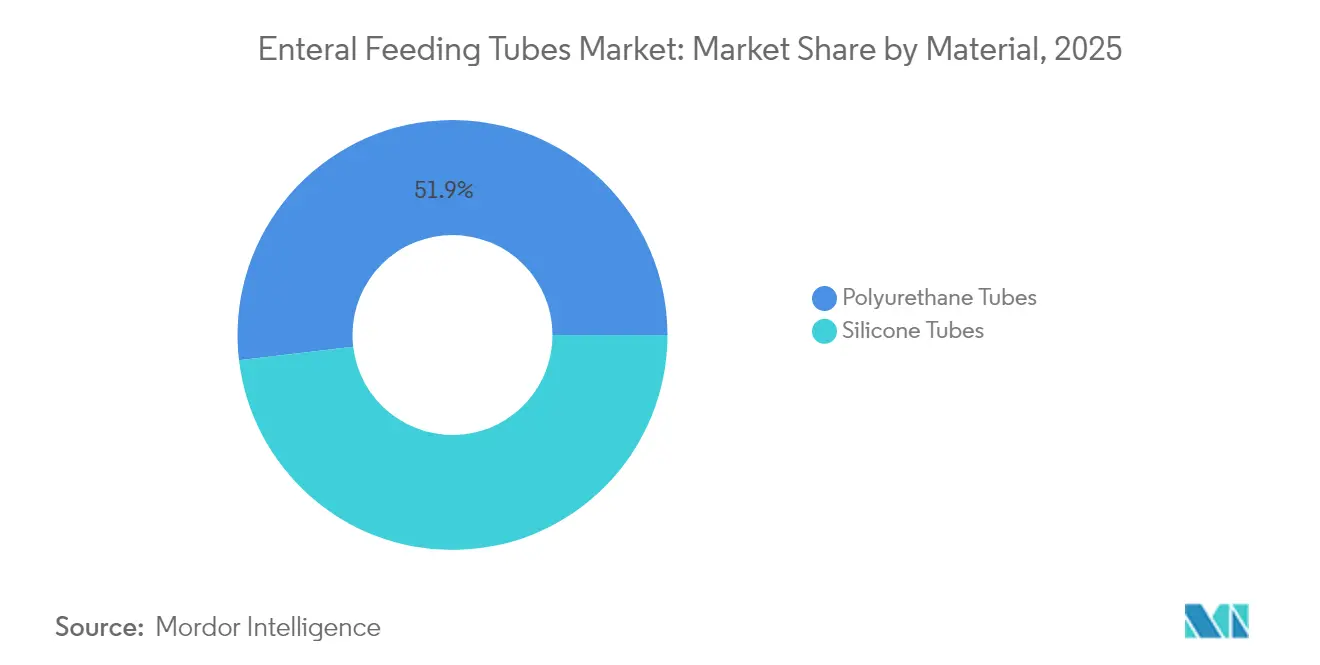
- By material, polyurethane tubes dominated with 51.88% share in 2025; silicone tubes usage is advancing at 8.11% CAGR to 2031.
- By placement technology, endoscopic placement owned the largest 63.92% revenue slice in 2025; the electromagnetic tracking placement is the fastest-growing segment at 9.81% CAGR.
- By geography, North America retained 38.12% of global revenue in 2025; Asia-Pacific is the fastest-growing region at 8.79% CAGR to 2031.
Note: Market size and forecast figures in this report are generated using Mordor Intelligence’s proprietary estimation framework, updated with the latest available data and insights as of 2026.
Market Trends and Insights
Drivers Impact Analysis of Enteral Feeding Tubes Market*
| Driver | (~) % Impact on CAGR Forecast | Geographic Relevance | Impact Timeline |
|---|---|---|---|
| Rising incidence of chronic gastrointestinal disorders | +1.8% | North America, Europe | Long term (≥ 4 years) |
| Growing global malnutrition burden | +1.2% | Asia-Pacific, MEA, South America | Medium term (2-4 years) |
| Sharp uptick in pre-term births in low-income countries | +0.9% | Asia-Pacific, MEA, South America | Long term (≥ 4 years) |
| Adoption of home enteral nutrition programs by payers | +1.1% | North America, Europe, Asia-Pacific | Medium term (2-4 years) |
| Miniaturised wireless sensors enabling placement verification | +0.7% | Global | Short term (≤ 2 years) |
| Mandates for nasogastric tube mis-placement audits in OECD hospitals | +0.5% | OECD countries | Short term (≤ 2 years) |
| Source: Mordor Intelligence | |||
Rising Incidence of Chronic Gastrointestinal Disorders
An aging global population, coupled with higher cancer and inflammatory bowel disease prevalence, is fueling long-term demand for enteral nutrition. British Society of Gastroenterology guidance issued in 2025 confirms that most cancer patients present multiple gastrointestinal symptoms requiring early feeding support[1]. Providers therefore rely on precision placement technologies, especially electromagnetic guidance, to optimize outcomes. Health systems acknowledge the cost avoidance that stems from preventing disease-related malnutrition, sustaining the enteral feeding tubes market’s growth trajectory.
Growing Global Malnutrition Burden
Malnutrition affects up to 80% of oncology patients and continues to burden elderly and critical-care cohorts. Industry players answer with plant-based formulations and tube innovations that improve nutrient delivery. Oncology Nursing Society data showing 17–55% food-insecurity rates among cancer patients underline the social-determinant dimension that keeps enteral nutrition essential.
Sharp Uptick in Pre-Term Births in Low-Income Countries
Survival gains among extremely-low-birth-weight infants create sustained neonatal feeding demand. Cleveland Clinic reported 5.5% mortality for G-tube–only neonates versus 26.9% for tracheostomy-only cases, underscoring enteral feeding’s life-saving role. Hospitals in emerging economies adopt scoring algorithms and ultrasound monitoring to manage intolerance, which expands the enteral feeding tubes market in resource-constrained regions.
Adoption of Home Enteral Nutrition Programs by Payers
Medicare’s 2025 Home Health rule enhanced reimbursement for home nutrition, validating cost savings gained by shifting suitable patients out of hospitals[2]. UPMC demonstrated that its nasogastric home protocol saved roughly 900 NICU days in 2024 without compromising feeding milestones. Such outcomes encourage private insurers to replicate home-based models, elevating demand for portable, easy-to-monitor tubes.
Restraints Impact Analysis of Enteral Feeding Tubes Market*
| Restraint | (~) % Impact on CAGR Forecast | Geographic Relevance | Impact Timeline |
|---|---|---|---|
| High tube-related infection rates in long-term care facilities | −0.8% | North America, Europe | Medium term (2-4 years) |
| Sub-optimal reimbursement for paediatric home care | −0.6% | North America, Europe, Asia-Pacific | Long term (≥ 4 years) |
| Silicone price volatility affecting OEM margins | −0.4% | Global | Short term (≤ 2 years) |
| Sterilisation-capacity shortages post-ethylene-oxide curbs | −0.7% | Global, especially North America | Medium term (2-4 years) |
| Source: Mordor Intelligence | |||
High Tube-Related Infection Rates in Long-Term Care Facilities
A study of geriatric patients showed 72% mortality during follow-up, spotlighting infection and aspiration challenges that dampen adoption in nursing homes. Inconsistent staff training and limited on-site expertise mean facilities struggle to meet best-practice protocols, restraining the enteral feeding tubes market in this segment.
Sub-Optimal Reimbursement for Paediatric Home Care
Coverage rules lag technological progress, leaving gaps for specialized pediatric formulations and placement aids. The Oley Foundation notes that U.S. reimbursement policies for home enteral products have changed little in 30 years, adding administrative hurdles and slowing therapy initiation[3]. Limited funding discourages manufacturers from fast-tracking pediatric-focused innovations.
*Our forecasts treat driver/restraint impacts as directional, not additive. The impact forecasts reflect baseline growth, mix effects, and variable interactions.
Enteral Feeding Tubes Market Segment Analysis
By Product:
Enterostomy Dominance Drives InnovationEnterostomy tubes contributed 45.86% of global revenue in 2025, underscoring their role in long-term nutritional support for oncology and neurology patients. Within the enteral feeding tubes market size, gastrostomy buttons and PEG variants retain clinician preference for comfort and reduced aspiration risk. Manufacturers refine internal retention disks and low-profile ports, elevating patient mobility. Self-advancing spiral tubes, set to grow 10.63% annually, employ embedded micro-motors and guidewires to reach the jejunum without fluoroscopy. That automation lowers procedure time, trims imaging costs, and is gaining acceptance in bariatric and critical-care units.
Nasojejunal and nasogastric tubes stay relevant for acute feeding but share of spend is gradually edging toward advanced spiral devices. Oroenteric tubes remain a neonatal niche used when nasal placement impedes breathing. Jejunostomy demand rises following upper-GI surgeries where gastric feeding is contraindicated, helping hospitals meet enhanced-recovery protocols. Clinical data linking self-advancing designs to higher first-pass success supports wider procurement, reinforcing the enteral feeding tubes market’s premiumization trend.


By Patient Type:
Adult Stability Contrasts Neonatal GrowthAdults provided 69.98% of revenue in 2025 as aging populations face dysphagia, stroke, and cancer-related cachexia. Hospitals favor electromagnetic trackers in these cohorts to navigate altered anatomy after surgery or radiation. Yet neonates deliver the fastest expansion at 8.32% CAGR, powered by improved survival of very-low-birth-weight infants and wider NICU capabilities in emerging markets. Studies show eliminating routine gastric residual checks can shorten hospital stays by two days, prompting broader acceptance of early feeding protocols.
Pediatric-specific tubes with narrower French sizes and softer tips improve tolerance, although reimbursement remains a headwind in some regions. Adult demand will stay anchored in chronic diseases, while neonatal gains diversify regional consumption patterns, sustaining the enteral feeding tubes market across age segments.
By Application:
Oncology Leadership Faces Critical-Care ChallengeOncology accounted for 32.44% of 2025 revenue, reflecting high malnutrition incidence and chemotherapy-induced mucositis that impedes oral intake. Radiation oncology centers integrate tube placement before treatment initiation to avoid weight-loss-related interruptions. Critical care and trauma is projected to rise 8.89% CAGR, propelled by guidelines calling for nutrition within 48 hours of ICU admission. Electromagnetic systems reduce bedside insertion time, a crucial advantage in unstable patients.
Neurology indications such as stroke and ALS continue to require long-term tubes with low-migration profiles. Gastroenterology cases, notably Crohn’s disease and gastroparesis, benefit from nasojejunal routes that bypass compromised gastric function. Metabolic and hepatology applications round out demand for specialized formulas. Oncology’s head-start in evidence and reimbursement keeps it the largest slice, yet ICU adoption rates may erode the gap as clinical protocols standardize, expanding the enteral feeding tubes market’s procedural mix.
By End User:
Hospital Dominance Challenged by Home Care ExpansionHospitals captured 61.94% of spend in 2025 because most initial placements still occur in-patient. Operating rooms and endoscopy suites maintain volume for PEG and jejunostomy procedures. However, insurers are channeling appropriate cases to outpatient centers, causing ambulatory surgical sites to grow steadily. Home care, scaling at 9.74% CAGR, benefits from remote monitoring apps that alert clinicians to occlusion or displacement events. UPMC’s NICU program proved cost and stay reductions, prompting other systems to pilot similar home pathways. Long-term care facilities remain a substantial but slower-growing outlet due to infection challenges. As reimbursement aligns with value-based care, the enteral feeding tubes market tilts toward decentralized service models that pair hardware with telehealth oversight.
By Material:
Polyurethane Leads Despite Silicone InnovationPolyurethane delivered 51.88% of 2025 revenue thanks to insertion-friendly stiffness that softens at body temperature, improving patient comfort. Silicone tubes, while pricier, are set to climb 8.11% CAGR as their chemical resistance and low protein adhesion extend device life. Suppliers hedge raw-material volatility by expanding capacity: Avient added medical-grade TPU lines in Suzhou to serve Asia-Pacific growth. Manufacturers also explore bio-based polymers that meet sustainability targets without sacrificing performance. Metal-infused tips for fluoroscopic visibility and antimicrobial coatings that deter biofilm formation surface across both material classes. Polyurethane will keep volume leadership, but silicone’s premium share gain supports margin uplift within the enteral feeding tubes market.
By Placement Technology:
Endoscopic Standard Faces Electromagnetic DisruptionEndoscopic guidance represented 63.92% of placements in 2025, valued for direct visualization and high accuracy when specialists are available. Yet staff shortages and radiation concerns spur interest in electromagnetic tracking, forecast to grow 9.81% annually. Avanos’ CORTRAK 2 system provides graphic pathways that confirm location without X-ray, aligning with audit mandates for misplacement prevention. A 2024 trial using low-cost magnet sensors achieved localization within 1.63 cm of X-ray benchmarks, proving feasibility for resource-limited settings. Fluoroscopic techniques still serve complex anatomies but face reimbursement pressure from dose-reduction policies. Camera-tipped tubes such as Cardinal Health’s IRIS deliver real-time internal images, carving a niche for high-risk or pediatric cases. The technology race elevates switching costs and entrenches brand differentiation, reinforcing competitive intensity inside the enteral feeding tubes market.
Geography Analysis
North America Enteral Feeding Tubes Market
North America held 38.12% of global revenue in 2025 due to robust reimbursement, established clinical guidelines, and early uptake of placement verification technologies. The United States drives R&D investment; companies like Cardinal Health and BD base electromagnetic or imaging platforms on domestic pilot data before global roll-out. Canada’s single-payer model secures province-wide contracts, enhancing vendor scale. Mexico, while smaller, adopts cost-effective polyurethane tubes for public hospitals, broadening regional consumption.
APAC Enteral Feeding Tubes Market
Asia-Pacific is expanding at a 8.79% CAGR, the fastest globally, underpinned by infrastructure upgrades and regulatory harmonization. China’s pending Medical Device Law raises compliance stakes but simplifies foreign registration, favoring global suppliers with quality records. India’s risk-based classification fast-tracks low-risk feeding kits yet still demands local performance data. Japan’s device-act amendments shorten review timelines, attracting launches of wireless sensors. South Korea’s Digital Medical Products Act encourages AI-enabled monitoring, complementing traditional tubes. Collectively these measures inject momentum into the enteral feeding tubes market across Asia-Pacific, where aging populations and neonatal care improvements converge.
EMEA and South America Enteral Feeding Tubes Market
Europe delivers steady growth through stringent safety protocols and high public-sector spending. Germany and the United Kingdom lead adoption of electromagnetic guidance, motivated by mandating misplacement audits. Southern and Eastern European markets, though smaller, invest EU recovery funds into modern endoscopy and ICU capacity, widening access to advanced tubes. Middle East and Africa witness incremental gains, driven by Gulf Cooperation Council hospital expansions and training programs that lift procedural volumes. In South America, Brazil and Argentina spearhead uptake despite economic volatility, leaning on public procurement to secure essential nutrition devices. These varied regional dynamics ensure a diversified revenue base for the enteral feeding tubes market.

Competitive Landscape
The enteral feeding tubes market shows moderate consolidation, with top multinationals acquiring smart-monitoring assets to augment core tubing lines. BD’s 2024 purchase of Edwards Lifesciences’ Critical Care portfolio brought advanced hemodynamic sensors that integrate with feeding platforms, enabling holistic patient oversight. Avanos leverages its CORTRAK electromagnetic navigation to retain hospital contracts and recently extended direct UK distribution for MIC-KEY buttons to sharpen service levels.
Production expansion secures supply and hedges sterilization constraints. Gerresheimer invested USD 180 million in a Georgia site for molded components, boosting U.S. capacity. Lubrizol’s partnership with Polyhose commits USD 350 million to a Chennai tubing plant, supporting Asia-Pacific material demand. Patent activity concentrates on wireless sensing, antimicrobial coatings, and self-propelling tips, sustaining high entry barriers.
Competition increasingly revolves around digital ecosystems that pair hardware with analytics dashboards. Cardinal Health integrates IRIS camera streams into its Kangaroo feed pumps, capturing device-linked data for performance reporting. Nestlé Health Science’s formula4success portal helps clinicians navigate reimbursement paperwork, deepening brand loyalty. In pediatrics, white-space remains for miniaturized connectors and family-friendly training apps. Regional manufacturers in China and Brazil compete on price, but premium Western brands retain share where misplacement audits favor advanced technologies, keeping rivalry intense yet focused on value-added differentiation within the enteral feeding tubes market.
Enteral Feeding Tubes Industry Leaders
-
Cardinal Health
-
Boston Scientific Corporation
-
ENvizion Medical Inc.
-
Applied Medical Technology Inc.
-
B Braun Melsungen AG
- *Disclaimer: Major Players sorted in no particular order
Enteral Feeding Tubes Market Companies Covered in this Report
- Avanos Medical
- Cardinal Health
- Fresenius
- B. Braun
- Beckton Dickinson
- Boston Scientific
- Cook Group
- Conmed
- Applied Medical Resources
- Vygon
- ENvizion Medical
- Halyard Health
- Moog Inc. (Enteral Division)
- Nestle
- Danone
- Medtronic
- Amsino International
- ALCOR Scientific
- CORPAK MedSystems
- Baxter
Market Opportunities and Future Outlook
Opportunities are concentrating on placement verification and workflow automation as hospitals operationalize misplacement audit requirements and work to reduce X-ray dependence. Electromagnetic navigation and connected platforms are shifting purchasing away from standalone tubes toward bundled solutions that combine the device, verification, software, and training, reinforced by evidence-generation activity within health networks. ENvue Medical secured a three-year contract renewal across a 12-hospital US network in May 2026, and this type of network-led adoption supports demand for verification-linked systems.
There is also ongoing white space in miniaturized pediatric and neonatal designs that pair gentler materials with verification features, along with home-care-ready systems that simplify set-up and monitoring for caregivers and telehealth teams. April 2026 FDA clearance of Luminoah Flow points to continued momentum in integrated enteral feeding platforms beyond the tube itself. At the same time, continued investment in automation for placement workflows, including ENvue Drive announced in July 2026, fits the broader push to reduce bedside time and variability. Supply resilience and sterilization capacity constraints remain practical sourcing considerations, keeping attention on regional material capacity additions and alternative manufacturing pathways for polyurethane- and silicone-based tubing.
Recent Industry Developments in Enteral Feeding Tubes Market
- July 2026: ENvue Medical announced ENvue Drive, a robotic-assisted, AI-enabled feeding tube automation tool intended to advance enteral tube placement workflows. The announcement underscores the shift toward automation and navigation-enabled placement as vendors compete on time-to-place, consistency, and verification capabilities.
- June 2025: Cardinal Health communicated supply disruptions affecting Kangaroo neonatal and pediatric feeding tubes and Argyle neonatal and pediatric PVC feeding tubes, citing machinery performance and parts sourcing issues. The update highlighted the operational importance of validated alternate equipment and supply assurance in high-dependency neonatal and pediatric care settings.
- July 2024: Alpha Capital Anstalt completed the acquisition of ENvizion Medical Ltd. operating assets and intellectual property, transitioning the business to a privately held company based in Arlington Heights, Illinois. The transaction provided a path to re-capitalize niche enteral device capabilities and refocus commercialization under new ownership.
Enteral Feeding Tubes Market Report Scope and Research Methodology
Market Definition and Coverage
For this methodology, the market covers revenue earned from enteral feeding tubes used to deliver nutrition and select medications into the stomach or intestine through nasal, oral, or surgically created access.
Scope exclusions: We exclude parenteral nutrition consumables and general GI devices that do not function as enteral feeding tubes.
Segments Covered in This Report
- By Product
- Nasoenteral Feeding Tubes
- Nasogastric Tubes
- Nasojejunal Tubes
- Enterostomy Tubes
- Gastrostomy Tubes (PEG, Button)
- Jejunostomy Tubes
- Oroenteric Tubes
- Self-Advancing Spiral Tubes
- Nasoenteral Feeding Tubes
- By Patient Type
- Adults
- Paediatrics
- Neonates
- By Application
- Oncology
- Neurology
- Gastroenterology
- Metabolic Disorders
- Hepatology
- Critical Care & Trauma
- By End User
- Hospitals
- Ambulatory Surgical Centres
- Home Care Settings
- Long-term Care Facilities
- By Material
- Polyurethane Tubes
- Silicone Tubes
- By Placement Technology
- Endoscopic Placement
- Fluoroscopic Placement
- Electromagnetic Tracking Placement
- Geography
- North America
- United States
- Canada
- Mexico
- Europe
- Germany
- United Kingdom
- France
- Italy
- Spain
- Rest of Europe
- Asia-Pacific
- China
- Japan
- India
- South Korea
- Australia
- Rest of Asia-Pacific
- Middle East and Africa
- GCC
- South Africa
- Rest of Middle East and Africa
- South America
- Brazil
- Argentina
- Rest of South America
- North America
Data Sources, Market Sizing, and Validation
Desk Research
Desk work started with mapping the care settings where these tubes are used (acute care, long term care, and home care), then aligning that with published clinical guidance and observed usage patterns. We relied on public sources such as the World Health Organization for health system indicators, the US FDA device databases for safety and labeling signals, the US National Library of Medicine for peer reviewed clinical evidence, and the CDC for patient risk factors that connect to tube feeding demand.
We also reviewed trade and reimbursement context where available, using sources such as OECD health statistics and national health ministry portals to understand procedure volumes and hospitalization mix by region. In parallel, we reviewed company filings, investor presentations, earnings call remarks, and reputable press to cross check product mix shifts, pricing discussion, and portfolio changes. Where context was hard to find, we used a paid subscription for company financials and a patent database selectively to validate product pipelines and addressable revenue pools. These desk research sources are not exhaustive, and other public and paid references were used during the study to collect, verify, and clarify inputs.
Primary Interviews and Surveys
Primary work was used to pressure test model assumptions that desk sources rarely quantify cleanly, especially tube replacement frequency, setting level mix, and typical pricing ranges by tube type and material. We spoke with stakeholders across manufacturing, distribution, procurement, and clinical users, and we kept the coverage global so regional practice differences could be reflected in the final market totals. When gaps showed up, we rechecked the logic with follow up calls, which helped keep inputs realistic and consistent across regions.
Distribution of primary research fieldwork respondents
| Company type | Respondent position | Region |
|---|---|---|
| Top tier: 32% | CXOs: 16% | APAC: 45% |
| Mid tier: 49% | Functional/Unit leaders: 36% | EMEA: 34% |
| Smaller Players: 19% | Managers: 48% | Americas: 21% |
Market-Sizing & Forecasting
Sizing begins with a top-down build where procedure and patient care signals are used to reconstruct the demand pool for tube feeding across major care settings, then translated into tube volumes and value using practical price ranges. To keep the totals grounded, we corroborate the result using selective bottom-up approximations, such as sampled supplier revenue roll ups, channel checks on mix by tube type, and simple ASP times volume checks for high volume categories.
Key inputs used in the model include the share of patients receiving enteral nutrition in hospitals and home care, replacement and dwell-time patterns by tube type, the mix shift between nasoenteric and underostomy tubes, and pricing progression by material and use setting. Region specific care delivery differences were also reflected, because what is common in one region can be less common elsewhere (for example, home care penetration and typical discharge practices). Where a variable was not consistently available for all countries, we used proxy indicators and then normalized them using expert feedback so the final values stayed comparable.
For forecasting, we used scenario analysis anchored to expected changes in chronic disease burden, aging population trends, and care setting shifts that push more feeding to home care. The scenarios were kept simple, and the final forecast path was chosen after checking that it matched what practitioners and supply chain respondents see as reasonable over the next few years.
Data Validation & Update Cycle
Before sign off, we run multiple checks so the numbers behave like a real market, not just a spreadsheet. Outputs are compared against independent signals, such as reported revenue direction from key participants, country level healthcare utilization context, and pricing movement that would logically change value even if volumes are stable.
Variance flags are reviewed by the analyst who built the model and then rechecked by a second reviewer, and any large jumps are traced back to the exact driver (volume, mix, or price). If a mismatch cannot be explained, we re-contact relevant interviewees and adjust assumptions only after the rationale is documented. Reports are refreshed annually, and material events trigger interim updates, with a final pre delivery review completed so clients receive the latest view.
Mordor Intelligence's Global Enteral Feeding Tubes Market Size Compared Against Other Published Estimates
Published market values can differ even when the topic name looks the same, because scope boundaries and counting rules are not always aligned. In this market, the biggest swings usually come from whether adjacent enteral feeding devices are bundled in, how home care usage is treated, and what is assumed for tube replacement frequency and price by setting.
Procedure related demand signals and setting level usage checks are the evidence that tie Mordor Intelligence's estimate to a defined demand pool for enteral feeding tubes, rather than a broader enteral device basket. Differences also show up when some publishers apply uniform global pricing, use aggressive adoption assumptions for specialty tubes, or convert currencies using a single point in time without reflecting yearly average effects.
Benchmark comparison
| Source | Market Size | Gaps in Research Methodology |
|---|---|---|
| Mordor Intelligence | USD 2.82 B (2025) | |
| Trade Journal A | USD 3.20 B (2025) | This figure appears to include a wider device scope, with pumps, administration sets, or connectors being counted alongside tubes, which inflates the revenue base versus tubes only. |
| Industry Bulletin B | USD 1.97 B (2025) | This estimate seems closer to a narrower subset, likely emphasizing nasoenteric tubes and undercounting enterostomy related demand, and it may apply conservative replacement and price assumptions across care settings. |
The spread across the three values is mainly explained by what gets counted as a tube market, and how volume and price are translated across hospital and home care settings. By keeping the scope tight to feeding tubes and then validating replacement and pricing inputs with field feedback, the resulting total stays traceable to practical variables that can be rechecked and updated each year.
Key Questions Answered in the Report
What is the current size of the enteral feeding tubes market?
The enteral feeding tubes market is estimated at USD 2.98 billion in 2026 and is projected to reach USD 3.95 billion by 2031.
Which product category leads the enteral feeding tubes market?
Enterostomy tubes led with 45.86% revenue share in 2025, driven by long-term oncology and neurology use.
Why is Asia-Pacific the fastest-growing region?
Infrastructure investment, regulatory modernization, and aging demographics push Asia-Pacific growth at a 8.79% CAGR through 2031.
How are payers influencing market dynamics?
Expanded reimbursement for home enteral nutrition programs lowers hospital stays and boosts demand for portable, easy-monitor tubes.
What technology trend is reshaping tube placement?
Electromagnetic tracking systems provide radiation-free, real-time verification and are forecast to grow 9.81% annually as hospitals comply with misplacement audit rules.